Bukhara
Bukhara, known across the Islamic world as Bukhara-i-Sharif (Noble Bukhara), was among the most important cities of Islamic civilization. Capital of the Samanid dynasty and a major Silk Road center, it produced scholars such as Imam al-Bukhari and Ibn Sina.
Bukhara (Persian: بخارا, Bukhara-i-Sharif, Noble Bukhara) was one of the most important cities in the history of Islamic civilization. Located in the fertile Zeravshan River valley in present-day Uzbekistan, it served for centuries as a major center of Islamic scholarship, Persian literature, and Silk Road commerce. As the capital of the Samanid dynasty -- the first major Persian-Islamic dynasty to emerge after the Arab conquests -- Bukhara became the intellectual heart of the Persian-speaking Islamic world, producing scholars whose influence extended from Central Asia to the Mediterranean. The city's most famous son, Muhammad al-Bukhari, gave his name to the most authoritative hadith collection in Sunni Islam; its most famous student, Ibn Sina, became the greatest physician and philosopher of the medieval Islamic world.
Ancient Origins and the Sogdian City
Bukhara's history extends back more than 2,500 years. The city was founded by the Sogdians -- an Iranian people who dominated Central Asian trade for centuries -- and it grew into an important commercial and cultural center in the Zeravshan valley. The Sogdians were merchants of genius, and Bukhara's position at the intersection of trade routes connecting Persia, India, and China made it one of the wealthiest cities of the ancient world.
The city passed through Achaemenid, Seleucid, and Kushan hands before the Sogdians reasserted their independence, and it remained a major commercial center through the Sassanian period. By the time the Arab armies arrived in the early eighth century, Bukhara had been a great city for a thousand years, with its own distinctive culture, its own administrative traditions, and its own intellectual heritage.
The Arab Conquest and Early Islamic Period
The Arab conquest of Bukhara was completed in 709 CE under Qutayba ibn Muslim, the Umayyad Caliphate's governor of Khorasan. The process of Islamization was gradual -- many local nobles converted to Islam while maintaining their administrative roles, and the city's existing cultural and intellectual infrastructure was largely preserved. This continuity would prove crucial to Bukhara's later development as a center of Islamic learning.
The Arab conquest also brought Bukhara into the broader network of Islamic scholarship. The city's scholars began studying Arabic, engaging with the Quran and hadith, and participating in the intellectual debates that were shaping the early Islamic world. Bukhara's position on the trade routes that connected the Islamic heartlands with Central Asia and China made it a natural conduit for the exchange of ideas as well as goods.
One consequence of the conquest that had lasting intellectual significance was the transmission of paper-making technology. When Arab forces captured Samarkand in 712 CE, they took Chinese craftsmen who knew the technique of making paper from plant fibers. Paper mills were established in Samarkand and then in Bukhara, and the availability of cheap, high-quality paper transformed Islamic scholarship across the region. The great libraries of Bukhara -- including the royal library that Ibn Sina would later use -- were made possible by this technology.
The Samanid Golden Age
The golden age of medieval Bukhara began with the rise of the Samanid dynasty in the ninth century CE. The Samanids, who ruled from 819 to 999 CE, were a Persian family from Balkh who had served as governors under the Abbasid Caliphate before establishing effective independence. They made Bukhara their capital and transformed it into one of the greatest cities of the Islamic world -- a city that rivaled Baghdad in its intellectual vitality and surpassed it in its cultivation of Persian language and literature.
Under Samanid rule, Bukhara became the political, cultural, and economic center of a vast empire that stretched from the Caspian Sea to the borders of India. The Samanid court was one of the most sophisticated in the Islamic world, patronizing poets, scholars, and scientists with a generosity that attracted talent from across the Persian-speaking world. The court poet Rudaki (c. 859-940 CE), considered the father of Persian poetry, worked under Samanid patronage in Bukhara, and his innovations in Persian verse established the literary tradition that would produce Firdausi, Rumi, and Hafiz in subsequent centuries.
The Samanid royal library was one of the most important intellectual institutions of the medieval world. It contained manuscripts in Arabic, Persian, and other languages covering the full range of Islamic and ancient knowledge -- philosophy, medicine, mathematics, astronomy, theology, and literature. When the young Ibn Sina came to Bukhara from his birthplace in nearby Afshana, he was given access to this library as a reward for successfully treating the Samanid ruler Nuh ibn Mansur. Ibn Sina later wrote that the library contained books he had never seen before and would never see again -- a testimony to the extraordinary collection that Bukhara's rulers had assembled.
The Samanid period also saw the construction of architectural monuments that remain among the finest examples of early Islamic architecture. The Samanid Mausoleum, built in the tenth century for Ismail Samani, is a masterpiece of brickwork and geometric decoration that influenced Islamic architecture throughout Central Asia. Its innovative use of fired brick, its intricate surface patterns, and its harmonious proportions established a model that subsequent builders in the region would follow for centuries.
Imam al-Bukhari and the Hadith Tradition
The most famous scholar associated with Bukhara is Muhammad al-Bukhari (810-870 CE), compiler of Sahih al-Bukhari, the most authoritative hadith collection in Sunni Islam. Al-Bukhari was born in Bukhara and received his early education there before embarking on the decades of travel that would take him across the Islamic world in pursuit of authentic prophetic traditions.
Al-Bukhari's connection to Bukhara was more than biographical. The city's scholarly tradition -- its emphasis on rigorous authentication, its access to manuscripts through the paper-making industry, its position as a crossroads where scholars from different traditions met and debated -- shaped the intellectual environment in which al-Bukhari developed his approach to hadith scholarship. The standards he applied in compiling the Sahih -- the insistence on verified contact between transmitters, the systematic evaluation of narrator reliability, the rejection of traditions that did not meet the highest standards of authentication -- reflected the rigorous scholarly culture of Bukhara and the broader Central Asian hadith tradition.
Al-Bukhari's fame reflected back on Bukhara, earning the city the title "Dome of Islam" (Qubbat al-Islam) and making it synonymous with hadith scholarship throughout the Muslim world. Students came to Bukhara to study hadith, and the city's scholars maintained the tradition of rigorous authentication that al-Bukhari had exemplified. Imam Muslim, Imam al-Tirmidhi, and Imam al-Nasa'i -- three of the other five canonical hadith scholars -- all studied in the broader Central Asian scholarly tradition that Bukhara helped define.
Ibn Sina and the Scientific Tradition
Ibn Sina (980-1037 CE), known in the West as Avicenna, was born in Afshana, a village near Bukhara, and spent his formative years in the city. His father was a government official in the Samanid administration, and the family's connections gave the young Ibn Sina access to the best teachers in Bukhara and eventually to the royal library itself.
Ibn Sina's education in Bukhara was extraordinary. He studied the Quran, Arabic grammar, mathematics, and philosophy with local teachers, and he supplemented this formal education with voracious independent reading in the royal library. By his own account, he had mastered the full range of knowledge available to him by the age of eighteen -- including Aristotle's Metaphysics, which he read forty times before understanding it fully, until he came across a commentary by al-Farabi that suddenly made everything clear.
The Samanid dynasty collapsed in 999 CE, when the Ghaznavid ruler Mahmud of Ghazni conquered Khorasan. Ibn Sina's father had died by this point, and Ibn Sina himself was now without the patronage and stability that the Samanid court had provided. He began a period of wandering through the cities of Khorasan and western Persia that would last for decades -- but the education he had received in Bukhara, and the access to the royal library that had made it possible, remained the foundation of everything he would later achieve.
The Mongol Catastrophe and Recovery
The Mongol invasion of 1220 CE brought catastrophic destruction to Bukhara. The city was captured by Genghis Khan himself, who reportedly entered the Friday Mosque and declared from the pulpit that he was the punishment of God sent to the people for their sins. The Mongols systematically destroyed much of the city, burned its libraries, and massacred a large portion of its population. The destruction was comparable to what the Mongols would later inflict on Baghdad in 1258 CE -- a catastrophic blow to one of the great centers of Islamic civilization.
The recovery was slow and incomplete. Under later Mongol rulers, particularly the Chagatai Khanate that controlled Central Asia after the division of the Mongol Empire, Bukhara gradually revived as a commercial center. But the libraries that had made it an intellectual capital were gone, and the scholarly tradition that had produced al-Bukhari and Ibn Sina had been severely disrupted. The city that emerged from the Mongol period was a shadow of the Samanid capital.
The Shaybanid Period and Later History
In the early sixteenth century, Bukhara became the capital of the Shaybanid Uzbek state, beginning a new period of prosperity that would last for several centuries. The Shaybanids chose Bukhara over Samarkand as their capital, recognizing the city's commercial advantages and religious prestige. Under their rule, Bukhara experienced extensive urban development and architectural construction.
The most important architectural achievement of the Shaybanid period was the construction of the Mir-i-Arab Madrasa in the 1530s. This magnificent building, with its distinctive blue domes and intricate tilework, became one of the most famous madrasas in Central Asia and attracted students from across the Islamic world. The madrasa continued to function as an educational institution for centuries, maintaining Bukhara's reputation as a center of Islamic learning even as the city's political importance declined.
Under Uzbek rule, Bukhara also became one of the wealthiest cities in Central Asia, benefiting from its position on trade routes and its role as a center of craft production. The city was famous for its textiles -- particularly its silk and cotton fabrics -- which were exported throughout Central Asia and beyond. This commercial prosperity supported extensive patronage of learning and culture, and Bukhara's scholars continued to make contributions to Islamic jurisprudence, theology, and Sufi mysticism.
The Kalyan Minaret and Architectural Heritage
One of Bukhara's most famous landmarks is the Kalyan Minaret, built in 1127 CE during the Karakhanid period. Standing 47 meters tall, this magnificent structure survived the Mongol invasion -- reportedly because Genghis Khan was so impressed by it that he ordered it spared -- and became a symbol of the city's resilience and enduring importance. The minaret's innovative design and construction techniques influenced minaret architecture throughout Central Asia.
The Poi Kalyan complex, centered around the Kalyan Minaret, represents one of the finest examples of Islamic architectural ensemble in Central Asia. The complex includes the Kalyan Mosque, the Mir-i-Arab Madrasa, and several other important buildings that showcase different periods of Bukhara's architectural development. Its harmonious integration of buildings from different eras creates a unique architectural landscape that reflects the city's long history.
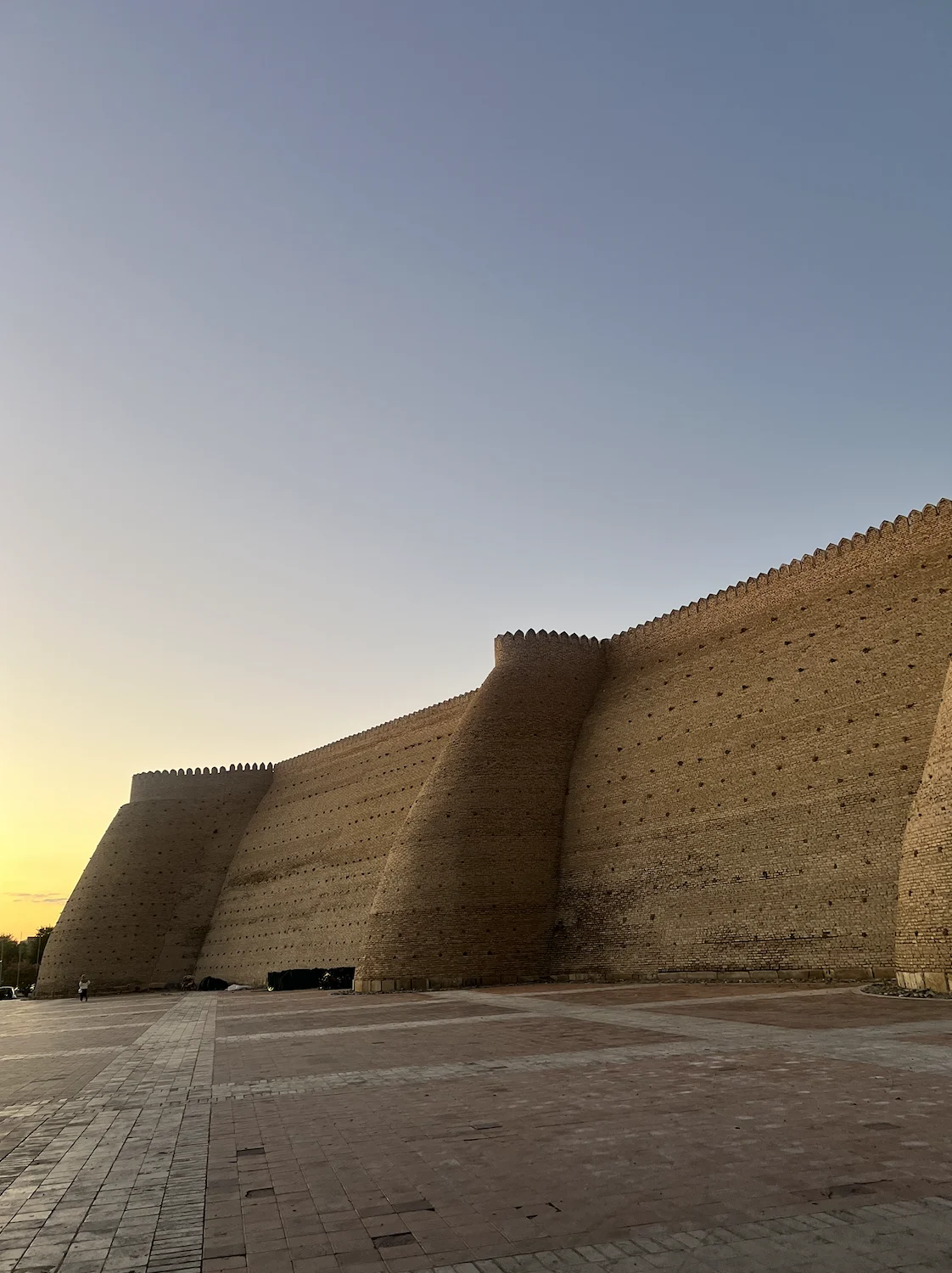
The Ark fortress, dating back to the fifth century CE but extensively rebuilt during the Islamic period, served as the residence of Bukhara's rulers for over a millennium. The Samanid Mausoleum, with its innovative brickwork and geometric patterns, remains one of the finest examples of early Islamic architecture anywhere in the world.
Legacy
Bukhara's legacy in the history of Islamic civilization is substantial and specific. It was the capital of the Samanid dynasty, the first major Persian-Islamic state, and the city where the Persian literary renaissance that would produce some of the greatest poetry in world literature began. It was the birthplace of Muhammad al-Bukhari, whose hadith collection became the most authoritative in Sunni Islam. It was the city where Ibn Sina received the education that made him the greatest physician and philosopher of the medieval Islamic world. And it was a major node in the Silk Road network that connected the Islamic world with China, India, and the steppes of Central Asia.
The city's intellectual tradition -- its emphasis on rigorous scholarship, its access to manuscripts through the paper-making industry, its position as a crossroads where scholars from different traditions met -- shaped the development of Islamic scholarship in ways that are still felt today. The hadith scholars who studied in Bukhara and the broader Central Asian tradition helped establish the standards of authentication that define Sunni hadith scholarship. The philosophers and scientists who studied in Bukhara's libraries helped transmit and develop the Greek and Persian intellectual heritage that would eventually reach medieval Europe through the translation movement.
Bukhara's architectural monuments -- the Samanid Mausoleum, the Kalyan Minaret, the Mir-i-Arab Madrasa -- are among the finest achievements of Islamic architecture, and they continue to draw visitors from around the world. The city's designation as a UNESCO World Heritage Site in 1993 recognized its outstanding universal value and ensured that its treasures would be preserved for future generations.
The name Bukhara -- Bukhara-i-Sharif, Noble Bukhara -- reflects the reverence in which the city was held throughout the Islamic world. That reverence was earned through centuries of scholarship, commerce, and cultural achievement that left a permanent mark on Islamic civilization.
References and Further Reading
Primary Islamic Sources
- Narshakhi, Abu Bakr Muhammad. Tarikh-i Bukhara (History of Bukhara). Translated by Richard N. Frye. Cambridge: Mediaeval Academy of America, 1954. [Original c. 944 CE]
- Al-Istakhri, Abu Ishaq. Masalik al-Mamalik (Routes of the Kingdoms), sections on Bukhara. Leiden: Brill, 1870. [Original c. 951 CE]
- Ibn Hawqal, Abu al-Qasim. Surat al-Ard, description of Bukhara. Leiden: Brill, 1873. [Original c. 977 CE]
- Al-Muqaddasi, Shams al-Din. Ahsan al-Taqasim, detailed account of Bukhara. Leiden: Brill, 1877. [Original c. 985 CE]
- Al-Sam'ani, Abd al-Karim. Al-Ansab (Genealogies), biographical entries on Bukharan scholars. Hyderabad: Dairat al-Ma'arif al-Uthmaniyyah, 1962. [Original c. 1166 CE]
Classical Islamic Sources
- Yaqut al-Hamawi. Mu'jam al-Buldan, entry on Bukhara. Beirut: Dar Sadir, 1977. [Original c. 1224 CE]
- Ibn Battuta. Rihlat Ibn Battuta, account of Bukhara. [Original c. 1355 CE]
- Khwandamir, Ghiyath al-Din. Habib al-Siyar, on Bukhara under the Timurids. [Original c. 1524 CE]
Academic and Scholarly Sources
- Frye, Richard N. Bukhara: The Medieval Achievement. Norman: University of Oklahoma Press, 1965.
- Frye, Richard N. The Golden Age of Persia: The Arabs in the East. London: Weidenfeld and Nicolson, 1975.
- Starr, S. Frederick. Lost Enlightenment: Central Asia's Golden Age from the Arab Conquest to Tamerlane. Princeton: Princeton University Press, 2013.
- Paul, Jürgen. The State and the Military: The Samanid Case. Bloomington: Indiana University Press, 1994.
- Soucek, Svat. A History of Inner Asia. Cambridge: Cambridge University Press, 2000.
- Knobloch, Edgar. Monuments of Central Asia: A Guide to the Archaeology, Art and Architecture of Turkestan. London: I.B. Tauris, 2001.
Further Reading
- Lapidus, Ira M. A History of Islamic Societies. 3rd ed. Cambridge: Cambridge University Press, 2014.
- Hodgson, Marshall G.S. The Venture of Islam, Vol. 2. Chicago: University of Chicago Press, 1974.
- Marozzi, Justin. The Man Who Invented History: Travels with Herodotus. London: John Murray, 2008.
- Chuvin, Pierre, et al. Les arts de l'Asie Centrale. Paris: Citadelles et Mazenod, 1999.
Mentioned In
34 articles reference this topic
and 22 more articles
More from Islamic Golden Age
Al-Ghazali
Abu Hamid al-Ghazali (1058–1111 CE) was among the most influential thinkers in Islamic history. His Ihya Ulum al-Din synthesized law, theology, and mysticism, while his critique of Aristotelian rationalism and account of spiritual crisis remain landmarks of medieval thought.
Ibn Arabi
Muhyi al-Din Ibn Arabi (1165-1240 CE) was an Andalusian mystic whose writings, above all al-Futuhat al-Makkiyya and Fusus al-Hikam, form the most influential and most disputed body of speculative thought in Islamic mysticism.
Ibn Sina
Ibn Sina (980-1037 CE), known in the Latin West as Avicenna, was the most influential physician and philosopher of the medieval Islamic world. His Canon of Medicine dominated medical education for six centuries, while his philosophical works shaped both Islamic and European thought.
Islamic Contributions to Science and Medicine: A Comprehensive Guide
Islamic scholars made groundbreaking contributions to science, medicine, mathematics, and astronomy during the 8th-15th centuries, preserving ancient knowledge and advancing human understanding through systematic research and institutional support.