Granada
Granada was the capital of the last Islamic kingdom in Iberia, ruled by the Nasrid dynasty from 1238 to 1492 CE. Home to the Alhambra, it was the final chapter of Islamic Al-Andalus, surviving two and a half centuries through diplomacy and culture before falling in 1492.
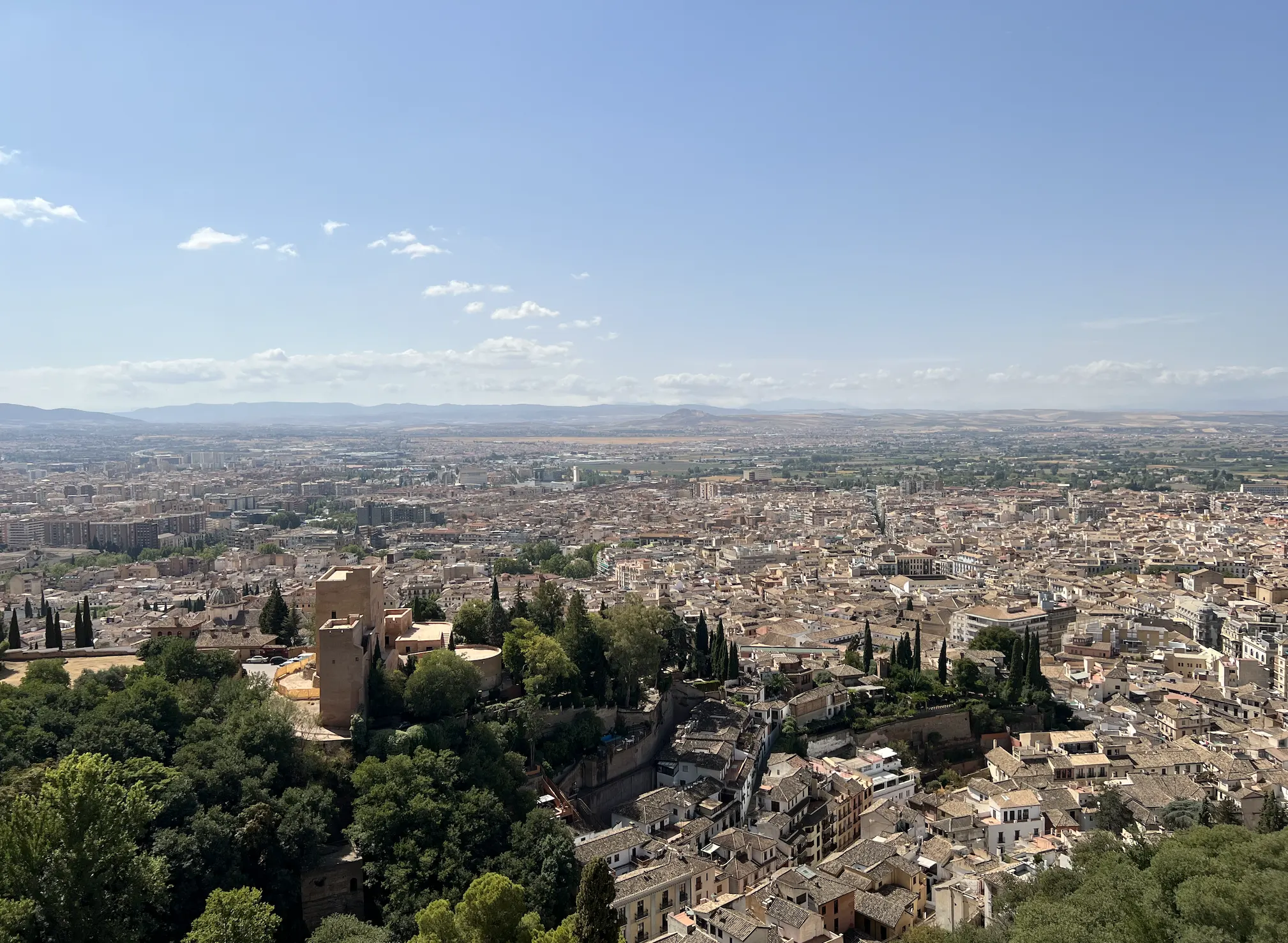
Granada (Arabic: غرناطة, Gharnata) was the capital of the last Islamic kingdom in the Iberian Peninsula, ruled by the Nasrid dynasty from 1238 to 1492 CE. Situated at the foot of the Sierra Nevada in the southeastern corner of Al-Andalus, it was a city of remarkable natural beauty and strategic defensibility -- a place where the mountains provided both protection and water, and where the fertile plain of the Vega supplied the agricultural foundation for a sophisticated urban civilization. For two and a half centuries, the Nasrid kingdom survived the relentless pressure of the Christian Reconquista through a combination of diplomatic skill, geographic advantage, and cultural vitality, producing in the process one of the most celebrated architectural achievements in the history of the world.
The Alhambra -- the palace complex that crowns the hill above the city -- is Granada's most enduring legacy. But Granada was more than its most famous monument. It was a functioning kingdom with a sophisticated court, a thriving economy based on silk production and trade, a scholarly tradition that preserved and developed the intellectual heritage of Al-Andalus, and a population that included Muslims, Jews, and Christians living under conditions of structured coexistence. Its fall in 1492 -- the same year Columbus sailed west under Spanish patronage -- marked the end of nearly eight centuries of Islamic political presence in the Iberian Peninsula.
The Founding of the Nasrid Kingdom
The Nasrid kingdom emerged from the catastrophic collapse of the Almohad dynasty in the early thirteenth century. The Almohads, who had ruled most of Al-Andalus from their base in Morocco, were defeated by a coalition of Christian kingdoms at the Battle of Las Navas de Tolosa in 1212 CE, and their authority in Iberia disintegrated rapidly in the following decades. The great cities of Islamic Spain fell one by one: Cordoba in 1236 CE, Valencia in 1238 CE, Seville in 1248 CE. By the mid-thirteenth century, the Islamic presence in Iberia had been reduced to a mountainous enclave in the southeast.
It was in this context that Muhammad ibn Yusuf ibn Nasr, known as Muhammad I al-Ghalib (the Victor), established the Nasrid dynasty in Granada in 1238 CE. Muhammad I was a skilled political operator who understood that the survival of his kingdom required a realistic assessment of its situation. He could not defeat the Christian kingdoms militarily; he could, however, make himself useful to them. In 1246 CE, he concluded a treaty with Ferdinand III of Castile that made Granada a tributary state -- paying annual tribute to Castile in exchange for recognition of Nasrid sovereignty and protection from further conquest. He even provided military assistance to Ferdinand's campaigns against other Muslim rulers.
This arrangement was humiliating in principle but effective in practice. It bought the Nasrid kingdom time -- time to consolidate its territory, develop its economy, build its fortifications, and establish the cultural institutions that would define Granada's golden age. Muhammad I began the construction of the Alhambra on the hill above the city, laying the foundations of what would become the most celebrated palace complex in the Islamic world. He attracted Muslim refugees from the conquered territories -- skilled craftsmen, scholars, merchants, and administrators -- who brought their knowledge and their capital to Granada and helped transform it into a sophisticated urban center.
The Nasrid Survival Strategy
The Nasrid kingdom's survival for two and a half centuries was not accidental. It was the product of a consistent and sophisticated strategy that balanced military defense, diplomatic flexibility, and economic development.
Geographically, Granada was well-positioned for defense. The Sierra Nevada provided a natural barrier to the east and south, and the city itself was built on hills that made it difficult to approach and easy to fortify. The Alhambra, perched on a ridge above the city, was both a palace and a fortress -- a symbol of royal power and a practical military installation. The kingdom's territory, though small, was compact and defensible, and its mountainous terrain made large-scale cavalry operations difficult for the Christian armies.
Diplomatically, the Nasrid rulers were pragmatic to a degree that sometimes shocked their contemporaries. They paid tribute to Castile when necessary, allied with Aragon when useful, and sought military assistance from the Marinid dynasty of Morocco when the pressure became too great. They played the competing interests of Castile and Aragon against each other, and they exploited the periodic conflicts between Christian kingdoms to buy breathing room. When the Marinids sent armies across the Strait of Gibraltar to assist Granada, the Nasrids welcomed the help while carefully managing the relationship to prevent the North Africans from becoming too powerful within the kingdom.
Economically, the kingdom developed a distinctive specialization in luxury goods -- particularly silk, which was produced in the mulberry groves of the Alpujarras mountains and woven into fabrics of exceptional quality that were exported throughout the Mediterranean world. The silk trade generated the revenue that funded the Alhambra's construction and the court's cultural patronage. Granada's ceramics, metalwork, and leather goods were also prized throughout Europe and the Islamic world, and the city's markets attracted merchants from Cordoba, North Africa, and the Italian city-states.
The Alhambra: Architecture and Experience
The Alhambra was not built in a single campaign but accumulated over more than a century, with each major ruler adding to and refining the complex. The result is a palatine city -- a self-contained world of palaces, gardens, towers, and administrative buildings -- that covers the entire summit of the Sabika hill above Granada.
The two rulers who did most to create the Alhambra as it exists today were Yusuf I (r. 1333-1354 CE) and his son Muhammad V (r. 1354-1391 CE). Yusuf I built the Comares Palace, whose throne room -- the Hall of the Ambassadors -- is one of the most magnificent spaces in medieval architecture. The room is a perfect cube, its walls covered from floor to ceiling in intricate geometric tilework and carved stucco, its ceiling a wooden dome representing the seven heavens of Islamic cosmology. The effect is of extraordinary richness and order -- a space designed to impress foreign ambassadors with the power and sophistication of the Nasrid court.
Muhammad V completed the Palace of the Lions, which is the Alhambra's most celebrated space. The Court of the Lions is a rectangular courtyard surrounded by a colonnade of 124 slender marble columns, at the center of which stands the famous fountain supported by twelve marble lions. The columns are so delicate that they seem barely adequate to support the elaborate muqarnas vaulting above them, and the effect is of a forest of stone -- a space that is simultaneously intimate and grand, enclosed and open to the sky. The walls are covered in carved stucco inscriptions, many of them verses by the court poet Ibn Zamrak celebrating the beauty of the palace itself.
What makes the Alhambra extraordinary is not any single element but the integration of all its elements. Water is everywhere -- in the reflecting pool of the Court of the Myrtles, in the channels that run through the gardens, in the fountains that cool the air and fill the spaces with sound. Light enters through carefully positioned windows and openings, creating patterns that shift through the day. The gardens of the Generalife, the royal summer retreat on the adjacent hill, extend the palace's relationship with the natural world -- terraced gardens with water channels, fruit trees, and views of the Sierra Nevada that make the boundary between architecture and landscape deliberately unclear.
The Alhambra was also a working palace -- a center of government, justice, and ceremony. The Nasrid motto, Wa la ghalib illa Allah (There is no victor but God), is inscribed throughout the complex, a reminder that the kingdom's survival was understood as a divine gift rather than a human achievement. The inscriptions that cover the walls -- Quranic verses, poetry, administrative texts -- made the palace itself a kind of book, a text that could be read by those who moved through its spaces.
Intellectual and Cultural Life
Granada under the Nasrids was not merely an architectural achievement. It was a center of intellectual and cultural life that preserved and developed the traditions of Al-Andalus during the period when most of the peninsula had passed under Christian rule.
The court patronized poets, historians, and scholars. Ibn al-Khatib (1313-1374 CE), who served as chief minister under Muhammad V, was one of the most accomplished Arabic prose writers of the medieval period -- a historian, poet, physician, and philosopher whose works covered an extraordinary range of subjects. His al-Ihata fi Akhbar Gharnata (The Comprehensive History of Granada) is the primary source for the history of the Nasrid kingdom. His student and rival Ibn Zamrak (1333-1393 CE) was the court poet whose verses are inscribed on the walls of the Alhambra -- a unique case of a poet's work becoming literally part of a building.
Ibn Khaldun, the greatest historian and social theorist of the medieval Islamic world, spent time at the Nasrid court in the 1360s and 1370s, serving as a diplomat and scholar. His encounter with the Nasrid kingdom -- a sophisticated but declining civilization surrounded by more powerful enemies -- contributed to the observations about the rise and fall of dynasties that he would later systematize in the Muqaddimah.
The kingdom also maintained the medical and scientific traditions of Al-Andalus. Hospitals operated in Granada, and physicians trained in the Islamic medical tradition continued to practice and teach. The city's libraries preserved manuscripts that might otherwise have been lost when the great libraries of Cordoba and Seville were dispersed after the Christian conquests.
The War of Granada and the Fall (1482-1492 CE)
The final decade of the Nasrid kingdom was shaped by two simultaneous crises: an external military campaign of unprecedented scale and an internal civil war that divided the kingdom at its most vulnerable moment.
The external pressure came from the Catholic Monarchs -- Isabella of Castile and Ferdinand of Aragon, whose marriage in 1469 CE had united the two most powerful Christian kingdoms of Iberia. They launched a systematic campaign to conquer Granada in 1482 CE, beginning with the capture of the fortress of Alhama -- a strategic position deep in Nasrid territory that gave the Christian forces a base for further operations. The campaign was methodical and well-resourced: the Catholic Monarchs used advanced artillery to reduce fortifications that had previously been impregnable, blockaded Granada's trade routes to cut off its economic lifeline, and systematically conquered the outlying territories before closing in on the capital.
The internal crisis was a succession dispute between the reigning sultan Abu al-Hasan Ali and his son Muhammad XII, known to Spanish sources as Boabdil. The dispute divided the Nasrid court and the kingdom's military forces at precisely the moment when unity was most needed. Boabdil was captured by the Christian forces in 1483 CE and released on condition that he support Castilian interests -- a compromise that further weakened the kingdom's ability to resist. The civil war between father and son, and later between Boabdil and his uncle Muhammad al-Zaghal, consumed resources and attention that should have been directed against the external threat.
By 1491 CE, the Catholic Monarchs had conquered virtually all of the Nasrid kingdom's territory. Granada itself was surrounded by a massive Christian army, its trade routes blocked, its food supply cut off. Boabdil, who had become the sole sultan after the defeat of his rivals, negotiated the terms of surrender. The Treaty of Granada, signed in November 1491 CE, guaranteed the Muslim population the right to practice their religion, maintain their mosques, use the Arabic language, and live under their own laws. On January 2, 1492 CE, Boabdil handed over the keys of the Alhambra to Ferdinand and Isabella.
The Aftermath: Broken Promises and Expulsion
The terms of the Treaty of Granada were not honored. Within a few years of the surrender, the Catholic Monarchs and their advisors began to pressure the Muslim population to convert to Christianity. In 1499 CE, Cardinal Cisneros launched a campaign of forced conversion in Granada, burning Arabic manuscripts and compelling mass baptisms. The Muslims of Granada rose in revolt in 1500 CE, and the revolt was used as a pretext to declare the treaty void: the Muslims of Granada were given the choice of conversion or expulsion.
Most converted outwardly, becoming the Moriscos -- nominal Christians who maintained their Islamic practices in private. The Moriscos were subject to surveillance by the Spanish Inquisition, prohibited from using Arabic, and subjected to increasing restrictions on their cultural and religious life. A major Morisco revolt in the Alpujarras mountains (1568-1571 CE) was suppressed with great violence, and the Morisco population of Granada was dispersed throughout Castile. Finally, between 1609 and 1614 CE, the Moriscos were expelled from Spain entirely -- approximately 300,000 people, many of them families that had lived in Iberia for generations and whose connection to Islamic practice was nominal at best.
The expulsion of the Moriscos was one of the largest forced migrations in early modern European history. It ended the continuous Muslim presence in the Iberian Peninsula that had begun with the Arab conquest of 711 CE -- a presence of nearly a thousand years.
Legacy
Granada's legacy is multiple and sometimes contradictory. The Alhambra is its most visible monument -- a UNESCO World Heritage Site that draws millions of visitors annually and that stands as one of the supreme achievements of Islamic architecture. The palace complex survived the Christian conquest largely intact because the Catholic Monarchs recognized its beauty and chose to preserve it rather than demolish it. Charles V, the Holy Roman Emperor, built a Renaissance palace within the Alhambra complex in the sixteenth century -- a jarring intrusion that nonetheless testifies to the building's continued prestige.
The memory of Granada has been a powerful presence in Islamic historical consciousness. The loss of the last Islamic kingdom in Iberia became a symbol of what could be lost when political power failed to protect a civilization, and the image of Boabdil weeping as he left the Alhambra -- the "Moor's Last Sigh," as the pass where he allegedly looked back at the city came to be called -- entered the repertoire of Islamic historical memory as an emblem of irreversible loss.
For historians, Granada offers a complex and instructive case study. The Nasrid kingdom's survival for two and a half centuries under conditions of extreme pressure was a genuine achievement of political and cultural resilience. The civilization it produced -- the Alhambra, the court poetry, the silk trade, the scholarly tradition -- was sophisticated and original, not merely a pale reflection of the earlier glories of Cordoba. And the manner of its ending -- the broken promises, the forced conversions, the eventual expulsion -- is a reminder that the terms on which civilizations end matter as much as the terms on which they flourish.
References and Further Reading
Primary Islamic Sources
- Ibn al-Khatib, Lisan al-Din. Al-Ihata fi Akhbar Gharnata (Comprehensive Account of Granada). Cairo: Maktabat al-Khanji, 2003. [Original c. 1374 CE]
- Ibn al-Khatib, Lisan al-Din. Al-Lamha al-Badriyya fi al-Dawla al-Nasriyya (The Nasrid Dynasty). Beirut: Dar al-Afaq al-Jadidah, 1978. [Original c. 1374 CE]
- Al-Maqqari, Ahmad ibn Muhammad. Nafh al-Tib, sections on Nasrid Granada. Cairo: Dar al-Kutub al-Misriyyah, 1949. [Original c. 1629 CE]
- Ibn Zamrak. Poems inscribed on the walls of the Alhambra. [c. 1370s CE]
- Anonymous. Nubdhat al-Asr fi Akhbar Muluk Bani Nasr (Chronicle of the Nasrid Kings). [Original c. 1492 CE]
Classical Islamic Sources
- Al-Himyari, Muhammad ibn Abd al-Munim. Kitab al-Rawd al-Mi'tar, entry on Granada. Beirut: Librairie du Liban, 1975. [Original c. 1461 CE]
- Leo Africanus (al-Hasan ibn Muhammad al-Wazzan). Description of Africa, sections on Granada. [Original c. 1526 CE]
- Yaqut al-Hamawi. Mu'jam al-Buldan, entry on Gharnata. Beirut: Dar Sadir, 1977. [Original c. 1224 CE]
Academic and Scholarly Sources
- Harvey, L.P. Islamic Spain, 1250 to 1500. Chicago: University of Chicago Press, 1990.
- Grabar, Oleg. The Alhambra. Cambridge: Harvard University Press, 1978.
- Catlos, Brian A. Kingdoms of Faith: A New History of Islamic Spain. New York: Basic Books, 2018.
- Kennedy, Hugh. Muslim Spain and Portugal: A Political History of al-Andalus. London: Longman, 1996.
- Bush, Olga. Reframing the Alhambra: Architecture, Poetry, Textiles and Court Ceremonial. Edinburgh: Edinburgh University Press, 2018.
- Ruggles, D. Fairchild. Gardens, Landscape, and Vision in the Palaces of Islamic Spain. University Park: Penn State University Press, 2000.
Further Reading
- Irving, Washington. Tales of the Alhambra. Philadelphia: Lea & Blanchard, 1832.
- Fletcher, Richard. Moorish Spain. London: Weidenfeld and Nicolson, 1992.
- Carr, Matthew. Blood and Faith: The Purging of Muslim Spain. New York: The New Press, 2009.
- Menocal, María Rosa. The Ornament of the World. Boston: Little, Brown, 2002.
Mentioned In
22 articles reference this topic
and 10 more articles
More from Al-Andalus
Alhambra
A magnificent palace and fortress complex in Granada, Spain, built by the Nasrid dynasty. Considered the pinnacle of Islamic architecture in Western Europe, the Alhambra represents the final flowering of Islamic art and culture in Al-Andalus.
Fall of Granada
Comprehensive history of the fall of Granada in 1492, marking the end of Islamic rule in the Iberian Peninsula after nearly 800 years and the conclusion of the Reconquista
Great Mosque of Córdoba (Mezquita)
The Great Mosque of Córdoba (Mezquita) is one of the most magnificent examples of Islamic architecture. Built over two centuries by Umayyad rulers, it features horseshoe arches and represents the pinnacle of Moorish achievement in Spain.
Umayyads of Cordoba
The Umayyads of Cordoba ruled Al-Andalus from 756 to 1031 CE, turning a distant province into one of medieval Europe's most sophisticated states. Founded by Abd al-Rahman I, survivor of the Abbasid massacre of his family, the dynasty produced the Caliphate of Cordoba before civil war.