Kufa as a Center of Governance
Founded in 638 CE as a military garrison, Kufa became one of the most consequential cities of early Islam — capital of Caliph Ali ibn Abi Talib, birthplace of the Iraqi legal tradition, a center of Arabic grammar and hadith, and the city where the Abbasid revolution was launched.
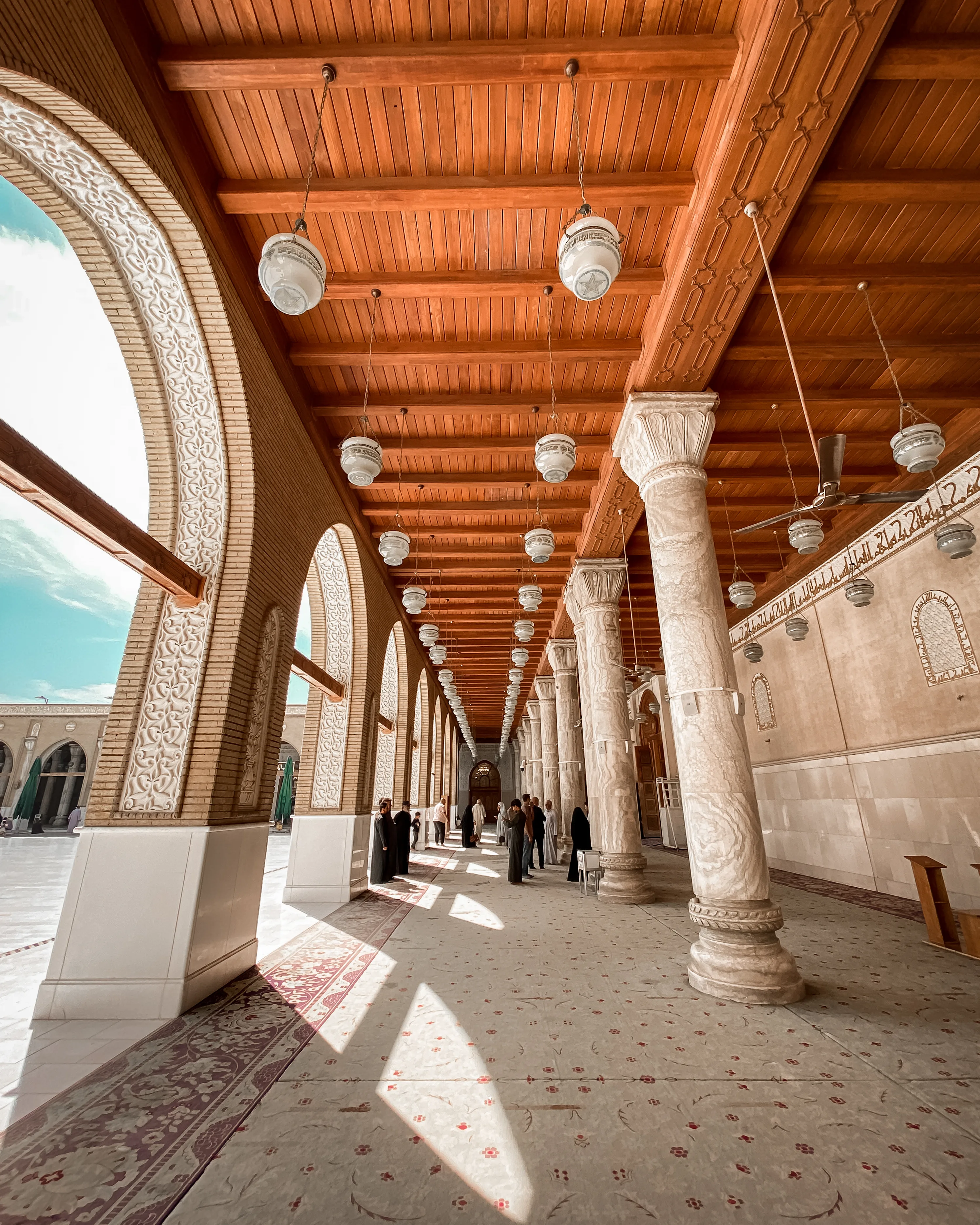
Kufa (Arabic: الكوفة) was one of the most consequential cities in early Islamic history. Founded in 638 CE as a military garrison on the edge of the Iraqi desert, it grew within a generation into a major political capital, a center of Islamic scholarship, and the crucible in which some of the most important traditions of Islamic law, Arabic grammar, and hadith transmission were formed. For a brief but decisive period it was the seat of the caliphate itself, and long after it lost that status it continued to shape the intellectual and political life of the Islamic world. To understand Kufa is to understand a great deal about how early Islamic civilization was built.
Foundation: The Garrison City
Kufa was founded in 638 CE on the orders of Caliph Umar ibn al-Khattab, who instructed his general Sa'd ibn Abi Waqqas to establish a permanent base for the Arab forces that had just conquered Iraq. The site chosen was on the western bank of the Euphrates, at the edge of the desert — close enough to the river for water and agriculture, but positioned where the Arab troops could maintain their desert mobility and avoid the diseases that plagued the river lowlands.
The city was laid out according to a deliberate plan. At its center stood the congregational mosque and the governor's palace (Dar al-Imara), placed side by side in a symbolic arrangement that expressed the unity of religious and political authority. From this central complex, the city extended outward in tribal quarters — each of the major Arab tribal confederations that had participated in the conquest of Iraq was allocated a specific residential sector. The Tamim, the Asad, the Bajila, the Kinda, the Hamdan — each had its own neighborhood, its own mosque, its own internal leadership. This tribal organization was not merely a social arrangement; it was the administrative structure of the city, the basis on which military service was organized, stipends were distributed, and political representation was exercised.
Within a decade of its founding, Kufa had grown into one of the largest cities in the Islamic world. The Arab warriors who settled there brought their families, and the city attracted merchants, craftsmen, and scholars from across Iraq and Persia. The conquered Persian population of the surrounding region — farmers, administrators, artisans — gradually integrated into the city's economic life, and many converted to Islam. By the time of the First Fitna in the 650s, Kufa had a population of perhaps 40,000 to 60,000 people, making it a major urban center by the standards of the ancient world.
The Scholarly Foundation: Abdullah ibn Mas'ud
Among the companions of the Prophet who settled in Kufa, none had a more lasting influence on the city's intellectual character than Abdullah ibn Mas'ud. One of the earliest converts to Islam and one of the Prophet's closest companions, Ibn Mas'ud was sent to Kufa by Caliph Umar as a teacher and religious guide for the new city's population. He arrived carrying an extraordinary personal authority: he had memorized the Quran directly from the Prophet, he had transmitted hundreds of hadith, and he had a reputation for legal reasoning that made him one of the most respected jurists of his generation.
Ibn Mas'ud established a teaching circle in Kufa's mosque that became the foundation of the city's entire scholarly tradition. He taught Quranic recitation, hadith, and legal reasoning to a generation of Kufan scholars who would in turn teach the next generation. His approach to legal questions — willing to exercise independent judgment (ra'y) when the Quran and hadith did not provide a clear answer — became the defining characteristic of the Kufan legal school. The chain of transmission from Ibn Mas'ud through his students Alqama ibn Qays and Ibrahim al-Nakha'i, and eventually to Abu Hanifa, is one of the most important intellectual lineages in Islamic legal history.
Ibn Mas'ud also brought to Kufa his own written copy of the Quran, which differed in some details from the text that Caliph Uthman ibn Affan would later standardize. When Uthman ordered all variant copies destroyed and distributed the standardized text, Ibn Mas'ud initially refused — a moment of principled resistance that reflected both his personal authority and the independent spirit that would characterize Kufan scholarship for generations. He eventually complied, but the episode illustrated the tension between the centralizing impulse of the caliphate and the scholarly autonomy that cities like Kufa had developed.
Ali's Capital: The First Fitna
The most dramatic chapter in Kufa's political history began in 656 CE, when Ali ibn Abi Talib became the fourth caliph following the assassination of Uthman. Ali faced immediate opposition from several directions — from Aisha, Talha, and al-Zubayr in the Hijaz, and from Mu'awiya ibn Abi Sufyan, the governor of Syria, who demanded justice for Uthman's death before recognizing Ali's authority. Faced with this opposition, Ali made a decision that would define his caliphate: he moved his capital from Medina to Kufa.
The choice was strategic. Kufa's population had a strong tradition of support for Ali — many Kufans had been among his earliest backers, and the city's tribal composition made it a more reliable base than Medina, where the political atmosphere had become poisonous. Kufa also offered military resources that Medina could not match: a large, experienced army drawn from the veterans of the Iraqi conquests, and a logistical infrastructure capable of supporting major campaigns.
Ali's arrival transformed Kufa into the capital of the caliphate. The governor's palace became the seat of the Commander of the Faithful, and the city's mosque became the center of Islamic political life. From Kufa, Ali organized the campaigns that defined the First Fitna: the Battle of the Camel in 656 CE, fought near Basra against Aisha's forces, and the Battle of Siffin in 657 CE, the prolonged and inconclusive confrontation with Mu'awiya's Syrian army on the upper Euphrates.
Siffin ended in arbitration — a decision that fractured Ali's own coalition. A significant portion of his army, convinced that agreeing to human arbitration of a matter they believed God had already decided, withdrew their support and formed the movement known as the Kharijites. Ali fought and defeated the main Kharijite force at the Battle of Nahrawan in 658 CE, but the movement was not extinguished, and it continued to drain his resources and political capital. In 661 CE, Ali was assassinated in Kufa's mosque by a Kharijite named Ibn Muljam, who struck him with a poisoned sword as he led the morning prayer. He died two days later and was buried at Najaf, a few miles from the city.
Ali's five years in Kufa left a permanent mark on the city's identity. The Kufans who had supported him — and who felt they had failed him by their inconsistency and factionalism — carried a sense of guilt and loyalty that would shape the city's political culture for generations. It was from Kufa that the invitation was sent to Ali's son Husayn in 680 CE, promising support for his challenge to Yazid ibn Mu'awiya — an invitation that led to the Battle of Karbala and the death of Husayn, an event that became the defining tragedy of Shi'a Islam.
Under Umayyad Rule: Opposition and Scholarship
After Ali's death, Kufa passed under Umayyad control. The city never fully reconciled itself to Umayyad rule. It remained a center of pro-Alid sentiment, periodic rebellion, and political opposition throughout the Umayyad period. The governors sent from Damascus faced a population that was proud of its history, conscious of its scholarly tradition, and deeply skeptical of the legitimacy of the dynasty that now ruled it.
Yet the Umayyad period was also, paradoxically, the era in which Kufa's intellectual tradition reached its greatest development. Freed from the immediate pressures of political crisis, the city's scholars turned their energy to the systematic development of Islamic knowledge. The hadith transmission networks that Ibn Mas'ud had established continued to grow, producing scholars who collected and authenticated the traditions of the Prophet with increasing rigor. The legal tradition that Ibn Mas'ud had founded continued to develop, with successive generations of scholars refining the methods of legal reasoning that would eventually crystallize in the work of Abu Hanifa.
The Umayyad period also saw the emergence of Kufa as a major center of Arabic grammar and linguistics. The Arab settlers of Kufa had come from many different tribal backgrounds, each with its own dialect and linguistic tradition, and the encounter between these dialects — and between Arabic and the Persian and Aramaic spoken by the local population — created both linguistic diversity and scholarly interest in the structure of the Arabic language. The Kufan grammatical school, associated with scholars like al-Kisa'i and al-Farra' in the late eighth century, developed a distinctive approach to Arabic grammar that emphasized the diversity of usage and the authority of tribal poetry, in contrast to the more prescriptive approach of the rival Basran school. This scholarly rivalry between Kufa and Basra over the correct analysis of Arabic grammar was one of the most productive intellectual debates in the history of Arabic linguistics.
Abu Hanifa and the Iraqi Legal Tradition
The most enduring intellectual legacy of Kufa is the legal tradition associated with Abu Hanifa (699–767 CE), the founder of the Hanafi school of Islamic law — the largest of the four Sunni legal schools, followed today by the majority of Muslims in South Asia, Central Asia, Turkey, and the Balkans.
Abu Hanifa was born in Kufa to a family of Persian origin and spent most of his life in the city. He was a student of Hammad ibn Abi Sulayman, who was himself a student of Ibrahim al-Nakha'i, who had studied directly under Ibn Mas'ud's students. This chain of transmission connected Abu Hanifa directly to the scholarly tradition that Ibn Mas'ud had established in Kufa a century earlier. Abu Hanifa absorbed that tradition's characteristic emphasis on ra'y — independent legal reasoning — and developed it into a sophisticated jurisprudential method that could address the complex legal questions arising in the rapidly expanding Islamic world.
Abu Hanifa's method was distinctive in several ways. He placed great emphasis on analogical reasoning (qiyas), using the principles underlying established rulings to derive answers to new questions. He was willing to set aside hadith that he considered unreliable or that conflicted with established Quranic principles. And he paid close attention to the practical consequences of legal rulings, seeking solutions that were workable in the real conditions of Muslim life. These characteristics made the Hanafi school particularly well-suited to the needs of a diverse, cosmopolitan empire, and they explain why it became the official legal school of the Abbasid caliphate and later of the Ottoman Empire.
Abu Hanifa's legal circle in Kufa was one of the most intellectually productive in Islamic history. He taught through discussion and debate rather than lecture, posing legal problems to his students and working through the solutions collectively. His students — including Abu Yusuf and Muhammad al-Shaybani, who would later codify and systematize his teachings — carried the Kufan legal tradition to Baghdad and beyond, where it became the foundation of the Abbasid legal system.
The Abbasid Revolution
Kufa played a decisive role in the revolution that ended Umayyad rule and brought the Abbasid Caliphate to power in 750 CE. The Abbasid movement, which drew its initial support from the discontented populations of Khorasan and Iraq, used Kufa as its organizational center in the final stages of the revolution. It was in Kufa that Abu al-Abbas al-Saffah was proclaimed the first Abbasid caliph in 749 CE, in the city's mosque — the same mosque where Ali had led prayers nearly a century earlier.
The choice of Kufa for this proclamation was deliberate and symbolic. The Abbasids were appealing to the pro-Alid sentiment that had always been strong in Kufa, presenting themselves as the legitimate heirs of the Prophet's family and the avengers of Husayn's death at Karbala. The Kufans, who had lived under Umayyad rule for nearly ninety years, responded with enthusiasm. The city that had been the capital of Ali's caliphate now became the birthplace of the dynasty that would rule the Islamic world for the next five centuries.
The Abbasid victory, however, ultimately diminished Kufa's political importance. When the Abbasids built their new capital at Baghdad in 762 CE — just forty miles from Kufa — the older city was eclipsed. Baghdad absorbed Kufa's scholars, merchants, and administrators, drawing the intellectual and commercial life of Iraq toward the new imperial capital. Abu Hanifa himself died in Baghdad in 767 CE, having spent his final years in the city that had superseded his own.
The City and Its People
Something should be said about Kufa's physical and social character, since its politics followed from both.
The city was laid out as a misr — a garrison settlement rather than an organic town. A congregational mosque and the governor's residence occupied the centre, and around them the tribal contingents were allotted quarters, each group settled together with its own open ground. The plan mattered politically: it meant that Kufa's population was organised by tribe on the ground, that each tribe had a recognised leader and a physical base, and that mobilising or dividing the city ran along tribal lines.
The population was also unusual in composition. It consisted largely of Arab tribesmen drawing stipends from the revenue of conquered Iraq, alongside a growing body of mawali — non-Arab converts, many of them Persian, working as artisans, secretaries and traders. Neither group had a settled agricultural livelihood of the ordinary kind. The result was a city of armed men with time, grievances, stipends that could be withheld, and no productive occupation to absorb their attention.
This is the structural explanation for Kufa's reputation as ungovernable. Every caliph and governor from Umar onward found the city difficult, and the sequence of governors sent to it — including Ammar ibn Yasir, removed after complaints, and the formidable al-Mughira ibn Shu'ba after him — reflects repeated attempts to find a formula. The grievances that fed the opposition to Uthman, the support for Ali, the Kharijite secession, the pro-Alid risings under the Umayyads, and eventually the Abbasid movement all drew on the same material: a concentrated, organised, aggrieved and idle military population with a strong sense of its own entitlement.
Legacy
Kufa's legacy in Islamic history is layered and substantial. As a military foundation, it established the model of the garrison city (misr) that the early Islamic state used to consolidate its conquests — a model also applied at Basra, Fustat in Egypt, and later at Qayrawan in North Africa. As a political capital, it was the seat of the last of the Rashidun caliphs and the city most closely associated with the crisis of the First Fitna, whose consequences — the Sunni-Shi'a division, the Kharijite movement, the question of legitimate authority in Islam — shaped Islamic civilization permanently.
As an intellectual center, Kufa's contributions were even more enduring. The legal tradition that began with Ibn Mas'ud and culminated in Abu Hanifa became the Hanafi school, which remains the most widely followed legal tradition in Sunni Islam. The grammatical school that developed in Kufa during the Umayyad and early Abbasid periods made fundamental contributions to the analysis of the Arabic language. The hadith transmission networks centered on Kufa produced scholars whose work fed into the great hadith collections of the ninth century.
The city's association with Ali and the early Shi'a movement gave it a special significance in Shi'a Islam that persists to the present day. The nearby shrine of Imam Ali at Najaf is one of the holiest sites in Shi'a Islam, and the region around Kufa remains a center of Shi'a religious life. The memory of Kufa's failure to support Husayn in 680 CE — the invitation sent and then withdrawn, the army that did not come — is woven into the fabric of Shi'a religious consciousness.
Kufa was, in the end, a city that mattered on almost every level that a city can matter: militarily, politically, legally, linguistically, and spiritually. Its history from 638 to 762 CE — from its founding as a desert garrison to its eclipse by Baghdad — encompasses some of the most important events and intellectual developments in the first century and a half of Islamic civilization.
References and Further Reading
Primary Islamic Sources
- Al-Tabari, Muhammad ibn Jarir. Tarikh al-Rusul wa al-Muluk, sections on the founding of Kufa and Ali's caliphate. Cairo: Dar al-Ma'arif, 1960. [Original c. 915 CE]
- Al-Baladhuri, Ahmad ibn Yahya. Futuh al-Buldan (Conquest of the Lands), sections on the founding of Kufa. Leiden: Brill, 1866. [Original c. 892 CE]
- Ibn Sa'd, Muhammad. Al-Tabaqat al-Kubra, biographies of Kufan scholars. Leiden: Brill, 1904. [Original c. 845 CE]
- Al-Ya'qubi, Ahmad ibn Abu Ya'qub. Tarikh al-Ya'qubi, sections on Kufa. Leiden: Brill, 1883. [Original c. 897 CE]
- Sahih al-Bukhari, Book of Virtues of the Companions — References to companions who settled in Kufa.
- Ibn al-Athir, Ali ibn Muhammad. Al-Kamil fi al-Tarikh, sections on Kufa's role in early Islamic politics. Beirut: Dar Sadir, 1979. [Original c. 1231 CE]
Classical Islamic Sources
- Al-Kindi, Muhammad ibn Yusuf. Kitab al-Wulat wa Kitab al-Qudat (Book of Governors and Book of Judges of Egypt and Kufa). Leiden: Brill, 1912. [Original c. 961 CE]
- Abu Mikhnaf, Lut ibn Yahya. Various historical narratives preserved in al-Tabari on events in Kufa. [Original c. 774 CE]
- Ibn Khaldun, Abd al-Rahman. Al-Muqaddimah, sections on garrison cities and urban development. [Original c. 1377 CE]
- Al-Mas'udi, Ali ibn al-Husayn. Muruj al-Dhahab, sections on Kufa's political significance. Beirut: Dar al-Andalus, 1966. [Original c. 947 CE]
Academic and Scholarly Sources
- Djait, Hichem. Al-Kufa: Naissance de la ville islamique (Kufa: Birth of the Islamic City). Paris: Maisonneuve & Larose, 1986.
- Kennedy, Hugh. The Prophet and the Age of the Caliphates. 3rd ed. London: Routledge, 2016.
- Donner, Fred M. The Early Islamic Conquests. Princeton: Princeton University Press, 1981.
- Morony, Michael G. Iraq After the Muslim Conquest. Princeton: Princeton University Press, 1984.
- Duri, Abd al-Aziz. "The Iraq School of History to the Ninth Century." Historians of the Middle East, edited by B. Lewis and P.M. Holt. Oxford: Oxford University Press, 1962.
- Melchert, Christopher. The Formation of the Sunni Schools of Law, 9th–10th Centuries CE. Leiden: Brill, 1997.
Further Reading
- Berkey, Jonathan P. The Formation of Islam: Religion and Society in the Near East, 600–1800. Cambridge: Cambridge University Press, 2003.
- Hodgson, Marshall G.S. The Venture of Islam, Vol. 1. Chicago: University of Chicago Press, 1974.
- Lapidus, Ira M. A History of Islamic Societies. 3rd ed. Cambridge: Cambridge University Press, 2014.
- Crone, Patricia. Slaves on Horses: The Evolution of the Islamic Polity. Cambridge: Cambridge University Press, 1980.
Mentioned In
8 articles reference this topic
More from Rashidun Caliphate
Ali ibn Abi Talib
The fourth and final Rashidun Caliph (656-661 CE), cousin and son-in-law of Prophet Muhammad. Known for his courage, eloquence, and commitment to justice. His caliphate was marked by civil wars (First Fitna) that led to the permanent division of the Muslim community.
Battle of Nahrawan: Ali's Conflict with the Kharijites
The Battle of Nahrawan (658 CE) was fought between Caliph Ali and the Kharijites who defected after the arbitration at Siffin. This battle marked the emergence of the Kharijite movement and led to Ali's assassination.
Battle of Siffin: The Defining Conflict of the First Islamic Civil War
The Battle of Siffin (657 CE) was a major confrontation between Caliph Ali and Muawiyah that ended with controversial arbitration, marking a turning point that led to the emergence of the Kharijites and deepening sectarian divisions.
Battle of the Camel: The First Islamic Civil War
The Battle of the Camel (656 CE) was the first major military confrontation between Muslims, fought near Basra between Caliph Ali and forces led by Aisha, Talha, and Zubayr. This battle marked the beginning of the First Fitna.