Sa'd ibn Abi Waqqas
Sa'd ibn Abi Waqqas (c. 595–674 CE) was one of the earliest converts to Islam and the commander who led the Muslims to victory at al-Qadisiyyah in 636 CE, breaking the Sassanian Empire and opening Iraq and Persia. He founded Kufa and stayed neutral in the First Fitna.
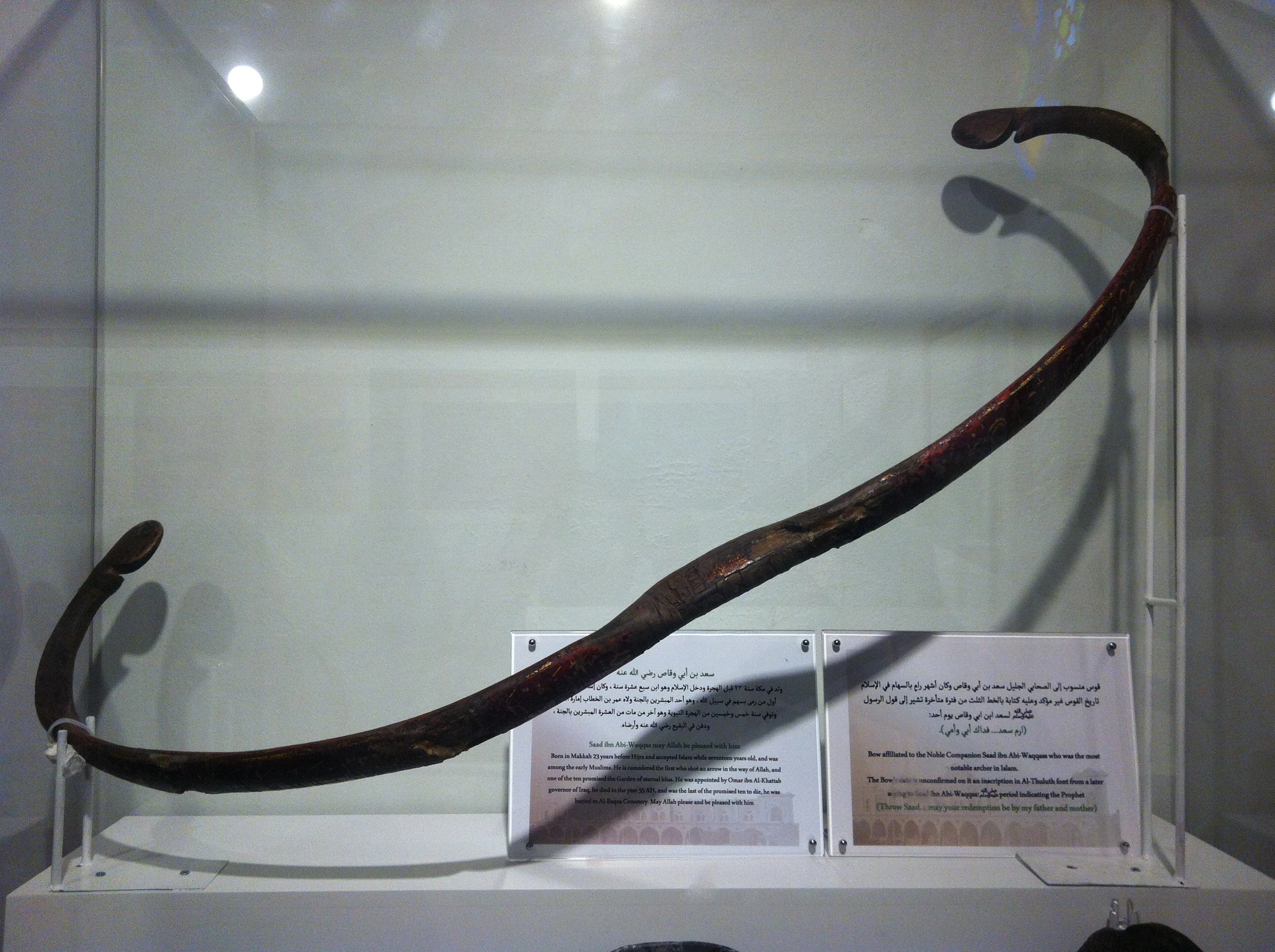
Sa'd ibn Abi Waqqas (c. 595–674 CE) was one of the earliest converts to Islam, a close companion of Prophet Muhammad, and the commander who led the Muslim forces to their decisive victory at the Battle of al-Qadisiyyah in 636 CE — the engagement that broke the Sassanian Empire and opened Iraq and Persia to Islamic rule. He founded the garrison city of Kufa, served as its first governor, and in his later years became known for a principled refusal to take sides in the civil war that divided the early Muslim community. He is counted among the ten companions whom the Prophet is reported to have promised Paradise, and he was the last of that group to die.
Early Life and Conversion
Sa'd was born around 595 CE into the Banu Zuhrah clan of the Quraysh — a respected lineage that gave him social standing in Mecca without placing him among the very wealthiest families. He was a young man, probably in his late teens, when he encountered Islam in its earliest days. By most accounts he was among the first seven or eight people to accept the Prophet's message, converting before Islam had any social protection to offer its followers and at a time when doing so meant real personal risk.
The most famous story from his early conversion concerns his mother. When she learned that Sa'd had become a Muslim, she refused to eat or drink, threatening to starve herself to death unless he renounced his new faith. Sa'd refused. He told her, with evident pain but without wavering, that he loved her deeply but that he could not abandon his religion even for her sake. The standoff continued for days. The episode became one of the most cited examples in early Islamic tradition of the tension between family loyalty and religious conviction — and it is the occasion for a Quranic verse (31:15) that acknowledges the duty to treat parents with kindness while affirming that obedience to God takes precedence over obedience to parents in matters of faith. His mother eventually relented and ate.
Sa'd's early years as a Muslim were shaped by his proximity to the Prophet. He was a frequent presence in the Prophet's company, and he developed a reputation as one of the finest archers in the Muslim community. The Prophet reportedly said of him, "Shoot, Sa'd — may my father and mother be sacrificed for you!" — a formula of high praise that the sources record as having been used for Sa'd alone among the companions. He is credited with shooting the first arrow in the cause of Islam during an early skirmish, a detail that later tradition preserved as a mark of his priority in military service.
Military Service Under the Prophet
Sa'd fought in the major engagements of the Medinan period — Badr, Uhud, the Trench, and the campaigns that followed. He was not a commander of large forces during the Prophet's lifetime; that role came later. But his archery was a practical military asset in an era when the bow was a primary weapon of war, and it produced the single distinction for which he is best known in the hadith literature.
"Shoot, Sa'd"
At Uhud the Prophet handed Sa'd a quiver of arrows and said, "Shoot — may my father and mother be your ransom" (Sahih al-Bukhari 4055; Sahih al-Bukhari 4057). The formula fidaka abi wa ummi was a strong expression of affection, and Ali ibn Abi Talib observed that he never heard the Prophet join both his parents in it for anyone other than Sa'd (Sahih al-Bukhari 6184; Sahih Muslim 2411; Jami' at-Tirmidhi 3755, graded sahih). Sa'd himself confirmed the same, saying simply that the Messenger of God mentioned both his parents for him on the day of Uhud (Jami' at-Tirmidhi 2830 and 3754, both graded sahih).
Sa'd's own account of the occasion is preserved in Sahih Muslim, and it is more specific than the formula alone suggests. A man among the polytheists had been pressing the Muslims hard. The Prophet told him to shoot. Sa'd drew a featherless arrow, struck the man in the side, and brought him down — and the Prophet laughed, Sa'd said, until he could see his back teeth (Sahih Muslim 2412). The detail matters because it shows what the phrase was for: it was said at a specific tactical moment, to the man who could resolve it.
He also participated in the smaller expeditions and reconnaissance missions of the Medinan years.
He also participated in the smaller expeditions and reconnaissance missions that the Prophet sent out during the Medinan years, gaining experience in the logistics and tactics of desert warfare that would serve him well in the much larger campaigns to come. By the time of the Prophet's death in 632 CE, Sa'd was in his mid-thirties, a seasoned soldier with nearly two decades of military experience and the complete confidence of the early Muslim leadership.
The Bequest Hadith
One of the most consequential texts in Islamic inheritance law arose from a conversation at Sa'd's sickbed. He fell gravely ill at Mecca and the Prophet came to visit him. Sa'd said that he had a large amount of property and only a daughter to inherit it, and asked whether he might give two-thirds away in charity. The Prophet said no. A half? No. A third? "A third — and a third is much."
The Prophet then gave the reasoning: that to leave your heirs rich is better than to leave them destitute and begging from people; and that nothing is spent seeking God's pleasure without being rewarded, down to the mouthful a man puts in his wife's mouth (Sunan Abu Dawud 2864, graded sahih by al-Albani). A related transmission has Sa'd saying he had willed the whole of his property to the cause of God, the Prophet asking what he had left his children, and the figure being negotiated down from a tenth to a third (Sunan an-Nasa'i 3631, graded hasan).
The one-third ceiling on bequests, which limits how much of an estate a Muslim may direct away from the fixed heirs, derives from this exchange. It is among the clearest instances of a general rule of law being settled in answer to one Companion's particular question.
In the same conversation Sa'd asked whether he would be left behind — that is, whether dying in Mecca would cost him the merit of the emigration. The Prophet told him that if he remained after him and did good works seeking God's pleasure, that would only raise him in rank; and that he might well remain, so that some peoples would benefit through him and others be harmed by him (Sunan Abu Dawud 2864). Sa'd did remain, for another forty years, and the conquest of Iraq is the most obvious reading of the second half of that statement.
The Conquest of Iraq and the Road to Qadisiyyah
The great test of Sa'd's career came under Caliph Umar ibn al-Khattab, who appointed him in 636 CE as the commander of the Muslim forces in Iraq. The campaign against the Sassanian Empire had been underway for several years, with earlier Muslim commanders achieving significant victories but failing to deliver a decisive blow. The Sassanians, despite the internal instability that had plagued their empire since the death of Khusraw II in 628 CE, still possessed a formidable military machine — professional infantry, war elephants, and the organizational capacity of a state that had been a great power for four centuries.
Umar's choice of Sa'd was deliberate. He was a companion of the Prophet with unquestioned religious authority, a proven soldier, and a man whose personal integrity Umar trusted completely. He was also, crucially, not a member of any of the great tribal factions whose rivalries complicated the politics of the early Islamic state — a quality that made him a unifying figure for the diverse Arab forces he would command.
Sa'd assembled his army at al-Qadisiyyah, a site on the edge of the Iraqi desert near the Euphrates, in the summer of 636 CE. The Sassanian force that came to meet him was commanded by Rustam Farrokhzad, one of the most capable generals the empire had produced, and it was substantially larger than the Muslim army. The Sassanians brought war elephants — animals that the Arab horses had never encountered and that caused serious disruption in the early stages of the fighting.
The Battle of al-Qadisiyyah
The Battle of al-Qadisiyyah was fought over three or four days in late 636 CE and is one of the most consequential military engagements in the history of the Middle East. The sources — primarily al-Tabari's detailed account, which draws on earlier traditions — describe a prolonged and brutal struggle in which the outcome was uncertain for much of the fighting.
Sa'd was ill during the battle, suffering from boils that prevented him from riding or fighting in person. He directed the engagement from a position behind the lines, watching through a window of the building where he had taken shelter and sending orders to his commanders. This detail — the general commanding from a sickbed — became one of the memorable images of the battle in later tradition, used to illustrate both his physical suffering and his mental composure under pressure.
The turning point came on the final day, when a sandstorm blew into the faces of the Sassanian forces and a contingent of Muslim reinforcements arrived from Syria. In the confusion, Rustam was killed — the sources give varying accounts of exactly how — and the Sassanian army, deprived of its commander and battered by days of fighting, broke and fled. The Muslim forces pursued, and the Sassanian military presence in Iraq effectively ceased to exist as an organized force.
The victory at al-Qadisiyyah opened the road to Ctesiphon, the Sassanian capital on the Tigris. Sa'd led his forces there within weeks, crossing the Tigris and entering the city after minimal resistance. The great palace of the Sassanian kings — the Taq Kasra, with its famous arch that still stands today — fell into Muslim hands along with the treasures of one of the ancient world's great empires. Sa'd sent the customary fifth of the spoils to Medina and distributed the rest among his troops according to the established rules of Islamic warfare.
The Founding of Kufa
One of Sa'd's most lasting contributions was not a battle but a city. In 638 CE, acting on instructions from Caliph Umar, he selected the site for and oversaw the founding of Kufa on the western bank of the Euphrates. The choice of location was deliberate: close enough to the river for water and agriculture, but on the desert edge where the Arab troops could maintain their mobility and avoid the diseases of the river lowlands.
Sa'd laid out the city according to a plan that placed the congregational mosque and the governor's palace at the center, with tribal quarters extending outward from this core. The arrangement expressed the unity of religious and political authority that characterized early Islamic governance, and it established a model that would be followed in other garrison cities — Basra in Iraq, Fustat in Egypt, Qayrawan in North Africa. Kufa grew rapidly, attracting not only Arab settlers but merchants, craftsmen, and scholars from across Iraq and Persia, and within a generation it had become one of the largest cities in the Islamic world.
The plan was that of a permanent settlement rather than a camp. Sa'd laid out streets, designated ground for a congregational mosque that became one of the largest in the early Islamic world, set aside a governor's residence (dar al-imara), and allotted quarters to the tribal contingents that made up the army. Kufa was intended as a base from which Muslim authority would be projected into Persia, and as a home for the settlers who would administer the conquered territories.
Its later importance exceeded anything its founding would have suggested. Kufa became the capital of Ali ibn Abi Talib's caliphate, gave its name to the Kufic script, became the centre of the Iraqi traditions in hadith and law, and was the city in which Abu Hanifa developed the legal school that would become the most widely followed in the Muslim world.
Sa'd served as Kufa's first governor, combining military command with civil administration. His tenure was not without controversy. Complaints reached Umar from some Kufans — accusations of favoritism, of mismanagement, of personal conduct unbecoming a governor. Umar, characteristically thorough, investigated the complaints. The investigation was inconclusive — some charges were substantiated, others were not — but Umar removed Sa'd from the governorship regardless, replacing him with Ammar ibn Yasir. The episode illustrates both the accountability that Umar demanded of his governors and the political complexity of managing a city as fractious as Kufa.
The First Fitna: A Principled Withdrawal
The most distinctive aspect of Sa'd's later career was what he chose not to do. When the First Fitna — the civil war between Ali ibn Abi Talib and his opponents — erupted in 656 CE following the assassination of Caliph Uthman ibn Affan, Sa'd refused to take sides. He withdrew from public life, declining to fight for either Ali or Mu'awiya, and maintained that neutrality until the conflict was resolved.
His reasoning, as the sources record it, was straightforward: he would not fight fellow Muslims without a clear divine command to do so, and he did not believe that either side in the civil war had established a claim that justified Muslim killing Muslim. He reportedly said that he would fight only when someone gave him a sword that could distinguish between a believer and an unbeliever — a way of saying that in a civil war between Muslims, the ordinary criteria for justified fighting did not apply.
This position was not universally admired. Some of Ali's supporters saw it as a failure of loyalty; some of Mu'awiya's supporters saw it as a failure of nerve. But Sa'd held to it consistently, and in later Islamic tradition his neutrality came to be seen as a mark of wisdom rather than weakness — the judgment of a man who had seen enough of war to know when fighting was not the answer. He was not alone in this position: several other senior companions, including Abdullah ibn Umar, also withdrew from the civil war rather than choose sides.
The China Tradition
The sources record a tradition that Sa'd led a diplomatic mission to China during the caliphate of Uthman, meeting with the Tang Emperor Gaozong and introducing Islam to the Chinese court. This tradition is preserved in Chinese Muslim historical memory and in some Arabic sources, and it has given Sa'd a special significance in the history of Islam in China.
The historicity of this tradition is uncertain. The dates are difficult to reconcile with what is known of Sa'd's movements during the same period, and the earliest Arabic sources do not mention a Chinese mission. It is possible that the tradition preserves a memory of early Muslim contact with China — contact that certainly occurred through trade routes — but attributes it to Sa'd because of his fame as a conqueror and explorer. Whether or not Sa'd personally traveled to China, the tradition reflects the remarkable geographic reach of the early Islamic world and the role that the companions' generation played in establishing Islam's presence across a vast territory.
Later Life and Death
Sa'd spent his final years in relative retirement, living on an estate outside Medina. He had outlived most of his generation — the Prophet's companions who had known Islam from its earliest days — and he carried the weight of that history. He continued to be consulted on religious and legal matters, and his authority as one of the last surviving members of the first Muslim generation gave his opinions considerable weight.
He died in 674 CE at approximately seventy-nine years of age, the last of the ten companions whom the Prophet had promised Paradise to pass away. He was buried in Medina. The sources record that he died in a state of contentment, having asked to be buried in the simple woolen garment he had worn at the Battle of Badr — a gesture that connected his death to the beginning of his military career and to the community he had served for more than half a century.
Legacy
Sa'd ibn Abi Waqqas left a legacy that operates on several distinct levels. As a military commander, his victory at al-Qadisiyyah was one of the most consequential battles in the history of the Middle East, ending four centuries of Sassanian rule over Iraq and Persia and opening those territories to the Islamic civilization that would transform them over the following centuries. As a city-builder, his founding of Kufa created one of the great centers of early Islamic learning and political life — the city that would become the capital of Ali's caliphate, the birthplace of the Hanafi legal tradition, and the launching point of the Abbasid revolution.
As a figure of later Islamic memory, Sa'd is remembered for the combination of early commitment — among the first to accept Islam, the first to shoot an arrow in its cause — and late-life wisdom, the refusal to add to the bloodshed of the civil war. That combination, of courage in the right cause and restraint when the cause was unclear, made him a model that later generations found instructive.
His connection to Kufa also links him, indirectly, to the intellectual tradition that Abdullah ibn Mas'ud would build in the city Sa'd founded — a tradition that ran through the generations to Abu Hanifa and the Hanafi school. The garrison city that Sa'd planted on the Euphrates became, in time, one of the most important intellectual centers in the history of Islamic civilization.
The Battle of al-Qadisiyyah: Sa'd's Greatest Achievement
The Strategic Situation
The Battle of al-Qadisiyyah (636 CE / 15 AH) was one of the most decisive military engagements in world history — the battle that broke the power of the Sasanian Persian Empire and opened Iraq, Persia, and eventually Central Asia to Islamic rule. Umar ibn al-Khattab, the second caliph, appointed Sa'd ibn Abi Waqqas as commander of the Muslim forces dispatched to confront the Persians — choosing him for his military experience, his prestige as one of the earliest companions, and his record as the first Muslim to shoot an arrow in combat.
The figures given for both armies vary widely across the sources and the modern estimates, and no reliable number can be stated for either; what the accounts agree on is that the Sasanian force under Rustam Farrokhzad was the larger. The Persians had the advantage of home territory, heavier equipment (including war elephants), and a professional military tradition stretching back centuries. The Muslims had motivation, mobility, discipline, and the conviction that they fought for God's cause.
The Three Days of Battle
Al-Qadisiyyah was fought over three days (with an intervening night of continued fighting — the "Night of Howling" or Laylat al-Harir). The first day saw heavy fighting with no decisive result, as the Persian elephants disrupted the Muslim cavalry and the two armies tested each other's strength. The second day brought reinforcements to the Muslim side (troops arriving from Syria) and a more aggressive Muslim posture. The night between the second and third days saw continuous fighting as neither side withdrew.
On the third day (the "Day of Qadisiyyah" proper), the Muslim forces launched a decisive assault. A sandstorm blew into the faces of the Persian army, and the Muslim fighters pressed their advantage. Rustam was killed — either in the fighting or while trying to cross a canal — and with his death the Persian army collapsed. The Sasanian forces broke and fled, and the Muslim victory was complete.
Sa'd's Command
Sa'd commanded the battle from his tent — not from the front lines, because he was suffering from painful boils (damamil) that prevented him from riding a horse. This detail, preserved in the sources, initially seems unremarkable, but it became the subject of later criticism: some accused Sa'd of avoiding danger by commanding from the rear. The sources defend him by noting that his condition genuinely prevented him from mounting a horse, that Umar had specifically instructed him to command rather than fight personally, and that his strategic decisions from the tent directed the battle's outcome.
Whether Sa'd deserved credit as a commander or merely as an administrator of a victory won by his subordinates (particularly the tribal commanders Qa'qa' ibn Amr and Tulayha ibn Khuwaylid) has been debated. What is not debated is the outcome: the Sasanian army was destroyed, Iraq was opened to Muslim rule, and the path was cleared for the conquest of the Persian heartland at the subsequent Battle of Nahavand.
Neutrality in the First Fitna
The Refusal to Take Sides
When the First Fitna erupted after the assassination of Uthman, Sa'd ibn Abi Waqqas made a deliberate choice that distinguished him from his fellow members of the Ashara Mubashara: he refused to take sides. While Talha and Zubayr fought against Ali at the Battle of the Camel, and while most other senior companions aligned with one faction or another, Sa'd withdrew from the conflict entirely.
His reasoning, as preserved in the sources, was that he could not be certain which side was right. Both Ali and his opponents were honorable companions; the rights and wrongs of the situation were unclear; and in a case of doubt, abstaining from Muslim bloodshed was safer before God than participating in it. He reportedly said: "Give me a sword that has eyes — one that can distinguish the believer from the unbeliever — and I will fight. But I will not fight when I cannot tell friend from foe."
This neutrality — maintained despite pressure from both sides — reflected a principled position that some later scholars praised as the wisest response to a situation in which the truth was genuinely unclear. Sa'd lived through the entire First Fitna without drawing his sword against a fellow Muslim, and he died with no Muslim blood on his hands — a distinction he reportedly valued above his military achievements.
The Last of the Ten
Sa'd ibn Abi Waqqas died around 674 CE (55 AH) at his estate in al-Aqiq, near Medina, at approximately seventy-seven years of age. He was the last surviving member of the Ten Promised Paradise — the final man alive who had been guaranteed entry to Paradise by the Prophet's own words. His death marked the end of an era: with Sa'd's passing, the generation that had known the Prophet personally and that had been promised Paradise had completely departed from the world.
He was buried at al-Aqiq, and the funeral was attended by many from Medina who came to pay their respects to the last of the Ten. His long life — spanning from the earliest days of Islam in Mecca through the conquests, the caliphates, and the civil wars — made him one of the most complete witnesses to the founding era of Islamic civilization.
References and Further Reading
Primary Islamic Sources
- Quran, Surah Luqman (31:15) — "But if they endeavor to make you associate with Me what you have no knowledge of, do not obey them but accompany them in [this] world with appropriate kindness" — revealed in the context of Sa'd's conflict with his mother over his conversion
- Sahih al-Bukhari 4055, 4057 — the Prophet handing Sa'd a quiver at Uhud and saying, "Shoot — may my father and mother be your ransom"
- Sahih al-Bukhari 6184; Sahih Muslim 2411 — Ali's testimony that he never heard the Prophet join both his parents in that formula for anyone but Sa'd
- Sahih Muslim 2412 — Sa'd's own account of the occasion: the featherless arrow, the man brought down, and the Prophet laughing until his back teeth showed
- Jami' at-Tirmidhi 2828, 2830, 3754, 3755 — parallel transmissions of the same reports from Ali and from Sa'd. All graded sahih (Darussalam). Note that Jami' at-Tirmidhi 2829 and 3753, which add the words "Shoot, O strong young man," are graded da'if by Darussalam and that addition is not relied upon here
- Sunan Abu Dawud 2864 (graded sahih by al-Albani) — Sa'd's illness at Mecca, the bequest negotiated down to "a third, and a third is much," the principle that leaving heirs rich is better than leaving them begging, and the Prophet's answer to his fear of dying in the city he had emigrated from
- Sunan an-Nasa'i 3631 (graded hasan) — a related transmission of the bequest exchange, beginning from Sa'd's intention to will his whole property to the cause of God
- Jami' at-Tirmidhi 3747 — the naming of the ten companions given glad tidings of Paradise (al-'Ashara al-Mubashshara), in which Sa'd is named. Graded sahih (Darussalam). The report is not in Sahih al-Bukhari or Sahih Muslim
Classical Islamic Sources
- Al-Tabari, Muhammad ibn Jarir. Tarikh al-Rusul wa al-Muluk. Edited by M.J. de Goeje. Leiden: Brill, 1879–1901. [Completed c. 915 CE] — primary source for the Battle of Qadisiyyah
- Ibn Sa'd, Muhammad. Al-Tabaqat al-Kubra. Edited by Eduard Sachau. Leiden: Brill, 1904–1940. [Compiled c. 845 CE]
- Al-Baladhuri, Ahmad ibn Yahya. Futuh al-Buldan. Beirut: Dar al-Kutub al-Ilmiyyah, 1987. [Original c. 892 CE] — detailed account of the Qadisiyyah campaign and founding of Kufa
- Al-Dhahabi, Shams al-Din. Siyar A'lam al-Nubala'. Beirut: Mu'assasat al-Risalah, 1981–1988. [Compiled c. 1348 CE]
- Ibn Kathir, Ismail. Al-Bidaya wa al-Nihaya. Beirut: Dar al-Kutub al-Ilmiyyah, 1994. [Compiled c. 1373 CE]
- Ibn Hajar al-Asqalani. Al-Isabah fi Tamyiz al-Sahabah. Beirut: Dar al-Kutub al-Ilmiyyah, 1995. [Compiled c. 1449 CE]
- Ibn Abd al-Barr, Yusuf. Al-Isti'ab fi Ma'rifat al-Ashab. Edited by Ali Muhammad al-Bajawi. Cairo: Nahdat Misr, 1960. [Compiled c. 1070 CE]
Academic and Scholarly Sources
- Kennedy, Hugh. The Great Arab Conquests: How the Spread of Islam Changed the World We Live In. London: Weidenfeld and Nicolson, 2007.
- Donner, Fred M. The Early Islamic Conquests. Princeton: Princeton University Press, 1981.
- Morony, Michael G. Iraq After the Muslim Conquest. Princeton: Princeton University Press, 1984.
- Rekaya, M. "Sa'd ibn Abi Waqqas." In Encyclopaedia of Islam, 2nd ed. Leiden: Brill, 1995.
- Petersen, Erling Ladewig. 'Ali and Mu'awiya in Early Arabic Tradition. Copenhagen: Scandinavian University Press, 1964.
Further Reading
- Al-Sallabi, Ali Muhammad. The Biography of Sa'd ibn Abi Waqqas. Riyadh: International Islamic Publishing House, 2007.
- Shoufani, Elias. Al-Riddah and the Muslim Conquest of Arabia. Toronto: University of Toronto Press, 1973.
- Pourshariati, Parvaneh. Decline and Fall of the Sasanian Empire. London: I.B. Tauris, 2008.
Mentioned In
24 articles reference this topic
and 12 more articles
More from Prophetic Era
Battle of Badr - The First Great Victory
The first major military victory of the Muslim community on March 13, 624 CE, where 313 Muslims defeated a much larger Meccan army. This decisive battle established the military credibility of the Islamic state and marked the beginning of Islamic expansion.
Battle of Uhud
The Battle of Uhud (March 625 CE) was the second major engagement between Medina's Muslims and the Meccan Quraysh. After an early Muslim advantage, archers left their posts, enabling a Qurayshi cavalry attack that wounded the Prophet, killed Hamza, and ended in a strategic draw.
The Meccan Period: The Foundation of Islam and Early Persecution
The Meccan Period (610-622 CE) encompasses the first thirteen years of Prophet Muhammad's mission, from the first revelation to the Hijra. This period saw the establishment of Islamic monotheism and the formation of the early Muslim community.
Al-Masjid al-Nabawi: The Prophet's Mosque
Al-Masjid al-Nabawi (the Prophet's Mosque) in Medina is the second holiest mosque in Islam. Founded by Prophet Muhammad in 622 CE after the Hijra, it served as the center of the early Muslim community and contains the Prophet's tomb beneath the Green Dome.