Prophet Muhammad (Peace Be Upon Him)
Muhammad ibn Abdullah (570-632 CE) was the final Prophet and Messenger of Allah who received the Quran's revelation. His exemplary character and teachings transformed Arabian society and established Islam as a complete way of life.
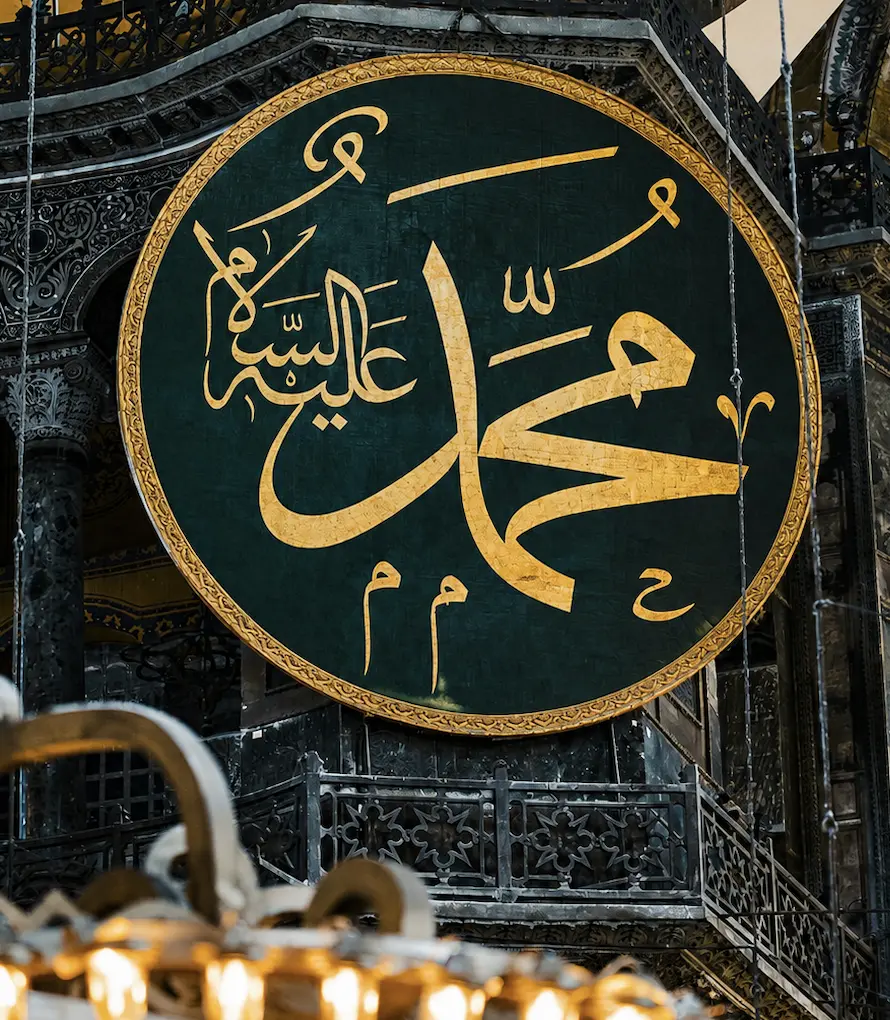
Muhammad ibn Abdullah (c. 570 – 632 CE / 53 BH - 11 AH) was the final Prophet and Messenger of Allah, through whom the Quran was revealed. Muslims believe he is the Seal of the Prophets, completing the line of messengers that began with Adam and included Abraham, Moses, and Jesus, and hold his conduct to be the model for their own, on the authority of the Qur'an's description of him as "an excellent pattern" for those who hope in God (Qur'an 33:21). His life, teachings, and character are accordingly the subject of a vast biographical and legal literature, and his message of monotheism, justice, and compassion reshaped Arabia within his lifetime and influenced civilisations far beyond it.
Arabia on the Eve of Islam
The world into which Muhammad was born was not a political vacuum, and understanding its shape explains a great deal of what follows — why Mecca was governed as it was, why there were Jewish tribes settled at Medina, and why the letters he later sent to foreign rulers were addressed to the particular courts they were.
The two empires and the Arab buffer kingdoms
Arabia in the sixth century lay between two great powers, and the Arab polities on its northern margins existed largely in relation to them. To the east, the Sasanian state had been established by Ardashir in 226 CE, and it exercised authority over Iraq and the neighbouring lands. Ar-Raheeq al-Makhtum preserves the reasoning by which the Persians came to govern the Arabs of their frontier indirectly: Ardashir concluded that he could neither rule them directly nor stop their raids on his borders unless he appointed as king one of their own, a man with the backing of his tribe. He saw a second advantage in the arrangement, in that such a client could be used against the Byzantine kings who harassed him — while the Arabs of Iraq could be set against the Arabs of Syria, who were themselves under Byzantine influence. A Persian garrison was nonetheless kept under the command of the king of Heerah, to be used against any Arabs who rebelled. From 268 CE the rulership of Heerah and Anbar passed to Amr ibn Adi of the Lakhm, and the Lakhmid kings held it thereafter.
The result was a frontier of proxies: Arab kingdoms on the Persian side and on the Byzantine side, each usable against the other, and neither fully independent. This is the political geography that gives the later episodes of the Prophet's career their weight — the correspondence with Heraclius and with the Persian court, the expedition to Mu'tah, and the march to Tabuk all took place along the seams of this arrangement rather than in empty desert.
Mecca stood outside it. Authority in the Hijaz did not rest on kingship or on the patronage of an empire but on custodianship of the Sacred House, which carried with it precedence among the tribes and the management of the pilgrimage. It was an authority of guardianship and consensus rather than of command, which is why the opposition Muhammad later faced in Mecca took the form of tribal and commercial pressure rather than of state coercion, and why the protection of an uncle could shield him for as long as it did.
The religious landscape
The Arabs of the Hijaz understood themselves to stand in the line of Abraham, and Ar-Raheeq al-Makhtum describes them as having retained fundamental elements of his religion, monotheism among them, before those elements were gradually forgotten. It attributes the decisive change to Amr ibn Luhai, a chief of the Khuza'ah who was held in high regard by his tribe for his piety and generosity. Returning from a journey to Syria, where he had seen images venerated and took the practice to be a righteous one — Syria being a land associated with earlier messengers and scriptures — he brought back an idol, Hubal, and set it within the Ka'bah, calling the people to its worship. From Mecca the practice spread through the Hijaz.
By the time of Muhammad's birth a considerable number of idols were established, and the sources name them: Hubal, al-Lat, al-Uzza, Manat, Wadd, Suwa', Yaghuth, Ya'uq, Nasr, Isaf and Nailah among others. Several had their own sanctuaries at a distance from Mecca — Manat at al-Mushallal near Qudayd on the Red Sea coast, al-Lat at Ta'if, al-Uzza in the valley of Nakhlah. The custodians of the Ka'bah were thus custodians of a sanctuary that had come to hold the images of many tribes, which gave Mecca a religious centrality with a direct commercial dimension, since the pilgrimage brought the tribes and their trade to the city.
Other faiths were present alongside this. Judaism, Christianity, Zoroastrianism and Sabianism all found their way into Arabia, and the Jewish presence in the Hijaz is of particular relevance to the later narrative. Ar-Raheeq al-Makhtum describes it as arriving in two phases: an early movement following the destruction of the temple and the deportations to Babylon, with some Jews leaving Palestine for the northern Hijaz around 587 BCE, and a much larger migration after the Roman occupation of Palestine in 70 CE, which brought settlement to the Hijaz and to Yathrib, and above all to Khaibar and Taima'. Those who settled built fortified villages, drew local tribes to their faith, and came to hold a significant place in the region's political life. By the rise of Islam several Jewish tribes were established, among them the Banu Qurayza, the Banu Qaynuqa and the Banu Nadir, with al-Samhudi putting the number of Jewish tribes as high as twenty. Judaism had also reached Yemen, introduced, in the account given, by As'ad Abi Karb, who embraced it at Yathrib and brought two rabbis of the Banu Qurayza back to instruct his people.
This is the background against which the events at Medina should be read. The tribes that appear in the article below as parties to the Constitution of Medina, and later as parties to its breakdown, were long-established communities with their own strongholds, alliances and standing, not recent arrivals.
Early Life and Background
Birth and Noble Lineage
Prophet Muhammad was born in Mecca in approximately 570 CE, during what is known as the Year of the Elephant ('Am al-Fil), when Abraha's army attempted to destroy the Kaaba but was miraculously repelled. He belonged to the Banu Hashim clan of the Quraysh, the tribe that held the custodianship of the Kaaba and the management of the pilgrimage, and with them a recognised precedence among the tribes of the Hijaz.
His father, Abdullah ibn Abd al-Muttalib, died before his birth, making him an orphan from the very beginning. His mother, Aminah bint Wahb, came from the Banu Zuhrah clan, also a noble family of Quraysh. Ibn Kathir, noting the reports that his father died while he was still unborn, observes that this is orphanhood in its fullest form.
The Prophetic Lineage
His lineage is traced in the Arab genealogical tradition through Adnan, who is held to descend from Ishmael (Ismail), the son of Prophet Abraham. The transmitted chain runs: Muhammad ibn Abdullah ibn Abd al-Muttalib ibn Hashim ibn Abd Manaf ibn Qusayy ibn Kilab, and onward through the generations to Adnan.
Above Adnan the genealogy is not established, and the classical authorities said so. Ibn Kathir and others declined to extend the chain beyond that point, holding the intervening names between Adnan and Ishmael to be unreliably transmitted. No count of generations from Muhammad to Abraham is therefore given here. The lineage as far as Adnan was well known among the Arabs, who placed great importance on descent and tribal affiliation.
The standing of the Quraysh rested on function as much as on descent. They were the custodians of the Kaaba, the house of worship the Qur'an associates with Abraham and Ishmael, and the pilgrimage that brought the tribes to Mecca brought their trade with it. Within Quraysh, the Banu Hashim held the offices of providing the pilgrims with food and water, and Al-Sira al-Nabawiyya describes Abd al-Muttalib as the lord of Quraysh and keeper of the well of Zamzam, who fed both the people of the plains and the beasts of the mountains. Muhammad's grandfather, Abd al-Muttalib, was the chief of Banu Hashim and one of the most influential leaders in Mecca.
The Year of the Elephant
The year of Muhammad's birth was marked by a momentous event that would be remembered throughout Arabian history. Abraha al-Ashram, the Christian viceroy of Yemen under the Aksumite Empire of Abyssinia, had built a magnificent cathedral in Sana'a, hoping to divert the Arab pilgrimage from Mecca to Yemen. When this plan failed and the Kaaba remained the center of Arabian religious life, Abraha decided to destroy it.
He assembled a large army, including war elephants—creatures unknown to the Arabs and terrifying in their size and power. The army marched toward Mecca, and the Meccans, unable to defend against such a force, retreated to the surrounding hills. Abd al-Muttalib went to Abraha and asked only for the return of the two hundred camels that had been taken from him. Ibn Kathir preserves the exchange from Ibn Ishaq. Abraha, who had received him with unusual courtesy, told his interpreter to say: "You impressed me when I saw you, but you displeased me when you spoke. You want to talk to me about two hundred camels I took from you, but not about the building which is your religion and your ancestors' religion that I have come to destroy?" Abd al-Muttalib answered, "I am the owner of the camels; the building has its own master who will protect it." Abraha replied that it would not be protected from him, and Abd al-Muttalib said, "Then it is between you and Him." The camels were returned.
As the army approached, the seerah literature records that the lead elephant refused to advance toward the sacred house while moving readily in any other direction. The outcome is described in the Qur'an itself, in the chapter named after the episode: "Have you not considered, [O Muhammad], how your Lord dealt with the companions of the elephant? Did He not make their plan into misguidance? And He sent against them birds in flocks, striking them with stones of hard clay, and He made them like eaten straw" (Qur'an 105:1-5). That the campaign ended in the army's destruction and the Kaaba's survival is therefore scripturally established, and it is on that basis rather than on the narrative details that the article rests the account. The year became a fixed point in Arabian memory, and it is the year to which the sources assign Muhammad's birth.
The Circumstances of Birth
Muhammad was born on a Monday, in the month of Rabi' al-Awwal, most likely on the 12th day, though some scholars suggest the 9th. His father Abdullah had died at Medina, on the return from a trading journey to Syria. When exactly he died is one of the points on which the sources do not agree, and they are worth setting out rather than choosing between silently. Al-Waqidi and Ibn Sa'd held that he died while Muhammad was still unborn, and Ibn Kathir reports this as both the more probable view and the one generally understood; other reports in the same work place the death two months after the birth, and another twenty-eight months after it, on which Ibn Kathir remarks that God knows best which account is true. Haykal, following a different reckoning, places it some seven months before the birth. What is not in dispute is that Muhammad never knew his father.
A number of reports gather around the birth. Ibn Kathir records in Al-Sira al-Nabawiyya that words occur in the hadith literature referring to "the visions of my mother who saw, as she bore me, a light come forth from her that lit up the castles of Syria," and he transmits from Ibn Ishaq that Aminah used to describe having been told, while carrying him, that she bore the lord of this nation, with the light that would accompany him given as the sign of it.
A further group of reports describes portents accompanying the birth: that the domed palace of the Persian emperor shook and fourteen of its balconies fell, that the fire of the Magians went out after burning a thousand years, and that Lake Sawa was emptied. These need to be handled precisely, because they are widely repeated and their standing is weaker than their fame suggests. Ar-Raheeq al-Makhtum names al-Tabari and al-Bayhaqi among those who recorded them, and then states plainly that none of the chains of narration are confirmed. Ibn Kathir gives the account in Al-Sira al-Nabawiyya with its full chain, tracing it to al-Khara'iti's Hawatif al-Jann through a line reaching a narrator said to have lived a hundred and fifty years. What can properly be said, then, is that this material exists in the early compilations and shows how the birth came to be remembered; it is reported here as a fact about that literature, and not asserted as a record of events.
His mother named him Muhammad, meaning "the praised one"—a name that was uncommon among the Arabs at that time. His grandfather Abd al-Muttalib was delighted with his grandson and took him to the Kaaba, where he thanked Allah for this gift and prayed for the child's protection and success.
Childhood and Early Years
Life with Halimah in the Desert
Following Arabian custom, the infant Muhammad was sent to the desert to be nursed by Halimah al-Sa'diyah of the Banu Sa'd tribe. The Bedouin practice of sending children to the desert was believed to strengthen them physically, develop their character through the harsh but pure desert environment, and teach them the eloquent Arabic language, away from the diseases and corruptions of city life.
The year Muhammad was born was a year of drought and famine. When the wet nurses from the Bedouin tribes came to Mecca seeking infants to nurse (a service for which they were paid), they were reluctant to take Muhammad because he was an orphan with no father to provide generous compensation. Halimah herself had come to Mecca on a weak donkey, with her own infant, and her family was suffering from the drought. She and her husband initially sought a more prosperous family's child.
When the other wet nurses had all chosen and she was left without a child, she took Muhammad rather than return empty-handed. Ibn Kathir names her as Halima bint Abi Dhu'ayb and her husband as al-Harith, and the seerah preserves what follows as her own narration rather than as an outside report. In her telling, the milk came to her in abundance where there had been none, sufficient for both infants; the weakened mount that had lagged on the road outward returned strong enough to outpace the company; and at the encampment of the Banu Sa'd her flocks came back full where the animals of her neighbours came back hungry, so that others told their shepherds to graze where Halima's shepherd grazed. Her husband, in the same account, said to her that she had taken a blessed soul.
These are the recollections of the woman who raised him, transmitted in the biographical literature, and they are given here as that: her account of the years in the desert, and evidence of how those years were remembered in the household that kept them.
The Opening of the Chest
While he was still in Halimah's care there occurred the episode known as the opening of the chest (Shaq al-Sadr). Unlike much of the material surrounding his infancy, this is transmitted in the soundest collections: Anas ibn Malik relates it in Sahih Muslim, in the Book of Faith. In that account it is Jibril who comes to him while he is playing with the other boys, takes hold of him, opens his chest and removes his heart, extracts from it a clot of blood with the words "This was the Shaitan's share of you," washes it in a vessel of gold filled with water from Zamzam, restores it and puts it back in its place. The boys ran to his wet nurse crying that Muhammad had been killed, and when they reached him his colour had changed.
One detail of Anas's narration is worth preserving because it is easily lost in retelling: he adds that he himself used to see the mark of that stitching on the Prophet's chest. The report is thus not presented in the collection as an event without trace, and the article follows the narration rather than the smoother versions that circulate.
Halimah, frightened by this event and fearing for Muhammad's safety, decided to return him to his mother in Mecca, though she had intended to keep him longer. She explained to Aminah what had happened, but Aminah reassured her, saying that she had seen signs during her pregnancy that indicated her son was destined for something great and that he would be protected by Allah.
The Loss of His Mother
Muhammad remained with his mother Aminah in Mecca until he was six years old. Despite her widowhood and limited means, Aminah cared for her son with great love and attention. The sources say little of these years beyond that he was with her.
When Muhammad was six his mother took him north to Medina, then called Yathrib. Ibn Kathir, transmitting from Ibn Ishaq, gives the purpose of the journey as a visit to her husband's kin, the Banu Adi ibn al-Najjar; al-Waqidi adds that she travelled in the company of Umm Ayman, the freedwoman who had cared for Muhammad from his infancy and remained attached to the household for the rest of her life. Abdullah had died and been buried in that city, which is why the visit brought the boy for the first time to the place that would later receive him as its own.
On the return journey to Mecca, at a place called Abwa (about halfway between Mecca and Medina), Aminah fell seriously ill. Despite Umm Ayman's care, her condition deteriorated rapidly. Aminah, knowing she was dying, entrusted her six-year-old son to Umm Ayman's care and passed away. She was buried at Abwa, leaving the young Muhammad doubly orphaned—without father or mother.
He was thus twice orphaned before the age of seven. The Qur'an addresses the fact directly, and does so in a passage recalling what followed from it: "Did He not find you an orphan and give [you] refuge?" (Qur'an 93:6). The same chapter goes on to enjoin that the orphan not be oppressed (Qur'an 93:9), and the care of orphans is a recurring concern of the Qur'an and of the teaching set out later in this article.
Under the Care of Abd al-Muttalib
Umm Ayman brought the orphaned Muhammad back to Mecca, where he was taken into the care of his grandfather, Abd al-Muttalib, who was then around eighty years old. Abd al-Muttalib was the chief of the Quraysh and one of the most respected men in Mecca. He had been the one who had rediscovered the well of Zamzam, which had been buried and lost for centuries, and he held the prestigious position of providing water to pilgrims visiting the Kaaba.
Abd al-Muttalib showed extraordinary affection for his grandson, treating him with a special tenderness that was noticed by all. He would have a special carpet spread for him in the shade of the Kaaba, and while his own sons would sit around the carpet out of respect, he would invite young Muhammad to sit with him on the carpet. When his sons tried to move Muhammad away, Abd al-Muttalib would say, "Leave my son alone, for by Allah, he has a great future."
The seerah literature describes the elderly chief taking Muhammad with him to the assemblies of the Quraysh leaders, where the affairs of the tribe, its trade and its disputes were discussed.
However, this period of stability was short-lived. When Muhammad was eight years old (some narrations say ten), Abd al-Muttalib fell ill and, sensing his approaching death, called his sons to his bedside. He entrusted the care of Muhammad to his son Abu Talib, Muhammad's paternal uncle, saying, "Take care of this orphan, for his father and mother are dead. Be to him better than a father and better than a mother." Abu Talib, though not wealthy, accepted this responsibility with love and dedication, promising to care for Muhammad as he would care for his own children.
Life in Abu Talib's Household
Abu Talib, though he was the brother of Muhammad's father Abdullah, was not a wealthy man. Unlike some of his brothers who had inherited wealth or engaged in profitable trade, Abu Talib had a large family to support and limited means. Nevertheless, he welcomed Muhammad into his household and treated him with exceptional kindness and love, fulfilling his father's dying wish.
Muhammad grew up alongside Abu Talib's children, particularly Ali, who was born when Muhammad was about thirty years old and would later become one of his closest companions and son-in-law. Abu Talib's wife Fatimah bint Asad — the mother of Ali, and not to be confused with the Prophet's daughter Fatimah — treated Muhammad as her own son, and he honoured her at her death.
The household was not a wealthy one, and the sources describe Muhammad sharing in its work and, as he grew, in earning toward its support. He grew up, on this account, in modest circumstances rather than in the households of Mecca that lived on the pilgrimage trade.
Youth and Character Development
Early Work as a Shepherd
Growing up in the household of Abu Talib, Muhammad learned the trade of commerce and accompanied his uncle on trading journeys. Despite the poverty of Abu Talib's family, Muhammad was treated with love and respect. From an early age, he was known for his exceptional character, earning the titles "Al-Amin" (The Trustworthy) and "Al-Sadiq" (The Truthful) among the Meccans.
As a young man, Muhammad worked as a shepherd, tending sheep in the hills around Mecca. This humble occupation, shared by many prophets before him including Moses, David, and others, taught him patience, responsibility, contemplation, and compassion for those under his care. The solitude of shepherding provided time for reflection and observation of nature, developing his contemplative nature and spiritual awareness.
He later said, "Allah did not send any prophet who was not a shepherd." When asked if he too had been a shepherd, he replied, "Yes, I used to tend sheep for the people of Mecca for some Qirats (a small wage)." (Sahih al-Bukhari, Book 37, Hadith 5) This work, though humble, was formative. Shepherding required vigilance, as the shepherd had to protect the flock from predators and thieves while guiding them to good pasture and water. These skills—protection, guidance, and care for those entrusted to one's responsibility—would later be essential in his role as a prophet and leader of the Muslim community.
The experience of shepherding also taught Muhammad about leadership through service rather than domination. A good shepherd leads from within the flock, not by driving the sheep with force but by guiding them with gentleness and wisdom. This model of servant leadership would characterize his later approach to leading the Muslim community.
The Journey to Syria with Abu Talib
When Muhammad was about twelve years old (some narrations say nine), Abu Talib decided to take him on a trading caravan to Syria. This was Muhammad's first journey outside Arabia, and it would prove to be significant in several ways. The caravan traveled north through the desert, following the ancient trade routes that connected Arabia with the civilizations of the Levant.
During this journey the caravan reached Busra (Bostra) in southern Syria. The biographical tradition attaches to this stop an encounter with a Christian monk, named Bahira in Ibn Ishaq's account, who is said to have recognised in the young Muhammad the signs of a coming prophet and to have warned Abu Talib to guard him carefully.
The evidentiary position of this episode needs to be stated, because it is one of the best-known stories of the Prophet's boyhood and one of the least securely transmitted. The detailed version — the shading cloud, the tree bending its branches, the examination for the mark between the shoulders, the dialogue in which Abu Talib is corrected about his relationship to the boy, and the monk's warning — comes from Ibn Ishaq, whose chain for it is not connected to an eyewitness. A shorter account of a journey to Syria in Abu Talib's company, with a monk's recognition, is transmitted in Jami' at-Tirmidhi, which al-Tirmidhi described as hasan gharib. The core of the episode therefore has some support in the hadith literature; the elaborated detail and the quoted dialogue do not, and they are reported here as Ibn Ishaq's narrative rather than as established history.
What can be said with confidence is that Muhammad travelled with his uncle on commercial journeys, that these journeys brought him into contact with Christian and Jewish communities in Syria, and that the trading experience he gained on them shaped the reputation for reliability that later brought him to Khadijah's attention.
Development of Character and Reputation
Muhammad was known for his honesty in all dealings, his kindness to the poor and needy, and his habit of meditation and reflection. He never participated in the idol worship that was prevalent in Mecca, nor did he engage in the drinking, gambling, and immoral practices common in pre-Islamic Arabian society. Even before prophethood, he was recognized as a man of exceptional moral character.
His reputation for truthfulness was so well-established that people would entrust him with their valuables for safekeeping, knowing they would be returned safely. The title by which the Meccans knew him — al-Amin, the trustworthy — is itself the evidence on this point, since it was conferred by the community that dealt with him commercially and was still in use when they opposed his message.
He was also known for his modesty and humility. Unlike many young men of Quraysh who boasted of their exploits and sought attention, Muhammad was quiet and reserved, speaking only when necessary and always with wisdom and kindness. He avoided the gatherings where young men would engage in frivolous talk, drinking, and gambling. Instead, he was often found in contemplation or helping those in need.
His compassion extended to all of creation. He was kind to animals, gentle with children, respectful to elders, and generous to the poor. He would help widows with their chores, assist orphans, and show kindness to slaves—behaviors that were unusual in a society that often treated these groups with contempt or indifference.
Even in his youth, Muhammad showed wisdom beyond his years. He was consulted in matters of dispute and was known for his fair judgment. His advice was sought by both young and old, and his opinions were respected even by the elders of Quraysh. This combination of moral integrity, wisdom, and compassion earned him the titles "Al-Amin" (The Trustworthy) and "Al-Sadiq" (The Truthful)—titles that would remain with him throughout his life and would be acknowledged even by his enemies.
Participation in Hilf al-Fudul
When Muhammad was about twenty years old, he participated in a significant event that demonstrated his commitment to justice and his opposition to oppression. A man from the Zubayd tribe came to Mecca to sell his goods to Al-As ibn Wa'il, a wealthy and powerful merchant. After the transaction, Al-As refused to pay the agreed price, and the Zubaydi man had no tribal protection in Mecca to help him seek justice.
The Zubaydi man stood near the Kaaba and called out, appealing to the sense of honor of the Quraysh, reciting poetry about the injustice done to him. This incident moved several noble men of Quraysh, including Al-Zubayr ibn Abd al-Muttalib (Muhammad's uncle), to form an alliance called Hilf al-Fudul (The Alliance of the Virtuous or The Pact of the Virtuous).
This alliance was formed in the house of Abdullah ibn Jud'an, and its members pledged to stand together to protect the oppressed, ensure justice for the wronged, and oppose tyranny in Mecca, regardless of whether the victim was a Meccan or a stranger, a powerful person or a weak one. They vowed to restore rights to those who had been wronged and to stand against oppressors, even if the oppressor was from their own tribe.
Muhammad participated in this alliance, and he would later say about it, even after becoming a prophet: "I witnessed in the house of Abdullah ibn Jud'an an alliance that was more beloved to me than a herd of red camels [the most valuable possession in Arabia]. If I were called to it now in Islam, I would respond." (Musnad Ahmad) This statement shows that Muhammad recognized the value of standing for justice and protecting the oppressed, even in the pre-Islamic period, and that such noble causes were consistent with Islamic values.
The Hilf al-Fudul demonstrated Muhammad's early commitment to social justice and his willingness to stand against oppression—values that would become central to his prophetic message. It also showed his ability to work with others for a common good cause, transcending tribal loyalties for the sake of justice.
Marriage to Khadijah
Khadijah's Business and Reputation
At the age of 25, Muhammad's reputation for honesty and trustworthiness led Khadijah bint Khuwaylid, a wealthy and respected businesswoman of Mecca, to hire him to manage her trade caravan to Syria. Khadijah was a remarkable woman in pre-Islamic Arabian society—a successful merchant who had inherited her father's business and expanded it through her intelligence, business acumen, and integrity.
Khadijah was a widow, fifteen years Muhammad's senior, who had been married twice before. Both her previous husbands had died, leaving her with children and considerable wealth. Despite her wealth and noble lineage (she was from the Banu Asad clan of Quraysh), she managed her own business affairs—unusual for women in that society. She was known as "Tahirah" (The Pure One) for her chastity and moral character, and she was respected by the Meccan elite for her wisdom and business success.
Many wealthy and powerful men of Quraysh had sought her hand in marriage, attracted by her wealth, beauty, and status. However, Khadijah had refused all proposals, preferring to maintain her independence and focus on her business. She employed agents to trade on her behalf, paying them a commission from the profits.
The Syrian Trading Journey
When Khadijah heard of Muhammad's reputation for honesty, trustworthiness, and business skill, she offered him employment to take her merchandise to Syria. She offered him double the commission she usually paid her agents, recognizing his exceptional character. Muhammad accepted the offer, and Abu Talib encouraged him, seeing it as an excellent opportunity.
Khadijah sent her trusted servant, Maysarah, to accompany Muhammad and observe how he conducted business. The caravan journey to Syria took several weeks, traveling through the harsh desert terrain. During this journey, Maysarah observed Muhammad's character closely—his honesty in dealings, his fair treatment of others, his wisdom in negotiations, and his trustworthiness in handling Khadijah's goods.
Haykal records that Maysarah returned with a strong regard for the man he had been sent to observe. Reports of marvels witnessed on that journey circulate in the later literature but are not carried in the approved sources consulted here, and the article rests instead on what the outcome shows: the servant's report and the profit of the venture were enough to change how Khadijah regarded him. When they rested at a place where a Christian monk lived, the monk told Maysarah that no one had sat under that particular tree except prophets, observing that Muhammad bore the signs of prophethood.
The trading mission was extraordinarily successful. Muhammad's honest dealings, fair negotiations, and business wisdom resulted in profits far exceeding what Khadijah's caravans usually earned. When the caravan returned to Mecca, Maysarah gave Khadijah a detailed account of the journey, describing not only the exceptional business success but also Muhammad's character and the unusual events he had witnessed.
The Proposal and Marriage
Impressed by his character and abilities, Khadijah found herself drawn to Muhammad. She saw in him not just an honest employee but a man of exceptional character, wisdom, and spiritual depth. She recognized qualities in him that transcended worldly success—a nobility of soul and purity of character that was rare in Meccan society.
Khadijah proposed marriage to Muhammad through her friend Nufaysah bint Munya. Despite the age difference and the fact that she was wealthier and from a more established family, Muhammad accepted. Muhammad consulted with his uncles, particularly Abu Talib, who was delighted with the match. Abu Talib himself delivered the marriage sermon, praising both families and highlighting Muhammad's noble character and lineage, despite his lack of wealth.
The marriage took place in approximately 595 CE. Abu Talib represented Muhammad in the marriage contract, and Khadijah's uncle Amr ibn Asad represented her. The mahr (dowry) was twenty young camels, which Abu Talib helped Muhammad provide.
A Partnership of Love and Respect
Their marriage was one of deep love, mutual respect, and true partnership. Khadijah would become not only his wife but his closest confidante, strongest supporter, and the first person to believe in his prophethood. What the sources record of the marriage is practical rather than sentimental: she entrusted her trade to him, she provisioned his retreats to Hira, and when the first revelation came she was the one he returned to and the first to accept what he brought.
Muhammad, for his part, treated Khadijah with exceptional love and respect. He helped with household chores, consulted her on important matters, and valued her opinions. Their relationship was characterized by mutual consultation (shura), emotional intimacy, and spiritual companionship. He would later say that she was one of the four perfect women in history, along with Mary (mother of Jesus), Asiya (wife of Pharaoh), and his daughter Fatimah.
Their Children
During their 25 years of marriage, Khadijah bore Muhammad several children. Their sons, al-Qasim (from whom Muhammad received the kunya "Abu al-Qasim") and Abdullah (also called al-Tayyib and al-Tahir), died in infancy, as was common in that era. The loss of their sons was deeply painful for both Muhammad and Khadijah, but they bore this trial with patience and faith.
Their daughters were Zainab, Ruqayyah, Umm Kulthum, and Fatimah, all of whom survived to adulthood. Muhammad was an exceptionally loving and attentive father to his daughters, treating them with tenderness and respect in a society that often devalued girls. All four daughters would accept Islam and make the Hijra to Medina. Through Fatimah, Muhammad's lineage would continue, and all his descendants trace their lineage through her.
Khadijah's wealth provided Muhammad with financial security, allowing him time for contemplation and spiritual reflection. The fifteen years between their marriage (595 CE) and the beginning of revelation (610 CE) were years of preparation for his prophetic mission. He established himself as a respected member of Meccan society, known for his integrity, wisdom, and moral character, while remaining distinct by never participating in idol worship or the immoral practices common among the Quraysh elite.
The Reconstruction of the Kaaba
The Need for Rebuilding
When Muhammad was 35 years old, a significant event occurred that demonstrated his wisdom and problem-solving abilities. The Kaaba, the ancient house of worship built by Prophets Abraham and Ishmael, had stood for centuries and had suffered damage over time. A major flood had weakened its structure, causing cracks in the walls and threatening its stability. The Quraysh, as custodians of the Kaaba, decided that it needed to be rebuilt to preserve this sacred structure.
The Kaaba at that time was a simple stone structure without a roof, and its walls were only about the height of a man. The Quraysh decided to rebuild it with a roof and make it taller and stronger. However, they faced a dilemma: they wanted to use only "pure" wealth for this sacred task, excluding any money earned through usury, prostitution, or other immoral means. This significantly limited their resources, so they decided to make the Kaaba smaller than its original Abrahamic foundations, leaving out the northern section (known as al-Hijr Ismail).
The Dispute Over the Black Stone
The reconstruction proceeded with each clan of Quraysh taking responsibility for one section of the walls. They worked together, with even the leaders and nobles carrying stones and participating in the construction—a rare display of unity and cooperation. However, when the walls reached the point where the Black Stone (al-Hajar al-Aswad) needed to be placed back in its position, a serious dispute arose.
The Black Stone, believed to have come from Paradise and given to Abraham, was the most sacred object associated with the Kaaba. Each clan wanted the honor of placing it in its position, as this would bring them prestige and honor. The dispute grew heated, with each clan claiming this right based on their nobility, their role as custodians, or their contributions to the reconstruction.
The disagreement threatened to escalate into violence. The clans began to form alliances and prepare for conflict. The Banu Abd al-Dar brought a bowl filled with blood, and they and their allies dipped their hands in it, swearing an oath to fight to the death over this issue. For four or five days, the situation remained tense, with Mecca on the brink of civil war.
Muhammad's Wise Solution
Finally, the eldest among them, Abu Umayyah ibn al-Mughirah, proposed a solution: they would accept the judgment of the first person to enter the sanctuary the next morning. Everyone agreed to this arbitration, relieved to have found a way to avoid bloodshed.
The next morning, the first person to enter was Muhammad ibn Abdullah. When they saw him, they exclaimed with joy and relief, "This is al-Amin (the Trustworthy), we are pleased with him; this is Muhammad!" Even at the age of 35, before his prophethood, Muhammad's reputation for fairness, wisdom, and trustworthiness was so well-established that all parties immediately accepted him as an arbitrator.
Muhammad listened carefully to the dispute, understanding both the importance of the Black Stone and the pride of each clan. Then, demonstrating remarkable wisdom and diplomatic skill, he proposed a solution that satisfied everyone. He asked for a cloak to be brought and spread on the ground. He then placed the Black Stone in the center of the cloak and asked a representative from each major clan to hold an edge of the cloak.
Together, they lifted the stone to the appropriate height. This solution was brilliant in its simplicity: every clan participated equally in the honor of raising the Black Stone, and no single clan could claim superiority over the others. When the stone reached the right position, Muhammad himself took it and placed it in its designated spot in the eastern corner of the Kaaba.
This solution prevented bloodshed and civil war, further enhancing Muhammad's reputation for wisdom and fairness. It demonstrated his ability to find creative solutions to seemingly intractable problems, his diplomatic skills in managing competing interests, and his concern for unity and peace. The same capacities appear again in the Medinan period described below, in the consultations before Badr and in the negotiation of the treaty at Hudaybiyyah.
The incident of the Black Stone also demonstrated the respect and trust that the Quraysh had for Muhammad, even before his prophethood. They recognized in him a man of exceptional character and judgment, someone who could be trusted to be fair and wise. This reputation would later make his claim to prophethood more credible to some, though it would also make his message more threatening to those whose interests were challenged by Islam.
The Call to Prophethood
Spiritual Preparation and Contemplation
The Practice of Tahannuth
As Muhammad approached the age of forty, he increasingly felt drawn to solitude and contemplation. He would often retreat to the Cave of Hira (Ghar Hira), located on Mount Jabal al-Nour (Mountain of Light), about two miles from Mecca. There, he would spend days and nights in meditation, reflecting on the creation of the universe, the purpose of life, and the corruption and injustice he saw in Meccan society.
This practice of spiritual retreat (tahannuth) was not uncommon among those seeking truth in pre-Islamic Arabia. The term tahannuth refers to the practice of devotion and withdrawal from worldly affairs for spiritual purposes. The seerah literature associates the practice with the hunafa, those in Arabia who kept apart from idol worship and held to a monotheism they traced to Abraham — consistent with the account given earlier in this article, in which elements of the Abrahamic religion persisted in the Hijaz alongside the images introduced later.
Muhammad would take provisions with him—usually dates, water, and simple food prepared by Khadijah—and spend extended periods in the cave, sometimes a whole month, particularly during the month of Ramadan. The provisioning is not an embellishment: Aisha's narration in Sahih al-Bukhari 3 states that he would take food with him for the stay and then return to Khadijah to be resupplied before going back.
The Cave of Hira
The Cave of Hira is a small cave, barely large enough for a person to sit or lie down, located near the summit of Jabal al-Nour. The climb to reach it is steep and challenging, taking about an hour of difficult hiking. The cave's entrance faces toward the Kaaba, and from its opening, one can see the city of Mecca spread below.
The isolation and austerity of the cave provided the perfect environment for deep contemplation. Away from the noise and distractions of city life, surrounded by the stark beauty of the desert mountains, Muhammad would spend his time in reflection and meditation. The silence of the cave, broken only by the wind and the occasional call of birds, created a space for spiritual awareness and inner transformation.
Contemplations and Spiritual State
During these periods of contemplation, Muhammad pondered the fundamental questions of existence. He reflected on the creation of the heavens and the earth, the alternation of day and night, the mountains and valleys, the stars in their courses. He contemplated the purpose of human life, the nature of good and evil, and the ultimate destiny of the soul.
He was deeply troubled by the idol worship prevalent in Mecca. The Kaaba, built by Abraham as a house for the worship of the One God, had been filled with 360 idols. The Quraysh and other Arab tribes would worship these idols, make offerings to them, and seek their intercession, despite the obvious fact that these stone and wood figures could neither hear nor respond. Muhammad, with his pure fitrah (natural disposition), found this practice absurd and offensive.
He was also troubled by the social injustices he witnessed: the exploitation of the poor by the wealthy, the mistreatment of slaves, the burial of infant daughters alive, the endless tribal warfare, the oppression of orphans and widows, and the general moral decay of society. The strong oppressed the weak, the wealthy exploited the poor, and might made right. There seemed to be no higher moral law, no accountability, no justice beyond the power of the sword and the loyalty of the tribe.
Muhammad felt a deep spiritual yearning, a sense that there must be more to existence than the material world and tribal loyalties. He sensed the presence of a higher reality, a divine purpose behind creation, a moral order that transcended human conventions. Yet he did not know how to access this truth or how to bring about the transformation that society so desperately needed.
True Dreams and Spiritual Signs
In the months leading up to the first revelation, Muhammad began experiencing true dreams (ru'ya sadiqah). These dreams were vivid and clear, and whatever he saw in them would come to pass exactly as he had seen it, like the breaking of dawn. This phenomenon, mentioned in authentic hadith, was a form of spiritual preparation, opening his consciousness to receive divine communication.
He also began to experience a deep love for solitude and an aversion to the frivolous gatherings and immoral practices of Meccan society. He would hear greetings of peace from stones and trees, though he saw no one. These experiences, while initially puzzling, were preparing him spiritually for the momentous event that was about to transform his life.
Khadijah noticed these changes in her husband. She saw his increasing need for solitude, his deep contemplation, his spiritual sensitivity. Rather than being concerned or trying to dissuade him, she supported and encouraged him, recognizing that he was undergoing a profound spiritual transformation. Her support during this period was crucial, providing him with the emotional security and material support he needed to pursue his spiritual quest.
The First Revelation
In the month of Ramadan in the year 610 CE, when Muhammad was forty years old, the Angel Gabriel (Jibril) appeared to him in the Cave of Hira. This encounter would mark the beginning of his prophethood and the revelation of the Quran.
According to authentic narrations, the Angel Gabriel appeared in his true form and commanded Muhammad: "Iqra!" (Read! or Recite!). Muhammad, who could neither read nor write, responded, "I cannot read." The angel embraced him tightly until he could bear it no more, then released him and repeated the command. This happened three times, and then the angel recited the first verses of divine revelation:
"Read in the name of your Lord who created. Created man from a clinging substance. Read, and your Lord is the Most Generous. Who taught by the pen. Taught man that which he knew not." (Quran 96:1-5)
These first verses emphasized knowledge, learning, and the importance of reading and writing—revolutionary concepts in a largely illiterate society. They established that all knowledge comes from Allah and that human beings have the capacity to learn and grow through divine guidance.
The Manner of Revelation
The way revelation reached the Prophet is itself described in the hadith. When al-Harith ibn Hisham asked him how the revelation came, he replied that at times it came "like the ringing of a bell, and this is the hardest on me, then it leaves me and I have grasped what was said," and at other times "the angel comes to me in the form of a man and speaks to me, and I grasp what he says." Aisha added that she saw revelation descend upon him on an intensely cold day, and that when it lifted, his forehead ran with sweat (recorded by Aisha in Sahih al-Bukhari 2, in the Book of Revelation, where she adds that she saw revelation descend on him on a bitterly cold day and the sweat ran from his forehead; also in Sunan an-Nasa'i). The Qur'an itself came down not all at once but in portions across some twenty-three years, the earlier and shorter chapters largely in Mecca and the longer, more legislative passages largely in Medina, each revealed in response to the circumstances and needs of the growing community.
Khadijah's Support and Waraqah's Confirmation
Deeply shaken by this overwhelming experience, Muhammad returned home trembling and asked Khadijah to cover him. He told her, "I fear for myself" (Sahih al-Bukhari 3; the same narrative appears in Sahih Muslim, Book of Faith). Her reply, preserved in the same narration, answered his fear by reciting his conduct back to him: "Never! By Allah, Allah will never disgrace you. You maintain family ties, you bear the burden of the weak, you help the poor and needy, you serve your guests generously, and you assist those who are afflicted with calamities." (Sahih al-Bukhari, Book 1, Hadith 3)
Khadijah then took Muhammad to her cousin, Waraqah ibn Nawfal, an elderly Christian scholar who was knowledgeable in the scriptures. After hearing Muhammad's account, Waraqah confirmed: "This is the same angel (Gabriel) whom Allah sent to Moses. I wish I were young and could live until the time when your people will drive you out." Muhammad was surprised and asked, "Will they drive me out?" Waraqah replied, "Yes, no man has ever brought something similar to what you have brought without being treated with hostility. If I should remain alive until that day, I will support you strongly." (Sahih al-Bukhari, Book 1, Hadith 3)
Khadijah became the first person to accept Islam, believing in Muhammad's prophethood without hesitation. Her unwavering support during the early, difficult years of Islam was crucial to the survival and growth of the new faith. She used her wealth to support the nascent Muslim community and provided emotional and spiritual support to the Prophet during times of intense persecution.
The Early Believers
Following Khadijah's acceptance of Islam, the next converts came from Muhammad's closest family and friends. Ali ibn Abi Talib, Muhammad's young cousin who lived in his household, was among the first to accept Islam, being only about ten years old at the time. Abu Bakr, Muhammad's closest friend and a respected merchant, also accepted Islam early and would become instrumental in spreading the message.
Abu Bakr's conversion was particularly significant because of his influence in Meccan society. He was known for his knowledge of Arab genealogy, his business acumen, and his respected position among the Quraysh. Through Abu Bakr's efforts, several prominent Meccans accepted Islam, including Uthman ibn Affan, Zubayr ibn al-Awwam, Abd al-Rahman ibn Awf, Sa'd ibn Abi Waqqas, and Talhah ibn Ubaydullah—men who would later become pillars of the Muslim community.
Zayd ibn Harithah, who had been enslaved and then freed and adopted by Muhammad, was also among the early believers. His acceptance of Islam demonstrated the universal nature of the message, transcending social status and origin. Other early converts included Bilal ibn Rabah, an Abyssinian slave who would later become the first muezzin (caller to prayer) of Islam.
The Meccan Period (610-622 CE)
Three Years of Secret Preaching
For the first three years after receiving revelation, Muhammad preached Islam privately, sharing the message only with those he trusted. This period of secret da'wah (invitation to Islam) allowed the early Muslim community to establish itself and grow in faith before facing the inevitable opposition from Meccan society.
During this time, the small group of believers would meet secretly in the house of al-Arqam ibn Abi al-Arqam, located near the Kaaba. This house, known as Dar al-Arqam, became the first center of Islamic learning and organization. Here, the Prophet would teach the Quran, explain the principles of Islam, and prepare his followers for the challenges ahead.
The revelations during this period focused on fundamental Islamic beliefs: the Oneness of Allah (Tawhid), the Day of Judgment, the importance of prayer and moral conduct, and the rejection of idol worship. The early Meccan surahs of the Quran are characterized by their powerful, poetic language and their emphasis on spiritual and moral transformation.
Public Declaration and Opposition
In the fourth year of prophethood, Muhammad received the divine command to proclaim his message publicly: "Therefore proclaim openly that which you are commanded, and turn away from the polytheists." (Quran 15:94) He climbed Mount Safa and called out to the various clans of Quraysh. When they gathered, he asked them, "If I were to tell you that an army was advancing to attack you from the valley on the other side of this mountain, would you believe me?" They replied, "Yes, we have never known you to tell a lie." He then declared, "I am a warner to you in face of a terrifying punishment."
This public declaration marked a turning point. The Quraysh leadership, particularly Abu Lahab (Muhammad's uncle) and Abu Jahl, became openly hostile. They saw Islam as a threat to their economic interests (the Kaaba pilgrimage brought significant revenue), their social status, and their ancestral traditions. The opposition intensified as more people, especially from lower social classes and slaves, began accepting Islam.
The Nature of Meccan Opposition
Stages of Opposition
The Quraysh employed various strategies to stop the spread of Islam, escalating their tactics as each approach failed. They first tried mockery and ridicule, calling Muhammad a poet, a madman, or a sorcerer. They spread false rumors about him and the Quran, trying to discredit his message. They would stand at the roads leading to Mecca during pilgrimage season, warning visitors not to listen to Muhammad, claiming he would bewitch them with his words and turn them against their fathers and tribes.
When mockery failed to stop the growth of Islam, they attempted bribery. A delegation of Quraysh leaders, including Utbah ibn Rabi'ah, came to Muhammad with an offer: "If you want wealth, we will collect money for you until you become the richest among us. If you want honor, we will make you our chief. If you want kingship, we will make you our king. If what comes to you is a jinn that you cannot control, we will find you a physician and spend our wealth until you are cured."
Muhammad's response was to recite verses from Surah Fussilat (Chapter 41), which speak of Allah's signs in creation and warn of consequences for those who reject the truth. When he reached the verse about prostration, he prostrated, and Utbah was so moved by the beauty and power of the Quran that he returned to his companions in a changed state. They asked, "What happened?" He replied, "I heard words that I have never heard before. By Allah, it is neither poetry, nor sorcery, nor soothsaying. O Quraysh, listen to me and leave this man alone."
However, the other leaders rejected Utbah's advice. They then applied pressure through Abu Talib, pressing him to make his nephew desist. Ibn Ishaq reports Muhammad's reply to his uncle: "By Allah, if you put the sun in my right hand and the moon in my left on condition that I abandon this course, I would not abandon it until Allah has made it victorious, or I perish therein." He then turned to leave, and Abu Talib called him back and said, "Go, my nephew, and say what you please. By Allah, I will never forsake you."
Physical Persecution of Vulnerable Muslims
When persuasion and bribery failed, the Quraysh turned to persecution. While Muhammad himself was protected by his uncle Abu Talib and the Banu Hashim clan, his followers, especially those without tribal protection, faced severe torture and abuse. Slaves and the poor were particularly vulnerable, as they had no clan to defend them or seek revenge on their behalf.
Bilal ibn Rabah's Ordeal Bilal ibn Rabah, an Abyssinian slave owned by Umayyah ibn Khalaf, endured some of the most brutal torture. When Umayyah discovered that Bilal had accepted Islam, he would take him out to the desert at noon—the hottest time of day—strip him, and make him lie on the burning sand. Then he would place a massive boulder on Bilal's chest, so heavy that Bilal could barely breathe.
Umayyah would say, "You will stay like this until you die or you renounce Muhammad and worship al-Lat and al-Uzza." Despite the excruciating pain, Bilal would respond with only one word: "Ahad, Ahad" (One, One—referring to Allah's oneness). His voice would grow weaker, but his faith never wavered. Sometimes they would tie a rope around his neck and have children drag him through the streets of Mecca, over rocks and thorns, while he continued to say "Ahad, Ahad."
This torture continued for days until Abu Bakr, passing by and seeing Bilal's suffering, purchased him from Umayyah and immediately freed him. Bilal became one of the closest companions of the Prophet and would later be chosen as the first muezzin (caller to prayer) in Islam, his voice that had proclaimed Allah's oneness under torture now calling believers to prayer.
The Family of Yasir Yasir ibn Amir, his wife Sumayyah bint Khayyat, and their son Ammar ibn Yasir were among the early converts to Islam. They were from the weak and unprotected members of society, making them prime targets for persecution. The family of Abu Jahl, one of Islam's fiercest enemies, would take them to the desert in the intense midday heat and torture them.
They would be made to lie on the burning sand, beaten with whips, and subjected to various forms of physical abuse. The torture was designed not just to cause pain but to break their spirits and force them to renounce Islam. The Prophet would pass by them during their torture, and though his heart ached for them, he lacked the power to physically protect them. He could only offer them words of comfort and hope: "Patience, O family of Yasir, for your appointed place is Paradise." The words are transmitted through al-Hakim's Mustadrak and works of Seerah rather than the two Sahih collections; the torture of the family and the martyrdom of Sumayyah, however, are firmly established in the biographical tradition.
Sumayyah, despite being an elderly woman, refused to renounce her faith. Abu Jahl, enraged by her steadfastness, took a spear and thrust it through her private parts, killing her. Sumayyah bint Khayyat thus became the first martyr in Islam, dying for her faith with unwavering conviction. Her husband Yasir was also tortured to death shortly after.
Their son Ammar survived, though he was tortured so severely that at one point, under extreme duress, he uttered words of disbelief while his heart remained firm in faith. When he came to the Prophet in tears, distressed by what he had been forced to say, Allah revealed verses confirming that those who are compelled under torture while their hearts remain firm in faith are not held accountable: "Whoever disbelieves in Allah after his belief... except for one who is forced while his heart is secure in faith." (Quran 16:106)
Khabbab ibn al-Aratt's Torture Khabbab ibn al-Aratt was a blacksmith and an early convert to Islam. His master and other Quraysh would torture him by heating iron rods in his own forge and then pressing them against his back. They would also make him lie on burning coals, placing rocks on his chest so he couldn't escape, until the fat from his back would extinguish the coals.
Years later, during the caliphate of Umar ibn al-Khattab, Khabbab showed the scars on his back—the flesh had been so badly burned that it never healed properly, leaving permanent disfigurement. Despite this horrific torture, Khabbab never renounced his faith. He would later participate in the Battle of Badr and other major events in Islamic history.
Torture of Other Early Muslims
-
Khabbab ibn al-Aratt, a slave and later a swordsmith, was tortured by his owner Umm Anmar and her brother Siba'a ibn Abd al-Uzza. He was afterwards manumitted and became a reciter of the Qur'an and a transmitter of hadith.
-
Zunayrah, a slave of the Banu Makhzum, lost her eyesight after being beaten. When the Quraysh told her that al-Lat and al-Uzza had taken her sight, she answered that those idols could neither harm nor heal and that the affliction was from God. Her sight afterwards returned, and the Quraysh attributed the recovery to Muhammad's sorcery. Abu Bakr purchased and freed her, together with her fellow slave Lubaynah.
-
Nahdiyah and her daughter were slaves who were tortured. Abu Bakr purchased and freed them.
-
Umm Ubays was tortured by the Banu Makhzum. Abu Bakr purchased and freed her too.
Abu Bakr spent much of his wealth purchasing and freeing slaves who were being tortured for their faith. His father, Abu Quhafah, who had not yet accepted Islam, once criticized him for freeing weak slaves instead of strong ones who could protect him. Abu Bakr replied, "O my father, I only seek what I seek," meaning he sought Allah's pleasure, not worldly benefit.
Psychological and Social Persecution
Beyond physical torture, the Quraysh employed psychological warfare and social persecution:
Economic Boycott: Muslims were boycotted economically. No one was to trade with them, buy from them, or sell to them. This made it difficult for Muslims to earn a living or purchase necessities.
Social Ostracism: Muslims were socially isolated. They were mocked in public gatherings, their reputations were slandered, and false accusations were spread about them. Family members who accepted Islam were disowned and disinherited.
Harassment and Intimidation: Muslims were harassed in the streets, their homes were vandalized, and they were prevented from praying at the Kaaba. Garbage and animal entrails would be thrown at them, especially at the Prophet when he prayed.
Attempts to Discredit the Message: The Quraysh would send people to interrupt the Prophet when he recited the Quran, making noise and mocking to prevent others from hearing. They spread rumors that the Quran was poetry, sorcery, or tales of the ancients copied from previous scriptures.
The First Migration to Abyssinia
As persecution intensified in 615 CE, in the fifth year of the prophethood, the Prophet advised some of his followers to migrate to Abyssinia (modern-day Ethiopia), where the Christian king, the Negus (An-Najashi), was known for his justice. This first migration included about 15 Muslims, among them Uthman ibn Affan and his wife Ruqayyah, the Prophet's daughter.
When the Quraysh learned of this, they sent emissaries with gifts to the Negus, asking him to return the Muslims. The Negus instead summoned the Muslims and questioned them about their religion. Ja'far ibn Abi Talib, speaking on their behalf, replied: "O King, we were a people in a state of ignorance and immorality, worshipping idols and eating the flesh of dead animals, committing all sorts of abomination and shameful deeds, breaking the ties of kinship, treating guests badly, and the strong among us exploited the weak. Then Allah sent us a Prophet, one of our own people, whose lineage, truthfulness, trustworthiness, and integrity were well-known to us."
Ja'far then recited verses from Surah Maryam (Chapter 19) concerning Mary and Jesus. The Negus declared, "This and what Jesus brought have come from the same source," and refused to surrender the Muslims to the Quraysh. A second and larger migration to Abyssinia followed, numbering about a hundred.
The Boycott of Banu Hashim
The boycott came after the first migration to Abyssinia, not before it. When the Quraysh realized that persecution of individual Muslims was not stopping the spread of Islam, and that Abu Talib refused to withdraw his protection from Muhammad, they decided on a more drastic measure: a complete boycott of the entire Banu Hashim and Banu Muttalib clans (the latter supported Banu Hashim out of tribal solidarity, even though most had not accepted Islam).
In the seventh year of prophethood (around 616-617 CE), the Quraysh drew up a document, which they hung inside the Kaaba, declaring a total boycott. The terms were severe:
- No one should marry women from these clans or give them women in marriage
- No one should buy from them or sell to them
- No one should have any social or economic dealings with them
- The boycott would continue until they handed over Muhammad to be killed
The two clans, numbering about 40 families, were forced to withdraw to Shi'b Abi Talib, a valley on the outskirts of Mecca owned by Abu Talib. For three years, they lived under siege, cut off from the rest of Meccan society. The conditions were harsh:
-
Hunger: Food supplies dwindled. They survived on whatever they had stored and whatever sympathetic individuals could smuggle to them. The cries of hungry children could be heard from outside the valley.
-
Poverty: Unable to trade, their economic situation deteriorated. Wealthy members of the clan shared what they had with the poor, but resources were limited.
-
Isolation: Cut off from social interaction, marriages, and normal life, the psychological toll was severe.
-
Humiliation: The Quraysh would sometimes allow food caravans to enter Mecca but prevent them from selling to the boycotted clans, forcing them to watch as others purchased supplies they desperately needed.
During the pilgrimage seasons, when the boycott was temporarily relaxed to avoid embarrassment before other Arab tribes, some Muslims would try to purchase supplies. However, Quraysh merchants would inflate prices to unaffordable levels. Abu Lahab, Muhammad's uncle and enemy, would follow Muslim buyers and offer double the price, forcing the seller to sell to him instead, then leave the goods, ensuring the Muslims couldn't buy anything.
The Prophet and his family ate leaves from trees when nothing else was available. The sound of children crying from hunger was heartbreaking. Yet the Muslims remained steadfast, and the clans refused to hand over Muhammad.
Breaking of the Boycott
After three years, the boycott began to crumble. Some Quraysh members, particularly those with family ties to the boycotted clans, began to feel uncomfortable with the injustice. Hisham ibn Amr, who had relatives in the boycotted clans, began working secretly to end it.
He approached Zuhayr ibn Abi Umayyah, whose mother was from Banu Hashim, and said, "Are you content to eat food and wear clothes while your uncles are in the state you know? By Allah, if they were the uncles of Abu al-Hakam ibn Hisham [Abu Jahl] and you asked him to do what he asked you to do, he would never agree to it."
Zuhayr agreed to help. They recruited three other men: Al-Mut'im ibn Adi, Abu al-Bakhtari ibn Hisham, and Zam'ah ibn al-Aswad. These five men went to the Kaaba and publicly denounced the boycott as unjust. When Abu Jahl tried to defend it, they outnumbered him.
Ar-Raheeq al-Makhtum gives the ending as a matter of pressure rather than portent. The five circumambulated the Sacred House seven times, then confronted the assembly gathered there, reproaching them for enjoying the comforts of life while their own kin of Banu Hashim were perishing of hunger, and swearing that they would not stop until the parchment was torn to pieces. Abu Jahl, standing nearby, retorted that it would never be torn; Zam'ah accused him of lying. The document was torn up and the pact broken.
A widely repeated version of this episode has the document found already eaten by termites, with only the opening invocation of God's name left intact. That report is not carried in the approved sources consulted for this article, which give the account above instead, and it is therefore noted here rather than asserted.
The boycott was lifted in the tenth year of prophethood, but the damage had been done. The three years of hardship had taken a toll on the health of many, including Khadijah, who would pass away shortly after.
The Year of Sorrow (619 CE)
The tenth year of prophethood, 619 CE, is known as the Year of Sorrow (Am al-Huzn) because Muhammad lost two of his greatest supporters: his beloved wife Khadijah and his uncle Abu Talib.
Khadijah had been Muhammad's companion for 25 years, his first believer, his emotional support, and the mother of his children. Her death left Muhammad deeply grieved. She had stood by him through the most difficult times, using her wealth to support the Muslim community and providing unwavering emotional support. The Prophet said of her, "She believed in me when people disbelieved in me, she trusted me when people belied me, she supported me with her wealth when people deprived me, and Allah blessed me with children from her while depriving me of children from other women." (Musnad Ahmad)
Abu Talib's death was equally significant, though in a different way. Despite never accepting Islam himself, Abu Talib had protected Muhammad from the Quraysh through his position as clan leader. With his death, Muhammad lost this crucial protection, and the persecution intensified. Abu Lahab, another uncle who was hostile to Islam, became the new leader of Banu Hashim and withdrew the clan's protection from Muhammad.
The Journey to Ta'if
Following these losses, Muhammad traveled to the nearby city of Ta'if, hoping to find support for his message. He walked approximately 60 miles to reach the city, accompanied only by his adopted son Zayd ibn Harithah. However, the leaders of Ta'if not only rejected his message but also incited their children and slaves to mock him and throw stones at him.
Muhammad and Zayd were forced to flee, with Muhammad bleeding from the stone-throwing. They took shelter in an orchard belonging to two Meccan nobles. A supplication attributed to him at this orchard is among the most widely quoted passages in Islamic devotional literature; it is transmitted by al-Tabarani on the authority of Abdullah ibn Ja'far, and hadith scholars have graded its chain weak. It is not reproduced here as a record of what was said at Ta'if, though it remains in wide devotional use.
The Angel Gabriel then appeared to Muhammad with the Angel of the Mountains, who said, "O Muhammad, if you wish, I will crush them between these two mountains." But Muhammad replied, "No, I hope that Allah will bring forth from their descendants people who will worship Allah alone, associating nothing with Him." (Sahih al-Bukhari, Book 54, Hadith 454) This response exemplified his mercy and his long-term vision for the spread of Islam.
The Night Journey and Ascension (Isra and Mi'raj)
Context and Timing
Around this time, following the Year of Sorrow and the rejection at Ta'if, Muhammad experienced one of the most significant events in Islamic history: the Night Journey and Ascension (Isra and Mi'raj). This miraculous journey occurred approximately one year before the Hijra, in the month of Rajab, during one of the darkest periods of the Prophet's mission.
The timing of this journey was significant. Muhammad had lost his beloved wife Khadijah and his protective uncle Abu Talib. He had been rejected and physically harmed at Ta'if. The persecution in Mecca continued unabated. In this moment of apparent weakness and isolation, Allah honored His Prophet with a journey that would demonstrate his elevated status and provide him with spiritual strength for the challenges ahead.
The Night Journey (Isra) - From Mecca to Jerusalem
The Beginning
One night, as Muhammad was sleeping in the Hijr Ismail (the semi-circular area adjacent to the Kaaba), or according to some narrations, in the house of Umm Hani (his cousin), the Angel Gabriel came to him. Gabriel was accompanied by another angel, and they brought with them a creature called al-Buraq.
Al-Buraq was a white animal, larger than a donkey but smaller than a mule, with wings on its sides. Its name comes from the Arabic word "barq" (lightning), referring to its incredible speed. The Prophet described it as a creature that could place its hoof at the farthest point its eye could see. Al-Buraq had been used by previous prophets for their journeys.
Sahih Muslim devotes a chapter of its Book of Faith to the Night Journey, and among the reports Anas ibn Malik relates there is one in which the Prophet said that he was taken and brought to Zamzam, where his chest was opened and washed with its water before he was taken onward — the same act, in the collection's arrangement, as the one narrated of his childhood.
The Journey to Jerusalem
Muhammad mounted al-Buraq, and in an instant, they traveled from Mecca to Jerusalem—a journey that normally took about a month by caravan. During this journey, Gabriel stopped at certain locations and asked Muhammad to pray. These stops included:
-
Yathrib (Medina): Gabriel said, "Pray here," and Muhammad prayed two rak'ahs. Gabriel then said, "This is Taybah (Medina), and to it you will migrate."
-
Mount Sinai: Gabriel said, "Pray here," and Muhammad prayed. Gabriel said, "This is where Allah spoke to Moses."
-
Bethlehem: Gabriel said, "Pray here," and Muhammad prayed. Gabriel said, "This is where Jesus was born."
These stops symbolically connected Muhammad to the previous prophets and the sacred history of monotheism, emphasizing the continuity of the prophetic message.
At Al-Aqsa Mosque
When they arrived in Jerusalem, Muhammad dismounted at the site of Al-Aqsa Mosque (the Farthest Mosque). He tied al-Buraq to a ring at the gate—the same ring where previous prophets had tied their mounts. This detail emphasizes the continuity of prophethood and Muhammad's connection to the prophets who came before him.
Inside Al-Aqsa Mosque, Muhammad found all the previous prophets gathered, waiting for him. They included Adam, Abraham, Moses, Jesus, and all the prophets sent by Allah throughout history. When the time for prayer came, Gabriel indicated that Muhammad should lead them. Muhammad led all the prophets in prayer, symbolizing his role as the final prophet and the seal of prophethood.
This moment was profoundly significant: the final messenger leading all previous messengers in prayer at the third holiest site in Islam. It demonstrated the unity of the prophetic message and Muhammad's position as the culmination of that message.
The Ascension (Mi'raj) - From Jerusalem to the Heavens
Ascending Through the Seven Heavens
From Jerusalem, Muhammad began his ascension through the seven heavens. Gabriel accompanied him, and at each heaven, they had to request permission to enter. The angels guarding each heaven would ask, "Who is it?" Gabriel would reply, "Gabriel." They would ask, "Who is with you?" He would say, "Muhammad." They would ask, "Has he been sent for?" Gabriel would confirm, "Yes." Then they would say, "Welcome! What an excellent visit!" and grant them entry.
The First Heaven: In the first heaven, Muhammad met Adam, the father of humanity. Adam welcomed him, saying, "Welcome, O righteous son and righteous prophet." Muhammad saw souls passing by Adam—when souls of the righteous passed on his right, Adam would smile and say, "A good soul from a good body." When souls of the wicked passed on his left, Adam would weep and say, "An evil soul from an evil body." This vision showed Muhammad the reality of human accountability and the consequences of righteousness and wickedness.
The Second Heaven: In the second heaven, Muhammad met two maternal cousins: John the Baptist (Yahya) and Jesus (Isa), sons of two sisters. They welcomed him as a righteous brother and prophet. Jesus, whom many Christians believe to be divine, welcomed Muhammad as a fellow prophet, emphasizing the Islamic understanding of Jesus as a human messenger of Allah, not divine.
The Third Heaven: In the third heaven, Muhammad met Joseph (Yusuf), son of Jacob. Joseph was described as having been given half of all beauty. He welcomed Muhammad warmly. Joseph's story of patience through trials and eventual triumph would have resonated with Muhammad's own situation.
The Fourth Heaven: In the fourth heaven, Muhammad met Idris (Enoch), whom Allah had raised to a high station. The Quran mentions Idris as a prophet of truth and patience. He welcomed Muhammad and prayed for his success.
The Fifth Heaven: In the fifth heaven, Muhammad met Aaron (Harun), the brother of Moses and a prophet in his own right. Aaron was beloved by his people and known for his eloquence and support of his brother Moses. He welcomed Muhammad warmly.
The Sixth Heaven: In the sixth heaven, Muhammad met Moses (Musa), one of the greatest prophets and the one to whom the Torah was revealed. Moses welcomed him, but when Muhammad passed by to continue his ascension, Moses wept. When asked why he wept, Moses said, "I weep because a young man has been sent after me whose followers will enter Paradise in greater numbers than my followers." This showed Moses's concern for his people and his recognition of Muhammad's special status.
The Seventh Heaven: In the seventh heaven, Muhammad met Abraham (Ibrahim), the father of monotheism and the one who built the Kaaba. Abraham was described as reclining with his back against al-Bayt al-Ma'mur (the Frequented House), a structure in the seventh heaven directly above the Kaaba. Every day, 70,000 angels enter it to worship, never to return to it again, showing the vastness of Allah's creation and the multitude of His worshippers.
Abraham welcomed Muhammad warmly, saying, "Welcome, O righteous son and righteous prophet." The meeting with Abraham was particularly significant, as Muhammad's mission was to restore the pure monotheism of Abraham, which had been corrupted in Arabia.
Beyond the Seventh Heaven
From the seventh heaven, Muhammad continued his ascension to realms beyond human comprehension. He reached Sidrat al-Muntaha (the Lote Tree of the Utmost Boundary), which marks the limit of creation beyond which no created being, not even Gabriel, can pass. The tree was described as having leaves like elephant ears and fruits like large clay jugs. Four rivers flowed from its base: two hidden rivers of Paradise and two manifest rivers (identified as the Nile and Euphrates in their spiritual reality).
The saying often attached to this point of the ascent — in which Gabriel tells the Prophet that he can go no further without being burned — is a popular narration with no sound chain, and it is not carried here. The sound accounts of the ascent in Sahih al-Bukhari and Sahih Muslim do not describe what lay beyond the point they reach, and Surah al-Najm (Quran 53:11-18), the Qur'anic passage on the vision, is similarly restrained.
Muhammad continued alone into the presence of Allah. What transpired in this meeting is known only to Allah and His Prophet. The Quran describes it with restraint: "The heart did not lie about what it saw. Will you then dispute with him about what he saw? And he certainly saw him in another descent at the Lote Tree of the Utmost Boundary, near which is the Garden of Refuge, when there covered the Lote Tree that which covered it. The sight did not swerve, nor did it transgress. He certainly saw of the greatest signs of his Lord." (Quran 53:11-18)
During this meeting, Allah prescribed the five daily prayers for Muslims. Initially, fifty prayers were prescribed. As Muhammad descended and passed by Moses in the sixth heaven, Moses asked, "What has your Lord enjoined upon your community?" Muhammad replied, "Fifty prayers." Moses, drawing from his experience with the Children of Israel, said, "Go back to your Lord and ask Him to reduce it, for your community will not be able to bear that. I tested the Children of Israel and know their capacity."
Muhammad returned and asked for a reduction. Allah reduced it to forty-five. Moses again advised him to ask for a reduction. This continued, with Muhammad going back and forth between Moses and Allah, until the prayers were reduced to five. Moses still advised him to ask for further reduction, but Muhammad declined to ask again. In the wording of Sahih al-Bukhari, in the Book of the Stories of the Prophets, he answered Moses, "I feel shy of asking my Lord now." Then a voice called out: "I have decreed My obligation and have lightened the burden on My servants. Each good deed will be rewarded tenfold." Thus, five prayers performed would be rewarded as if fifty were performed.
This interaction showed several important lessons: the mercy of Allah in making religious obligations manageable, the wisdom of Moses from his experience, Muhammad's humility and shame to keep asking, and the generous reward system of Islam where good deeds are multiplied.
Visions of Paradise and Hell
During his journey, Muhammad was also shown Paradise and Hell. He saw the rewards awaiting the righteous and the punishments awaiting the wicked. These visions included:
-
The People of Paradise: He saw their dwellings, their beauty, and their eternal bliss. He saw rivers of milk, honey, and wine (which does not intoxicate), and fruits of every kind.
-
The People of Hell: He saw various punishments for different sins. He saw those who ate usury (interest) with bellies swollen like houses. He saw those who backbit others having their lips cut with scissors of fire. He saw those who committed adultery being offered beautiful meat but choosing rotten meat instead (symbolizing their preference for the forbidden over the lawful). He saw those who didn't pay zakat being burned by their own wealth.
These visions served to reinforce the reality of the afterlife and the importance of righteous conduct in this world.
The Return and Reaction
The Return to Mecca
Muhammad returned to Mecca the same night, before dawn. The entire journey—from Mecca to Jerusalem, through the seven heavens to the divine presence, and back to Mecca—occurred in a portion of one night. When he awoke, he found his bed still warm and a cup of water he had knocked over still spilling.
Telling the Quraysh
The next morning, Muhammad told the Quraysh about his night journey. Their reaction was one of mockery and disbelief. They said, "Do you claim that you went to Jerusalem and came back in one night, when it takes us a month to go there and a month to return?"
Some Muslims who had weak faith apostatized upon hearing this account, unable to accept such a miraculous claim. The Quraysh rushed to Abu Bakr, saying, "Your companion claims that he went to Jerusalem and came back in one night!" They expected Abu Bakr to reject this claim and abandon Muhammad.
Abu Bakr's response was immediate and unwavering: "If he said it, then it is true." They said, "Do you believe him when he says he went to Jerusalem and came back in one night?" Abu Bakr replied, "Yes, I believe him in what is even more extraordinary than that—the news of heaven coming to him at any time of day or night." From this moment, Abu Bakr earned the title "As-Siddiq" (The Truthful, The One Who Believes).
Proof of the Journey
To prove his journey, Muhammad described the Al-Aqsa Mosque in detail, though he had never been there before in his physical life. The Quraysh brought people who had been to Jerusalem to verify his description. Muhammad described the mosque, its doors, its surroundings, and its features with perfect accuracy, amazing those who had been there.
He also told them about a caravan he had seen on his return journey. He described its location, the color of its camels, and said it would arrive in Mecca at sunrise from a particular direction. Everything happened exactly as he described, providing physical evidence of his miraculous journey.
Spiritual Significance
The Isra and Mi'raj held profound spiritual significance:
-
Divine Honor: At his lowest point, Allah honored Muhammad with a journey no other human had experienced, demonstrating his elevated status.
-
Spiritual Strength: The journey provided Muhammad with spiritual strength and certainty to face the coming challenges.
-
Connection to Previous Prophets: Meeting all the prophets and leading them in prayer emphasized the continuity and unity of the prophetic message.
-
Prescription of Prayer: The five daily prayers, the most important pillar of Islam after faith, were prescribed during this journey, emphasizing their significance.
-
Reality of the Unseen: The journey demonstrated the reality of the unseen world, the afterlife, and the spiritual realm beyond physical existence.
-
Test of Faith: The journey tested the faith of Muslims—those with weak faith apostatized, while those with strong faith, like Abu Bakr, believed without hesitation.
The Isra and Mi'raj remains one of the most significant events in Islamic history, commemorated annually by Muslims worldwide, and serving as a reminder of the Prophet's special status and the reality of the spiritual realm.
The Hijra and Establishment in Medina (622 CE)
The Pledge of Aqabah
In 620 CE, during the pilgrimage season, Muhammad met six men from the Khazraj tribe of Yathrib (later renamed Medina). They accepted Islam and returned to Yathrib, spreading the message. The following year, twelve men from Yathrib came to Mecca and took the First Pledge of Aqabah, promising to worship Allah alone, avoid theft, adultery, infanticide, and slander, and to obey the Prophet in all that is good.
In 622 CE, seventy-three men and two women from Yathrib came to Mecca and took the Second Pledge of Aqabah, this time pledging not only to follow Islam but also to protect Muhammad as they would protect their own families. This pledge included a commitment to fight in defense of Islam if necessary. The Prophet sent Mus'ab ibn Umayr to Yathrib to teach the Quran and Islam, preparing the city for the arrival of the Muslim community.
The Migration (Hijra)
The Assassination Plot
As the situation in Mecca became increasingly dangerous, with the Quraysh plotting to assassinate Muhammad, Allah gave permission for the Muslims to migrate to Yathrib. The migration (Hijra) began gradually, with Muslims leaving Mecca in small groups to avoid suspicion. By the time Muhammad himself prepared to leave, most of the Muslims had already migrated, leaving behind their homes, businesses, and possessions.
The Quraysh, realizing that Muhammad's departure would mean the end of their control over the Muslim community and fearing the establishment of a Muslim state in Yathrib, plotted to kill him. They held a council at Dar al-Nadwah (the Assembly House) to devise a plan. Various suggestions were made: exile him, imprison him, or kill him. They rejected exile and imprisonment, fearing he would gather followers elsewhere and return stronger.
Finally, Abu Jahl proposed a cunning plan: select one young, strong man from each clan of Quraysh, arm them with swords, and have them strike Muhammad simultaneously. This way, his blood would be on the hands of all the clans, making it impossible for Banu Hashim to seek revenge against any single clan. They would have to accept blood money instead, which the Quraysh would pay collectively. The council agreed to this plan, and the night of execution was set.
The assassins, numbering about eleven men from different clans, gathered outside Muhammad's house after nightfall. They waited for him to fall asleep so they could break in and kill him in his bed. However, Allah informed Muhammad of their plot through revelation: "And remember when those who disbelieved plotted against you to restrain you or kill you or evict you. But they plan, and Allah plans. And Allah is the best of planners." (Quran 8:30)
The Night of Migration
On the night of the planned assassination, Muhammad implemented a counter-plan. He asked his cousin Ali ibn Abi Talib to sleep in his bed, wearing his green cloak—the same cloak Muhammad usually wore. Ali, though aware of the danger, agreed without hesitation, demonstrating his courage and devotion. Muhammad assured him that no harm would come to him.
As the assassins watched the house, they saw a figure lying in Muhammad's bed, covered with his distinctive green cloak, and assumed it was him. They waited for the household to fall asleep before breaking in. Meanwhile, Muhammad, accompanied by Abu Bakr, left through a back window while the assassins waited outside the front door.
Muhammad left while the house was still under watch, and the watchers did not prevent him. The verse of Surah Ya-Sin commonly attached to this moment — "And We have put before them a barrier and behind them a barrier and covered them, so they do not see" (Quran 36:9) — belongs to a Meccan passage concerning those who rejected the message and makes no reference to the migration. The associated account of dust sprinkled on the watchers' heads has no sound chain. Neither is carried here as part of the night's events.
In the morning, when the assassins finally broke into the house, they found Ali in the bed instead of Muhammad. They realized they had been deceived. Ali calmly informed them that Muhammad had left, and they rushed out to search for him, furious at being outwitted.
The Cave of Thawr
Muhammad and Abu Bakr traveled south toward the Cave of Thawr, opposite to the direction of Yathrib, to throw off pursuers. The cave was located in Mount Thawr, about five miles south of Mecca. The climb was difficult, especially at night, and Abu Bakr's feet bled from the rocky terrain. They reached the cave before dawn and decided to hide there for three days until the initial search died down.
Abu Bakr entered the cave first to ensure it was safe. He found several holes in the cave walls and, fearing they might contain snakes or scorpions that could harm the Prophet, he tore pieces from his garment and plugged the holes. When one hole remained and he had no more cloth, he placed his foot over it. Then he invited Muhammad to enter and rest.
As Muhammad slept with his head on Abu Bakr's lap, a snake or scorpion in the hole bit Abu Bakr's foot. The pain was excruciating, but Abu Bakr remained motionless, not wanting to disturb the Prophet's rest. His tears fell on Muhammad's face, waking him. When Muhammad saw what had happened, he applied his saliva to the wound, and the pain immediately subsided. The episode is recorded in the seerah literature for what it shows of the conditions of the flight and of Abu Bakr's conduct during it.
The Search
The Quraysh, desperate to find Muhammad, announced a reward of 100 camels (a fortune) for anyone who brought him back, dead or alive. Trackers and bounty hunters scoured the area around Mecca. The Quraysh search parties followed tracks leading south and eventually reached the Cave of Thawr.
As the searchers approached the cave, Abu Bakr became extremely anxious. He whispered to Muhammad, "If any of them looks down at his feet, he will see us." The searchers were so close that Abu Bakr could see their feet from inside the cave. Muhammad's response to him survives in two distinct texts, which should not be merged into one quotation. Sahih al-Bukhari, in the chapter on the virtues of the Companions, records him saying: "What do you think of two, the third of whom is Allah?" Separately, the Qur'an refers to this episode and preserves his words to his companion: "Do not grieve; indeed Allah is with us." (Quran 9:40) The first is hadith; the second is scripture.
A widely repeated account holds that a spider's web across the entrance and a dove nesting at the mouth of the cave persuaded the searchers that no one had entered. This account carries no sound chain of transmission and was not accepted by the hadith critics, and it is therefore not presented here as history. What the reliable material establishes is that the search parties came close enough for Abu Bakr to fear discovery, and that the two men in the cave were not found.
Abdullah ibn Urayqit - The Guide
While hiding in the cave, Muhammad and Abu Bakr had arranged for Abdullah ibn Urayqit, a skilled tracker and guide who was still a polytheist but was known for his trustworthiness, to bring them two camels and meet them at the cave after three days. This decision to hire a non-Muslim guide demonstrated Muhammad's wisdom in recognizing competence and trustworthiness regardless of religious affiliation.
Abu Bakr's son Abdullah would visit them at night, bringing news from Mecca, then return before dawn so his absence wouldn't be noticed. Abu Bakr's servant, Amir ibn Fuhayrah, would bring a flock of sheep to the cave at night, providing milk for them to drink. In the morning, he would graze the sheep over their tracks, erasing any evidence of human activity around the cave.
After three days, when the initial search had died down, Abdullah ibn Urayqit arrived with two camels. One was for Muhammad, and one was for Abu Bakr. Abu Bakr offered his she-camel, al-Qaswa, to the Prophet, but Muhammad insisted on paying for it, saying, "I will not ride an animal that is not mine." This demonstrated his principle of not accepting gifts that might create obligations, even from his closest friend.
The Journey to Yathrib
They set out from the cave, taking a longer, less-traveled coastal route to avoid the main roads where the Quraysh would be watching. The journey, which normally took about 8-11 days by the main route, would take them longer, but it was safer.
The Pursuit of Suraqah ibn Malik Despite their precautions, they were spotted. Suraqah ibn Malik, a skilled horseman and tracker, saw them and, tempted by the reward of 100 camels, set out in pursuit. He was mounted on a fast horse and quickly gained on them.
As Suraqah drew near, Abu Bakr kept looking back anxiously, saying, "O Messenger of Allah, we have been overtaken!" But Muhammad remained calm, repeating, "Do not grieve; indeed Allah is with us." When Suraqah came close enough to throw his spear, Muhammad prayed, and suddenly Suraqah's horse's legs sank into the ground up to its belly, though the ground was solid rock. The horse couldn't move despite Suraqah's efforts.
Suraqah, terrified, called out, "O Muhammad, I know this is your doing! Pray to your Lord to free my horse, and I swear by al-Lat and al-Uzza that I will turn back and mislead anyone who comes searching for you!" The horse was freed, and Suraqah abandoned the pursuit. He called out, "O Muhammad, I see that you are protected. I will not harm you, and I will turn back anyone who comes after you. But give me a guarantee of safety for when you become victorious." According to Suraqah's own narration in Sahih al-Bukhari, Muhammad directed Amir ibn Fuhayrah — Abu Bakr's freedman, who was travelling with them — to write the guarantee on a piece of leather. Ali was not present on the journey; he had remained in Mecca to return the deposits held in the Prophet's keeping.
Suraqah returned to Mecca and, true to his word, told anyone who asked that he had searched in that direction and found nothing. Years later, after the conquest of Mecca, Suraqah came to Muhammad with the written guarantee. Muhammad honored it and welcomed him. Suraqah eventually accepted Islam and lived to see the expansion of the Islamic state. During the caliphate of Umar ibn al-Khattab, Suraqah was given the golden bracelets of the Persian emperor Khosrow, fulfilling Muhammad's prophecy that Islam would conquer Persia.
Arrival at Quba
They arrived at Quba, on the outskirts of Yathrib, on the 12th of Rabi' al-Awwal (September 622 CE). The migration gives the Islamic calendar its name and its starting year, but not its starting day: the era was fixed later, during the caliphate of Umar ibn al-Khattab, and year 1 was counted from the 1st of Muharram of that year — a date some two months before the migration itself. The abbreviation AH stands for Anno Hegirae, "in the year of the Hijra".
The Muslims of Yathrib had been waiting eagerly for the Prophet's arrival. Every morning, they would go out to the outskirts of the city, watching the road from Mecca, waiting until the heat of midday forced them to return to their homes. On the day of his arrival, after they had returned home, a Jewish man who had climbed a palm tree to work saw the travelers approaching. He called out, "O Banu Qayla! Your fortune has arrived!" (Banu Qayla was a reference to the Aws and Khazraj tribes).
The Muslims rushed out to welcome the Prophet. The scene was one of joy and celebration. Men, women, and children lined the streets. Young girls sang songs of welcome:
"The full moon has risen upon us
From the valley of Wada'
Gratitude is incumbent upon us
As long as one caller calls to Allah"
This song, known as "Tala'a al-Badru Alayna," is still sung by Muslims worldwide in celebration of the Prophet.
Building the First Mosque
Muhammad's first act upon arriving at Quba was to build a mosque—the first mosque in Islam, Masjid Quba. He participated in its construction himself, carrying stones and working alongside the companions. This mosque is mentioned in the Quran: "A mosque founded on righteousness from the first day is more worthy for you to stand in." (Quran 9:108)
The Prophet stayed in Quba for several days, during which Ali ibn Abi Talib arrived, having completed his mission in Mecca. Muhammad had instructed Ali to stay behind to return the items that people had entrusted to Muhammad for safekeeping—even his enemies had trusted him with their valuables. Ali returned everything to its rightful owners before making the journey to Yathrib, demonstrating the Islamic principle of fulfilling trusts even to one's enemies.
Entry into Medina
After a few days in Quba, Muhammad set out for the main city of Yathrib on a Friday. When the time for Friday prayer came, he stopped in the valley of Ranuna, in the territory of Banu Salim ibn Awf, and led the first Jumu'ah (Friday congregational prayer) in Islamic history. About 100 Muslims participated in this historic prayer.
Then he continued toward the city. The Ansar (Helpers—the Muslims of Yathrib) competed for the honor of hosting him. Everyone wanted the Prophet to stay in their home. As he rode through the streets, people would grab the reins of his camel, saying, "Stay with us, O Messenger of Allah! We have strength, protection, and wealth!"
Muhammad would reply kindly, "Let her go, for she is under command," referring to his camel, al-Qaswa. He had decided to let the camel roam freely, trusting that Allah would guide it to the right place. The camel walked through the streets of the city until it reached a plot of land used for drying dates, belonging to two orphan boys, Sahl and Suhayl, who were under the guardianship of As'ad ibn Zurarah. There, the camel knelt down.
Muhammad dismounted and asked, "Whose land is this?" When told it belonged to the two orphans, he said, "I will buy it from them to build a mosque" (Ibn Kathir, Al-Sira al-Nabawiyya). The orphans, honored that the Prophet wanted their land, offered it as a gift, but Muhammad insisted on paying them fairly, demonstrating the Islamic principle of not taking advantage of others, even in religious matters.
This site would become Masjid an-Nabawi (the Prophet's Mosque), one of the holiest sites in Islam. The mosque was built with the Prophet and the companions working together, carrying mud bricks and stones, singing work songs to maintain their spirits during the labor. The Prophet's living quarters were built adjacent to the mosque, simple rooms made of palm trunks and mud bricks, with roofs of palm leaves.
The Hijra was complete. The Muslims now had a home, a base from which Islam could grow and flourish. The city of Yathrib would be renamed "Madinat an-Nabi" (The City of the Prophet), or simply "Medina" (The City). A new chapter in Islamic history had begun.
Establishing the Muslim Community in Medina
The arrival itself, the mosque at Quba and the choice of the site for the Prophet's Mosque are described in the preceding section. What follows concerns the institutions established once he was settled in the city.
One of Muhammad's first major acts in Medina was the establishment of the Constitution of Medina, a remarkable document that created a pluralistic society. This constitution defined the rights and duties of all citizens, including Muslims, Jews, and pagans. It established principles of religious freedom, mutual defense, and justice, creating a unified community (ummah) while respecting diversity. In the text preserved by Ibn Ishaq, the document treats the Jewish groups party to it as forming one community with the believers while retaining their own religion, obliges the signatories to mutual defence of Medina, and reserves unresolved disputes for referral to the Prophet. The English sentence frequently quoted from it, beginning "The Jews who attach themselves to our commonwealth", comes from a nineteenth-century paraphrase rather than from the transmitted text; its vocabulary of "commonwealth", "equal rights" and "good offices" is anachronistic, and it is not quoted here.
Muhammad also established the bond of brotherhood (mu'akhah) between the Muhajirun (Emigrants from Mecca) and the Ansar (Helpers of Medina). Each Ansari was paired with a Muhajir, sharing their homes, wealth, and resources. This created strong bonds of Islamic brotherhood that transcended tribal loyalties. The generosity of the Ansar was remarkable; they offered to share their date palm groves and even proposed divorcing one of their wives so the Muhajirun could marry them. The Muhajirun, however, preferred to work and earn their own living, with the Prophet encouraging them to engage in trade and agriculture.
The mosque itself became the third of these institutions, and it functioned as far more than a place of prayer. It was the community's assembly hall, its court, the place where delegations were received, and — a fact recorded plainly in the hadith collections — its shelter. A body of Companions who had no house and no family in Medina lodged in the mosque itself, and came to be known as the Ashab as-Suffa, the companions of the shaded portico. Sahih al-Bukhari devotes a chapter of its Book of Prayer to men sleeping in the mosque, and there records the description given by Abd al-Rahman ibn Abi Bakr, that the people of the Suffa were poor, together with the report of Anas that a group from the tribe of Ukl joined them. In the same chapter Abdullah ibn Umar recalls that he himself used to sleep in the Prophet's mosque while he was young and unmarried (Sahih al-Bukhari 440). They were supported by the community's charity, and the Prophet directed provisions to them as these became available: Abu Hurayra relates that on finding milk in a basin the Prophet told him, "Go and call the people of the Suffa to me," and they were brought in (Sahih al-Bukhari 6246). Ar-Raheeq al-Makhtum records that the party of reciters later sent toward Najd would gather firewood by day to buy food for the people of the Suffa as charity, and spend the night studying the meanings of the Qur'an.
The arrangement is worth noticing because of what it says about the shape of the community being built. Provision for the destitute was not an activity conducted at the edge of the mosque but something housed at its centre, and the same building that served as the place of worship served as lodging for those who had nothing and as the setting in which the Qur'an was learned. The institutions of the Medinan period — a compact binding the city's groups, a system of paired households, and a mosque that was at once sanctuary, school, court and shelter — together formed the framework within which the events of the following decade unfolded.
The Changing of the Qibla
Among the developments of the early Medinan period was the changing of the qibla, the direction Muslims face in prayer. For the first period after the Hijra the believers had prayed toward Jerusalem, as had been the practice in Mecca. About sixteen or seventeen months after the arrival in Medina, revelation came directing that prayer be turned toward the Sacred Mosque in Mecca — that is, toward the Kaaba built by Abraham. The Qur'an records the change and the Prophet's anticipation of it: "We have certainly seen the turning of your face, [O Muhammad], toward the heaven, and We will surely turn you to a qibla with which you will be pleased. So turn your face toward al-Masjid al-Haram. And wherever you [believers] are, turn your faces toward it" (Qur'an 2:144). The surrounding verses (Qur'an 2:142–150) address the change at length, presenting it as a test distinguishing those who followed the Messenger, and affirming that east and west alike belong to God. The Kaaba has remained the direction of prayer for Muslims ever since.
Major Events and Battles in Medina
The Battle of Badr (624 CE / 2 AH)
The Battle of Badr was the first major military encounter between the Muslims and the Quraysh. In Ramadan of 2 AH, Muhammad received intelligence that a large Quraysh trade caravan led by Abu Sufyan was returning from Syria with significant wealth. The Muslims, numbering about 313 men, set out to intercept it.
Abu Sufyan, learning of the Muslim plan, sent word to Mecca for reinforcements. The Quraysh army, numbering about 1,000 well-equipped warriors, marched out to protect their caravan and crush the Muslim community. Although Abu Sufyan managed to divert the caravan to safety, the Quraysh army, led by Abu Jahl, decided to proceed to Badr to demonstrate their military superiority.
Before the battle, Muhammad consulted with his companions, demonstrating his practice of shura (consultation). He was concerned in particular to hear from the Ansar, since their pledge at Aqabah had spoken of defending him within Medina, and this was a march beyond it. The Ansar, through their spokesman Sa'd ibn Mu'adh, pledged their full support, saying that they would follow him wherever he went — that if he were to cross the sea, they would cross it with him. This response strengthened the resolve of the whole army.
The choice of ground was itself the subject of consultation, and the episode is often cited as an example of the Prophet's openness to counsel. When the army first halted, al-Hubab ibn al-Mundhir asked him, "Has Allah inspired you to choose this very spot, or is it strategy of war and the product of consultation?" The Prophet answered, "It is strategy of war and consultation." Al-Hubab then advised that they move forward to the nearest well, take control of the water, and deny it to the enemy; the Prophet approved the plan and carried it out (as recorded in The Sealed Nectar). At Sa'd ibn Mu'adh's suggestion, a shelter (arish) was also built to serve as a command post.
The same practical cast of mind appears in how the Muslims established what they were facing. Muhammad sent a scouting party toward the wells of Badr — among them Ali ibn Abi Talib, al-Zubayr ibn al-Awwam and Sa'd ibn Abi Waqqas — which returned with two youths from the Quraysh camp. Under questioning the boys could report where the Meccan army lay but not how many men it held. Muhammad therefore asked a different question: how many animals were being slaughtered for the army's food each day. The answer was nine on one day and ten the next, from which he inferred that the force numbered between nine hundred and a thousand, since each camel would feed roughly a hundred men. The figure proved close to the mark. Haykal, who gives the exchange in The Life of Muhammad, notes that the boys also confirmed that the chiefs of Quraysh were present in person, which drew from the Prophet the remark that Mecca had come against them with all its sons in one body. The detail of the daily slaughter is independently recorded in Ar-Raheeq al-Makhtum, and Ibn Kathir's Al-Sira al-Nabawiyya preserves the corresponding account from the Meccan side, naming Umayya ibn Khalaf, Suhayl ibn Amr and Shayba ibn Rabi'a among those who provided camels for the army on successive days. The episode is a small but concrete illustration of a method visible throughout the Medinan campaigns: reconnaissance before commitment, and inference from what could actually be counted.
The battle took place on the 17th of Ramadan, 2 AH (March 13, 624 CE). It opened, in the Arab manner, with single combat: Ubaydah ibn al-Harith, Hamzah ibn Abd al-Muttalib, and Ali ibn Abi Talib went forward against three champions of Quraysh. Hamzah and Ali overcame their opponents; Ubaydah was mortally wounded and died of his wound a few days later. The general engagement followed. The Qur'an describes the believers as having been reinforced: "[Remember] when you asked help of your Lord, and He answered you, 'Indeed, I will reinforce you with a thousand from the angels, following one another'" (Qur'an 8:9).
Despite being outnumbered roughly three to one and poorly equipped, the Muslims achieved a decisive victory. About seventy of the Quraysh were killed, including Abu Jahl, and about seventy captured; the Muslims lost fourteen. The death of Abu Jahl is related in The Sealed Nectar on the authority of Abdullah ibn Mas'ud, who found him dying on the field; when the Prophet was brought word, he praised God, saying, "Allah is Great; praise is to Allah, Who has fulfilled His promise, helped His servant, and alone defeated the Confederates." The victory was understood as divine help rather than human achievement, as the Qur'an states: "And you did not kill them, but it was Allah who killed them. And you threw not when you threw, but it was Allah who threw." (Qur'an 8:17)
Even in victory, restraint was enjoined. The Prophet directed that certain men who had gone out with the Quraysh unwillingly, or who had shown kindness during the Meccan years, be spared where possible — among them his uncle al-Abbas ibn Abd al-Muttalib and Abu al-Bukhtari, who had worked to end the boycott of Banu Hashim. The treatment of the prisoners became a lasting example: they were held and, in the reports, fed from the same food as their captors, and many were released for ransom, some in exchange for teaching Muslim children to read and write — a notable emphasis on literacy even in the aftermath of battle.
The Battle of Badr had profound psychological and strategic consequences. It established the credibility of the young Muslim community as a power in the region and gave the surah al-Anfal ("The Spoils") its occasion, much of which addresses the conduct, meaning, and aftermath of the battle.
Banu Qaynuqa
In the period after Badr, the first of the treaty communities of Medina to come into open conflict with the Muslim state was Banu Qaynuqa, one of the Jewish tribes party to the compact drawn up on the Prophet's arrival. According to the biographical sources, they were the first of the parties to that agreement to break it, and a series of incidents in their quarter of the city — culminating in the mistreatment of a Muslim woman in their marketplace and the killing that followed — brought matters to a head. The Prophet besieged them in their strongholds; after some days they surrendered, and the outcome was their expulsion from Medina rather than bloodshed. The episode is recorded in the Seerah literature and in the hadith collections, and it is presented there as the consequence of a broken treaty within the framework of the city's compact.
The Battle of Uhud (625 CE / 3 AH)
The Quraysh, seeking revenge for their defeat at Badr, assembled an army of 3,000 warriors, including cavalry and archers, and marched toward Medina. The Battle of Uhud took place on the 7th of Shawwal, 3 AH (March 23, 625 CE), near Mount Uhud, just outside Medina.
The Prophet had at first inclined to remain and defend Medina from within, but a body of the younger Muslims, eager to meet the enemy in the open as they had at Badr, urged a battle outside the city, and he deferred to the majority view — later declining to reverse it once he had taken up his armour, teaching that a leader who has resolved on a course after consultation should see it through. On the way out, Abdullah ibn Ubayy, a leader of the Medinan faction that had not sincerely embraced the cause, withdrew with about a third of the men, leaving roughly seven hundred to face the Meccan army.
Muhammad drew up his army with Mount Uhud at its back, so that it could not be attacked from the rear on that side. The one point of vulnerability was the flank, which could be turned by way of a low hill known as Aynayn. To guard it he placed fifty archers on the hill under the command of Abdullah ibn Jubayr, with orders that The Sealed Nectar and Sword of Allah record in emphatic terms: to keep the enemy cavalry off the Muslims' backs, to hold the position whatever happened, and — in the Prophet's words — "If you see us winning, do not join us; if you see us losing, do not come to help us."
The battle opened in the Muslims' favour, and the Meccan lines broke and began to flee. Seeing the enemy routed and the spoils on the field, most of the archers concluded the battle was won and left their post to gather booty, despite their commander's reminder of the Prophet's order. Khalid ibn al-Walid — then still fighting for the Quraysh, and the commander of their cavalry — saw the hill abandoned, wheeled his horsemen around it, and struck the Muslims from the rear. The reversal was sudden and severe.
The Muslims suffered heavy losses, among them Hamzah ibn Abd al-Muttalib, the Prophet's uncle, who had been one of the foremost of the believers in battle and whose death grieved the Prophet deeply. Muhammad himself was wounded in the face, and one of his teeth was broken. A rumour spread that he had been killed, and for a time the Muslim ranks were thrown into confusion; when it became known that he was alive, the survivors rallied around him and withdrew in order to the high ground of Uhud. The Meccans, having recovered their honour but lacking the strength or will to besiege Medina, turned back toward Mecca.
The Qur'an addressed the battle at length in Surah Al Imran, drawing out its lessons on obedience, steadfastness, and the testing of faith: "And Allah had certainly fulfilled His promise to you when you were killing them by His permission until [the moment] when you lost courage and fell to disputing about the order [given by the Prophet] and disobeyed after He had shown you that which you love. Among you are some who desire this world, and among you are some who desire the Hereafter." (Qur'an 3:152) The defeat, though painful, purified the community and impressed upon it the necessity of discipline and trust in the Prophet's command.
The Expeditions of al-Raji and Bir Ma'una (4 AH)
The year after Uhud brought two episodes that the sources record with particular sorrow, both involving small parties of Muslims sent out at the request of Arab tribes and then betrayed. In the affair of al-Raji, a group of Muslims was sent to teach a delegation that had asked for instructors in religion; on the way they were set upon, and several were killed. Among those taken was Khubayb ibn Adi, who was carried to Mecca and put to death. The Sealed Nectar preserves his answer when Abu Sufyan asked whether he would not rather Muhammad were in his place: Khubayb replied that he would not wish even a thorn to harm the Prophet in exchange for his own safety among his family — a saying long remembered for its devotion.
The second episode, at the Well of Ma'una, was graver still. At the request of a chieftain who undertook to protect them, the Prophet sent out a party of the reciters of the Qur'an — the sources give their number as seventy in the sound reports — to carry the message to the people of Najd. They were attacked and killed almost to a man. The Prophet was deeply grieved by the loss of so many of those who had learned and carried the Qur'an, and the reports record that he prayed against those responsible for a period in the dawn prayer. These betrayals sharpened the community's sense of the dangers surrounding it and form part of the background to the events that followed.
Banu Nadir (4 AH)
Not long after these events came the departure of Banu Nadir, another of the Jewish tribes of Medina party to the city's compact. The biographical sources relate that the breach arose from a plot against the Prophet's life while he was among them on an errand concerning blood-money. When the plot was disclosed, he called on the tribe to leave the territory of Medina. They at first prepared to resist, encouraged by the promises of the disaffected faction within the city, but no help came, and after a short siege they agreed to depart, carrying what their camels could bear. The episode is the subject of Surah al-Hashr, which opens by naming their exile: "It is He who expelled the ones who disbelieved among the People of the Scripture from their homes at the first gathering. You did not think they would leave, and they thought that their fortresses would protect them from Allah" (Qur'an 59:2). The surah presents the outcome as an act of God's decree, and it is from this passage that the event takes its place in the Qur'anic record.
The Battle of the Trench (627 CE / 5 AH)
In 5 AH, the Quraysh formed a coalition with several other tribes, assembling an army of approximately 10,000 warriors—the largest force ever gathered against the Muslims. This confederacy marched toward Medina with the intention of destroying the Muslim community once and for all.
Upon learning of this massive army, Muhammad consulted with his companions. Salman al-Farsi, a Persian companion, suggested digging a trench (khandaq) around the vulnerable parts of Medina—a defensive strategy unknown to the Arabs but common in Persia. The Muslims worked day and night for six days to dig the trench, with the Prophet himself participating in the labor.
The digging was carried out in cold and hunger, and the sources record the Prophet labouring alongside the companions, carrying earth and heartening them with verses of rhymed encouragement as they worked. When the confederate army arrived, they were checked by the trench, which their cavalry could not cross — a form of defence the Arabs had not encountered, which nullified the coalition's great advantage in horsemen. The Battle of the Trench (also known as the Battle of the Confederates, or al-Ahzab, after the surah that treats it) therefore became a siege rather than a pitched battle, lasting about two weeks in worsening weather. During it the Muslims faced danger from two directions at once: the vast army encamped beyond the trench, and, within reach of the city, the defection of the Jewish tribe of Banu Qurayza, who — encouraged by the confederates — set aside their treaty with the Muslims at the most perilous moment of the siege, exposing Medina's most vulnerable quarter.
The situation was dire, with the Quran describing it: "When they came at you from above you and from below you, and when eyes shifted and hearts reached the throats, and you assumed about Allah various assumptions. There the believers were tested and shaken with a severe shaking." (Quran 33:10-11)
However, Muhammad's diplomatic skills and strategic thinking prevailed. He sent Nu'aym ibn Mas'ud, a new convert whose conversion was not yet known to the confederates, to sow mistrust between the Quraysh and Banu Qurayza, so that neither side would fully commit to the other. A severe windstorm then struck the exposed confederate camp, overturning tents and extinguishing fires. Demoralised, short of supplies, and unable to cross the trench, the great coalition broke up and its constituent armies returned home. Medina had been defended without a general battle, and the failure of the largest force ever assembled against the Muslims marked a turning point: after the Trench, the initiative passed to the Muslim side.
Banu Qurayza (5 AH)
Immediately upon the withdrawal of the confederates, the Prophet turned to Banu Qurayza, the last of the major Jewish tribes remaining in Medina and party to the city's compact, who during the siege had entered into negotiations with the besieging confederacy against the terms of that compact — a breach that, at the most dangerous moment of the siege, had threatened the city from within. The Prophet's march to their strongholds is recorded in Sahih al-Bukhari, including the well-known incident in which he instructed the Muslims to pray the afternoon (Asr) prayer only when they reached Banu Qurayza: some of the companions, taking the command literally, delayed the prayer until they arrived, while others, taking it as an instruction to hasten, prayed on the way, and the Prophet did not rebuke either group — an episode later cited in Islamic law on the interpretation of instructions.
After a siege, Banu Qurayza surrendered, and — at their own request — agreed to accept the judgment of Sa'd ibn Mu'adh, the chief of the Aws, who had been their allies in the pre-Islamic period. Sa'd, gravely wounded at the Trench, delivered his judgment upon them. The sound sources record that his verdict was carried out. The events are reported in Sahih al-Bukhari and the Seerah literature within the setting of a treaty broken during a siege that had placed the survival of the whole community in the balance.
The Expedition against Banu Mustaliq and the Affair of the Slander (5–6 AH)
The expedition against Banu Mustaliq, a tribe that had gathered to attack Medina, ended quickly in the Muslims' favour, and from it came the marriage of the Prophet to Juwayriyah bint al-Harith, the daughter of the tribe's chief, after which — the sources relate — many captives were freed by the Muslims out of regard for their new kinship with the Prophet.
It is the return from this expedition that forms the setting of one of the most searching episodes of the Medinan years, known as the affair of the slander (al-ifk). Aisha, who had accompanied the army, was accidentally left behind when the caravan moved off at night, her absence from her covered litter unnoticed; she was found and brought back to Medina by a companion, Safwan ibn al-Mu'attal. On this a rumour was raised against her honour, spread by some in the city and seized upon by the faction hostile to the Prophet. For about a month the accusation circulated, causing the Prophet and his household great distress, while no revelation came to settle the matter. Aisha's own account of this ordeal is preserved at length in Sahih al-Bukhari: she describes her illness and grief, her parents' anguish, and her turning to God in patience. The matter was resolved by revelation declaring her innocence and condemning the spreading of the slander: "Indeed, those who came with falsehood are a group among you. Do not think it bad for you; rather, it is good for you" (Qur'an 24:11). The passage that follows (Qur'an 24:11–20) rebukes the believers for not having thought well of one another and for repeating what they had no knowledge of, and it established a lasting principle of Islamic law and ethics — that an accusation of unchastity requires four witnesses, and that in their absence the accuser, not the accused, stands condemned. The episode became a permanent lesson on guarding the tongue, thinking well of others, and refusing to carry rumour.
The Treaty of Hudaybiyyah (628 CE / 6 AH)
In 6 AH, Muhammad had a dream in which he saw himself and his companions performing pilgrimage to the Kaaba. Acting on this vision, he set out for Mecca with about 1,400 Muslims, unarmed and in pilgrim's garb (ihram), demonstrating their peaceful intentions. However, the Quraysh, unwilling to let him enter, refused them passage and sent a series of negotiators to turn them back.
To reassure the Quraysh that the Muslims had come only to visit the Sacred House and not to fight, the Prophet resolved to send an envoy into Mecca. He first asked Umar ibn al-Khattab, who excused himself on the ground that he had no clan in Mecca to protect him and pointed instead to Uthman ibn Affan, who belonged to one of the city's most powerful families. Uthman entered Mecca and delivered the message, but he was detained, and word reached the Muslim camp that he had been killed. In response, the Prophet gathered the believers beneath a tree and took from them a solemn pledge that they would not flee — a pledge the Qur'an honours as the Pledge of Ridwan (the Pledge of Good Pleasure): "Certainly was Allah pleased with the believers when they pledged allegiance to you, [O Muhammad], under the tree" (Qur'an 48:18). Uthman proved not to have been killed and returned, but the pledge remained one of the defining moments of the community's loyalty.
After tense negotiations at a place called Hudaybiyyah, just outside Mecca — the Quraysh represented by Suhayl ibn Amr — a treaty was concluded. The Treaty of Hudaybiyyah included several terms that initially seemed unfavorable to the Muslims:
- The Muslims would return to Medina without performing pilgrimage that year
- They could return the following year for three days to perform pilgrimage
- A ten-year truce would be established between Mecca and Medina
- Any person from Mecca who went to Medina without permission would be returned, but not vice versa
- Arab tribes were free to ally with either side
Many companions, including Umar ibn al-Khattab, were initially disappointed by these terms, feeling they were too favorable to the Quraysh. However, the treaty proved to be a strategic victory for the Muslims. The Quran called it "a clear victory" (Fath Mubin), and indeed it was. The treaty provided several crucial benefits:
- It gave the Muslims legitimacy and recognition as a political entity
- The ten-year peace allowed Islam to spread freely throughout Arabia
- Many Quraysh members, including Khalid ibn al-Walid and Amr ibn al-As, converted to Islam during this period
- The Muslims could focus on consolidating their position and spreading their message without constant military threats
The treaty also demonstrated Muhammad's wisdom in accepting short-term concessions for long-term strategic gains. Within two years, the treaty's benefits became apparent, and the Muslim community grew significantly in strength and numbers.
The Conquest of Khaybar (628 CE / 7 AH)
Following the Treaty of Hudaybiyyah, the Muslims turned their attention to Khaybar, a wealthy Jewish settlement north of Medina that had become a center of opposition to Islam. The Jewish tribes there had been involved in inciting various Arab tribes against the Muslims and had played a role in organizing the confederate army during the Battle of the Trench.
The conquest of Khaybar was significant both militarily and economically. After a siege lasting several weeks, the fortresses of Khaybar fell one by one. The Jewish inhabitants were allowed to remain on their lands and continue farming in exchange for giving half their produce to the Muslim state. This arrangement was mutually beneficial and demonstrated the Islamic principle of treating non-Muslim subjects fairly.
During this campaign, Muhammad married Safiyyah bint Huyayy, the daughter of a Jewish chief, after she accepted Islam. This marriage, like many of the Prophet's marriages, had political and social dimensions, creating bonds between different communities and demonstrating the inclusive nature of Islam.
The Letters to the Rulers (6–7 AH)
The peace secured at Hudaybiyyah allowed the Prophet to address his message beyond Arabia. In the years that followed the treaty, he dispatched letters carried by envoys to a number of rulers and governors of the surrounding empires and kingdoms, inviting them to Islam. Among those addressed were Heraclius, the Byzantine emperor; the Negus of Abyssinia; the Muqawqis, the Byzantine governor of Egypt; Khosrow, the emperor of Persia; and several Arab princes and chieftains.
The best-documented of these is the letter to Heraclius, the account of which is preserved at length in Sahih al-Bukhari. The narration, related on the authority of Abdullah ibn Abbas from Abu Sufyan, records that the letter reached the emperor while Abu Sufyan — then still an opponent of the Prophet — happened to be in Syria on a trading journey. Heraclius summoned him and questioned him closely about Muhammad: his lineage, whether he had ever been known to lie, who followed him, and whether his followers were increasing. Abu Sufyan, though hostile, answered truthfully, and his answers, the narration reports, matched what Heraclius expected of a prophet. The letter itself opened, "In the name of Allah, the Most Beneficent, the Most Merciful," and called the emperor with the words, "Embrace Islam and you will be safe, and Allah will give you a double reward" (Sahih al-Bukhari, Book of Revelation).
The rulers responded in different ways — some with courtesy, some with hostility, none with acceptance at the time — but the letters mark an important development in the mission: the message of Islam was now being presented as a universal call, addressed not only to the tribes of Arabia but to the great powers of the age.
The Expedition of Mu'tah (8 AH)
In Jumada al-Awwal of 8 AH, a few months before the conquest of Mecca, the Muslims fought their first major engagement on the northern frontier, at Mu'tah, in the region of what is now Jordan — against the forces of the Byzantine empire and its Christian Arab allies. The Prophet dispatched a force and, according to the accounts preserved in Sword of Allah and the Seerah literature, appointed its command in succession: Zayd ibn Harithah was to lead; if he fell, Ja'far ibn Abi Talib; and if he too fell, Abdullah ibn Rawaha.
When the force reached Ma'an it learned that a far larger army lay ahead, and there was a debate over whether to send to the Prophet for fresh instructions. Abdullah ibn Rawaha urged them on, and the accounts preserve the substance of his words — that men do not conquer by numbers or weapons but by faith, and that they marched toward one of two goods, victory or martyrdom. The two forces met at Mu'tah. In the battle the three appointed commanders were killed in the order the Prophet had named — Zayd, then Ja'far, then Abdullah ibn Rawaha. With the leaders fallen, the men gave the standard to Khalid ibn al-Walid, who by a careful handling of the outnumbered force was able to hold the enemy off and withdraw the army intact — a feat for which he is said to have earned from the Prophet the title Sayf Allah, "the Sword of Allah." Though not a victory in the field, Mu'tah established a Muslim presence on the Syrian frontier and is remembered above all for the martyrdom of the three commanders, among them the Prophet's cousin Ja'far and his freedman and beloved companion Zayd.
The Conquest of Mecca (630 CE / 8 AH)
In 8 AH, the Quraysh violated the Treaty of Hudaybiyyah by supporting their allies in an attack on a tribe allied with the Muslims. This breach gave Muhammad the justification to march on Mecca. He assembled an army of 10,000 Muslims and advanced toward Mecca in Ramadan of 8 AH (January 630 CE).
The Conquest of Mecca was achieved with minimal bloodshed, demonstrating Muhammad's preference for peace and reconciliation over revenge. As the Muslim army approached, Abu Sufyan, the leader of the Quraysh, came out to negotiate. He accepted Islam and was given assurances of safety. Muhammad declared that anyone who entered Abu Sufyan's house, or the Kaaba, or remained in their own homes with doors closed, would be safe.
When Muhammad entered Mecca, he did so with humility, his head bowed so low that it almost touched his camel's saddle, reciting verses from the Quran: "Indeed, We have given you a clear conquest, that Allah may forgive for you what preceded of your sin and what will follow." (Quran 48:1-2)
His first act was to go to the Kaaba and, using his staff, point to each of the 360 idols surrounding it, reciting: "Truth has come, and falsehood has departed. Indeed, falsehood is bound to depart." (Quran 17:81) The idols were removed, and the Kaaba was purified and restored to its original purpose as a house of monotheistic worship.
In a remarkable display of mercy and forgiveness, Muhammad granted a general amnesty to the Meccans who had persecuted him and the Muslims for years. Standing at the door of the Kaaba, he asked the assembled Quraysh, "O people of Quraysh, what do you think I am about to do with you?" They replied, "Good — a noble brother, and the son of a noble brother." He then answered them, as The Sealed Nectar records, with the very words the prophet Joseph had spoken to the brothers who had wronged him: "No reproach upon you this day" (Qur'an 12:92) — "Go your way, for you are free." This act of clemency, extended to his former persecutors at the moment of his complete victory over them, led to widespread acceptance of Islam among the Meccans. Only a small number of individuals guilty of specific grave offences were at first excepted, and most even of these were pardoned when they sought it.
The custodianship of the Kaaba's key was confirmed in the hands of Uthman ibn Talha, and the office of supplying water to the pilgrims left with al-Abbas, so that the honourable functions of the sanctuary were preserved rather than seized. When the time for prayer came, Bilal ibn Rabah — once tortured in the sands of Mecca for his faith — ascended the Kaaba and called the adhan over the city, a reversal of fortune the sources note with particular weight. This conquest marked the end of Meccan opposition to Islam and opened the way for its rapid spread throughout Arabia.
The Battle of Hunayn and the Siege of Ta'if (630 CE / 8 AH)
Shortly after the conquest of Mecca, the tribes of Hawazin and Thaqif, fearing Muslim expansion, assembled a large army to confront the Muslims. The Battle of Hunayn took place in the valley of Hunayn, between Mecca and Ta'if.
The Muslim army, now numbering some 12,000 (including many new converts from Mecca), was the largest force the Muslims had yet fielded, and their numbers gave some of them a confidence the day would rebuke. Malik ibn Awf, the young commander of Hawazin, had entered the valley of Hunayn by night and concealed his men along its roads, entrances, and narrow places, with orders to open with a hail of stones and arrows and then charge all at once. As the Muslims descended into the valley in the dark before dawn, unaware of the ambush, the attack fell upon them; their forward ranks recoiled and, for a moment, much of the army broke in confusion. The Qur'an describes the reversal plainly: "...and [remember] the day of Hunayn, when your great number pleased you, but it did not avail you at all, and the earth was confining for you with its vastness; then you turned back, fleeing" (Qur'an 9:25).
In that moment the sources record the Prophet holding his ground with only a small band around him, calling out, "People, come to me; I am the Messenger of Allah, I am Muhammad, the son of Abdullah." His uncle al-Abbas, who had a powerful voice, called the Muslims back by name and by their pledges. The Muslims regrouped and, with renewed determination, defeated the enemy. The victory at Hunayn was followed by a siege of Ta'if, the city that had rejected Muhammad years earlier. However, after a prolonged siege without success, Muhammad lifted the siege, saying, "We shall return if Allah wills."
The distribution of the war booty after Hunayn demonstrated Muhammad's political wisdom. He gave generous shares to the new converts from Mecca to win their hearts and strengthen their commitment to Islam, while the Ansar received less. When some Ansar felt disappointed, Muhammad addressed them with words that moved them to tears: "O Ansar, are you disturbed in your hearts because of the things of this world by which I have sought to incline these people to Islam while I have entrusted you to your Islam? Are you not satisfied that the people go with sheep and camels while you go with the Messenger of Allah to your homes? By Him in Whose Hand is my soul, if there were no migration, I would be one of the Ansar. If the people took one valley and the Ansar took another, I would take the valley of the Ansar." (Sahih al-Bukhari 4330)
The Tabuk Expedition (630 CE / 9 AH)
In 9 AH, reports reached Medina that the Byzantine Empire was amassing troops on the northern borders of Arabia, possibly planning an invasion. Despite the extreme heat of summer and a period of drought and hardship, Muhammad decided to march north to confront this threat. This expedition to Tabuk was the longest and most difficult journey undertaken by the Muslims, covering about 700 kilometers.
The journey tested the faith and commitment of the Muslims. Some hypocrites (munafiqun) made excuses and stayed behind, while true believers sacrificed despite their poverty and the harsh conditions. The Quran extensively discusses this expedition in Surah At-Tawbah, praising those who participated and criticizing those who stayed behind without valid reasons.
When the Muslim army reached Tabuk, they found no Byzantine army. However, the expedition achieved its strategic objectives: it demonstrated Muslim military capability, secured the northern borders, and brought several Christian and Jewish tribes under Muslim protection through treaties. On the northern frontier the Prophet received the submission of border towns such as Ayla, whose ruler agreed to pay the jizya in return for protection.
The most enduring lesson of Tabuk concerns three sincere believers who stayed behind without excuse: Ka'b ibn Malik, Murara ibn al-Rabi, and Hilal ibn Umayya. When the army returned, the many who had stayed behind out of hypocrisy came with false excuses and oaths, which the Prophet outwardly accepted, leaving their hearts to God; but these three told the plain truth — that they had no excuse. The Prophet directed the community to withdraw from speaking with them. Ka'b's own account, preserved at length in Sahih al-Bukhari, describes how for fifty days the earth "closed in" upon them despite its vastness, until at last their sincerity was vindicated and their forgiveness announced in revelation: "And [He also forgave] the three who were left alone [i.e., boycotted]... to the point that the earth closed in on them in spite of its vastness and their souls confined them" (Qur'an 9:118). The episode became a celebrated lesson on the value of truthfulness even at great cost.
The Mosque of Dissension
The return from Tabuk also brought to a head an episode the Qur'an addresses directly, in the passage distinguishing a place of worship "founded on righteousness from the first day" from one taken "as a station of harm and disbelief and division among the believers" (Qur'an 9:107-108). Ibn Kathir sets out the background in his Tafsir. A man of Medina named Abu Amir had refused the Prophet's call and, after Uhud, travelled to Heraclius seeking support against him; receiving promises, he remained there and wrote to associates in Medina instructing them to establish a stronghold that could serve as an outpost for his messengers and as a base should he return with an army. A building was accordingly raised beside the mosque at Quba, and completed before the Prophet set out for Tabuk. Its builders invited him to pray in it, which would have signified his approval, explaining that it had been put up for the weak and the ill on rainy nights; he deferred, saying he would do so on his return, if God willed. Ibn Kathir records that as the army came back within a day or two of Medina the matter was disclosed to him, and he sent men ahead to bring the building down before he entered the city. In his Al-Sira al-Nabawiyya Ibn Kathir gives the episode in a single compressed sentence: the structure had the form of a mosque but was in substance something else, and on the Prophet's orders it was destroyed.
The point the Qur'an draws is not about architecture. The two buildings stood within sight of one another and were outwardly alike; what the passage distinguishes is the intention behind them, and the contrast it sets up — between a foundation of piety and a foundation laid to divide — is the reason the episode is remembered rather than the demolition itself.
The Year of the Delegations (9–10 AH)
The conquest of Mecca and the Tabuk expedition removed the last doubts among the tribes of Arabia about the standing of the new faith, and the ninth year is remembered as the Year of the Delegations (Am al-Wufud), when deputations came to Medina from across the peninsula to accept Islam and pledge their loyalty. Delegations arrived from Thaqif of Ta'if — the city that had once driven the Prophet out — and from the tribes of Tamim, Abd al-Qays, the people of Najran, and many others. The Prophet received them, taught them the essentials of the religion, appointed teachers and administrators to return with them, and wrote for them documents setting out their obligations and rights. In this period the structures of a wider community took shape: governors and collectors of zakat were sent to the tribes, and the norms of the new order were extended across Arabia by agreement rather than, for the most part, by arms.
Ibn Kathir devotes a distinct book of his Al-Sira al-Nabawiyya to these embassies, and preserves from Ibn Ishaq an explanation of why they arrived when they did rather than earlier. The Arabs, on this account, had been holding back their decision in order to see how matters would end between Muhammad and the Quraysh, because it was the Quraysh whom the other tribes regarded as their leaders and guides and whose lead they expected to follow. Once Mecca had come over and the Tabuk march had passed without challenge, the question the tribes had been waiting on was settled, and the delegations followed. Ibn Hisham, reporting from Abu Ubayda, fixes the year as 9 AH and gives it the name by which it is known, sanat al-wufud. Among the first was a delegation from the Thaqif of Ta'if, which came in Ramadan of that year, concluded terms on behalf of its people, and returned with a guarantee of security.
One of these visits is recorded in enough detail to show what such an embassy actually involved. Ibn Kathir relates, on the authority of Ibn Abbas, that the Banu Sa'd ibn Bakr sent a man named Dimam ibn Tha'laba to Medina. He made his camel kneel at the door of the mosque, hobbled it, and came in to where the Prophet was sitting with his companions — a large, heavily built man wearing his hair in two plaits. He asked which of them was the son of Abd al-Muttalib, and on being answered, said that he had hard questions to put and hoped no offence would be taken. Told to ask what he wished, he put each obligation to the Prophet in turn as a sworn question — adjuring him by God, the God of those who came before him and those who would come after, whether it was God who commanded that He alone be worshipped and the idols of their fathers be taken down; whether it was God who commanded the five prayers; and so on through almsgiving, fasting and the pilgrimage. Receiving confirmation each time, he made the testimony of faith and undertook to perform what had been named and abstain from what had been forbidden, adding that he would neither add to it nor subtract from it. The exchange is notable for the manner of it: a tribal envoy cross-examining the Prophet point by point before committing his people, and being invited to do so.
The delegations of that year and the next came from across the peninsula — among them the Banu Tamim, the Banu Abd al-Qays, the Christians of Najran, the Banu Hanifa, the Tayy with Zayd al-Khayl and later Adi ibn Hatim, the Kinda with al-Ash'ath ibn Qays, and tribes of the Yemen and the south. Ibn Kathir's handling of this material also illustrates the critical apparatus such compilations carry: for the account of Dimam he traces the report through al-Bukhari and then through Abu Dawud, al-Nasa'i and Ibn Maja, notes that al-Nasa'i transmits it by a chain other than the one the others share, weighs whether a single earlier narrator may lie behind both routes, and closes the discussion by saying that God knows best.
The Farewell Pilgrimage and Final Days
The Farewell Pilgrimage (632 CE / 10 AH)
In 10 AH, Muhammad performed the only Hajj of his life after the Hijra, known as the Farewell Pilgrimage (Hajjat al-Wada). It drew the largest assembly of Muslims gathered in one place during his lifetime; the classical sources give widely divergent figures for the number of pilgrims and no reliable count survives. Those present learned the rites of Hajj directly from the Prophet, and his instruction to take their rites from him, transmitted in Sahih Muslim, is the reason the pilgrimage became the normative model that Muslims follow today.
On the 9th of Dhul-Hijjah, at Arafat, Muhammad addressed the pilgrims. The fullest record of what was said is the long narration of Jabir ibn Abdullah in Sahih Muslim 1218, and further material belongs to the addresses he delivered at Mina during the days that followed, transmitted in Sahih al-Bukhari. A widely circulated English text presented as "the Last Sermon" is a modern composite rather than a translation of any single authenticated narration, and it is not used here. The elements the authentic reports establish are these:
On the Sanctity of Life and Property: The Prophet declared the blood and property of those present inviolable, measuring that inviolability against the sanctity of the day, the month, and the place. The parallel report of the Mina address in Sahih al-Bukhari adds honour to life and property in the same formula.
On Usury: Interest-bearing obligations were cancelled. Jabir's narration records that he began with his own family, naming the interest owed to his uncle Abbas ibn Abd al-Muttalib and declaring it waived in full.
On Blood Vengeance: Outstanding claims of blood revenge from the pre-Islamic period were extinguished, again beginning with a claim belonging to his own kin.
On Spouses: He enjoined those present to fear God in their treatment of their wives, describing them as a trust, and set out the obligations each spouse owes the other.
On Human Equality: The declaration usually quoted under the heading of the Farewell Sermon belongs to the address delivered during the days of Tashriq at Mina, transmitted in Musnad Ahmad. It states that all people descend from one father, that no Arab has precedence over a non-Arab nor a non-Arab over an Arab, that neither a red-skinned nor a black-skinned man has precedence over the other, and that precedence lies only in piety. The wording of the Tashriq report contrasts ahmar and aswad — red and black, the conventional distinction in Arabic usage of the period. Other narrations of the same principle carry abyad and aswad, white and black, which is the form most familiar in English. The version beginning "All mankind is from Adam and Eve" is a modern paraphrase and not the wording of any of the transmitted reports.
At the end of his sermon, Muhammad asked, "Have I conveyed the message?" The multitude responded with a resounding "Yes!" He then raised his finger to the sky and said, "O Allah, bear witness," repeating this three times. During this pilgrimage the verse was revealed: "This day I have perfected for you your religion and completed My favor upon you and have approved for you Islam as religion." (Quran 5:3) That it was revealed at Arafat is well attested in Sahih al-Bukhari on the authority of Umar ibn al-Khattab. It is often called the final revelation, but that is not established: the majority of the exegetes name a different verse as the last revealed, most commonly Qur'an 2:281, and no such claim is made here.
How the moment was understood by those present is caught in a report which Ibn Kathir preserves in his Tafsir on the authority of Ibn Jarir al-Tabari. When the verse came down on the Day of Arafah, Umar wept. Asked by the Prophet what had brought him to tears, he answered that what moved him was that the religion was being perfected for them — and that what is complete can afterwards only decline. The Prophet told him he had spoken the truth. Whatever weight is given to the report, it records something about the character of that day: those who heard the verse understood it as marking a completion, and therefore also as marking an ending. Ibn Kathir himself reads the verse as the greatest favour conferred on the community, in that its religion was finished and it would need no further prophet after Muhammad.
The Final Illness and Death
In the early months of 11 AH (May-June 632 CE), Muhammad began to feel unwell. Despite his illness, he continued to lead prayers and attend to community affairs. As his condition worsened, he asked permission from his wives to stay in Aisha's chamber, where she nursed him during his final days.
As the illness grew heavy upon him and he could no longer lead the congregation himself, he directed that Abu Bakr lead the people in prayer — an instruction recorded in Sahih al-Bukhari, and one the community afterwards understood as a sign pointing to Abu Bakr's succession. When Aisha, concerned for her father's tenderness of heart, suggested another might be appointed, the Prophet repeated the direction firmly.
Even in his illness, Muhammad's concern was for his community. He emphasized the importance of prayer, saying, "Prayer, prayer, and what your right hands possess (i.e., treat your slaves well)." He also warned against turning his grave into a place of worship, saying, "May Allah curse the Jews and Christians, for they built places of worship at the graves of their prophets." (Sahih al-Bukhari 1390) In these final days he freed his servants, gave away what small wealth was in the house, and counselled the believers to hold fast to the Qur'an and to prayer.
On the last day of his life, Monday, the 12th of Rabi' al-Awwal, 11 AH (June 8, 632 CE), Muhammad felt slightly better in the morning. He pulled aside the curtain of Aisha's chamber and saw the Muslims praying behind Abu Bakr. He smiled, pleased to see his community united in prayer. This was the last time the companions saw him alive.
Later that day, Muhammad's condition deteriorated. In his final moments, he was heard repeating, "Rather, the highest companionship (in Paradise)," referring to his choice to be with Allah rather than remain in this world. He passed away with his head resting on Aisha's chest, at the age of 63.
The news of his death shocked the Muslim community. Umar ibn al-Khattab, overcome with grief, initially refused to believe it and threatened anyone who said the Prophet had died. It was Abu Bakr who calmed the situation with his famous words: "Whoever worshipped Muhammad, let him know that Muhammad is dead. But whoever worshipped Allah, let him know that Allah is Ever-Living and never dies." He then recited: "Muhammad is not but a messenger. Other messengers have passed on before him. So if he was to die or be killed, would you turn back on your heels? And he who turns back on his heels will never harm Allah at all; but Allah will reward the grateful." (Quran 3:144)
Muhammad was buried in the chamber where he died, in Aisha's house adjacent to the Prophet's Mosque in Medina. His grave remains there to this day, visited by millions of Muslims annually.
Character and Personal Qualities
His Names and Titles
Before describing what the Prophet was like, it is worth setting out what he was called, since several of his names were given by him or to him precisely in order to say something about his role. The Companions treated the subject as a defined one: al-Bukhari gathers the material in the Book of Virtues, Muslim gives it a chapter of its own headed "His Names," and al-Tirmidhi does the same in the Chapters on Manners.
The central report is an enumeration the Prophet gave of himself. Jubayr ibn Mut'im related that he said: "I have five names: I am Muhammad and Ahmad; I am al-Mahi through whom Allah will eliminate disbelief; I am al-Hashir who will be the first to be resurrected, the people being resurrected thereafter; and I am also al-Aqib" — the last being explained, in the wording preserved by al-Bukhari, as meaning that there will be no prophet after him (Sahih al-Bukhari 3532 and 4896; Sahih Muslim 2354; Sunan al-Tirmidhi 2840, graded sahih). Al-Zuhri, asked in one chain what al-Aqib meant, gave the same answer: the one after whom there is no other prophet (Sahih Muslim 2354). The two names the Prophet did not gloss are the two by which he is most commonly known, and the commentators explain them from the same Arabic root for praise: Muhammad as the one abundantly praised for qualities beyond counting, and Ahmad as the foremost in praising (Sunan al-Tirmidhi 2840).
A second report widens the list. Abu Musa al-Ash'ari related that the Prophet "mentioned several of his names to us," giving Muhammad and Ahmad together with al-Muqaffi, the last in succession, al-Hashir, and the titles Prophet of Repentance and Prophet of Mercy (Sahih Muslim 2355). Al-Ghazali, quoting the enumeration in al-Maqsad al-Asna, gives it in a form that adds Prophet of the Decisive Encounter (Nabi al-Malhama) to the same set.
Alongside the names he gave himself stand those given him by Allah. Muslim records the point directly, noting after one version of the enumeration that "Allah called him Ra'ufan Rahima" — kind and merciful — which is the description at the close of Surah al-Tawba (Qur'an 9:128). The Qur'an also supplies the name Ahmad in the annunciation attributed to Jesus (Qur'an 61:6), names him the seal of the prophets (Qur'an 33:40), sends him "as a mercy to the worlds" (Qur'an 21:107), and in two consecutive verses gathers five descriptions of his office at once: a witness, a bringer of good tidings, a warner, one who invites to Allah by His permission, and an illuminating lamp (Qur'an 33:45-46).
| Name (Arabic) | Transliteration | Meaning | Established in |
|---|---|---|---|
| محمد | Muhammad | The much-praised, praised for qualities beyond counting | Qur'an 3:144, 33:40, 47:2, 48:29; Bukhari 3532; Muslim 2354; Tirmidhi 2840 |
| أحمد | Ahmad | The foremost in praising; most praiseworthy | Qur'an 61:6; Bukhari 3532; Muslim 2354; Tirmidhi 2840 |
| الماحي | Al-Mahi | The Effacer, through whom Allah effaces disbelief | Bukhari 3532; Muslim 2354; Tirmidhi 2840 |
| الحاشر | Al-Hashir | The Gatherer, first to be resurrected, at whose feet the people are gathered | Bukhari 3532; Muslim 2354 and 2355; Tirmidhi 2840 |
| العاقب | Al-Aqib | The Last, after whom there is no prophet | Bukhari 3532; Muslim 2354; Tirmidhi 2840 |
| المقفّي | Al-Muqaffi | The last in succession, who comes after the prophets before him | Muslim 2355 |
| نبي التوبة | Nabi al-Tawba | The Prophet of Repentance | Muslim 2355 |
| نبي الرحمة | Nabi al-Rahma | The Prophet of Mercy | Muslim 2355 |
| نبي الملحمة | Nabi al-Malhama | The Prophet of the Decisive Encounter | Al-Ghazali, al-Maqsad al-Asna, quoting the enumeration |
| رءوف رحيم | Ra'uf Rahim | Kind and merciful — a description Allah gave him | Qur'an 9:128; noted as such in Muslim 2354 |
| خاتم النبيين | Khatam al-Nabiyyin | The Seal of the Prophets | Qur'an 33:40 |
| رحمة للعالمين | Rahmatan lil-Alamin | A mercy to the worlds | Qur'an 21:107 |
| شاهد | Shahid | A witness | Qur'an 33:45; also 48:8 |
| مبشّر | Mubashshir | A bringer of good tidings | Qur'an 33:45; also 48:8 |
| نذير | Nadhir | A warner | Qur'an 33:45; also 48:8 |
| داعٍ إلى الله | Da'i ila Allah | One who invites to Allah by His permission | Qur'an 33:46 |
| سراج منير | Siraj Munir | An illuminating lamp | Qur'an 33:46 |
Readers will encounter lists that present ninety-nine names of the Prophet, arranged so as to parallel the ninety-nine names of Allah. The parallel does not hold, and the difference is worth stating plainly. In the case of the divine names a sound hadith gives the number itself — that Allah has ninety-nine names — even though the enumeration of which names they are rests on a weaker narration. No comparable report gives a number for the names of the Prophet. What the sound tradition supplies instead is his own enumeration, introduced in al-Bukhari's wording with "I have five names," and in Muslim's with "I have several names."
Al-Ghazali addresses the point directly, and his reasoning explains what the longer lists actually contain. Having quoted the Prophet's enumeration, he observes that these names "are numbered," and draws a distinction that governs the whole subject: "It is not up to us to add to these so far as naming him is concerned; but so far as recounting his attributes is concerned, it is permissible for us to say that he is a learned man, a counsellor, a discerning man, a true guide, and so on" — not, he adds, "as a way of naming him, but as a way of recounting his attributes." On this reading a name may be given only by the one named, by his father, or by his Lord, which is why the table above is limited to the names the Prophet gave himself and those the Qur'an applies to him.
The longer devotional lists are therefore best understood as collections of his attributes and honorifics rather than of names in this stricter sense — and understood that way they carry no difficulty, since the qualities they gather are drawn from the Qur'an and the Sunnah. The titles al-Amin, the trustworthy, and al-Sadiq, the truthful, by which the Meccans knew him before his prophethood, belong to this second category: they were conferred by the community that dealt with him, in recognition of the conduct described earlier in this article, rather than being among the names he enumerated for himself.
Physical Appearance
Detailed Descriptions from Companions
The companions have left remarkably detailed descriptions of Muhammad's physical appearance, preserved in authentic hadith collections. These descriptions were so precise that someone who had never seen him could form a clear mental image. The companions considered describing the Prophet an act of worship and a way of preserving his memory for future generations.
Height and Build
Muhammad was of medium height, neither very tall nor short—what the Arabs called "between two heights" (bayna al-rijalayn). When he walked among people, he was neither conspicuously tall nor noticeably short. Ali ibn Abi Talib described him as "not extremely tall (mummaghit) nor extremely short (mutaraddid), but of medium height among his people."
However, when he stood with a group, he would appear taller than those around him, and when he sat, he would appear taller than those sitting with him. This was attributed to the dignity and presence he carried, which made him seem larger than his actual physical size. Anas ibn Malik reported, "I have never seen anyone more handsome than the Messenger of Allah."
His build was strong and well-proportioned. He had broad shoulders and a wide chest. The space between his shoulders was broad, indicating strength and good health. His bones were large and sturdy, and his joints were well-formed. He had strong, muscular arms and large hands and feet, yet they were soft to the touch. His body was neither fleshy nor thin, but perfectly balanced.
Face and Complexion
Muhammad's face was described as neither round like the full moon nor thin and elongated, but somewhere between—slightly round with a handsome, noble appearance. His complexion was fair (azhar) with a rosy or reddish tint (mushrab bi-humrah), giving his face a radiant, glowing quality. The Arabs considered this the most beautiful complexion.
His forehead was broad and smooth, described as "spacious" (sath), indicating intelligence and nobility. Between his eyebrows, there was a vein that would become visible when he was angry or deeply concerned. His eyebrows were thin, long, and arched, with a slight gap between them. They were naturally dark without being bushy.
His eyes were large, intensely black (shiddat sawad al-'ayn), with long eyelashes. The whites of his eyes had a slight redness (humrah), which was considered a sign of beauty among Arabs. His gaze was powerful yet gentle—when he looked at someone, he would look at them fully, not with sidelong glances. He would lower his gaze modestly and look at the ground more than he looked at the sky.
His nose was straight and well-proportioned, with a slight prominence at the bridge (aqna), which the Arabs considered a sign of beauty and nobility. His cheeks were smooth, neither fleshy nor hollow. His mouth was moderately sized, and his teeth were white, even, and slightly spaced (aflaj), which was considered attractive. When he smiled, his teeth would shine like pearls or hailstones.
Hair and Beard
Muhammad's hair was neither straight nor curly, but wavy (rajil), described as "between curly and straight." It was thick, black, and lustrous. In his youth and middle age, it was completely black. The first white hairs appeared after the revelation of Surah Hud, which contains descriptions of the destruction of previous nations—a chapter that weighed heavily on his heart.
His hair reached his earlobes, and sometimes he would let it grow to his shoulders. He would part it in the middle (farq), though initially he did not part it, following the practice of the People of the Book (Jews and Christians), until he was commanded to differ from them. Sometimes he would plait his hair, especially when traveling.
His beard was thick and full, covering his cheeks and chin. It was predominantly black, with white hairs appearing in his later years, particularly on his chin and at the sides of his mouth. Anas ibn Malik reported, "I counted fourteen white hairs in his beard." The white hairs were few and scattered, not concentrated in one area. He never dyed his hair or beard, though he did not forbid others from doing so.
He had a thin line of hair (masrubah) extending from his chest to his navel, but the rest of his body had little hair. His chest and stomach were smooth, with only this fine line of hair connecting them.
The Seal of Prophethood
Between his shoulder blades, slightly toward the left shoulder, was a distinctive mark known as the "Seal of Prophethood" (Khatam an-Nubuwwah). This was a raised, fleshy mark about the size of a pigeon's egg or a clenched fist, depending on different narrations. It was the same color as his body but slightly raised.
This mark had hair growing on it and was surrounded by moles. Some companions described it as resembling a cluster of moles, while others said it looked like a button or a protruding piece of flesh. This seal was mentioned in previous scriptures as a sign of the final prophet, and it was this mark that Bahira the monk recognized when Muhammad was a child, and that Salman al-Farsi sought when he first met Muhammad to verify his prophethood.
Hands and Feet
Anas ibn Malik, who served the Prophet's household for years, is recorded in Sahih al-Bukhari and Sahih Muslim as saying that he never touched silk or brocade softer than the Prophet's palm, and never smelled a scent more pleasant than his. This is the basis of the descriptions of his hands; the further claim that his scent remained on the hand of anyone he greeted for the rest of the day does not come from the sound collections and is not carried here.
His palms were wide and thick, indicating generosity (a wide palm was associated with generosity in Arab culture). His fingers were long and well-formed, neither thin nor stubby. His hands were strong—he could lift heavy objects and work alongside his companions in construction and other physical tasks.
His feet were smooth and well-formed, with high arches. They were so smooth that water would not remain on them but would run off. When he walked, he would lift his feet clearly off the ground, not dragging them. His footprints were deep and clear, indicating a purposeful, energetic walk.
Walk and Posture
Muhammad's walk was distinctive and purposeful. He would walk briskly, as if descending a slope, leaning forward slightly with energy and determination. He did not walk slowly or lazily, nor did he rush frantically. His walk was balanced, dignified, and purposeful.
When he walked, he would lift his feet clearly and place them firmly on the ground. He did not drag his feet or shuffle. His steps were close together, not wide apart. When he turned to look at something, he would turn his whole body, not just his head, showing respect and full attention to what he was looking at.
His posture was upright and dignified. He did not slouch or lean unnecessarily. When he sat, he sat with dignity, usually on his heels (iq'a) or cross-legged. He would not stretch his legs out in front of him in gatherings, out of respect for others. He would not lean on his left hand while sitting, as this was considered a posture of arrogance.
Voice and Speech
Muhammad's voice was pleasant and clear, neither too loud nor too soft. When he spoke, his words were distinct and well-articulated. He would speak in a measured pace, not rushing his words, so that anyone who listened could understand and remember what he said. He would sometimes repeat important statements three times to ensure they were understood and remembered.
His speech was concise and meaningful—he would convey much meaning in few words (jawami' al-kalim). He did not speak unnecessarily or engage in idle talk. When he spoke, those present would listen attentively, as if birds were perched on their heads (an Arab expression meaning complete stillness and attention).
He had a pleasant laugh—he would smile often, but his laughter was usually a smile that showed his teeth. He rarely laughed loudly, and when he did, it was a gentle, pleasant sound. Most often, he would smile, and his smile would light up his face like the full moon.
Clothing and Adornment
Muhammad dressed simply and modestly, preferring comfort and cleanliness over luxury. His most common garment was a cotton shirt (qamis) and a cloak (rida). He preferred white clothes: "Wear your white garments, for they are among your best garments, and shroud your dead in them" (Sunan Abu Dawud 4061; Sunan an-Nasa’i 5323, sahih). However, he also wore clothes of other colors—green, red, black, and yellow—showing that variety in clothing was permissible.
He would wear a turban ('imamah), sometimes with a tail hanging down between his shoulders, and sometimes without. Under the turban, he would wear a cap (qalansuwa). In cold weather, he would wear a thick cloak, and in hot weather, lighter garments.
He wore leather socks (khuffayn) and sandals (ni'alayn). His sandals had two straps and were simple in design. He would sometimes walk barefoot, especially in his home or in the mosque.
He wore a silver ring on his right hand, on the little finger. The ring had "Muhammad Rasul Allah" (Muhammad, Messenger of Allah) inscribed on it in three lines. He used this ring to seal letters sent to foreign rulers. He instructed that no one else should engrave the same inscription on their ring. After his death, Abu Bakr, then Umar, then Uthman wore this ring, until it fell into the Well of Aris during Uthman's caliphate and was lost.
Personal Hygiene and Grooming
Muhammad was meticulous about personal hygiene and cleanliness. He would apply kohl (antimony) to his eyes, usually three times in each eye before sleeping, saying it strengthened the eyesight and helped hair growth on the eyelids. He encouraged others to use kohl as well.
He used perfume regularly and loved good scents. His favorite perfumes were musk and ambergris. He would never refuse perfume when offered, saying, "It has a good scent and is light to carry." He would apply perfume to his beard and hair, and the fragrance would remain with him throughout the day.
He would use a miswak (tooth-stick from the arak tree) frequently to clean his teeth, saying, "If it were not a hardship on my ummah, I would have commanded them to use the miswak before every prayer." He would use it when waking up, before prayers, before entering his home, and before sleeping.
He would comb his hair and beard regularly, using oil to keep them lustrous and healthy. He would part his hair in the middle and sometimes plait it. He encouraged others to groom themselves well, saying, "Whoever has hair should honor it," meaning one should keep it clean and well-groomed.
He would trim his mustache short and let his beard grow, following the practice of Prophet Abraham and differing from the Zoroastrians who did the opposite. He would trim his nails regularly, considering it part of the fitrah (natural disposition) that Allah loves.
The Radiance of His Face
Perhaps the most frequently mentioned aspect of Muhammad's appearance was the radiance and light that emanated from his face. Companions would describe his face as being like the full moon in brightness and beauty. This was not merely poetic exaggeration but a consistent description from multiple companions.
Ka'b ibn Malik said, "When the Messenger of Allah was happy, his face would shine as if it were a piece of the moon." Jabir ibn Samurah said, "I saw him on a moonlit night wearing a red cloak, and I looked at him and at the moon, and he was more beautiful to me than the moon."
This radiance was not physical light but a spiritual luminosity that reflected his inner purity, his closeness to Allah, and his noble character. It made people feel drawn to him, comforted in his presence, and inspired by his example.
The Overall Impression
What the descriptions above are drawn from is worth stating plainly, because it bears on how much weight they carry. They come from Companions who saw him daily and were asked, sometimes decades later, to describe him, and the hadith literature preserves their answers in unusual detail — the set of his shoulders, the line of his hair, the way he turned when he was addressed. The consistency across independent narrators is what gives the composite its value as evidence.
Ali ibn Abi Talib beautifully summarized: "Whoever saw him suddenly would stand in awe of him, and whoever associated with him and got to know him would love him. Those who described him said they had never seen anyone like him before or after."
Moral Character and Conduct
Muhammad's character was exemplary in every aspect. The Quran describes him as being "of a great moral character" (Quran 68:4), and Aisha, when asked about his character, replied, "His character was the Quran," meaning he embodied the teachings of the Quran in his daily life. He set the refinement of character at the very centre of his mission: as Abu Hurayra reports in al-Bukhari's Al-Adab al-Mufrad, he said, "I was sent to perfect good character" (Hadith 273, authentic). And he made character the measure of a believer's excellence, teaching, again in Al-Adab al-Mufrad, that "the best of you in Islam are the best of you in character, when they have understanding of the religion" (authentic).
Honesty and Trustworthiness: Even before prophethood, he was known as "Al-Amin" (The Trustworthy). His enemies, despite their opposition to his message, trusted him with their valuables. When he migrated to Medina, he left Ali behind to return the items people had entrusted to him.
Humility: Despite being the leader of the Muslim community and a prophet of Allah, Muhammad lived simply. He would mend his own clothes, repair his shoes, help with household chores, and milk his own goats. He sat on the ground, ate simple food, and refused to be treated as superior to others. Anas ibn Malik reported that, although no one was more beloved to the companions than the Messenger of Allah, they would not stand up when he came, because they knew he disliked it.
Mercy and Compassion: Muhammad was known for his exceptional mercy. He showed kindness to children, the elderly, animals, and even his enemies. He would shorten his prayers if he heard a baby crying, out of consideration for the mother. He forbade cruelty to animals and taught that showing mercy to all of Allah's creation was a means of earning Allah's mercy.
Justice and Fairness: He was scrupulously fair in his dealings, never showing favoritism. When a woman from a noble family was caught stealing, some companions suggested leniency due to her status. Muhammad was angered by this suggestion and declared, "The people before you were destroyed because they used to inflict legal punishments on the poor and forgive the rich. By Allah, if Fatimah, the daughter of Muhammad, stole, I would cut off her hand." (Sahih al-Bukhari 6787)
Generosity: Muhammad was extremely generous, never refusing anyone who asked him for something if he had it. He would give away everything he had, trusting in Allah's provision. Anas ibn Malik reported that the Prophet was never asked for anything for the sake of Islam except that he gave it.
Patience and Forgiveness: Throughout his life, Muhammad demonstrated remarkable patience in the face of persecution, hardship, and personal loss. He forgave those who wronged him, including the people of Mecca who had persecuted him for years. When asked to invoke a curse against the idolaters, he replied, "I was not sent as a curser; I was sent as a mercy." (Al-Adab al-Mufrad 321, authentic)
Courage: Muhammad showed great physical and moral courage. In battle, he would be at the forefront, and companions reported that in times of danger, they would seek protection near him. His moral courage in standing up for truth against overwhelming opposition was equally remarkable.
Daily Life and Habits
Daily Routine
Muhammad's daily life was structured around worship, service to others, and fulfilling his responsibilities as a prophet and leader. His routine provides a model for Muslims seeking to balance spiritual devotion with worldly obligations.
Night and Early Morning: Muhammad would sleep early, usually after the Isha prayer, and wake up in the last third of the night for Tahajjud (night prayer). He said, "The best prayer after the obligatory prayers is the night prayer." (Sahih Muslim 1163) He would pray for extended periods, sometimes standing so long that his feet would swell. When asked why he exerted himself so much when Allah had forgiven his past and future sins, he replied, "Should I not be a grateful servant?" (Sahih al-Bukhari 1130)
After Tahajjud, he would use the miswak (tooth-stick) to clean his teeth and perform ablution. He would then rest briefly before the Fajr (dawn) prayer. After Fajr, he would remain in the mosque, engaging in dhikr (remembrance of Allah) and supplication until sunrise. He would then pray two rak'ahs (the Duha prayer) and return home or attend to community affairs.
Morning Activities: His mornings were spent teaching, judging between people, receiving delegations, planning military campaigns, or attending to the needs of the Muslim community. He would sit with his companions, answering their questions about religion, listening to their concerns, and providing guidance.
Afternoon: After the Dhuhr (noon) prayer, he would often take a brief rest (qaylulah), a practice he encouraged as it provided energy for night worship. He himself rested at midday, and the practice of the qaylulah is well attested as the habit of the early Muslims of Medina; the popular saying that "the devils do not take a nap" is not found in the canonical collections and is not cited here. After the Asr (afternoon) prayer, he would visit the sick, attend funerals, or spend time with his family.
Evening: After Maghrib (sunset) prayer, he would spend time with his family, eating dinner and conversing with his wives. After Isha (night) prayer, he would retire to rest, sleeping on his right side and reciting specific supplications. He taught, "When you go to bed, perform ablution as you do for prayer, then lie down on your right side." (Sahih al-Bukhari 6311)
Eating Habits
Muhammad's eating habits reflected moderation, gratitude, and mindfulness. He never ate to full capacity, saying, "The son of Adam does not fill any vessel worse than his stomach. It is sufficient for the son of Adam to eat a few mouthfuls to keep him going. If he must fill it, then one-third for food, one-third for drink, and one-third for air." (Jami’ at-Tirmidhi 2380, graded sahih)
Before Eating: He would wash his hands and say "Bismillah" (In the name of Allah) before eating. He taught that saying Bismillah prevents Satan from sharing the food.
Manner of Eating: He would eat with his right hand, taking food from what was directly in front of him, not reaching across to other parts of the dish. He would eat with three fingers (thumb, index, and middle), not using all five fingers unless the food required it. He would lick his fingers after eating, saying, "When one of you eats, let him lick his fingers, for he does not know in which of them the blessing is." (Sahih Muslim 2033)
Food Preferences: He loved honey, dates, milk, meat (especially lamb shoulder), pumpkin, and vinegar. He said, "The best of condiments is vinegar." (Sahih Muslim 2052) He would eat whatever was available, never criticizing food. If he liked something, he would eat it, and if he disliked it, he would leave it without comment.
After Eating: He would praise Allah, saying, "Praise be to Allah who has fed us and given us drink and made us Muslims." (Sunan Abi Dawud) He would lick his fingers and the plate, ensuring no food was wasted.
Fasting: Besides the obligatory fasting of Ramadan, he would fast Mondays and Thursdays, saying these were days when deeds were presented to Allah. He would fast three days of each month (the 13th, 14th, and 15th) and encouraged fasting six days of Shawwal. He would fast the Day of Arafah (9th of Dhul-Hijjah) and the Day of Ashura (10th of Muharram).
Sleep Patterns
Muhammad's sleep was moderate and purposeful. He would sleep early and wake early, maximizing the blessed hours of the night and early morning. He taught that sleeping after Fajr prayer prevented provision (rizq) and that staying awake after Isha prayer without benefit was discouraged.
Sleeping Position: He would sleep on his right side, placing his right hand under his right cheek. He taught this position, saying, "When you go to bed, lie on your right side." (Sahih al-Bukhari 6314) He would not sleep on his stomach, saying, "This is a way of lying down that Allah dislikes." (Sunan Abi Dawud)
Before Sleep Supplications: He would recite specific verses and supplications before sleeping, including Ayat al-Kursi (Quran 2:255), the last two verses of Surah Al-Baqarah, and Surah Al-Ikhlas, Al-Falaq, and An-Nas. He would blow into his hands after reciting and wipe them over his body.
Dreams: He experienced true dreams (ru'ya sadiqah), which were a form of revelation. He said, "The true dream of a righteous person is one of forty-six parts of prophethood." (Sahih al-Bukhari 6983) He would ask his companions about their dreams and interpret them, teaching them the etiquette of dealing with good and bad dreams.
Personal Hygiene
Muhammad was meticulous about cleanliness, considering it part of faith. As Abu Malik al-Ash'ari related, he said, "Purification is half of faith" (Sahih Muslim 223) — the term used, al-tuhur, carrying the sense of ritual purity rather than hygiene alone.
Ablution (Wudu): He would perform ablution before each of the five daily prayers and often at other times. He taught the proper method of ablution, washing each part three times and being thorough yet not wasteful with water.
Bathing (Ghusl): He would perform ghusl (full bath) on Fridays, after sexual relations, and when needed. He encouraged bathing on Fridays, saying, "Whoever performs ghusl on Friday, purifies himself as much as he can, applies oil or perfume, then goes to the mosque without pushing between people, then prays as much as Allah wills, then listens attentively when the imam speaks, his sins between that Friday and the next will be forgiven." (Sahih al-Bukhari 883)
Miswak: He used the miswak (tooth-stick) frequently—when waking up, before prayers, before entering his home, before sleeping, and whenever his mouth felt unclean. He said, "If it were not a hardship on my ummah, I would have commanded them to use the miswak before every prayer." (Sahih al-Bukhari 887)
Trimming and Grooming: He would trim his nails regularly, considering it part of the fitrah (natural disposition). He would trim his mustache short and let his beard grow. He would comb his hair and beard, applying oil to keep them healthy and lustrous. He would remove hair from his armpits and private areas regularly, not letting more than forty days pass without doing so.
Perfume: He used perfume, and the practice is recorded in the soundest collections rather than only in later report. Aisha related that she applied perfume to him with her own hands when he was about to enter the state of ihram for the pilgrimage, and again at Mina before he departed to perform the circumambulation (Sahih al-Bukhari 5922). Reports naming particular scents he favoured, and the frequently quoted saying distinguishing the perfumes suited to men from those suited to women, are graded weak (da'if) in the approved editions of Sunan an-Nasa'i and Jami' al-Tirmidhi, and are therefore not relied on here.
Clothing
Muhammad dressed modestly and simply, preferring comfort and cleanliness over luxury. A report to the effect that one may eat, drink, give charity and dress as one wishes so long as extravagance and vanity are avoided is transmitted in Sunan Ibn Majah 3605, though it is graded weak (da’if); the same restraint, however, is firmly established in the sound material on modesty in dress.
Preferred Colors: He preferred white clothes, saying, "Wear white clothes, for they are the purest and best." (Sunan Abu Dawud 4061; Sunan an-Nasa’i 5323, sahih) However, he also wore green, red, black, and yellow garments, showing that variety was permissible.
Types of Garments: He would wear a shirt (qamis), a cloak (rida), a waist wrapper (izar), and sometimes a jubba (a long outer garment). He would wear a turban, sometimes with a tail hanging down, and sometimes without. In cold weather, he would wear thicker garments, and in hot weather, lighter ones.
Footwear: He wore leather socks and sandals. His sandals had two straps. He taught the etiquette of wearing shoes: putting on the right shoe first and removing the left shoe first.
Jewelry: He wore a silver ring on his right hand, on the little finger, with "Muhammad Rasul Allah" inscribed on it. He forbade men from wearing gold but allowed them to wear silver. He allowed women to wear gold and silver jewelry.
Social Interactions
In Gatherings: Muhammad would sit wherever there was space available, not seeking a special place. He would sit on the ground, on a mat, or on a simple cushion. He would not stretch his legs out in front of him in gatherings, out of respect for others.
Greeting: He would initiate greetings, saying "As-salamu alaykum" (Peace be upon you) to everyone he met, including children. He taught that greeting was a means of spreading love and peace in the community.
Handshake: When shaking hands, he would not withdraw his hand until the other person withdrew theirs. His handshake was firm yet gentle, and his hand would remain fragrant in the other person's hand.
Conversation: He would speak clearly and distinctly, at a moderate pace. He would repeat important statements three times to ensure understanding. He would listen attentively when others spoke, giving them his full attention. He would not interrupt or speak over others.
Humor: He had a sense of humor and would joke with his companions, but his jokes were always truthful and kind, never hurtful or inappropriate. Once, an old woman asked him if old women would enter Paradise. He said, "No old woman will enter Paradise," causing her distress. Then he smiled and explained, "Because Allah will make them young again" (reported in al-Tirmidhi’s Shama’il al-Muhammadiyya 240, outside the six canonical collections).
With Children: He would greet children, play with them, and show them affection. He would carry them on his shoulders, race with them, and make them feel valued. He taught that showing mercy to children was a sign of faith.
Time Management
The biographical literature describes him dividing his time into portions: time for worship, time for family, time for companions, time for community affairs, and time for rest.
He taught the value of time, saying, "Take advantage of five before five: your youth before your old age, your health before your illness, your wealth before your poverty, your free time before your busyness, and your life before your death." (Reported by al-Hakim in the Mustadrak, where he judged it authentic by the criteria of al-Bukhari and Muslim although neither included it; consulted here through 40 Hadiths on Health and Well-being, which reproduces the reference and al-Hakim's assessment.)
He would not waste time in idle talk or useless activities. Every moment was purposeful, whether in worship, teaching, serving others, or resting to gain energy for worship and service.
Work and Livelihood
Despite being a prophet and leader, Muhammad engaged in physical work. He would help build mosques, dig trenches, tend to animals, mend his clothes, repair his shoes, and assist with household chores. He said, "No one has ever eaten better food than that which he eats from the work of his own hands." (Sahih al-Bukhari 2072)
He encouraged Muslims to work and earn a halal (lawful) living, saying, "It is better for one of you to take his rope, go to the mountain, bring a bundle of firewood on his back and sell it, thereby saving his face (from the humiliation of begging), than to beg from people whether they give him or refuse." (Sahih al-Bukhari 1470)
He honored all types of lawful work and did not consider any halal profession beneath dignity. He said, "The best earnings are from the work of a man's own hands and from honest trade." (Musnad Ahmad)
Family Life and Relationships
Muhammad's family life exemplified Islamic teachings on marriage, parenting, and family relations. He was a loving husband, caring father, and devoted grandfather.
As a Husband: Muhammad treated his wives with kindness, respect, and affection. He would help with household chores, showing that such work was not beneath a man's dignity. He was playful with his wives, racing with Aisha and showing affection openly. He emphasized the importance of treating wives well, saying, "The best of you are those who are best to their wives, and I am the best of you to my wives." (Jami’ at-Tirmidhi 3895, graded sahih)
After Khadijah's death, Muhammad married several women, most of these marriages having social, political, or humanitarian purposes. He married widows of martyrs to provide for them, formed alliances with different tribes through marriage, and demonstrated that Islam honored women regardless of their age or previous marital status.
The Mothers of the Believers
The Prophet's wives are known in Islam as the Mothers of the Believers (Ummahat al-Mu'minin), a title the Qur'an itself gives them: "The Prophet is more worthy of the believers than themselves, and his wives are [in the position of] their mothers" (Qur'an 33:6). For the twenty-five years of his marriage to Khadijah bint Khuwaylid he took no other wife; the later marriages belong to the Medinan period and to the last decade of his life.
After Khadijah, he married Sawdah bint Zam'ah, an early Muslim widow. He then married Aisha bint Abu Bakr, the daughter of his closest companion, who became one of the most learned of the community and a major transmitter of hadith and of the details of his private conduct. He married Hafsah bint Umar, the daughter of Umar ibn al-Khattab; Zaynab bint Khuzaymah, known for her care of the poor; and Umm Salamah (Hind bint Abi Umayyah), the widow of a companion, remembered for her wisdom and counsel. He married Zaynab bint Jahsh, his cousin, a marriage connected in the sources with the Qur'anic teaching abolishing the pre-Islamic taboos surrounding adopted sons (Qur'an 33:37); Juwayriyah bint al-Harith and Safiyyah bint Huyayy, both of whom came from tribes with which the Muslims had been at war, their marriages bringing reconciliation; and Umm Habibah (Ramlah bint Abi Sufyan), whose marriage created a tie with the leading family of Quraysh. He also married Maymunah bint al-Harith. His marriage to Mariyah, who bore his son Ibrahim, is also recorded.
The biographical and hadith literature treats these marriages as bearing consistent purposes: providing for widows, honouring and binding together the families of his companions, reconciling former enemies, and establishing that women of every background and status held dignity in the new community. The households of his wives, and especially the reports of Aisha and Umm Salamah, became one of the principal channels through which the details of the Prophet's worship, character, and daily conduct were preserved for later generations.
As a Father: Muhammad was deeply devoted to his daughters. He would stand up when Fatimah entered the room and kiss her forehead. When his infant son Ibrahim died, he wept, showing that expressing grief was not contrary to faith. He said, "The eye weeps and the heart grieves, and we say only what pleases our Lord; and we are grieved by your departure, O Ibrahim." (Sahih al-Bukhari 1303)
As a Grandfather: Muhammad showed great affection for his grandchildren, Hassan and Hussain. He would carry them on his shoulders, play with them, and shorten his prayers if they climbed on his back during prostration. This demonstrated the importance of showing love and affection to children.
Treatment of Others
Servants and Slaves: Anas ibn Malik, who served Muhammad for ten years, reported that the Prophet never rebuked him or asked "Why did you do that?" or "Why did you not do that?" Muhammad emphasized the humane treatment of servants and slaves, saying, "They are your brothers whom Allah has placed under your authority. So whoever has a brother under his authority should feed him from what he eats and clothe him from what he wears, and do not burden them beyond their capacity, and if you burden them, then help them." (Sahih al-Bukhari 30)
Children: Muhammad showed special kindness to children. He would greet them, play with them, and make them feel valued. When he saw children, he would initiate greetings and show them affection. He taught that showing mercy to children was a sign of faith.
The Poor and Needy: Muhammad had a special concern for the poor and vulnerable. He would visit the sick, attend funerals, and help those in need. He established the principle of social welfare in Islam, making care for the poor a religious obligation through zakat (obligatory charity) and encouraging voluntary charity (sadaqah).
Neighbors: Muhammad emphasized the rights of neighbors, saying, "Gabriel kept advising me about the neighbor until I thought he would make him an inheritor." (Sahih al-Bukhari 6015) He taught that a person's faith was incomplete if their neighbor went to bed hungry while they were full.
Animals: Muhammad's mercy extended to animals. He forbade cruelty to animals, taught proper methods of slaughter to minimize suffering, and emphasized that showing kindness to animals could lead to Paradise. He told the story of a prostitute who was forgiven by Allah for giving water to a thirsty dog, and of a woman who was punished for starving a cat to death.
Teachings and Legacy
Core Theological Teachings
Tawhid (Monotheism): The central message of Muhammad's prophethood was the absolute oneness of Allah, or Tawhid. He called people to abandon idol worship and recognize Allah as the sole Creator, Sustainer, and deity worthy of worship. This message was not new but a restoration of the original monotheistic faith of Abraham. The declaration of faith (Shahada)—"There is no deity except Allah, and Muhammad is the Messenger of Allah"—encapsulates this fundamental belief. The doctrine itself, with the divine names and attributes it rests on, is set out in the article on Allah; what belongs here is that it was the substance of what he preached from the first day to the last.
Prophethood: Muhammad taught that Allah had sent prophets to every nation throughout history, all conveying the same essential message of monotheism and moral conduct. He emphasized that he was the final prophet, the "Seal of the Prophets" (Khatam an-Nabiyyin), completing the line of messengers. He taught respect for all previous prophets, particularly Abraham, Moses, and Jesus, whom he described as his brothers in prophethood.
The Quran: Muhammad presented the Quran as the literal word of Allah — His speech rather than a human composition — revealed to him over 23 years through the Angel Gabriel. He emphasized that the Quran was a miracle in its linguistic beauty, its comprehensive guidance, and its preservation. Unlike previous scriptures, the Quran was to be preserved in its original form, and during his lifetime it was committed to memory by his Companions and written down in portions on the materials then available. Its collection into a single volume was carried out under Abu Bakr, and the standardisation of the written text under Uthman ibn Affan.
The Hereafter: Muhammad taught extensively about life after death, the Day of Judgment, Paradise, and Hell. He emphasized that this worldly life is a test, and that every person will be held accountable for their beliefs and actions. This belief in accountability gave moral weight to human actions and provided hope for justice beyond this world.
Angels and the Unseen: Muhammad taught about the existence of angels, jinn, and other aspects of the unseen world. He described angels as beings created from light who carry out Allah's commands, including Gabriel who brought revelation, Michael who controls rain and vegetation, and Israfil who will blow the trumpet on the Day of Judgment.
The Framework of Practice: Alongside what he taught believers to hold, Muhammad set out what they were to do, and he framed it as a structure rather than a list. Ibn Umar related that he said, "Islam is based on five: to testify that none has the right to be worshipped but Allah and that Muhammad is the Messenger of Allah; to perform the prayer; to pay zakat; to perform the pilgrimage to Mecca; and to observe the fast during the month of Ramadan" (Sahih al-Bukhari 8). The same five appear in his answer to Gabriel when asked what Islam is, there given in the order of testimony, prayer, zakat, the fast of Ramadan and the pilgrimage (Sahih Muslim 8) — the two reports differing only in whether the fast or the pilgrimage is named fourth, which the jurists did not treat as a matter of precedence.
These became known as the Five Pillars of Islam, and they were not all instituted at once: the prayer was established during the Night Journey and Ascension described earlier, while zakat and the fast were ordered after the migration to Medina, and the pilgrimage was performed by him only once, in the Farewell Pilgrimage of the final year. The obligations, their conditions and the juristic differences over them are set out in the article on the pillars; what belongs to his biography is that he left them behind as a settled framework, practised in his lifetime and taught to the delegations who came to him in the closing years.
Social and Ethical Teachings
Social Justice: Muhammad revolutionized Arabian society by establishing principles of social justice. He abolished the practice of burying infant daughters alive, elevated the status of women, protected the rights of orphans, and established a system of social welfare through zakat. He taught that wealth was a trust from Allah and that the rich had obligations toward the poor.
Women's Rights: In a society where women had few rights, Muhammad brought revolutionary changes. He gave women the right to own property, inherit wealth, choose their spouses, seek divorce, and receive education. He emphasized that men and women were equal in their spiritual worth and accountability before Allah, a principle the Qur'an states without qualification: "Whoever does righteousness, whether male or female, while being a believer — We will surely cause them to live a good life" (Qur'an 16:97). The reward is tied to belief and conduct, and the verse names both sexes in the same breath and on the same terms.
Racial Equality: Muhammad rejected claims of superiority based on descent, teaching that the only basis for precedence was piety and conduct. His address during the days of Tashriq at Mina, transmitted in Musnad Ahmad, states the principle directly: "O people, your Lord is one and your father is one. There is no superiority of an Arab over a non-Arab, nor of a non-Arab over an Arab, nor of the white over the black, nor of the black over the white, except by righteousness."
Economic Ethics: Muhammad established principles of economic justice, prohibiting usury (riba), fraud, hoarding, and exploitation. He encouraged honest trade, fulfillment of contracts, and fair treatment of workers. He taught that workers should be paid their wages before their sweat dried, emphasizing prompt and fair compensation.
Environmental Stewardship: Muhammad taught respect for the environment and sustainable use of resources. He prohibited cutting trees unnecessarily, wasting water even when performing ablution at a running stream, and causing harm to the environment. He encouraged planting trees, saying, "If the Hour is about to be established and one of you has a palm-seedling in his hand, if he is able to plant it before the Hour is established, let him plant it." (Musnad Ahmad)
Knowledge and Education: Muhammad placed emphasis on the seeking of knowledge. The report "Seeking knowledge is an obligation upon every Muslim" is transmitted in Sunan Ibn Majah 224; hadith scholars grade that clause as established through its multiple corroborating chains, while rejecting the remainder of the text attached to it in that narration. The phrase "seek knowledge from the cradle to the grave", very widely attributed to the Prophet, is not found in any canonical collection and has no chain of transmission. It is not a hadith and is not carried here.
Political and Governance Principles
Consultation (Shura): Despite receiving divine revelation, Muhammad regularly consulted with his companions on worldly matters. This established the Islamic principle of consultation in governance. He would seek advice on military strategy, economic policies, and community affairs, demonstrating that leadership should be consultative rather than autocratic.
Justice and Rule of Law: Muhammad established that law applied equally to all, regardless of social status. He refused to show favoritism and insisted that even his own family members would be subject to the same laws as everyone else. This principle of equality before the law was revolutionary in a tribal society where justice often depended on one's tribal affiliation and social status.
Treaties and International Relations: Muhammad honored treaties and agreements, teaching that Muslims must fulfill their commitments even to non-Muslims. The Treaty of Hudaybiyyah demonstrated his commitment to peace and his willingness to make short-term concessions for long-term strategic benefits. He established principles of diplomatic relations, treatment of ambassadors, and conduct during war.
Minority Rights: The Constitution of Medina established unprecedented protections for religious minorities. Jews, Christians, and other non-Muslims living under Muslim rule were guaranteed freedom of religion, protection of life and property, and the right to their own legal systems in personal matters. This pluralistic approach was remarkable for its time and established principles that influenced later Islamic governance.
Military Ethics and Conduct of War
Despite being involved in numerous military campaigns, Muhammad established strict ethical guidelines for warfare that were revolutionary for his time:
Prohibition of Targeting Non-Combatants: The prohibition on killing women and children is established in the sound collections, where the Prophet is reported to have forbidden it on finding a woman killed in one of the expeditions. The fuller set of instructions often quoted alongside it — not to cut down trees, destroy buildings, or slaughter animals except for food — belongs to Abu Bakr's charge to Yazid ibn Abi Sufyan on despatching the army to Syria, recorded in Malik's Muwatta. It is Abu Bakr's, not a saying of the Prophet, and is attributed here accordingly.
Treatment of Prisoners: Muhammad established humane treatment of prisoners of war. After the Battle of Badr, he instructed that prisoners should be fed the same food as their captors and treated with dignity. Many prisoners were released for ransom or in exchange for teaching literacy to Muslim children.
Prohibition of Mutilation and Torture: Muhammad strictly forbade mutilation of enemy dead, torture, and excessive violence. Even in the heat of battle, ethical conduct was to be maintained.
Preference for Peace: Muhammad always preferred peace over war when possible. He accepted the Treaty of Hudaybiyyah despite its apparently unfavorable terms, and he conquered Mecca with minimal bloodshed, offering general amnesty to his former persecutors.
The Companions
The men and women who believed in the Prophet, kept his company, and carried his message after him are known as the Companions (Sahaba). It was through them that the Qur'an was memorised and preserved, the details of his conduct transmitted, and the community held together after his death. The Islamic tradition holds them in high honour as the first generation to receive and pass on the faith, and the biographical literature devotes vast attention to their lives.
Foremost among them were the four who would lead the community as caliphs after him. Abu Bakr al-Siddiq was his closest friend, his companion in the cave during the Hijra, the first adult man to believe, and the one he appointed to lead the prayers in his final illness; he became the first caliph. Umar ibn al-Khattab, whose acceptance of Islam strengthened the early community, was known for his justice and became the second caliph. Uthman ibn Affan, twice a son-in-law of the Prophet and remembered for his generosity and modesty, became the third caliph and oversaw the standardisation of the written Qur'an. Ali ibn Abi Talib, his cousin raised in his household, the first youth to believe, who slept in the Prophet's bed on the night of the Hijra and married his daughter Fatimah, became the fourth caliph and is revered across the traditions of Islam for his knowledge and courage.
Beyond these were a great many others whose names recur throughout the Seerah: Hamzah ibn Abd al-Muttalib, the Prophet's uncle, who fell at Uhud; Khalid ibn al-Walid, who had commanded the Meccan cavalry at Uhud and, after accepting Islam, became one of the foremost commanders of the Muslim armies; Bilal ibn Rabah, the freed Abyssinian who became the first to call the adhan; Salman al-Farsi, the Persian seeker of truth whose counsel produced the trench at the siege of Medina; Zayd ibn Harithah and his son Usama, both entrusted with command; and the learned wives of the Prophet, especially Aisha bint Abu Bakr, from whom a great body of hadith and knowledge of his private conduct was transmitted. The women among the Companions — the first martyr Sumayyah bint Khayyat, the devoted Umm Ayman, and many others — hold an honoured place in this history alongside the men.
Impact and Historical Significance
Transformation of Arabian Society
Muhammad's impact on Arabian society was profound and multifaceted. Within 23 years, he transformed a fragmented, tribal society characterized by constant warfare, idol worship, and social injustice into a unified community based on monotheism, social justice, and moral principles.
Religious Transformation: He eliminated idol worship from Arabia and established monotheism. The Kaaba, which had housed 360 idols, was purified and restored to its original purpose as a house of worship for the One God.
Social Transformation: He abolished many pre-Islamic practices such as female infanticide, unlimited polygamy, and the exploitation of orphans and widows. He elevated the status of women, slaves, and the poor, establishing their rights and dignity.
Political Transformation: He united the warring tribes of Arabia under the banner of Islam, creating a political entity that would soon expand beyond the Arabian Peninsula. The concept of ummah (community) transcended tribal loyalties and created a new basis for social organization.
Economic Transformation: He established principles of economic justice, prohibiting usury, fraud, and exploitation while encouraging trade, charity, and equitable distribution of wealth.
Influence on World Civilization
Muhammad's influence extended far beyond Arabia, shaping the course of world history:
Islamic Civilization: The principles and teachings of Muhammad laid the foundation for Islamic civilization, which would flourish for centuries. The Islamic Golden Age, spanning roughly from the 8th to the 14th centuries, saw unprecedented advances in science, mathematics, medicine, philosophy, and the arts, all inspired by Muhammad's emphasis on knowledge and learning.
Legal Systems: Islamic law (Sharia), based on the Quran and Muhammad's teachings and example (Sunnah), influenced legal systems across the Muslim world and beyond. Concepts such as contracts, property rights, and criminal justice in Islamic law influenced European legal development during the Middle Ages.
Interfaith Relations: Muhammad's example of coexistence with Jews and Christians in Medina, as codified in the Constitution of Medina, established principles of religious pluralism that influenced later Islamic governance. The concept of dhimmi (protected non-Muslim citizens) provided a framework for religious minorities to live under Muslim rule with guaranteed rights and protections.
Social Justice Movements: Muhammad's teachings on social justice, equality, and human rights have inspired reform movements throughout Islamic history and continue to influence contemporary discussions on these issues.
Global Spread of Islam: Islam is the world's second-largest religion. This global community traces its faith back to Muhammad's teachings and strives to follow his example in their daily lives.
The Sunnah and Hadith Literature
Muhammad's teachings, actions, and approvals (collectively known as the Sunnah) were carefully preserved by his companions and later compiled into collections of hadith. These collections, particularly the Sahih (authentic) collections of Bukhari and Muslim, serve as the second source of Islamic guidance after the Quran.
The science of hadith criticism developed to authenticate these narrations, examining the chain of transmission (isnad) and the content (matn) to determine authenticity. This rigorous methodology of historical criticism was unprecedented in its time and influenced later Western historical methodology.
The hadith literature provides detailed information about Muhammad's life, character, and teachings, allowing Muslims throughout history to understand and emulate his example. The concept of following the Prophet's Sunnah has been central to Islamic practice and has ensured the continuity of Islamic teachings across time and geography.
Continuing Influence
Muhammad's influence continues to shape the lives of Muslims worldwide:
Daily Practice: Muslims invoke blessings upon Muhammad in their daily prayers, follow his example in their worship, and seek to emulate his character in their interactions with others.
Legal and Ethical Guidance: Islamic scholars continue to derive legal rulings and ethical guidance from Muhammad's teachings and example, applying his principles to contemporary issues.
Spiritual Inspiration: Muhammad's life story, his patience in adversity, his trust in Allah, and his moral character continue to inspire Muslims in their spiritual journey.
Social Reform: Muhammad's teachings on social justice, women's rights, and economic equity continue to inspire reform movements within Muslim societies.
Historiographical Note
The evidence for the Prophet's life is unusually abundant for a figure of the seventh century, and it is worth setting out in one place how it is layered, since most disagreements about the biography reduce to how the layers are weighed against one another.
Nearest to the events is the Qur'an itself, contemporaneous with them but not a narrative biography: it alludes to episodes — the migration, Badr, Uhud, Hudaybiyyah, the affair of the slander — rather than recounting them in sequence, and it presupposes a story its first hearers already knew. Next are the hadith collections, assembled in the third Islamic century by compilers who developed a formal apparatus for examining the chain of transmission and the content of each report; the article above draws on Sahih al-Bukhari and Sahih Muslim throughout for precisely this reason. Then comes the sira and maghazi literature: the biography of Ibn Ishaq, surviving in the recension of Ibn Hisham, together with al-Waqidi's Maghazi and Ibn Sa'd's Tabaqat. This layer is far richer in narrative detail than the hadith collections — much of the connected story of the Meccan years exists nowhere else — but the standing of its individual reports varies more widely, and the classical tradition itself said so. Furthest out lie the later compilations and the devotional literature, valuable as evidence of how the Prophet was remembered and venerated, and weaker as evidence of what occurred.
The principal point on which serious scholarship divides is how to treat reports of the marvellous. One well-represented position holds that the Prophet's biography should be written without them, on the ground that he himself resisted being regarded as a worker of wonders. Muhammad Husayn Haykal, whose The Life of Muhammad is among the most widely read modern biographies, stated the case directly: the Prophet was careful that Muslims should think of him as a human being to whom revelation came, and accepted no miracle attributed to him beyond his association with the coming of the Qur'an, telling his Companions as much. Haykal wrote his biography on that principle, declining to recount the miracle reports as the earlier biographies and hadith collections had done, and he recorded that a number of Muslim scholars of his own day criticised him for the omission — a disagreement he set out in his later editions rather than concealing. He grounded the approach in the Qur'an's own insistence on evidence over conjecture, citing the verse that "assumption avails not against the truth at all" (Qur'an 53:28), and in the Qur'an's repeated instruction to examine the created order.
Two cautions follow, and they run in opposite directions. Haykal's position is not a denial of the miraculous, and it does not show the reports to be worthless: the opening of the chest, to take the best-known instance, is transmitted in the canonical collections with formal chains of narration, and the majority of Muslim scholarship has received such reports as sound. Equally, the abundance of narrative detail in the sira literature is not by itself a guarantee of accuracy, and the tradition of criticism that produced the hadith sciences was a Muslim achievement rather than something imposed on the sources from outside. The disagreement is therefore about method and emphasis — which reports can carry a biography, and how much weight circumstantial detail can bear — rather than about whether the sources are usable.
The article above follows the practice of naming the difficulty where one exists rather than resolving it silently. Where a well-known episode rests on weaker ground than its fame suggests, as with the encounter with the monk Bahira, that is stated; where a widely repeated claim is not established, as with the description of Qur'an 5:3 as the final revelation, it is identified as unestablished and the more commonly held alternative is named.
Conclusion
Prophet Muhammad (Peace Be Upon Him) stands as one of the most influential figures in human history. His life journey from an orphan in Mecca to the Prophet of Islam and leader of a unified Arabian community is a testament to his character, wisdom, and the divine message he carried.
His teachings transformed not only Arabian society but influenced the course of world civilization. The principles he established—monotheism, social justice, human dignity, knowledge-seeking, and moral conduct—continue to guide Muslims worldwide and have contributed to human civilization in countless ways.
For Muslims, Muhammad is not merely a historical figure but the perfect example of how to live according to Allah's guidance. His life, as recorded in the Quran, hadith, and biographical works, provides a comprehensive model for personal conduct, family life, social relations, and governance. The Islamic greeting of peace and blessings upon him—"Peace Be Upon Him" (PBUH) or "Sallallahu Alayhi Wasallam" (SAW)—reflects the love, respect, and reverence Muslims hold for him.
His message was universal and timeless: to worship Allah alone, to treat all people with justice and compassion, to seek knowledge, to establish social justice, and to prepare for the eternal life to come. This message, preserved in the Quran and his Sunnah, continues to guide humanity toward truth, justice, and spiritual fulfillment.
As the Quran states: "Indeed, in the Messenger of Allah you have an excellent example for whoever has hope in Allah and the Last Day, and remembers Allah often." (Quran 33:21)
References and Further Reading
Primary Islamic Sources
- Quran, Surah Al-Ahzab (33:21) — "Indeed, in the Messenger of Allah you have an excellent example for whoever has hope in Allah and the Last Day, and remembers Allah often."
- Quran, Surah Al-Anbiya (21:107) — "And We have not sent you except as a mercy to the worlds."
- Quran, Surah Al-Qalam (68:4) — "And indeed, you are of a great moral character."
- Quran, Surah Al-Fath (48:29) — Description of the Prophet and his companions.
- Sahih al-Bukhari, Book of Revelation (Kitab Bad' al-Wahy), Hadith 1 — The first revelation to the Prophet in the Cave of Hira.
- Sahih al-Bukhari 2 (Aisha), Book of Revelation — al-Harith ibn Hisham's question on how revelation came, and Aisha's account of seeing it descend on a cold day.
- Sahih Muslim, Book of Faith (Anas ibn Malik) — the opening of the chest in childhood, including Anas's statement that he used to see the mark of the stitching; and the chapter on the Night Journey and the enjoining of the prayers.
- The Qur'an, Surah al-Fil (105:1-5) — the destruction of the army of the elephant, cited from the Sahih International rendering in the approved library.
- The Qur'an, Surah al-Duha (93:6, 93:9) — "Did He not find you an orphan and give [you] refuge?" and the injunction not to oppress the orphan.
- Sahih al-Bukhari 3 (Aisha), Book of Revelation — the fuller narrative of the first revelation, including "Cover me" and "I fear for myself."
- Sahih al-Bukhari, Book of the Stories of the Prophets — the Night Journey narrative, including the reduction of the prayers and "I feel shy of asking my Lord now."
- Al-Adab al-Mufrad by al-Bukhari, Hadith 273 (Abu Hurayra), graded authentic — "I was sent to perfect good character."
- Sahih al-Bukhari, Book of Merits of the Companions, Hadith 3605 — The Prophet's character described by Aisha.
- Sahih Muslim, Book of Faith (Kitab al-Iman), Hadith 1 — The pillars of Islam and faith.
- Sahih Muslim, Book of Virtues (Kitab al-Fada'il), Hadith 2327 — Description of the Prophet's physical appearance and character.
- Sunan Abi Dawud, Book of General Behaviour (Kitab al-Adab), Hadith 4799 — the Prophet's gentleness and mercy.
- Jami' al-Tirmidhi, Chapters on al-Manaqib, Hadith 3620 (Abu Musa al-Ash'ari) — the journey to Syria with Abu Talib and the meeting with the monk, the hadith source underlying the Bahira episode discussed above.
- The Qur'an, Surah al-Nahl (16:97) — "Whoever does righteousness, whether male or female, while being a believer," on the equality of men and women in reward and accountability.
- Sahih al-Bukhari 5922 (Aisha), Book of Dress — applying perfume to the Prophet with her own hands before ihram and again at Mina.
- Sahih Muslim 223 (Abu Malik al-Ash'ari) — "Purification is half of faith."
- 40 Hadiths on Health and Well-being — consulted in the approved library for the report "take advantage of five before five," which it references to al-Hakim's Mustadrak and quotes with al-Hakim's own assessment of it.
- Al-Adab al-Mufrad by al-Bukhari, Hadith 321 — "I was not sent as a curser; I was sent as a mercy."
- Sahih al-Bukhari 1303 — the Prophet's grief at the death of his son Ibrahim ("The eye weeps and the heart grieves...").
- Sahih al-Bukhari 440, Book of Prayer, in the chapter on men sleeping in the mosque — Abdullah ibn Umar sleeping in the Prophet's mosque as a young unmarried man, with the accompanying reports of Abd al-Rahman ibn Abi Bakr that the Ashab as-Suffa were poor, and of Anas that a group from the tribe of Ukl joined them.
- Sahih al-Bukhari 6246 (Abu Hurayra) — "Go and call the people of the Suffa to me," on the Prophet directing provisions to those lodged in the mosque.
- Quran, Surah al-Ma'ida (5:3) — "This day I have perfected for you your religion," revealed during the Farewell Pilgrimage.
- Sahih al-Bukhari 8, narrated by Ibn Umar — "Islam is based on five," enumerating the testimony of faith, the prayer, zakat, the pilgrimage and the fast of Ramadan; the hadith of Gabriel in Sahih Muslim 8 gives the same five with the fast named before the pilgrimage
- Sahih al-Bukhari 3532 (Book of Virtues) and 4896 (Book of Commentary, on Qur'an 61:6), narrated by Jubayr ibn Mut'im — "I have five names: I am Muhammad and Ahmad; I am al-Mahi... al-Hashir... al-Aqib," with the explanation of each
- Sahih Muslim 2354, in the chapter headed "His Names" — the same enumeration with the glosses on al-Mahi, al-Hashir and al-Aqib; al-Zuhri's answer that al-Aqib means the one after whom there is no other prophet; and the note that Allah called him Ra'ufan Rahima
- Sahih Muslim 2355, narrated by Abu Musa al-Ash'ari — the Prophet "mentioned several of his names to us," adding al-Muqaffi, the Prophet of Repentance, and the Prophet of Mercy
- Sunan al-Tirmidhi 2840, Chapters on Manners, in the chapter on what has been related about the names of the Prophet — graded sahih, al-Tirmidhi adding hasan sahih, with the gloss on Muhammad as abundantly praised and Ahmad as foremost in praising
- Quran, Surah al-Saff (61:6) — the annunciation attributed to Jesus of "a messenger to come after me, whose name is Ahmad"
- Quran, Surah al-Tawba (9:128) — "to the believers is kind and merciful," the description Muslim identifies as a name Allah gave him
- Quran, Surah al-Ahzab (33:40) — "the Messenger of Allah and seal [i.e., last] of the prophets"
- Quran, Surah al-Ahzab (33:45-46) — the five descriptions of his office: a witness, a bringer of good tidings, a warner, one who invites to Allah by His permission, and an illuminating lamp; the first three also at Surah al-Fath (48:8)
- Quran, Surah Al Imran (3:144) and Surah Muhammad (47:2) — Qur'anic occurrences of the name Muhammad
Classical Islamic Sources
- Ibn Kathir, Ismail ibn Umar. Al-Sira al-Nabawiyya (The Prophetic Biography), 4 vols. Translated by Trevor Le Gassick. Consulted in the approved library — for the exchange between Abd al-Muttalib and Abraha over the two hundred camels, transmitted from Ibn Ishaq; the naming of Halima bint Abi Dhu'ayb and her husband al-Harith, and her own narration of the years in the desert; the variant reports on when Abdullah died, including al-Waqidi's and Ibn Sa'd's view that he died before the birth; Aminah's death at al-Abwa when Muhammad was six, on the authority of Ibn Ishaq and al-Waqidi; the chain behind the birth-portent reports, traced to al-Khara'iti's Hawatif al-Jann; the dating of the Battle of the Trench to Shawwal of 5 AH on the authority of Ibn Ishaq; the strength of the Muslim force at Badr; and for the Book of Delegations and Ibn Ishaq's explanation of why the tribes withheld their decision until the question between Muhammad and the Quraysh was settled; Ibn Hisham's dating of sanat al-wufud to 9 AH on the authority of Abu Ubayda; the Thaqif delegation of Ramadan 9 AH; the account of Dimam ibn Tha'laba on the authority of Ibn Abbas, together with Ibn Kathir's tracing of its chains through al-Bukhari, Abu Dawud, al-Nasa'i and Ibn Maja; the destruction of the mosque built beside Quba; and the reconnaissance of the Quraysh camp before Badr.
- Ibn Kathir, Ismail ibn Umar. Tafsir al-Qur'an al-Azim — on Qur'an 5:3, for its revelation on the Day of Arafah, the report transmitted from Ibn Jarir al-Tabari of Umar's weeping when it came down, and Ibn Kathir's reading of the verse as the completion of the religion. Consulted in the approved library.
- Sahih al-Bukhari, 9 volumes. Consulted in the approved library.
- Sahih Muslim, 7 volumes. Consulted in the approved library.
- Sunan Abi Dawud, Sunan al-Tirmidhi, Sunan an-Nasa'i, and Sunan Ibn Majah. Consulted in the approved library.
- Musnad Ahmad ibn Hanbal and Al-Lu'lu wa'l-Marjan (the reports agreed upon by al-Bukhari and Muslim). Consulted in the approved library.
- Al-Ghazali, Abu Hamid. Al-Maqsad al-Asna fi Sharh Asma Allah al-Husna, trans. David B. Burrell and Nazih Daher (Islamic Texts Society) — for the Prophet's names as a numbered set that he enumerated, and for the distinction between imposing a name, which belongs only to the one named, his father or his Lord, and recounting his attributes, which is open to others.
- Explanation of Riyadus Saliheen (Vols 1-6) — al-Nawawi's thematic collection with commentary. Consulted in the approved library.
- Ibn Hisham, Abd al-Malik. Al-Sirah al-Nabawiyyah [based on the recension of Ibn Ishaq, c. 768 CE].
- Al-Tabari, Muhammad ibn Jarir. Tarikh al-Rusul wa al-Muluk (History of the Prophets and Kings) [c. 915 CE].
- Ibn Sa'd, Muhammad. Al-Tabaqat al-Kubra (The Great Classes) [c. 845 CE].
Academic and Scholarly Sources
- Al-Mubarakpuri, Safi-ur-Rahman. Ar-Raheeq al-Makhtum (The Sealed Nectar). Consulted in the approved library — for its statement that the chains of narration behind the birth-portent reports are not confirmed, which is the basis on which those reports are handled here; for the ending of the boycott of Banu Hashim through the pressure of the five who swore at the Sacred House that the parchment would be torn; for the strength of the Quraysh at Uhud, the coalition at the Trench, the Muslim party at Hudaybiyyah and the army at the conquest of Mecca; for the dating of Khaybar to Muharram of 7 AH; and for the pre-Islamic background set out above (the Sasanian frontier policy of governing the Arabs through client kings at Heerah, the introduction of idol worship to the Ka'bah attributed to Amr ibn Luhai, the named idols and their sanctuaries, and the two phases of Jewish settlement in the Hijaz, with al-Samhudi's figure for the number of Jewish tribes), and for the consultation before Badr, al-Hubab ibn al-Mundhir's advice on the wells, the daily slaughter in the Quraysh camp, and the provisioning of the Ashab as-Suffa.
- Strategies of Prophet Muhammad. Consulted in the approved library.
- Sword of Allah (on Khalid ibn al-Walid and the early campaigns). Consulted in the approved library.
- Guillaume, Alfred, trans. The Life of Muhammad: A Translation of Ibn Ishaq's Sirat Rasul Allah. Oxford: Oxford University Press, 1955.
- Lings, Martin. Muhammad: His Life Based on the Earliest Sources. Cambridge: Islamic Texts Society, 1983.
- Watt, W. Montgomery. Muhammad at Mecca (1953), Muhammad at Medina (1956), and Muhammad: Prophet and Statesman (1961). Oxford: Oxford University Press.
- Haykal, Muhammad Husayn. The Life of Muhammad. Translated by Isma'il Razi A. al-Faruqi. — consulted in the approved library for the scouting of the Quraysh camp before Badr and the inference of the enemy's strength from the daily slaughter, and for the statement of critical method discussed in the Historiographical Note, including Haykal's position that the Prophet accepted no miracle attributed to him beyond his association with the coming of the Qur'an, and his record of the criticism this drew.
Further Reading
- Al-Mubarakpuri, Safi-ur-Rahman. The Sealed Nectar (Ar-Raheeq Al-Makhtum). Darussalam, 2002. [Winner of the first prize in the World Muslim League biography competition]
- Brown, Jonathan A.C. Muhammad: A Very Short Introduction. Oxford: Oxford University Press, 2011.
- Ramadan, Tariq. In the Footsteps of the Prophet: Lessons from the Life of Muhammad. Oxford: Oxford University Press, 2007.
- Schimmel, Annemarie. And Muhammad Is His Messenger: The Veneration of the Prophet in Islamic Piety. Chapel Hill: University of North Carolina Press, 1985.
Mentioned In
155 articles reference this topic
and 143 more articles