Standardization of the Quran under Uthman ibn Affan
The standardization of the Quran under Caliph Uthman (644–656 CE) was a defining act of early Islam. Undertaken around 650 CE to address regional differences in recitation, it produced the Uthmanic codex that became the basis for all later manuscripts used by Muslims worldwide.
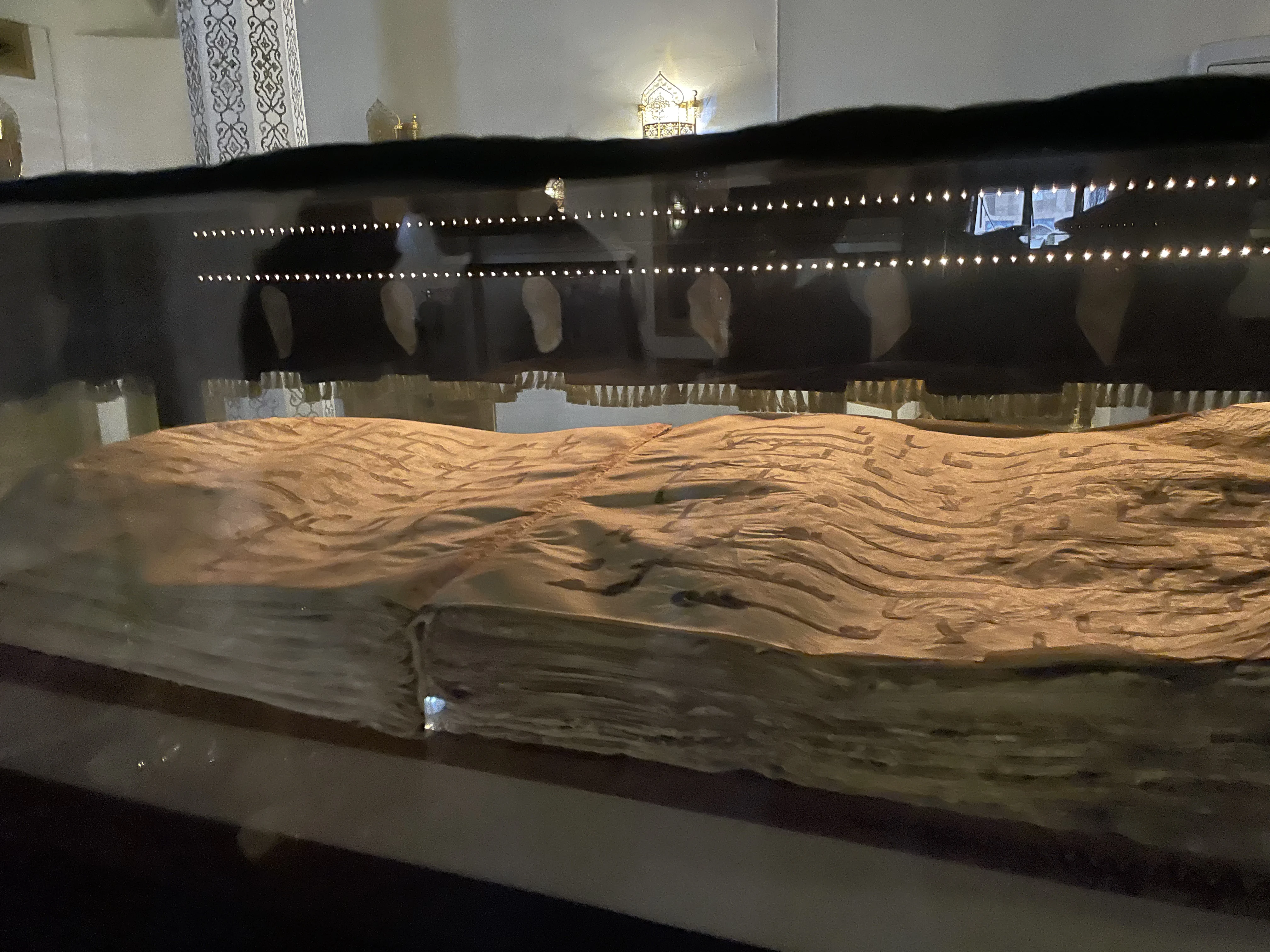
The standardization of the Quran under Caliph Uthman ibn Affan (r. 644-656 CE), undertaken around 650 CE (29-30 AH), was one of the most consequential decisions of the early Islamic period. It produced the Uthmanic codex (mushaf) — a standardized written text that unified the consonantal script of the Quran, resolved disputes over variant readings that had emerged across the rapidly expanding Islamic empire, and established the textual foundation upon which all subsequent Quran manuscripts, recitations, and printed editions are based. Fourteen centuries later, the text that Uthman's committee produced remains the basis of every Quran in the world.
The standardization was not the Quran's first compilation — that had been accomplished under Abu Bakr after the Prophet's death — but it was the decisive act that transformed a single master copy into multiple authorized copies distributed to the major cities of the empire, accompanied by the controversial order to destroy all variant written materials. This decision preserved the unity of the Quranic text at a moment when the empire's expansion threatened to fragment it, but it also generated controversy — both at the time and in subsequent scholarly discussion — over the relationship between the Uthmanic text and the earlier compilations of individual companions.
Understanding this event requires understanding the complex history of Quranic transmission that preceded it: the dual oral-written channels through which the Quran was preserved during the Prophet's lifetime, the circumstances that prompted Abu Bakr's compilation, and the specific crisis that made Uthman's standardization urgent.
The Quran During the Prophet's Lifetime
Dual Transmission: Oral and Written
The Quran was revealed to Prophet Muhammad ﷺ over approximately twenty-three years (610-632 CE), and from the beginning it was transmitted through two parallel channels: oral memorization and written recording. The oral tradition was primary — the Prophet recited the revelations to his companions, who memorized them and recited them in prayer, teaching, and daily life. The written tradition was supplementary — scribes recorded revelations on whatever materials were available (palm stalks, flat stones, pieces of leather, shoulder bones of camels, and pottery shards), but these written materials were not organized into a single bound codex during the Prophet's lifetime.
The emphasis on oral transmission reflected both the cultural context (Arabia was primarily an oral society where memory was highly developed and valued) and the nature of the revelation itself (the word "Quran" derives from qara'a, to recite — it was meant to be spoken and heard). The Prophet would recite newly revealed passages to his companions, who would memorize them immediately. Those with particularly strong memories — the huffaz (memorizers) — committed the entire revelation to memory and could recite it from beginning to end.
The Scribes of the Prophet
The Prophet designated specific companions as scribes (kuttab al-wahy) whose task was to record the revelations in writing. Among the most prominent of these scribes were:
- Zayd ibn Thabit — the most frequently mentioned scribe, who would later play the central role in both the Abu Bakr and Uthmanic compilations
- Ubayy ibn Ka'b — a senior companion known for his Quranic expertise
- Abdullah ibn Mas'ud — who claimed to have received seventy surahs directly from the Prophet's mouth
- Ali ibn Abi Talib — the Prophet's cousin and future fourth caliph
- Muawiyah ibn Abi Sufyan — who served as a scribe during the later Medinan period
The existence of multiple scribes meant that the Quranic text existed in multiple written copies during the Prophet's lifetime — but these were partial, personal collections rather than complete, unified codices. Different scribes had recorded different portions, on different materials, at different times. The complete text existed primarily in the collective memory of the community rather than in any single written document.
The Annual Review (Ard al-Quran)
According to the hadith traditions, the Prophet reviewed the entire Quran with the angel Jibril (Gabriel) once each year during Ramadan, and twice in the final year of his life. This annual review (ard) served to confirm the text, to establish the sequence of verses within surahs, and to confirm or abrogate any elements that God willed to change. The final review in the Prophet's last Ramadan (11 AH / 632 CE) was understood by the companions as establishing the definitive form of the Quran — the version that was to be transmitted going forward.
Zayd ibn Thabit is reported to have been present at the final review, giving him firsthand knowledge of the Prophet's last recitation — a qualification that would make him the natural choice to lead subsequent compilation efforts.
The Abu Bakr Compilation
The Crisis of Yamama
The first compilation of the Quran into a single written codex occurred under Abu Bakr's caliphate (632-634 CE), prompted by a specific crisis: the Battle of Yamama in 633 CE, in which a significant number of Quran memorizers (huffaz) were killed fighting the false prophet Musaylima. The loss of these living repositories of the Quranic text alarmed Umar ibn al-Khattab, who urged Abu Bakr to collect the Quran into a single written document before more memorizers were lost.
Abu Bakr was initially reluctant — "How can I do something the Prophet did not do?" — but was convinced by Umar's argument that the preservation of the Quran was an overriding necessity. He appointed Zayd ibn Thabit to lead the compilation. Zayd's qualifications were unique: he was one of the Prophet's scribes, he had been present at the final review, he was a hafiz (memorizer of the entire Quran), and he was young enough to undertake the demanding task.
Zayd's Methodology
Zayd's compilation methodology, described in the hadith sources, was rigorous: he collected written materials from across the community (the palm stalks, stones, and other recording surfaces on which verses had been written) and verified each written portion against the testimony of at least two witnesses who had memorized the same verses. The written evidence and the oral testimony had to agree before a verse was accepted into the compilation. This dual-verification approach — written evidence confirmed by oral memory — produced a text whose reliability was attested by both transmission channels simultaneously.
The result was a single written codex (mushaf) that represented the complete Quran in the order established by the Prophet's final review. This codex was kept by Abu Bakr during his caliphate, then passed to Umar during his, and after Umar's death was held by his daughter Hafsa bint Umar — one of the Prophet's wives and a woman trusted with the preservation of this most sacred document.
The Nature of the Abu Bakr Codex
The Abu Bakr codex was a single document, not multiple copies. It served as a reference and a safeguard — a guarantee that the complete text existed in written form — rather than as a text for mass distribution. The primary mode of Quranic transmission remained oral: the huffaz continued to teach the Quran through memorization and recitation, and the Abu Bakr codex existed alongside their memories rather than replacing them.
Importantly, the Abu Bakr codex was written in the bare consonantal script of early Arabic — a script that did not include the diacritical dots (which distinguish letters like ba, ta, tha, nun, and ya) or the vowel marks (which indicate the pronunciation of words). This meant that the written text alone was not fully self-interpreting — it required the oral tradition to supply the correct pronunciation and vocalization. The relationship between the written text and the oral tradition was thus complementary: the text preserved the consonantal skeleton, and the oral tradition preserved the full pronunciation.
The codex remained in state custody throughout its existence: with Abu Bakr during his brief caliphate, with Umar during his ten-year rule, and then with Umar's daughter Hafsa bint Umar after his death. Hafsa's custody of the codex was significant: she was both a wife of the Prophet (giving her religious authority) and the daughter of the previous caliph (giving her political connection). The document remained in her possession until Uthman borrowed it for the standardization project, and it was returned to her afterward. Some sources report that after Hafsa's death, the caliph Marwan ibn al-Hakam had it destroyed — ensuring that the Uthmanic copies were the sole authoritative written texts in existence.
The Personal Codices of the Companions
Alongside the Abu Bakr codex, several companions had their own personal collections of the Quranic text — compiled from their individual memorization and their personal recordings. The most important of these were:
Before describing these, one caution applies to all of them: none of the personal codices survives. Not one has been identified in any early Qur'anic manuscript, and everything known about them comes from literary references in later works — principally Ibn Abi Dawud's Kitab al-Masahif — whose accounts are not consistent with one another. What follows is therefore a summary of what the literary tradition reports, not a description of documents anyone has examined.
The codex of Abdullah ibn Mas'ud: Ibn Mas'ud was among the earliest Muslims and one of the four Companions the Prophet named as authorities from whom the Qur'an should be learned. His codex was the basis of instruction in Kufa and had a substantial following in Iraq, and the reports indicate that it arranged the surahs in an order different from the Uthmanic one.
The reports also state that his codex omitted Surah al-Fatiha and the two closing surahs, al-Falaq and al-Nas (the mu'awwidhatayn). This requires careful handling, because it is the single most consequential claim in the literature on the early codices, and the bare report does not represent the state of the evidence.
The narration is transmitted from Zirr ibn Hubaysh in the Musnad of Ahmad ibn Hanbal and in Ibn Hibban. Its own structure is significant: Zirr raises the matter with Ubayy ibn Ka'b, and Ubayy's response is to testify that the Prophet told him Jibril had instructed him to recite these two surahs, and that the community says what the Prophet said. The report thus carries its own answer within it — the affirmation of the two surahs by another senior Companion, on prophetic authority.
The classical scholarly response has been of two kinds. Most traditional scholars either reject these reports or read them as meaning something narrower than they appear to say: that Ibn Mas'ud did not write these surahs in his personal copy because they were universally known and needed no recording, or because he treated his copy as a record of what he had personally received rather than as a complete edition — not that he denied their Qur'anic status. Interpretations along these lines are found in the classical commentary literature and remain the mainstream position. A minority of reports state the stronger claim, and those reports are the ones most often quoted in isolation.
This encyclopaedia therefore records that the reports exist, that they are transmitted in collections of standing, that the same narration contains a Companion's affirmation of the surahs on the Prophet's authority, and that mainstream scholarship rejects or reinterprets the stronger reading. It does not present the stronger reading as an established fact about Ibn Mas'ud's belief, because the evidence does not support doing so.
The codex of Ubayy ibn Ka'b: Ubayy was a senior Companion and Qur'anic authority; a report transmitted in Jami' at-Tirmidhi names him as the most knowledgeable of the community in the Book of God. His codex is reported to have been used in Syria, to have arranged the surahs differently from the Uthmanic order, and to have included two short supplicatory passages (the qunut) that the Uthmanic text does not contain. The same caution applies: this rests on the literary reports rather than on any surviving copy, and the reports on the additional passages are among the weaker material in this literature.
The existence of these variant codices — each reflecting the personal transmission that their compilers had received from the Prophet — was not in itself problematic during the Prophet's lifetime or the early years after his death. The variations they contained were understood as legitimate expressions of the seven ahruf (modes) in which the Quran had been revealed. The problem arose only when the empire's expansion brought the users of different codices into contact with each other and generated disputes about which reading was "correct."
The Crisis That Prompted Uthman's Standardization
The Expansion of the Empire
By the time of Uthman's caliphate (644-656 CE), the Islamic empire had expanded far beyond Arabia. The conquests under Umar had brought Syria, Egypt, Iraq, and much of Iran under Muslim rule. New converts from diverse linguistic backgrounds were learning the Quran, and the companions who had dispersed to these provinces were teaching it according to their own recollections and personal codices.
The problem was that different companions recited the Quran with minor variations — differences in pronunciation, in the ordering of surahs (the Abu Bakr codex had established a standard order, but not all personal codices followed it), and in certain readings of specific words. These variations were rooted in the concept of the seven ahruf (seven modes) — a prophetic teaching that the Quran had been revealed in seven modes to accommodate the dialectal diversity of the Arab tribes. During the Prophet's lifetime, these variations had been contained within a community that shared a common teacher (the Prophet himself). But with the expansion of the empire and the dispersal of the companions, variations began to multiply and to generate confusion and dispute.
Hudhaifa's Warning
The immediate trigger for Uthman's standardization was a report from the companion Hudhayfah ibn al-Yaman, and it is preserved in the soundest collection. Anas ibn Malik's narration in Sahih al-Bukhari (Kitab Fada'il al-Qur'an, no. 4987) has Hudhayfah come to Uthman while on campaign with the people of Syria and the people of Iraq in the conquest of Armenia and Azerbaijan, deeply alarmed at the differences in their recitation. As-Sallabi's biography of Uthman records what the disputants were saying to one another: that one man's recitation was better than another's.
The disputes were not merely academic: they threatened to fragment the community along provincial lines, with each region claiming its own "version" of the Quran as authoritative. Soldiers who had been united in battle against non-Muslim armies were now turning against each other over the text of their own scripture. The situation had all the hallmarks of a sectarian crisis in the making.
His words to the caliph, in the same hadith, were: "O Commander of the Faithful, save this ummah before they differ concerning the Book as the Jews and the Christians did." The reference to Jewish and Christian scriptural divergence was pointed: the Muslim community had criticized the People of the Book for allowing their scriptures to fragment into competing versions, and now the same process threatened to afflict the Quran unless decisive action was taken.
As-Sallabi draws a further inference from the episode that is easy to miss. That Hudhayfah came to Medina to resolve a dispute arising among troops in the field indicates that the reference point for matters of religious law was consultation with the caliph in Madinah, and that the city remained the centre of the Sunnah and the place where the jurists among the Companions were concentrated.
The Concept of Seven Ahruf
To understand the crisis and its resolution, one must understand the concept of the sab'at ahruf (seven modes/letters) — a prophetic teaching that the Quran was revealed in seven modes to accommodate the dialectal diversity of the Arab tribes. The Prophet said: "The Quran was revealed in seven ahruf, so recite it in whichever is easy for you" (Sahih al-Bukhari, Hadith 4992).
The precise meaning of "seven ahruf" has been debated by scholars for centuries, with over thirty-five opinions recorded. The most common interpretations include:
- Seven dialectal variations of Arabic (allowing different tribes to pronounce words in their native accent)
- Seven modes of meaning (command, prohibition, promise, warning, narrative, parable, and legislation)
- Seven types of textual variation (synonyms, grammatical variants, morphological differences, etc.)
Whatever the precise meaning, the practical effect was that the Prophet authorized multiple legitimate ways of reciting the same Quranic text. During his lifetime, this plurality was non-problematic: he was present to adjudicate disputes and to confirm that variant readings were both valid. After his death, and particularly after the companions dispersed across the empire, the absence of a central authority to confirm the legitimacy of variants led to the disputes that Hudhaifa witnessed.
Uthman's standardization resolved this by establishing a single written consonantal text (rasm) that could accommodate multiple oral readings (the later qira'at) while preventing the proliferation of conflicting written texts. The genius of this solution was that it preserved legitimate oral diversity within a framework of written unity.
Uthman's Standardization Process
The Committee
Uthman did not act alone, and he did not act first. As-Sallabi is careful on both points: the compilation was not an innovation of his, since Abu Bakr had done it before him, and it was not his own idea acted on privately. He assembled the Muhajirun and the Ansar and put the question to them, with Ali ibn Abi Talib at the head of those consulted. Views were exchanged until each side understood the other, and the meeting's conclusion was made public. Al-Qurtubi's account in his tafsir agrees: Uthman gathered the Muhajirun, the Ansar and most of the prominent Muslims, consulted them, and they agreed to compile the text on the basis of what was soundly established of the well-known recitation narrated from the Prophet.
Maariful Quran preserves the exchange. When the Companions asked Uthman for his own view, he answered that the community should be united on one Book so that they faced no difference or division, and they approved. His sermon at Madinah put the reasoning plainly: if those living close to him in the city could differ with one another over the readings, then those far away would dispute on a much larger scale, and so all should agree on a single copy that would be binding.
He then sent word to Hafsa bint Umar for the folios prepared under Abu Bakr's orders, which had passed from Abu Bakr to Umar and which Umar, when he knew he was dying, left in his daughter's keeping. The message, in the words of the hadith, was: "Send us the manuscript so that we may make copies of it, then we will return it to you." She sent it, and it was returned to her when the work was done.
The committee was led again by Zayd ibn Thabit — the same companion who had led the Abu Bakr compilation and who remained the community's foremost authority on the written text of the Quran. Alongside Zayd, Uthman appointed three senior Qurayshi companions: Abdullah ibn al-Zubayr, Sa'id ibn al-As, and Abd al-Rahman ibn al-Harith ibn Hisham. As-Sallabi notes that the four were chosen for their precision in memorisation, their knowledge of the recitations, their skill in reciting and their command of the Quran's language, and that three were Qurayshi and one — Zayd — an Ansari.
The number is not uniformly reported. As-Sallabi records, on the authority of Saadiq Arjun's study of Uthman, that according to some reports those ordered to write the Mus-haf were twelve men, Ubayy ibn Ka'b among them, drawn from both Quraysh and the Ansar. The four named in the Sahih are the better-attested account and the one this article follows; the larger number is noted rather than set aside, since it may describe the wider body of copyists rather than the committee that settled the text.
The inclusion of Qurayshi members alongside the Medinan Zayd was deliberate. Uthman's instruction, given in the hadith itself, was that if they and Zayd differed concerning anything of the Quran they should write it in the dialect of Quraysh, for it was revealed in their dialect. Ibn al-Tin's comment brings out what this did and did not mean: Uthman adopted the dialect of Quraysh to the exclusion of others even though recitation in other dialects remained permissible, judging that the variant written forms were no longer needed and that confining the text to one dialect would ward off hardship.
The Production of Copies
The committee produced multiple copies of the standardized codex. The sources differ on the exact number — ranging from four to seven — but the consensus is that copies were sent to the major cities of the empire: Mecca, Medina, Kufa, Basra, Damascus, and possibly others. Each city received an official copy (mushaf imam) that was to serve as the reference standard for that province. A copy was retained in Medina as the master text.
The copies were produced with painstaking care. The text was written in the Qurayshi script, following the orthographic conventions of the time (consonantal script without diacritical dots or vowel marks). The script was thus a consonantal skeleton (rasm) that recorded the consonantal structure of the text while leaving the exact vocalization to be supplied by the oral tradition. This was not a deficiency but a feature: it preserved the text's relationship to the living oral transmission and accommodated the legitimate range of readings (qira'at) that the seven ahruf had authorized.
The Order to Destroy Variant Copies
The most controversial aspect of Uthman's standardization was his order that all Quranic materials that differed from the standardized copies should be destroyed — burned or otherwise disposed of. This order applied to the personal codices of individual companions (such as the collections of Abdullah ibn Mas'ud and Ubayy ibn Ka'b, both of which differed from the Uthmanic text in certain details of arrangement and reading) and to any other written Quranic materials that might generate confusion if compared to the official text.
This order was accepted by most of the community but generated opposition from some quarters. Abdullah ibn Mas'ud, one of the most senior companions and an authority on Quranic recitation, was particularly offended. He had his own collection of the Quran, which he had compiled from his personal reception of verses from the Prophet, and he regarded the elevation of Zayd's compilation above his own as an affront to his seniority and his direct relationship with the Prophet. The ground of his complaint is preserved in Sunan an-Nasa'i, where he sets his own long service against Zayd's youth: he had taken the Quran from the mouth of the Messenger of God while Zayd was still a boy with two braids, playing with the other boys.
Ibn Mas'ud's objection was not that the Uthmanic text was incorrect in its content but that the process had elevated Zayd — a younger, less senior companion — above men who had a longer and more direct relationship with the Prophet's recitation. His resistance was eventually overcome, and his personal codex ceased to be used as an authoritative text, though reports of its contents were preserved in the hadith and tafsir literature as records of legitimate variant readings.
Against that, the sources record approval rather than acquiescence, and they record it with gradings attached. Mus'ab ibn Sa'd met the Companions at the time Uthman burned the copies and saw that they approved of what he had done; as-Sallabi cites the report from al-Bukhari's al-Tarikh al-Saghir and grades its chain hasan li ghayrihi, sound by virtue of corroborating evidence. Ali's own position is preserved more strongly still. He rebuked those who criticised Uthman over it: "O people, do not go to extremes with regard to Uthman, and do not say anything but good about him, for by Allah he did not do what he did — with regard to the Mus-hafs — until after he had consulted all of us, and by Allah, if I were the caliph I would have done what he has done." As-Sallabi cites this from Fath al-Bari and grades the chain hasan. Coming from the man who would become the fourth caliph, and who had himself been among the Prophet's scribes, it places the standardization outside the factional politics that later engulfed Uthman's reign.
Specific Examples of Standardization Choices
The sources preserve a few specific examples of decisions the committee made in establishing the standard text, illustrating how the process worked in practice:
The verse of Surah al-Baqarah (Quran 2:259): The word that the Uthmanic codex spells as nunshizuha ("We raise them up") was read by some companions as nunshiruha ("We spread them out") — a difference that depends on the placement of a dot that the early script did not include. The committee standardized the consonantal skeleton in a form that could accommodate both readings, leaving the oral tradition to preserve both possibilities.
The closing verses of Surah al-Tawbah (Quran 9:128-129): Zayd ibn Thabit's narration in Sahih al-Bukhari 4986 records that during the Abu Bakr compilation he found these verses with Abu Khuzayma al-Ansari and with no one else; some transmissions of the report name Khuzayma ibn Thabit. The episode illustrates the standard of corroboration the work was held to, and the fact that a difficulty of this kind was recorded rather than smoothed over is one reason the account is treated as reliable.
The arrangement of surahs: The Uthmanic ordering became permanent and is the arrangement used universally today. The reports do not establish the arrangement of Abu Bakr's suhuf, and the question of when the present order was fixed — and on what authority — is discussed in the classical Qur'anic sciences literature without a single settled answer. What the sources do record is that the personal codices of Ibn Mas'ud and Ubayy arranged the surahs differently, and that those alternative arrangements are preserved in the scholarly literature as historical information rather than as competing texts.
Provincial Reception
The reception of the Uthmanic codex varied by province:
Medina accepted it readily — the standardization had been carried out there, under the caliph's direct supervision, and the copy retained as the master reference was kept in the city's central mosque.
Mecca accepted without recorded resistance — the city had been part of the standardization process through the committee member Abdullah ibn al-Zubayr.
Basra accepted the new standard, with its scholars integrating the Uthmanic text into their teaching.
Damascus accepted smoothly — Syria's reading tradition (later represented by the qira'a of Ibn Amir) was already compatible with the Uthmanic text.
Kufa was the most resistant — because it was the city of Abdullah ibn Mas'ud, whose personal codex had been the basis of Kufan Quranic teaching for years. Ibn Mas'ud's opposition, though eventually overcome, reflected genuine concern among Kufan scholars that their own well-established tradition was being displaced. Nevertheless, Kufa eventually produced three of the seven canonical reciters (Asim, Hamza, and al-Kisa'i), demonstrating that the Uthmanic framework was ultimately adopted and became the basis of Kufa's own reading tradition.
The Uthmanic Text and the Qira'at Tradition
The Rasm (Consonantal Skeleton)
The Uthmanic codex established the rasm — the consonantal skeleton of the Quranic text — as the permanent standard. This rasm is the unvocalized, undotted written form of the text: the basic letter shapes without the dots that distinguish (for example) ba from ta from tha, or the vowel marks that indicate pronunciation. The rasm is thus a more compact representation of the text than a fully vocalized script would be, and it accommodates multiple valid readings within a single written framework.
The relationship between the rasm and the qira'at (variant readings) is one of the most important features of the Uthmanic standardization. The rasm does not determine a single pronunciation for every word — it permits a range of pronunciations (readings) that are all consistent with the written consonantal skeleton but differ in vocalization, morphology, or certain consonantal alternatives. These permitted variations are the basis of the qira'at tradition — the system of multiple authorized readings that developed in the following centuries.
The Development of Diacritical Marks and Vowels
The bare Uthmanic rasm — without dots or vowels — served the first Islamic century adequately because readers were native Arabic speakers whose oral knowledge of the text supplied what the script left unspecified. But as Islam spread to non-Arab populations (Persians, Berbers, Turks, and others who were learning Arabic as a second language), the need for a more explicit written system became pressing.
The development of diacritical dots (to distinguish otherwise identical letter shapes) is attributed to the early Islamic linguists, with Abu al-Aswad al-Du'ali (d. 688 CE) traditionally credited as the pioneer. The system was refined over the following century, with the final standardized form of Arabic script — complete with all diacritical dots — established by the late first / early second Islamic century.
The development of vowel marks (tashkil — including fatha, kasra, damma, sukun, shadda, and tanwin) followed a parallel course. The initial system, attributed to Abu al-Aswad, used colored dots above and below letters; this was later replaced by the small letter-based system familiar today, developed by al-Khalil ibn Ahmad al-Farahidi (d. 786 CE), the great linguist and lexicographer of Basra.
These innovations did not alter the Uthmanic text — they supplemented it, making explicit what the oral tradition had always supplied. The rasm remained unchanged; the dots and vowels were additions that aided readers without modifying the underlying consonantal structure that Uthman's committee had established.
What Makes a Reading Sound
Before the readings could be enumerated, the test for admitting one had to be settled, and Maariful Quran sets out the three conditions the imams of qira'ah required. A reading is sound if it conforms to the script of the Uthmanic copies; if it is correct in the Arabic language; and if it rests on sound authority, reaching back through uninterrupted succession and being well known among the imams of recitation. A reading failing any of the three is not admitted.
The number of readings satisfying all three is larger than seven, and this is the point at which the subject is most often misunderstood. Maariful Quran states plainly that a great many readings were transmitted in uninterrupted succession, and that the seven later singled out are a part of the sound readings rather than the whole of them.
The association of the number seven with a fixed list of readers is the work of one scholar, and Maariful Quran treats what followed from it as a misunderstanding worth correcting. Ibn Mujahid gathered the readings of seven reciters in one place; he did not hold that other readings were wrong or unacceptable. Some afterwards took the Qur'an's revelation in seven ahruf to mean precisely the seven readings he had collected, which does not follow — every reading meeting the three conditions is sound and falls within the seven ahruf.
The Seven Readers
The seven who became best known through Ibn Mujahid's collection, with the cities where each reading took hold and the transmitters through whom it passed, are as Maariful Quran gives them:
- Abdullah ibn Kathir al-Dari (d. 120 AH), who had seen the Companions Anas ibn Malik, Abdullah ibn al-Zubayr and Abu Ayyub al-Ansari. His reading became better known at Mecca; among its transmitters are al-Bazzi and Qanbal.
- Nafi' ibn Abd al-Rahman ibn Abi Nu'aym (d. 169 AH), who studied under seventy of the Successors, themselves direct disciples of Ubayy ibn Ka'b, Abdullah ibn Abbas and Abu Hurayrah. His reading became better known at Medina; its best-known transmitters are Qalun (d. 220 AH) and Warsh (d. 197 AH).
- Abdullah al-Hisbi, known as Ibn Amir (d. 118 AH), who had seen the Companions Nu'man ibn Bashir and Wathilah ibn al-Asqa', and who learned recitation from Mughirah ibn Shihab al-Makhzumi, a disciple of Uthman. His reading gained currency mostly in Syria; its transmitters include Hisham and Dhakwan.
- Abu Amr Zabban ibn al-Ala (d. 154 AH), who reported his rendition from Ibn Abbas and Ubayy ibn Ka'b through Mujahid and Sa'id ibn Jubayr. His reading became well known at Basra; its transmitters include Abu Umar al-Duri (d. 246 AH) and Abu Shu'ayb al-Susi (d. 261 AH).
- Hamzah ibn Habib al-Zayyat (d. 188 AH), a disciple of Sulayman al-A'mash, in a chain running back through Yahya ibn Waththab and Zirr ibn Hubaysh, who had learned from Uthman, Ali and Abdullah ibn Mas'ud. Among his transmitters are Khalaf ibn Hisham and Khallad ibn Khalid (d. 220 AH).
- Asim ibn Abi al-Najud al-Asadi (d. 127 AH), a disciple of Abdullah ibn Mas'ud through Zirr ibn Hubaysh and of Ali through Abu Abd al-Rahman al-Sulami. His better-known transmitters are Shu'bah ibn Ayyash (d. 193 AH) and Hafs ibn Sulayman (d. 180 AH).
- Abu al-Hasan Ali ibn Hamzah al-Kisa'i (d. 189 AH), whose better-known transmitters are Abu al-Harith al-Marwazi (d. 240 AH) and Abu Umar al-Duri, himself also a transmitter of Abu Amr.
Two details in that list carry the most weight for a reader today. The readings of the last three became more common at Kufa. And Maariful Quran records that recitation of the Qur'an in the present day is generally made following the rendition of Hafs ibn Sulayman, the transmitter of Asim's reading — which is why the printed text most Muslims hold is described as Hafs from Asim.
The list was later extended. Maariful Quran notes that some scholars worked with ten rather than seven, under the title al-qira'at al-'ashra, adding three readings to those of the seven, among them those of Ya'qub ibn Ishaq and Khalaf ibn Hisham; a reckoning of fourteen reciters also circulated. The extension changed nothing about the underlying test. Each addition had to satisfy the same three conditions, and each operated within the single Uthmanic rasm.
None of these are "versions" of the Quran in the sense of differing texts. They are authorised modes of recitation, and the rasm accommodates all of them, differing only in elements — vocalisation, gemination, certain consonantal choices — that the consonantal skeleton does not record.
This system — a fixed written text that supports multiple oral readings — is unique among the world's scriptures and represents one of the most sophisticated approaches to textual preservation in pre-modern literary history. It honors both the fixity of the written record and the richness of the oral tradition, without sacrificing either to the other.
The Significance of Uthman's Standardization
Preservation of Textual Unity
The most immediate and enduring significance of Uthman's standardization was the preservation of the Quran's textual unity across the expanding Muslim world. Without the standardization, the regional variations that Hudhaifa had witnessed would have continued to multiply, potentially producing multiple divergent "versions" of the Quran associated with different cities and scholarly traditions. By acting decisively — producing authorized copies and destroying variants — Uthman ensured that all Muslims, regardless of location, recited from the same textual base.
This unity has been maintained for fourteen centuries. The Quran in use today — whether in Morocco, Indonesia, Nigeria, or Iran — is textually identical in its consonantal skeleton to the Uthmanic codex. No other scripture of comparable antiquity has achieved this degree of textual uniformity across such a vast geographical and temporal span. The standardization is thus not merely a historical event but a living reality: every Quran printed today bears the textual imprint of Uthman's committee's work.
Preservation of the Oral Tradition
Paradoxically, the standardization also preserved the oral tradition by giving it a stable written reference point. The qira'at tradition — with its multiple readings, its authenticated chains of transmission, and its sophisticated phonological analysis — could develop systematically because it operated within the framework of an agreed-upon written text. Without the Uthmanic rasm as a shared reference, the oral variants might have diverged without limit; with it, they were constrained to readings that could be reconciled with the written skeleton.
The ten canonical readings that the qira'at tradition preserves are thus a controlled diversity — a range of variation that is anchored to a fixed text and transmitted through verified chains. This combination of written fixity and oral richness represents a uniquely Islamic solution to the problem of textual preservation across time and space.
Political Unity and Religious Authority
The standardization also served an immediate political function: it reinforced the authority of the caliph as the guardian of the community's religious text. By taking responsibility for the Quran's preservation, Uthman asserted the caliphate's role in religious as well as political matters — a role that would later become contested but that at this moment served the community's interests by providing a single authoritative reference for the text of scripture.
The distribution of copies to the major cities — each accompanied by a qualified reciter who could teach the correct pronunciation — created a network of authoritative texts that radiated from Medina to the provinces. This network mirrored the political network of the caliphate itself, with the center (Medina) setting the standard and the provinces receiving and implementing it.
Historiographical Note
What the word "compilation" conceals
The most useful correction in the classical literature on this subject concerns the word most often used to describe what Uthman did. Al-Harith al-Muhasibi, cited by as-Sallabi, put it directly: it is well known among people that the one who compiled the Quran was Uthman, but that is not the case. Abu Bakr was the first to compile it. What Uthman did was to hold the people to a single recitation, chosen by himself and those of the Muhajirun and the Ansar who were present, when it was feared that discord would follow from the differences between the people of Iraq and Syria over which dialect to read in. Before that, the written copies could be read in all seven of the ahruf in which the Quran had been revealed.
Ibn al-Tin's formulation of the same distinction is the one this article has followed throughout: Abu Bakr acted from fear that the text would be lost with the loss of those who carried it, and Uthman acted from fear that the community would fracture over how to read what had already been preserved. Al-Qadi Abu Bakr al-Baqillani adds that even Abu Bakr's purpose was not simply to place the Quran between two covers but to unite the community on the recitations proven from the Prophet. Calling either man "the compiler of the Quran" without qualification flattens two different acts into one.
The layers of evidence, and one gap in them
The evidence here is unusually well ordered for a seventh-century subject. Nearest to the events is a single sahih hadith, Sahih al-Bukhari no. 4987, which carries almost the whole narrative in one report: the campaign, Hudhayfah's alarm, his words to the caliph, the message to Hafsa, the four named copyists, the instruction about the dialect of Quraysh, and the order to burn the rest. Most of what this article states rests directly on it. Around that sit reports of lesser but stated grade — Ali's rebuke at hasan, Mus'ab ibn Sa'd's testimony at hasan li ghayrihi — and it is worth noting that the tradition attached those gradings itself rather than having them supplied from outside. Furthest out lie the assessments of the classical commentators, which are arguments about the reports rather than additional reports.
Two points are left unresolved above rather than settled. The number of copyists is given as four in the Sahih and as twelve in reports that as-Sallabi relays from Saadiq Arjun, Ubayy ibn Ka'b among them; the article follows the four while recording the larger figure, since the two may describe the committee and the wider body of scribes rather than contradicting one another. The number of copies produced and their destinations is likewise variously reported, and no single figure is asserted here.
One absence should be explained, because a reader who has met this subject elsewhere will expect it. Nothing above draws on the physical manuscript evidence — the Sana'a palimpsest, the Birmingham folios and their radiocarbon dating, or the comparative work on early codices. That material is real and it bears on the question, but it lies outside the source base this project works from, and under the project's own rules a claim that cannot be traced to that base is omitted rather than repeated on trust. Its absence here is a statement about this article's evidence, not a judgement on the manuscripts.
Muslim Scholarly Tradition
Within the Islamic scholarly tradition, Uthman's standardization is universally regarded as a necessary and praiseworthy act that preserved the integrity of God's final revelation. The destruction of variant copies, while initially controversial (particularly regarding Ibn Mas'ud), came to be accepted as justified by the greater good of textual unity. The classical scholars of Quranic sciences ('ulum al-Quran) — including al-Zarkashi (al-Burhan fi 'Ulum al-Quran) and al-Suyuti (al-Itqan fi 'Ulum al-Quran) — all treat the standardization as an act of preservation rather than alteration.
The key principle in the Islamic understanding is that Uthman did not change, add to, or subtract from the Quranic text — he standardized its written form to match the oral tradition as established in the Prophet's final review. What was destroyed was not "the Quran" but variant written materials that might generate confusion; the Quran itself continued to live in the memory of the huffaz and in the standard written form.
Legacy and Continuing Significance
The Foundation of Islamic Textual Culture
The Uthmanic standardization established patterns of textual care and preservation that shaped Islamic intellectual culture more broadly. The principles developed for Quranic preservation — rigorous chains of transmission, multiple verification, the complementarity of oral and written channels — were later applied to the preservation of hadith, to the transmission of legal knowledge, and to the broader culture of isnad (chain of authority) that characterizes Islamic scholarship.
The concept of a fixed, authoritative text that supports multiple valid interpretations — embodied in the relationship between the rasm and the qira'at — also influenced Islamic approaches to law, theology, and philosophy. The idea that a single textual foundation can support a legitimate plurality of readings and interpretations became a model for how the Islamic tradition handled intellectual diversity more generally. The four Sunni schools of jurisprudence, for example, all derive their rulings from the same Quranic text but arrive at different conclusions through different methodologies — a plurality that mirrors the qira'at tradition's plurality within a fixed rasm.
The Quran in the Modern World
The arrangement Uthman established still governs how the Quran is produced and recited. Maariful Quran records that recitation in the present day generally follows the rendition of Hafs ibn Sulayman from Asim, which is the reading behind the printed text in most Muslim hands; the readings of Nafi' transmitted by Qalun and Warsh, and the others named above, continue in the regions where they took hold. The King Fahd Complex for the Printing of the Holy Quran at Medina is the largest producer of printed copies.
The structure is the point. The text is one, the readings are several, and the community is unified in its scripture while remaining diverse in its recitation — which is the arrangement the rasm was fitted to carry.
The Digital Age and Quranic Preservation
The twenty-first century has added new dimensions to the preservation and dissemination of the Quranic text. Digital Quran applications, online recitation platforms, and searchable databases have made the text more accessible than at any point in history. The Uthmanic rasm remains the standard for all these digital formats, ensuring continuity between the seventh-century standardization and twenty-first-century technology.
What is worth noticing is the structure such work has to adopt. The rasm is the starting point and the qira'at supply the vocalised readings, which is the same division of labour Uthman's committee settled on. The digital age has not superseded the Uthmanic text so much as inherited its architecture.
Uthman's Achievement in Historical Perspective
What distinguishes the episode is less the decision itself than the conditions under which it was taken. Uthman acted while the men who had received the Quran from the Prophet were still alive and available to be consulted, and he consulted them: the Muhajirun and the Ansar were assembled, Ali among them, and the conclusion was made public rather than imposed quietly. The manuscript he worked from was not newly assembled but the one prepared under Abu Bakr, kept afterwards by Umar and then by his daughter Hafsa. The committee he appointed was chosen for precision in memorisation and command of the language, and the instruction he gave it was narrow — a rule about which dialect to prefer where its members disagreed, not a licence to revise.
As-Sallabi's summary of the reception is the one the sources support: the Companions approved, no dissent was recorded at the time, and Ali both endorsed the action and rebuked those who used it against Uthman. The classical commentators who examined the episode centuries later — al-Qurtubi, al-Baqillani, al-Muhasibi, Ibn al-Tin — differed over how to describe what Uthman had done, and not over whether he had been right to do it.
That is the point on which the sources are least divided. Uthman's caliphate ended in a violence that has been argued over ever since, and his other decisions have been weighed in every direction. On the masahif, the tradition speaks with one voice.
Theological Implications
Divine Preservation and Human Agency
The Quranic verse "Indeed, it is We who sent down the reminder, and indeed, We will be its guardian" (15:9) is understood by Muslims as a divine promise that the Quran would be preserved without corruption. The Uthmanic standardization is understood within this theological framework as the human mechanism through which God's promise was fulfilled. God's preservation of the Quran was not miraculous in the sense of bypassing human agency but providential in the sense of guiding human actors to take the decisions necessary for the text's survival.
This theological understanding gives the standardization a significance beyond the merely historical: it is not simply that Uthman made a wise political decision, but that God guided the community — through Hudhaifa's warning, Uthman's decisiveness, Zayd's expertise, and Ali's endorsement — to preserve His final revelation from the corruption that had affected earlier scriptures. The contrast with the Jewish and Christian scriptural traditions, where textual divergence is acknowledged and studied, is central to the Islamic self-understanding: the Quran's textual unity is seen as confirmation that it remains God's word in its original form, unaltered by human error or manipulation.
The Quran as Living Scripture
The dual system of preservation — fixed written text supporting multiple oral readings — reflects a theological understanding of the Quran as a living scripture rather than merely a historical document. The Quran is not simply read; it is recited (tilawa) — performed aloud with specific rules of pronunciation (tajwid) that have been transmitted from teacher to student in unbroken chains since the Prophet's time. This oral dimension, preserved alongside the written text, ensures that the Quran is experienced as living speech rather than dead letters on a page.
The science of tajwid — the rules governing proper Quranic recitation, including the points of articulation for each letter, the duration of vowels, the assimilation of sounds, and the pauses and continuations in breathing — developed within the framework established by the Uthmanic standardization. The written text tells the reader what to say; the tajwid tradition tells them how to say it. Together, they preserve the complete sonic reality of the revelation as it was received from the Prophet.
This system of living transmission — where every generation receives the Quran not only in writing but in sound, from mouth to ear, teacher to student — means that the Uthmanic standardization preserved not merely a text but a performance tradition. The Quran that a child in Cairo, Jakarta, or London learns today is connected through an unbroken chain of oral transmission to the Prophet's own recitation — a continuity that the written text alone, however well preserved, could not guarantee.
References and Further Reading
Primary Islamic Sources
- The Quran, Surah al-Hijr (15:9) — "Indeed, it is We who sent down the reminder, and indeed, We will be its guardian" — understood as God's undertaking to preserve the Quran
- Sahih al-Bukhari, Kitab Fada'il al-Qur'an, no. 4987 — the sahih hadith from Anas ibn Malik that carries the whole Uthmanic episode: Hudhayfah ibn al-Yaman's alarm at the differences in recitation on the Armenian and Azerbaijan campaign, his appeal to Uthman, the message to Hafsa, the naming of Zayd ibn Thabit, Abdullah ibn al-Zubayr, Sa'id ibn al-As and Abd al-Rahman ibn al-Harith ibn Hisham as copyists, the instruction to write in the dialect of Quraysh, and the order that other Qur'anic material be burnt
- Sahih al-Bukhari, Kitab Fada'il al-Qur'an, no. 4986 — Zayd ibn Thabit's account of the compilation under Abu Bakr, including the closing verses of Surah al-Tawbah found with Abu Khuzayma al-Ansari
- Sahih al-Bukhari, Hadith 4992 — "The Quran was revealed in seven ahruf, so recite it in whichever is easy for you"
- Sunan an-Nasa'i — the report in which Ibn Mas'ud describes Zayd ibn Thabit as still a boy with two braids playing with other boys, the ground of his objection to the primacy given to Zayd's compilation
- Al-Bukhari, al-Tarikh al-Saghir — Mus'ab ibn Sa'd's report that he met the Companions when Uthman burned the copies and found that they approved; graded hasan li ghayrihi, cited here from as-Sallabi
Classical Islamic Sources
- Ibn Hajar al-Asqalani, Fath al-Bari — the source, cited here through as-Sallabi, for Ali's rebuke of those who criticised Uthman over the copies, with its chain graded hasan
- Al-Qurtubi, al-Jami' li Ahkam al-Qur'an — on Uthman's assembling of the Muhajirun, the Ansar and the prominent Muslims before acting, and on why he compelled adherence to his copy when Abu Bakr had already compiled the text; cited here through as-Sallabi
- Ibn al-Tin — on the difference between the two compilations: Abu Bakr's motivated by fear that the Quran might be lost with the loss of those who carried it, Uthman's by the variety of recitations; cited here through as-Sallabi
- Al-Qadi Abu Bakr al-Baqillani — that Abu Bakr's aim was not to gather the Quran between two covers but to unite the community on the proven recitations; cited here through as-Sallabi
- Al-Harith al-Muhasibi — the correction that although it is commonly said that Uthman compiled the Quran, this is not so: Abu Bakr was the first to compile it, and what Uthman did was to hold the people to one recitation; cited here through as-Sallabi
Academic and Scholarly Sources
- As-Sallabi, Ali Muhammad. The Biography of 'Uthman Ibn 'Affan: Dhun-Noorayn, translated by Nasir Khattab. The principal source for this article: the three stages of compilation, the hadith of Hudhayfah and its implications, the consultation of the Companions, the composition and selection of the committee, the variant report of twelve copyists, the gradings attached to the reports of Ali's and the Companions' approval, and the assessments of the classical authorities listed above
- Mufti Muhammad Shafi. Maariful Quran, translated by Muhammad Hasan Askari and Muhammad Shamim, revised by Mufti Muhammad Taqi Usmani — Volume 1 introduction, for the Companions' question to Uthman and his answer, the text of his sermon at Madinah, the borrowing of the folios from Hafsa, the three conditions of a sound reading, the correction of the misunderstanding surrounding Ibn Mujahid's seven, the seven readers with their dates, cities and transmitters, the extension to ten, and the note that recitation today generally follows Hafs from Asim
Further Reading
- Al-Suyuti, Jalal al-Din. Al-Itqan fi 'Ulum al-Quran — the standard classical survey of the Quranic sciences, including the history of the compilation
- Al-Zarkashi, Badr al-Din. Al-Burhan fi 'Ulum al-Quran — an earlier treatment of the same field
- Ibn Abi Dawud, Kitab al-Masahif — the classical collection of reports on the early codices
- Ibn al-Jazari, Munjid al-Muqri'in — on the reciters and the readings, named in Maariful Quran as a source for the fourteen
- Muhammad Mustafa al-Azami. The History of the Quranic Text from Revelation to Compilation. Leicester: UK Islamic Academy, 2003 — a book-length treatment of the subject of this article. Named here for the reader; it lies outside the project's approved source base and nothing above rests on it
More from Rashidun Caliphate
Sunni and Shia Islam: Historical Origins and Development
The division between Sunni and Shia Islam, originating from disputes over leadership succession after Prophet Muhammad's death, evolved into distinct theological, legal, and political traditions that have shaped Islamic civilization.
Uthman ibn Affan
The third Rashidun Caliph (644-656 CE), known for standardizing the Quran and expanding the Islamic navy. A wealthy merchant from the Umayyad clan, he was one of the earliest converts to Islam and married two daughters of Prophet Muhammad.
Zaynab bint Ali: The Eloquent Voice of Karbala
Zaynab bint Ali (626-682 CE), granddaughter of Prophet Muhammad and sister of Husayn, played a crucial role in preserving the legacy of Karbala through her eloquence, courage, and steadfast leadership during one of Islam's most tragic events.
Abu Bakr al-Siddiq
The first Rashidun Caliph (632-634 CE) and closest companion of Prophet Muhammad. Known as 'Al-Siddiq' (The Truthful), he preserved Islamic unity after the Prophet's death, defeated the Ridda rebellions, compiled the Quran, and initiated Islamic conquests beyond Arabia.