Compilation of the Qur'an under Abu Bakr
After heavy losses among the Qur'an reciters at Yamama, Caliph Abu Bakr ordered Zayd ibn Thabit to gather the Qur'an into a single written record. The resulting suhuf was an archival master held in the caliph's keeping, not a published edition, and it became the basis of Uthman's standardisation.
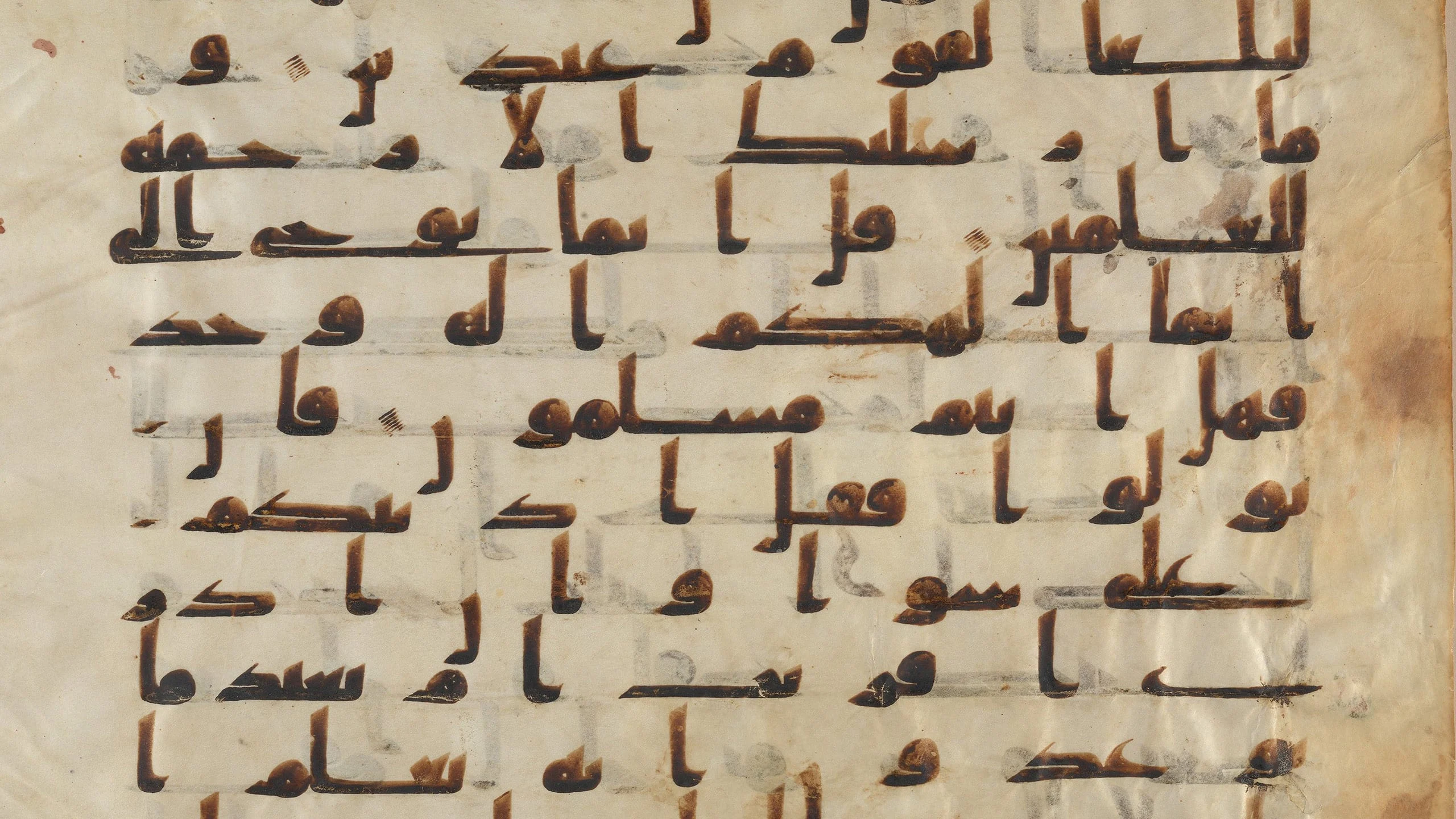
The compilation of the Qur'an under Abu Bakr (633–634 CE / 12–13 AH) was the first gathering of the entire Qur'anic text into a single written record. It was undertaken after the Battle of Yamama, in which a substantial number of the Qur'an's reciters were killed, and it produced a set of sheets (suhuf) that passed from Abu Bakr to Umar ibn al-Khattab and then to Umar's daughter Hafsa bint Umar. Two decades later those sheets were the reference from which the standardisation under Uthman proceeded.
The Evidentiary Basis
Because this subject concerns the textual history of the Qur'an, the evidence for it should be identified before the narrative is given.
Almost everything that can be established about Abu Bakr's compilation comes from a single report: the narration of Zayd ibn Thabit transmitted in Sahih al-Bukhari in the Book of the Virtues of the Qur'an, hadith 4986, and again at hadith 7191. It is a first-person account by the man who carried out the work, and it is the foundational text for the entire subject. Further detail appears in Ibn Abi Dawud's Kitab al-Masahif, a third-century compilation specifically devoted to the early codices, and in the historians and the Qur'anic sciences literature, above all al-Suyuti's Al-Itqan. These later sources are attributed by name below rather than merged with the hadith, because their standard of transmission is not the same.
Three consequences follow, and they shape this article:
The account is compact. Zayd's narration is a few hundred words. It establishes the occasion, the instruction, the method in outline, and one specific difficulty encountered. It does not describe the resulting document's appearance, format, binding, or the arrangement of chapters within it.
Nothing is known of the physical object. Abu Bakr's suhuf does not survive and no description of it is preserved. Statements about its parchment, script, binding, or storage conditions — which circulate in popular accounts — have no source. None are made here.
The figures are later than the hadith. The narration reports that "a great number" of reciters were killed at Yamama. The figure of seventy, universally repeated, comes from the later historical literature rather than from the hadith, and it is given below as such.
The Qur'an Before the Compilation
Understanding what Abu Bakr's project did and did not achieve requires knowing what already existed in 632 CE, and this is often misunderstood. The compilation was not the first time the Qur'an was written down. It was the first time the written material was gathered into one place.
The text was being written throughout the Prophet's lifetime. A number of Companions served as scribes of revelation, writing passages as they were received. Zayd ibn Thabit was among them, and the Sahih al-Bukhari narration presupposes this: Zayd's task was to search out and collect written material that was already in existence, not to create a written record from memory alone.
The writing surfaces were whatever was available. Zayd's own description names palm stalks and thin white stones. Other early reports mention pieces of leather, and the shoulder blades of animals. Parchment was expensive and paper had not yet reached the Hijaz, so the physical record was necessarily heterogeneous. This is why the material was bulky, awkward, and scattered rather than held as a single archive.
Memorisation was the primary mode of preservation. In a society where poetry and genealogy were carried in memory as a matter of course, and where literacy was limited, memory was the more reliable medium and the more honoured one. Written material functioned as an aid to memory rather than as its replacement. This is the reverse of modern assumptions and it explains why the community had not previously felt the need for a single codex: the text was preserved in a large number of independent human memories, cross-checked against one another continuously in communal prayer.
The Prophet indicated the arrangement of verses within chapters. The reports establish that the ordering of verses within each surah was not left to the community's discretion. The wider question of the ordering of the surahs relative to one another is treated separately below, because the evidence there is weaker.
A periodic review is reported. The sources describe an annual review of the revealed text during Ramadan, and a final review in the last year of the Prophet's life. This is the basis on which Muslim scholarship holds that the text's content and internal arrangement were settled before his death.
The situation in 632 was therefore not one of textual uncertainty. It was one of distributed custody: a text securely held, but held in many places at once, in memories and on scattered material, with no single point of reference. That arrangement had functioned while the Prophet was alive to resolve any question. Its vulnerability was demographic — it depended on the survival of the people who carried it.
The Occasion: Yamama and the Loss of the Reciters
Following the death of Prophet Muhammad in 632 CE, a number of Arabian tribes withdrew from their agreements with Medina, some refusing the obligatory alms on the ground that their commitment had been personal to the Prophet, others following rival claimants to prophethood. The campaigns that followed are known as the Ridda Wars.
The heaviest fighting was at Yamama in central Arabia, where a Muslim force under Khalid ibn al-Walid confronted the followers of Musaylima, a claimant to prophethood among the Banu Hanifa. The engagement ended in close fighting within a walled garden that the sources call the Garden of Death, and Muslim casualties were unusually severe.
Among the dead were many of the qurra' — the reciters. The term requires care. It is often rendered as "memorisers of the entire Qur'an", and the distinction matters for assessing what was at risk. Zayd's narration and Umar's reported words use qurra', which in this period denoted those who carried and taught Qur'anic recitation; it does not necessarily mean each had memorised the whole. The later historians give the number killed as around seventy, and that figure is what the secondary literature repeats, but it is not in the hadith.
One of the dead was Salim, the freed client of Abu Hudhayfah — one of four Companions whom the Prophet had named, in a report transmitted in Sahih al-Bukhari, as those from whom the Qur'an should be learned, the others being Abdullah ibn Mas'ud, Ubayy ibn Ka'b and Mu'adh ibn Jabal. The loss of a man of that standing in a single engagement is what gave the concern its force.
Umar's Proposal and Abu Bakr's Hesitation
The narration in Sahih al-Bukhari 4986 preserves the exchange, and the sequence is worth following closely because it shows the reasoning of all three men involved.
Umar came to Abu Bakr after Yamama and said that a great number of the reciters had been killed, that he feared such losses would continue in other engagements, and that a large part of the Qur'an might consequently be lost. His proposal was that Abu Bakr have the Qur'an collected.
Abu Bakr's objection was religious rather than practical: how could he do something the Messenger of God had not done? The force of the objection lies in a principle the early community took seriously — that acts of religion are established by prophetic precedent, and that introducing a practice without one is hazardous. Abu Bakr was not doubting the value of the project; he was doubting his authority to undertake it.
Umar continued to press. In Abu Bakr's own words as Zayd reports them, Umar kept urging until God opened his chest to the matter and he came to see the good in it that Umar had seen.
Abu Bakr then summoned Zayd ibn Thabit and put the task to him. Zayd raised the same objection, and it was overcome the same way: he too was pressed until, as he puts it, God opened his chest to it as He had opened the chests of Abu Bakr and Umar. The narration's willingness to record the reluctance of all three men, rather than presenting the decision as immediately obvious, is one reason it carries the weight it does.
Zayd ibn Thabit and the Method
Zayd ibn Thabit was an Ansari of Medina, young at the time — the sources place him in his early twenties — and he had served as one of the Prophet's scribes, writing revelation as it was received. That combination is what the sources actually identify as his qualification: direct experience of recording the text, together with a reputation for reliability sufficient for the community to accept his work. The elaborate characterisations of his intellect and temperament found in popular accounts are not in the sources and are not reproduced here.
The method is described in the narration in Zayd's own words, and it is the most important sentence in the whole report. He states that he began searching out the Qur'an and collecting it from palm stalks, from thin white stones, and from the men who knew it by heart.
Three things follow from that description. First, written material already existed in quantity — the Qur'an had been being written down throughout the Prophet's lifetime, on whatever was to hand, and Zayd's task was collection rather than first inscription. Second, the written material was scattered rather than gathered, held by individuals rather than in an archive. Third, memory and writing were used together and checked against each other, which is the specific character of Qur'anic transmission and the reason the tradition treats the two as mutually corroborating rather than as alternatives.
The narration also records a particular difficulty, and its inclusion is significant. Zayd found the closing verses of Surah al-Tawbah with Abu Khuzayma al-Ansari and with no one else. The report of a passage traced through a single individual is not what a later invention would supply, and both classical and modern scholarship have treated it as a mark of the account's authenticity rather than as a difficulty for it.
A further procedural principle — that Zayd accepted a passage only on the testimony of two witnesses — is reported in Ibn Abi Dawud's Kitab al-Masahif rather than in the hadith. It is consistent with the account but stands on later authority, and it is attributed here accordingly.
What the Compilation Produced
The result was a set of sheets, suhuf, containing the Qur'anic text. Its status is the point on which popular accounts most often go wrong, and it needs stating precisely.
The suhuf were not a published edition. They were not copied and circulated, not sent to the provinces, and not imposed as a standard on the community's recitation. They remained in Abu Bakr's keeping, passed on his death to Umar, and on Umar's assassination in 644 CE to Hafsa bint Umar, in whose custody they remained. The compilation was, in effect, an archival master: a single authoritative record held by the head of the community against the possibility of loss or dispute.
The consequence is essential to the sequence of Qur'anic history. Because the suhuf were not promulgated, the regional Muslim communities continued to learn and recite from the Companions who had taught them — Abdullah ibn Mas'ud's teaching in Kufa, Ubayy ibn Ka'b's in Syria, and others elsewhere. Personal codices remained in use. Divergences in recitation therefore persisted, and it was those divergences, becoming a source of dispute as the community expanded, that prompted Uthman's very different project two decades later: not a first collection, but the production and distribution of a standard.
Statements that Abu Bakr's compilation was accepted by the entire community, endorsed by all authorities, or verified by every memoriser are therefore not merely unsupported but inconsistent with what followed. If the matter had been settled in 634, there would have been nothing for Uthman to do.
What Is Not Known
An honest account of this event has to be explicit about its gaps, and there are several.
The arrangement of the chapters in Abu Bakr's suhuf is not recorded. Whether they stood in the order familiar today is not established by the sources, and the question is bound up with the wider scholarly discussion of when the present arrangement was fixed.
The physical form is unknown: whether the sheets were bound, what they were made of, how they were stored. The word suhuf itself means sheets or leaves rather than a bound volume, and the term mushaf, used for a bound codex, is generally associated with the later Uthmanic copies.
The fate of the suhuf after Hafsa's death is reported inconsistently, with accounts stating that they were destroyed and others that they were returned to her family, and no reliable determination can be made.
Historiographical Note
The early history of the Qur'anic text has been examined critically in modern academic scholarship, and the state of that discussion is worth recording.
John Burton's The Collection of the Qur'an (1977) argued that the traditional collection reports were shaped by later legal concerns and questioned the historicity of the Abu Bakr compilation as conventionally described. Other scholars proposed alternative reconstructions of the sequence. Harald Motzki's re-examination of the reports, published in 2001, applied isnad analysis to the collection narratives and concluded that they can be traced back considerably earlier than the sceptical scholarship had allowed, substantially strengthening the case for the traditional account's early provenance.
Muslim scholarship, represented in English most fully by Muhammad Mustafa al-A'zami's The History of the Qur'anic Text, treats the collection reports as sound and reads the manuscript evidence as corroborating them. The manuscript findings of recent decades — including the early Hijazi fragments and the Sana'a palimpsest — have become central to this discussion, and specialists differ on their implications.
This encyclopaedia records that the academic discussion exists and does not adjudicate it. What can be said without controversy is that the traditional account rests on a first-person report in the most rigorously transmitted of the hadith collections, that its internal features — the reluctance of the participants, the single-witness passage — are not those of a tidied narrative, and that the isnad work of the past two decades has told in its favour rather than against it.
Significance
Three things are established by this episode and are not in dispute.
It marks the transition from a text preserved in distributed form — in the memories of many individuals and on scattered written material — to one existing as a single collected record. That transition was made under the pressure of a specific and quantifiable risk, and it was made within two years of the Prophet's death, by people who had heard the revelation themselves.
It set the procedural pattern that Uthman's committee later followed: collection by a scribe of known reliability, verification against both memory and existing written material, and the requirement of corroboration before a passage was accepted. The later project's authority derived in part from its continuity with this one.
And it produced the document without which the standardisation of the 650s could not have been carried out in the way it was. Uthman's committee did not begin from nothing; it began from Hafsa's sheets.
References and Further Reading
Primary Islamic Sources
- Sahih al-Bukhari, Kitab Fada'il al-Qur'an, Hadith 4986 — the narration of Zayd ibn Thabit: Umar's proposal after Yamama, Abu Bakr's objection and Zayd's, the collection from palm stalks, thin white stones and the memories of men, and the closing verses of Surah al-Tawbah found with Abu Khuzayma al-Ansari alone. The foundational text for this subject.
- Sahih al-Bukhari, Hadith 7191 — a further transmission of the same narration.
- Sahih al-Bukhari, Kitab Fada'il al-Qur'an — the report naming Abdullah ibn Mas'ud, Salim the client of Abu Hudhayfah, Ubayy ibn Ka'b and Mu'adh ibn Jabal as those from whom the Qur'an should be learned.
- Quran, Surah Al-Hijr (15:9) — the statement that God has sent down the reminder and will preserve it, the verse Muslim scholarship reads as the theological frame for the history of the text's transmission
- Quran, Surah Al-Qiyamah (75:16-19) — the address to the Prophet concerning the gathering and recitation of the revelation
- Ibn Abi Dawud, Abdullah. Kitab al-Masahif (The Book of Codices). [Original c. 900 CE]. The earliest work devoted specifically to the early Qur'anic codices, and the source for the two-witness procedure attributed to Zayd.
Classical Islamic Sources
- Al-Suyuti, Jalal al-Din. Al-Itqan fi Ulum al-Qur'an (The Perfect Guide to the Sciences of the Qur'an). [Original c. 1500 CE]. The standard classical synthesis of the Qur'anic sciences, including the collection reports and their variants.
- Al-Tabari, Muhammad ibn Jarir. Tarikh al-Rusul wa'l-Muluk. [Original c. 915 CE]. Narrative of the Ridda Wars and of Yamama, and the source of the figures for the casualties among the reciters.
- Ibn Kathir, Ismail. Al-Bidayah wa'l-Nihayah. [Original 14th century CE]. Synthesis of the historical and hadith material on the compilation.
- Al-Zarkashi, Badr al-Din. Al-Burhan fi Ulum al-Qur'an. [Original 14th century CE]. Earlier treatment of the Qur'anic sciences, including the collection and the arrangement of the text.
- Ibn Hajar al-Asqalani. Fath al-Bari, commentary on Kitab Fada'il al-Qur'an. [Original 15th century CE]. The standard commentary on Zayd's narration, addressing the questions the report raises.
Academic and Scholarly Sources
- Al-A'zami, Muhammad Mustafa. The History of the Qur'anic Text from Revelation to Compilation. Leicester: UK Islamic Academy, 2003. The fullest treatment from within Muslim scholarship, engaging directly with the Western critical literature.
- Motzki, Harald. "The Collection of the Quran: A Reconsideration of Western Views in Light of Recent Methodological Developments." Der Islam 78 (2001). Isnad-critical re-examination concluding that the collection reports are considerably earlier than sceptical scholarship had allowed.
- Burton, John. The Collection of the Qur'an. Cambridge: Cambridge University Press, 1977. The principal sceptical reconstruction, included because it is the position Motzki and others responded to.
- Nöldeke, Theodor, et al. The History of the Qur'an. Edited and translated by Wolfgang Behn. Leiden: Brill, 2013. The foundational work of Western Qur'anic historiography, in its modern English edition.
- Sadeghi, Behnam, and Mohsen Goudarzi. "San'a' 1 and the Origins of the Qur'an." Der Islam 87 (2012). Detailed study of the Sana'a palimpsest and its bearing on the early history of the text.
- Déroche, François. Qur'ans of the Umayyads: A First Overview. Leiden: Brill, 2014. Manuscript study of the earliest surviving copies.
Further Reading
- Cook, Michael. The Koran: A Very Short Introduction. Oxford: Oxford University Press, 2000. Accessible survey including the transmission history.
- Von Denffer, Ahmad. Ulum al-Qur'an: An Introduction to the Sciences of the Qur'an. Leicester: Islamic Foundation, 1983. Standard introductory treatment of the Qur'anic sciences from within the tradition.
- Small, Keith E. Textual Criticism and Qur'an Manuscripts. Lanham: Lexington Books, 2011. Technical study of the manuscript evidence for readers wishing to pursue the material basis of the discussion.
Mentioned In
4 articles reference this topic
More from Rashidun Caliphate
Abu Bakr al-Siddiq
The first Rashidun Caliph (632-634 CE) and closest companion of Prophet Muhammad. Known as 'Al-Siddiq' (The Truthful), he preserved Islamic unity after the Prophet's death, defeated the Ridda rebellions, compiled the Quran, and initiated Islamic conquests beyond Arabia.
Jerusalem (Al-Quds)
The third holiest city in Islam, known as Al-Quds (The Holy). Site of the Al-Aqsa Mosque and Dome of the Rock, and the destination of Prophet Muhammad's Night Journey (Isra and Miraj). Conquered peacefully by Umar ibn al-Khattab in 637 CE.
Rashidun Caliphate
The first four Caliphs of Islam (632-661 CE), known as the 'Rightly-Guided Caliphs,' who succeeded Prophet Muhammad and established the foundations of Islamic civilization through unprecedented territorial expansion, administrative innovation, and preservation of Islamic teachings.
Umar ibn al-Khattab
The second Rashidun Caliph (634-644 CE), known as 'Al-Faruq' (The Criterion). Under his leadership, the Islamic empire expanded dramatically, conquering the Sassanian Empire and much of the Byzantine Empire, while establishing sophisticated administrative and legal systems.