Amina of Zazzau: The Warrior Queen of the Hausa States
Amina of Zazzau (c. 1533-1610) was a Hausa warrior queen who ruled the city-state of Zazzau (modern Zaria, Nigeria) for 34 years, expanding its territory through sustained military campaigns, establishing fortified walls, and integrating the region into trans-Saharan trade networks.
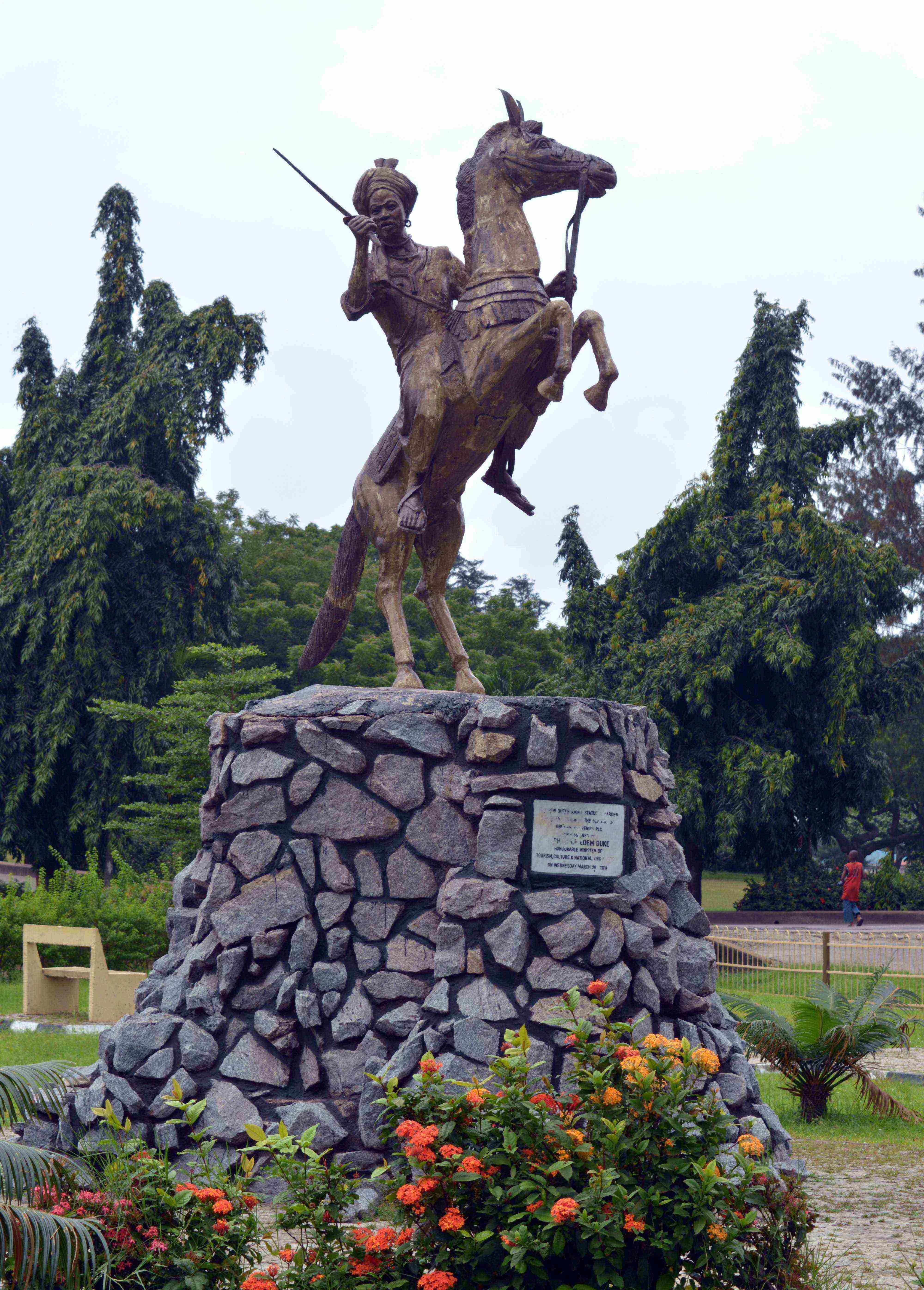
Amina of Zazzau (c. 1533 – c. 1610 CE), also rendered Aminatu, was a Hausa ruler of the city-state of Zazzau — corresponding to the present-day city of Zaria in Kaduna State, northern Nigeria — whose thirty-four-year reign of sustained military expansion made her one of the most celebrated figures in the history of the Hausa States and one of the most widely recognized women rulers in the pre-colonial history of West Africa. Ruling at a time when Zazzau was already one of the seven original Hausa Bakwai states and the principal source of the slaves traded at the markets of Kano and Katsina, Amina expanded her state's territory further than any of her predecessors, extended its commercial reach through the establishment of new fortified trading centers, and left a physical legacy — the earthen defensive walls that came to be known across Hausaland as ganuwar Amina, "Amina's walls" — that endured as a defining feature of Hausa urban fortification for centuries after her death.
Amina's story occupies a distinctive place in the historiography of the Hausa States and of Islamic Africa more broadly, both because of the genuine scale of her military and commercial achievements and because the historical record concerning her reign is characterized by significant chronological uncertainty and by a substantial admixture of oral legend alongside the more securely documented textual references to her found in works such as the Kano Chronicle and the writings of the nineteenth-century Sokoto scholar Muhammad Bello. This combination of genuine historical substance and legendary elaboration has made Amina a figure whose basic historicity is not in serious doubt among historians of the region, even as many of the specific details surrounding her reign, and even its precise dating, remain subjects of ongoing scholarly discussion.
Amina's place within the specifically Islamic history of West Africa requires some careful contextualization, since the surviving sources describing her reign do not present her, in the manner of many other rulers treated within Islamic historiography, as a self-consciously Muslim monarch whose governance was explicitly framed in Islamic legal or theological terms. Rather, Amina reigned during a transitional period in the religious history of the Hausa States, when Islam had been present in the region for roughly a century but had not yet achieved the depth of social and political penetration that it would attain following the nineteenth-century Sokoto jihad led by Usman dan Fodio and continued through the scholarly and educational work of figures such as Nana Asma'u. Amina's reign is therefore best understood as belonging to a formative period of Hausa Islamic history in which royal authority, military organization, and commercial life operated within a religious environment characterized by the coexistence and gradual synthesis of Islamic practice with pre-Islamic Hausa political and religious tradition — a pattern common across many regions of West Africa during the corresponding centuries of Islam's gradual, largely peaceful spread through trade and scholarly contact rather than through conquest.
The Hausa States and the Kingdom of Zazzau
The Hausa States (Hausa Bakwai, or "Hausa Seven") comprised a group of city-states in what is now northern Nigeria and southern Niger, of which Zazzau, Kano, Katsina, Daura, Gobir, Rano, and Garun Gabas were traditionally reckoned as the original seven, each tracing its founding to a legendary common ancestor, Bayajidda, in Hausa oral tradition. These states developed as centers of trade, craft production, and, from at least the fifteenth century CE, of Islamic scholarship and governance, situated along trans-Saharan trade routes that connected the West African interior to the Mediterranean world via routes crossing the Sahara to North Africa, as well as to the Sahelian trading networks linking the Hausa States to the neighboring Mali and Songhai empires further west and to the Bornu Empire to the east. Islam had reached the Hausa States by the late fifteenth century, arriving through the trans-Saharan trade networks and through the influence of the neighboring Mali Empire, and by the time of Amina's reign in the later sixteenth century, Islamic practice, scholarship, and legal norms had become significantly, though not universally or uniformly, integrated into the political and social life of the Hausa ruling classes, coexisting and interacting with pre-Islamic Hausa religious and political traditions in patterns that varied across the different Hausa States and across different periods of their history.
Zazzau, located to the south of the other principal Hausa States and consequently positioned as a frontier zone between Hausaland proper and the diverse polities and peoples of the Middle Belt region of what is now central Nigeria, had developed a distinctive role within the broader Hausa political and commercial system as a major source of slaves obtained through raiding and warfare against neighboring non-Hausa populations to its south, slaves who were then sold onward through the markets of Kano and Katsina into the broader trans-Saharan slave trade. This particular economic and military orientation — a frontier state whose wealth and political power derived substantially from organized raiding and slave-trading directed against neighboring populations — provides essential context for understanding the specifically military character of Amina's reign and the sustained campaign of territorial expansion for which she became renowned, since the pattern of expansion attributed to her, extending Zazzau's reach and influence over neighboring territories including Kwararafa and Nupe, aligns with the broader established pattern of Zazzau's political economy in the period both before and after her reign.
The political structure of Zazzau and the other Hausa States during this period combined elements of centralized monarchical authority with a more diffuse network of subordinate titleholders, tribute-paying vassal towns, and semi-autonomous frontier settlements, a structure that provided the institutional framework within which a ruler such as Amina could translate successful military campaigns into durable territorial control. Hausa governance of the period drew on a body of political titles and offices — including specifically female offices such as that held by the Magajiya and other titled royal women who exercised recognized, if circumscribed, authority within the palace and, in some documented instances, within the broader administration of the state — that provided institutional precedent for women's exercise of political authority, even as the paramount kingship itself was, in ordinary circumstances, understood as a male prerogative. Amina's own reign, whether formally recognized as that of a sarauniya (queen regnant) or understood by some traditions as an extraordinary personal exercise of authority over conquered territories rather than a formally regularized kingship, represented in either case an exceptional expansion of the scope of female political authority beyond even the recognized women's offices of ordinary Hausa court practice.
Early Life and Ascent to Power
According to the oral traditions and later historical accounts of her life, Amina was born around 1533 CE to King Nikatau, described in the sources as the twenty-second ruler of Zazzau, and Queen Bakwa Turunku, who herself ruled Zazzau from approximately 1536 to 1566 CE — a detail suggesting that Amina's mother reigned in her own right as sovereign of the state, itself an indication that women's exercise of paramount political authority in Zazzau, while presumably exceptional, was not without precedent even before Amina's own more celebrated reign. According to oral legends recorded by the anthropologist David E. Jones, Amina was raised within her grandfather's royal court and was particularly favored by him, who is said to have carried her with him within the court and instructed her personally in matters of politics and military affairs from a young age, an upbringing that, if accurately reflected in the oral tradition, would help account for the political and military competence she is credited with demonstrating once she assumed positions of authority as an adult.
At the age of sixteen, Amina was formally designated Magajiya, meaning heir apparent or crown princess, a position that came with the practical grant of forty female slaves (kuyanga) placed under her authority, reflecting both the material resources and the household or administrative responsibilities that customarily accompanied this rank within Hausa court practice. Amina's status as a marriageable royal woman attracted, according to the oral tradition, a series of suitors offering substantial bridewealth in the form of slaves and valuable trade goods, including an offer from a suitor identified as Makama of ten slaves offered daily, and, from the ruler of Kano (the Sarkin Kano), an offer of one hundred slaves divided equally between male and female, along with fifty bags of fine cloth. The sources do not indicate that Amina accepted any of these marriage offers, and later oral tradition holds that she deliberately declined to marry throughout her life specifically out of a concern that marriage might compromise or dilute her personal political authority — an interpretation that, whatever its precise historical accuracy, reflects the broader thematic emphasis within the Amina tradition on her fierce guardianship of independent political and military authority.
Following the deaths of her parents around 1566 CE, Amina's brother Karama ascended to the Zazzau throne, and it was during her brother's reign that Amina is described in the sources as having distinguished herself as a leading warrior within her brother's cavalry forces, establishing a reputation for military skill and courage that is preserved in traditional Hausa praise poetry celebrating her as "Amina, daughter of Nikatau, a woman as capable as a man, who was able to lead men to war." This period of military service under her brother's reign provided the foundation of practical combat and command experience upon which Amina's own subsequent reign as an independent ruler would be built.
Accession and Territorial Expansion
Following the death of her brother Karama in 1576 CE, Amina ascended to the position of ruler (sarauniya, "queen," though some traditions describe her status as that of a princess or gimbiya exercising authority in the territories she personally conquered rather than as the formally enthroned sovereign of Zazzau itself, a distinction that reflects the complexity and, in places, internal inconsistency of the surviving traditions regarding her precise constitutional status). Whatever the precise nature of her formal title, the traditional accounts agree that Amina moved with remarkable speed to establish a sustained and ambitious program of military expansion: according to the Kano Chronicle and related traditions, she began a campaign of conquest within only three months of assuming power, a campaign that would continue for thirty-four years and that one of her earliest recorded pronouncements as ruler is said to have been a call for her people to "resharpen their weapons" in preparation for war.
Amina's military forces are described in the sources as comprising approximately twenty thousand foot soldiers and one thousand cavalry troops, a substantial force by the standards of sixteenth-century West African warfare and one that, if the figures are accurate, would have placed Zazzau's military capacity on a scale comparable to or exceeding that of its neighboring Hausa rivals. With Zazzau's expansion blocked to the north by the established and powerful states of Kano and Katsina, and to the east by the rugged terrain of the Jos Plateau, Amina directed her campaigns primarily toward the southeast and southwest, extending Zazzau's military and commercial reach into the territories of Kwararafa and the Nupe kingdom, and incorporating the regions of Bauchi and Yauri under Zazzau's sphere of influence or direct control. The nineteenth-century Sokoto Caliphate scholar Muhammad Bello, in his historical work Infaq al-Maysur, credited Amina with reaching as far as the confluence of the Niger and Benue rivers and with extracting tribute even from the powerful states of Katsina and Kano — claims that modern historians regard with some skepticism regarding their full literal accuracy but that nonetheless attest to the scale of territorial and commercial ambition attributed to her reign within the historical memory of the wider region. The Chronicle of Abuja records that the ruler of Nupe sent Amina a tribute of forty eunuchs and ten thousand kola nuts, and credits her with introducing kola nut cultivation to Hausaland — a claim of genuine economic significance, as kola nuts became and remained a major commercial crop and trade good throughout the subsequent history of the region, valued both for their stimulant properties and for their ceremonial and social uses across West Africa.
The specific military and diplomatic mechanics by which Amina's campaigns achieved and consolidated their territorial gains reflected established patterns of West African statecraft in the period, combining direct military conquest of some territories with the extraction of tribute and formal or informal vassalage from others, a mixed strategy that allowed a comparatively modest city-state such as Zazzau to project effective authority over a territory considerably larger than could have been permanently garrisoned or directly administered by its own resources alone. The cavalry component of Amina's forces, though numerically smaller than her infantry, likely played a disproportionately significant tactical role given the general military advantages that mounted forces possessed over infantry in the open savanna terrain characteristic of much of the territory over which her campaigns ranged, a pattern consistent with the broader military history of the Sahelian and savanna zones of West Africa, where cavalry-based states, including the neighboring Kwararafa confederacy and the more distant Bornu Empire, had long derived significant military advantage from access to horses, whose availability was itself dependent on trans-Saharan trade networks supplying horses bred in regions less afflicted by the tsetse fly and the trypanosomiasis it transmits to livestock.
According to some traditions recorded by the colonial-era compiler Sidney John Hogben, Amina's campaigns were also associated with a pattern of personal conduct involving temporary liaisons formed with men in each town through which her campaigns passed — liaisons that these traditions describe as ending, in each case, with the death of her temporary companion the following morning, a detail Hogben records citing the phrase that "her brief bridegroom was beheaded so that none should live to tell the tale." This particular element of the Amina tradition, while frequently repeated in popular and some scholarly accounts of her life, should be treated with the same source-critical caution appropriate to other dramatically vivid but difficult-to-verify elements of pre-colonial African oral historical tradition, and its function within the broader corpus of Amina legend likely relates more to established narrative tropes concerning powerful and dangerous female rulers — tropes with parallels across numerous world historical and legendary traditions concerning warrior queens — than to a straightforwardly reliable historical record of Amina's personal conduct.
Fortification, Trade, and Administrative Legacy
Beyond the purely military dimensions of her reign, Amina is credited with a lasting programme of urban fortification that transformed the physical character of Hausa cities for centuries after her death. She is said to have ordered the construction of earthen defensive walls around the cities and towns brought under Zazzau's control during her campaigns, a building programme sufficiently extensive and influential that such fortifications became a standard and near-universal feature of Hausa urban construction from her reign onward, persisting as a defining element of Hausa city architecture until the British conquest of the Hausa States in 1904, and surviving in physical remnants, still known as ganuwar Amina ("Amina's walls"), that can be observed in various Hausa cities into the present day. These walls served the practical defensive function of protecting Zazzau's expanded territories and its commercial wealth from raids and counter-attack, and their construction across a network of conquered and allied towns effectively created an integrated defensive and administrative infrastructure binding Amina's expanded domain together.
Amina's reign is also credited with the establishment or expansion of trade routes connecting Zazzau to wider commercial networks across northern and western Africa, building on the state's existing role as a slave-trading hub to develop a broader commercial infrastructure encompassing the kola nut trade introduced, according to tradition, through her Nupe campaigns, as well as continued participation in the trans-Saharan trade in goods including cloth, leather, salt, and other commodities that moved along the caravan routes linking Hausaland to North Africa. This commercial expansion, combined with the military security provided by her fortification programme, is credited by historians with contributing to a period of substantial economic growth and increased regional commercial significance for Zazzau during and following her reign, cementing the state's position among the most consequential of the Hausa city-states in the subsequent centuries leading up to the nineteenth-century Sokoto jihad and the eventual establishment of the Sokoto Caliphate's suzerainty over the Hausa States more broadly.
The kola nut trade that Amina is credited with introducing to Hausaland deserves particular emphasis given its long-term economic significance for the region. Kola nuts, native to the forest zones of West Africa considerably to the south of Hausaland, contain caffeine and other stimulant compounds and were, and remain, widely chewed across West Africa both for their mild stimulant effect and for their significant ceremonial role in hospitality, marriage negotiations, and other social rituals across numerous West African cultures, Muslim and non-Muslim alike. The establishment of a reliable supply chain bringing kola nuts north from the forest zone into Hausaland, credited to Amina's Nupe campaigns and the tribute relationship she is said to have established with that kingdom, integrated Zazzau into a north-south trading axis that complemented the pre-existing east-west trans-Saharan trade routes, positioning the state advantageously within an increasingly complex regional commercial network linking the West African forest zone, the Sahel, and the trans-Saharan trade to North Africa — a three-way commercial integration that would remain a defining feature of the Hausa States' economic role within West Africa for centuries after Amina's death.
The defensive walls attributed to Amina's building programme, beyond their immediate military function, also had significant implications for the administrative and demographic organization of Hausa urban settlements. Walled towns provided secure environments within which craft production, market activity, and the residence of scholars, traders, and administrative personnel could be concentrated and protected, contributing to the broader process of urbanization that characterized Hausa civilization in the centuries following Amina's reign. The city of Zaria itself — the modern name by which Zazzau's capital came to be known, and which some traditions link to Amina's own successor — retained walls in the tradition established or expanded during her reign into the twentieth century, with substantial remnants surviving as a recognized heritage feature of the city into the present day, providing a tangible physical connection between the modern city and the historical figure credited with shaping its early defensive architecture.
Chronological Uncertainty and Historical Sources
The dating of Amina's reign is a matter of ongoing scholarly discussion arising from apparent inconsistencies among the various historical sources addressing her life. Muhammad Bello's early nineteenth-century account in Infaq al-Maysur, composed around 1836 CE, describes Amina as "the first to establish government among [the Hausa]" and credits her with forcing Katsina, Kano, and other regions to pay tribute, but provides no specific chronological framework situating her reign within a broader historical timeline. The Kano Chronicle, a detailed history of Kano compiled in its written form in the late nineteenth century but incorporating substantially earlier oral and documentary material, places Amina as a contemporary of the Kano ruler Muhammad Dauda, who reigned from approximately 1421 to 1438 CE — a dating that, if accepted, would place Amina's reign in the early to mid-fifteenth century, more than a century earlier than the dating suggested by other traditions. Some historians, including several who have worked extensively with the Kano Chronicle as a primary source, have accepted this earlier fifteenth-century dating.
A separate local chronicle of Zaria itself, compiled principally in the nineteenth century though extending its coverage to 1902 and published in 1910, provides a list of Zazzau's rulers and the durations of their respective reigns; this chronicle does not itself mention Amina by name, but early twentieth-century oral tradition recorded alongside it identified her as the daughter of Bakwa Turunku, whose reign this chronicle dates to 1492-1522 CE — a dating that would place Amina's own reign in the early sixteenth century, still earlier than, though closer to, the more commonly cited dating of 1576-1610 CE. The historian Abdullahi Smith, working from a critical assessment of the various available sources, has argued for placing Amina's reign after 1576 CE, a dating that has been widely adopted in more recent historical reference works, including the Oxford Encyclopedia of Women in World History and the Dictionary of African Biography, and which is followed in the chronology presented in this article, while acknowledging that the question cannot be regarded as definitively settled given the genuine complexity and apparent inconsistency of the underlying source material.
This chronological uncertainty, while a genuine complication for the precise historical placement of Amina's reign, does not undermine the broader historical credibility of her existence or of the essential outline of her military and administrative achievements, which are attested with reasonable consistency across the various sources despite their disagreement on precise dating — a situation analogous to chronological uncertainties affecting other pre-colonial African polities whose history was preserved primarily through oral tradition before being committed to writing, often centuries after the events in question, by scholars working within a still-developing historiographical tradition that combined elements of oral historical memory, dynastic king-lists, and, in the Hausa case, the increasing influence of Arabic literacy and Islamic historiographical conventions introduced through the region's integration into the broader network of trans-Saharan Islamic scholarship.
The broader introduction of Arabic literacy and Islamic historiographical practice into Hausaland, occurring gradually from the fifteenth century onward and considerably deepened during and after the period of Amina's reign, is itself an important part of the historical context for understanding why her story survives in the specific mixed form — part king-list entry, part oral praise-poem tradition, part later Islamic scholarly commentary — in which it has come down to modern historians. Before the fuller development of a written Hausa Islamic historiographical tradition, exemplified by works such as the Kano Chronicle in its eventual written form, the primary vehicle for the transmission of historical memory across generations in Hausaland was oral tradition, transmitted through court historians, praise-singers, and general communal memory, a mode of historical transmission that, while capable of preserving core factual information about major rulers and events across considerable spans of time, is also characteristically prone to the kind of chronological compression, conflation of similarly-named or similarly-situated figures, and progressive dramatic elaboration that appears to characterize the specific case of the Amina tradition. Modern historians working with this material, including Abdullahi Smith and the various contributors to the Oxford Encyclopedia of Women in World History and the Dictionary of African Biography, have generally approached the task of reconstructing Amina's most probable historical dating and biography through a careful cross-comparison of the various available written and oral sources, seeking points of convergence and internal consistency across otherwise divergent traditions, a methodology broadly analogous to the source-critical techniques employed by historians working with comparably complex oral-derived traditions in other regions of the pre-colonial and early colonial world.
Comparative Context: Women Rulers in Islamic Africa
Amina's reign should be understood within a broader pattern of women's exercise of significant political authority across various regions and periods of Islamic Africa, even as the specific circumstances, religious context, and historical documentation of each case differ considerably. In East Africa, a succession of queens known by the title Nabiira ruled portions of the Kilwa Sultanate and other Swahili Coast polities at various points in their history, exercising authority within Islamic legal and political frameworks considerably more thoroughly established than those prevailing in sixteenth-century Hausaland. In the Sahel, Arwa al-Sulayhi had governed Yemen for decades as a Fatimid-aligned Ismaili queen in the eleventh and twelfth centuries, ruling within an explicitly and elaborately articulated Islamic political and religious framework quite different from Amina's own context. Within the specific historical trajectory of Hausaland and the broader Sokoto Caliphate region, the nineteenth-century Islamic scholar Nana Asma'u, daughter of the Sokoto Caliphate's founder Usman dan Fodio, would later exercise extensive religious and educational authority — organizing a formal system of women's Islamic education across the caliphate — within a context in which the underlying society had by then undergone a far more thorough process of Islamic reform and consolidation than had prevailed during Amina's own reign more than two centuries earlier.
This comparative context helps clarify Amina's specific historical position: she ruled and campaigned within a Hausa political and religious environment in which Islam, though present and influential, had not yet achieved the kind of comprehensive social, legal, and educational penetration that later reform movements — above all the Sokoto jihad beginning in 1804 — would bring to the same geographic region. Her authority derived primarily from inherited royal status, personal military capability, and the specific institutional traditions of Hausa kingship (including its provisions for women's political offices) rather than from any distinctly Islamic theory of female rulership or religious authority, distinguishing her case from that of later Muslim women rulers and scholars in the same region, such as Nana Asma'u, whose authority was explicitly grounded in and legitimated through Islamic scholarly credentials and religious office. Considered together, however, these various cases — spanning the Swahili Coast, Yemen, and the Hausa States across several centuries — demonstrate that women's exercise of significant, and in several instances paramount, political and religious authority was a recurring, if never dominant or unchallenged, feature of the broader historical experience of Islamic Africa, complicating any simplified narrative that would treat women's exclusion from political power as a uniform or unvarying feature of pre-colonial African Muslim societies.
Death and Succession
The precise circumstances of Amina's death are, like much of the detail surrounding her reign, subject to some variation across the different historical accounts. The nineteenth-century Sokoto scholar Dan Tafa records that she died at a place called Attaagar, and Sidney John Hogben, drawing on Dan Tafa's account, places this location near the present-day town of Idah, reflecting the fact that Amina's military campaigns had, by the time of her death, pushed the frontiers of Zazzau's influence south of the confluence of the Niger and Benue rivers — though Hogben also notes that other authors have placed her death at Vom, near Jos, reflecting the same underlying pattern of variant traditions that affects other aspects of her biography. The Oxford Dictionary of African Biography states that, according to tradition, Amina dominated Hausaland for thirty-four years and died at Attaagar (likely to be identified with Idah) while on campaign, with her body reportedly never recovered — a detail that, if accurate, would be consistent with a death occurring during active military campaigning at a considerable distance from her capital, rather than in more conventional retirement or peaceful succession.
Some traditions hold that Amina was succeeded as ruler of Zazzau by her sister, sometimes named as Zaria in later sources (a name that some historians have suggested may be connected to the eventual renaming of the city of Zazzau itself as Zaria, though the precise relationship between the queen's name and the city's later name remains a matter of some scholarly discussion rather than settled historical fact).
Legacy and Historical Assessment
The historian Michael Crowder observed that, following Amina's death, the ruling-class women of Hausa society who had previously exercised recognized authority experienced a steady decline in political influence and were progressively deprived of the formal titles and offices — including those specifically concerned with women's affairs and the redress of women's grievances — that had previously accorded them institutionalized political standing within Hausa governance. This observation suggests that Amina's own exceptional exercise of paramount political and military authority did not establish a durable institutional precedent for women's continued access to comparable positions of power within Hausa political structures in the centuries following her reign, even as her personal reputation and legend continued to grow within Hausa historical memory and popular tradition.
Despite this apparent institutional discontinuity, Amina achieved and has sustained a historical reputation bordering on legend as a woman warrior and ruler of exceptional capability, commemorated in traditional Hausa praise poetry and celebrated in the writings of subsequent Islamic scholars of the region, including Muhammad Bello of Sokoto, who, notwithstanding the political and religious differences separating the nineteenth-century Sokoto Caliphate from the pre-jihad Hausa States that it eventually subordinated, nonetheless preserved and transmitted an admiring account of Amina's unprecedented territorial achievements. That a scholar writing within the reformist, explicitly Islamic political culture of nineteenth-century Sokoto — a polity whose founding jihad had been directed in significant part against what its leaders regarded as the religiously deficient governance of the pre-jihad Hausa ruling dynasties — nonetheless preserved and transmitted an admiring account of a sixteenth-century Hausa queen's military achievements suggests that Amina's reputation for effective governance and military capability had, by Bello's time, achieved a status transcending the specific political and religious controversies that otherwise divided Sokoto's Islamic reformist tradition from the historical memory of the pre-jihad Hausa States.
In the modern era, Amina has become a symbol of women's historical political and military capability across Nigeria and the wider West African region, commemorated in the Queen Amina Statue erected at the National Arts Theatre in Lagos — a prominent public monument depicting her mounted and armed, that has become one of the most widely recognized visual representations of a historical African woman in Nigerian public art — and in the naming of numerous Nigerian educational institutions, including secondary schools and university halls of residence across northern Nigeria. Her story has been incorporated into Nigerian primary and secondary school history curricula as an example of pre-colonial African political and military achievement, and she has been invoked repeatedly in Nigerian public discourse and political rhetoric as a historical precedent for women's capacity for effective political and military leadership, particularly within the specific context of northern Nigerian and Hausa Muslim society, where her example is sometimes cited in contemporary debates regarding women's appropriate political and social roles.
Beyond Nigeria itself, Amina's story has achieved a degree of international recognition reflected in a range of modern cultural depictions, including the historical novel Queen of Zazzau (2018) by J.S. Emuakpor, which offers a fictionalized narrative treatment of her life beginning in the 1550s; the 2021 Nigerian film Amina, directed by Izu Ojukwu and distributed internationally through Netflix, which dramatizes her rise to power; and her appearance as a playable leader and historical figure in several internationally popular strategy video games addressing world history, including the Civilization and Age of Empires franchises, through which her story has reached a global audience of players engaging with simplified but broadly historically grounded representations of world civilizations and their notable historical figures. This range of modern commemoration — spanning formal public monuments, educational curricula, popular literature, film, and digital entertainment media — reflects Amina's emergence as one of the relatively small number of pre-colonial African historical figures, and a still smaller number of pre-colonial African women, to have achieved recognition extending significantly beyond the specific national and regional context of her own historical activity, situating her alongside a select group of African historical figures, including Mansa Musa of the Mali Empire, who have come to serve as internationally recognized symbols of pre-colonial African civilizational achievement.
References and Further Reading
Primary Islamic Sources
- Muhammad Bello. Infaq al-Maysur, chapter 7. Composed c. 1836 CE — the earliest substantial written account crediting Amina with the establishment of government among the Hausa and with the extraction of tribute from neighboring states
- The Kano Chronicle — a detailed history of Kano incorporating earlier oral and documentary material, compiled in written form in the late 19th century, placing Amina as a contemporary of Muhammad Dauda of Kano (r. 1421-1438 CE)
- Dan Tafa, Abd al-Qadir. Rawdat al-Afkaar — nineteenth-century Sokoto scholarly account recording the location and circumstances of Amina's death
- E.J. Arnett, ed. "A Hausa Chronicle." Journal of the Royal African Society 9 (1910) — local chronicle of Zaria providing a king-list and reign lengths for Zazzau's rulers
Classical Islamic Sources
- Traditional Hausa praise poetry (take) commemorating Amina as "a woman as capable as a man that was able to lead men to war," transmitted through the oral tradition of Hausaland
- Oral traditions recorded by Sidney John Hogben in the colonial-era compilation of Hausa historical memory, drawing on earlier indigenous oral historiography
Academic and Scholarly Sources
- Hogben, S.J. Emirates of Northern Nigeria. London: Oxford University Press, 1966.
- Smith, Bonnie G., ed. "Aminatu, Queen of Zaria." The Oxford Encyclopedia of Women in World History, Vol. 1. Oxford University Press, 2008.
- Denzer, Laray. "Amina." Dictionary of African Biography. Oxford University Press, 2011.
- Falola, Toyin, and Ann Genova. Historical Dictionary of Nigeria. Lanham: Scarecrow Press, 2009.
- Abubakr, Sa'ad. "Queen Amina of Zaria." In Nigerian Women in Historical Perspective, edited by Bolanle Awe. Ibadan: Sankore Publishers/Bookcraft, 1992.
- Jones, David E. Women Warriors: A History. Washington, D.C.: Brassey's, 2000.
Further Reading
- Crowder, Michael. The Story of Nigeria. London: Faber and Faber, 1978.
- Smith, Abdullahi. "Some Notes on the History of Zauzau under the Hausa Kings." In Zaria and Its Region: A Nigerian Savannah City and Its Environs, edited by M.J. Mortimore. Zaria: Ahmadu Bello University, 1970.
- Adamu, Mahdi. "The Hausa and Their Neighbours in the Central Sudan." In UNESCO General History of Africa, Vol. 4, edited by D.T. Niane. London: Heinemann/UNESCO, 1984.
- Lovejoy, Paul E. Transformations in Slavery: A History of Slavery in Africa. Cambridge University Press, 1983.
Mentioned In
1 article references this topic
More from African Islamic Empires
Islam in Africa - Historical and Contemporary Overview
Africa holds the largest Muslim population of any continent, some 550 million people or roughly 31 per cent of Muslims worldwide. Islam reached Egypt and the Maghreb in the 640s and spread over the following centuries through trade, scholarship and teaching.
Timbuktu: The Golden City of Scholars
Timbuktu was a major center of Islamic learning and trade in medieval Africa, flourishing from the 13th to 16th centuries. Home to Sankore University and hundreds of thousands of manuscripts, it became synonymous with wealth, knowledge, and scholarship.
Islamic Ethiopia - Islam in the Horn of Africa
Islamic Ethiopia spans the history of Islam in the Horn of Africa, from the first Hijra of refuge in Christian Axum (615 CE), through sultanates like Ifat and Adal, to the Muslim communities that form about a third of modern Ethiopia, developing alongside an ancient Christian civilization.
Mali Empire - The Golden Age of West African Islam
The Mali Empire (1235-1600 CE) was one of West Africa's wealthiest Islamic empires, renowned for its gold resources and Timbuktu's Islamic scholarship. Under Mansa Musa, Mali spread Islam throughout West Africa and established centers of learning that attracted scholars from across the Muslim world.