Hisham ibn Abd al-Malik: Administrator of an Empire at Its Limits
Hisham ibn Abd al-Malik (72-125 AH / 691-743 CE) was the tenth Umayyad caliph, whose nineteen-year reign was the dynasty's last long one. A careful administrator, he reorganised the diwans, the police and the postal service while the frontiers stopped advancing.
Hisham ibn Abd al-Malik ibn Marwan (72–125 AH / 691–743 CE) was the tenth caliph of the Umayyad dynasty, ruling from 105 to 125 AH (724–743 CE). His nineteen-and-a-half-year reign was the longest of any Umayyad after Abd al-Malik, and the last long one the dynasty had. He was the fourth of Abd al-Malik's sons to hold the office, following al-Walid, Sulayman and — after the interval of their cousin Umar ibn Abd al-Aziz — his brother Yazid II.
He is remembered in the sources chiefly as an administrator. The Encyclopedia of Islam published by the Turkish Religious Foundation records al-Tabari's judgement that no Marwanid caliph kept better-ordered diwans than Hisham's, and al-Mas'udi's report that the Abbasid caliph al-Mansur took him as his model in the conduct of government. He reorganised the registers of state, separated the police from the office of the judge, rebuilt the postal and intelligence service, replaced Persian with Arabic in the correspondence of Khurasan, and spent heavily on canals, dykes and bridges. He moved the working centre of the caliphate out of Damascus altogether, to the town of al-Rusafa on the Euphrates, where he died.
The reign is also the point at which the empire stopped growing. Every frontier he inherited was still advancing when he came to power and static or receding when he left it: superiority in Transoxiana passed to the Türgesh Turks within two years of his accession, the army in Gaul was broken near Poitiers in 732, the Byzantines inflicted a heavy defeat at Akroinon in 740, and in the same year the Berbers of the Maghrib rose against Arab rule and were never fully brought back. Because the state's finances and its standing army had both been built on continuous conquest, the end of expansion turned taxation into the central political problem of the reign — and it was the attempt to tax Muslim converts like non-Muslims, in Transoxiana and in North Africa alike, that produced the revolts that did the dynasty most damage. The TDV entry's summary is that his years are counted as the Umayyads' third ascendancy, that he preserved stability to a large degree, and that because he could not check the Abbasid and Kharijite movements the state collapsed into disorder shortly after him and lost its character as a state organised for war.
Name, Birth and Family
He was born in 72 AH (691–92 CE), at Medina according to the TDV entry, which records Damascus as an alternative. His father, the caliph Abd al-Malik ibn Marwan, gave him the name Mansur; the name by which he is known was given by his mother, Aisha, and it was hers that stuck. History of Islam gives her more fully as Aisha of the family of Hisham ibn Isma'il al-Makhzumi, which placed his maternal line in Banu Makhzum, one of the leading clans of Quraysh. His kunya was Abu al-Walid.
Readers meeting the name in chains of hadith transmission should be aware of a namesake: Abu al-Walid Hisham ibn Abd al-Malik al-Tayalisi, a traditionist of Basra who appears in the isnads preserved by Ibn Kathir and others, is a different man entirely and not the caliph.
Before the Caliphate
Hisham was brought into the succession by his brother. The TDV entry records that in 102 AH (720–21) the caliph Yazid ibn Abd al-Malik designated Hisham as heir together with Yazid's own son al-Walid, then eleven years old — an arrangement that placed Hisham first and the boy second, and which would shape the last years of the reign and the crisis that followed it.
One episode from his years as heir apparent is recorded, and it is of a piece with the way he later governed. Sent against a Kharijite leader named Ukfan who had risen against the state, Hisham induced him to abandon the revolt without a battle being necessary.
Accession, 105 AH / 724 CE
Yazid II died on 25 Sha'ban 105 AH after a reign of four years and one month. Hisham was not at the capital but at Hims, and History of Islam preserves the form the transfer took: a messenger reached him there with the news of his brother's death, together with the staff and the ring of office. He travelled from Hims to Damascus and there received the oath of allegiance.
What he inherited was the largest contiguous territory any Islamic state has governed, assembled under his father and his brother al-Walid and held together by a Syrian army paid from the revenues of the conquered provinces. He also inherited the two divisions that ran through the whole Marwanid period: the resentment of the non-Arab Muslims, the mawali, at being taxed and treated as though they had not converted; and the rivalry of the Arab tribal blocs, the northern Qays/Mudar and the southern Kalb/Yemen, which the TDV entry describes as having reached its height in his time. Neither was of his making. Both defined what he could and could not do.
Government and Administration
The diwans, the barid and the shurta
The administrative record is the strongest part of his reputation, and it rests on the testimony of hostile as well as friendly sources.
He had the registers of the diwan reorganised, and the TDV entry reports the general acceptance — citing al-Tabari — that among the Marwanids there were no healthier or better-ordered diwans than those of Hisham's time. He separated the shurta, the police, from the office of the qadi to which it had been attached, making it independent and confining the sahib al-shurta to the pursuit of offenders rather than to judicial business. He reorganised the barid, the postal and intelligence service on which a caliph's knowledge of his provinces depended, and the sources note that he took particular care over it. And he ordered that the correspondence of Khurasan be conducted in Arabic rather than Persian, extending to the eastern administration the language policy his father had applied further west.
The measure of this work is that his enemies adopted it. Al-Mas'udi records that al-Mansur, the second Abbasid caliph and the man who consolidated the dynasty that destroyed Hisham's, took Hisham as his model in the business of the state.
His seal bore the words al-hukm li'l-hakam al-hakim — judgement belongs to the Wise Judge.
Revenue, and why it became the central problem
Hisham's fiscal reputation is for closeness, and it should be read against the position he was in rather than as a personal trait. The Syrian army was the instrument that held the empire together, and its pay was the largest charge on the treasury. So long as the frontiers advanced, conquest paid for the army that made it. Once they stopped, the same army had to be paid out of ordinary taxation — and ordinary taxation meant, in practice, the land tax and the poll tax levied on non-Muslims.
Two consequences followed, and between them they account for most of the violence of the reign. The first was pressure on the provinces to yield more, which produced the Coptic risings in Egypt and the Berber revolt in the Maghrib. The second was the problem of the convert: a non-Muslim who accepted Islam ceased, in law, to owe the poll tax, so that successful preaching reduced revenue. Administrators in both Transoxiana and North Africa responded by taxing Muslim converts as though they were not Muslims, and in both places the result was rebellion.
Smaller economies are recorded too. The literature on Umar ibn Abd al-Aziz notes that Umar had assigned a narrator at Medina two dinars a month for telling the people the accounts of the Prophet's expeditions; when Hisham came to office he reduced the stipend to six dinars a year. That the retrenchment was systematic rather than arbitrary is suggested by what happened after him: when Yazid III cancelled al-Walid II's ten-dirham increase to army pay, History of Islam records that what he restored was the scale that had been in use under Hisham.
Water, agriculture and building
Against the economies stands a substantial programme of public works, and it was directed at production rather than display.
The TDV entry records that Hisham gave great importance to agriculture and had dykes built to hold back the flooding of the Tigris. At Damascus thirteen canals were cut from the river Barada in his time, and in Iraq, using the services of the engineer Hasan al-Nabati, further canals were opened and dams and bridges built.
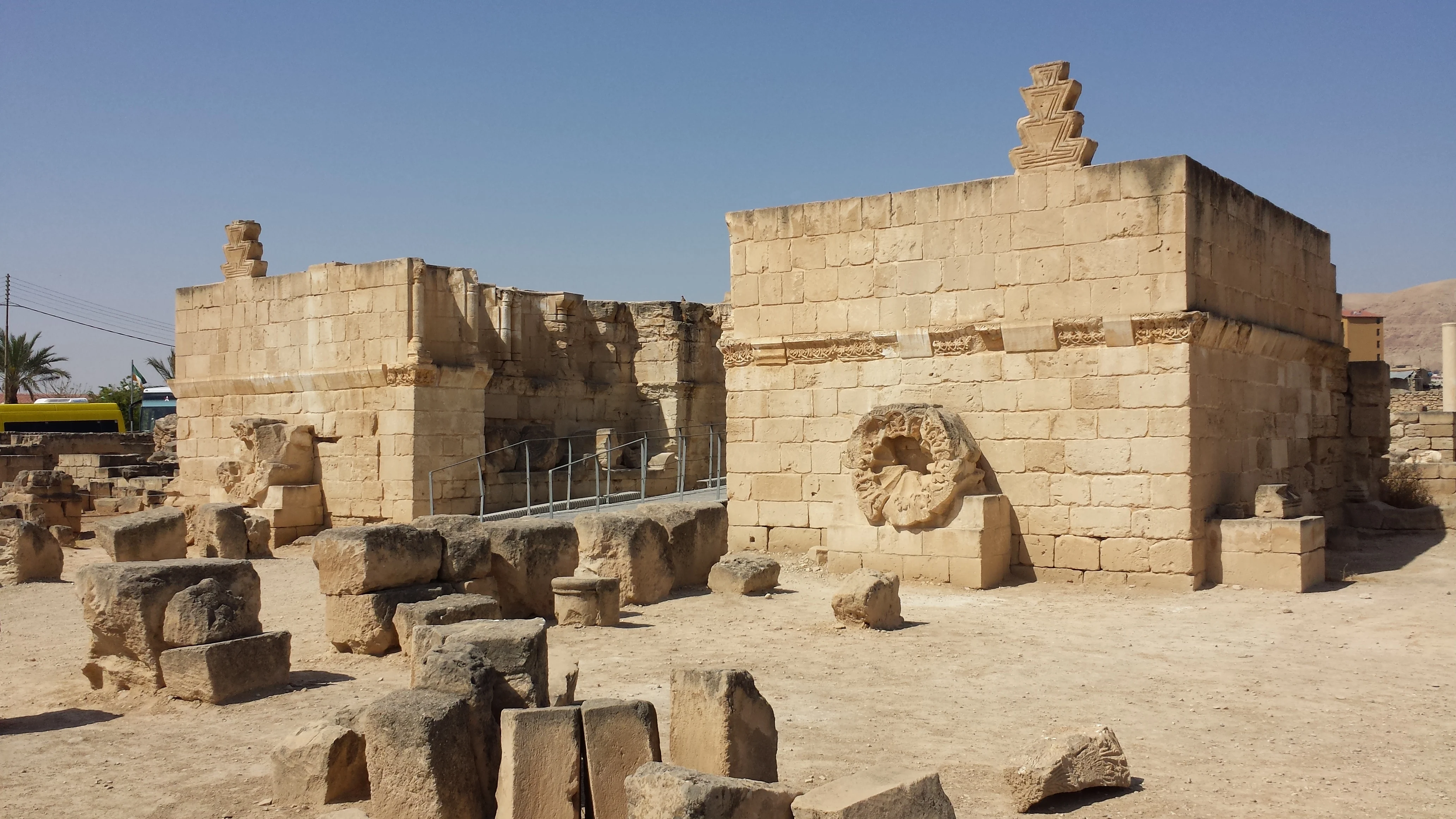
His building included two of the principal surviving examples of Umayyad secular architecture, Qasr al-Hayr al-Gharbi and Qasr al-Hayr al-Sharqi, the western and eastern enclosures of the Syrian steppe. And he made a decision no other Umayyad made: he transferred the centre of the caliphate from Damascus to al-Rusafa, on the Euphrates. It was there that he held his court, there that he raised the grandson who would carry the dynasty to Spain, and there that he died.
The shape of provincial government
History of Islam sets out the framework Hisham worked within. The empire was divided into large provinces — the Hijaz, Iraq, the Jazira, Armenia, Syria, Egypt, North Africa, al-Andalus and Khurasan — each under a single governor who appointed his own subordinates and held both military command and responsibility for order. Some units moved between arrangements: Yemen was sometimes part of the Hijaz and sometimes separate; al-Andalus was sometimes governed from Qayrawan and sometimes directly from Damascus; Khurasan was sometimes a province in its own right and sometimes a dependency of Iraq.
Two practices mattered for the caliph's grip. Revenue officers were sometimes appointed by the caliph directly, and were then not answerable to the provincial governor — which is how fiscal policy could be pressed against a governor's own judgement, as it was in Transoxiana and in Egypt. And the chief judge was sometimes sent from the caliph's court, though leadership of the prayer always belonged to the governor.
Hisham used the flexibility deliberately. When his governor of Khurasan, Asim ibn Abdullah, argued that the province should be reattached to Iraq so that reinforcements from Basra and Kufa could reach it in time, History of Islam records that Hisham thought the reasoning sound — and dismissed him anyway, transferring Khurasan to the governor of Iraq as Asim had proposed and letting that governor appoint his own brother to it.
Iraq: Khalid al-Qasri and Yusuf ibn Umar
Iraq was the province that had broken more Umayyad governors than any other, and Hisham's handling of it was, for fifteen years, unusually successful.
On his accession he removed Umar ibn Hubayra and appointed Khalid ibn Abdullah al-Qasri, who held the governorship until 120/738. The TDV entry's assessment of that tenure is notably positive: during his fifteen years Khalid gave Iraq one of its most peaceful and prosperous periods, suppressed the Kharijite risings begun by Bahlul ibn Bishr and al-Wazir al-Sakhtiyani, and forestalled a Shi'i rising under Mughira ibn Sa'id. History of Islam observes, in the same vein, that Iraq and the Hijaz in Hisham's time saw no governor of the severity the province had known under al-Hajjaj.
Khalid's dismissal in 120/738 came on charges rather than on failure: the TDV entry records accusations of converting state property to his own use and of protecting Christians, Jews and Zoroastrians. His successor, Yusuf ibn Umar al-Thaqafi, held Iraq for the rest of the reign, and it was under him that the revolt of Zayd ibn Ali took place, discussed below.
The governorship of Iraq mattered beyond Iraq, because Khurasan was frequently administered as its dependency. It was Khalid al-Qasri who appointed and removed several of the eastern governors in Hisham's name, and Khalid's brother Asad held Khurasan twice — so the fiscal thinking of Kufa and Damascus reached directly into Transoxiana, where the reign's hardest fighting and its most consequential mistake both occurred.
The Eastern Frontier: Khurasan and Transoxiana
No frontier consumed more of Hisham's attention than the north-east, and none illustrates the reign's central difficulty more exactly. The territory in question was Transoxiana, the land between the Oxus and the Jaxartes, taken a generation earlier by Qutayba ibn Muslim; the opponents were the Türgesh confederation under the khan Su-lu, who had the advantage of fighting close to home against an army at the end of a very long line of supply.
The reverse of 106
The collapse came almost at once. The TDV entry records that the army in Khurasan was advancing towards Farghana and Balkh when, during the siege of Tashkent, it was surprised by Su-lu and fell back on Khujand with heavy losses; rivalry among the Arab tribal contingents is identified as the cause of the failure. By 106 AH (724–25), within two years of Hisham's accession, superiority in Transoxiana had passed to the Turks. Nothing in the remaining nineteen years of the reign recovered it.
Hisham's response was a rapid turnover of governors, and the sequence is worth following because each appointment was a different answer to the same question. Muslim ibn Sa'id was replaced by Asad ibn Abdullah al-Qasri, brother of the governor of Iraq, who campaigned into Herat and Ghur and repeatedly into Tokharistan without lasting success and whose harshness towards his own officers and the people of Khurasan is recorded by History of Islam; the TDV entry states he was dismissed in 109 (727) for misgovernment. He was followed by Ashras ibn Abdullah al-Sulami, whose governorship produced the crisis of the reign.
Conversion, taxation and revolt
Ashras began by attempting to win the population rather than hold it down. History of Islam records that in 110 AH he sent Abu al-Sayda Salih ibn Tarif and Rabi ibn Imran al-Tamimi into Samarkand and the lands beyond the Oxus to explain Islam and call the inhabitants to it, in a region where rebellion was frequent and authority had rested on force. The mission succeeded: people began to enter Islam in large numbers.
The success created a fiscal problem, and the way it was handled destroyed the gain. As conversions rose, the yield of the jizya fell, and the revenue officer of Samarkand, Hasan ibn Umar, wrote to complain. Ashras replied that many had probably converted only to escape the tax; let it be seen whether they were circumcised and kept the prayer, and if not, the tax was to be collected notwithstanding their claim to be Muslims. History of Islam states plainly where the pressure came from: Ashras himself disapproved of the method, but Khalid al-Qasri and Hisham wanted the converts dealt with strongly. Hasan ibn Umar hesitated to comply because the order was contrary to the Shari'a, and was dismissed for it; his replacement, Hani ibn Hani, wrote back that the people had accepted Islam and built mosques and asked how he could tax them, and was told to collect from everyone who had paid before, converted or not.
Abu al-Sayda, who had brought them to Islam, then took their side. He gathered seven thousand converts and encamped a few miles from Samarkand; a number of Muslim leaders left the garrison and joined him. Ashras replaced the governor of Samarkand with Mahshar ibn Muzahim al-Sulami, who summoned Abu al-Sayda and his associates to a reconciliation, imprisoned them, and sent them to Ashras. The exemption was eventually granted, but by then the cohesion of the converts had broken; History of Islam describes them as thereafter treated harshly and humiliated. The consequence was the one the whole episode had been designed to avoid: men who had accepted Islam renounced it, rebelled, and appealed to the Türgesh, who came in force. Ashras himself took the field, and the fighting ended in a negotiated settlement.
The TDV entry states the charge against Ashras in a single line — that he took the jizya from Muslims and non-Muslims alike, and so drove the local population to combine with the Turks. It adds that Ashras suffered heavy losses near Amul while crossing the Oxus, that the army was extricated in 110 (728–29) through the efforts of Harith ibn Surayj, and that when it was ambushed again on the road to Bukhara it escaped destruction only because of the relief force Hisham sent under Junayd ibn Abd al-Rahman al-Murri in 111 (729–30).
Junayd and the Battle of the Defile
Junayd was appointed governor in Ashras's place and fought the hardest campaigns of the reign. He defeated the Türgesh near Baykand and sent the khan's son — or, in another report, his nephew — to Hisham as a captive. In 112 AH (730) the Turks besieged Samarkand, and in the engagement fought to relieve it, known as the Battle of the Defile (Waq'at al-Shi'b), Junayd's army took heavy casualties but saved the city. In Ramadan 113 (November 731) he succeeded in lifting the siege of Bukhara.
History of Islam preserves the texture of the Samarkand relief: Junayd marching with too few men because he would not leave his subordinate Sura ibn al-Hurr besieged while he waited to assemble fifty thousand; the Turks leaving a holding force at the city and intercepting him on the road; Junayd fighting with a mountain at his back and driving them off; and the failure of the sortie from Samarkand, which took a different route from the one it had been given and was surrounded, so that the relief Junayd expected never arrived.
Hisham's support was substantial and is recorded on both sides. History of Islam has him order the governors of Kufa and Basra to send ten thousand armed men each, and write to Junayd that twenty thousand soldiers, thirty thousand spears and thirty thousand swords were on their way. The TDV entry names the commanders of the two ten-thousand-strong forces, equipped with heavy materiel, as Amr ibn Muslim and Abd al-Rahman ibn Nu'aym.
Junayd's fall had nothing to do with his fighting. Having pacified Khurasan, he married Fadila, a daughter of Yazid ibn al-Muhallab — and Hisham's hostility to the Muhallabid family, which had rebelled against Yazid II, was such that on hearing of the marriage he dismissed him. Junayd was already dying of dropsy when his successor arrived.
Harith ibn Surayj and the grievance of the mawali
The rising that followed was the direct political expression of the grievance the taxation policy had created. Harith ibn Surayj rose in 116 AH (734), when Junayd was replaced by Asim ibn Abdullah. The TDV entry identifies him as one of the armed propagandists of the Murji'a and states his purpose as the defence of the rights of the mawali — men who, in its words, were treated as second-class and taxed like non-Muslims although they were Muslims, and who gathered under his banner. History of Islam adds the outward form of the movement: he wore black, and called people to the Book and the Sunnah.
Militarily he was formidable. Beginning at Sughran, he took Faryab, Balkh, Marw al-Rudh and Herat and came to dominate the whole of Tokharistan; History of Islam has him defeat Nasr ibn Sayyar's ten thousand at Balkh, occupy Jurjan, and advance on Merv with sixty thousand men including the chiefs of Azd and Tamim, only to be checked when four thousand of them changed sides as the battle opened. Asim beat him twice without destroying him. Khalid al-Qasri then replaced Asim with his own brother Asad ibn Abdullah again in 117 (735); Asad retook Balkh and Termez and fought Harith and the Turks for two years; and Harith, reduced to seeking help from Su-lu, was finally beaten at Juzjan in 119 (737). He survived in Türgesh territory for more than a decade.
Nasr ibn Sayyar and the belated remedy
Asad died at Balkh in Rabi al-Awwal 120 (738). After a four-month interim Hisham appointed Nasr ibn Sayyar, formerly governor of Balkh and a veteran of the eastern campaigns, in Rajab 120 — the last Umayyad governor of Khurasan.
Nasr's first act went to the root of the trouble. History of Islam records that he stopped the collection of the jizya from converts, and that the effect was immediate: Islam began to spread rapidly among the Turks. The remedy was correct and it was fifteen years late. By 120 the mawali of Khurasan had a settled grievance, an experience of armed revolt, and an organisation already in the province recruiting against the dynasty.
The Caucasus and the Khazars
The northern frontier produced the reign's sharpest crisis and its most complete recovery.
Hisham appointed Jarrah ibn Abdullah al-Hakami to Armenia. In 111 AH Jarrah campaigned from the direction of Tiflis and took the town of Baiza. In 112 AH the Khazars came south in force; Jarrah met them on the plain of Ardabil, was heavily outnumbered, and was killed, having first named his brother as his deputy. The Khazar advance reached as far south as the neighbourhood of Mosul.
History of Islam preserves the exchange at Damascus when the news arrived, and it is one of the few passages that shows Hisham in conversation. The caliph's first assumption was the worst one: "Jarrah fled after being defeated." Sa'id al-Harashi contradicted him — Jarrah feared God too much to flee, and could not have borne the disgrace of defeat and flight together; "I think he met his martyrdom." Asked what should now be done, al-Harashi proposed a method rather than an army: send me with forty men, and keep sending forty a day, with orders to every governor to reinforce me as needed. Hisham approved it.
The campaign that followed worked exactly as described. Al-Harashi collected Jarrah's survivors on the road and recruited from the Muslim tribes he passed; he beat the Khazars at Khalat, forced them to raise the siege of Warsan, advanced to Ardabil, and destroyed two separate encampments in night attacks that freed five thousand Muslim captives, among them Jarrah's own sons and family. He defeated them again at Zarand and a fourth time on a river, where most of those who escaped the fighting drowned. He then sent the fifth of the spoils to Hisham with the news.
Hisham recalled him and sent his own brother Maslama ibn Abd al-Malik to Armenia and Azerbaijan. Maslama judged his force insufficient for a pitched battle and withdrew the army's dependants and materiel to Derbent; for the year and a half or two years of his command he treated the population of Armenia with a leniency that History of Islam credits with discouraging further revolt. It was Maslama who conquered Derbent, the pass between the Caucasus and the Caspian.
His conduct was reported against him at Damascus by Marwan ibn Muhammad — the future Marwan II — who argued that the leniency had encouraged rebellion and that with a hundred and twenty thousand men he would settle the matter. Hisham gave him the men. Maslama fell ill and died at Derbent; Marwan, faced with an army of that size, received the submission of the Khazars without a battle and restored the position across Armenia. Georgia was conquered in the same period, and Maslama's raids had established Islamic authority in Dagestan.
The Byzantine Frontier and the Mediterranean
Against the Byzantines the war was seasonal and institutional rather than a matter of campaigns of conquest. The summer and winter expeditions maintained in the north since Mu'awiya's time continued every year through Hisham's reign. The TDV entry records that they were generally commanded by the caliph's two sons, Mu'awiya and Sulayman, and his brother Maslama; History of Islam adds Sa'id ibn Hisham, Marwan ibn Muhammad and Abbas ibn al-Walid to the list of princes who led them. Many places were taken, and Arab tribes were settled in parts of south-eastern Anatolia — a lasting demographic consequence of an otherwise indecisive frontier war.
Two commanders became names the Byzantines knew: Abdullah al-Battal and Abd al-Wahhab ibn Bakht.
The frontier's verdict came late. In 122 AH (740) the Umayyad armies met the forces of the emperor Leo III at Akroinon and were heavily defeated. Abdullah al-Battal, famous for his part in the Anatolian fighting since 717, probably fell in that battle.
At sea the reign was more active than is often noticed. Under Bishr ibn Safwan, expeditions went against Corsica, Sardinia and Sicily. The Atlas of the Islamic Conquests gives the Sicilian sequence: Bishr ibn Safwan in 109/728, taking many captives; Mustanir ibn al-Harith in 113/731, whose ships were lost in a storm on the return; Habib ibn Abi Ubayda in 116/734, who scattered the Byzantine ships; and in 122/739 Habib again with his son Abd al-Rahman, who rode as far as Syracuse, the island's capital, and accepted the jizya from its people before returning.
Egypt and the Coptic Risings
Egypt shows the fiscal pattern of the reign in its clearest form, because there the tax demand and the revolt follow one another without any intervening complication.
Hisham replaced Hanzala ibn Safwan as governor of Egypt with his own brother Muhammad ibn Abd al-Malik, and shortly afterwards with Hurr ibn Yusuf in 105/724. The kharaj official Ubaydullah ibn al-Habhab judged that the country could bear more, and raised the taxes with the caliph's approval. The result was a wide Coptic uprising, put down by Hurr ibn Yusuf in 107/725. By Hisham's order, Arabs of the Qays tribe were settled in Egypt — a deliberate strengthening of the Arab presence in a province that had just rebelled, and at the same time a move in the tribal politics of the reign. Hurr fell out with Ubaydullah and was dismissed in 108/726. When Hanzala ibn Safwan governed Egypt a second time, his severity brought the Copts out again in 121/739, and they were again suppressed.
North Africa and the Berber Revolt
The revolt that began in the Maghrib in 740 was the most damaging event of the reign, and the sources agree closely on why it happened.
The governors and the tribal seesaw
Hisham confirmed Bishr ibn Safwan al-Kalbi, his brother's appointee, in Ifriqiya. Bishr worked to hold the internal peace and to balance Arabs and mawali precisely in order to blunt Kharijite preaching — but he filled the subordinate governorships with men of his own Kalbi bloc, which displeased Hisham. On Bishr's death in 109/727 Hisham appointed the Qaysi Ubayda ibn Abd al-Rahman, who replaced the Kalbi governors with Qaysis and dealt hardly with the Kalbis, and whose severity towards the mawali, in the TDV entry's assessment, increased the number of Berbers who adopted Kharijism. He was replaced in 116/734 by another Qaysi, Ubaydullah ibn al-Habhab — the same official who had raised the taxes in Egypt — whose policy was likewise tribal and likewise pressed against the mawali. Under him Ifriqiya and the Maghrib saw, for the first time in their history, a Kharijite-Berber revolt.
Causes
The grievance was specific, and both the TDV entry and Hugh Kennedy's Muslim Spain and Portugal identify it as fiscal at root. The Berbers had accepted Islam, had guided the Arabs through the Maghrib, and had played a large part in the conquest of Spain. What they had not received was the equal share of the spoils that their status as Muslims entitled them to; they were treated instead as non-Muslims. Kennedy sets out the mechanism: during the years of conquest the Arabs had been content to grant their Berber followers the tax privileges of full members of the community, but with expansion at an end, Ubayd Allah ibn al-Habhab tried to impose the kharaj on these Berbers and reduce them to a subordinate status, in order to raise the revenue now needed to pay the Syrian army — the backbone of the caliphate. He notes a further provocation in the practice of taking Berber children for the households of the Umayyad elite. History of Islam records the same resentment in plainer terms, as the reason the Berbers joined every movement against Arab rule.
Into that situation came the Kharijites, driven out of Iraq and finding among the excluded Berber Muslims a population receptive to a doctrine that preached equality, justice and brotherhood and denied the legitimacy of the Umayyad caliphs and the obligation to pay them tax.
The rising
It began while much of the Ifriqiyan army was away on the Sicilian expedition. On 15 Ramadan 122 (13 August 740) the Azraqi leader Abd al-A'la ibn Jurayj, joined by the Ibadi Kharijites of the Maghrib, rose and defeated and killed Umar ibn Abdullah, the governor of Tangier. The Kharijite leader Maysara al-Matghari entered Tangier and proclaimed himself caliph, receiving the oath of allegiance — the point at which a religious movement became a claim to sovereignty. The Rise of Cordoba records that Maysara had been a water-carrier at Qayrawan and took the title Amir al-Gharb, Commander of the West, and that he made himself master of the north-west of Africa. He was defeated and then killed by his own followers, and the Kharijites gave their allegiance instead to Khalid ibn Humayd al-Zanati of the Zanata. After a further Berber victory near Tangier in 123, the revolt spread into al-Andalus.
The Rise of Cordoba preserves Hisham's reaction in his own words. Sending a powerful Syrian contingent to North Africa, he swore: "By Allah, I shall show them the wrath of the Arab. I shall send against them an army whose van will be with them while its rear is still with me."
The Syrian army and the recovery
The army he raised for it had consequences far beyond North Africa. Kennedy describes the method: with the local forces completely defeated, Hisham set about recruiting a new army in Syria, organised on the basis of the junds, the small military districts into which Syria was divided. Soldiers were drawn from the junds of Qinnasrin, Hims, Damascus and Jordan, and were joined on the way by Egyptians reckoned as a separate jund. These were not merely administrative units: by the middle Umayyad period each was dominated by one or other of the great tribal blocs, Qays/Mudar or Yemen. The organisation of the relief force thus carried the tribal division of Syria into the western provinces.
Hisham dismissed Ubaydullah ibn al-Habhab and appointed Kulthum ibn Iyad al-Qushayri over Ifriqiya and the Maghrib in 123/741. The campaign went badly. Kulthum was killed the following year fighting Khalid ibn Humayd al-Zanati. History of Islam records the episode that followed as one of the more damaging demonstrations of the tribal split: Kulthum's force — ten thousand Syrians — took refuge in the fortress of Ceuta, where their provisions ran out; Abd al-Malik ibn Qatan, the governor of Spain, refused to send grain out of hostility to the Syrians, and when a Spanish merchant, Zayd ibn Amr, sent several shiploads on his own initiative, Abd al-Malik had him killed. It was Hisham, learning of the condition of the besieged force, who sent Hanzala at the head of a large army, defeating the Berbers and relieving the Syrians.
Hanzala ibn Safwan then became governor of Ifriqiya, and it was under him that the tide turned. He replaced the governors, fought the Sufri Kharijite risings, and in 124/742 defeated the two Berber columns converging on Qayrawan with heavy loss. The main revolt was over; The Rise of Cordoba notes that it went on simmering for years but never again reached the scale of 740–42. What it had achieved was permanent all the same: Arab authority over the far Maghrib was never restored to what it had been.
Al-Andalus and the Frankish Frontier
In the far west Hisham's authority was real but thin. Kennedy observes that the caliph was named in the Friday prayers and on the coinage of al-Andalus, but that it is unclear whether he drew any revenue from it, and that attempts to secure a share of the province's revenues for the central government were vigorously resisted by the settlers.
Expansion beyond the Pyrenees continued in the first part of the reign. Anbasa ibn Suhaym al-Kalbi campaigned into France and took a number of its cities; when he died in 107/725 his army had to withdraw. About five years later the governorship went to Abd al-Rahman ibn Abdullah al-Ghafiqi — appointed, Kennedy notes, in place of an unpopular outsider as a concession to local opinion.
Al-Ghafiqi's expedition is the best-known event of Hisham's reign in the West. The Rise of Cordoba records that he crossed the Pyrenees in 732, beat a Frankish army at Bordeaux, and then met Charles Martel near Poitiers, where he was killed and his army driven back. The TDV entry dates the battle to Ramadan 114 (November 732) and gives its Arabic name, Balat al-Shuhada, the Pavement of the Martyrs; the Atlas of the Islamic Conquests likewise places the death of al-Ghafiqi at the Battle of Tours in 114 AH / 732 CE. The Rise of Cordoba assesses the outcome carefully: it was a tactical reverse rather than the decisive victory often claimed for Charles Martel, but its effect was to discourage operations so far from the Spanish base.
Hisham's response was to hold his governors to account for the frontier. Grieved by two successive defeats, he dismissed al-Ghafiqi's successor, Abd al-Malik ibn Qatan al-Fihri, for failing to fight the Franks, and appointed Uqba ibn al-Hajjaj al-Saluli in 117/735.
Uqba's governorship was the most constructive in Spain during the reign, and History of Islam sets out its measures: he established order; created separate police departments and mounted patrols to make the roads safe; set up local courts in every village to relieve the central courts; opened at least one school in every village and settlement, setting aside a portion of the revenue to maintain them, and built mosques with schools attached; brought the Berber population into constructive employment; and reduced the rates of tax. He then turned to the Frankish frontier, fortified the occupied towns and cities, built forts, and defeated the Frankish attacks of his period.
His fall was a consequence of the African revolt rather than of his own government. Called from Spain to help deal with the Berber rising of 121, he left disorder behind him, and on his return found that Abd al-Malik ibn Qatan — the man he had replaced — had built a following and claimed the governorship. Uqba died at Córdoba in 123 before he could act, and Abd al-Malik took the province; the TDV entry dates his restoration to Safar 123 (January 741).
What followed belongs to the aftermath of Hisham's reign rather than to the reign itself, but it flowed directly from his decision to raise the Syrian junds. The Syrian force under Balj ibn Bishr, nephew of Kulthum, crossed from Africa to Spain at Abd al-Malik's request, suppressed the Berber revolt there, and then — its men remembering the starvation at Ceuta — arrested and killed Abd al-Malik, by then a centenarian, in the last days of 123. Balj was himself mortally wounded in the fighting that followed and died in 124, after eleven months. The province passed to Thalba ibn Salama, whose favouring of the Yemenis provoked the other Arabs, and then in 125 to Abu al-Khattab Husam ibn Dirar al-Kalbi, who settled the matter in the way that shaped al-Andalus for a generation: he settled each tribe in a separate territory, dispersing the Syrians across the country. The Syrian junds Hisham had recruited for North Africa thus became the military settlement of Muslim Spain.
Opposition Within
Zayd ibn Ali
Zayd ibn Ali ibn al-Husayn, a great-grandson of Ali ibn Abi Talib, began taking oaths of allegiance secretly at Kufa. History of Islam records the scale of his support — fifteen thousand men took the oath — and names Abu Hanifa, the founder of the Hanafi school, among those who supported him. He was advised by those who had watched earlier risings to wait, and did not.
The revolt failed before it began. The TDV entry records that Yusuf ibn Umar learned that Zayd intended to rise on 1 Safar 122 (6 January 740) and struck a day early, killing many of those around him; Zayd himself died of an arrow wound.
History of Islam preserves the collapse of his following in more detail, and the terms of it mattered for the later history of Islamic thought. When the moment for fighting came, Zayd's Kufan adherents put a question to him instead: what was his opinion of Abu Bakr and Umar? He answered that he had never heard anyone in his family speak ill of them. They replied that if his own forebears had not resented those two taking the caliphate, he could not call the Umayyads usurpers and fight them — and they withdrew their oaths and left. Zayd called them Rafida, the rejectors, a name that passed into the vocabulary of Islamic sectarian history. Two hundred and twenty men remained with him. With those he defeated the governor's troops several times before the arrow struck him in the forehead.
What was done afterwards did the dynasty lasting harm, and History of Islam says so directly. Yusuf ibn Umar sent Zayd's head to Hisham at Damascus, and Hisham had it displayed on the city gate; the bodies of Zayd's companions were left hanging at Kufa for years. The effect was to move opinion towards the house of the Prophet rather than away from it. Zayd's son Yahya ibn Zayd escaped to Nineveh and then to Khurasan, where he was killed at Jurjan in 125, in the reign of Hisham's successor, by an arrow to the forehead as his father had been.
The revolt's most durable consequence was doctrinal. The Muslim 500 records that the Zaydi branch of Shi'ism takes its name from the followers of Zayd ibn Ali, who led the unsuccessful revolt against Hisham in 740; the Zaydis are the branch of Shi'ism closest to Sunni Islam, with a jurisprudence resembling the Hanafi.
Other movements were suppressed in the same years. Abu Mansur al-Ijli, who claimed prophethood and founded the extremist Mansuriyya, was killed by Yusuf ibn Umar.
The Abbasid underground
The movement that eventually destroyed the dynasty ran for the whole of Hisham's reign, and History of Islam is detailed on it. It had begun in 100 AH, under Umar ibn Abd al-Aziz, when Abu Hashim Abdullah ibn Muhammad ibn al-Hanafiyya — returning from Damascus and taken ill at al-Balqa in the house of Muhammad ibn Ali ibn Abdullah ibn al-Abbas — designated his host as his successor on his deathbed, and his followers transferred their allegiance. Muhammad ibn Ali appointed twelve deputies and sent agents into Iraq, Khurasan, the Hijaz, Yemen and Egypt. Presenting his fifteen-day-old son to a delegation of Khurasanis, he told them: "This will be your chief" — the child later reigned as the first Abbasid caliph. Bukayr ibn Mahan, serving in Sindh, was recruited at Kufa in 105 and became the movement's organiser for Iraq and Khurasan.
Hisham's governors detected it repeatedly. When Bukayr sent four agents into Khurasan in 107, Asad al-Qasri discovered them by chance, arrested them and had them killed, only one escaping; when Ammar ibn Zayd, operating under the name Kharash, was sent in 118, Asad had him arrested and killed too. The organisation survived each blow. Muhammad ibn Ali died in captivity in 124, designating his son Ibrahim, and in the same year Ibrahim sent Abu Muslim to Khurasan.
This is the balance sheet of the reign in miniature. The apparatus worked: the barid and the governors found the conspirators, twice, and executed them. What the apparatus could not do was remove the grievance that kept replacing them.
Religion, Learning and the Court
Hisham is described in the TDV entry as a pious caliph who respected learning and scholars, and it names two he was close to: Abu al-Zinad and al-Zuhri, the latter the most important figure in the early collection of hadith and sira material.
One anecdote of that relationship survives and is cited in the literature as an illustration of a method of hadith criticism — testing a narrator by comparing his reports on separate occasions. Hisham wished to verify al-Zuhri's memorisation, and had him dictate four hundred hadith to some of the caliph's children. About a month later Hisham told him that the book had been lost and asked him to dictate it again; on comparison, he had not departed from a single word.
The same reign saw two executions on doctrinal grounds. The TDV entry records that Hisham had Ghaylan al-Dimashqi and Ja'd ibn Dirham put to death — scholars of the generation after the Companions who were notable for divergent views on the divine attributes, the createdness of the Qur'an and human free will, and who had taken up positions against the Umayyads. History of Islam, citing al-Dhahabi, supplies the earlier history of the first case: Ghaylan had denied divine determination in the reign of Umar ibn Abd al-Aziz, who summoned him, urged him to repent, prayed that he be guided if he was sincere, and released him. Ghaylan held to the position and continued to propagate it, and under Hisham he was mutilated and executed.
Two personal interests are recorded. Before his accession Hisham occupied himself with poetry; as caliph he was devoted to ansab, the science of genealogy, took pleasure in establishing the descent of the tribes, and encouraged genealogists to write books — patronage that helped fix in writing a body of material on which later Arabic historiography depended. And the TDV entry notes a report that the practice of calling the adhan when the imam ascends the pulpit on Fridays began with him.
The Succession, and Death
The arrangement Hisham had inherited bound him. Yazid II's testament had made Hisham caliph and al-Walid ibn Yazid his heir, and as al-Walid grew up Hisham came to want the succession for his own son instead. History of Islam records that he attempted it and failed: the notables and leading men of the government would not agree, and the attempt left lasting enmity between Hisham and al-Walid. History of Islam's chapter on Abd al-Rahman I adds that Hisham had also considered his grandson.
That grandson is the reason Hisham's line mattered after the dynasty fell. Abd al-Rahman ibn Mu'awiya, born in 113, lost his father — one of Hisham's sons — at the age of five, and History of Islam records that Hisham himself took charge of the boy's education and training while he was on the throne. He was twelve when his grandfather died. Part of that upbringing was at al-Rusafa, and when the same man, after escaping the destruction of his family, founded the emirate of Córdoba, he gave the country estate he built outside the city the name al-Rusafa after his grandfather's residence.
Hisham died on 6 Rabi al-Akhir 125 AH (6 February 743 CE) at al-Rusafa; the TDV entry notes that other reports of the date exist. History of Islam gives the length of the reign as nineteen and a half years. On the number of his sons the sources differ: the TDV entry states that the sources give him ten, while the literature on Umar ibn Abd al-Aziz speaks of eleven in the course of a narration contrasting the large inheritance Hisham left them with Umar's estate of seven hundred dinars, which barely covered his shroud and his grave.
What happened next showed how much of the stability had depended on him personally. Al-Walid II succeeded and turned at once on Hisham's family and officials: History of Islam records that he had Sulayman ibn Hisham flogged, his beard shaved and himself publicly exposed, took other sons of the house captive, and handed Hisham's former governor of Iraq, Khalid al-Qasri, to Yusuf ibn Umar, who had him tortured to death. Within fifteen months al-Walid II had been killed by his own kinsmen and the Umayyad house was at war with itself. Sulayman ibn Hisham later claimed the caliphate himself and was defeated by Marwan II at Qinnasrin; and when Marwan II sought to secure his own succession, he married two of his sons to daughters of Hisham. The dynasty fell seven years after that.
Legacy
The TDV entry evaluates Hisham's caliphate as the third ascendancy of the Umayyad dynasty and describes him as a serious statesman, a capable administrator and a pious caliph who, despite everything working against him, largely preserved the stability of the state. The same entry gives the other half of the judgement: because he could not devise measures against the steadily strengthening Abbasid opposition — which had the support of the mawali — or against Kharijite propaganda, the state fell into complete disorder shortly after his death and lost its character as a state organised for holy war. History of Palestine, surveying the province from Abd al-Malik onwards, records the same turn: stability and prosperity until Hisham, and with his reign the beginning of weakness in the Umayyad state and the escalation of internal conflict.
Both halves of that verdict are visible in what he left behind. The administrative machinery was good enough that the dynasty which replaced his own copied it, and al-Mansur's emulation of Hisham is the clearest measure of the reign's technical success. The reorganised diwans, the independent police, the rebuilt barid and the Arabised eastern chancery all outlasted him.
What he did not solve was the problem created by the end of expansion. The Syrian army had to be paid; the revenue to pay it could only come from taxing the provinces harder; and taxing them harder meant, again and again, treating Muslim converts as though they were not Muslims. That policy produced the Transoxianan revolt of Abu al-Sayda's converts, the rising of Harith ibn Surayj in the name of the mawali, the Coptic risings in Egypt, and the Berber revolt that cost the caliphate the far Maghrib. Nasr ibn Sayyar's ending of the tax on converts in Khurasan in 120 showed that the remedy was known; that it came fifteen years into the reign, and only in one province, is the measure of the failure.
Three consequences of the reign outlived the dynasty. The Zaydi branch of Shi'ism dates from the revolt of Zayd ibn Ali in 740 and from the manner of its suppression, which moved sympathy towards the house of the Prophet. The Syrian junds Hisham raised for North Africa ended up settled across al-Andalus, and became the military foundation of Muslim Spain. And his grandson Abd al-Rahman I, whose education he had personally supervised at al-Rusafa, escaped the fall of the family to found at Córdoba an Umayyad state that outlived the caliphate of Damascus by nearly three centuries.
References and Further Reading
Primary Islamic Sources
The narrative of Hisham's reign rests on the classical chronicles rather than on scriptural material, and the entries here reflect that.
- The chronicle of al-Tabari, Tarikh al-Rusul wa al-Muluk — the fundamental narrative source for the reign, and the authority for the judgement that no Marwanid caliph maintained better-ordered diwans; quoted for both in the TDV Encyclopedia of Islam entry
- Al-Mas'udi, Muruj al-Dhahab — for the report that the Abbasid caliph al-Mansur took Hisham as his model in the conduct of government
- Al-Baladhuri, Ansab al-Ashraf and Futuh al-Buldan — the early genealogical and conquest material on the Marwanids and their provinces
- Theophanes, Chronicle — the contemporary Byzantine record of the Anatolian frontier in these years, including the campaigns that ended at Akroinon
- Khalifa ibn Khayyat, Al-Tarikh, and Ibn Abd al-Hakam, Futuh Misr — the early Egyptian and chronological material on the governorships and the Coptic risings
These works are named as the primary record of the reign, identified through the bibliography of the TDV entry and through the narrative of History of Islam, rather than as texts consulted directly in the original for this article.
Classical Islamic Sources
- Ibn al-Athir, Al-Kamil fi al-Tarikh — the standard classical synthesis of the reign, drawing the eastern, Caucasian and western fronts into one narrative
- Ibn Kathir, Al-Bidaya wa al-Nihaya — the Umayyad sections covering Hisham's caliphate and death; his Al-Sira al-Nabawiyya was consulted directly in translation for the distinction between the caliph and the traditionist Abu al-Walid al-Tayalisi
- Ibn Khaldun, Al-Ibar — for the reign within his account of the dynasty's rise and decline
- Al-Dhahabi, Duwal al-Islam, and his account of Ghaylan al-Dimashqi, reported in History of Islam
- Al-Suyuti, Tarikh al-Khulafa — the biographical notice of Hisham among the caliphs
- Ibn Idhari, Al-Bayan al-Mughrib, and Akhbar Majmua — the North African and Andalusian material on the Berber revolt and the Syrian junds
Academic and Scholarly Sources
- "HİŞÂM b. ABDÜLMELİK", TDV İslâm Ansiklopedisi, vol. 18 (Istanbul: TDV İslâm Araştırmaları Merkezi, 1998), pp. 148–150. https://islamansiklopedisi.org.tr/hisam-b-abdulmelik — the principal source for this article, and the fullest single treatment available within the approved base: his birth and naming, his designation as heir, the provincial narratives east and west, the administrative reforms, the building and irrigation programme, the executions of Ghaylan and Ja'd ibn Dirham, and the assessment of the reign
- History of Islam, Vols. 1–3 — the detailed connected narrative of the reign, the Khurasanian taxation crisis, the Caucasian campaigns, the revolt of Zayd ibn Ali, the Abbasid underground, the Andalusian governorships, and the succession dispute
- Hugh Kennedy, Muslim Spain and Portugal: A Political History of al-Andalus — for the fiscal analysis of the Berber revolt, the organisation of the Syrian junds, and the limits of caliphal authority in al-Andalus
- The Rise of Cordoba — for al-Ghafiqi's campaign and the assessment of Poitiers, and for Maysara's revolt and Hisham's response to it
- Atlas of the Islamic Conquests — for the dating of the Battle of Tours, the regnal dates, Maslama's conquest of Derbent, and the sequence of expeditions against Sicily
- Ali Muhammad as-Sallabi, Umar Bin Abd al-Aziz — for Hisham's testing of al-Zuhri, the reduction of the Medinan stipend, and the comparison of his estate with Umar II's
- History of Palestine; The Muslim 500 — for the provincial assessment of the reign and for the Zaydi legacy of Zayd ibn Ali's revolt
Further Reading
- Khalid Yahya Blankinship, The End of the Jihad State: The Reign of Hisham ibn Abd al-Malik and the Collapse of the Umayyads (Albany: State University of New York Press, 1994) — the only full-length modern monograph in English devoted to this reign, and the study from which the framing of the period as the end of a state organised for continuous conquest derives
- G. R. Hawting, The First Dynasty of Islam: The Umayyad Caliphate AD 661–750; H. A. R. Gibb, Studies on the Civilization of Islam; and F. Gabrieli, "Hishām", in the Encyclopaedia of Islam, 2nd edition, vol. III, pp. 493–495 — the standard shorter scholarly treatments, named for the reader; nothing above rests on them
- Umayyad Caliphate — the dynasty as a whole, its structure, and the causes of its fall, of which this reign is the turning point
- Al-Walid ibn Abd al-Malik and Umar ibn Abd al-Aziz — his brother and his cousin, whose reigns set the territorial extent and the fiscal questions Hisham inherited
- Abd al-Rahman I and The Umayyads of Córdoba — the survival of his line in the west
- Battle of Tours and The Umayyad and Abbasid Caliphates Compared — the Frankish frontier of his reign, and the transition that followed it
Mentioned In
3 articles reference this topic