Ibn Majah
Abu Abdullah Muhammad ibn Yazid ibn Majah (824–887 CE) compiled Sunan Ibn Majah, the sixth and most debated of the six canonical Sunni hadith collections. It is noted for its broad coverage and many unique traditions, though it includes more weak and disputed reports than the others.
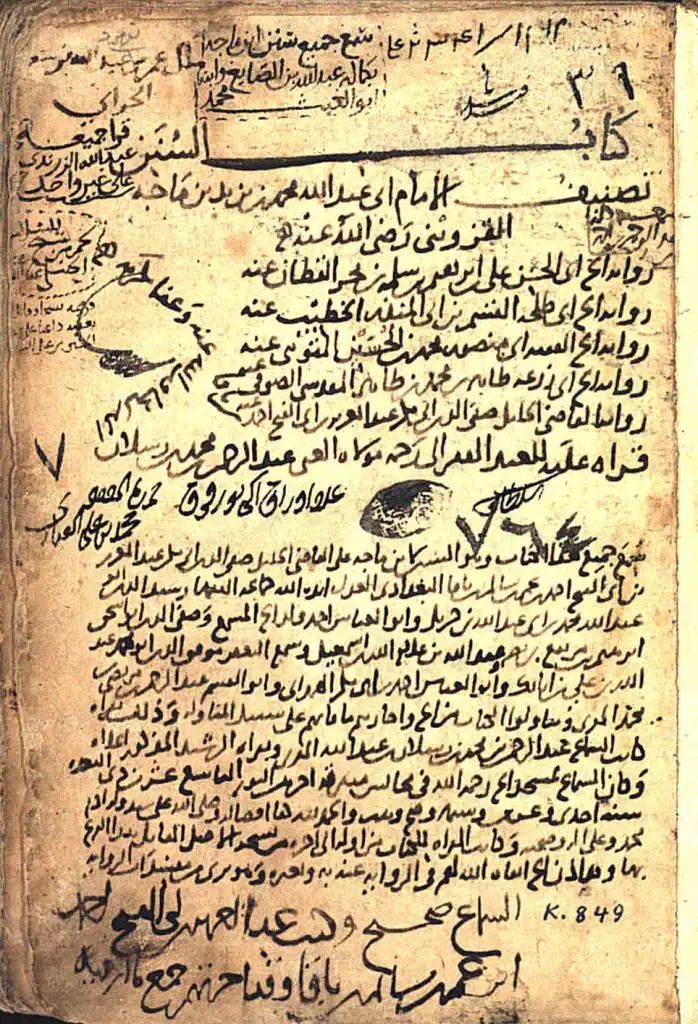
Abu Abdullah Muhammad ibn Yazid ibn Majah al-Qazwini (824-887 CE / 209-273 AH) was the compiler of Sunan Ibn Majah, the sixth and most debated of the six canonical hadith collections in Sunni Islam. His collection is distinguished by its comprehensive coverage of Islamic topics -- it includes many traditions not found in the other five collections -- but it also contains more weak and disputed hadith than its counterparts. The Sunan's canonical status was itself a matter of scholarly debate: it was not originally included in the canon of five collections that most early scholars recognized, and its elevation to the sixth canonical position came through the advocacy of later scholars. Understanding Ibn Majah's collection requires understanding both its genuine contributions and the honest scholarly assessment of its limitations.
Historical Context: Qazwin and the Hadith Tradition
Ibn Majah was born in 824 CE (209 AH) in Qazwin, a city in northwestern Iran (in present-day Qazvin province). Qazwin was an important center of Islamic learning in the Abbasid Caliphate -- a city with a strong tradition of hadith scholarship and a position on the trade routes connecting the Persian heartland with the Caspian coast. The region had produced important scholars, and Ibn Majah grew up in an environment that valued Islamic learning and the preservation of prophetic traditions.
He came of age during the mature phase of the hadith movement -- the same generation that produced Muhammad al-Bukhari, Imam Muslim, Imam Abu Dawood, Imam al-Tirmidhi, and Imam al-Nasa'i. This was the generation that compiled the six canonical collections, and Ibn Majah was the last of the six to complete his work. The intellectual environment of the period was shaped by the aftermath of the Mihna -- the inquisition imposed by Caliph al-Ma'mun to enforce the Mu'tazilite doctrine of the created Quran -- and the failure of that episode had strengthened the position of the hadith scholars as the guardians of authentic Islamic knowledge.
The third Islamic century (roughly 815-915 CE) was the golden age of hadith compilation. The great scholars of this period understood that the oral transmission of prophetic traditions, which had been the primary means of preservation since the Prophet's death, was becoming increasingly unreliable as the generations who had direct connections to the Prophet's companions died out. The systematic compilation of authenticated hadith collections was, in this context, an urgent scholarly and religious obligation -- a race against time to preserve the prophetic legacy before the chains of transmission became too attenuated to be reliable. Ibn Majah participated in this project with the same dedication as his contemporaries, even if his standards of selection were somewhat less rigorous than theirs.
Early Life and the Journey of Learning
Ibn Majah began his hadith studies in Qazwin under local scholars before embarking on the extensive travels that were essential for any serious hadith scholar of his generation. He traveled to the major centers of Islamic learning across the Abbasid world -- to Baghdad, to Basra, to Kufa, to Syria, to Mecca and Medina, and to Egypt -- seeking out scholars who possessed traditions he had not yet collected.
Among his most important teachers was Abu Bakr ibn Abi Shaybah (776-849 CE), one of the most prolific hadith scholars of the period and the compiler of the Musannaf -- a comprehensive collection of hadith and legal opinions that was one of the most important reference works of the third Islamic century. The Musannaf was notable for its breadth of coverage, and it is likely that Abu Bakr ibn Abi Shaybah's comprehensive approach influenced Ibn Majah's own methodology. Ibn Majah also studied under Ali ibn Muhammad al-Tanafusi, Muhammad ibn Rumh, and other major scholars of the period.
He reportedly studied under Imam Ahmad ibn Hanbal, though the extent of this relationship is debated by historians. What is clear is that Ibn Majah had access to the major hadith scholars of his generation and that his collection reflects the full range of traditions that were in circulation in the third Islamic century -- including many that more selective compilers had chosen not to include.
His travels also gave him access to traditions that were preserved in specific regional centers and that might otherwise have been lost. The Islamic world of the ninth century was vast, and the hadith traditions preserved in Syria, Egypt, Iraq, and the Hijaz were not always the same. A scholar who traveled widely could collect traditions that a scholar who stayed in one place would never encounter. This breadth of collection was one of Ibn Majah's genuine contributions to the preservation of prophetic traditions, even if it came at the cost of including some traditions of questionable reliability.
The Sunan: Methodology and Distinctive Character
Ibn Majah compiled his Sunan over a period of years, producing a collection of approximately 4,341 hadith organized by legal topic. The collection is notable for the number of traditions it contains that are not found in the other five canonical collections -- approximately 1,339 hadith appear only in Ibn Majah's Sunan. This makes his collection a valuable source for traditions that might otherwise be inaccessible, and it is one of the reasons scholars have valued it despite its limitations.
The Sunan's most significant limitation is the quality of some of its hadith. Unlike al-Bukhari and Muslim, who applied extremely rigorous standards of authentication, Ibn Majah included traditions of varying quality -- some sahih (authentic), some hasan (good), some da'if (weak), and some that later scholars identified as fabricated. The collection contains approximately 613 hadith that later scholars classified as weak, and a smaller number that were identified as fabricated or severely problematic.
This is not a criticism unique to Ibn Majah -- Imam Abu Dawood also included weak hadith when no stronger tradition existed on a legal topic, and he was transparent about this in his methodology. But Ibn Majah's collection contains more problematic traditions than Abu Dawood's, and this is why it has always been ranked last among the six canonical collections and why its canonical status was debated.
The Sunan is organized by legal topic in the manner of the other Sunan collections, covering the full range of Islamic practice: ritual purity, prayer, fasting, pilgrimage, commercial transactions, marriage and divorce, inheritance, criminal law, and much more. It also includes sections on topics not covered in the other collections, including medicine, dreams, and various aspects of daily life that the more selective compilers had not addressed. This comprehensive coverage is one of the collection's genuine strengths.
The Canonical Status Debate
The most historically significant aspect of Ibn Majah's collection is the debate over its canonical status. The concept of the Kutub al-Sitta (the Six Books) as the canonical hadith collections of Sunni Islam was not established from the beginning -- it developed gradually over the centuries as scholars debated which collections deserved canonical recognition.
The earliest formulations of the hadith canon recognized only five collections: al-Bukhari's Sahih, Muslim's Sahih, Abu Dawood's Sunan, al-Tirmidhi's Jami', and al-Nasa'i's al-Mujtaba. Some scholars substituted the Muwatta of Imam Malik for one of these five, but Ibn Majah's Sunan was not generally included in the early canon. The reason was straightforward: the collection's quality was considered lower than the other five, and scholars who were selecting a canon of the most reliable hadith collections had good reasons to prefer the Muwatta or other collections over Ibn Majah's Sunan.
The first scholar to set out a six-book canon including Ibn Majah was the Khurasani hadith scholar Abu al-Fadl Muhammad ibn Tahir al-Maqdisi (d. 507 AH / 1113 CE), in his Shurut al-a'imma al-sitta. He is generally credited both with delineating the Six Books as a category and with admitting the Sunan to it. The two other works that had been proposed for the sixth place were the Muwatta of Malik ibn Anas and the Sunan of al-Darimi; Ibn Majah's collection prevailed largely because it overlapped less with the other five, and so added more that was not already available -- approximately 1,339 hadith that appear only in Ibn Majah's collection and not in the other five. His argument was that these unique traditions were too valuable to exclude from the canon, even if the collection as a whole was of lower quality than its counterparts. His advocacy was influential, and over time the Sunan Ibn Majah came to be recognized as the sixth canonical collection.
The debate over Ibn Majah's canonical status reflects a genuine tension in hadith scholarship between comprehensiveness and quality. The other five canonical collections were selected partly because of their high standards of authentication; Ibn Majah's collection was included partly because of its breadth of coverage. Both criteria are legitimate, and the debate over which should take precedence has never been fully resolved. Some contemporary scholars continue to prefer a canon of five collections, while others accept the six-book canon that has become standard in most Islamic educational institutions.
It is worth noting that the canonical status of a hadith collection does not mean that every hadith in it is authentic -- even al-Bukhari's Sahih contains a small number of traditions that later scholars have questioned. What canonical status means is that the collection as a whole is recognized as a reliable and authoritative source for Islamic scholarship, and that its contents deserve serious scholarly attention. In Ibn Majah's case, this means that his unique traditions are worth studying and evaluating, even if they require more careful critical scrutiny than the traditions in the other five collections.
The Sunan's Place Among the Six Canonical Collections
The six canonical hadith collections of Sunni Islam -- the Kutub al-Sitta -- are the Sahih of Muhammad al-Bukhari, the Sahih of Imam Muslim, the Sunan of Imam Abu Dawood, the Jami' of Imam al-Tirmidhi, the Sunan of Imam al-Nasa'i, and the Sunan of Ibn Majah. Among these six, al-Bukhari's and Muslim's collections are ranked highest for authenticity; Ibn Majah's Sunan is consistently ranked last.
Despite its lower ranking, the Sunan Ibn Majah has genuine value for Islamic scholarship. Its approximately 1,339 unique traditions -- hadith not found in the other five collections -- make it an important source for scholars studying the full range of prophetic guidance. Many of these unique traditions are authentic and provide valuable information about Islamic practice and the Prophet's teachings on topics not covered in the other collections.
The Sunan also attracted important scholarly commentary. Ibn al-Mulaqqin (d. 1401 CE) wrote a commentary on the collection, and later scholars including al-Suyuti and al-Sindhi produced annotations and explanations that helped readers navigate the collection's varying quality. These commentaries typically identified the weak and problematic traditions, providing guidance on which hadith could be used as legal evidence and which required caution.
Later Life and Legacy
Ibn Majah spent his later years in Qazwin, teaching the Sunan to students and continuing his scholarly work. He died in Qazwin in 273 AH (887 CE), in his mid-sixties by the lunar reckoning. His tomb in Qazwin became a site of scholarly pilgrimage.
His legacy in Islamic scholarship is more complex than that of the other five canonical scholars. He is recognized as a significant hadith scholar who made a genuine contribution to the preservation of prophetic traditions, but his collection is also acknowledged to have limitations that the other canonical collections do not share. This honest assessment -- recognizing both the contribution and the limitations -- is the appropriate way to understand Ibn Majah's place in the history of Islamic hadith scholarship.
The Sunan Ibn Majah's inclusion in the canon reflects the Islamic scholarly tradition's commitment to comprehensiveness alongside quality -- the recognition that even traditions of lower authenticity can have value for understanding the full range of prophetic guidance, provided that their limitations are clearly acknowledged. Ibn Majah's collection, with its unique traditions and its honest scholarly assessment, continues to serve this function in Islamic scholarship today.
The six canonical collections together -- al-Bukhari's Sahih, Muslim's Sahih, Abu Dawood's Sunan, al-Tirmidhi's Jami', al-Nasa'i's al-Mujtaba, and Ibn Majah's Sunan -- represent the collective achievement of a generation of hadith scholars who worked in the third Islamic century to preserve, authenticate, and organize the prophetic traditions that are the foundation of Islamic law and practice. Ibn Majah's contribution to that achievement was the most comprehensive in scope, if not the most rigorous in authentication, and it has earned him a permanent place in the history of Islamic scholarship.
The Debate Over Ibn Majah's Canonical Status
The Sixth Position
The inclusion of Ibn Majah's Sunan among the six canonical collections was not immediate or uncontested. Early scholars who discussed the "canonical" hadith works listed only five books (al-Bukhari, Muslim, Abu Dawood, al-Tirmidhi, and al-Nasa'i) without including Ibn Majah. The sixth position was established for Ibn Majah's collection by Muhammad ibn Tahir al-Maqdisi, discussed above — the same scholar who is also known as Ibn al-Qaysarani, after his family's origin in Caesarea, and who is sometimes mistakenly treated as two separate authorities. His designation was eventually accepted by the broader scholarly community, but it remained debated for centuries. Al-Maqdisi himself observed that the Sunan was well regarded in Rayy but not widely known among jurists elsewhere.
The arguments for Ibn Majah's inclusion centered on the unique traditions his collection contained — hadith not found in the other five collections that provided important evidence for legal rulings. The arguments against centered on the collection's inclusion of weaker hadith and less reliable narrators than the other five. Some scholars (including Ibn Hajar al-Asqalani) suggested that the Muwatta of Imam Malik or the Musnad of al-Darimi would have been more appropriate as the sixth canonical work. Nevertheless, Ibn Majah's position became established through scholarly consensus by the medieval period and has been maintained since.
The Value of Unique Traditions (Zawa'id)
The scholarly term zawa'id (additions/extras) refers to hadith found in Ibn Majah that are not found in the other five canonical collections. These zawa'id number approximately 1,339 traditions — a substantial body of unique material. Scholars have evaluated these unique traditions and found that they vary significantly in quality: some are sahih or hasan (and are genuinely valuable additions to the hadith corpus), while others are weak or even fabricated (and are included only as curiosities or for the sake of comprehensiveness).
This variability means that the Sunan Ibn Majah requires more careful critical use than the other canonical collections. A hadith found only in Ibn Majah does not carry the same presumption of authenticity as one found in al-Bukhari or Muslim — it must be individually evaluated. This requirement has not diminished the collection's scholarly utility, but it has meant that it is used differently: as a supplement to the other collections rather than as a standalone reference, and with awareness that its unique contents include both gems and dross.
Ibn Majah's Other Works
Ibn Majah's scholarly output was not confined to the Sunan, though it is the only major work of his to survive complete, and the losses are worth recording because they affect how his overall standing should be judged.
He is credited by the biographical and bibliographical tradition with a substantial Quranic commentary, a work of Islamic history, and other writings in the hadith sciences beyond the Sunan itself. None of these has come down to the present in a form scholars can examine directly; they are known only through the references later writers made to them, in the manner common to a great many secondary works of the ninth century that did not attract the sustained institutional copying and teaching that would have preserved them. This pattern is itself informative about how a scholar's reputation in this period could narrow over time to a single surviving book, whatever the breadth of his actual output had been.
Among his teachers, the relationship with Abu Bakr ibn Abi Shaybah deserves particular emphasis beyond the general influence already noted. Later scholars examining the Sunan's chains of transmission have found that more than a quarter of its contents trace back through Ibn Abi Shaybah, which makes him by a clear margin the single most important channel through which material reached Ibn Majah's collection, and it explains why the Musannaf's comprehensive and inclusive approach to gathering tradition is visible as an inheritance in Ibn Majah's own working method. Other named teachers whose material appears in the Sunan include Muhammad ibn Abdallah ibn Numayr, Hisham ibn Ammar, and Muhammad ibn Rumh, figures who between them gave Ibn Majah access to hadith circulating across Iraq, Syria and the Hijaz.
Ibn Majah's Life
From Qazvin to the Scholarly World
Abu Abdullah Muhammad ibn Yazid ibn Majah al-Rab'i al-Qazwini was born in 824 CE (209 AH) in Qazvin (in modern Iran), a city that was a significant center of Islamic learning in the third Islamic century. Like his fellow canonical scholars, he traveled extensively in pursuit of hadith — to Baghdad, Basra, Kufa, the Hejaz, Egypt, and Syria — studying under the major scholars of his generation and collecting the traditions that would form his collection.
He was a contemporary of the other five canonical scholars (overlapping with al-Bukhari, Muslim, Abu Dawood, al-Tirmidhi, and al-Nasa'i) and shared many of the same teachers. His decision to compile a comprehensive collection — broader in scope than Abu Dawood's legal focus or al-Tirmidhi's juristic commentary — reflected a desire to preserve as much prophetic tradition as possible, even at the cost of including some material of lower authenticity.
Ibn Majah died in 887 CE (273 AH) in Qazvin at approximately sixty-three years of age. He was buried in his native city, where his scholarly legacy was preserved through students who transmitted his collection and through the broader scholarly networks that carried it across the Islamic world.
References and Further Reading
Primary Islamic Sources
- Quran, Surah al-Hujurat (49:6) — "If a transgressor brings you news, verify it" — the Quranic call to verify transmitted information, foundational to the hadith sciences
- Quran, Surah al-Baqara (2:143) — "Thus We have made you a just community that you will be witnesses over the people" — cited in the context of the scholarly community's responsibility to preserve authentic knowledge
- Ibn Majah, Muhammad ibn Yazid. Sunan Ibn Majah. Edited by Muhammad Fu'ad Abd al-Baqi. 2 vols. Cairo: Dar Ihya' al-Kutub al-Arabiyya, 1952. [Compiled c. 857–887 CE] The canonical collection itself.
- Sahih al-Bukhari, Book of Knowledge, Hadith 80 — on the responsibility of scholars to transmit knowledge accurately, the ethical framework within which Ibn Majah worked
Classical Islamic Sources
- Ibn Majah, Muhammad ibn Yazid. Sunan Ibn Majah. Edited by Muhammad Fu'ad Abd al-Baqi. 2 vols. Cairo: Dar Ihya' al-Kutub al-Arabiyya, 1952. [Compiled c. 887 CE]
- Al-Sindi, Muhammad Abid. Hashiyat al-Sindi 'ala Sunan Ibn Majah. Printed with the Sunan. [Original c. 18th century CE] The standard commentary.
- Al-Dhahabi, Shams al-Din. Siyar A'lam al-Nubala. Edited by Shu'ayb al-Arna'ut. Mu'assasat al-Risala, 1981. [Original c. 1320 CE]
- Al-Mizzi, Jamal al-Din. Tahdhib al-Kamal fi Asma' al-Rijal. Edited by Bashshar Awwad Ma'ruf. Beirut: Mu'assasat al-Risala, 1980. [Original c. 1341 CE]
- Ibn al-Mulaqqin, Siraj al-Din. Al-Badr al-Munir fi Takhrij al-Ahadith wa al-Athar al-Waqi'a fi al-Sharh al-Kabir. Riyadh: Dar al-Hijra, 2004. [Original c. 14th century CE] Includes grading of traditions found in Ibn Majah.
Academic and Scholarly Sources
- Brown, Jonathan A.C. Hadith: Muhammad's Legacy in the Medieval and Modern World. Oxford: Oneworld Publications, 2009.
- Brown, Jonathan A.C. The Canonization of al-Bukhari and Muslim: The Formation and Function of the Sunni Hadith Canon. Leiden: Brill, 2007.
- Siddiqi, Muhammad Zubayr. Hadith Literature: Its Origin, Development and Special Features. Cambridge: Islamic Texts Society, 1993.
- Al-Azami, Muhammad Mustafa. Studies in Hadith Methodology and Literature. Indianapolis: American Trust Publications, 1977.
- Melchert, Christopher. The Formation of the Sunni Schools of Law, 9th–10th Centuries CE. Leiden: Brill, 1997.
Further Reading
- Juynboll, G.H.A. Muslim Tradition: Studies in Chronology, Provenance and Authorship of Early Hadith. Cambridge: Cambridge University Press, 1983.
- Lucas, Scott C. Constructive Critics, Hadith Literature, and the Articulation of Sunni Islam. Leiden: Brill, 2004.
- Robson, James. An Introduction to the Science of Tradition. London: Royal Asiatic Society, 1953.
Mentioned In
10 articles reference this topic
More from Abbasid Caliphate
University of al-Qarawiyyin
The University of al-Qarawiyyin in Fez, Morocco, founded as a mosque in 857-859 CE, is recognised by UNESCO as the oldest existing, continually operating institution of higher learning in the world, and a historic centre of Maliki legal scholarship in the western Islamic world.
Abbasid Caliphate
The third major Islamic caliphate (750–1258 CE), centered in Baghdad. It presided over the Islamic Golden Age, with landmark advances in science, philosophy, literature, and the arts, forging a cosmopolitan empire that blended Greek, Persian, Indian, and Arab traditions.
Baghdad
Baghdad, founded in 762 CE by Caliph al-Mansur, served as the capital of the Abbasid Caliphate and became the intellectual, cultural, and economic center of the Islamic world during the Islamic Golden Age, reaching a population of over one million before its destruction by the Mongols in 1258 CE.
Islamic Schools of Jurisprudence: The Madhabs
The madhabs, the schools of Islamic law that developed methods for deriving rulings from the Qur'an and the Sunnah. Four Sunni schools and the Shi'a traditions have guided Muslim practice for over a millennium; they are schools of method, not sects.