Imam Abu Dawood
Abu Dawood Sulaiman ibn al-Ash'ath (817–889 CE) was one of the six canonical hadith scholars of Sunni Islam. His Sunan Abu Dawood, distilled to about 4,800 hadith, was the first major collection organized around Islamic legal topics, becoming an essential reference for jurists.
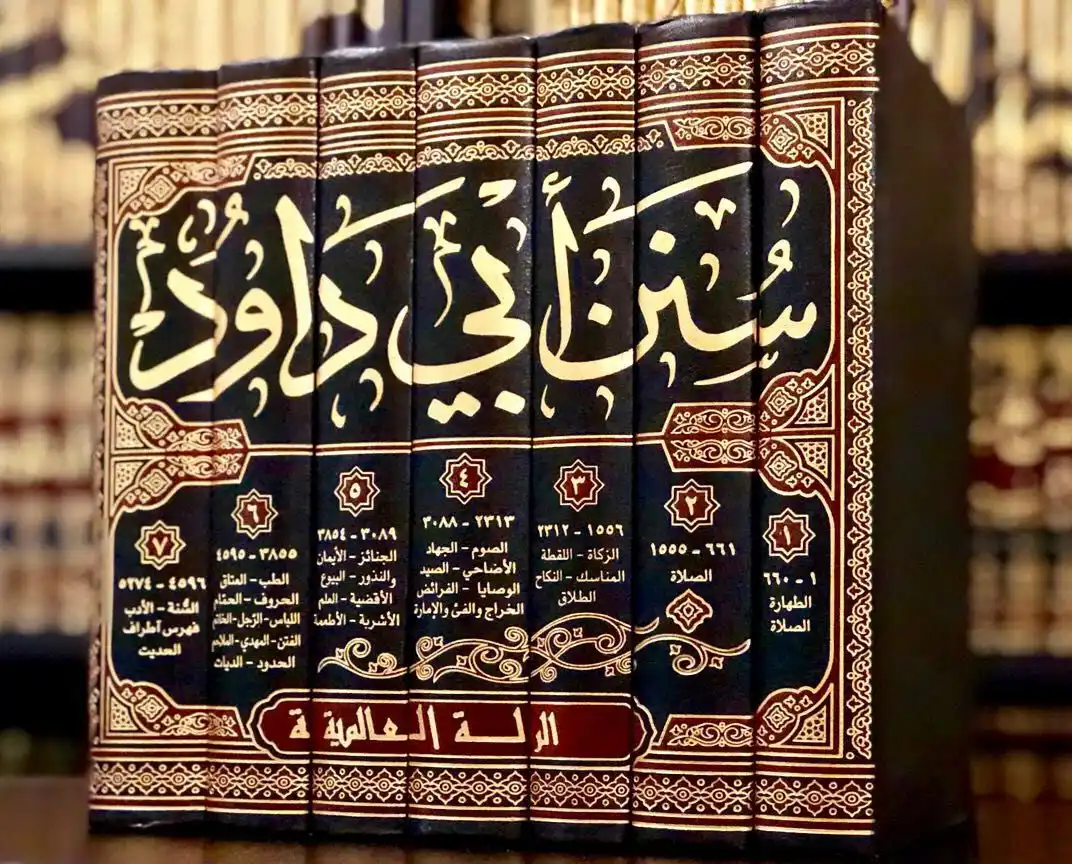
Abu Dawood Sulaiman ibn al-Ash'ath al-Azdi as-Sijistani (817-889 CE / 202-275 AH) was one of the six canonical hadith scholars of Sunni Islam and the compiler of Sunan Abu Dawood, the first major hadith collection organized specifically around Islamic legal topics. His work occupies a distinctive place among the six canonical collections: where Muhammad al-Bukhari and Imam Muslim aimed for the highest standards of authenticity, Abu Dawood aimed for comprehensiveness in legal coverage -- collecting every hadith that bore on a legal question, even when the strongest available tradition was weak, so that jurists would have the full range of prophetic guidance on every topic. This approach made the Sunan the essential reference for Islamic jurisprudence across all four major Sunni legal schools.
Historical Context: The Hadith Movement in the Third Islamic Century
Abu Dawood was born in 817 CE in Sijistan, a region in the eastern reaches of the Abbasid Caliphate corresponding to modern eastern Iran and western Afghanistan. He came of age during one of the most intellectually productive periods in Islamic history -- the third Islamic century (roughly 815-915 CE), when the great hadith collections were being compiled, the four major Sunni legal schools were taking their definitive forms, and the relationship between hadith scholarship and legal reasoning was being worked out in ways that would shape Islamic thought for centuries.
The intellectual environment of this period was shaped by the aftermath of the Mihna -- the inquisition imposed by Caliph al-Ma'mun to enforce the Mu'tazilite doctrine of the created Quran. The Mihna's failure, symbolized by Ahmad ibn Hanbal's steadfast refusal to submit, had established the principle that the transmitted sources of Islamic knowledge -- the Quran and the authenticated traditions of the Prophet -- were the foundation of religious authority, and that no political power had the right to override them. This principle shaped the entire generation of hadith scholars who came after the Mihna, including Abu Dawood, who studied directly under Ahmad ibn Hanbal.
Early Life and the Journey of Learning
Abu Dawood's early education in Sijistan gave him the foundation in Arabic, Quranic studies, and Islamic jurisprudence that was standard for scholars of his class. But the real education of a hadith scholar in the ninth century required travel -- extensive, decades-long travel across the Islamic world to study with the scholars who possessed the most reliable chains of transmission.
Abu Dawood began his travels as a teenager and continued them for more than two decades, visiting virtually every major center of Islamic learning in the Abbasid world. He studied in Baghdad, the Abbasid capital and the most intellectually vibrant city in the medieval world. He traveled to Basra, the great port city of southern Iraq that had been a center of hadith scholarship since the early Islamic period. He visited Mecca and Medina, the holy cities whose scholars preserved the most direct connections to the Prophet's community. He traveled to Syria, Egypt, and Khurasan, collecting traditions from scholars whose chains of transmission he could not find elsewhere.
The most important of his teachers was Ahmad ibn Hanbal (780-855 CE), the founder of the Hanbali school of jurisprudence and the scholar whose resistance to the Mihna had made him the most respected religious figure in the Sunni world. Abu Dawood studied under Ahmad for years, absorbing not only his hadith but his methodological approach -- the insistence on the primacy of transmitted sources over rational reasoning, the willingness to accept a weak hadith as evidence when no stronger tradition existed on a topic, and the conviction that the Prophet's practice was the most reliable guide to Islamic law. These principles would shape the Sunan in fundamental ways.
He also studied under Yahya ibn Ma'in (775-847 CE), the greatest hadith critic of his generation, whose encyclopedic knowledge of narrator biographies and transmission chains was unmatched. From Yahya ibn Ma'in, Abu Dawood learned the techniques of rijal criticism -- the systematic evaluation of the men and women who had transmitted hadith across the generations -- that were essential for any serious hadith scholar.
The Sunan: Methodology and Distinctive Character
Abu Dawood eventually settled in Basra, where he compiled the Sunan over a period of years. He reportedly examined approximately 500,000 hadith in the course of his career and selected approximately 4,800 for inclusion in the Sunan -- a ratio of roughly one in a hundred, reflecting both the breadth of his collection and the rigor of his selection.
The Sunan's most distinctive feature was its organization and purpose. Where al-Bukhari's Sahih and Muslim's Sahih were organized to demonstrate the highest standards of hadith authenticity -- selecting only traditions that met the most stringent criteria -- Abu Dawood's Sunan was organized to serve the needs of jurists. Every major topic of Islamic law -- ritual purity, prayer, fasting, pilgrimage, commercial transactions, marriage and divorce, inheritance, criminal law, governance -- was covered with the full range of relevant prophetic traditions, from the most authentic to the merely acceptable.
This approach required a methodological decision that distinguished Abu Dawood from al-Bukhari and Muslim: he included weak hadith when no stronger tradition existed on a legal topic. His reasoning was practical and explicitly stated: a jurist who needed to know the Prophet's guidance on a specific question needed to know all the relevant traditions, not just the strongest ones. A weak hadith was better than no hadith at all, and better than the opinion of a scholar who had no prophetic precedent to rely on. Abu Dawood was careful to note when a hadith was weak, and he sometimes added brief comments explaining the degree of weakness, but he did not exclude weak traditions from the collection simply because they failed to meet al-Bukhari's standards.
Abu Dawood described his methodology in a famous letter to the people of Mecca, which has been preserved and studied by later scholars. In it, he explained that he had organized the Sunan to cover every legal topic on which the Prophet had spoken, that he had included the strongest available tradition on each topic, and that when a tradition was weak he had noted this. He also explained that he had sometimes included traditions that were disputed or that had problems in their chains of transmission, because the legal question they addressed was important and no better tradition existed. This transparency about his methodology was unusual and reflects the intellectual honesty that characterized his scholarship.
The Sunan's Place Among the Six Canonical Collections
The six canonical hadith collections of Sunni Islam -- known collectively as the Kutub al-Sitta (the Six Books) -- are the Sahih of Muhammad al-Bukhari, the Sahih of Imam Muslim, the Sunan of Abu Dawood, the Jami of Imam Tirmidhi, the Sunan of Imam al-Nasa'i, and the Sunan of Ibn Majah. Among these six, al-Bukhari's and Muslim's collections are ranked highest for authenticity; Abu Dawood's Sunan is generally ranked third, and it is the most important of the four Sunan collections for legal purposes.
The Sunan's legal focus made it the natural reference for jurists across all four major Sunni legal schools -- Hanafi, Maliki, Shafi'i, and Hanbali. Unlike al-Bukhari's Sahih, which was organized partly to demonstrate the authenticity of specific traditions and partly to make legal arguments through the arrangement of chapter headings, Abu Dawood's Sunan was organized straightforwardly by legal topic, making it easy for a jurist to find all the relevant prophetic traditions on any question. This practical utility ensured that the Sunan was studied and cited across the full range of Sunni legal scholarship, not just within the Hanbali school that Abu Dawood's teacher Ahmad ibn Hanbal had founded.
The Sunan also served an important function in the ongoing debates between the legal schools. When Hanafi, Maliki, Shafi'i, and Hanbali jurists disagreed about a legal question, they could turn to Abu Dawood's collection to find the full range of prophetic traditions bearing on the question, including traditions that might support positions other than their own. This made the Sunan a common reference point for inter-school legal debate, and it contributed to the development of a shared Sunni legal culture that transcended the boundaries of individual schools.
Later Life and the Transmission of the Sunan
Abu Dawood spent his later years in Basra, teaching the Sunan to students who came from across the Islamic world. The transmission of the Sunan -- the process by which students learned the collection from Abu Dawood and then taught it to their own students -- was the mechanism through which the collection became part of the Sunni hadith canon. Abu Dawood reportedly presented the Sunan to Ahmad ibn Hanbal, who praised it highly, and this endorsement from the most respected religious figure of the age helped establish the collection's authority.
The Sunan attracted commentaries from later scholars almost immediately. The most important early commentary was by al-Khattabi (931-998 CE), whose Ma'alim al-Sunan (The Landmarks of the Sunan) explained the legal implications of each hadith and addressed the methodological questions raised by Abu Dawood's inclusion of weak traditions. Later commentaries by Ibn al-Qayyim al-Jawziyyah and others extended this tradition of scholarly engagement with the Sunan across the centuries.
Abu Dawood died in Basra in 889 CE at approximately seventy-two years of age. He had spent his life in the service of hadith scholarship, and the collection he left behind became one of the most studied and most cited texts in the history of Islamic jurisprudence.
Legacy
Abu Dawood's legacy in Islamic scholarship is inseparable from the Sunan. The collection he compiled -- from a reported 500,000 hadith down to approximately 4,800, organized by legal topic and accompanied by methodological transparency about the quality of each tradition -- became the essential reference for Islamic jurisprudence across all four major Sunni legal schools. It was studied in the great madrasas of the medieval Islamic world, cited in the legal opinions of jurists from Baghdad to Cordoba, and commented upon by scholars across fourteen centuries.
His methodological contribution was as significant as the collection itself. By explicitly including weak hadith when no stronger tradition existed on a legal topic, and by being transparent about the degree of weakness, Abu Dawood established a model for legal hadith scholarship that balanced the demands of authenticity with the practical needs of jurists. This model -- comprehensive coverage of legal topics, transparent evaluation of hadith quality, practical orientation toward the needs of legal practice -- influenced the subsequent development of Islamic jurisprudence in ways that are still felt today.
The Sunan also demonstrates something important about the relationship between hadith scholarship and legal reasoning in the Sunni tradition. Abu Dawood was not simply a collector of traditions; he was a jurist who understood that the Prophet's practice was the most reliable guide to Islamic law, and who organized his collection to make that guidance as accessible as possible to the scholars who needed it. His work embodies the conviction -- shared with his teacher Ahmad ibn Hanbal and with the broader hadith movement of the third Islamic century -- that the transmitted sources of Islamic knowledge were the foundation of religious authority, and that the task of the scholar was to preserve, authenticate, and transmit those sources as faithfully as possible.
Abu Dawood's Methodology: The Letter to the People of Mecca
The Risala: A Methodological Self-Description
One of the most valuable documents for understanding Abu Dawood's methodology is his letter (risala) to the people of Mecca, in which he described the principles he followed in compiling the Sunan. This letter is remarkable for its transparency — Abu Dawood explained exactly what he was doing and why, allowing future scholars to evaluate his work against his stated criteria.
The principles he described are several. He selected approximately 4,800 hadith from a pool of 500,000 that he had collected during his travels, including the most reliable hadith on each legal topic, along with weaker traditions when no strong hadith existed — transparently noting the weakness — and omitting traditions on topics where he felt the evidence was too weak to be useful even for legal inference. He organized the collection specifically for the use of jurists rather than hadith critics, placing traditions under the legal topics they addressed rather than by narrator or by grade of authenticity. And he described his silence on a hadith — not commenting on its authenticity — as indicating that it was at least salih (suitable for use), establishing a principle that "silence is approval" in his collection.
This letter gave subsequent scholars a key to interpreting the Sunan: when Abu Dawood commented on a hadith's weakness, it was genuinely problematic; when he remained silent, it could be used as evidence; and when he explicitly praised a hadith's chain, it met the highest standards.
The Legal Organization
Abu Dawood's decision to organize his collection by legal topic (abwab fiqhiyya) rather than by narrator (as Ahmad's Musnad did) or by a mix of topics and methodology (as al-Bukhari's Sahih did) made the Sunan the most juristically accessible of the canonical collections. A jurist seeking hadith on ablution, on the conditions of prayer, on commercial contracts, or on criminal punishment could find all relevant traditions gathered in one place, with Abu Dawood's evaluative comments guiding them toward the strongest evidence.
This organizational principle reflected Abu Dawood's primary audience: he was writing for judges and jurists who needed practical access to prophetic guidance on legal questions, not for hadith critics who wanted to study chains of transmission or for devotional readers who wanted to contemplate the Prophet's character. The Sunan was, in effect, a legal reference work built from hadith evidence — a bridge between the raw materials of prophetic tradition and the practical needs of Islamic governance.
The Transmitters of the Sunan
The Sunan as it circulated after Abu Dawood's death was not a single fixed text handed down uniformly, and the reason is a normal feature of how hadith collections were transmitted rather than a defect peculiar to his work. Abu Dawood taught the collection to a number of students over years of instruction in Basra, and at least nine of them are named in the later transmission literature as having passed on their own versions, differing in minor respects — the inclusion of a small number of additional traditions, slight variations in wording or arrangement — depending on exactly when each had studied with him and which recitation of the text he gave on that occasion.
The version that became standard and that is printed today descends principally through the transmission of Abu Ali Muhammad ibn Ahmad al-Lu'lu'i, one of Abu Dawood's Basran students, whose recension was judged the most complete and the most carefully checked against the master's own copy. Modern scholarship on the Sunan's textual history, including the analysis summarised in the Encyclopaedia of Islam and in specialist studies of the work's transmission, has traced the relationships among the surviving recensions in detail; the differences between them are minor and do not affect the collection's substantive content, but they are a reminder that a hadith collection of this period is properly understood as a taught text passed from teacher to named students, each transmission independently verifiable, rather than as a book published once and then simply copied.
Later scholars computed that a very high proportion of the Sunan's content — estimates converge on something close to nine-tenths — consists of hadith attributed directly to the Prophet, with the remainder drawn from the sayings and rulings of his Companions and their successors, included where Abu Dawood judged them relevant to the legal question at hand. This proportion is itself evidence for the collection's character: a work built overwhelmingly from prophetic material, organised for legal use, with a smaller supplementary layer of authoritative early opinion where the prophetic record needed the context that only the earliest generations could supply.
Abu Dawood's Life and Travels
From Sijistan to the World
Abu Dawood Sulaiman ibn al-Ash'ath ibn Ishaq al-Azdi al-Sijistani was born in 817 CE (202 AH) in Sijistan (modern Sistan, on the Iran-Afghanistan border). He began his scholarly travels young and journeyed extensively — to Baghdad, Basra, Kufa, the Hejaz (Mecca and Medina), Egypt, Syria, Khorasan, and other centers of learning. His teachers included many of the greatest hadith scholars of his generation, and most significantly he studied under Ahmad ibn Hanbal — the great Imam of hadith whose influence permeates the Sunan.
Ahmad ibn Hanbal's influence on Abu Dawood was profound. Ahmad's insistence on the primacy of hadith evidence in legal reasoning, his comprehensive collection of traditions in the Musnad, and his personal example of scholarly independence all shaped Abu Dawood's approach. The Sunan can be understood, in part, as an attempt to make Ahmad's vast hadith knowledge practically accessible to jurists — to take the raw material that Ahmad had collected and organize it into a usable legal reference.
Settlement in Basra
After his years of travel, Abu Dawood settled in Basra, where he taught and transmitted his Sunan until his death in 889 CE (275 AH) at approximately seventy-two years of age. Basra was an appropriate home for a scholar of his orientation — it was a major center of hadith learning (having produced scholars like Abu Amr al-Basri, one of the seven canonical Quran readers) and a city with an active judiciary that could benefit from his legally-oriented collection. He was buried in Basra beside the grave of Sufyan al-Thawri, one of the great early jurist-hadith scholars.
References and Further Reading
Primary Islamic Sources
- Quran, Surah al-Nisa (4:59) — "Obey Allah and obey the Messenger" — the Quranic basis for the legal authority of hadith that Abu Dawood's Sunan was compiled to preserve
- Quran, Surah al-Ahzab (33:36) — "It is not for a believing man or believing woman, when Allah and His Messenger have decided a matter, that they should have any other choice in their matter" — key verse for the binding legal authority of the Prophet's practice
- Sunan Abu Dawood. Kitab al-Salah, Hadith 769 — on the detailed practice of prayer, an example of the legal focus that defines the collection
- Sunan Abu Dawood. Kitab al-Adab, Hadith 4800 — ethical hadith; the collection covers topics from ritual law to personal conduct
- Abu Dawood, Sulaiman ibn al-Ash'ath. Risala ila Ahl Mecca fi Wasf Sunanuh (Letter to the People of Mecca describing the Sunan). Preserved in classical hadith scholarship — Abu Dawood's own methodological statement.
Classical Islamic Sources
- Abu Dawood, Sulaiman ibn al-Ash'ath. Sunan Abu Dawood. Edited by Muhammad Muhyi al-Din Abd al-Hamid. 4 vols. Beirut: Dar al-Fikr, n.d. [Compiled c. 840–889 CE]
- Al-Khattabi, Abu Sulayman. Ma'alim al-Sunan (Landmarks of the Sunan). 4 vols. Aleppo: al-Matba'a al-Ilmiyya, 1932. [Original c. 998 CE] The earliest and most important commentary on Sunan Abu Dawood.
- Ibn al-Qayyim al-Jawziyya, Muhammad ibn Abi Bakr. Tahdhib Sunan Abi Dawood. Edited by Ahmad Muhammad Shakir. Beirut: Dar al-Ma'rifa, n.d. [Original c. 1350 CE]
- Al-Dhahabi, Shams al-Din. Siyar A'lam al-Nubala. Edited by Shu'ayb al-Arna'ut. Mu'assasat al-Risala, 1981. [Original c. 1320 CE]
- Ibn Hajar al-Asqalani, Ahmad ibn Ali. Tahdhib al-Tahdhib. Hyderabad: Da'irat al-Ma'arif al-Nizamiyya, 1907. [Original c. 1449 CE]
Academic and Scholarly Sources
- Brown, Jonathan A.C. Hadith: Muhammad's Legacy in the Medieval and Modern World. Oxford: Oneworld Publications, 2009.
- Siddiqi, Muhammad Zubayr. Hadith Literature: Its Origin, Development and Special Features. Cambridge: Islamic Texts Society, 1993.
- Al-Azami, Muhammad Mustafa. Studies in Hadith Methodology and Literature. Indianapolis: American Trust Publications, 1977.
- Hallaq, Wael B. The Origins and Evolution of Islamic Law. Cambridge: Cambridge University Press, 2005.
- Lucas, Scott C. Constructive Critics, Hadith Literature, and the Articulation of Sunni Islam. Leiden: Brill, 2004.
Further Reading
- Schacht, Joseph. The Origins of Muhammadan Jurisprudence. Oxford: Oxford University Press, 1950.
- Motzki, Harald, ed. Hadith: Origins and Developments. Aldershot: Ashgate, 2004.
- Juynboll, G.H.A. Encyclopedia of Canonical Hadith. Leiden: Brill, 2007.
Mentioned In
15 articles reference this topic
and 3 more articles
More from Abbasid Caliphate
Islamic Schools of Jurisprudence: The Madhabs
The madhabs, the schools of Islamic law that developed methods for deriving rulings from the Qur'an and the Sunnah. Four Sunni schools and the Shi'a traditions have guided Muslim practice for over a millennium; they are schools of method, not sects.
The Dhimmi System and Religious Minorities in Islamic Societies
The legal status accorded to Christians, Jews and other recognised religious minorities under Islamic rule. It secured life, property, worship and communal autonomy in return for a special tax and defined restrictions, and lasted into the twentieth century.
University of al-Qarawiyyin
The University of al-Qarawiyyin in Fez, Morocco, founded as a mosque in 857-859 CE, is recognised by UNESCO as the oldest existing, continually operating institution of higher learning in the world, and a historic centre of Maliki legal scholarship in the western Islamic world.
Abbasid Caliphate
The third major Islamic caliphate (750–1258 CE), centered in Baghdad. It presided over the Islamic Golden Age, with landmark advances in science, philosophy, literature, and the arts, forging a cosmopolitan empire that blended Greek, Persian, Indian, and Arab traditions.