Imam al-Nasa'i
Ahmad ibn Shu'ayb al-Nasa'i (829–915 CE) was one of the six canonical hadith scholars of Sunni Islam. His al-Sunan al-Sughra (al-Mujtaba) is distinguished by exceptionally rigorous narrator criticism — standards so demanding he rejected narrators other major scholars accepted.
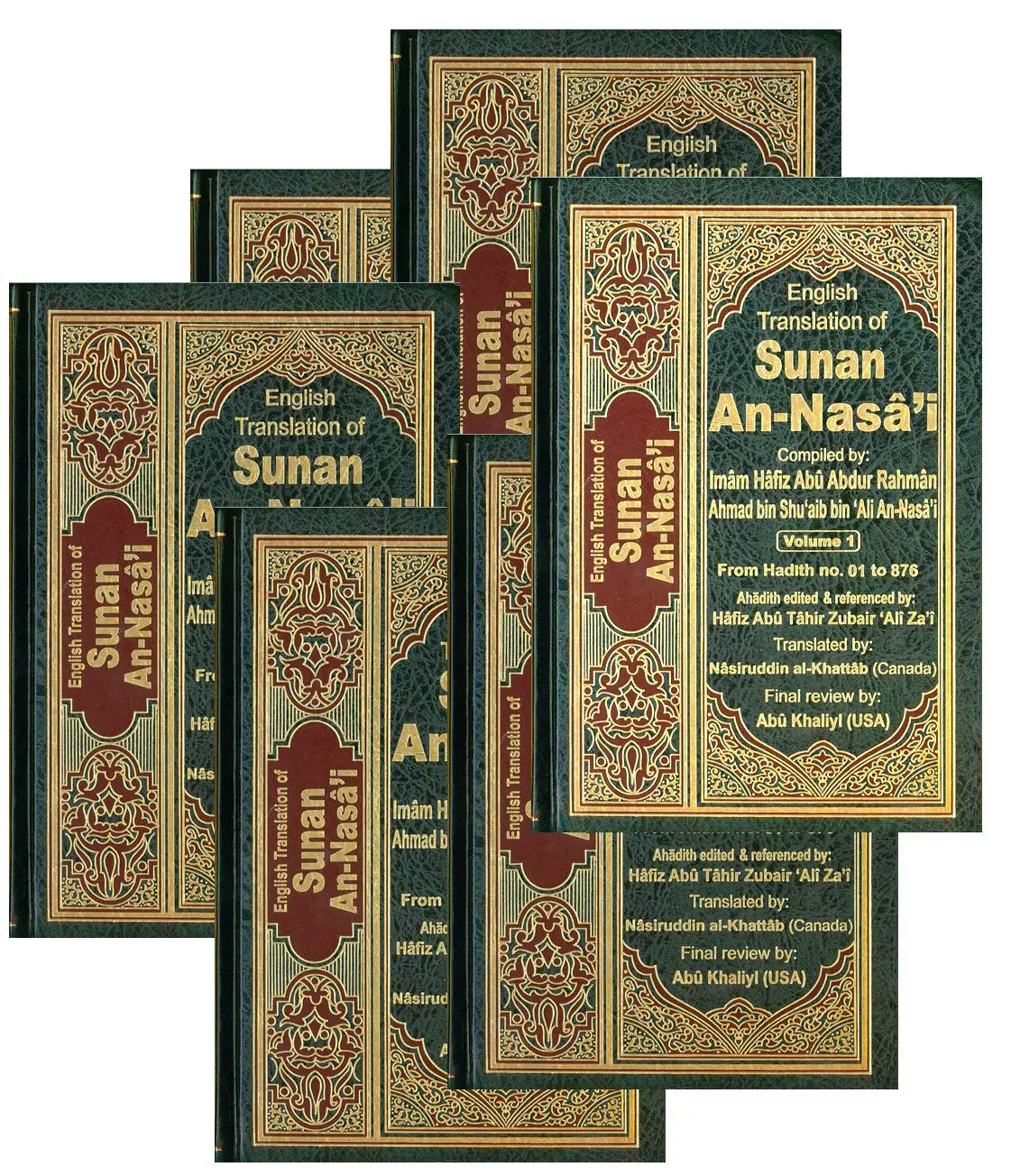
Abu Abd al-Rahman Ahmad ibn Shu'ayb al-Nasa'i (829-915 CE / 214-303 AH) was one of the six canonical hadith scholars of Sunni Islam and the compiler of al-Sunan al-Sughra (The Small Sunan), also known as al-Mujtaba (The Selected), which became the fifth of the six canonical hadith collections. Al-Nasa'i is distinguished among the six canonical scholars by the exceptional rigor of his narrator criticism -- his standards for evaluating the reliability of hadith transmitters were so demanding that he was willing to reject narrators that Muhammad al-Bukhari and Imam Muslim had accepted. This uncompromising approach to authenticity, combined with his comprehensive coverage of legal topics, gave his collection a distinctive character that made it an essential reference for Islamic scholarship.
Historical Context: Egypt and the Late Abbasid Hadith Tradition
Al-Nasa'i was born in 829 CE in Nasa, a city in the Khurasan region of Central Asia (in present-day Turkmenistan). He came of age during the mature phase of the Abbasid Caliphate's intellectual flowering -- a period when the great hadith collections were being compiled, the four major Sunni legal schools had taken their definitive forms, and the science of hadith criticism had developed into a sophisticated discipline with its own technical vocabulary and methodological standards.
The generation of hadith scholars to which al-Nasa'i belonged -- which also included Imam Abu Dawood (817-889 CE) and Imam Tirmidhi (824-892 CE) -- worked in the shadow of the two great collections that had already been compiled: al-Bukhari's Sahih and Muslim's Sahih. These two collections had set the standard for hadith authenticity, and the scholars who came after them had to define their own contributions in relation to that standard. Al-Nasa'i's response was to push the standards of narrator criticism even further -- to apply a more demanding evaluation of transmitter reliability than al-Bukhari and Muslim had used, and to produce a collection that, while not claiming to match the Sahihayn in overall authenticity, was distinguished by the rigor of its critical apparatus.
Early Life and the Journey of Learning
Al-Nasa'i began his travels in pursuit of hadith at a young age, following the established pattern of the great hadith scholars of his generation. He traveled extensively across the Islamic world -- to Baghdad, to Basra, to Kufa, to Syria, to Mecca and Medina, to Egypt -- studying with the leading hadith scholars of each region and collecting traditions from chains of transmission that he could not find elsewhere.
Among his most important teachers was Qutayba ibn Sa'id (d. 240 AH), one of the most prolific hadith transmitters of the period, from whom al-Nasa'i received a large number of traditions. He also studied under Ishaq ibn Rahawayh, the great hadith scholar and jurist who had been a teacher of Imam Ahmad ibn Hanbal and who was known for his exceptionally rigorous standards. The influence of these teachers shaped al-Nasa'i's own approach to hadith criticism -- his insistence on the highest standards of narrator reliability and his willingness to criticize transmitters that other scholars had accepted.
Al-Nasa'i eventually settled in Egypt, where he spent the most productive decades of his scholarly career. Egypt had been a center of Islamic learning since the early Islamic period, and by the ninth century it had developed a distinctive hadith tradition that drew on both the eastern and western streams of Islamic scholarship. Al-Nasa'i became the leading hadith authority in Egypt, attracting students from across the Islamic world and producing the scholarly work that would define his legacy.
The Two Versions of the Sunan
Al-Nasa'i's most important scholarly achievement was his hadith collection, but the story of that collection is more complex than is sometimes recognized. He produced two versions: the al-Sunan al-Kubra (The Large Sunan) and the al-Sunan al-Sughra (The Small Sunan), also known as al-Mujtaba (The Selected).
The al-Sunan al-Kubra was al-Nasa'i's comprehensive collection -- a large work that included all the hadith he had collected and authenticated, organized by legal topic. It was a substantial scholarly achievement in its own right, and it remains an important reference work for hadith scholars. But it was not the version that became canonical.
The al-Mujtaba was produced at the request of the governor of Ramla (in present-day Palestine), who asked al-Nasa'i to select from the al-Kubra only those traditions that were sound enough to be used as legal evidence. Al-Nasa'i complied, producing a more selective collection that applied his most rigorous standards of authentication. The al-Mujtaba contains approximately 5,700 hadith -- fewer than the al-Kubra but more carefully selected -- and it is this version that became the fifth of the six canonical collections.
The existence of two versions reflects something important about al-Nasa'i's scholarly approach. He understood that different purposes required different standards: a comprehensive collection for scholarly research could include traditions of varying quality, while a collection intended for legal use required the highest standards of authenticity. The al-Mujtaba was his answer to the question of what a jurist needed -- a collection that was comprehensive in its coverage of legal topics but rigorous in its selection of individual traditions.
Scale of the Larger Collection
The al-Sunan al-Kubra is worth describing in its own right, because the relationship between it and the canonical al-Mujtaba is easy to state imprecisely. The Kubra is a substantial work of roughly twelve thousand hadith, organised like the Mujtaba by legal topic but including a considerably wider range of material — sound, good and weaker traditions together, with al-Nasa'i's own critical apparatus available to a reader prepared to work through it in full.
The often-repeated account of how the Mujtaba was produced from it deserves to be set out with its actual content rather than abbreviated to "a selection." Al-Nasa'i presented the Kubra to the governor of Ramla, in Palestine, and was asked directly whether everything in it was authentic. He answered honestly that it contained authentic material, good material, and material close to those grades — an answer consistent with everything else known about his exactness — and the governor then asked him to produce a version confined to what was reliable enough for practical use. The Mujtaba is that response: not a different book so much as the reliable core of the same one, extracted at a patron's request and for a stated practical purpose.
This origin explains a feature of the Mujtaba that distinguishes it from the other Sunan collections. Where Abu Dawood set out to gather everything bearing on a legal question, including weak material flagged as such, al-Nasa'i's canonical work existed specifically to remove that weaker material at the point of compilation, because removing it was the task he had been asked to perform. The Kubra remains available to scholars who want the fuller picture; the Mujtaba is what resulted from applying his standards to it without compromise.
Al-Nasa'i's Distinctive Approach to Narrator Criticism
What most distinguished al-Nasa'i from his contemporaries was the rigor of his narrator criticism -- his evaluation of the men and women who had transmitted hadith across the generations. The science of rijal criticism (the evaluation of hadith transmitters) was the foundation of hadith authentication, and al-Nasa'i was its most demanding practitioner among the six canonical scholars.
Al-Nasa'i's approach was characterized by a willingness to criticize narrators that other major scholars had accepted. He produced a work specifically devoted to weak narrators -- al-Du'afa wa al-Matrukin (The Weak and the Abandoned) -- in which he identified transmitters whose reliability he considered insufficient for their hadith to be used as evidence. Some of the narrators he criticized in this work had been accepted by al-Bukhari or Muslim, and al-Nasa'i's willingness to disagree with his predecessors on these evaluations reflects both his scholarly independence and his exceptionally high standards.
This rigor had practical consequences for the al-Mujtaba. The collection contains fewer hadith than al-Bukhari's Sahih or Muslim's Sahih, not because al-Nasa'i had access to fewer traditions but because he applied more demanding criteria for inclusion. A tradition that al-Bukhari had accepted might be excluded from the al-Mujtaba if al-Nasa'i had reservations about one of the narrators in its chain of transmission. This made the al-Mujtaba a more selective collection than the Sahihayn in some respects, even though it was not ranked as highly in overall authenticity.
Al-Nasa'i also paid particular attention to the subtle differences between narrators who were generally reliable but had specific weaknesses -- narrators who were reliable in transmitting from certain teachers but not others, or who were reliable in certain periods of their lives but not others. This nuanced approach to narrator evaluation was one of his most significant contributions to the science of hadith criticism.
Character and Method as a Teacher
Al-Nasa'i's personal reputation among his contemporaries and immediate successors reinforces the picture that emerges from his scholarship. He was known in Egypt by the title Hafiz al-Hadith — a designation reserved for a scholar whose command of the transmitted material, and of the biographies of those who transmitted it, was considered exhaustive rather than merely extensive. Students travelled to study under him specifically because his critical apparatus was regarded as the most demanding available, and being certified by al-Nasa'i as a reliable narrator, or having one's hadith admitted into his collection, carried a weight that scholars of the next generation continued to invoke.
His personal conduct is described in the biographical tradition as ascetic and disciplined, consistent with the general profile of the hadith scholars of this period: regular fasting, a plain manner of living, and an evident seriousness about the responsibility of transmitting material attributed to the Prophet. Whether or not every detail of this description can be verified, it is consistent with the substance of his scholarly method, which treated the acceptance of a single unreliable transmitter as a real harm to be avoided rather than a technicality to be waived for convenience.
The Sunan's Place Among the Six Canonical Collections
The six canonical hadith collections of Sunni Islam -- the Kutub al-Sitta -- are the Sahih of Muhammad al-Bukhari, the Sahih of Imam Muslim, the Sunan of Imam Abu Dawood, the Jami of Imam Tirmidhi, the Sunan of al-Nasa'i, and the Sunan of Ibn Majah. Among these six, al-Bukhari's and Muslim's collections are ranked highest for authenticity; al-Nasa'i's al-Mujtaba is generally ranked third or fourth, alongside Abu Dawood's Sunan.
The al-Mujtaba's distinctive contribution to the canon was its combination of rigorous narrator criticism with comprehensive legal coverage. Where Abu Dawood's Sunan was distinguished by its inclusion of weak hadith when no stronger tradition existed on a legal topic, al-Nasa'i's al-Mujtaba was distinguished by its refusal to include traditions whose narrators he considered unreliable, even when this meant leaving some legal topics less well-covered. The two collections thus represented complementary approaches to the challenge of legal hadith scholarship: Abu Dawood prioritized comprehensiveness, al-Nasa'i prioritized rigor.
Al-Nasa'i's collection was particularly valued for its treatment of prayer (salah) -- the section on prayer in the al-Mujtaba is the most comprehensive and most carefully authenticated treatment of the subject in any of the six canonical collections, and it has been the standard reference for scholars studying the legal details of Islamic prayer.
The Damascus Episode and Death
The final chapter of al-Nasa'i's life was marked by an episode that has been recorded in the biographical tradition with varying accounts and that requires careful, balanced treatment. In his final years, al-Nasa'i traveled from Egypt to Damascus. The biographical sources record that he was asked in Damascus about the merits (fada'il) of Muawiyah ibn Abi Sufyan -- the founder of the Umayyad Caliphate and a figure whose status was a point of contention between different Islamic communities. Al-Nasa'i's response -- which the sources describe as less favorable to Muawiyah than the audience expected -- provoked a violent reaction from some members of the crowd, and he was physically attacked.
The sources differ on what happened next. Some accounts say he died in Damascus from his injuries; others say he was carried to Mecca and died there; still others say he died in Ramla in Palestine. Al-Dhahabi, the great biographical scholar, records that al-Nasa'i died in 915 CE at approximately eighty-six years of age, but the location of his death and burial remains uncertain in the sources.
The Damascus episode is historically significant for several reasons. It illustrates the political and social tensions that surrounded questions about the early Islamic community in the late ninth and early tenth centuries -- tensions that were connected to the broader Sunni-Shia divide and to the specific question of Muawiyah's role in the first Islamic civil war. It also illustrates the personal courage that al-Nasa'i's scholarly independence sometimes required: his willingness to give an honest scholarly assessment even when it was unwelcome was consistent with the same intellectual integrity that characterized his approach to narrator criticism throughout his career.
Legacy
Al-Nasa'i's legacy in Islamic scholarship rests primarily on the al-Mujtaba and on his contributions to the science of narrator criticism. The al-Mujtaba became one of the most studied texts in the Islamic scholarly tradition, attracting commentaries from later scholars and serving as a primary reference for jurists across the Sunni legal schools. His al-Du'afa wa al-Matrukin and other works on narrator evaluation became essential references for hadith critics, and his judgments on specific narrators continued to be cited and debated by scholars for centuries after his death.
His place among the six canonical scholars reflects the recognition that his approach to hadith criticism -- demanding, independent, and willing to disagree with predecessors -- represented a genuine and valuable contribution to the tradition. The al-Mujtaba is not the most comprehensive of the six canonical collections, nor the most widely cited in legal contexts, but it is the most rigorously critical, and that rigor has given it a distinctive and enduring place in the Sunni hadith canon.
The six canonical collections together -- al-Bukhari's Sahih, Muslim's Sahih, Abu Dawood's Sunan, al-Tirmidhi's Jami, al-Nasa'i's al-Mujtaba, and Ibn Majah's Sunan -- represent the collective achievement of a generation of hadith scholars who worked in the third Islamic century to preserve, authenticate, and organize the prophetic traditions that are the foundation of Islamic law and practice. Al-Nasa'i's contribution to that achievement was the most demanding critical standard of the group, and it is a standard that has shaped Islamic hadith scholarship ever since.
Al-Nasa'i's Distinctive Critical Standard
The Most Rigorous Narrator Criticism
Among the six canonical hadith scholars, al-Nasa'i is recognized as the most stringent in his evaluation of narrators. His criteria for accepting a transmitter were so demanding that he would reject narrators whom al-Bukhari and Muslim had accepted — a remarkable position given the prestige of those two scholars. His principle was simple but exacting: if there was any credible criticism of a narrator — even criticism that other scholars considered insufficient to disqualify them — al-Nasa'i would exclude their hadith from his collection.
This stringency means that the al-Mujtaba (his shorter, selected collection) contains proportionally fewer problematic narrators than any other canonical collection. Hadith critics across the centuries have noted that a narrator's presence in al-Nasa'i's collection is a particularly strong endorsement of their reliability — stronger even than their presence in al-Bukhari, because al-Nasa'i's bar for inclusion was higher.
The Two Collections: Al-Kubra and Al-Mujtaba
Al-Nasa'i originally compiled a larger collection called al-Sunan al-Kubra (The Great Sunan), containing a broader range of hadith with varying grades of authenticity. When this was presented to the Amir of Ramla (in Palestine), the ruler asked whether everything in it was sahih (authentic). Al-Nasa'i replied that it was not — it contained hadith of varying quality. The ruler then asked him to compile a selection containing only the strongest traditions. The result was al-Sunan al-Sughra (The Small Sunan), also known as al-Mujtaba (The Selected) — the collection that became canonical.
This two-stage process — a comprehensive collection followed by a selective abridgment — meant that al-Nasa'i's canonical work represented the cream of an already carefully assembled collection. The al-Mujtaba was, in effect, a selection within a selection: traditions selected from the vast hadith corpus for the Kubra, and then the best of those selected again for the Mujtaba. This double filtering accounts for the exceptional quality of the final product.
References and Further Reading
Primary Islamic Sources
- Quran, Surah al-Hujurat (49:6) — "If a transgressor brings you news, verify it" — the Quranic basis for the rigorous narrator criticism that distinguishes al-Nasa'i among the six canonical hadith scholars
- Quran, Surah al-Baqara (2:282) — "And let a scribe write it between you in justice" — cited in hadith literature contexts about accurate testimony and transmission
- Al-Nasa'i, Ahmad ibn Shu'ayb. Al-Sunan al-Kubra (The Large Sunan). Edited by Abd al-Ghaffar Sulayman al-Bandari. 6 vols. Beirut: Dar al-Kutub al-Ilmiyya, 1991. [Compiled c. 850–915 CE]
- Al-Nasa'i, Ahmad ibn Shu'ayb. Al-Sunan al-Sughra (Al-Mujtaba). Edited by Abd al-Fattah Abu Ghudda. 9 vols. Aleppo: Maktab al-Matbu'at al-Islamiyya, 1986. [Compiled c. 880–915 CE] The canonical fifth collection.
- Al-Nasa'i, Ahmad ibn Shu'ayb. Al-Du'afa wa al-Matrukin (The Weak and the Abandoned). Edited by Mahmud Ibrahim Zayid. Beirut: Dar al-Ma'rifa, 1986. [Original c. 9th century CE] Al-Nasa'i's critical work on unreliable hadith transmitters.
Classical Islamic Sources
- Al-Suyuti, Jalal al-Din. Zahr al-Ruba 'ala al-Mujtaba (commentary on al-Nasa'i's Sunan). Printed with the Sunan. Cairo: Mustafa al-Babi al-Halabi, 1964. [Original c. 1505 CE]
- Al-Sindhi, Muhammad ibn Abd al-Hadi. Hashiyat al-Sindhi 'ala Sunan al-Nasa'i. Printed with editions of the Sunan. [Original c. 1729 CE]
- Al-Dhahabi, Shams al-Din. Siyar A'lam al-Nubala. Edited by Shu'ayb al-Arna'ut. Mu'assasat al-Risala, 1981. [Original c. 1320 CE]
- Al-Mizzi, Jamal al-Din. Tahdhib al-Kamal fi Asma' al-Rijal. Edited by Bashshar Awwad Ma'ruf. Beirut: Mu'assasat al-Risala, 1980. [Original c. 1341 CE]
- Ibn Hajar al-Asqalani, Ahmad ibn Ali. Tahdhib al-Tahdhib. Hyderabad: Da'irat al-Ma'arif al-Nizamiyya, 1907. [Original c. 1449 CE]
Academic and Scholarly Sources
- Brown, Jonathan A.C. Hadith: Muhammad's Legacy in the Medieval and Modern World. Oxford: Oneworld Publications, 2009.
- Brown, Jonathan A.C. The Canonization of al-Bukhari and Muslim: The Formation and Function of the Sunni Hadith Canon. Leiden: Brill, 2007.
- Siddiqi, Muhammad Zubayr. Hadith Literature: Its Origin, Development and Special Features. Cambridge: Islamic Texts Society, 1993.
- Al-Azami, Muhammad Mustafa. Studies in Hadith Methodology and Literature. Indianapolis: American Trust Publications, 1977.
- Melchert, Christopher. The Formation of the Sunni Schools of Law, 9th–10th Centuries CE. Leiden: Brill, 1997.
Further Reading
- Lucas, Scott C. Constructive Critics, Hadith Literature, and the Articulation of Sunni Islam. Leiden: Brill, 2004.
- Juynboll, G.H.A. Muslim Tradition: Studies in Chronology, Provenance and Authorship of Early Hadith. Cambridge: Cambridge University Press, 1983.
- Robson, James. An Introduction to the Science of Tradition. London: Royal Asiatic Society, 1953.
Mentioned In
10 articles reference this topic
More from Abbasid Caliphate
University of al-Qarawiyyin
The University of al-Qarawiyyin in Fez, Morocco, founded as a mosque in 857-859 CE, is recognised by UNESCO as the oldest existing, continually operating institution of higher learning in the world, and a historic centre of Maliki legal scholarship in the western Islamic world.
Abbasid Caliphate
The third major Islamic caliphate (750–1258 CE), centered in Baghdad. It presided over the Islamic Golden Age, with landmark advances in science, philosophy, literature, and the arts, forging a cosmopolitan empire that blended Greek, Persian, Indian, and Arab traditions.
Baghdad
Baghdad, founded in 762 CE by Caliph al-Mansur, served as the capital of the Abbasid Caliphate and became the intellectual, cultural, and economic center of the Islamic world during the Islamic Golden Age, reaching a population of over one million before its destruction by the Mongols in 1258 CE.
Islamic Schools of Jurisprudence: The Madhabs
The madhabs, the schools of Islamic law that developed methods for deriving rulings from the Qur'an and the Sunnah. Four Sunni schools and the Shi'a traditions have guided Muslim practice for over a millennium; they are schools of method, not sects.