Mecca (Makkah)
The holiest city in Islam, birthplace of Prophet Muhammad, and site of the Kaaba. Located in Saudi Arabia's Hejaz region, it is the destination of the annual Hajj pilgrimage and the direction of prayer for Muslims worldwide.
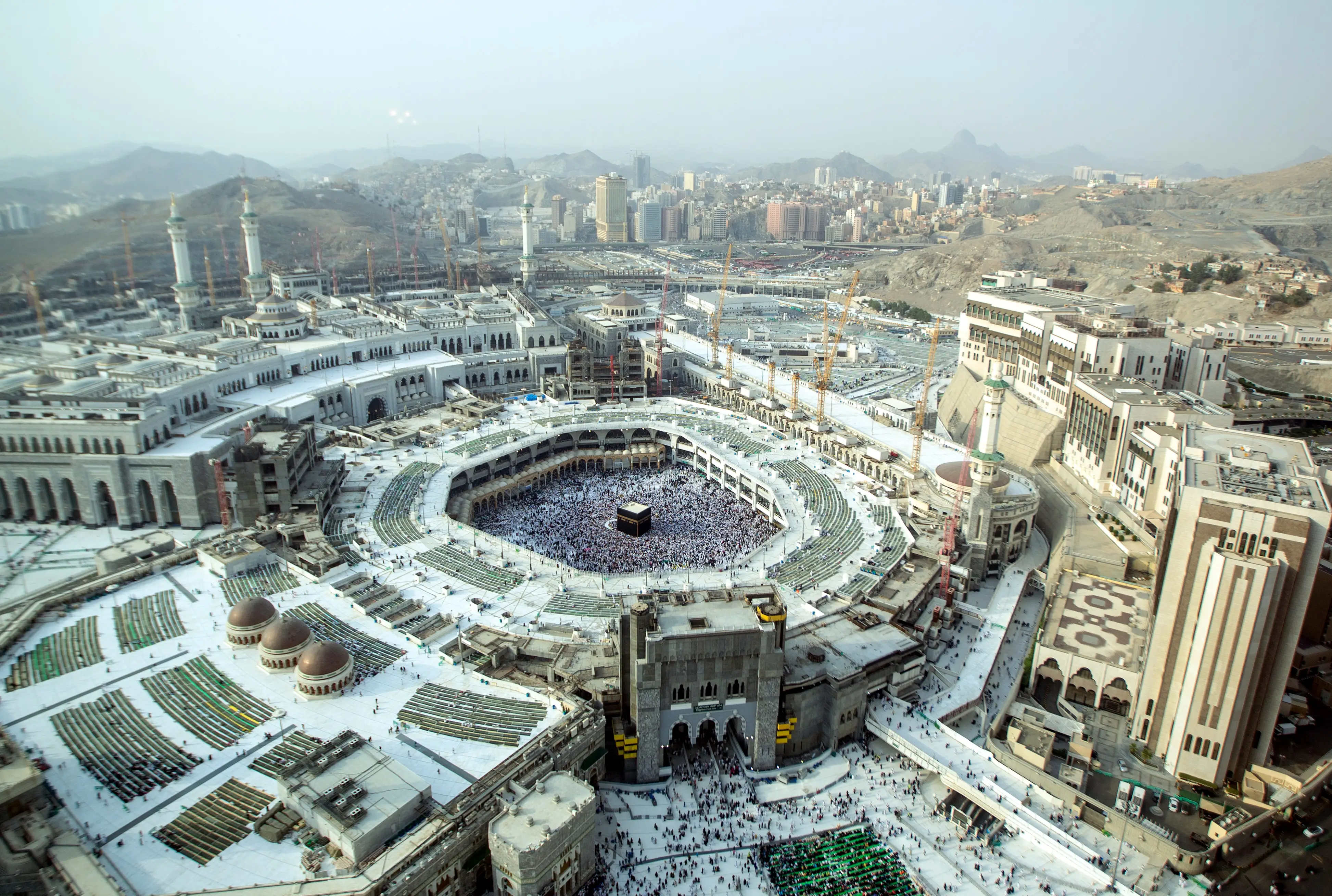
Mecca (Arabic: مكة, Makkah), officially known as Makkah al-Mukarramah (Makkah the Honored), is the holiest city in Islam and the birthplace of Prophet Muhammad. Located in the Hejaz region of Saudi Arabia, approximately 70 kilometers inland from the Red Sea port city of Jeddah, Mecca is the spiritual center of the Islamic world and the destination of millions of pilgrims annually.
Geography
Mecca lies in a narrow valley among the low hills of the Sirat range in the Hejaz, about seventy kilometres inland from the Red Sea port of Jeddah and some 277 metres above sea level. The valley position is the fact from which most of the city's history follows: it sits on the natural corridor between Yemen and the Levant, which made it a stopping point for caravans, and it has almost no agricultural capacity, which meant that whoever held it lived by trade and by the sanctuary rather than by farming. The climate is hot desert, with summer temperatures regularly above 45°C and rainfall averaging under 110 millimetres a year.
Three of the surrounding heights carry particular significance. Jabal al-Nur, the Mountain of Light, holds the cave of Hira where the first revelation came to Prophet Muhammad. Jabal Thawr is the mountain in which he and Abu Bakr concealed themselves during the migration to Medina. Mount Arafat, some twenty kilometres east of the city, is where the pilgrims stand on the ninth of Dhu al-Hijjah, the act without which the Hajj is not valid.
The Sanctity of the City in Islamic Law
Mecca's status is not merely honorific. It is a haram, a sanctuary with a defined boundary inside which specific prohibitions apply, and the terms were set out by the Prophet in a sermon delivered on the day of the conquest.
Ibn Abbas transmitted it: God made this town sacred on the day He created the heavens and the earth, and it is sacred by the sanctity God conferred on it until the Day of Resurrection. Fighting in it was not made lawful to anyone before him, nor would it be lawful to anyone after him, and it was made lawful to him for no more than an hour of a single day. Its thorn trees are not to be cut, its game not to be disturbed, its fresh herbage not to be uprooted, and property found in it not to be picked up except by someone who will announce it publicly (Sahih al-Bukhari 3189; Sahih al-Bukhari 4313; Sahih Muslim 1353; also Sahih al-Bukhari 112, 1349, 1833, 2090, and Sunan an-Nasa'i 2875, graded sahih).
Al-Abbas ibn Abd al-Muttalib interjected to ask that idhkhir — a rush used by the blacksmiths and for roofing — be excepted, and the Prophet allowed it. The exchange is preserved in every transmission of the sermon, and the jurists took it as establishing that the prohibitions admit of necessity.
Two points in the wording carried great legal weight. That the sanctity is described as coeval with creation rather than as instituted by the Prophet meant the jurists treated it as prior to Islam rather than established by it. And that the licence to fight was expressly limited to a single hour on a single day closed off any argument from the conquest as precedent — which is why the classical law of war treats Mecca as a category of its own.
From the Origins to the Quraysh
Islamic tradition places the origin of the city's sanctity with Abraham and his son Ishmael, who raised the first structure of the Kaaba as a house dedicated to the worship of God alone. The Quran describes the House at Bakka as the first place of worship appointed for humankind (Quran 3:96–97), records Abraham and Ishmael raising its foundations and praying that it be accepted (Quran 2:127), and preserves Abraham's prayer that he had settled his descendants in a barren valley by God's sacred House, asking that provision be sent to them (Quran 14:37). The barrenness in that verse is the geographical fact noted above, and the Quran treats the settlement of the valley as requiring explanation for exactly that reason.
The well of Zamzam belongs to the same body of tradition, which holds that it appeared when Hagar was searching for water for the infant Ishmael. Whatever its origin, a perennial water source in that valley is what made permanent settlement possible at all, and the well remains the physical reason a city exists on the site.
Claims about the archaeology of the Mecca valley should be treated with care. Excavation in and around the sanctuary has not been possible on any scale, and confident statements about the antiquity of settlement there are not supported by published archaeological work. What can be said from documentary evidence is that by the sixth century CE the Quraysh controlled the city and the Kaaba, and had organised both a pilgrimage and a trade.
That organisation was substantial. The Quraysh maintained caravan routes north to Syria and Palestine, south to Yemen, east to Iraq and Persia, and across the Red Sea to Abyssinia; the Quran's short chapter named for the tribe refers to their winter and summer journeys (Quran 106). They also established sacred months during which fighting was suspended, which is what allowed pilgrims to travel to Mecca in safety, and derived from the arrangement both revenue and standing among the Arab tribes. The Kaaba in this period housed the idols of many tribes, and the pilgrimage that sustained Mecca economically was a polytheistic one — which is the immediate reason the Meccan leadership treated the preaching of strict monotheism as a threat to its interests rather than merely to its beliefs.
The Prophetic Era
Muhammad was born in Mecca around 570 CE, into the Banu Hashim clan of the Quraysh, and began his mission in the city in 610 CE. The Meccan phase of that mission lasted roughly twelve years and was marked by the progressive isolation of the Muslims: the boycott of his clan, the torture of converts who lacked tribal protection, the emigration of a group of believers to Abyssinia, and finally the Hijra to Medina in 622 CE.
For the following eight years Mecca remained the centre of opposition to the new community, and the two cities fought at Badr, at Uhud, and at the Trench. The Treaty of Hudaybiyyah in 628 CE interrupted the conflict, and its effect was the opposite of what its terms suggested: the truce gave Islam two years in which to spread across Arabia without opposition.
Mecca was taken in 630 CE and the surrender was effectively without resistance. The Prophet's first substantive act was the clearing of the idols from the Kaaba and its rededication to the worship of God alone; the traditional figure of 360 idols comes from the biographical literature rather than from the hadith collections. The amnesty granted to the population, including to men who had led the persecution, is the feature of the conquest that the sources dwell on, and the sermon on the city's sanctity quoted above was delivered on the same occasion.
Mecca Under the Caliphates and the Ottomans
The Caliphate Period
Following Prophet Muhammad's death in 632 CE, Mecca's role as the spiritual center of Islam was firmly established, even as political power shifted to Medina and later to Damascus and Baghdad. The early caliphs recognized the importance of maintaining and improving the facilities in Mecca to accommodate the growing number of pilgrims.
The Rashidun Caliphs (632-661 CE) made important contributions to Mecca's development. Caliph Umar ibn al-Khattab expanded the area around the Kaaba to accommodate more worshippers, purchasing and demolishing surrounding houses to create more space. He also established the first formal boundaries of the Haram, the sacred precinct around the Kaaba where certain activities are prohibited and special rules apply.
During the Umayyad Caliphate (661-750 CE), further expansions and improvements were made to the Great Mosque. Caliph Abd al-Malik ibn Marwan and his son al-Walid I undertook major construction projects, adding covered colonnades around the courtyard and improving the facilities for pilgrims. These improvements reflected the caliphs' understanding that maintaining Mecca's sanctity and accessibility was a crucial responsibility of Islamic leadership.
The Abbasid Caliphate (750-1258 CE) continued this tradition of care for Mecca. Despite moving the capital to Baghdad, the Abbasid caliphs invested heavily in Mecca's infrastructure, expanding the mosque, improving water supply systems, and building facilities for pilgrims. They also established endowments (waqf) to support the ongoing maintenance of the holy sites and to provide services for pilgrims.
The Ottoman Period
The Ottoman Empire's control of Mecca, beginning in the early 16th century, marked a new chapter in the city's history. The Ottomans took their role as custodians of the holy cities very seriously, viewing it as a source of legitimacy and prestige. They invested enormous resources in maintaining and improving the facilities in Mecca and in ensuring the safety of pilgrims traveling to the holy city.
The Ottomans made several major expansions to the Great Mosque, adding new minarets, expanding the prayer areas, and improving the infrastructure. They also established a sophisticated administrative system for managing the Hajj, including the provision of security for pilgrims, the organization of caravans from various parts of the empire, and the maintenance of the pilgrimage routes.
One of the most significant Ottoman contributions was the improvement of water supply to Mecca. They built aqueducts and cisterns to bring water from distant sources, addressing one of the city's most pressing challenges. They also established charitable foundations that provided food, shelter, and medical care for pilgrims, many of whom arrived in Mecca after long and difficult journeys.
The Ottoman period also saw the development of Mecca as a center of Islamic learning. Scholars from across the Muslim world came to Mecca to teach and study, creating a vibrant intellectual community. The city's libraries and madrasas (religious schools) became important repositories of Islamic knowledge, and studying in Mecca was considered a mark of scholarly distinction.
The Kaaba and the Sacred Sites
The Kaaba and the Qibla
The Kaaba stands at the centre of the Great Mosque of Mecca, the Masjid al-Haram. It is the qibla, the direction Muslims face in prayer, and the focus of the circumambulation performed during both Hajj and Umrah.
Two of the Five Pillars are tied directly to the city: the five daily prayers are performed facing it, and the pilgrimage is made to it by those able to undertake the journey. The connection is geographical in the first case and physical in the second, and no other place in Islam carries either.
Sacred Sites Within and Around the Sanctuary
The Maqam Ibrahim, the Station of Abraham, stands near the Kaaba and is identified in tradition as bearing the mark of Abraham's feet; the Quran refers to it directly as a sign (Quran 2:125). The hills of Safa and Marwah, now enclosed within the mosque, are the points between which pilgrims perform the sa'y. The well of Zamzam lies within the precinct. The cemetery of Jannat al-Mu'alla, outside the mosque, holds the graves of members of the Prophet's family, including his first wife Khadijah.
The Pilgrimage
Every year the Hajj brings some two million pilgrims to Mecca in the month of Dhu al-Hijjah, and several million more perform Umrah at other times of year. The rites are fixed to dates rather than to a pilgrim's own schedule: the eighth of the month is spent at Mina, the ninth is the standing at Arafat, the night that follows is passed at Muzdalifah, and the tenth through twelfth involve the casting of pebbles at Mina, the sacrifice, the cutting of hair, and a return to the Kaaba for the circumambulation.
Umrah consists of entering the state of ihram, the sevenfold circumambulation of the Kaaba, the sa'y between Safa and Marwah, and the cutting or shaving of the hair. It may be performed at any time and does not discharge the obligation of Hajj.
Modern Mecca
Saudi Custodianship and the Expansions of the Mosque
Since 1932 the Kingdom of Saudi Arabia has held the custodianship of the two sanctuaries at Mecca and Medina, and the expansion of the Great Mosque has been the principal expression of that role. Three major building campaigns are conventionally distinguished: the first from the mid-1950s under King Abdulaziz and his successors, the second in the 1980s under King Fahd, and the third begun in 2007 under King Abdullah and continued under King Salman. The mosque in its present form accommodates upwards of two million worshippers at once and is the largest in the world.
The infrastructure built around the pilgrimage is on a comparable scale: airports, the Haramain high-speed railway linking Mecca to Medina by way of Jeddah, the Mashair metro line serving the pilgrimage sites, hotel capacity in the tens of thousands of rooms, and dedicated medical and crowd-management services. The Jamarat bridge at Mina, where the stoning rite takes place and where fatal crushes occurred in earlier decades, has been rebuilt on multiple levels specifically to separate the flows of pilgrims.
The City Today
Mecca has a resident population of roughly 2.4 million, a mixture of Saudi citizens, a large expatriate workforce drawn mainly from other Muslim countries, and a permanent scholarly and student community. Arabic is the official language, but the city is among the most linguistically mixed in the Arab world: Urdu, Indonesian, Malay, Turkish, Persian and several African languages are all widely heard, and during the pilgrimage the range is wider still. Umm al-Qura University is the principal institution of higher education.
Historic Meccan building was in the Hijazi manner — several storeys, timber-latticed balconies known as rawashin, internal courtyards, and stone and Red Sea coral as materials. Very little of it survives. The skyline is now dominated by the Abraj al-Bait complex facing the mosque, whose clock tower is among the tallest buildings in the world.
The Spiritual Significance of Mecca in Islamic Practice
The Qibla - Direction of Prayer
One of the most profound aspects of Mecca's significance in Islam is its role as the qibla, the direction Muslims face during their five daily prayers. This practice, established during the Prophet Muhammad's time in Medina, creates a powerful sense of unity among Muslims worldwide. No matter where they are on Earth, Muslims turn toward the Kaaba in Mecca, creating invisible lines of devotion that converge on this sacred site.
The establishment of Mecca as the qibla has deep historical and spiritual significance. Initially, Muslims prayed facing Jerusalem, following the practice of earlier Abrahamic faiths. However, in the second year after the Hijra, divine revelation instructed the Prophet Muhammad to change the direction of prayer to the Kaaba in Mecca. This change, commanded in the Qur'an (Quran 2:144), symbolized the distinct identity of the Muslim community while maintaining continuity with the Abrahamic tradition through the Kaaba's connection to Abraham and Ishmael.
The practical implementation of facing Mecca for prayer has led to remarkable developments in Islamic civilization. Medieval Muslim scholars developed sophisticated methods of determining the qibla direction from any location on Earth, contributing to advances in mathematics, astronomy, and geography. They created qibla compasses, astronomical tables, and mathematical formulas that allowed Muslims to accurately determine the direction to Mecca from distant lands. These scientific achievements demonstrate how religious practice can drive intellectual and technological innovation.
In modern times, technology has made determining the qibla direction easier than ever. Smartphone applications use GPS and digital compasses to point toward Mecca with precision. However, the spiritual significance of this practice remains unchanged. Five times each day, Muslims around the world pause their activities, orient themselves toward Mecca, and engage in prayer, creating a continuous wave of worship that circles the globe as the sun moves across time zones.
The Symbolism of Circumambulation
The ritual of circumambulating the Kaaba, known as tawaf, is one of the most visually striking and spiritually significant practices in Islam. During both Hajj and Umrah, pilgrims walk counterclockwise around the Kaaba seven times, following the practice established by Prophet Muhammad and tracing back to the tradition of Abraham.
The act of circumambulation carries multiple layers of meaning. On a physical level, it represents the believer's journey around the house of God, demonstrating devotion through bodily movement and effort. The counterclockwise direction mirrors the movement of celestial bodies and the natural flow of creation, symbolizing harmony with the divine order of the universe. The seven circuits have been interpreted by scholars as representing the seven heavens, the seven days of creation, or the completeness and perfection of the spiritual journey.
On a deeper spiritual level, tawaf represents the believer's life revolving around the worship of Allah. Just as the pilgrims circle the Kaaba, Muslims are called to make Allah the center of their lives, with all their actions and intentions oriented toward divine pleasure. The Kaaba itself, as a physical structure, serves as a focal point for this devotion, but the true object of worship is Allah alone, not the building itself.
The experience of performing tawaf is profoundly moving for most pilgrims. Surrounded by thousands or even millions of fellow believers from every nation, race, and social class, all dressed in simple white garments (ihram) and moving in unison around the Kaaba, pilgrims experience a powerful sense of unity and equality. The diversity of languages, cultures, and backgrounds dissolves into a single community of faith, all seeking the same divine presence and mercy.
The emotional and spiritual intensity of tawaf often brings pilgrims to tears. Many describe feeling overwhelmed by the presence of so many believers united in worship, by the weight of Islamic history embodied in the Kaaba, and by the sense of standing in a place where prophets and saints have stood for millennia. This emotional response is not merely sentimental but reflects a deep spiritual reality—the soul's recognition of its proximity to the divine and its connection to the broader community of believers across time and space.
The Zamzam Well - A Source of Blessing
The Zamzam well, located within the precincts of the Great Mosque, holds a special place in Islamic tradition and in the hearts of pilgrims. According to Islamic belief, this well was miraculously created by Allah when Hagar, the wife of Abraham, was searching desperately for water for her infant son Ishmael in the barren valley of Mecca. As she ran between the hills of Safa and Marwah seeking help, the angel Gabriel struck the ground, and water gushed forth, saving mother and child and eventually attracting the settlement that would become Mecca.
The water of Zamzam is considered blessed, and drinking it is an important part of the pilgrimage experience. The report that the water of Zamzam serves the purpose for which it is drunk is transmitted in Sunan Ibn Majah, and on its basis believers drink it with a specific intention and supplication. Pilgrims often drink Zamzam water during their pilgrimage and take bottles of it home to share with family and friends who could not make the journey.
Scientific studies have examined the unique properties of Zamzam water, finding it to have a distinctive mineral composition and remarkable purity despite being drawn from a well in the middle of a major city. The well has been flowing continuously for thousands of years, providing water for countless pilgrims without ever running dry—a fact that many Muslims view as a continuing miracle.
The Zamzam well also connects to the ritual of Sa'i, the walking between Safa and Marwah that commemorates Hagar's search for water. This ritual, performed during both Hajj and Umrah, reminds pilgrims of Hagar's trust in Allah during her moment of desperate need and of Allah's mercy in responding to that trust. It teaches important spiritual lessons about perseverance in difficulty, trust in divine providence, and the certainty that Allah responds to those who call upon Him in sincerity.
Contemporary Challenges and Developments
Managing Mass Pilgrimage
One of the greatest challenges facing modern Mecca is managing the enormous number of pilgrims who visit each year. The Hajj has grown from a few hundred thousand pilgrims in the early 20th century to over two million in recent years, with millions more performing Umrah throughout the year. This massive influx of people creates unprecedented logistical, safety, and infrastructure challenges.
The Saudi government has invested billions of dollars in infrastructure to accommodate these pilgrims. The Great Mosque has been expanded multiple times, with the most recent expansion allowing it to accommodate over two million worshippers simultaneously. New hotels, transportation systems, and service facilities have been built to house and serve the pilgrims. The Jamarat Bridge, where pilgrims perform the ritual stoning of pillars representing Satan, has been redesigned and expanded to prevent the deadly stampedes that occurred in past years.
Technology plays an increasingly important role in managing the Hajj. Electronic bracelets track pilgrims' locations and health status, allowing authorities to respond quickly to emergencies. Mobile applications provide pilgrims with information about prayer times, crowd conditions, and available services. Surveillance systems monitor crowd density and flow, helping authorities prevent dangerous overcrowding. These technological solutions, combined with improved infrastructure and better organization, have significantly enhanced the safety and experience of pilgrims.
Despite these improvements, challenges remain. The sheer number of people creates environmental pressures, including waste management, air quality, and water consumption. The intense concentration of pilgrims in a small area during specific days of the Hajj continues to pose safety risks. And the rapid development of Mecca has raised concerns about the preservation of historical sites and the character of the holy city.
Balancing Modernization and Preservation
The rapid modernization of Mecca has sparked considerable debate within the Muslim world. On one hand, improvements in infrastructure and facilities have made the pilgrimage more accessible and comfortable for millions of Muslims. Modern hotels, transportation systems, and amenities allow elderly and disabled pilgrims to perform Hajj with relative ease, fulfilling a religious obligation that would have been impossible for them in earlier eras.
On the other hand, this modernization has come at a cost. Many historical sites associated with early Islamic history have been demolished to make way for new development. The house where Prophet Muhammad was born, the homes of his companions, and other sites of historical and spiritual significance have been replaced by hotels, shopping centers, and other modern structures. This loss of historical heritage has been mourned by many Muslims and historians who see these sites as irreplaceable links to Islamic history.
The construction of massive hotel towers around the Great Mosque has also changed the character of Mecca. The Abraj Al-Bait complex, which includes the world's third-tallest building and a massive clock tower, dominates the skyline and dwarfs the Kaaba itself. Critics argue that this commercialization of the holy city contradicts Islamic values of simplicity and equality, creating a hierarchy where wealthy pilgrims enjoy luxury accommodations with views of the Kaaba while poorer pilgrims stay in distant, basic facilities.
Defenders of the development argue that it is necessary to accommodate the growing number of pilgrims and that preserving historical sites should not take precedence over facilitating the religious obligations of living Muslims. They point out that Islam emphasizes the spiritual significance of places rather than their physical structures, and that the essence of Mecca lies in its role as a center of worship rather than in its historical buildings.
This debate reflects broader tensions within the Muslim world about how to balance tradition and modernity, preservation and development, and spiritual values and practical necessities. It also raises questions about who has the authority to make decisions about the holy city and how the interests of the global Muslim community should be represented in those decisions.
Environmental Sustainability
The environmental impact of millions of pilgrims visiting Mecca each year is substantial. The city faces challenges related to water supply, waste management, air quality, and energy consumption. Addressing these challenges while continuing to accommodate growing numbers of pilgrims requires innovative approaches to sustainability.
Water is perhaps the most critical environmental challenge. Mecca is located in a desert region with limited natural water sources. The city relies heavily on desalination plants on the Red Sea coast, with water pumped inland to Mecca. During the Hajj period, water consumption increases dramatically, straining the supply system. Conservation efforts, including water-efficient fixtures in hotels and mosques and public education campaigns, aim to reduce consumption.
Waste management is another major challenge. The concentration of millions of people in a small area generates enormous amounts of waste, including food waste, plastic bottles, and other disposable items. The Saudi government has implemented comprehensive waste management systems, including recycling programs and waste-to-energy facilities. However, the sheer volume of waste remains a significant challenge, and efforts continue to reduce waste generation and improve recycling rates.
Air quality in Mecca is affected by vehicle emissions, construction activities, and the concentration of people. The development of public transportation systems, including the Mecca Metro and bus rapid transit, aims to reduce reliance on private vehicles and improve air quality. Regulations on construction activities and vehicle emissions also contribute to air quality management.
Energy consumption in Mecca is substantial, particularly for air conditioning in the hot desert climate. The Great Mosque and surrounding facilities require enormous amounts of energy to maintain comfortable temperatures for worshippers. Efforts to improve energy efficiency, including the use of advanced cooling systems and renewable energy sources, are ongoing. Solar energy, in particular, offers significant potential given Mecca's abundant sunshine.
The Global Muslim Community and Mecca
Unity in Diversity
One of the most remarkable aspects of the Hajj pilgrimage is the way it brings together Muslims from every corner of the world, representing every race, ethnicity, language, and culture. This annual gathering demonstrates the universal nature of Islam and the unity of the Muslim ummah (community) despite its incredible diversity.
During Hajj, a Nigerian farmer stands shoulder to shoulder with an Indonesian businessman, an American convert prays beside an elderly Arab sheikh, and a Chinese Muslim shares a meal with a Brazilian pilgrim. All wear the same simple white garments (ihram), removing visible markers of wealth, status, and nationality. This equality before God, manifested in the physical uniformity of the pilgrims and their shared rituals, powerfully demonstrates Islamic principles of human equality and brotherhood.
The diversity of the pilgrims also creates opportunities for cultural exchange and mutual understanding. Pilgrims share stories of their lives, their communities, and their journeys to faith. They learn about the challenges facing Muslims in different parts of the world and the various ways Islamic principles are practiced in different cultural contexts. These interactions foster a sense of global Islamic solidarity and help break down stereotypes and prejudices.
The linguistic diversity of the pilgrims is particularly striking. While Arabic is the language of Islamic ritual and many pilgrims learn basic Arabic phrases for prayer and pilgrimage rites, the vast majority of Muslims are not native Arabic speakers. During Hajj, one can hear dozens of languages spoken—Urdu, Indonesian, Turkish, Persian, French, English, Swahili, and countless others. This linguistic diversity, far from being a barrier, enriches the pilgrimage experience and demonstrates that Islam transcends linguistic and cultural boundaries.
Mecca as a Symbol of Islamic Identity
For Muslims worldwide, Mecca holds profound symbolic significance beyond its role as a pilgrimage destination. It represents the spiritual center of Islam, the birthplace of the Prophet Muhammad, and the site of the Kaaba, which Muslims believe was built by Abraham and Ishmael as a house of worship for the one true God. This symbolic importance shapes Muslim identity and practice in numerous ways.
The direction of Mecca (qibla) orients Muslim life both literally and figuratively. Five times each day, Muslims around the world turn toward Mecca in prayer, creating a physical and spiritual connection to the holy city. This practice reinforces Muslim identity and creates a sense of belonging to a global community united in worship. Even Muslims who may never have the opportunity to visit Mecca maintain this daily connection through their prayers.
Mecca also serves as a reference point for Islamic time and calendar. The Islamic calendar is lunar, and the beginning of each month is traditionally determined by the sighting of the new moon in Mecca. While modern Muslims use various methods to determine the start of months, Mecca's role as a reference point reflects its central position in Islamic consciousness. The timing of Ramadan, Eid celebrations, and other Islamic observances is often discussed in relation to Mecca, reinforcing its symbolic importance.
For many Muslims, the dream of visiting Mecca represents a lifetime aspiration. The title "Hajji" (one who has performed Hajj) is a mark of honor and respect in Muslim communities. Those who have made the pilgrimage often describe it as the most significant spiritual experience of their lives, a transformative journey that deepens their faith and commitment to Islamic principles. This aspiration to visit Mecca, shared by Muslims worldwide, creates a common goal that transcends national and cultural boundaries.
The Economic Impact of Pilgrimage
The annual Hajj pilgrimage and year-round Umrah visits have enormous economic implications, both for Saudi Arabia and for Muslim communities worldwide. The pilgrimage economy involves transportation, accommodation, food services, retail, and numerous other sectors, creating employment and generating revenue on a massive scale.
For Saudi Arabia, the pilgrimage represents a significant source of revenue and employment. Millions of pilgrims require hotels, transportation, food, and various services, creating a substantial industry. The Saudi government has invested heavily in infrastructure to support this industry, including airports, roads, hotels, and service facilities. The pilgrimage economy also provides employment for hundreds of thousands of Saudis and expatriate workers in various sectors.
The economic impact extends far beyond Saudi Arabia. Travel agencies in Muslim-majority countries organize Hajj and Umrah packages, airlines operate special pilgrimage flights, and various businesses cater to pilgrims' needs before, during, and after their journeys. In many Muslim countries, the Hajj season is a significant economic event, with businesses offering special products and services for pilgrims.
For individual Muslims and their families, performing Hajj represents a major financial undertaking. Pilgrims must save for years to afford the journey, which includes not only the cost of travel and accommodation but also the loss of income during the pilgrimage period. Many Muslim communities have established savings programs and financial assistance schemes to help members fulfill their Hajj obligation. This financial aspect of Hajj reinforces its significance as a major life event and a demonstration of commitment to faith.
The economic dimension of Hajj also raises important questions about accessibility and equity. As costs have risen, particularly with the development of luxury accommodations and services, concerns have been raised about whether Hajj is becoming increasingly accessible only to wealthy Muslims. Islamic scholars and community leaders continue to discuss how to ensure that the pilgrimage remains accessible to all Muslims, regardless of their economic circumstances, in accordance with Islamic principles of equality and social justice.
Conclusion
Mecca stands as the spiritual heart of Islam, a city where the temporal and eternal intersect in profound and meaningful ways. From its ancient origins as a trading center and site of Abraham's monotheistic worship to its current status as the destination of the world's largest annual pilgrimage, Mecca continues to play a central and irreplaceable role in the lives of Muslims worldwide.
The city's significance extends far beyond its physical boundaries. As the qibla, Mecca orients Muslim prayer and consciousness, creating invisible lines of devotion that connect believers across the globe. As the site of the Kaaba, it provides a focal point for Islamic worship and a symbol of the unity of the Muslim ummah. As the birthplace of Prophet Muhammad and the cradle of Islam, it embodies the historical roots of the faith and the continuity of Islamic tradition across fourteen centuries.
The rituals performed in Mecca during Hajj and Umrah—the circumambulation of the Kaaba, the walking between Safa and Marwah, the standing at Arafat, and the other prescribed acts—connect contemporary Muslims to the practices of Prophet Muhammad and, through him, to the ancient tradition of Abraham. These rituals, performed by millions each year, create a living link between past and present, between the individual believer and the global Muslim community, between earthly worship and divine presence.
The city's unique position as both a historical site and a living, breathing center of faith presents ongoing challenges and opportunities. The rapid modernization and expansion necessary to accommodate growing numbers of pilgrims must be balanced with the preservation of Mecca's sacred character and historical significance. The environmental impact of mass pilgrimage requires innovative solutions that ensure sustainability while maintaining accessibility. The commercialization of the holy city raises questions about Islamic values and priorities that the Muslim community continues to grapple with.
Despite these challenges, Mecca's essential role in Islam remains unchanged. It continues to be the place where Muslims from every nation, race, and social class come together in worship, demonstrating the universal nature of Islamic faith and the equality of all believers before God. It remains the destination of a lifetime aspiration for millions of Muslims, a place where spiritual transformation and renewal occur, where sins are forgiven and faith is strengthened.
For Muslims, Mecca represents not just a geographical location but a spiritual destination that embodies the unity, diversity, and devotion of the global Islamic community. It is a place where the barriers of language, culture, and nationality dissolve in the shared experience of worship. It is where the individual believer connects with the broader ummah and with the long chain of believers stretching back to the time of the Prophet and beyond to Abraham himself.
The enduring significance of Mecca lies in its ability to fulfill multiple roles simultaneously—as a historical site preserving the memory of Islamic origins, as a ritual center where prescribed acts of worship are performed, as a symbol of Islamic identity and unity, and as a living city adapting to the needs of contemporary Muslims while maintaining its sacred character. This multifaceted significance ensures that Mecca will continue to occupy a central place in Islamic consciousness and practice for generations to come.
As the Muslim world continues to grow and evolve, Mecca's role as the spiritual center of Islam remains constant. It stands as a testament to the enduring power of faith, the importance of sacred space, and the human need for connection to the divine and to community. Whether viewed from the perspective of history, theology, sociology, or personal spirituality, Mecca emerges as a place of profound and lasting significance—truly the heart of Islam and a beacon of faith for Muslims throughout the world.
References and Further Reading
Primary Islamic Sources
- Quran, Surah Al-Imran (3:96–97) — "Indeed, the first House [of worship] established for mankind was that at Makkah — blessed and a guidance for the worlds."
- Quran, Surah Ibrahim (14:35–37) — Abraham's supplication for the security and prosperity of Mecca.
- Quran, Surah Al-Qasas (28:57) — "Have We not established for them a safe sanctuary to which are brought the fruits of all things?"
- Quran, Surah At-Tin (95:1–3) — "By the fig and the olive, and [by] Mount Sinai, and [by] this secure city."
- Quran 2:125–127 — the Maqam Ibrahim named as a sign, and Abraham and Ishmael raising the foundations of the House
- Quran 106 (Surah Quraysh) — the winter and summer journeys of the Quraysh caravans
- Quran 2:144 — the change of the qibla to the Sacred House
- Sahih al-Bukhari 3189, 4313; Sahih Muslim 1353 — the sermon on the day of the conquest: God made Mecca sacred on the day He created the heavens and the earth; fighting in it was lawful to no one before the Prophet nor after him, and to him only for an hour of one day; its thorn trees, game, herbage and lost property are protected. Also Sahih al-Bukhari 112, 1349, 1833, 2090 and 6880, and Sunan an-Nasa'i 2875 (graded sahih)
- The same sermon records al-Abbas ibn Abd al-Muttalib asking that idhkhir be excepted for the blacksmiths and for roofing, and the Prophet allowing it — the basis on which the jurists held the sanctuary's prohibitions to admit of necessity
- Al-Azraqi, Abu al-Walid. Akhbar Makkah (History of Mecca). Beirut: Dar al-Andalus, 1969. [Original c. 865 CE]
- Al-Fakihi, Muhammad ibn Ishaq. Akhbar Makkah fi Qadim al-Dahr wa Hadithihi. Mecca: Maktabat al-Nahda al-Hadithah, 1965. [Original c. 885 CE]
Classical Islamic Sources
- Al-Fasi, Muhammad ibn Ahmad. Shifa al-Gharam bi-Akhbar al-Balad al-Haram. Beirut: Dar al-Kutub al-Ilmiyyah, 2000. [Original c. 1428 CE]
- Qutb al-Din al-Nahrawali. Al-I'lam bi-A'lam Bayt Allah al-Haram. Wiesbaden: Bibliotheca Islamica, 1857. [Original c. 1572 CE]
- Ibn Jubayr, Muhammad. Rihlat Ibn Jubayr, description of Mecca. [Original c. 1185 CE]
- Ibn Battuta. Rihlat Ibn Battuta, accounts of Mecca. [Original c. 1355 CE]
Academic and Scholarly Sources
- Peters, Francis E. Mecca: A Literary History of the Muslim Holy Land. Princeton: Princeton University Press, 1994.
- Peters, Francis E. The Hajj: The Muslim Pilgrimage to Mecca and the Holy Places. Princeton: Princeton University Press, 1994.
- Sardar, Ziauddin. Mecca: The Sacred City. London: Bloomsbury, 2014.
- Creswell, K.A.C. Early Muslim Architecture, Vol. 1. Oxford: Clarendon Press, 1932.
- Firestone, Reuven. Journeys in Holy Lands: The Evolution of the Abraham-Ishmael Legends in Islamic Exegesis. Albany: SUNY Press, 1990.
- Watt, W. Montgomery. Muhammad at Mecca. Oxford: Oxford University Press, 1953.
Further Reading
- Wolfe, Michael. One Thousand Roads to Mecca. New York: Grove Press, 1997.
- Bianchi, Robert R. Guests of God: Pilgrimage and Politics in the Islamic World. Oxford: Oxford University Press, 2004.
- Lings, Martin. Muhammad: His Life Based on the Earliest Sources. Cambridge: Islamic Texts Society, 1983.
- Long, David E. The Hajj Today. Albany: SUNY Press, 1979.
Mentioned In
142 articles reference this topic
and 130 more articles