Islamic Heritage
Encyclopedia

The Kingdom of Mysore: Dynasty and State

The Kingdom of Mysore rose from a small principality under the Wodeyar dynasty in 1399 to become one of South India's most powerful states, reaching its zenith under Hyder Ali and Tipu Sultan before its restoration as a princely state under British suzerainty.

🏔️Islam in South Asia

Introduction

The Kingdom of Mysore stands as one of the most significant political entities in the history of South India, spanning over five centuries from its modest origins as a small principality in the southern Deccan to its eventual merger with the Indian Union in 1950. Founded in 1399 by Yaduraya Wodeyar, the kingdom evolved through distinct phases — from a feudatory under the mighty Vijayanagara Empire, to an independent sovereign state, to a formidable military power under Hyder Ali and Tipu Sultan, and finally to a model princely state under British paramountcy. Its history encapsulates the broader transformations of South Indian politics, the encounter between indigenous kingdoms and European colonial powers, and the complex processes through which the Indian subcontinent was reshaped between the medieval and modern periods.

The geographical heart of the kingdom lay in the southern Karnataka plateau, centred on the city of Mysore (modern Mysuru) and its surrounding fertile plains. Bounded by the Western Ghats to the west, the Eastern Ghats and Tamil plains to the east, and the Tungabhadra River system to the north, the kingdom occupied a strategically vital position controlling trade routes between the Malabar Coast and the Coromandel. This geography shaped both the kingdom's economic prosperity — built on agriculture, spice trade, silk weaving, and sandalwood — and its military vulnerabilities, as it faced pressures from the Marathas to the north, the Nizam of Hyderabad to the northeast, and eventually the British East India Company from multiple directions.

The kingdom's history is inseparable from the broader narrative of Islamic civilisation in South India. While the Wodeyar dynasty was Hindu, the kingdom's most dramatic chapter was written by its Muslim rulers — Hyder Ali and his son Tipu Sultan — who transformed Mysore into one of the most powerful and innovative states in eighteenth-century India. Their resistance to British expansion, their diplomatic engagement with the Ottoman Empire, revolutionary France, and the Mughal Empire, and their administrative and military innovations left an enduring legacy that transcended the kingdom's political boundaries.


Origins and Foundation of the Wodeyar Dynasty (1399–1565)

The Founding of Mysore

The origins of the Wodeyar dynasty are intertwined with legend and historical tradition. According to the dynasty's own genealogical records, preserved in texts such as the Mysore Rajavamshavali and various copper-plate inscriptions, the founders traced their ancestry to the ancient Yadu lineage of the Lunar dynasty. The historical founder, Yaduraya Wodeyar, established his authority over the small territory around Mysore around 1399 CE. The name "Wodeyar" (also rendered as "Odeyar") derives from the Kannada word meaning "lord" or "master," and it became the hereditary title of the ruling family.

The territory over which Yaduraya established his rule was modest — comprising the area around the hill fortress of Mysore (originally called Mahishasurana Ooru, or "the town of Mahishasura," referring to the mythological buffalo-demon). The early Wodeyars governed this small principality as feudatories, first of the Hoysala remnants and then of the expanding Vijayanagara Empire, which by the early fifteenth century had established its dominance over much of peninsular India south of the Krishna River.

Under Vijayanagara Suzerainty

The relationship between the Wodeyar principality and the Vijayanagara Empire defined the kingdom's first century and a half. The Vijayanagara rulers, governing from their magnificent capital at Hampi, maintained a system of provincial governance (nayankara system) wherein local chiefs and governors (nayakas) administered territories in exchange for military service and revenue payments to the imperial centre. The Wodeyars occupied a subordinate position within this hierarchy, governing their small domain while acknowledging Vijayanagara's overlordship.

During this period, the Wodeyar chiefs gradually consolidated their local authority. Chamaraja Wodeyar III (r. 1513–1553) and Timmaraja Wodeyar II (r. 1553–1572) expanded the principality's boundaries incrementally, absorbing neighbouring petty chieftaincies and establishing administrative structures that would later serve the independent kingdom. The Wodeyars maintained their loyalty to Vijayanagara through the empire's golden age under Krishnadevaraya (r. 1509–1529) and its subsequent decline following the catastrophic defeat at the Battle of Talikota (Rakkasa-Tangadi) in 1565.

The Battle of Talikota and Its Aftermath

The Battle of Talikota in January 1565, in which the combined forces of the Deccan Sultanates — Ahmadnagar, Bijapur, Golconda, and Bidar — decisively defeated the Vijayanagara army and sacked the imperial capital at Hampi, fundamentally altered the political landscape of South India. The destruction of imperial authority created a power vacuum that subordinate chiefs and governors rushed to fill. Across the southern Deccan, former nayakas and feudatories began asserting independence, establishing the Nayaka kingdoms of Madurai, Thanjavur, Gingee, and Keladi, among others.

For the Wodeyars, the collapse of Vijayanagara presented both opportunity and danger. The weakening of imperial oversight allowed the Mysore chiefs to expand their ambitions, but it also removed the protective umbrella that had shielded smaller principalities from larger predators. The decades following Talikota saw the Wodeyars navigate a complex and dangerous political environment, building alliances, consolidating territories, and gradually positioning themselves for outright independence.


The Rise to Independence (1565–1638)

Bola Chamaraja Wodeyar and Territorial Expansion

The transformation of Mysore from a petty chieftaincy into a significant kingdom began under Bola Chamaraja Wodeyar IV (r. 1572–1576) and accelerated under his successors. During this period, the Wodeyars took advantage of the ongoing fragmentation of Vijayanagara's successor states to expand their territories. They absorbed portions of the Channapatna region to the north, pushed eastward toward the Tamil plains, and secured control over strategic hill fortresses that commanded the major trade routes.

Raja Wodeyar I (r. 1578–1617) proved to be the crucial figure in Mysore's transition from feudatory to sovereign state. Ascending to power during a period of political chaos across the southern Deccan, Raja Wodeyar systematically expanded the kingdom's boundaries through a combination of military conquest, strategic marriage alliances, and diplomatic manoeuvring. He conquered the important fortress of Srirangapatna (Seringapatam) on an island in the Kaveri River in 1610, an event of transformative significance for the kingdom.

The Capture of Srirangapatna (1610)

The acquisition of Srirangapatna marked a turning point in Mysore's history. The island fortress, situated at the confluence of channels of the Kaveri River, was one of the most formidable natural defensive positions in South India. Its strategic location — controlling river crossings, commanding fertile agricultural lands, and sitting astride major trade routes — made it an ideal capital for an ambitious state. Raja Wodeyar wrested Srirangapatna from the declining Vijayanagara governor Tirumala and established it as the new Mysore capital, a status it would retain until 1799.

The capture of Srirangapatna also represented a symbolic break with Vijayanagara overlordship. By seizing a fortress that had been governed by a Vijayanagara appointee, Raja Wodeyar was effectively declaring Mysore's independence from imperial authority — an authority that, by 1610, was largely nominal in any case. From this new, more defensible capital, the Wodeyars could project power across a much wider area than had been possible from the old town of Mysore.

Consolidation Under Chamaraja Wodeyar VI and VII

Following Raja Wodeyar's death in 1617, his successors continued the process of consolidation. Chamaraja Wodeyar VI (r. 1617–1637) and Immadi Raja Wodeyar (r. 1637–1638) maintained the kingdom's territorial integrity and administrative development, though neither achieved the dramatic expansions of their predecessor. This period saw the development of Mysore's administrative infrastructure — revenue collection systems, military organisation, and diplomatic protocols — that would support the kingdom's subsequent growth.

The early seventeenth century also witnessed the first significant contacts between Mysore and the Mughal Empire to the north. While the Mughals under Jahangir and Shah Jahan were primarily focused on the Deccan Sultanates, their expanding influence in peninsular India began to impinge upon the political calculations of southern kingdoms like Mysore. The Wodeyars maintained careful neutrality in the conflicts between the Mughals and the Deccan Sultanates, focusing instead on consolidating their own position in the far south.


The Golden Age Under Kanthirava Narasa Raja and Chikka Devaraja (1638–1704)

Kanthirava Narasa Raja Wodeyar (1638–1659)

The reign of Kanthirava Narasa Raja Wodeyar marked the beginning of Mysore's emergence as a major regional power. An energetic and ambitious ruler, Kanthirava Narasa Raja expanded the kingdom significantly in all directions. He conquered territories from the Nayakas of Keladi to the west, pushed into the Tamil country to the east and south, and established Mysore's authority over a substantial portion of the southern Karnataka plateau.

Kanthirava Narasa Raja was also notable for his cultural patronage and administrative innovations. He introduced the "Kanthiraya Fanam," a gold coin that became widely circulated in South Indian trade and testified to Mysore's growing economic significance. His court attracted scholars, poets, and artists, and he patronised both Kannada and Sanskrit literature. The Kanthirava Narasaraja Vijaya, a court chronicle, records his military campaigns and administrative achievements in detail.

His military campaigns brought Mysore into contact — and sometimes conflict — with the Sultanate of Bijapur, which controlled much of the northern Deccan. These encounters introduced the Wodeyar court to the military technologies and administrative methods of the Muslim states, including the use of cavalry, gunpowder weapons, and Persian-influenced bureaucratic practices that would later be adopted and refined by Mysore's rulers.

Dodda Devaraja Wodeyar (1659–1672)

Dodda Devaraja Wodeyar continued his predecessor's expansionist policies, though his reign was also marked by internal court intrigues and succession disputes that would become a recurring feature of Wodeyar politics. He maintained the kingdom's territorial gains and further developed its administrative apparatus, including the establishment of a more systematic revenue collection framework and the organisation of provincial governance through appointed officials (Dalawais and other officers).

Chikka Devaraja Wodeyar (1672–1704): The Kingdom's First Zenith

The reign of Chikka Devaraja Wodeyar represents the high point of the independent Wodeyar kingdom before the later transformations under Hyder Ali. A shrewd politician and capable administrator, Chikka Devaraja consolidated Mysore's territorial gains, reformed its administration, and elevated the kingdom to a position of pre-eminence among the states of South India.

Chikka Devaraja's most significant administrative innovation was the systematic centralisation of power. He curtailed the authority of the hereditary nobility (palegars and local chiefs) who had traditionally enjoyed considerable autonomy within the kingdom. By replacing hereditary officials with appointed administrators who served at the king's pleasure, Chikka Devaraja created a more responsive and controllable bureaucracy — a process that historians have compared to the centralisation efforts of contemporary European monarchs.

His revenue reforms were equally significant. Chikka Devaraja commissioned detailed land surveys and revenue assessments, establishing a more equitable and efficient tax collection system. He reorganised the kingdom's provinces (sime or sheeme) and established clear administrative hierarchies. These reforms increased royal income significantly, enabling the maintenance of a larger military and the prosecution of further territorial expansion.

Militarily, Chikka Devaraja expanded Mysore's boundaries to their greatest pre-Hyder Ali extent. He conquered the Nayaka kingdom of Madurai and portions of the Tamil country, pushed the kingdom's northern boundaries toward the Tungabhadra, and secured control over the western trade routes leading to the Malabar Coast. His campaigns against the Nayakas of Keladi, the chiefs of Coorg (Kodagu), and various palegars along the eastern frontier demonstrated Mysore's military capabilities.

Diplomatically, Chikka Devaraja navigated the complex politics of late seventeenth-century South India with considerable skill. He maintained relations with the Mughal Empire — whose armies under Aurangzeb were campaigning in the Deccan during this period — while avoiding entanglement in the destructive wars that consumed the Deccan Sultanates. His ability to play the Mughals, the Marathas (who were emerging as a major power under Shivaji and his successors), and other regional powers against one another preserved Mysore's independence and territorial integrity.

Chikka Devaraja's court was also a centre of cultural achievement. He patronised Kannada literature, music, and the arts, and his reign is remembered as a period of prosperity and cultural flourishing in Mysore's history. The administrative and territorial foundations he laid would sustain the kingdom through the turbulent decades that followed his death in 1704.


Decline and the Dalawai Period (1704–1761)

Succession Crises and Weakening Monarchy

The death of Chikka Devaraja in 1704 inaugurated a period of dynastic instability and gradual erosion of royal authority that would ultimately pave the way for the usurpation of power by military strongmen. Chikka Devaraja's immediate successors — Kanthirava Narasa Raja II (r. 1704–1714) and Dodda Krishna Raja I (r. 1714–1732) — proved unable to maintain the centralised authority their predecessor had established. Court factions, succession disputes, and the reassertion of aristocratic power undermined the monarchy's effectiveness.

The fundamental problem was structural: the Wodeyar system of governance lacked clear rules of succession, and the death of a strong king invariably triggered factional competition among princes, queens, and powerful courtiers. Each succession crisis weakened the monarchy further, as contending factions bargained away royal prerogatives in exchange for support. The powerful families of the court — particularly those holding the office of Dalawai (chief minister and commander-in-chief) — accumulated authority at the expense of the throne.

The Rise of the Dalawais

The office of Dalawai, which had originally been a subordinate position within the Mysore administration, gradually evolved into the effective seat of power. As successive Wodeyar kings proved weak or youthful, their Dalawais assumed ever-greater authority over military command, revenue administration, and diplomatic relations. This process bears comparison to the rise of the Peshwas in the Maratha Confederacy, where hereditary prime ministers similarly overshadowed their nominal sovereigns.

Devarajiah served as Dalawai during the early eighteenth century and established a pattern of ministerial dominance that his successors would intensify. The Kalale family, which controlled the Dalawai office through much of this period, became the de facto rulers of Mysore, reducing the Wodeyar kings to ceremonial figureheads. Nanjaraja Wodeyar (r. 1732–1734) and Krishnaraja Wodeyar I (r. 1734–1766) reigned but did not rule, their authority circumscribed by powerful ministers who controlled the army, treasury, and administration.

Nanjarajiah and Devarajiah: The Last Dalawais

The brothers Nanjarajiah and Devarajiah (not to be confused with earlier holders of these names) served as joint administrators of the kingdom during the mid-eighteenth century, with Nanjarajiah holding the title of Dalawai and Devarajiah serving as Sarvadhikari (chief of administration). Under their leadership, Mysore maintained its territorial integrity but failed to keep pace with the rapidly changing military and political landscape of South India.

The mid-eighteenth century was a period of extraordinary upheaval across the Indian subcontinent. The Mughal Empire was in terminal decline following the devastating invasion of Nadir Shah in 1739 and the subsequent fragmentation of imperial authority. The Marathas, under their Peshwas, were expanding aggressively into South India. The Nizam of Hyderabad was asserting independence while simultaneously fending off Maratha pressure. And the European trading companies — particularly the British East India Company and the French Compagnie des Indes — were transitioning from commercial enterprises into territorial powers, using Indian political divisions to expand their influence.

In this volatile environment, the Dalawai administration's cautious, conservative approach left Mysore increasingly vulnerable. The army had not been modernised to match the disciplined infantry and artillery tactics that European-trained forces were demonstrating in the Carnatic Wars (1746–1763). The administration lacked the dynamism to respond to rapidly shifting alliances and threats. It was into this power vacuum that Hyder Ali would step.

External Pressures: Marathas, Nizam, and Europeans

Throughout the Dalawai period, Mysore faced mounting external pressures that exposed the limitations of its weakened governance. The Marathas, who had established their dominance over much of western and central India, conducted repeated raids into Mysore territory, extracting tribute and territory. The campaigns of Maratha generals into the southern Deccan during the 1720s–1750s imposed significant financial burdens on the Mysore treasury and demonstrated the inadequacy of the kingdom's military defences.

The Nizam of Hyderabad, while nominally the Mughal viceroy of the Deccan, operated as an independent sovereign and periodically interfered in Mysore's affairs, supporting factional candidates for the throne or demanding tribute. The European powers, initially peripheral actors in peninsular Indian politics, became increasingly significant as their military capabilities and political ambitions grew. The Anglo-French rivalry played out across South India during this period, with Indian rulers drawn into European conflicts and vice versa.

These combined pressures created the conditions for a military strongman to seize power by promising — and delivering — more effective defence of the kingdom's interests. That strongman was Hyder Ali Khan.


Hyder Ali and the Transformation of Mysore (1761–1782)

The Rise of Hyder Ali

Hyder Ali Khan's rise from a junior military officer to the de facto ruler of Mysore is one of the most remarkable stories of political ascent in eighteenth-century India. Born around 1720 into a family of modest means — his father, Fath Muhammad, served as a minor military commander (naik) in the Mysore army — Hyder Ali entered military service as a young man and rapidly demonstrated exceptional talent as a soldier, strategist, and political operator.

Hyder Ali's early career was spent in the service of the Dalawai administration, where he distinguished himself in campaigns against the Marathas and various rebellious palegars. His military abilities, combined with a shrewd understanding of factional politics, enabled him to build a personal following among the soldiery and to accumulate wealth and influence. He studied the military methods of the French and British carefully, recognising that disciplined infantry trained in European tactics, supported by modern artillery, represented the future of warfare in India.

By the late 1750s, Hyder Ali had become the most powerful military commander in Mysore, commanding the loyalty of a substantial portion of the army. He exploited the rivalry between the Dalawais Nanjarajiah and Devarajiah, and their mutual suspicion of him, to manoeuvre himself into a position of dominance. In 1761, following a complex series of political intrigues and military confrontations, Hyder Ali overthrew the Dalawai administration and established himself as the effective ruler of Mysore, though he retained the Wodeyar king, Krishnaraja Wodeyar II, as a nominal sovereign.

Military Modernisation

Hyder Ali's most lasting contribution to Mysore was the comprehensive modernisation of its military forces. Drawing on his observation of European military methods during the Carnatic Wars, he created a disciplined standing army trained in modern infantry tactics, equipped with up-to-date muskets and artillery, and organised along lines that combined European methods with Indian military traditions.

The transformation of Mysore's army under Hyder Ali was systematic and far-reaching. He replaced the feudal military levies — contingents raised by local chiefs and palegars who owed military service to the crown — with a permanent, professional army paid directly from the royal treasury. Soldiers served on regular pay scales, were subject to uniform discipline, and trained according to standardised drill. This transition from feudal to professional military organisation paralleled developments in contemporary European states and gave Mysore a decisive advantage over neighbours who still relied on traditional military systems.

He established arsenals for the manufacture of weapons and ammunition at Srirangapatna, Bangalore, and other fortresses, employing skilled craftsmen in iron-working, gun-casting, and powder manufacture. He recruited European deserters and adventurers as technical advisors and drill instructors — French, Dutch, and even British soldiers who served Mysore in exchange for generous pay. These European officers trained Mysorean soldiers in the use of flintlock muskets, bayonet drill, and coordinated volley fire that was the hallmark of European infantry effectiveness.

The development of the famous Mysorean rockets represented perhaps the most innovative element of Hyder Ali's military programme. Iron-cased rocket weapons — tube-launched projectiles filled with incendiary material and strapped to bamboo or iron guide sticks — had existed in Indian warfare for centuries. Under Hyder Ali, however, these weapons were systematised, improved, and deployed on a scale unprecedented in military history. Dedicated rocket corps (cushoon) were established, with specialised soldiers trained in their manufacture and deployment. The iron casings allowed higher internal pressures and greater range than the paper or leather casings used previously. These rockets, deployed in massed barrages against enemy formations, could break cavalry charges, shatter infantry lines, and set fire to enemy positions at ranges exceeding one kilometre. They would later inspire the development of the Congreve rocket in Britain, which played a significant role in the Napoleonic Wars.

Hyder Ali also established a formidable cavalry force, drawing on the martial traditions of the Deccan's Muslim military communities. His light cavalry, numbering tens of thousands at its peak, gave him a strategic mobility that confounded his enemies, allowing him to strike rapidly at distant targets and to outmanoeuvre slower-moving European forces. The cavalry's ability to devastate an enemy's supply lines, intelligence networks, and rear areas — demonstrated devastatingly in the 1767 raid on Madras — made Mysore's armies uniquely dangerous opponents.

Territorial Expansion

With his modernised military, Hyder Ali embarked on an ambitious programme of territorial expansion that transformed Mysore from a significant regional state into one of the most powerful kingdoms in India. He conquered the kingdom of Keladi (Ikkeri) to the northwest in 1763, gaining control over the valuable pepper and spice trade of the Malabar Coast. He absorbed the territories of numerous palegars and minor chiefs across the southern Deccan, pushing Mysore's boundaries in all directions.

His conquest of the Malabar Coast (1766) was particularly significant, giving Mysore direct access to maritime trade and the wealthy port cities of the western coast. He also expanded northward, challenging both the Marathas and the Nizam of Hyderabad for control of disputed territories. By the 1770s, the Kingdom of Mysore under Hyder Ali controlled a territory vastly larger than anything the Wodeyar kings had governed, stretching from the Malabar Coast to the eastern approaches of the Tamil country, and from the Tungabhadra River in the north to the borders of Travancore in the south.

The First and Second Anglo-Mysore Wars

Hyder Ali's expansion inevitably brought him into conflict with the British East India Company, whose territories in the Madras Presidency bordered Mysore to the east. The First Anglo-Mysore War (1767–1769) demonstrated both Hyder Ali's military capabilities and his strategic acumen. After initial British successes, Hyder Ali launched a devastating cavalry raid that reached the very gates of Madras (Chennai), forcing the British to sue for a humiliating peace — the Treaty of Madras (1769) — in which they agreed to a mutual defence alliance and the restoration of conquered territories.

The British failure to honour this treaty during a subsequent Maratha invasion of Mysore sowed the seeds of lasting enmity between Hyder Ali and the Company. The Second Anglo-Mysore War (1780–1784) was triggered by British aggression against Mysore's ally, the French settlement at Mahé on the Malabar Coast. Hyder Ali, allied with the Nizam of Hyderabad and the Maratha Confederacy, invaded the Carnatic with devastating effect, winning a major victory at the Battle of Pollilur (1780) — one of the worst defeats suffered by the British in India during the eighteenth century.

Hyder Ali died of a cancerous carbuncle on 7 December 1782 at Chittor during the prosecution of the Second Anglo-Mysore War, leaving the kingdom and the ongoing conflict to his son, Tipu Sultan.


The Reign of Tipu Sultan (1782–1799)

Accession and Continuation of the War

Tipu Sultan, born in 1750, had been groomed for rulership from a young age and had served with distinction in his father's campaigns. His accession to power in December 1782 was seamless — he was already commanding Mysorean forces in the field — and he immediately took charge of the ongoing Second Anglo-Mysore War. Tipu prosecuted the war with energy and skill, winning several engagements against British forces before the Treaty of Mangalore (March 1784) ended hostilities on terms of mutual restitution — the last occasion on which an Indian power would conclude a war with the British on equal terms.

Administrative Innovations

Tipu Sultan proved to be not merely a warrior but a visionary administrator who sought to transform Mysore into a modern, efficient state. His administrative reforms touched every aspect of governance and demonstrated a level of systematic thinking rare among contemporary Indian rulers:

Revenue and land administration: Tipu conducted fresh land surveys and introduced a new revenue system (the Asthana system) that replaced hereditary landlord intermediaries with state officials. He established fixed revenue rates based on soil quality and crop type, promoted agriculture through the construction of irrigation works (including new canals from the Kaveri and its tributaries), and introduced new crops — including sericulture on a large scale, which he promoted by distributing mulberry seeds and silkworm eggs to cultivators and establishing state-run silk-reeling facilities. His agricultural policies also encouraged the cultivation of sugar cane, spices, and improved rice varieties. Land grants were offered to cultivators willing to bring waste land under cultivation, and tax holidays provided incentives for agricultural expansion.

Commerce and industry: Tipu established state trading companies — effectively early experiments in state capitalism — to monopolise the export of valuable commodities including sandalwood, silk, pepper, and cardamom. He established state factories (karkhanas) for the production of textiles, weapons, sugar, paper, and other manufactured goods, employing thousands of skilled artisans. His commercial policies aimed at capturing the profits of trade that had previously flowed to private merchants and European companies. He established new ports and encouraged maritime trade, seeking to develop an independent naval and commercial presence in the Indian Ocean.

Military innovations: Building on his father's foundations, Tipu further developed Mysore's military capabilities. He expanded and improved the rocket artillery corps, creating specialised units with standardised rocket sizes for different tactical purposes. He introduced new infantry drill and organisation modelled on French practice, established a nascent naval force with dockyards at Wajenagar and other coastal towns, and maintained close contacts with French military advisors who helped modernise his artillery and fortification techniques. His army, at its peak numbering over 50,000 regular soldiers supplemented by militia and irregular forces, was one of the best-equipped and best-trained in contemporary India.

Governance and law: Tipu introduced a new administrative code, the Fathnama, which standardised procedures across his administration. He promulgated a comprehensive system of civil and criminal law, reorganised the provincial administration into a hierarchical structure with clear lines of authority and reporting, established a postal system for government communications, and introduced a new calendar (the Mauludi era) for official business. He also commissioned a land revenue manual (the Athara Kacheri) that detailed the procedures for revenue assessment, collection, and disbursement.

Diplomacy and International Relations

Tipu Sultan conducted an ambitious foreign policy aimed at constructing an anti-British alliance that could check Company expansion in India. His diplomatic efforts reached remarkable breadth and demonstrated a sophisticated understanding of international power dynamics that few contemporary Indian rulers possessed:

He sent ambassadors to the Ottoman Empire (1785–1787), seeking military alliance and recognition of his sovereignty. The Ottoman Sultan acknowledged Tipu's status and sent symbolic gifts, though practical military assistance was not forthcoming due to the Ottoman Empire's own strategic preoccupations. He dispatched embassies to revolutionary France (1788), exploring the possibility of French military intervention against the British in India — an initiative that gained momentum after Napoleon's Egyptian campaign raised the prospect of a French advance toward the subcontinent. He corresponded with Zaman Shah Durrani of Afghanistan, encouraging an Afghan invasion of northern India that might distract British attention and relieve pressure on Mysore. He maintained contacts with the Mughal Empire's diminished court at Delhi, seeking Mughal recognition of his authority and the symbolic legitimacy that Mughal investiture could confer.

Tipu also maintained commercial and diplomatic contacts with Muscat, the Maldives, and various Southeast Asian polities, seeking to develop Mysore's maritime connections independent of European intermediaries. His establishment of a nascent navy and his encouragement of direct trade with Middle Eastern and Southeast Asian ports reflected an understanding that commercial independence was as important as military capability in resisting European domination.

While these diplomatic efforts ultimately failed to produce the grand alliance Tipu sought — each potential ally was constrained by its own concerns and reluctant to risk British retaliation — they demonstrated the sophistication of his strategic thinking and his awareness that Mysore's survival required international support to counterbalance British power. His contacts with revolutionary France, in particular, alarmed the British and contributed to their determination to neutralise Mysore as a threat. Governor-General Lord Wellesley cited Tipu's "Jacobin" connections as a primary justification for the Fourth Anglo-Mysore War.

The Third Anglo-Mysore War (1790–1792)

The Third Anglo-Mysore War was provoked by Tipu's attack on the British-allied state of Travancore in 1789. A grand alliance of the British East India Company, the Nizam of Hyderabad, and the Maratha Confederacy invaded Mysore from multiple directions. Despite fierce resistance, Tipu was gradually driven back to his capital at Srirangapatna. Facing the prospect of a prolonged siege, he agreed to the Treaty of Seringapatam (March 1792), which imposed harsh terms: the cession of half his territories, an indemnity of 33 million rupees, and the surrender of two of his sons as hostages.

The treaty was a devastating blow but not a fatal one. Tipu retained his core territories and immediately set about rebuilding his military strength, reforming his administration, and resuming his diplomatic efforts to construct an anti-British alliance. His resilience and determination in the face of this setback testified to both his personal qualities and the underlying strength of the Mysorean state.

The Fourth Anglo-Mysore War and the Fall of Srirangapatna (1799)

The final confrontation between Mysore and the British came in 1799, triggered by British alarm at Tipu's continued diplomatic contacts with France (now under Napoleon Bonaparte, who was campaigning in Egypt with an eye toward India) and the Governor-General Lord Wellesley's aggressive forward policy. The British assembled overwhelming forces — including their own troops, Nizam's contingent, and Company sepoys — and invaded Mysore in February 1799.

The campaign was brief but intense. Tipu, lacking the allies who had deserted him (both the Nizam and the Marathas had been induced to join the British side or remain neutral), was forced to defend Srirangapatna with his own resources alone. The British besieged the island fortress and, on 4 May 1799, launched a storming assault. Tipu Sultan died fighting in the breach, his body later found among the slain near the northern gate of the fortress.

The fall of Srirangapatna marked the end of an era. Mysore's territories were partitioned: the British and the Nizam took the lion's share, while a rump kingdom was restored to the Wodeyar dynasty — now under strict British control. The kingdom that Hyder Ali and Tipu Sultan had built into one of India's most powerful states was reduced to a medium-sized princely state under British paramountcy.


The Restoration of the Wodeyars and Early British Period (1799–1831)

The Partition of 1799

Following the fall of Srirangapatna, the victorious British and their allies partitioned Tipu Sultan's domains in a process that deliberately dismembered the military-fiscal apparatus that had made Mysore dangerous. The British East India Company absorbed the Malabar Coast (Canara and Malabar districts), the coastal strip of South Kanara, the districts of Coimbatore and parts of the Carnatic — strategically valuable territories that gave the Company control over the western coast and the approaches to Mysore from the east. The Nizam of Hyderabad received territories in the northern portions of the former Mysorean state as reward for his alliance. What remained — a substantially reduced but still significant territory in the central Karnataka plateau, roughly one-third of Tipu's former domains — was reconstituted as the Kingdom of Mysore under a restored Wodeyar dynasty.

The British chose to restore the Wodeyar family rather than annexing the entire kingdom for several reasons. The presence of a legitimate Hindu dynasty provided a useful counterweight to potential Muslim unrest following Tipu's death. A compliant princely state could serve as a buffer between British territories and potentially hostile powers, and reduce the costs of direct administration. The restoration allowed the British to present themselves as liberators restoring a "rightful" dynasty rather than mere conquerors — an important consideration for legitimacy in a region where memory of the Wodeyars' long reign (despite their half-century of powerlessness) remained strong. Furthermore, the creation of a dependent princely state demonstrated to other Indian rulers that cooperation with British power was rewarded, while resistance was destroyed.

Krishnaraja Wodeyar III (1799–1831)

The restored king was Krishnaraja Wodeyar III, a five-year-old boy installed on the throne by the British in 1799. During his minority, a regency council governed the state under close British supervision, with a British Resident stationed at the capital to oversee affairs. The Resident's authority, though theoretically advisory, was in practice paramount — the restored Mysore was a satellite state of the Company from its inception.

Despite these constraints, the early years of the restoration saw significant efforts to rebuild the war-devastated kingdom. The administration was reorganised along lines that combined elements of Tipu's efficient bureaucracy with the traditional Wodeyar structures. Land revenues were reassessed, irrigation works restored, and commerce encouraged. The young king was educated in both traditional Indian and modern subjects, and showed genuine interest in governance and cultural patronage.

As Krishnaraja Wodeyar III reached adulthood and assumed personal rule, he proved to be a cultured and well-intentioned sovereign, though not a particularly effective administrator. His court became a centre of arts and learning — he was himself an accomplished musician and composer, contributing significantly to Carnatic music. He patronised scholars, poets, and artists, and his reign saw a cultural renaissance in Mysore, particularly in music, literature, and the fine arts.

Administrative Difficulties and British Takeover (1831)

However, the kingdom's administration deteriorated during Krishnaraja Wodeyar III's personal rule. Revenue collection became inefficient, debts mounted, and popular disturbances — including a significant peasant uprising in Nagar in 1830–1831 — indicated widespread administrative failures. Whether these problems were primarily the fault of the king's governance or the result of structural constraints imposed by British paramountcy (including heavy tribute payments to the Company) remains debated by historians.

In 1831, the British took the decisive step of assuming direct administration of Mysore, citing misgovernance. Krishnaraja Wodeyar III was retained as a titular sovereign — maintaining his court, his dignity, and his pension — but all administrative authority was transferred to a British Commissioner. This arrangement would persist for half a century, during which Mysore was governed directly by British officials while technically remaining a princely state rather than a formal part of British India.

The king, deprived of political power, devoted his remaining decades to cultural pursuits. He died in 1868, having reigned (though not ruled) for sixty-nine years — one of the longest reigns in Indian history. His cultural legacy, particularly in music and the arts, remained significant long after his political authority had been taken from him.


Direct British Administration (1831–1881)

The Commissioners' Period

The half-century of direct British administration transformed Mysore in fundamental ways. A succession of British Commissioners — including Sir Mark Cubbon (1834–1861), whose long tenure was particularly influential, and Sir Lewin Bowring (1862–1870) — governed the state with a combination of efficiency and paternalism that characterised the best of Victorian colonial administration.

The transition to British rule was managed carefully to avoid alienating the population. The Commissioners maintained many of the administrative structures inherited from the Tipu Sultan and early Wodeyar restoration periods, gradually introducing reforms rather than imposing wholesale change. Revenue rates were initially kept at established levels, local customs and religious practices were respected, and the existing judicial and administrative personnel were largely retained in their positions.

Sir Mark Cubbon's administration was notable for its emphasis on infrastructure development, judicial reform, and agricultural improvement. Under his governance, Mysore's road network was expanded significantly, connecting the interior to the ports and major markets. A modern judicial system was established, with codified laws and regular courts replacing the more arbitrary justice of the pre-colonial era. Revenue administration was systematised, and measures were taken to protect peasant cultivators from excessive taxation and landlord exploitation. Cubbon's long tenure (twenty-seven years) provided administrative continuity that enabled sustained developmental investment, and his name remains attached to major institutions and landmarks in Bangalore.

Sir Lewin Bowring continued Cubbon's developmental approach while placing greater emphasis on education and social reform. His tenure saw the establishment of additional schools, the expansion of public works, and the further professionalisation of the Mysore administration. The transition between Commissioners was generally smooth, with each building upon his predecessor's foundations rather than reversing established policies.

The Commissioner's period also saw the introduction of modern education in Mysore. English-medium schools were established in major towns, technical education was promoted through industrial schools and workshops, and a class of English-educated administrators began to emerge who would later staff the restored Mysore government. The Bangalore cantonment, already established as a major British military base, grew into a significant urban centre during this period, attracting commerce, industry, and a cosmopolitan population.

Economic Development and Infrastructure

The British administrators invested significantly in Mysore's economic infrastructure. Coffee cultivation was introduced and expanded in the Coorg and Malnad regions, eventually making Mysore one of India's primary coffee-producing areas. Gold mining was developed in the Kolar Gold Fields, which became one of the world's most productive gold mines and a significant source of revenue. Silk production, which Tipu Sultan had promoted, was further developed and systematised.

The introduction of railways in the 1880s — initially the Bangalore-Mysore line — transformed the kingdom's connectivity and economic geography. Roads, bridges, and telegraph lines were constructed, integrating Mysore into the broader colonial communications network. These infrastructure investments, while serving British strategic and economic interests, also created the foundations for Mysore's later industrial development.

The Rendition Movement

By the 1860s and 1870s, a movement for the "rendition" (return) of administrative authority to the Wodeyar dynasty gained momentum. Indian and British opinion increasingly recognised that the indefinite continuation of direct British administration was neither just nor necessary. The Wodeyar family — particularly the adopted heir, Chamarajendra Wodeyar X — lobbied persistently for restoration. Liberal opinion in Britain questioned whether a state could be permanently administered by foreign commissioners while its legitimate dynasty survived.

The rendition movement drew support from multiple constituencies. Indian nationalists saw the principle at stake — if legitimate rulers could be displaced at colonial pleasure, then no Indian sovereignty was secure. British liberals found the arrangement embarrassing to their self-image as champions of just governance. And practical administrators recognised that a cooperative princely state, governed by its own educated ruler under British supervision, was cheaper and more stable than direct administration.

The rendition movement received support from progressive British officials who recognised that Mysore's administration had been sufficiently modernised to be returned to Indian hands. The Report of 1878 by Sir James Gordon recommended the restoration of native rule, and in 1881, the British government agreed to transfer administrative authority back to the Wodeyar dynasty, subject to conditions that preserved British paramountcy and oversight. These conditions included the maintenance of a British Resident at court, limitations on military forces, obligations regarding railways and communications, and the right of the paramount power to intervene in cases of gross misgovernment.


The Model Princely State (1881–1947)

Chamarajendra Wodeyar X (1881–1894)

The restoration of Mysore to Wodeyar rule in 1881 inaugurated what is often called the kingdom's most progressive era. Chamarajendra Wodeyar X, who had been carefully educated for his future responsibilities, assumed administrative power with energy and vision. Though his reign was cut short by his premature death in 1894 at the age of thirty-one, he established the direction that Mysore would follow for the next seven decades.

Chamarajendra Wodeyar's education had been overseen by British tutors and Indian scholars, producing a ruler fluent in English, Kannada, and Sanskrit, familiar with both Western and Indian intellectual traditions, and committed to the modernisation of his kingdom within a framework of traditional authority. His approach to governance — combining personal initiative with reliance on capable ministers and modern administrative methods — set a precedent that his successors would follow.

Chamarajendra Wodeyar continued and expanded the modernisation programmes initiated during the Commissioner's period. He established the Representative Assembly (1881) — one of the earliest deliberative bodies in any Indian princely state — which, while lacking legislative power, provided a forum for the expression of public opinion and the discussion of policy. He promoted education at all levels, established the Mysore Civil Service on merit-based principles, and encouraged industrial development. He reformed the judiciary, expanded public health services, and invested in irrigation and agricultural improvement.

His reign also saw the beginning of Mysore's famous Dasara celebrations in their modern form — the ten-day festival that became the kingdom's most spectacular public event and a major cultural tradition that continues to this day. The festival combined religious celebration with royal pageantry, military display, and popular entertainment, serving as both a legitimation of Wodeyar rule and a unifying public spectacle. The procession of the Maharaja atop a decorated elephant through the streets of Mysore, accompanied by military bands, caparisoned elephants, and vast crowds, became one of India's most famous public celebrations.

Krishnaraja Wodeyar IV (1894–1940): The Philosopher-King

The accession of Krishnaraja Wodeyar IV in 1894 — another child-king, initially governed by a regency — inaugurated what many historians consider the golden age of Mysore as a princely state. Krishnaraja Wodeyar IV, who assumed personal rule in 1902, proved to be one of the most capable and progressive rulers of any Indian princely state. His forty-six-year reign transformed Mysore into what was widely recognised as the "model princely state" of British India.

The key to Krishnaraja Wodeyar IV's success was his partnership with exceptional administrators, most notably Sir M. Visvesvaraya, who served as Dewan (chief minister) from 1912 to 1918. Visvesvaraya, a brilliant engineer and administrator, implemented an ambitious programme of industrialisation and modernisation that made Mysore the most progressive state in India.

Industrial development: Under Visvesvaraya's leadership, Mysore established pioneering state-owned industries including the Mysore Iron and Steel Works at Bhadravati (1923), the Mysore Sandal Oil Factory, the Government Soap Factory, and the Mysore Sugar Company. The state actively promoted private enterprise through favourable policies and infrastructure support.

Hydroelectric power: The Krishna Raja Sagara Dam, completed in 1924 across the Kaveri River, was one of the largest reservoirs in Asia at the time. It provided both irrigation water and hydroelectric power, enabling the electrification of Mysore city and Bangalore — making them among the first cities in Asia to have public electric lighting. The Sivasamudram hydroelectric project (1902) was Asia's second hydroelectric power station.

Education: Krishnaraja Wodeyar IV established the University of Mysore in 1916 (the sixth university founded in India), expanded primary education dramatically, promoted technical and professional education, and invested heavily in libraries and research institutions. Female education received particular attention, with girls' schools established throughout the state.

Social reform: The king supported social reform measures including the expansion of educational opportunities for lower castes, the establishment of scholarships for disadvantaged communities, and progressive legislation on social issues. The Miller Committee's recommendations (1918) for the reservation of posts for underrepresented communities in government service were implemented — among the earliest affirmative action measures in India. The Mysore government also enacted legislation against untouchability-related discrimination, promoted widow remarriage, and established institutions for the education and uplift of depressed classes. These measures anticipated by decades the social reform programmes that independent India would later implement nationally.

Public health: The kingdom invested heavily in modern medical infrastructure during Krishnaraja Wodeyar IV's reign. Hospitals were established throughout the state, a medical college trained indigenous physicians, and public health campaigns addressed endemic diseases including malaria, plague, and cholera. The state-wide vaccination programme achieved coverage rates that surpassed those in many contemporary European countries. Water supply and sanitation improvements in urban areas reduced disease burdens significantly.

Infrastructure: Railways, roads, hospitals, water supply systems, and public buildings were constructed throughout the state. Bangalore's development as a modern city accelerated during this period, with the establishment of the Indian Institute of Science (1909), funded partly by Mysore and by the industrialist Jamsetji Tata. The expansion of the railway network connected Mysore's interior to the major ports and commercial centres, while improved roads linked rural areas to market towns. Telegraph and telephone services were extended throughout the state, and by the 1930s, Mysore boasted one of India's most developed communications networks.

Governance and Constitutional Development

Mysore's governance during the princely state era combined traditional monarchical authority with increasingly modern administrative structures. The Dewan, appointed by the Maharaja, served as the effective head of government, supported by a professional bureaucracy recruited through competitive examination. The Representative Assembly was gradually expanded and given greater deliberative functions, though it never acquired full legislative authority.

Notable Dewans who shaped Mysore's development included Sir K. Seshadri Iyer (1883–1901), Sir M. Visvesvaraya (1912–1918), Sir Albion Banerjee (1918–1922), Sir Mirza Ismail (1926–1941), and Sir Arcot Ramaswamy Mudaliar (1946–1947). These administrators — drawn from diverse religious and regional backgrounds — implemented progressive policies that made Mysore a byword for enlightened governance among India's princely states.

Sir Mirza Ismail, a Muslim administrator who served as Dewan for fifteen years, was particularly notable for his contributions to Mysore's urban development and industrial growth. Under his leadership, Bangalore was developed with parks, gardens, and planned infrastructure that gave it the character of a "garden city." His tenure demonstrated the kingdom's tradition of cosmopolitan governance that transcended religious boundaries.

Cultural and Religious Life

The Mysore of the princely state era was characterised by a rich cultural life that drew on both traditional and modern influences. The Maharaja's patronage supported classical music (Carnatic tradition), dance, literature in Kannada and other languages, painting (the Mysore school of painting), and scholarship. The palace libraries and archives preserved valuable manuscripts and historical records.

The kingdom maintained a tradition of religious pluralism that reflected its diverse population. While the Wodeyar dynasty was Hindu and the state's ceremonial life centred on Hindu festivals (particularly Dasara), the kingdom's Muslim minority — descendants of soldiers, administrators, and merchants from the Hyder Ali-Tipu Sultan era and earlier — maintained their mosques, educational institutions, and cultural practices. Churches and other religious institutions similarly functioned freely.

The legacy of Tipu Sultan remained a complex presence in the restored kingdom's cultural life. While the Wodeyar restoration had been premised partly on the delegitimisation of the Hyder Ali–Tipu Sultan interregnum, the cultural and architectural legacy of the Muslim period — including Tipu's palace, his mosques, and the transformed landscape of Srirangapatna — remained visible features of the kingdom's heritage.


The Second World War and the End of the Princely State (1940–1950)

Jayachamarajendra Wodeyar (1940–1950)

Krishnaraja Wodeyar IV died in August 1940 and was succeeded by his nephew, Jayachamarajendra Wodeyar, the last ruling Maharaja of Mysore. Jayachamarajendra Wodeyar, who was twenty-one at his accession, inherited a well-administered state but faced the unprecedented challenges of the Second World War and the impending end of British rule in India.

During the Second World War (1939–1945), Mysore contributed significantly to the Allied war effort. The state's industries — particularly the iron and steel works at Bhadravati — were geared toward military production. Mysore's government cooperated fully with British war requirements, providing resources, recruits, and industrial output. The war stimulated further industrial development and urbanisation, particularly in Bangalore, where defence-related establishments expanded significantly.

The Indian Independence Movement and Mysore

The princely states occupied an ambiguous position in relation to the Indian independence movement. The Indian National Congress and other nationalist organisations had traditionally focused on British India rather than the princely states, though from the 1930s onward, the "Praja Mandal" (people's organisation) movement demanded responsible government in the princely states as well. In Mysore, the Mysore Congress (affiliated with the Indian National Congress) demanded democratic governance and eventual integration with a free India.

The political awakening in Mysore was shaped by the state's relatively high literacy rates and the presence of an educated middle class that had benefited from the kingdom's investment in education. Newspapers, political associations, and public meetings became vehicles for the expression of democratic aspirations. The Congress movement in Mysore drew its leadership from lawyers, teachers, journalists, and other professionals who argued that the kingdom's progressive reputation was incomplete without genuine popular sovereignty.

The Mysore government's response to these demands was cautious and conservative, balancing limited concessions toward representative governance against the preservation of the dynasty's prerogatives. The establishment of a reconstituted representative assembly with limited legislative functions in 1939 represented an incremental step toward constitutional governance but fell far short of the democratic demands of the Praja Mandal movement. The government also occasionally suppressed political activities, censored newspapers, and detained activists — actions that sat uncomfortably with the kingdom's progressive self-image.

Indian Independence and the Integration of Princely States (1947)

The achievement of Indian independence on 15 August 1947 transformed the political landscape for the princely states fundamentally. Under the terms of the Indian Independence Act (1947) and the lapsing of British paramountcy, the princely states were technically free to join either India or Pakistan, or to remain independent. In practice, the new Indian government under Jawaharlal Nehru and Sardar Vallabhbhai Patel — supported by Lord Mountbatten, the last Viceroy — made clear that the integration of the princely states into the Indian Union was expected and, if necessary, would be compelled.

Mysore, under Jayachamarajendra Wodeyar, was among the first princely states to accede to India. The Maharaja signed the Instrument of Accession on 9 August 1947 — before the formal transfer of power — ceding defence, foreign affairs, and communications to the Indian government. This early accession reflected both the Mysore government's pragmatic assessment of political realities and the kingdom's longstanding tradition of cooperation with paramount power.

The End of the Wodeyar Monarchy

The integration of Mysore into the Indian Union represented the end of a dynastic tradition stretching back over five centuries to the founding of the kingdom in 1399. For the Wodeyar family, the transition required a fundamental reimagining of their role — from sovereign rulers to private citizens, albeit ones of great wealth and social distinction. Jayachamarajendra Wodeyar navigated this transition with characteristic grace, accepting the diminution of his political authority while maintaining his family's cultural and ceremonial position.

The financial settlement provided the former royal family with a privy purse and the retention of personal properties, including the Mysore Palace and various other estates. These arrangements, while generous by some standards, represented a dramatic reduction from the resources of a ruling sovereign. The privy purses would themselves be abolished by constitutional amendment in 1971, further reducing the former ruling family's official privileges.

The Merger and Democratic Transition (1947–1950)

The accession of 1947 was, however, only the first step. Over the following three years, the Indian government progressively integrated the princely states into the democratic Indian Union. In Mysore's case, this process was relatively smooth, owing to the state's existing administrative sophistication and the Maharaja's cooperative disposition.

In 1947, Mysore established responsible government with an elected ministry under K. Chengalaraya Reddy as Chief Minister. The Maharaja accepted the position of constitutional head of state — Rajpramukh — analogous to a state governor. In 1950, with the promulgation of the Indian Constitution, Mysore became a full democratic state within the Indian Union, and Jayachamarajendra Wodeyar served as the first Rajpramukh of Mysore State.

The States Reorganisation Act of 1956 merged the former princely state of Mysore with the Kannada-speaking areas of Bombay, Hyderabad, and Madras presidencies to create a unified Mysore State — renamed Karnataka in 1973. This merger ended the territorial continuity with the historical kingdom, though the Wodeyar family continued to occupy a prominent position in Karnataka's social and cultural life.


The Significance of the Anglo-Mysore Wars in World History

A Contest of Military Systems

The four Anglo-Mysore Wars (1767–1769, 1780–1784, 1790–1792, 1799) represent one of the most significant military confrontations between an indigenous Asian power and a European colonial force in the eighteenth century. These wars were not merely regional conflicts but engagements that shaped the future of British imperialism in India and, by extension, global history. The outcome of these wars — the eventual destruction of Mysore as an independent power — removed the last serious military obstacle to British supremacy in South India and demonstrated patterns of colonial conquest that would be repeated across Asia and Africa in the nineteenth century.

The military contest between Mysore and the British was remarkable for its relative equality during the first three wars. Unlike many colonial encounters where European technological superiority was overwhelming, the Anglo-Mysore Wars pitted two roughly comparable military systems against each other. Hyder Ali and Tipu Sultan had successfully adopted and adapted European military technologies — disciplined infantry, modern artillery, and innovative rocket weapons — while retaining the advantages of Indian military traditions, particularly the strategic mobility provided by large cavalry forces.

The Mysorean rocket corps, in particular, represented an area where Mysore's military technology actually surpassed that of its European adversaries. The iron-cased rockets deployed at Pollilur (1780), Seringapatam (1792), and other engagements had a range and destructive power that exceeded contemporary European rocket weapons. British officers who experienced these weapons — including Colonel Arthur Wellesley (later the Duke of Wellington) — reported their devastating effectiveness. William Congreve's subsequent development of military rockets for the British Army drew directly on captured Mysorean rockets studied after 1799.

The Diplomacy of Resistance

The diplomatic dimensions of the Anglo-Mysore conflict were equally significant. Tipu Sultan's efforts to construct an anti-British alliance — reaching out to France, the Ottoman Empire, Afghanistan, and various Indian powers — represented one of the most sophisticated diplomatic campaigns mounted by any Indian ruler against European expansion. While ultimately unsuccessful, these efforts demonstrated an awareness of global geopolitics and a strategic vision that transcended the provincial horizons often attributed to Indian rulers of this period.

Tipu's embassy to France in 1788 coincided with the French Revolution and produced a fascinating encounter between an Indian Muslim sovereign and revolutionary French republicanism. The French revolutionary government received Tipu's ambassadors with enthusiasm, viewing an alliance against Britain as a natural convergence of interests. The subsequent correspondence between Tipu and Napoleon Bonaparte — who explicitly planned to use an Indian alliance in his campaign against British power — demonstrated the global dimensions of the contest for Mysore.

Impact on British Indian Policy

The lessons the British drew from the Anglo-Mysore Wars profoundly shaped their subsequent approach to Indian politics. The difficulty of the wars — the humiliating defeat at Pollilur, the repeated failure to achieve quick victories, the enormous cost in treasure and blood — convinced British strategists that potentially hostile Indian powers must be neutralised before they could develop the military capability to resist effectively. This lesson informed the aggressive "subsidiary alliance" system developed by Lord Wellesley, which reduced Indian rulers to dependence on British military force and prevented the emergence of any future Hyder Ali or Tipu Sultan.

The wars also demonstrated to the British the importance of dividing Indian powers against each other. The successful exploitation of rivalries between Mysore, the Nizam, and the Marathas — turning former allies against Tipu Sultan in the crucial fourth war — became a template for British diplomacy throughout the subsequent conquest of India. The principle of "divide and rule," while not invented in the Mysore wars, received one of its most successful applications there.


Administration, Economy, and Society

Administrative Structure

The Kingdom of Mysore developed increasingly sophisticated administrative structures over its history. Under the Wodeyar kings, the traditional administrative framework centred on the Maharaja, assisted by a Dalawai (commander-in-chief and chief minister) and various other officials (Sarvadhikari, Pradhani, etc.). The kingdom was divided into provinces (simes or nazims), each administered by appointed governors.

Under Hyder Ali and Tipu Sultan, the administration was extensively reformed and centralised. Tipu divided his dominions into seven provinces (asofs), each subdivided into districts and further into taluks. He established a systematic bureaucracy with defined responsibilities, regular pay scales, and professional standards that represented one of the most efficient administrations in contemporary India.

The restored Wodeyar administration combined elements of both traditions with British institutional models. The Dewan-led government, the professional civil service, the judiciary, and the representative institutions that developed during the princely state era created an administrative framework that compared favourably with British Indian provinces — and in some respects surpassed them.

Economic Life

Mysore's economy was primarily agricultural, based on rice cultivation in the irrigated lowlands of the Kaveri basin, dry-farmed millets and pulses on the plateau, and commercial crops including spices, sandalwood, silk, coffee, and sugarcane. The kingdom's position astride trade routes between the western and eastern coasts ensured a vibrant commercial economy, with urban centres like Mysore, Bangalore, and Srirangapatna serving as important market towns.

The kingdom's trade connections extended far beyond its borders. The Malabar Coast ports — particularly after Hyder Ali's conquest of that region in the 1760s — linked Mysore to the maritime trading networks of the Indian Ocean, bringing the kingdom's produce to markets in the Middle East, Southeast Asia, and East Africa. Sandalwood, pepper, cardamom, and textiles were major export commodities, while the kingdom imported horses (from Arabia and Central Asia for cavalry), metals, and luxury goods.

The currency systems of Mysore reflected its evolving political identity. The early Wodeyar coinage — gold fanams and pagodas — was succeeded by Hyder Ali's and Tipu Sultan's distinctive coinage bearing Islamic inscriptions and symbols. Tipu's gold "sultan" and silver "rupee" coins circulated widely in South Indian trade. The restored Wodeyar coinage returned to Hindu symbols while maintaining the metrical standards that facilitated commercial exchange.

Under Hyder Ali and Tipu Sultan, the economy was extensively directed by the state, with royal monopolies on key commodities and state factories producing textiles, weapons, and other manufactured goods. Tipu's economic policies included the forced cultivation of specified crops, the state monopoly on sandalwood and pepper trade, and the establishment of trading companies with monopoly rights in specific commodities. This state-directed economic model, while efficient in generating revenue for military purposes, constrained private enterprise and aroused opposition from merchant communities. However, it also produced significant economic growth — Mysore under Tipu was, by many measures, one of the wealthiest states in India, with per capita income levels that compared favourably with contemporary European countries.

The princely state era saw a transition to a more mixed economy combining state enterprise with encouraged private investment. The industrial development programme of the early twentieth century — particularly under Visvesvaraya and Mirza Ismail — created a diversified economic base that included heavy industry, hydroelectric power, mining, and modern agriculture, laying the foundations for the industrial development of modern Karnataka.

Social Structure and Religious Communities

Mysore's society was characterised by the diversity typical of South Indian kingdoms, encompassing multiple caste, religious, and linguistic communities. The Hindu majority included diverse caste groups — Brahmins (who dominated the administrative and priestly classes), Vokkaligas and Lingayats (major agricultural communities), and numerous other castes with distinct occupational and social positions. The kingdom's social hierarchy, while rigid in theory, allowed for considerable mobility in practice — military service, commerce, and administrative talent could elevate individuals and families across caste boundaries.

The linguistic landscape of the kingdom was predominantly Kannada-speaking, though significant Telugu, Tamil, Urdu, and Tulu-speaking minorities existed, particularly in border regions and urban centres. The administrative language shifted across periods — Kannada under the Wodeyars, Persian under Hyder Ali and Tipu Sultan, and increasingly English during the British period — reflecting the kingdom's changing political character.

The Muslim community, which constituted roughly 5-7% of the population during the princely state era, was concentrated in urban areas and retained a significant presence in trade, military service, and certain crafts. The community's origins lay in multiple historical layers — medieval-era Arab and Persian traders who settled along the Malabar Coast and in interior market towns, Sufi missionaries who established khanqahs and dargahs from the thirteenth century onward, soldiers and administrators who arrived with the Bahmani Sultanate and its successor states, and the substantial Muslim establishment that developed under Hyder Ali and Tipu Sultan. Each wave left distinctive cultural traces — architectural, linguistic, culinary, and religious — that enriched the kingdom's composite culture.

The relationship between the restored Hindu Wodeyar dynasty and the Muslim community that had supported the Hyder Ali–Tipu Sultan regime was managed with considerable pragmatism. While the restoration inevitably displaced Muslims from the commanding political and military positions they had held under Hyder Ali and Tipu Sultan, the community was not subjected to persecution and retained its economic and religious freedoms. Muslim charitable endowments (awqaf) continued to function, mosques remained open and maintained, and Muslim merchants continued their commercial activities without disruption. By the twentieth century, figures like Sir Mirza Ismail demonstrated that Muslims could attain the highest administrative positions in the restored kingdom.

The Christian community, though smaller, also had deep roots in Mysore. Catholic missions had been present since the Portuguese period, and Protestant missionaries arrived during the early nineteenth century, establishing schools, hospitals, and churches that contributed to the kingdom's modernisation. The Basel Mission's industrial and educational activities in the Canara region were particularly significant.

Irrigation and Agriculture

Agriculture in Mysore depended fundamentally on water management. The kingdom's location in the semi-arid Deccan plateau meant that rainfall was irregular and irrigation essential for stable cultivation. The Kaveri River and its tributaries formed the backbone of Mysore's agricultural economy, and successive rulers invested heavily in irrigation infrastructure.

Traditional irrigation systems — tanks (artificial reservoirs), channels, and wells — were maintained and expanded over centuries. Chikka Devaraja's reign saw significant investment in tank construction, and Tipu Sultan commissioned major irrigation works including new channels from the Kaveri. The princely state era brought modern engineering to irrigation: the Krishna Raja Sagara Dam (1924) and the Vani Vilasa Sagara Dam (1907) represented massive investments in agricultural infrastructure that transformed cultivation patterns across large areas of the kingdom.


Architecture, Culture, and Legacy

Architectural Heritage

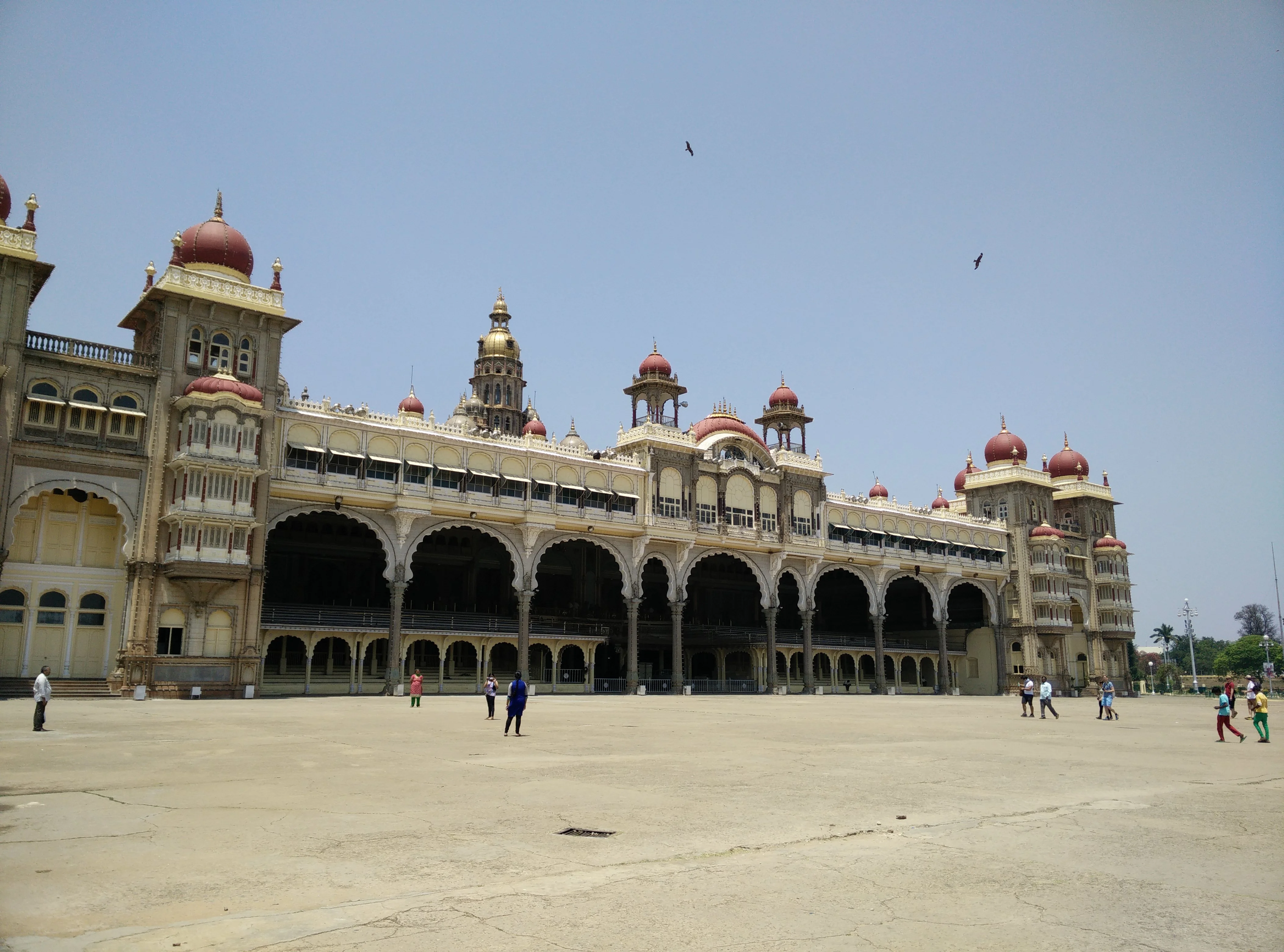
The Kingdom of Mysore left a rich architectural legacy that reflects the successive phases of its history. The Mysore Palace — rebuilt in its current Indo-Saracenic form in 1912 after a fire destroyed the earlier wooden structure — is the kingdom's most iconic monument, a magnificent synthesis of Hindu, Islamic, and European architectural elements that embodies the cosmopolitan character of the princely state. Designed by the British architect Henry Irwin, the palace combines domes, arches, turrets, and colonnades in a style that defies simple categorisation, reflecting the composite cultural identity of the kingdom it served.

The fortifications of Srirangapatna — the island fortress that served as Mysore's capital from 1610 to 1799 — preserve the military architecture of both the Wodeyar and Hyder Ali–Tipu Sultan periods. The massive granite walls, surrounded by the waters of the Kaveri, represented one of the strongest defensive positions in South India. The fortress's layout — with its multiple gates, bastions, and interior subdivisions — reflects centuries of military engineering refinement. Tipu Sultan's Summer Palace (Daria Daulat Bagh), with its remarkable murals depicting the Battle of Pollilur, and the Gumbaz mausoleum where Hyder Ali and Tipu Sultan are buried, represent outstanding examples of Indo-Islamic architecture in South India.

Tipu Sultan's architectural programme extended beyond Srirangapatna. He commissioned mosques, gardens, and public buildings across his dominions, introducing architectural styles that drew on Mughal, Deccani, and indigenous Dravidian traditions. The Jama Masjid at Srirangapatna, the mosque at Masjid-i-Ala in Mysore, and numerous smaller mosques across the former kingdom demonstrate a distinctive Mysorean Islamic architectural vocabulary characterised by restrained decoration, elegant proportions, and integration with the surrounding landscape.

The religious architecture of the kingdom reflects its pluralistic character: Hindu temples (including the ancient Chamundeshwari temple atop Chamundi Hill, renovated and expanded by successive Wodeyar kings), mosques (including Tipu Sultan's Masjid-e-Ala and numerous smaller mosques), and churches coexist within the kingdom's cultural landscape. The Wodeyar-period temples exhibit the characteristic South Indian Dravidian style, while the mosques of the Hyder Ali–Tipu Sultan era show influences from both Deccan Sultanate and Mughal architectural traditions.

The princely state era added a new layer of monumental architecture: public buildings in Indo-Saracenic and colonial styles, including the Mysore University buildings, the Lalitha Mahal Palace (1921), government offices, railway stations, and market buildings. These structures, designed to project the image of a progressive modern state, combined Indian and European architectural elements in ways that reflected the kingdom's position between tradition and modernity.

Cultural Contributions

The Kingdom of Mysore made significant contributions to South Indian culture across multiple domains:

Music: The Mysore court was one of the great centres of Carnatic music patronage. Composers including Vasudevacharya, Mysore Maharaja Jayachamarajendra Wodeyar (himself a accomplished musician), and numerous court musicians enriched the Carnatic tradition. The kingdom also produced notable practitioners of Hindustani music.

Literature: Kannada literature flourished under royal patronage, from the court poetry of the medieval Wodeyar period through the modern literary renaissance of the early twentieth century. The University of Mysore became a major centre of Kannada literary scholarship.

Painting: The Mysore school of painting, which developed during the seventeenth and eighteenth centuries, is characterised by its rich colours, fine detail, and distinctive style combining elements of Vijayanagara, Deccan, and Maratha artistic traditions. Court paintings of the princely state era document royal ceremonies, landscapes, and historical subjects.

Dance and theatre: The kingdom patronised classical dance forms (Bharatanatyam) and traditional theatre, including the distinctive Yakshagana folk theatre tradition of Karnataka.

The Legacy of the Kingdom

The Kingdom of Mysore's legacy extends far beyond its political history. The administrative traditions established during the princely state era — professional bureaucracy, investment in education and infrastructure, progressive social policies — contributed significantly to Karnataka's development as one of India's more prosperous and well-governed states. Bangalore's emergence as India's technology capital builds upon the educational and industrial foundations laid during the princely state era.

The kingdom's history also offers important lessons in governance, cultural pluralism, and the management of political transitions. The capacity of a Hindu dynasty to employ Muslim administrators at the highest levels, the relatively smooth transition from princely autocracy to democratic governance, and the preservation of cultural heritage across political changes all reflect a tradition of pragmatic statecraft that characterised Mysore at its best.

The economic legacy is equally significant. The industrial and educational foundations laid during the princely state era — particularly the investments in hydroelectric power, engineering education, and research institutions — created the conditions for Bangalore's later emergence as India's technology capital. The Indian Institute of Science, the engineering colleges, and the culture of technological innovation that Visvesvaraya and others fostered continue to shape Karnataka's economy in the twenty-first century. The tradition of state-led developmental investment that Mysore pioneered influenced India's post-independence economic planning and industrial policy.

The contested legacy of Hyder Ali and Tipu Sultan remains central to contemporary debates about Indian history, secularism, and communal relations. Their contributions to Mysore's development — military modernisation, administrative reform, economic innovation, and resistance to colonialism — are acknowledged by historians across the political spectrum, even as debates continue about specific policies and events during their reigns. The kingdom's history, spanning both Hindu and Muslim rulers, embodies the complexity of India's past in ways that resist simple categorisation.


Chronology of Major Events

  • 1399 — Yaduraya Wodeyar founds the Wodeyar dynasty at Mysore
  • 1399–1565 — Wodeyars serve as feudatories of the Vijayanagara Empire
  • 1565 — Battle of Talikota; collapse of Vijayanagara imperial authority
  • 1578–1617 — Reign of Raja Wodeyar I; expansion and assertion of independence
  • 1610 — Capture of Srirangapatna; establishment as new capital
  • 1638–1659 — Reign of Kanthirava Narasa Raja Wodeyar; major territorial expansion
  • 1672–1704 — Reign of Chikka Devaraja Wodeyar; administrative centralisation and kingdom's first zenith
  • 1704–1761 — Dalawai period; gradual weakening of royal authority
  • 1761Hyder Ali seizes effective power in Mysore
  • 1766 — Conquest of Malabar Coast
  • 1767–1769 — First Anglo-Mysore War; Treaty of Madras
  • 1780–1784 — Second Anglo-Mysore War; Battle of Pollilur (1780)
  • 1782 — Death of Hyder Ali; accession of Tipu Sultan
  • 1784 — Treaty of Mangalore concludes Second Anglo-Mysore War
  • 1790–1792 — Third Anglo-Mysore War; Treaty of Seringapatam (1792)
  • 1799 — Fourth Anglo-Mysore War; Fall of Srirangapatna; death of Tipu Sultan; restoration of Wodeyar dynasty
  • 1799–1831 — Reign of Krishnaraja Wodeyar III under British supervision
  • 1831–1881 — Direct British administration (Commissioner's period)
  • 1881 — Rendition; restoration of Wodeyar administrative authority
  • 1894–1940 — Reign of Krishnaraja Wodeyar IV; "model princely state" era
  • 1902 — Sivasamudram hydroelectric project commissioned
  • 1912–1918 — Dewanship of Sir M. Visvesvaraya; industrialisation programme
  • 1916 — University of Mysore established
  • 1924 — Krishna Raja Sagara Dam completed
  • 1940–1950 — Reign of Jayachamarajendra Wodeyar; final Maharaja
  • 1947 — Accession to Indian Union (9 August 1947)
  • 1950 — Full integration under Indian Constitution; Mysore becomes democratic state
  • 1956 — States Reorganisation; Mysore State expanded to include all Kannada-speaking areas
  • 1973 — Mysore State renamed Karnataka

References and Further Reading

Primary Islamic Sources

  • Quran, Surah Al-Hujurat (49:13) — cited in relation to Tipu Sultan's cosmopolitan governance and treatment of diverse communities
  • Tipu Sultan. Fathnama-i-Tipu Sultan (Administrative Code). Late 18th century CE — primary administrative document of Tipu's governance
  • Tipu Sultan. Hukumnamas (Royal Orders). Collections preserved in the Oriental Research Institute, Mysore — correspondence and administrative orders
  • Mir Hussain Ali Khan Kirmani. Nishan-i-Haidari (History of Hyder Ali). Early 19th century — court chronicle written under Tipu Sultan's patronage

Classical Islamic Sources

  • Kirmani, Mir Hussain Ali Khan. Tarikh-i-Tipu Sultan (also called Nishan-i-Haidari). Written c. 1802. The most important Persian-language chronicle of Hyder Ali and Tipu Sultan's reigns.
  • Ghulam Muhammad. Ahwal-i-Sultanat-i-Khudadad. Early 19th century. Persian administrative history of the Kingdom of Mysore under its Muslim rulers.
  • Zain ul-Abidin Shustari. Tuhfat al-Alam. Late 18th century. Travel account including descriptions of Mysore under Tipu Sultan.
  • Abd al-Qadir Husaini. Tarikh-i-Sultanat-i-Tipu. c. 1800. Persian chronicle of the Sultanate period in Mysore.

Academic and Scholarly Sources

  • Brittlebank, Kate. Tipu Sultan's Search for Legitimacy: Islam and Kingship in a Hindu Domain. Delhi: Oxford University Press, 1997.
  • Hasan, Mohibbul. History of Tipu Sultan. Delhi: Aakar Books, 2005 (reprint of 1951 edition).
  • Habib, Irfan. Resistance and Modernization under Haidar Ali and Tipu Sultan. New Delhi: Tulika Books, 1999.
  • Stein, Burton. "Eighteenth Century India: Another View." Studies in History 5, no. 1 (1989): 1–26.
  • Narasimhachar, R. The Kesava Temple at Somanathapura. Mysore Archaeological Survey, 1917.
  • Wilks, Colonel Mark. Historical Sketches of the South of India. 3 vols. London: Longman, Hurst, Rees, Orme, and Brown, 1810–1817.
  • Rice, B. Lewis. Mysore: A Gazetteer Compiled for Government. 2 vols. Westminster: Archibald Constable, 1897.
  • Saletore, B.A. Ancient Karnataka: History of Tuluva. 2 vols. Poona: Oriental Book Agency, 1936.
  • Subrahmanya, N.S. "The Wodeyars of Mysore." Indian Historical Quarterly 13 (1937): 505–525.
  • Rao, Hayavadana C. History of Mysore, 1399–1799 A.D. 3 vols. Bangalore: Government Press, 1943–1946.

Further Reading

  • Dalrymple, William. The Anarchy: The Relentless Rise of the East India Company. London: Bloomsbury, 2019.
  • Sen, Amartya. "Mysore as a Model State." In The Argumentative Indian. London: Allen Lane, 2005.
  • Subrahmanyam, Sanjay. "Between Eastern Africa and Western India, 1500–1650: Slavery, Commerce, and Elite Formation." Comparative Studies in Society and History 53, no. 4 (2011): 805–834.
  • Bayly, C.A. Indian Society and the Making of the British Empire. Cambridge: Cambridge University Press, 1988.
  • Fernandes, Praxy. The Tigers of Mysore: A Biography of Hyder Ali and Tipu Sultan. New Delhi: Viking, 1991.