Ahmad Shah Durrani: Founder of the Durrani Empire
Ahmad Shah Durrani (c. 1722-1772) founded the Durrani Empire at Kandahar in 1747 and is generally regarded as the founder of the modern Afghan state. He invaded India repeatedly and broke Maratha power at Panipat in 1761, but established no lasting rule there.
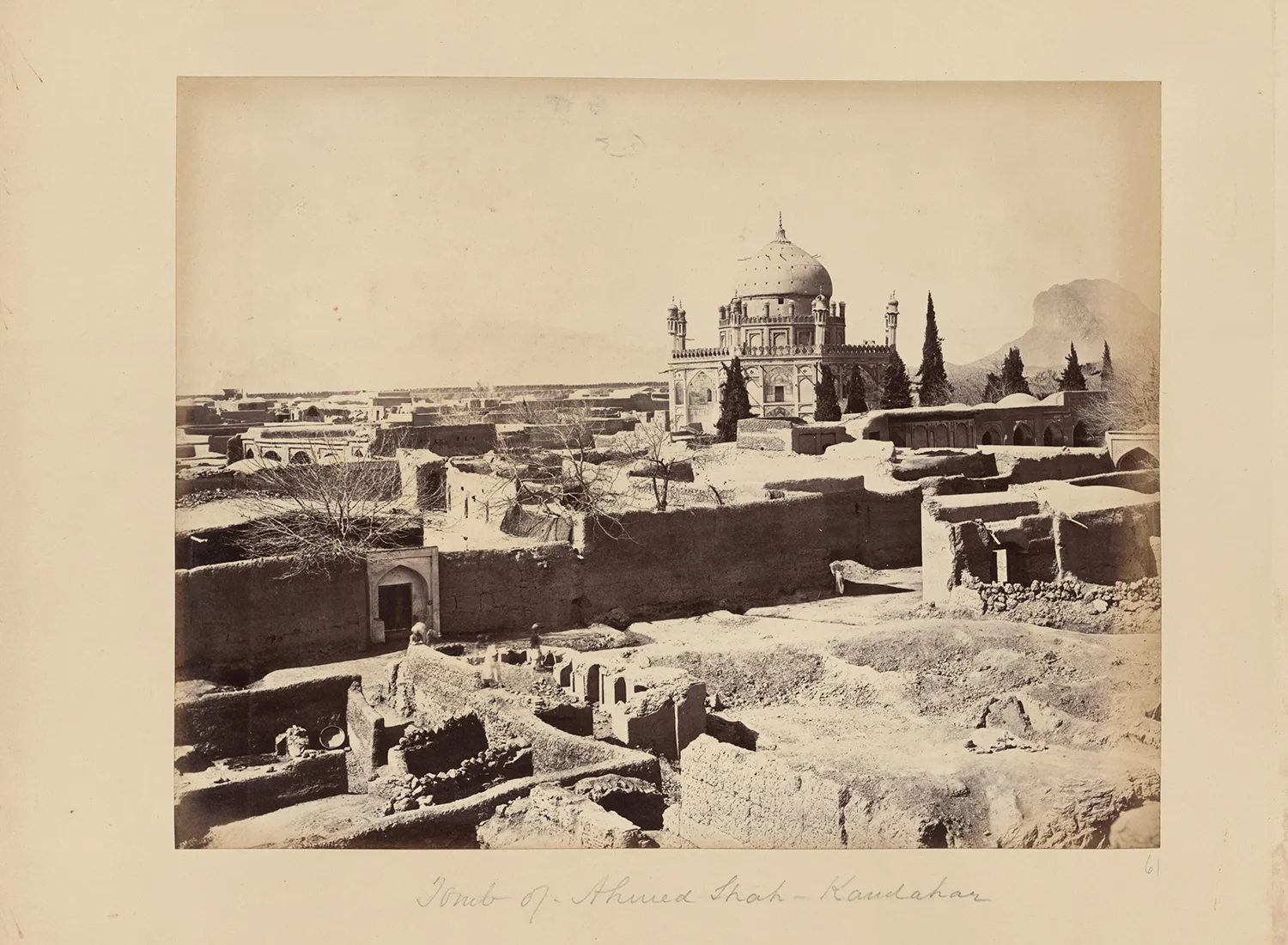
Ahmad Shah Durrani, known before his accession as Ahmad Khan Abdali, established in 1747 the state that is generally treated as the origin of modern Afghanistan, and for a quarter of a century was the dominant military power between the Iranian plateau and the Punjab. He is honoured in Afghanistan as Ahmad Shah Baba, the father of the nation.
His career belongs to two histories at once. In Afghan history he is a founder: the man who converted a tribal confederation into a state with a capital, a treasury, an army, and a recognised dynasty. In Indian history he is one of the external powers whose repeated interventions accompanied the disintegration of the Mughal Empire, and whose victory at Panipat in 1761 destroyed the northern ascendancy of the Maratha Confederacy without replacing it. The consequences of that outcome for the subsequent history of the subcontinent were considerable, and largely unintended.
Origins and Service Under Nader Shah
Ahmad Khan belonged to the Sadozai lineage of the Abdali, a Pashtun tribal confederation of the Kandahar region, and was the son of an Abdali chief. His birth is placed between about 1720 and 1722, and the sources disagree on his birthplace, giving either Herat or Multan; neither the year nor the place can be settled from the available material.
His early life was shaped by the turbulence of the Iranian plateau after the fall of the Safavids. The Abdali had been in conflict with, and then subordinated to, Nader Shah Afshar, the Iranian conqueror who campaigned across the region and sacked Delhi in 1739. Ahmad Khan entered Nader Shah's service and rose to command a contingent of Abdali cavalry, a position that gave him direct experience of large-scale campaigning, of siege warfare, and of the administration of a conquest state.
Nader Shah was assassinated in June 1747, and his empire fragmented immediately. Ahmad Khan withdrew eastward with his Abdali troops toward Kandahar.
The Founding of the Durrani State
At Kandahar in the summer of 1747 an assembly of Pashtun tribal leaders selected Ahmad Khan as their head. The choice of a young man from the Sadozai line, rather than one of the more senior claimants, is explained in the sources by his command of troops and treasure and by his acceptability as a compromise among rival tribal interests; the accounts also record the involvement of a religious figure in the acclamation.
He took the royal title Shah, adopted the epithet Durr-i Durran — pearl of pearls — and renamed the Abdali confederation Durrani after it. Kandahar became his capital, and coin was struck in his name. The Durrani dynasty he founded held power in Afghanistan, with interruptions and diminishing territory, into the nineteenth century.
The state he built rested on a bargain characteristic of the region: the Durrani tribal nobility supplied military service and received in return a share of revenue and plunder, exemption from certain taxes, and a voice in government, while the ruler retained the treasury, the artillery, and the conduct of foreign war. This arrangement made him formidable in the field and dependent on continual campaigning to satisfy his supporters — a dynamic that helps explain the frequency of his Indian expeditions.
Among the assets he secured from Nader Shah's dispersed treasury was the Koh-i-Noor diamond, which passed with the Durrani dynasty and eventually, through the turbulence of Afghan and Sikh politics, to the Punjab and then to Britain.
Campaigns in India
Ahmad Shah invaded India repeatedly; the standard reckoning is nine expeditions between 1747 and 1769. The Mughal state by this date retained ceremonial authority and very little effective power, and the political vacuum in the north was contested between the Mughal court's factions, the successor states, the Marathas expanding from the Deccan, the Rohilla Afghans, the Nawab of Awadh, and the rising Sikh polity in the Punjab.
His first incursion in 1748 was checked at Manupur. In 1749 he obtained the cession of territory in the Punjab, and in 1752 he annexed Kashmir and consolidated his hold on Sindh and the Punjab. These acquisitions gave the Durrani state a revenue base in the Indus basin that its Afghan territories alone could not provide, and defending them was the stated reason for much of what followed.
In 1757 he occupied Delhi. The city was plundered, the reigning emperor was left on the throne as a dependent, and a marriage alliance was concluded between the Durrani house and the Mughal family. The campaign of that year also extended to Mathura and Vrindavan, which were sacked, and to Amritsar, where the Sikh sanctuary of the Harmandir Sahib was desecrated and the sacred pool filled in. These acts are recorded in the contemporary and near-contemporary sources and are stated here as part of the historical record.
The Third Battle of Panipat
The decisive engagement of his career was fought at Panipat, north of Delhi, on 14 January 1761. The Maratha Confederacy, having become the principal power in northern India, advanced to confront the Durrani forces. Ahmad Shah's coalition included the Rohilla Afghans of the Doab and Shuja-ud-Daula, the Nawab of Awadh; the sources also record that appeals for intervention against Maratha expansion had come from Indian Muslim notables, and the reformist scholar Shah Waliullah of Delhi is among those associated with such appeals.
The battle ended in the comprehensive defeat of the Maratha army, with very heavy casualties among its commanders and troops. It was among the largest and bloodiest engagements fought in eighteenth-century India.
Its consequences were not what the victor intended. Ahmad Shah did not annex the territory he had won; he withdrew to Afghanistan, leaving the Mughal shell in place and no Durrani administration behind him. The result was that the one indigenous power capable of establishing a successor state across northern India had been broken, and no other power took its place. Historians of the period generally identify this as an important condition for the expansion of British authority from Bengal over the following decades — an outcome produced by the battle rather than sought in it.
The Punjab and the Sikhs
The more intractable problem for Durrani rule proved to be the Punjab. Sikh military organisation in the region grew during precisely the years of his greatest victories, and his repeated campaigns against it produced severe episodes without securing the province. The engagement of February 1762, remembered in Sikh tradition as the Vada Ghalughara or great massacre, inflicted very heavy casualties on the Sikh community, and Amritsar was attacked again in that period.
These campaigns did not achieve their objective. By the later 1760s Durrani authority in the Punjab was contested and receding, and after his death the province passed out of Afghan control to the Sikh confederacies and ultimately to the Sikh kingdom of Ranjit Singh.
The Western and Northern Frontiers
Ahmad Shah's state was not oriented solely toward India, and the western campaigns are essential to understanding it, since the Indian expeditions were in part financed by and in part competing with them.
Herat was taken in 1750 after a siege lasting the better part of a year, bringing western Afghanistan under Durrani control and removing the most plausible rival centre of Afghan power. He then campaigned into Khurasan against the remnants of Afsharid authority, taking Mashhad and Nishapur; the reduction of Nishapur in 1751 required heavy artillery brought up for the purpose and is described in the sources as costly. Mashhad, the shrine city, was left under a subordinate ruler of the Afsharid line rather than annexed outright — a treatment that acknowledged its religious standing.
To the north he asserted authority over Balkh and the territories reaching toward the Amu Darya, which brought him into contact with the khanate of Bukhara. The relationship was settled by agreement rather than conquest: the Amu Darya was recognised as the boundary between them, and the arrangement was sealed by a marriage alliance. It was in the course of these dealings that the Bukharan amir made him the gift of the relic discussed below.
He also engaged in diplomatic correspondence with the Ottoman court, presenting himself as a Sunni sovereign of standing and seeking recognition in those terms. At its greatest extent the Durrani domain reached from eastern Iran to Kashmir and Sindh, making it the largest Muslim state of its day after the Ottoman Empire.
The strategic pattern across both fronts is consistent. Where Ahmad Shah faced a defined state with a capital and an army, he was able to defeat it and impose terms that held. Where he faced dispersed and locally rooted resistance — the Sikhs in the Punjab above all — he was not. His empire was assembled from the former and lost to the latter.
Death and Succession
In his later years Ahmad Shah suffered from a disfiguring and ultimately fatal illness of the face, described in the sources as an ulcerating growth, which progressively limited his ability to campaign. He died in 1772 in the mountains near Kandahar; the sources differ on the precise date within that year. He was buried at Kandahar, where his shrine remains a place of national significance in Afghanistan.
He was succeeded by his son Timur Shah, who moved the capital to Kabul. The Durrani state contracted under his successors, and the dynasty's authority was progressively eroded by internal division among the Durrani nobility and by the loss of the Indian provinces.
The Assembly of 1747 and the Nature of Durrani Kingship
The manner in which Ahmad Shah came to power shaped the state he built, and it distinguishes the Durrani polity from the empires around it.
He was not a conqueror imposing himself on a subject population, nor an heir succeeding within an established dynasty. He was selected by an assembly of tribal leaders who possessed independent military followings and who were choosing a head for a confederation. The authority he received was therefore contractual in character: real, but bounded by the expectations of those who had conferred it.
The consequences ran through the whole reign. The great Durrani clans retained their own armed retainers, were exempted from certain forms of taxation, and expected a share in the revenues of conquest and in the offices of state. A council of Durrani chiefs functioned alongside the ruler. In return they supplied the cavalry on which his campaigns depended. Ahmad Shah kept for himself the artillery, the treasury, the household troops, and the conduct of external war — the classic instruments by which a tribal chief becomes a monarch — and he used non-Durrani troops, including Qizilbash cavalry of Iranian origin, as a counterweight to the tribal contingents.
This arrangement had a structural implication that explains much of his behaviour. A ruler whose nobility served in expectation of revenue and plunder must keep producing both. The frequency of the Indian expeditions is not fully explained by strategy or by religious motive; it is substantially explained by the requirements of the bargain that made him king. Thomas Barfield's analysis of Afghan state formation treats this as the defining feature of the polity, and it accounts equally for its early strength and for its later fragmentation, since successors with less military success had less to distribute.
Administration and the Character of the Durrani State
The Durrani state was an empire of tribute rather than of administration, and the distinction matters for assessing it.
In the Afghan heartland around Kandahar, Kabul, and Herat, government operated through tribal intermediaries and appointed governors, collecting what the local balance of power allowed. In the conquered provinces — Kashmir, Sindh, and the Punjab — the pattern was to leave existing administrative structures in place under a Durrani governor charged with remitting tribute. There was no attempt at the kind of revenue survey, standardised assessment, and salaried service nobility that Sher Shah Suri had built in India two centuries earlier, or that the Mughals had inherited from him.
This choice was rational in the circumstances and limiting in its results. It required little bureaucratic capacity and it did not challenge the interests of his nobility. But it meant that provinces were held only so long as an army could be brought to them, and that revenue depended on the credible threat of return. When Durrani military superiority in the Punjab eroded in the 1760s, the province was lost quickly, because nothing but force had tied it to Kandahar.
The state did possess the marks of sovereignty: coinage in the ruler's name, a court with Persian as its language of administration and culture, diplomatic correspondence with the Ottoman and other courts, and a recognised dynasty. Persian literary and administrative culture, inherited from the Safavid and Mughal worlds, supplied the idiom of Durrani kingship, and the shrine complexes and mosques patronised by Ahmad Shah at Kandahar belong to that tradition.
Panipat in Its Context
The battle of 1761 is best understood as the culmination of a contest for the succession to Mughal authority in northern India, in which the Durrani intervention was one factor among several.
By the 1750s the Mughal Empire retained legitimacy and almost no power. The Maratha Confederacy, expanding north from the Deccan, had become the strongest indigenous force and was extending tributary claims across Rajasthan, the Doab, and the Punjab. Ranged against that expansion were the Rohilla Afghan chiefs of the upper Doab, the Nawab of Awadh, factions of the Mughal court, and the Durrani state, whose Punjab and Kashmir possessions the Maratha advance directly threatened.
The coalition Ahmad Shah assembled was therefore a coalition of those with a common interest in stopping Maratha expansion, and it was cemented by a shared religious identity that the sources of both sides emphasise. The Maratha army at Panipat was large, well supplied with artillery, and commanded by Sadashivrao Bhau; it was also operating far from its base, short of cavalry forage, and without the local allies it had expected. The Durrani coalition cut its supply lines and forced the engagement on 14 January 1761.
The outcome was catastrophic for the Marathas, with losses among their commanders and troops that the Marathi sources describe in detail. The strategic result, however, was a vacuum rather than a transfer. Ahmad Shah installed no administration, took his plunder, and withdrew; his own troops were in any case mutinous over arrears. Within a few years the Marathas had recovered much of their position in the north, but the confederacy never regained the coherence of leadership that Panipat destroyed, and the intervening years had allowed the East India Company, victorious at Plassey in 1757 and Buxar in 1764, to establish itself as the dominant power in Bengal and the Ganges valley. Historians of the period generally treat Panipat as having removed the most plausible indigenous successor to the Mughals at precisely the moment a European commercial power was becoming a territorial one.
The Sequence of the Indian Campaigns
The conventional reckoning gives Ahmad Shah nine expeditions into India between 1747 and 1769. Setting out the sequence shows a pattern that a summary conceals: an initial failure, a period of territorial acquisition, a decade of intervention in the politics of the Mughal capital, and a final phase in which he could no longer hold what he had taken.
The first incursion, in the winter of 1747–48, ended in defeat. Mughal forces under the governor of the Punjab, Mu'in al-Mulk — generally called Mir Mannu — checked him at Manupur near Sirhind in March 1748, and he withdrew. It was the only substantial reverse of his Indian career, and it demonstrated that the Mughal state, though decayed, could still field an effective army in its own heartland.
He returned in 1748–49 and this time obtained by negotiation what he had failed to take by force: the cession of the revenues of the Punjab districts. In 1752 Kashmir was annexed and Mughal authority over the Punjab formally transferred to him, giving the Durrani state a substantial Indian revenue base. Sindh was brought under tribute in the same period.
The campaign of 1756–57 was the most consequential of the middle phase. Ahmad Shah occupied Delhi, which was plundered; the reigning emperor Alamgir II was left on the throne as a dependent, and a marriage alliance was concluded that took a Mughal princess into the Durrani house and gave his son Timur Shah a stake in Mughal legitimacy. Timur was installed as governor of the Punjab with the general Jahan Khan beside him. The same campaign extended to Mathura and Vrindavan, which were sacked, and to Amritsar, where the Sikh sanctuary was desecrated and its pool filled in.
The expedition of 1759–61 culminated at Panipat. Thereafter the pattern reversed: the campaigns of 1762, 1764–65, and 1766–67 were directed largely at holding the Punjab against Sikh forces that were growing stronger, and they failed to do so. By the final expedition of 1769 the province was effectively lost.
The Mughal Connection and the Regional Powers
Ahmad Shah's dealings with the Indian powers repay attention, because they show a ruler who understood that legitimacy in India could not simply be seized.
He never claimed the Mughal throne. Delhi was plundered and its emperors made dependent, but the dynasty was left in place and its formal sovereignty acknowledged — a calculation that the Mughal name still carried authority he could use and could not replace. The marriage alliance of 1757 served the same end: it attached his house to the imperial family without requiring him to displace it.
His coalition partners were the powers with a shared interest in resisting Maratha expansion. Najib al-Daula and the Rohilla Afghan chiefs of the upper Doab, themselves of Afghan descent and settled in India for generations, were his most reliable allies and among the parties that urged his intervention. Shuja al-Daula, the Nawab of Awadh, joined the Panipat coalition after hesitation, weighing Durrani strength against Maratha proximity. The scholar Shah Waliullah of Delhi is among the Indian Muslim figures associated with appeals for intervention against Maratha advance.
These relationships were transactional and did not outlast the campaigns. Shuja al-Daula was fighting the East India Company at Buxar three years after Panipat; the Rohillas were absorbed by Awadh and the Company within a generation. Ahmad Shah left no permanent alignment in India, which is another way of stating the central limitation of his intervention.
Religion, Legitimacy and the Kherqa
The Durrani monarchy required a basis of legitimacy beyond tribal acclamation, and Ahmad Shah assembled one from the materials available to a Muslim sovereign of the period.
He patronised religious foundations, endowed mosques and shrines, and cultivated the ulama of Kandahar and Kabul. Persian remained the language of his administration and Islamic kingship its idiom, inherited from the Safavid and Mughal states in whose shadow the Durrani polity was formed. His campaigns in India were presented, in his own correspondence and in the accounts of his allies, partly in religious terms — as the defence of Muslim rule in Hindustan against Maratha ascendancy.
The most durable expression of this legitimation is a relic. Around 1768 the amir of Bukhara presented Ahmad Shah with a garment traditionally held to have been worn by the Prophet Muhammad — the kherqa, or cloak. Ahmad Shah brought it to Kandahar and built a shrine for it, the Kirka Sharif, where it has remained. The attribution of the garment rests on tradition rather than on documentary evidence and is reported here as such; what is historically significant is the use made of it. Possession of a relic of that standing gave the new dynasty and its new capital a claim to sanctity that no amount of military success could supply, and the shrine became a place of national significance in Afghanistan. The relic has been produced at moments of political crisis in the country since, and Ahmad Shah's own tomb was built beside the complex.
Ahmad Shah as a Poet
Ahmad Shah composed verse in Pashto, and this is not an incidental detail: he occupies a place in the history of Pashto literature as well as in the political history of Afghanistan.
A body of poetry is attributed to him, and he is included among the principal Pashto poets in H.G. Raverty's Selections from the Poetry of the Afghans, the anthology published in London in 1867 that first presented the tradition to European readers and which remains a standard collection. The verse attributed to him works in the conventional registers of the tradition — the merits of his homeland and its people, the transience of worldly power, the obligations of faith — and it is composed in Pashto rather than in the Persian that was the language of his own administration and of Islamic high culture in the region.
That choice carries some weight. A ruler whose chancery worked in Persian, who corresponded with the Ottoman court in the idiom of Islamic kingship, and who drew his legitimacy from a Pashtun tribal assembly, was writing poetry in the language of the tribes. The Afghan national tradition has made much of this, and it is one basis of his standing as a founder-figure rather than merely a conqueror. As with most attributed pre-modern diwans, the boundary between what he wrote and what was later ascribed to him cannot be drawn with confidence, and the attribution should be read with that caution.
Timur Shah and the Durrani Succession
The trajectory of the state after 1772 bears on the assessment of its founder, since it reveals which of his achievements were structural and which personal.
Timur Shah, who succeeded his father, moved the capital from Kandahar to Kabul. The reason was the one his father had managed by other means: Kandahar was the heartland of the Durrani tribal nobility, and a ruler resident among them was subject to their influence. Kabul was more defensible politically, more central to the empire's remaining territories, and further from the clan assemblies. The move is evidence that the tribal bargain of 1747 had become a constraint that a less militarily successful ruler could not carry.
Under Timur Shah and his successors the empire contracted. The Indian provinces went first — the Punjab to the Sikh confederacies and then to Ranjit Singh, Kashmir with it, Sindh to its own dynasties. Internal conflict among Ahmad Shah's descendants and between the Sadozai royal line and the Barakzai nobility consumed the state's capacity, and by the 1820s the Durrani monarchy in its original form had effectively ended, giving way to Barakzai rule.
The state, however, did not disappear. The territorial core around Kabul, Kandahar, Herat and the Pashtun regions persisted as a distinct polity through the nineteenth century, resisted British invasion twice, and became the modern state of Afghanistan. That continuity is the substance of the claim that Ahmad Shah founded a country rather than merely an empire.
Assessment
Ahmad Shah Durrani's historical standing rests on the durability of the polity he created and the transience of the conquests he made.
The state was the achievement. He took a tribal confederation, gave it a monarchy, a capital, a coinage, a relic-shrine, and an army capable of operating at imperial scale, and established a dynasty that survived him by generations and a territorial core that survives still. Afghan national historiography treats him as the founder of the country, and modern scholarship on Afghanistan, while attentive to the tribal bargain that constrained him, generally accepts that the Afghan state's continuous existence dates from 1747.
The Indian campaigns are harder to assess favourably in their own terms. They produced revenue and prestige, and at Panipat a battlefield victory of the first magnitude, but they did not result in territory that could be held; the Punjab and Kashmir were lost within a generation of his death, and the pattern of the later expeditions is of a ruler returning repeatedly to a province slipping from his grasp. Nor did he build anything in India. He installed no administration, left no permanent alliance, and did not attempt the Mughal throne he had the power to take.
What the interventions did accomplish was destructive rather than constructive: they hastened the end of effective Mughal authority, they broke Maratha power in the north, and they left a vacuum that neither he nor any other regional power filled — a vacuum into which the East India Company moved. The acts of plunder and desecration committed during these campaigns, at Delhi, at Mathura and Vrindavan, and at Amritsar, belong to the record of that period and are part of how his intervention in India is remembered there.
There is also a structural verdict to record. The arrangement that made him powerful — a nobility serving in expectation of revenue and plunder — required continual military success to hold together, and it therefore drove the campaigning that produced no lasting gain. His son's first act was to move the capital away from the men who had made his father king. A state built on that bargain could be founded by a great commander and could not easily be governed by anyone else.
The two reputations are therefore not easily reconciled, and this article does not attempt to reconcile them. In Afghanistan he is a founder; in the history of northern India he is a destabilising external force in a period of disintegration. Both descriptions rest on the same set of events.
References and Further Reading
Primary Islamic Sources
- Quran, Surah Al-Imran (3:26) — on the giving and withdrawal of sovereignty by God, a text conventional in the Persian dynastic histories of the period
- Quran, Surah al-Nisa (4:58) — on rendering trusts and judging with justice, the standard applied to rulers in Indo-Persian and Afghan writing on governance
- Quran, Surah al-Anfal (8:60–61) — on military preparedness and on inclining to peace, verses invoked in the period's discussions of war and settlement
- Sahih al-Bukhari and Sahih Muslim, Books of Jihad and of Leadership — the prophetic material on the conduct of war, including the protection of non-combatants and places of worship, against which contemporary and later Muslim scholars assessed campaigns of this kind
Classical Islamic Sources
- Mahmud al-Husaini. Tarikh-i Ahmad Shahi. [Compiled c. 1773] — the court chronicle of the reign, the principal Persian narrative source
- Ghulam Husain Khan Tabatabai. Siyar al-Mutakhkhirin. Calcutta, 1789. — an Indian Persian history of the eighteenth century covering the invasions from the Indian side
- Imad al-Mulk (Ghazi al-Din Khan). Memoirs and correspondence of the later Mughal court
- Kashi Raj Pandit and the Marathi bakhar literature on Panipat — the accounts from the defeated side, essential for a balanced reconstruction of the battle
- Nur Muhammad Qandahari and the Afghan chronicle tradition of the Durrani period
Academic and Scholarly Sources
- Singh, Ganda. Ahmad Shah Durrani: Father of Modern Afghanistan. Bombay: Asia Publishing House, 1959. — the standard monograph, based on Persian, Marathi, and Punjabi sources
- Gommans, Jos J.L. The Rise of the Indo-Afghan Empire, c. 1710–1780. Leiden: Brill, 1995.
- Lee, Jonathan L. Afghanistan: A History from 1260 to the Present. London: Reaktion Books, 2018.
- Barfield, Thomas. Afghanistan: A Cultural and Political History. Princeton: Princeton University Press, 2010. — on the tribal basis of Durrani state formation
- Dupree, Louis. Afghanistan. Princeton: Princeton University Press, 1980.
- Gordon, Stewart. The Marathas 1600–1818. Cambridge: Cambridge University Press, 1993. — for the Maratha side of the Panipat campaign
- Bayly, C.A. Indian Society and the Making of the British Empire. Cambridge: Cambridge University Press, 1988. — on the consequences of the eighteenth-century power vacuum
- Grewal, J.S. The Sikhs of the Punjab. Cambridge: Cambridge University Press, 1990. — for the Punjab campaigns and their Sikh context
Further Reading
- Eaton, Richard M. India in the Persianate Age, 1000–1765. London: Allen Lane, 2019.
- Alam, Muzaffar. The Crisis of Empire in Mughal North India. Delhi: Oxford University Press, 1986.
- Axworthy, Michael. The Sword of Persia: Nader Shah. London: I.B. Tauris, 2006. — on the empire in whose service Ahmad Shah was formed
- Roy, Kaushik. India's Historic Battles: From Alexander the Great to Kargil. Delhi: Permanent Black, 2004.
- Raverty, H.G. Selections from the Poetry of the Afghans. London: Williams and Norgate, 1867. — the standard early anthology of Pashto verse, including the poetry attributed to Ahmad Shah
Mentioned In
1 article references this topic
More from South Asian Islam
Ahmed Raza Khan Barelvi and the Barelvi Movement
Ahmed Raza Khan of Bareilly (1856-1921) was an Indian Hanafi jurist, Sufi of the Qadiri order and prolific writer whose defence of the veneration due to the Prophet and the saints gave rise to the movement known as Barelvi, whose adherents call themselves the ulama of the Ahl-i Sunnat wa Jamaat.
Darul Uloom Deoband: The Seminary and the School of Thought
Darul Uloom Deoband is an Islamic seminary founded in northern India in 1866 or 1867 and the origin of the Deobandi school of thought. Its innovation was institutional: it carried the traditional religious sciences in the form of a modern school funded by public subscription.
Delhi Sultanate: Islamic Rule in Medieval India
The Delhi Sultanate (1206-1526 CE) was a series of five successive Islamic dynasties that ruled northern India for over three centuries, establishing Muslim political power in the subcontinent, creating a unique Indo-Islamic culture, and leaving an enduring architectural and administrative legacy.
The Ahl-i Hadis Movement
A nineteenth-century Indian Sunni movement that set aside the authority of the historic schools of law in favour of direct recourse to the Qur'an and hadith. Led by scholars at Delhi and Bhopal, it was marked by its manner of prayer and an austere standard of interpretation.