Murad I: The Conquest of the Balkans
Murad I (1326-1389) ruled the Ottoman state for some twenty-seven years, moving its capital to Edirne in Europe, reducing the Balkan principalities to vassalage, and developing the institutions of Ottoman government. He was killed at the Battle of Kosovo in 1389.
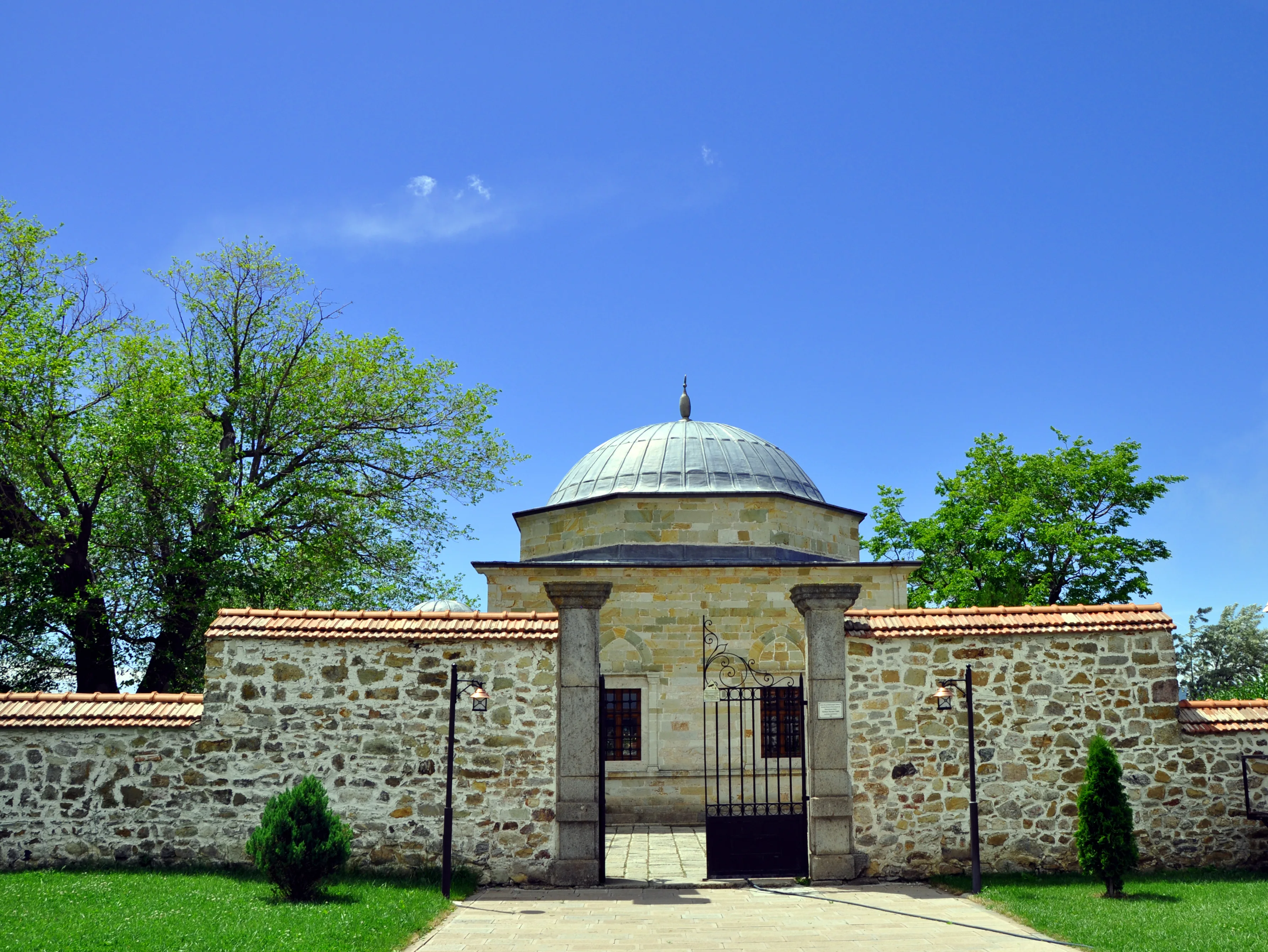
Murad I, son of Orhan Ghazi, ruled from 1362 until his death at the Battle of Kosovo in June 1389. His reign converted the Ottoman foothold in Thrace into dominance over the whole Balkan peninsula, moved the centre of the state from Asia to Europe, and built the administrative and military institutions that sustained Ottoman power for the next three centuries.
He is known in Ottoman tradition as Hüdavendigâr, a Persian honorific rendered roughly as "the devotee of God" or "sovereign," and he was the first Ottoman ruler to be treated by contemporaries as a sovereign of the first rank rather than a frontier prince. He was also the only Ottoman sultan ever killed on a battlefield.
Accession
Murad was born at Bursa on 29 June 1326, the son of Orhan and a consort recorded as Nilüfer Hatun. He was not the intended heir: his elder half-brother Süleyman Pasha, who had commanded the Ottoman operations in Thrace and secured the crossing at Gallipoli, was the presumptive successor and died in a riding accident around 1357.
Murad succeeded on Orhan's death in March 1362. Some accounts date the beginning of his authority to 1360, reflecting the period when he was already governing in his father's name during Orhan's old age; the discrepancy in the sources is of this kind rather than a genuine dispute. He faced and defeated a challenge from a brother early in the reign, and the Ottoman practice of eliminating rival claimants within the family — which became formal policy under later sultans — is visible from this point.
The Balkan Campaigns
The strategic situation Murad inherited was favourable in a way that requires explanation. The Balkans in the 1360s were politically fragmented to an unusual degree: the Serbian empire of Stefan Dušan had disintegrated after his death in 1355 into competing lordships; the Bulgarian territories were divided between rival rulers; Byzantium retained Constantinople, Thessalonica and fragments; and the Latin and Hungarian powers to the north and west pursued their own interests. There was no single opponent, and none of the local rulers could combine effectively against a determined external power.
Murad exploited this systematically. Adrianople — Edirne — was taken in the 1360s and became the Ottoman capital, a decision of considerable symbolic weight: the seat of government now lay in Europe, on the road to Constantinople. Philippopolis and the Thracian towns followed. In 1371 an Ottoman victory at the Maritsa river broke the Serbian and Bulgarian forces of the southern Balkans, and its consequence was the reduction of the local rulers to tributary status.
The method that followed was as important as the fighting. Rather than annexing and garrisoning every conquest, Murad accepted the submission of local Christian rulers on terms: they retained their lands and titles, paid tribute, and supplied troops for Ottoman campaigns. Serbian, Bulgarian and Byzantine contingents accordingly fought in Ottoman armies, sometimes against their own co-religionists. The Byzantine emperor John V himself accepted vassal status.
This system of graduated dependence was cheaper than conquest, generated revenue and manpower immediately, and progressively hollowed out the independence of the Balkan states before their formal annexation. It also meant that when annexation came, the Ottomans already knew the country, its resources, and its factions.
By the 1380s Ottoman authority extended over Thrace, Macedonia, much of Bulgaria and Serbia, and into Albania; Sofia fell in 1385 and Niš in 1386. In Anatolia, Murad simultaneously expanded at the expense of the neighbouring Turkish principalities, acquiring territory by marriage, purchase and war, and defeating Karaman, the strongest of them.
Institutions
Murad's reign is where the characteristic institutions of the Ottoman state take recognisable form.
The timar system — the assignment of the revenue of a district to a cavalryman in return for military service, with the land remaining state property and the assignment revocable — was systematised in the conquered Balkan territories. It gave the state a large cavalry force at minimal cash cost and tied the holders' interests to the survival of the regime. Much existing Christian landholding was accommodated within it, and Christian timar-holders are documented in the early Ottoman registers.
The standing infantry developed into the janissary corps during this period. The recruitment mechanism associated with it — the devşirme, a periodic levy of boys from the Christian rural population of the Balkans, who were converted, educated, and trained for military or administrative service — is generally dated in its systematic form to Murad's reign or shortly after. The institution was unusual and consequential: it produced a professional force loyal to the sultan personally rather than to any tribal or landed interest, and it eventually supplied much of the empire's senior administration. Its origins in a levy on subject populations are stated plainly in the sources and belong to any account of it.
The office of kadi was extended into the conquered territories, giving the state a judiciary applying Islamic law alongside the accommodations made for non-Muslim communities. The post of beylerbeyi — commander-in-chief — and the division of the realm into the two great commands of Anatolia and Rumelia also date from this period.
Murad was, on the evidence of these developments, the first Ottoman ruler to govern rather than merely to conquer.
Anatolia and the Turkish Principalities
Murad's Balkan achievement is the better known, but the simultaneous consolidation in Anatolia was equally necessary and considerably more delicate.
The Ottomans were one of several Turkish principalities in Asia Minor, and their rivals had a strong argument against them: while the Ottomans fought Christians on the Balkan frontier and could claim the prestige of gaza, expansion at the expense of fellow Muslim Turks was harder to justify and risked the disapproval of the religious classes whose support the dynasty cultivated.
Murad's methods reflected the difficulty. Territory was acquired by marriage — his son Bayezid was married to a daughter of the ruler of Germiyan, bringing districts as dowry — and by purchase, with the principality of Hamid selling territory outright. Where force was used, it was justified by the rival's alleged collusion with Christian powers or by breach of agreement. Karaman, the strongest of the principalities and the one with the best claim to the Seljuk inheritance in Anatolia, was defeated in the 1380s but not annexed.
The strategic logic was that Anatolia supplied manpower and legitimacy while Rumelia supplied revenue and expansion. Both were needed, and the two theatres were connected: Anatolian troops fought in the Balkans, and Balkan revenue paid for Anatolian campaigns. The tension between the two — and the resentment of the Anatolian principalities at Ottoman encroachment — resurfaced disastrously under Bayezid, when the dispossessed Turkish rulers made common cause with Timur.
The Vassal System in Practice
The arrangement by which Murad governed the Balkans deserves closer description, because it was unusual and because it explains the speed of Ottoman success.
A defeated ruler retained his lands, his title and his internal authority. In return he paid an annual tribute, attended the Ottoman court when summoned, supplied a contingent for Ottoman campaigns, and in some cases sent a son to the sultan's court as a hostage and companion. He remained Christian, and his church and nobility were untouched.
The advantages to the Ottomans were considerable. Conquest cost nothing beyond the initial campaign; revenue began immediately; the vassal's troops added to Ottoman strength and were removed from any coalition against it; the hostage sons returned home familiar with Ottoman ways; and Ottoman officers gained detailed knowledge of the country and its politics. Meanwhile the vassal's own standing was eroded — a ruler who taxed his subjects to pay a foreign tribute and sent their sons to fight a foreign war lost authority steadily.
Annexation, when it came, was therefore into territory already known, already partly administered, and with a nobility already divided between those who had accommodated and those who had not. Many of the accommodating families entered Ottoman service and retained their estates as timar-holders; the early Ottoman registers of the Balkans record Christian cavalrymen in significant numbers.
The system's weakness was that it depended on Ottoman strength being obvious. When it ceased to be — after Ankara in 1402 — the vassals defected at once, and the Ottoman position in the Balkans had to be rebuilt.
The Battle of Kosovo
The confrontation that ended Murad's life took place at Kosovo Polje, north-west of modern Pristina, on 15 June 1389 — 28 June by the modern calendar, and it is under the latter date that it is commemorated.
The coalition against him was assembled by Prince Lazar Hrebeljanović of Serbia and included Bosnian and Albanian contingents. It was the most substantial combined effort the Balkan powers mounted against Ottoman expansion, and it was provoked by the recognition that vassalage was becoming annexation.
The battle was hard fought and its details are poorly recorded. The Ottoman force prevailed; Lazar was captured and killed. Murad himself was killed during or immediately after the engagement. The tradition, Serbian and Ottoman alike, attributes his death to a Serbian knight named Miloš Obilić, who is said to have gained access to the sultan by feigning desertion and killed him with a concealed weapon. The story is early and widely transmitted but is not established as fact; the circumstances of Murad's death cannot be recovered with confidence, and accounts differ on whether he was killed before, during or after the fighting. His son Bayezid took command and was proclaimed sultan on the field.
The battle's consequences were less immediately decisive than its later reputation suggests. Serbia was not annexed at once; Lazar's successors continued as Ottoman vassals, and Serbian troops fought for Bayezid at Nicopolis in 1396 and against Timur at Ankara in 1402. But Serbian military capacity was broken, and no comparable coalition was assembled again.
Kosovo subsequently acquired an enormous symbolic weight in Serbian national memory, becoming the central event of a tradition of sacrifice and martyrdom developed in epic poetry and, from the nineteenth century, in nationalist politics. That later history is substantial and is distinct from the events of 1389; readers should be aware that a great deal written about the battle reflects the commemorative tradition rather than the evidence.
The Title of Sultan
Murad's reign is where Ottoman rulership acquires its formal vocabulary, and the development reflects a real change in standing rather than mere self-aggrandisement.
His grandfather Osman had been a bey — a frontier chief. His father Orhan had struck coin in his own name and used sultan in some documents while remaining, in practice, one Anatolian ruler among several. Murad governed a territory spanning two continents, received the submission of Christian kings, and commanded an army drawn from a dozen subject peoples. The titles used of him — sultan, hüdavendigâr, ghazi — record that position.
The Ottoman claim was still modest by later standards. Murad did not assert authority over the Muslim world, did not claim the caliphate, and did not challenge the Mamluk sultans of Cairo, who held the holy cities and sheltered the shadow Abbasid caliphate and who were the pre-eminent Sunni power of the age. The grander Ottoman claims came with Mehmed II and Selim I a century and more later.
What Murad established was that the head of the house of Osman was a sovereign of the first rank in his own region, whose recognition other rulers sought and whose vassals included Christian kings and Muslim beys alike. The apparatus of a sultanate — a court, a chancery, a treasury, a standing army, a judiciary, a capital — was assembled in his reign to match the claim.
Edirne and the Move to Europe
The transfer of the capital from Bursa to Edirne was among the most consequential decisions of the reign, and its implications were understood at the time.
Edirne — Adrianople to the Greeks — stood at the junction of the Tunca and Maritsa rivers in Thrace, commanding the road system of the southern Balkans and the approaches to Constantinople from the west and north. A ruler based there could reach Serbia, Bulgaria, Macedonia and the Byzantine capital in a single campaigning season, which Bursa did not allow.
The symbolic weight was equal to the practical. The Ottoman court now sat on European soil, in a former Byzantine city, within a hundred and fifty miles of Constantinople. Byzantine writers understood the message; so did the Balkan rulers who came there to submit. Bursa remained the dynastic burial place and the commercial capital, but government moved west, and Edirne remained the Ottoman seat until 1453 — longer than Bursa had been.
Murad and his successors built there accordingly: palaces, mosques, madrasas, and the covered markets that made the city a commercial centre in its own right. Edirne became the place where Ottoman princes were trained and where the army mustered, and its selection set the empire's orientation for a century.
Religion, Law and the Frontier
Murad's reign is where the Ottoman state's relationship with the Islamic religious establishment takes durable form, and the arrangement was more complex than the gazi rhetoric suggests.
The extension of the kadi judiciary into conquered territory brought Islamic law and its trained personnel into the Balkans, and with them the madrasas that produced them. Murad and his commanders endowed such institutions, and the jurists they trained staffed the courts, the chanceries and eventually the higher administration. This gave the state a literate class with an interest in its survival, and it gave the dynasty religious legitimation for its wars.
The legitimation was needed, and not only against Christians. Expansion in Anatolia at the expense of Muslim principalities required justification, and the sources show Murad's court seeking it — in accusations that rivals had allied with infidels, in claims of prior agreement broken, and in the argument that unified Muslim rule under a gazi sultan served the faith better than a patchwork of quarrelling beys. The jurists supplied opinions accordingly. Whether the arguments were sincere or instrumental is not a question the sources allow to be settled, and both elements were probably present.
Alongside this ran the frontier reality: Christian vassals fighting in Ottoman armies, Christian timar-holders in the registers, monasteries confirmed in their properties, and a ruling household that included Christian-born women and, through the devşirme, Christian-born officials. The Ottoman state of Murad's reign was simultaneously an instrument of Islamic expansion and a polity that ran on the participation of the people it had conquered. The tension is not resolved by choosing one description; the state worked because both were true.
Assessment
Murad I is the ruler under whom the Ottoman enterprise became an empire, and the case rests on three achievements.
He acquired the Balkans, and he did so by a method — tributary vassalage converting gradually into direct rule — that minimised cost and maximised the absorption of local resources. The manpower and revenue of Rumelia became the foundation of Ottoman power, and the region remained the empire's demographic core until the nineteenth century.
He built the institutions. The timar cavalry, the janissary infantry with its distinctive recruitment, the extension of the kadi judiciary, and the division of command between Anatolia and Rumelia all took form in his reign. These were what allowed the state to survive shocks that destroyed its contemporaries — including the catastrophe at Ankara thirteen years after his death, from which the Ottomans recovered and no comparable polity would have.
And he moved the capital to Edirne, which was both a practical decision and a declaration. The Ottoman state was henceforth a European as much as an Anatolian power, oriented toward Constantinople, which his great-grandson would take.
The reign is not without its qualifications. The vassalage system that served him so well depended on Ottoman military superiority remaining evident, and it produced armies containing large Christian contingents whose reliability was conditional. The devşirme solved the problem of a loyal standing force by taking children from subject populations, and the human cost of that arrangement is part of its history. And his death at Kosovo, in the moment of his greatest victory, illustrated the vulnerability that the absence of any settled rule of succession created — a weakness the Ottomans never resolved and which nearly destroyed them under his son.
References and Further Reading
Primary Islamic Sources
- Quran, Surah al-Anfal (8:60–61) — on military preparedness and on inclining toward peace, both relevant to Murad's combination of campaigning and tributary settlement
- Quran, Surah al-Nisa (4:58) — on rendering trusts and judging with justice, the standard invoked in the Ottoman literature on the duties of rulers
- Quran, Surah al-Hajj (22:39–40) — on permission granted to those wronged, part of the frontier vocabulary of gaza inherited from his predecessors
- Sahih al-Bukhari and Sahih Muslim, Books of Jihad and of Leadership — the prophetic material on warfare, the treatment of non-combatants, and the accountability of rulers, the framework of contemporary juristic assessment
- The earliest Ottoman tahrir survey registers and timar grants, and the surviving inscriptions and waqf deeds of Murad's foundations at Bursa and Edirne
Classical Islamic Sources
- Aşıkpaşazade. Tevarih-i Al-i Osman. [Compiled c. 1480s]
- Neşri, Mehmed. Kitab-i Cihannüma. [Compiled c. 1490s]
- Ahmedi. İskendername. [Early 15th century] — contains the earliest Ottoman literary treatment of the reign
- The anonymous Tevarih-i Al-i Osman chronicles and the Gazavatname tradition of campaign narratives
- Şükrullah. Behcetü't-Tevarih. [Compiled c. 1460s]
Academic and Scholarly Sources
- İnalcık, Halil. The Ottoman Empire: The Classical Age, 1300–1600. London: Weidenfeld and Nicolson, 1973.
- Imber, Colin. The Ottoman Empire, 1300–1650: The Structure of Power. 2nd ed. Basingstoke: Palgrave Macmillan, 2009.
- Fine, John V.A. The Late Medieval Balkans: A Critical Survey from the Late Twelfth Century to the Ottoman Conquest. Ann Arbor: University of Michigan Press, 1987.
- Emmert, Thomas A. Serbian Golgotha: Kosovo, 1389. New York: Columbia University Press, 1990. — on the battle and on the commemorative tradition
- Zachariadou, Elizabeth, ed. The Ottoman Emirate, 1300–1389. Rethymnon: Crete University Press, 1993.
- Kafadar, Cemal. Between Two Worlds: The Construction of the Ottoman State. Berkeley: University of California Press, 1995.
- Fleet, Kate, ed. The Cambridge History of Turkey, Volume 1: Byzantium to Turkey, 1071–1453. Cambridge: Cambridge University Press, 2009.
Further Reading
- Finkel, Caroline. Osman's Dream: The Story of the Ottoman Empire, 1300–1923. London: John Murray, 2005.
- Malcolm, Noel. Kosovo: A Short History. London: Macmillan, 1998. — on the battle's afterlife in national memory
- Nicol, Donald M. The Last Centuries of Byzantium, 1261–1453. 2nd ed. Cambridge: Cambridge University Press, 1993.
- Ménage, V.L. "Devshirme." In Encyclopaedia of Islam, 2nd ed. Leiden: Brill, 1965.
Mentioned In
7 articles reference this topic
More from Ottoman Empire
Battle of Nicopolis (1396 CE)
The Battle of Nicopolis, fought on 25 September 1396, was a decisive Ottoman victory over a combined Western European crusading army under Sigismund of Hungary. The last major crusade of the medieval period, its failure cemented Ottoman dominance over the Balkans.
Bosnia and Herzegovina: Islamic Heritage in the Balkans
The westernmost region of sustained Muslim presence in Europe. Ottoman rule from 1463 until the Austro-Hungarian occupation of 1878 produced a distinctive Bosniak Muslim culture that joined Ottoman traditions to indigenous Balkan ones.
Conquest of Constantinople - The Fall of Byzantium
The historic conquest of Constantinople by Ottoman Sultan Mehmed II on May 29, 1453 CE, ending the Byzantine Empire and establishing Ottoman dominance in southeastern Europe. This pivotal victory transformed the Ottomans into a major European power.
Ottoman Empire (1299-1922 CE)
The Ottoman Empire ruled for over 600 years, spanning three continents at its height. Founded by Osman I in 1299 CE, it became one of history's most powerful empires, serving as the seat of the Islamic Caliphate from 1517 until 1922.