Qutham ibn Abbas: History and Tradition
Qutham ibn Abbas was a son of the Prophet's uncle al-Abbas and served as governor of Mecca under Ali ibn Abi Talib. Little else about him is firmly established. The Shah-i-Zinda shrine at Samarkand grew around a tomb attributed to him, on the basis of a tradition scholarship treats as legendary.
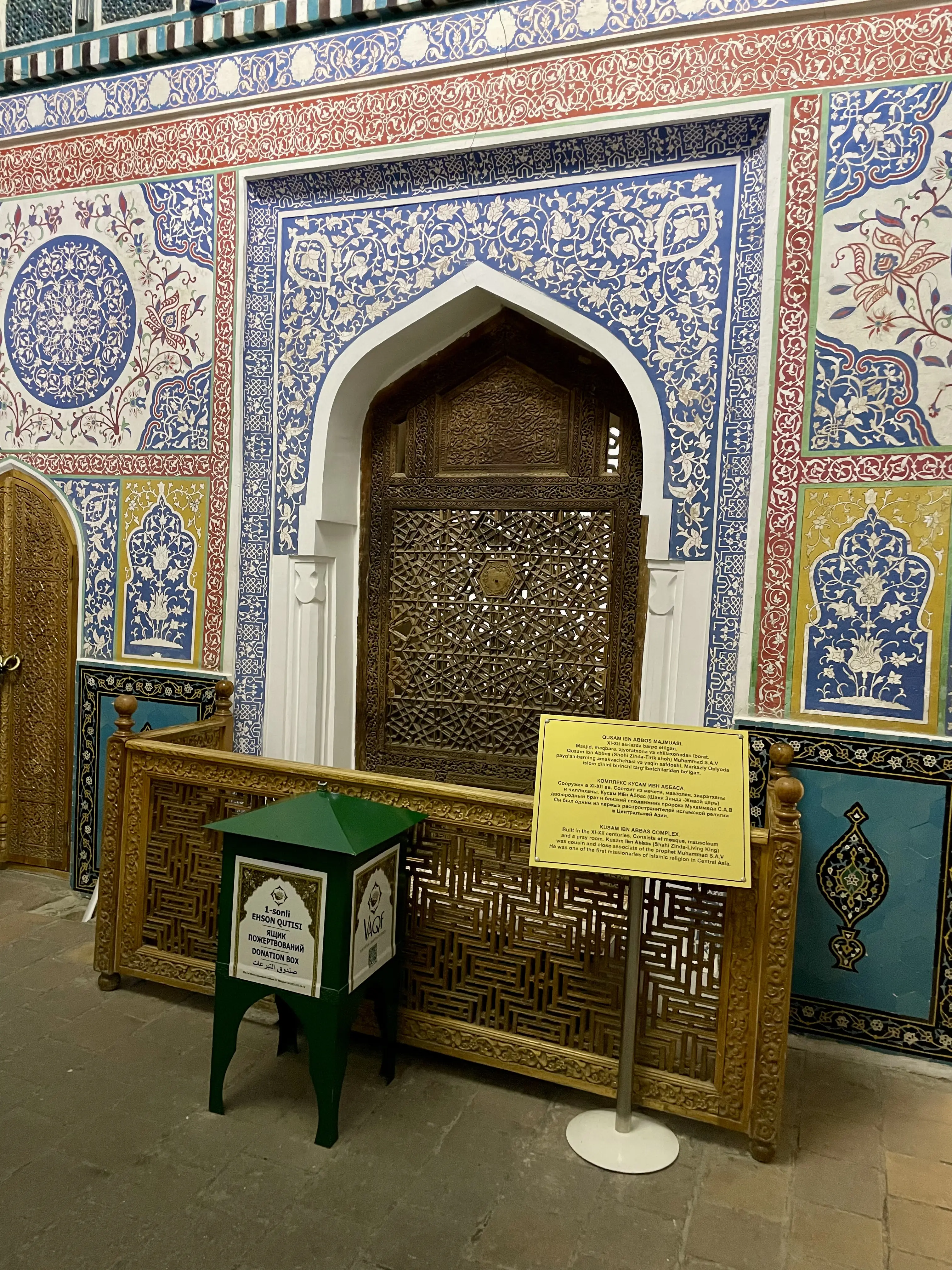
Qutham ibn al-Abbas was a son of al-Abbas ibn Abd al-Muttalib, the Prophet Muhammad's paternal uncle, and therefore a first cousin of the Prophet and a member of the Banu Hashim. He is counted among the Companions, and he held administrative office during the caliphate of Ali ibn Abi Talib.
He is also the subject of one of the most elaborate devotional traditions in Central Asian Islam: the Shah-i-Zinda complex at Samarkand, among the most celebrated monuments of the Islamic world, grew over the centuries around a tomb identified as his. The historical basis of that identification is weak, and the tradition attached to it is legendary in character.
This article is shorter than most in the encyclopaedia, and deliberately so. What is reliably established about Qutham ibn Abbas amounts to a few sentences; what is narrated about him amounts to a great deal. Setting the two apart is the honest treatment of the subject, and padding the established material to match the fame of the shrine would misrepresent the state of the evidence.
Family and Early Life
Qutham belonged to one of the most prominent households in early Islam. His father al-Abbas ibn Abd al-Muttalib was the Prophet's uncle, a Meccan merchant who accepted Islam and whose descendants would in time found the Abbasid caliphate. Qutham's brothers included Abdullah ibn Abbas, the celebrated Quranic exegete, and Ubaydullah, remembered in the biographical literature for learning and piety.
His birth is placed at Medina around 624, which would make him a young child at the Prophet's death in 632. The biographical notices record of him one distinguishing detail: a marked physical resemblance to the Prophet, which the sources remark upon and which is the trait most consistently attached to his name.
Beyond this, the classical biographical works — Ibn Sa'd's Tabaqat, Ibn Hajar's Isabah, Ibn Abd al-Barr's Isti'ab — treat him briefly. He does not appear as a significant transmitter of hadith, he is not associated with any military command of note, and the reports about him are few.
Governor of Mecca
The one substantial public role recorded for Qutham is administrative. During the caliphate of Ali ibn Abi Talib — the period of the first civil war treated in the article on the Rashidun Caliphate — he was appointed governor of Mecca, and the sources also associate him with authority over Ta'if.
The appointment is intelligible in context. Ali's support was concentrated in Iraq, and the Hijaz — the religious heartland containing Mecca and Medina — was politically exposed and of enormous symbolic importance. Appointing a member of the Banu Hashim, a cousin of the Prophet, to hold Mecca was a natural choice for a caliph whose own claim rested substantially on kinship with the Prophet and whose authority in the Hijaz was contested.
How long he held the post, and how it ended, are not clearly recorded. The chronology of provincial appointments during Ali's caliphate is uncertain in general, and the accounts of the period were shaped by the partisan divisions that followed.
The Shah-i-Zinda Tradition
The reason Qutham ibn Abbas is widely known has little to do with the foregoing.
At Samarkand, on the southern slope of the Afrasiyab plateau, stands the Shah-i-Zinda — "the Living King" — a funerary complex of mosques, mausoleums and shrines built and rebuilt between roughly the eleventh and the nineteenth centuries, and elaborated most spectacularly under the Timurids in the fourteenth and fifteenth centuries. Its tilework is among the finest surviving anywhere in the Islamic world, and it forms part of the Samarkand World Heritage property.
The focal point of the complex — the reason the other tombs were built around it — is a shrine identified as the burial place of Qutham ibn Abbas. The associated tradition holds that he travelled to Transoxiana with the Arab armies to preach Islam, that he was beheaded at or near Samarkand, and that he did not die: carrying his own head, and led by the figure of Khizr, he descended into a well, where he lives on in an underground palace. The name of the complex derives from this account.
The tradition has considerable elaboration in the hagiographical literature and has been the object of pilgrimage for many centuries. The historical record of the conquests, however, does not support it, for the two reasons set out below.
The Historical Difficulty
Two problems stand in the way of accepting the Samarkand account.
The first is chronological. Samarkand was taken by Muslim forces under Qutayba ibn Muslim in 712, and the earlier Arab raids across the Oxus belong to the 670s and after. If Qutham was born around 624, he would have been in his fifties at the time of the earliest such raids and approaching ninety by the conquest itself. Neither is impossible, but neither is documented, and the sources that record his governorship of Mecca in the 650s say nothing of a subsequent journey to Central Asia.
The second is the silence of the early sources. The classical biographical dictionaries of the Companions, which are the appropriate place to record the death of a cousin of the Prophet in a distant campaign, do not report a martyrdom at Samarkand. H.A.R. Gibb's study of the Arab conquests in Central Asia, which remains a standard treatment of the campaigns, does not place him there. The Samarkand identification appears in the local tradition of the shrine rather than in the historical record of the conquests.
The reasonable conclusion is that the shrine's attribution reflects a devotional tradition rather than a historical event. This pattern is common and well understood: shrines associated with Companions and early martyrs are found across the Islamic world at sites those figures are unlikely to have reached, and they served to root newly Islamised regions in the sacred history of the community's origins. The Shah-i-Zinda is the most architecturally distinguished example of the type.
Stating this does not diminish the site. Its significance is real and lies in what was built there and in the devotion of those who built it — the accumulated patronage of Karakhanid, Timurid and later rulers, and the continuous religious life of the complex over a millennium. That significance is independent of whether the tomb at its centre is what tradition says it is.
The Household of al-Abbas
Some context on Qutham's family helps explain both his appointment to Mecca and the readiness of later generations to attach a martyr's death to his name.
Al-Abbas ibn Abd al-Muttalib was the Prophet's paternal uncle and among the wealthiest Meccan merchants of his generation, with interests in the Zamzam water concession and in the caravan trade. He accepted Islam — the sources differ on how early — and after the conquest of Mecca his household held a position of unusual honour in the community as the Prophet's closest surviving paternal kin.
That position had a legal dimension. The Quran assigns a share of certain public revenues to the Prophet's kin, and the Banu Hashim were barred from receiving zakat precisely because they were entitled to this alternative provision. Members of the household therefore had a recognised standing in the fiscal arrangements of the early state, quite apart from any office they held.
Qutham's brothers illustrate the range of what such standing could produce. Abdullah ibn Abbas became the most important Quranic exegete of the first generation and the ancestor of a scholarly tradition. Ubaydullah is recorded for learning and piety. Al-Fadl was present at the Prophet's final illness and is a source for events surrounding it. And it was through another line of this household that the Abbasid caliphate would claim legitimacy a century later, ruling in the name of descent from al-Abbas.
Against these, Qutham is barely visible. This is not evidence of insignificance so much as of the ordinary distribution of attention in the biographical literature: a household that produced a great exegete and a caliphal line will preserve less about a son who held one governorship. The resemblance to the Prophet is what the tradition kept.
Shrine Traditions and the Islamisation of Central Asia
The Shah-i-Zinda attribution is best understood as an instance of a pattern, and setting out the pattern explains it better than treating the case in isolation.
As Islam spread into regions distant from Arabia — Transoxiana, the Indian subcontinent, North Africa, Anatolia, the Malay world — newly Muslim populations acquired a religious identity whose foundational events had occurred far away and long before. Shrines associated with Companions of the Prophet, with early martyrs, or with figures of the founding generation served to close that distance. A community with the grave of a cousin of the Prophet in its own city was not peripheral to sacred history; it was part of it.
Such attributions were rarely fabrications in any cynical sense. They typically grew from a local grave of uncertain identity, an early Muslim burial, or a site of pre-Islamic sanctity that acquired an Islamic identity over generations, and they were then consolidated by the patronage of rulers who had their own reasons to sponsor a sacred site. Devin DeWeese's work on Islamisation in the Turkic world examines how such traditions functioned and why they were persuasive to the communities that held them.
Samarkand's case had a specific political dimension. When Timur made the city his capital in the late fourteenth century, he was a ruler of contested legitimacy — neither a descendant of the Prophet nor of Genghis Khan, governing through a puppet khan — and he invested heavily in religious patronage. The elaboration of the Shah-i-Zinda in this period, and the popularisation of the legend attached to it, belong to that programme. His own mausoleum, the Gur-e-Amir, and the monuments described in the article on Samarkand served the same end.
The result is a site of genuine and layered historical importance. It records the piety of a millennium of pilgrims, the architectural achievement of several dynasties, and the process by which Central Asia became part of the Islamic world. None of that requires the tomb at its centre to hold the man whose name it bears.
Assessment
Qutham ibn Abbas presents an unusual case in which the fame of a figure is almost entirely detachable from his documented life.
What can be established is modest: he was a son of al-Abbas and a cousin of the Prophet, counted among the Companions; he bore a noted resemblance to the Prophet; and he governed Mecca and Ta'if for Ali ibn Abi Talib during the first civil war. For a member of so prominent a family this is a thin record, but it is not unusual — many Companions of good lineage are known to the biographical tradition by little more than their names, their kinship and a single office.
What cannot be established is the account that made him famous. The journey to Transoxiana, the martyrdom at Samarkand, and the legend of the Living King belong to the devotional and architectural history of Central Asian Islam rather than to the biography of a seventh-century Meccan. They are worth knowing, and they are worth labelling accurately.
The wider point is methodological, and it recurs across this encyclopaedia. Shrine traditions are historical evidence — of the piety, politics and self-understanding of the communities that produced them — but they are evidence of the period that produced them rather than of the period they describe. A tradition first attested in fourteenth-century Samarkand tells us about fourteenth-century Samarkand. Treating it as information about the 650s confuses two quite different kinds of knowledge, and the confusion is avoidable.
References and Further Reading
Primary Islamic Sources
- Quran, Surah al-Ahzab (33:33) — on the household of the Prophet, the basis of the standing that the Banu Hashim held in the early community
- Quran, Surah al-Anfal (8:41) and Surah al-Hashr (59:7) — on the shares due to the Prophet's kin from public revenue, the fiscal expression of that standing
- Quran, Surah al-Nisa (4:58) — on rendering trusts and judging with justice, the standard applied to those holding office such as the governorship of Mecca
- Sahih al-Bukhari and Sahih Muslim, Books of the Virtues of the Companions — the material on al-Abbas and his household, within which Qutham's brothers are considerably better attested than he is
Classical Islamic Sources
- Ibn Sa'd, Muhammad. Al-Tabaqat al-Kubra. Edited by Eduard Sachau. Leiden: Brill, 1904–1940. [Compiled c. 845 CE] — the earliest systematic biographical notice of the household of al-Abbas
- Ibn Hajar al-Asqalani. Al-Isabah fi Tamyiz al-Sahabah. Beirut: Dar al-Kutub al-Ilmiyyah, 1995. [Compiled c. 1449 CE] — the standard reference on the Companions
- Ibn Abd al-Barr, Yusuf. Al-Isti'ab fi Ma'rifat al-Ashab. Cairo: Nahdat Misr, 1960. [Compiled c. 1070 CE]
- Al-Tabari, Muhammad ibn Jarir. Tarikh al-Rusul wa al-Muluk. Leiden: Brill, 1879–1901. [Completed c. 915 CE] — for the provincial appointments of Ali's caliphate and for the Central Asian campaigns
- Al-Baladhuri, Ahmad ibn Yahya. Futuh al-Buldan. Beirut: Dar al-Kutub al-Ilmiyyah, 1987. [Original c. 892 CE] — the standard early account of the conquests, including Transoxiana
Academic and Scholarly Sources
- Gibb, H.A.R. The Arab Conquests in Central Asia. London: Royal Asiatic Society, 1923. — the standard treatment of the campaigns in which the tradition places Qutham's death
- Golombek, Lisa, and Donald Wilber. The Timurid Architecture of Iran and Turan. 2 vols. Princeton: Princeton University Press, 1988. — the authoritative survey of the Shah-i-Zinda in its Timurid phase
- Madelung, Wilferd. The Succession to Muhammad: A Study of the Early Caliphate. Cambridge: Cambridge University Press, 1997. — for the politics of Ali's caliphate and the position of the Banu Hashim
- DeWeese, Devin. Islamization and Native Religion in the Golden Horde. University Park: Pennsylvania State University Press, 1994. — on the formation of shrine traditions in Central Asian Islam
- Frye, Richard N. The Heritage of Central Asia. Princeton: Darwin Press, 1996.
Further Reading
- Kennedy, Hugh. The Great Arab Conquests. London: Weidenfeld and Nicolson, 2007.
- Blair, Sheila S., and Jonathan M. Bloom. The Art and Architecture of Islam, 1250–1800. New Haven: Yale University Press, 1994.
- UNESCO World Heritage Centre, documentation on Samarkand – Crossroad of Cultures (inscribed 2001).
- Manz, Beatrice Forbes. The Rise and Rule of Tamerlane. Cambridge: Cambridge University Press, 1989. — on the dynasty that made the shrine what it is
Mentioned In
1 article references this topic
More from Prophetic Era
Battle of Uhud
The Battle of Uhud (March 625 CE) was the second major engagement between Medina's Muslims and the Meccan Quraysh. After an early Muslim advantage, archers left their posts, enabling a Qurayshi cavalry attack that wounded the Prophet, killed Hamza, and ended in a strategic draw.
Conquest of Mecca
The conquest of Mecca in 630 CE (8 AH) was the decisive event of the Prophetic era. After eight years of exile, Prophet Muhammad led ten thousand Muslims into the city, declared a general amnesty, purified the Kaaba of its idols, and transformed the Arabian political landscape.
Great Mosque of Mecca: The Sacred Sanctuary
The Great Mosque of Mecca (Masjid al-Haram) is Islam's holiest site, housing the Kaaba and serving as the focal point for the Hajj pilgrimage and daily prayers for Muslims worldwide.
Mecca (Makkah)
The holiest city in Islam, birthplace of Prophet Muhammad, and site of the Kaaba. Located in Saudi Arabia's Hejaz region, it is the destination of the annual Hajj pilgrimage and the direction of prayer for Muslims worldwide.