Salman al-Farsi
Salman al-Farsi was a Persian who left Zoroastrianism for Christianity, was sold into slavery on his way to Arabia, and became a Companion of Prophet Muhammad. His own first-person account of that search survives, and he is credited in the biographical sources with proposing the trench at Khandaq.
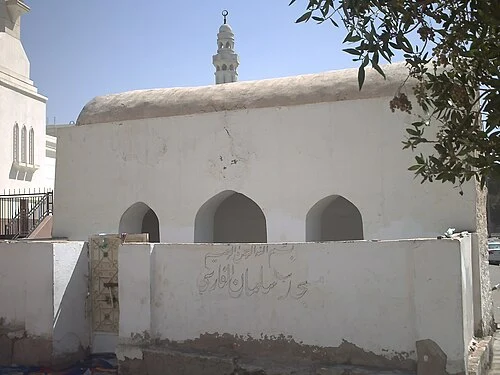
Salman al-Farsi — Salman the Persian — was a Companion of Prophet Muhammad who reached Islam by an unusually long route: born a Zoroastrian in Persia, he left that religion for Christianity, travelled west and then south in search of a prophet he had been told to expect, was betrayed and sold into slavery on the way, and arrived in Medina as the property of a Jewish household shortly before the Prophet's own arrival there.
His significance is threefold. He is the source of one of the few extended first-person conversion narratives to survive from the Companions. The biographical sources credit him with proposing the defensive trench at the Battle of Khandaq, the tactic that decided that siege. And as a Persian former slave who became a governor, he is cited throughout Islamic literature as evidence that standing in the early community did not depend on Arab descent.
A Note on the Sources
The material on Salman divides sharply in quality, and the division should be stated before the narrative.
The account of his search and conversion is transmitted as his own first-person narration, preserved in Ibn Hisham's recension of Ibn Ishaq and in the Musnad of Ahmad ibn Hanbal. It is detailed, geographically specific, and unflattering in places — features that tell in its favour. Elements of his life in Medina, including his manumission, appear in the hadith collections.
The attribution of the trench proposal comes from the biographical and campaign literature — Ibn Ishaq and al-Waqidi — rather than from the canonical hadith collections, and that distinction is maintained below.
A third body of material is legendary and is not used here. Some later sources give Salman an age of two hundred and fifty years or more, and a range of miracles and sayings are attributed to him in devotional literature. The statement "Salman is one of us, the People of the House," very widely quoted, is transmitted by al-Tabarani and al-Hakim with a chain that hadith critics have graded weak; it is frequently and wrongly cited to Sahih Muslim. It is recorded here as a report of weak transmission, not as a prophetic statement.
Origins in Persia
Salman's narration begins in Persia. He names his birthplace as Jayy, a village in the district of Isfahan, and describes his father as a wealthy landowner who was devoted to him — so much so, he says, that he kept him confined to the house as one would keep a girl.
He was raised in Zoroastrianism and was, by his own account, an exceptionally devoted adherent: he was given charge of the sacred fire and was responsible for tending it so that it never went out. This detail matters, because his later departure was not the drift of an indifferent believer but the decision of someone entrusted with the religion's central rite.
The turn came, as he tells it, through an errand. Sent by his father to an estate, he passed a Christian church and heard the people at prayer inside. He went in, watched, and was impressed by what he saw. Asked where the religion had originated, he was told Syria. He returned home and told his father, who confined him — in some transmissions in irons — and Salman escaped with a caravan travelling to Syria.
The concreteness here is worth noting. There is no account of theological reasoning or spiritual crisis in the narration; there is a young man who saw a form of worship he found more compelling than his own and went to find its source.
The Search Through Syria and Anatolia
In Syria Salman attached himself to the bishop of the church, asking to serve him and learn. What follows is the passage that most argues for the account's authenticity: the bishop, Salman says, was a corrupt man who instructed the people to give alms and then hoarded the money for himself. When he died and Salman told the congregation what he had found, they exhumed and stoned the body.
His successor was a man Salman describes with real affection — an ascetic who cared nothing for the world. When he was dying, Salman asked to whom he should go. He was directed to a man in Mosul.
The pattern then repeats across four cities. The man at Mosul, dying, sent him to a man at Nisibis. That man, dying, sent him to a man at Ammuriyah — Amorium, in Byzantine Anatolia. At Ammuriyah Salman worked and acquired some livestock.
When the man at Ammuriyah was dying, Salman asked again, and received a different answer. There was no one left, he said, following the way they had followed. But the time of a prophet had come, who would be sent with the religion of Abraham, and who would appear in the land of the Arabs before migrating to a place between two lava fields with palm trees growing between them.
He gave Salman three marks by which to know him: he would accept a gift, he would not accept charity, and between his shoulders would be the seal of prophethood.
Betrayal, Slavery, and Arrival at Medina
Salman arranged passage with a party of the Banu Kalb, giving them his livestock in exchange for taking him to Arabia. They betrayed him. At Wadi al-Qura they sold him as a slave, and he was bought by a Jewish man, then sold on to a cousin of his from the Banu Qurayza, who took him to Medina.
Salman's own words on seeing the place are that he recognised it at once from the description he had been given — the palms, the two lava flows — and he says he was certain, though he said nothing.
He was working at the top of a palm tree, his master beneath, when a man came and spoke of the arrival at Quba of one who claimed to be a prophet. Salman describes the physical effect of hearing it, and his master striking him for his agitation.
He tested the three signs in order. He took dates and offered them as charity; the Prophet told his companions to eat and did not eat himself. On a later occasion he offered dates as a gift, and the Prophet ate and his companions with him. Then, at a gathering, Salman contrived to see his back, and the Prophet — understanding what he wanted — let his cloak fall so that he could see the seal between his shoulders. Salman embraced Islam then.
Manumission
Salman's slavery had a direct consequence that the sources record plainly: he missed the Battle of Badr and the Battle of Uhud, because he was another man's property and not free to go.
The Prophet instructed him to seek a contract of manumission. The terms his master set were substantial: three hundred date palms to be planted and brought to maturity, together with a weight of gold. The Prophet called on the Companions to assist, and the sources record him planting the palms himself, with the community supplying the trees and the gold. Salman was freed.
This episode is among the more concrete illustrations of the early community's treatment of slavery. Salman was not freed by declaration; his freedom was purchased, through a legal mechanism, by the collective effort of the community, with the Prophet participating physically in the work.
Khandaq
In 5 AH a confederate army besieged Medina. The city was exposed on its northern approaches, where the terrain was open, and the defenders were heavily outnumbered.
The biographical sources — Ibn Ishaq as transmitted by Ibn Hisham, and al-Waqidi — record that Salman proposed digging a continuous trench across the open ground, a defensive technique used in Persian warfare and unfamiliar in Arabia. The proposal was adopted, the trench was dug by the whole community, and it prevented the confederate cavalry from closing with the Muslim force for the duration of the siege. The coalition withdrew after roughly a month without a general engagement.
The evidentiary position should be stated: the digging of the trench is extensively documented in the canonical hadith collections, including reports at Sahih al-Bukhari 4100, 4101, 4102 and 4106 describing the labour, the hunger, and the Prophet's participation in it. The attribution of the idea to Salman is not in those collections; it comes from the campaign literature. There is no reason to doubt it — it is early, it is consistent, and it explains where an unfamiliar technique came from — but it rests on the sirah rather than on hadith, and the two should not be conflated.
Later Life at Mada'in
After the conquest of Iraq, Umar ibn al-Khattab appointed Salman governor of Mada'in — Ctesiphon, the former Sasanian capital. The appointment placed a Persian former slave in authority over the administrative centre of the empire he had been born in.
The sources are consistent about how he conducted himself in office, and the detail is specific rather than laudatory. He is reported to have declined to live on his official stipend, giving it away and supporting himself by weaving palm leaves, and to have lived in conditions that visitors found startling for a governor. Reports describe him without the retinue or residence the office would ordinarily carry.
He died at Mada'in. The date is not firmly established: the sources give 32, 33, 34, 35 and 36 AH, corresponding to a range between about 652 and 657 CE. His age at death is also unsettled, and the very high figures found in some later sources are legendary and are not repeated here. His tomb at Mada'in, south of modern Baghdad, has been a visited site for centuries.
Assessment
Salman's place in Islamic memory rests on the combination of two things that would ordinarily be separate.
The first is the narrative itself. A man leaves the religion he was raised to serve, follows a chain of dying teachers across four cities, is sold into slavery by the people he paid to help him, and arrives — by accident, as a slave — in the one town where the person he was looking for was about to appear. Whatever view one takes of the account's transmission, it is a story that early Muslims found compelling for the obvious reason, and it was preserved at unusual length because of it.
The second is what he represented structurally. The early community absorbed a Persian, a former Zoroastrian, a former Christian and a former slave, and placed him in a position of military counsel and then provincial authority. The Qur'anic principle that God made humanity into peoples so that they might know one another, and that precedence lies in piety alone (Quran 49:13), was cited in connection with figures like Salman from an early date, and his career is the practical case the principle describes.
Both of these have made him a figure of particular importance in Persian Islamic memory, where he is the point at which Persia enters Islamic history not as a conquered territory but as a participant from the beginning.
References and Further Reading
Primary Islamic Sources
- Quran, Surah Al-Hujurat (49:13) — humanity created as peoples and tribes so that they might know one another, with precedence belonging to piety; the verse cited in connection with Salman's standing
- Quran, Surah Al-Rum (30:1-5) — the reference to the Persians and the Byzantines, the geopolitical setting of Salman's early life
- Salman's own narration of his search and conversion, transmitted in Ibn Hisham's Al-Sirah al-Nabawiyyah and in the Musnad of Ahmad ibn Hanbal — the primary source for everything in this article concerning his life before Medina, including the three signs and the sequence of teachers
- Sahih al-Bukhari, Kitab al-Maghazi, Hadith 4100, 4101, 4102 and 4106 — the reports on the digging of the trench at Khandaq, the hunger of the workers, and the Prophet's participation in the labour
- Sahih al-Bukhari, Kitab al-Manaqib — reports concerning Salman's standing among the Companions
- The report "Salman is one of us, the People of the House" — transmitted by al-Tabarani and al-Hakim; the chain is graded weak by hadith critics, and the report is not in Sahih Muslim, to which it is frequently attributed
Classical Islamic Sources
- Ibn Hisham. Al-Sirah al-Nabawiyyah. Edited by Mustafa al-Saqqa. Cairo: Maktabat Mustafa al-Babi al-Halabi, 1955. [Transmitting Ibn Ishaq, c. 760 CE]. Contains Salman's narration in full, and the attribution of the trench proposal to him.
- Al-Waqidi, Muhammad ibn Umar. Kitab al-Maghazi. Edited by Marsden Jones. Oxford: Oxford University Press, 1966. [Original c. 820 CE]. Campaign detail on Khandaq and the trench.
- Ibn Sa'd, Muhammad. Al-Tabaqat al-Kubra. Edited by Eduard Sachau. Leiden: Brill, 1904–1940. [Original c. 845 CE]. Biographical notice, the manumission, and the reports on his governorship and austerity.
- Al-Tabari, Muhammad ibn Jarir. Tarikh al-Rusul wa'l-Muluk. Edited by M.J. de Goeje. Leiden: Brill, 1879–1901. [Original c. 915 CE]. The conquest of Iraq and the administration of Mada'in.
- Al-Dhahabi, Shams al-Din. Siyar A'lam al-Nubala'. Beirut: Mu'assasat al-Risalah, 1981–1988. [Original c. 1348 CE]. Assessment of the reports on his age and death date.
- Ibn Hajar al-Asqalani. Al-Isabah fi Tamyiz al-Sahabah. [Original c. 1449 CE]. Critical biographical entry, distinguishing established material from the weaker reports.
Academic and Scholarly Sources
- Bosworth, C.E. "Salman al-Farisi." In The Encyclopaedia of Islam, 2nd edition. Leiden: Brill. Reference article with the source-critical apparatus and the range of proposed death dates.
- Morony, Michael G. Iraq After the Muslim Conquest. Princeton: Princeton University Press, 1984. On Mada'in and the administration of the former Sasanian territories in the period of Salman's governorship.
- Pourshariati, Parvaneh. Decline and Fall of the Sasanian Empire. London: I.B. Tauris, 2008. The Persian world Salman was born into and its religious landscape.
- Donner, Fred M. The Early Islamic Conquests. Princeton: Princeton University Press, 1981. The conquest of Iraq and the establishment of Muslim administration there.
- Levy-Rubin, Milka. Non-Muslims in the Early Islamic Empire. Cambridge: Cambridge University Press, 2011. On the status of non-Arab and non-Muslim populations in the period.
- Massignon, Louis. Salman Pak et les prémices spirituelles de l'Islam iranien. Tours: Arrault, 1934. Classic study of Salman's place in Iranian Islamic memory and of the legendary material that accumulated around him.
Further Reading
- Lings, Martin. Muhammad: His Life Based on the Earliest Sources. Cambridge: Islamic Texts Society, 1983. Narrative treatment of Salman's conversion and of Khandaq drawn from the early sources.
- Kennedy, Hugh. The Great Arab Conquests. London: Weidenfeld and Nicolson, 2007. Accessible account of the conquest of Persia and its aftermath.
- Crone, Patricia, and Michael Cook. Hagarism. Cambridge: Cambridge University Press, 1977. Included for readers interested in the source-critical debates surrounding early Islamic biography, whose conclusions are widely contested.
Mentioned In
8 articles reference this topic