Turgut Reis: The Seaman of Tripoli
Turgut Reis (c. 1485-1565), known in Europe as Dragut, rose from gunner to Ottoman admiral and Pasha of Tripoli. A former galley slave of the Genoese, he took Tripoli in 1551, won at Djerba in 1560, and was killed at the siege of Malta in 1565.
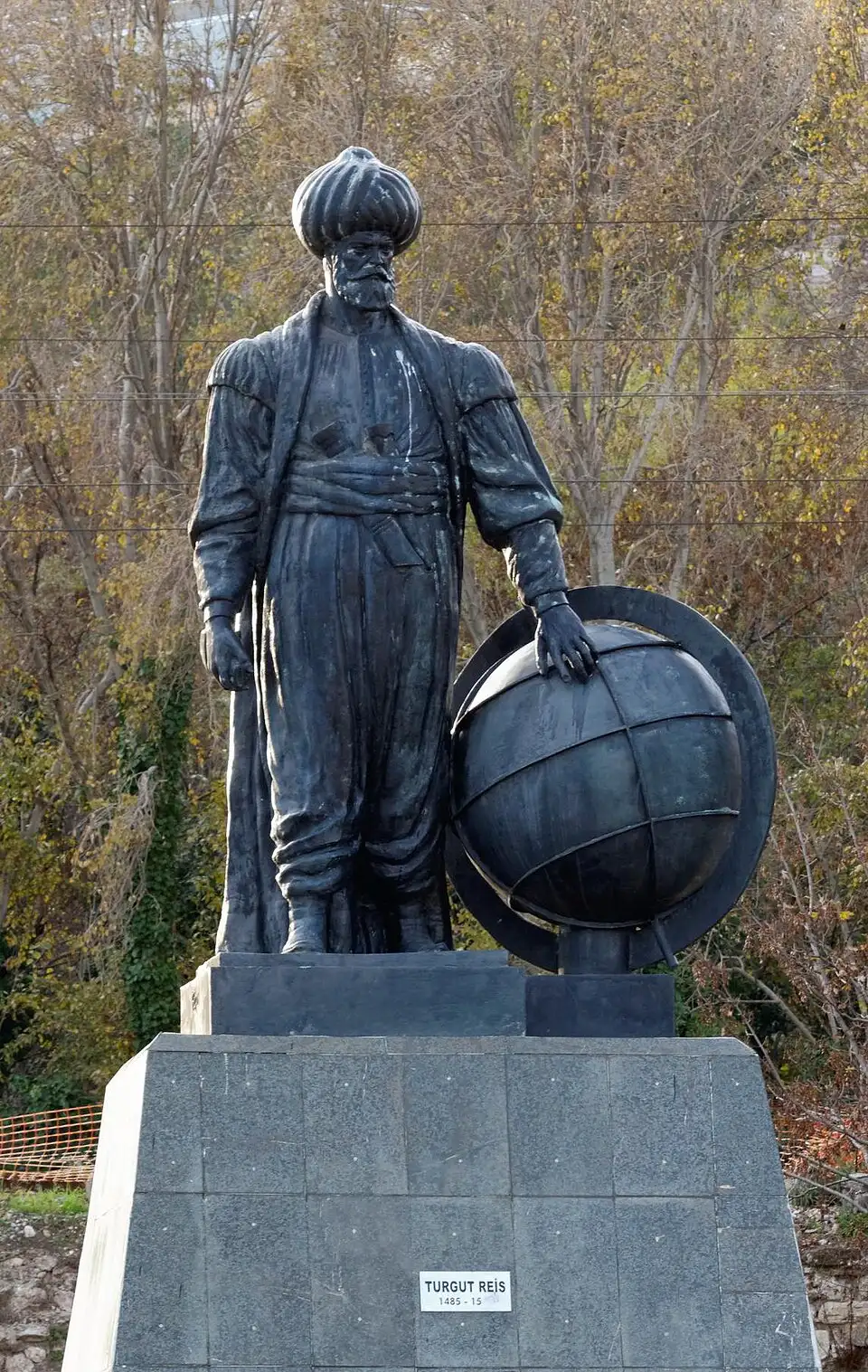
Turgut Reis, called Dragut in the European sources, was an Ottoman admiral and provincial governor whose career ran from the 1510s to his death at the siege of Malta in 1565. He served under Hayreddin Barbarossa, commanded a squadron at Preveza, spent four years chained to the oar of a Genoese galley, was ransomed, and returned to become the most feared seaman in the Mediterranean, governor of Tripoli, and beylerbey of the Ottoman fleet's western command.
His career is the clearest illustration of how the Ottoman naval system worked at its height. He was not of the palace élite, not a product of the imperial school, and not connected by family to anyone of consequence: he was a peasant's son from the Anatolian coast who began as an artilleryman and rose entirely on demonstrated competence at sea. The Ottoman Empire of the sixteenth century could take such a man and make him a pasha, and the corsair captains of the Maghrib coast were integrated into the imperial navy on exactly those terms.
He is also, in the European tradition, a figure of dread — the raider who carried off the population of an island, the commander whose name appears in the coastal alarm systems of Italy and Spain. That reputation is not baseless, and this article treats the raiding for what it was rather than passing over it.
Origins and Apprenticeship
Turgut was born around 1485 in a village near Bodrum on the southwestern Anatolian coast, in a region of small farming and fishing communities. The sources describe a family of modest means with no military or maritime distinction, and give his father as a farmer.
He went to sea young and began as a gunner. Artillery was the technical speciality of the period, and skill with it was a route to advancement in a navy where most seamen were sailors first; the sources consistently emphasise his gunnery, and later his reputation as a navigator and pilot with an exceptional knowledge of Mediterranean coasts and shoal water.
He entered the service of the corsair captains of the western Mediterranean and by the 1520s was operating under Hayreddin Barbarossa, who had by then attached Algiers to the Ottoman Empire and was building the fleet described in the article on his career. Turgut commanded his own vessels and then his own squadron, raiding the coasts of Italy, Sicily, Spain and the islands, and he was among the captains Hayreddin brought into the imperial service after his appointment as grand admiral in 1533. He commanded a squadron at the Battle of Preveza in 1538.
Captivity
In 1540 Turgut was surprised while his ships were careened at Girolata on the Corsican coast and captured by a Genoese force under Giannettino Doria, a nephew of the admiral Andrea Doria.
He spent approximately four years as a galley slave, chained to the oar in Genoese service. This was the standard fate of captured Muslim seamen, as the enslavement of Christian captives was the standard practice on the Muslim side, and the Mediterranean galley economy of the sixteenth century depended on it. He was released in 1544, ransomed in an arrangement that the sources connect with pressure from Hayreddin Barbarossa, whose fleet was then operating in the western Mediterranean in concert with France and who was in a position to make the Genoese uncomfortable.
The four years at the oar are worth recording because they were not exceptional. Men on both sides of this war expected capture, slavery and — if they were valuable enough — ransom, and a considerable number of the period's commanders had been prisoners. Robert Davis's work on Mediterranean slavery examines the scale of the traffic in both directions.
Independent Command and Tripoli
After his release Turgut operated as a commander in his own right, and the decade from 1544 to 1554 made his reputation.
He established a base at Mahdia on the Tunisian coast in 1550 and used it to raid across the central Mediterranean. The Spanish and the Knights of St John responded with a substantial expedition that took Mahdia later the same year, and Turgut escaped — the accounts describe him extricating his ships from Djerba through a channel his pursuers believed impassable, an episode that became part of his reputation as a pilot.
In August 1551, in a joint operation with the Ottoman admiral Sinan Pasha, he took Tripoli from the Knights of St John, who had held it since the Emperor Charles V granted it to them in 1530. Tripoli became his base and his governorship: he was made its bey and subsequently its pasha, and he ruled it as an Ottoman province until his death, developing the city, its fortifications and its harbour. The Ottoman regency of Tripoli established at this point lasted into the twentieth century.
The same 1551 campaign included the raid on Gozo, the smaller island of the Maltese group, where the population was carried off into slavery. The sources on both sides agree on the substance, and it stands as a plain instance of what corsair warfare meant for the civilian populations of the Mediterranean islands and coasts. It is also part of the immediate background to 1565: the Knights of St John, expelled from Tripoli and raided at Gozo, and the Ottomans, whose shipping the Knights preyed upon from Malta, had a specific and mutual account to settle.
Further operations followed. In 1552 Turgut and Sinan Pasha defeated a Genoese squadron under Andrea Doria off Ponza. He campaigned in the western Mediterranean through the 1550s, raiding Corsica, the Balearics — Ciutadella on Minorca was sacked in 1558 — and the Italian coasts, and he was appointed to the senior Ottoman naval command in the western Mediterranean.
In 1560 a large Spanish-led expedition assembled to retake Tripoli was caught at Djerba by an Ottoman fleet under Piyale Pasha, with Turgut participating, and destroyed. The Battle of Djerba was one of the heaviest naval defeats Spain suffered in the century and it confirmed Ottoman control of the central Mediterranean.
Tripoli under Turgut
Turgut governed Tripoli for fourteen years, and the province he built there is his most concrete legacy.
The city he took in 1551 was a Knights' outpost on an exposed stretch of the Libyan coast with a poor hinterland, held mainly for its harbour. Under his government it became a functioning Ottoman provincial capital and a corsair base of the first rank. He rebuilt and extended the fortifications, improved the harbour and its defences, and endowed the city with the mosque complex in which he was later buried. He extended Ottoman authority inland and along the coast, into the Jebel and toward the oases, bringing tribal populations into a tributary relationship with the city.
The administrative form was the one Hayreddin Barbarossa had established at Algiers a generation earlier and which the Ottomans applied across the Maghrib: a governor appointed from Istanbul, holding the rank of bey and later pasha, supported by a garrison of Janissaries sent from the capital, with the corsair captains organised as a recognised corporation and the revenues of raiding, customs and tribute funding the establishment. It gave the Ottoman Empire real authority on a coast it could not have garrisoned conventionally, at almost no cost to the imperial treasury, and it left a great deal of practical autonomy to the man on the spot.
The regency of Tripoli founded on this basis long outlived him. It remained an Ottoman province, with periods of considerable independence under local dynasties, until the twentieth century. Together with Algiers and Tunis it completed a chain of Ottoman-aligned ports along the southern shore of the Mediterranean, and the strategic consequence was that Spain — which had held or threatened most of these places at the beginning of the century — was excluded from North Africa permanently.
Galley Warfare and Its Constraints
Turgut's career was shaped by the technical realities of Mediterranean naval warfare, and they are worth setting out because they explain why his particular skills mattered so much.
The war galley was the dominant warship of the sixteenth-century Mediterranean, and its characteristics dictated strategy. It was long, narrow, shallow-draught, and propelled principally by oars, with sails used for passage rather than combat. It could move in calm weather and against the wind, which sailing ships could not, and it could operate close inshore and enter shallow harbours. It carried its main armament forward, so that a galley attacked bow-on, and combat culminated in boarding.
The limitations were severe. A galley carried a very large crew relative to its size — oarsmen, seamen and fighting men — and had almost no capacity to store water and provisions for them. This meant it had to touch land every few days, which in turn meant that galley fleets could operate only along coasts with friendly or neutral watering places. Control of harbours, islands and watering points, rather than command of open sea, was therefore the object of naval strategy, and this is why the sixteenth-century Mediterranean war was fought over fortresses: Tripoli, Djerba, Mahdia, Malta, the Peñón of Algiers, the Aegean islands.
Campaigning was also strictly seasonal. Galleys were unsafe in winter weather, so fleets sailed from roughly spring to early autumn and laid up for the rest of the year. A commander had perhaps five months to achieve an objective, after which he had to reach a secure base.
Two consequences follow for Turgut specifically. First, his value as a pilot was strategic rather than merely technical: a commander who knew where the water was, which channels could be used at what draught, and which anchorages were safe in which winds could operate where others could not, and could escape from positions that appeared closed. The Djerba episode of 1550 is the standard illustration. Second, his governorship of Tripoli and his earlier base at Mahdia were not incidental to his raiding but its precondition, since a corsair squadron without a friendly harbour within a few days' rowing could not function at all.
John Guilmartin's study of galley warfare established these logistical constraints as the key to understanding the period's naval history, and they explain why campaigns such as Malta in 1565 turned on the reduction of individual forts and why an unsuccessful siege meant complete failure: once the season closed, the fleet had to go home.
The Knights of St John and a Two-Sided War
Turgut's principal enemies were the Knights of St John, and because the European tradition casts them as the victims of Muslim piracy it is worth setting out what the Order actually was and did.
The Knights Hospitaller were a military religious order founded in Jerusalem during the crusades. Expelled from the Levant, they held Rhodes from the early fourteenth century until Suleiman took it in 1522, and were then granted Malta by the Emperor Charles V in 1530, together with Tripoli — which Turgut and Sinan Pasha took from them in 1551.
From Malta the Order conducted a naval war that was, in its methods and its economics, the mirror image of the corsair activity it opposed. Its galleys raided Muslim shipping and coasts as a matter of institutional practice; knights were required to serve cruises — the caravans — as a condition of advancement; prizes were taken and divided by established shares; and Muslim captives were held on Malta in substantial numbers, employed at the oar and in labour, or held for ransom. Comparable squadrons operated from Tuscany under the Order of Santo Stefano, and from Sicily, Naples and Spain under royal licence.
The point is not that this excuses anything Turgut did. It is that the sixteenth-century Mediterranean supported a single integrated economy of raiding, captivity, ransom and slavery, in which both sides were principals rather than one being the aggressor and the other the victim. Robert Davis's work on Mediterranean slavery examines the scale in both directions; Molly Greene's study of the shared Mediterranean examines how the two societies nonetheless remained in constant commercial and personal contact across the confessional line.
Two consequences for Turgut's career follow. His four years at the oar in Genoese galleys after 1540, and the raid on Gozo in 1551 in which the island's population was carried off, were the same institution operating in opposite directions; both were routine and both were brutal. And the mutual account between Turgut and the Order — the loss of Tripoli, the sack of Gozo, the raiding of Ottoman and pilgrim shipping from Malta — is the immediate background to the expedition of 1565 in which he died.
Djerba and the High Point of Ottoman Seapower
The Battle of Djerba in 1560 is much less known than Lepanto and was, in its immediate strategic effect, at least as decisive. It also marks the point at which Ottoman naval dominance in the central Mediterranean was at its most complete.
The occasion was Tripoli. Its loss in 1551 was intolerable to Spain and to the Knights, and in 1559–60 a large expedition was assembled under Spanish direction, with Genoese, Papal, Tuscan, Sicilian and Maltese contingents, to recover it. The fleet gathered in Sicily, crossed to the Tunisian coast, and in March 1560 occupied the island of Djerba, fortifying it as a forward base for the attack on Tripoli.
An Ottoman fleet under Piyale Pasha arrived from Istanbul in May, with Turgut participating from Tripoli. The allied fleet, caught at anchor and poorly prepared, was destroyed over several days in the middle of May. Roughly half of it was lost, together with very large numbers of men killed or taken; the fortress the expedition had built on Djerba held out for some weeks and surrendered in July.
The consequences were substantial. It was among the heaviest naval defeats Spain suffered in the sixteenth century, and it left the Ottomans in effective command of the central Mediterranean for the following five years. Tripoli was secured, Turgut's position there was consolidated, and the initiative passed decisively to Istanbul — which is the context in which the expedition against Malta was mounted in 1565.
Malta is where the sequence broke. The failure of that siege, in which Turgut was killed, was the first serious check to Ottoman expansion in the western basin, and it was followed by the loss of the fleet at Lepanto in 1571. It is worth noting, since Lepanto is often treated as the decisive turning point, that the Ottomans rebuilt their fleet within about two years and retained Cyprus, which they had taken in 1570; the older view of Lepanto as the moment Ottoman seapower was broken has been substantially qualified by modern scholarship. What did change after 1565 was the strategic balance in the western basin, and the ambition that Djerba had made plausible was not renewed.
Malta and Death
In 1565 Suleiman mounted a major amphibious expedition against Malta, the base from which the Knights of St John raided Ottoman shipping and pilgrim traffic. The fleet and army were commanded by Piyale Pasha and Mustafa Pasha, and Turgut was ordered to join them from Tripoli with his own squadron.
His arrival was awaited because he knew the waters and because his judgement was respected; the accounts, including the eyewitness Christian narrative of Francisco Balbi di Correggio, indicate that he disagreed with the decision the besiegers had already taken to reduce Fort St Elmo first rather than moving directly on the main fortifications. The siege of St Elmo consumed weeks and a great many men.
Turgut was mortally wounded before St Elmo, struck in the head by splinters of rock thrown up by artillery — accounts differ as to whether the round was Ottoman or Christian — and died on 23 June 1565, aged about eighty. Some sources give the date as a few days earlier.
The siege failed. A relief force from Sicily landed in September and the Ottomans withdrew, having lost heavily. Turgut's body was taken to Tripoli and buried there, in the mosque complex that bears his name and which he had endowed.
Malta was the first serious check to Ottoman naval expansion in the western Mediterranean, and Suleiman died the following year. Six years after that, at Lepanto in 1571, the Ottoman fleet was destroyed by a Christian coalition — although the empire rebuilt it within two years and retained Cyprus, so the older view of Lepanto as a decisive turning point has been substantially qualified by modern scholarship.
Historiographical Note
Turgut is documented from both sides and the two bodies of evidence pull in opposite directions.
Ottoman material includes Katip Çelebi's seventeenth-century naval history, the narrative tradition surrounding Hayreddin Barbarossa, and the chancery and arsenal records that establish appointments, fleet strengths and campaign chronology. These sources are administrative and laconic where they are most reliable, and celebratory where they are fullest.
European sources are far more voluminous and far more hostile. Spanish, Genoese, Venetian and Maltese accounts treat Turgut as the archetypal corsair scourge, and the name Dragut carried a specific terror in the coastal communities of Italy and Spain. Balbi di Correggio's account of the siege of Malta is an eyewitness narrative of high value for the events of 1565 and is written from within the besieged garrison. The seventeenth-century Spanish description of Algiers published under Diego de Haedo's name transmits the general European tradition about the Barbary captains.
The result is a subject on whom the factual outline — offices, campaigns, dates — is reasonably secure, while character and motive are supplied almost entirely by enemies. His birth year is approximate and given variously in the 1480s. The date of his death is usually 23 June 1565 but other dates appear. The circumstances of his ransom in 1544 are reported rather than documented. And the celebrated escape from Djerba has grown in the telling.
A word on the framing. The older European historiography treated the Ottoman and Maghribi captains as pirates and the Knights of St John and the Spanish galley fleets as their victims, which inverts as much as it describes: the Knights were themselves a raiding and slaving power, licensed by the papacy, and their attacks on Muslim shipping and pilgrim traffic were the reason Malta was besieged. Recent work, including Andrew Hess's study of the Ibero-African frontier and Molly Greene's work on the shared Mediterranean, treats the whole system as a two-sided frontier war with a common economy of raiding, captivity and ransom.
Assessment
Turgut Reis was the most accomplished practical seaman of the sixteenth-century Mediterranean, and his career shows both the strengths of the Ottoman naval system and the nature of the war it fought.
His professional quality is attested most convincingly by his enemies, who took extraordinary trouble to catch him, held him at the oar for four years, and mounted expeditions specifically to remove him from Mahdia and from Tripoli. He was a gunner by training, a pilot of exceptional local knowledge, and a commander who won engagements at Ponza and Djerba and extricated himself from positions that should have been fatal. Over some fifty years at sea he was captured once.
The institutional point is as important. Turgut's rise from an Anatolian village to the pashalik of Tripoli was possible because the Ottoman navy recruited on demonstrated competence and because the empire absorbed the Maghribi corsair captains into its command structure rather than treating them as auxiliaries. The comparison with Spain, where naval command was largely a matter of aristocratic and Genoese contract, is instructive, and it is part of the explanation for Ottoman naval superiority in the middle decades of the century.
The territorial legacy is Tripoli. His capture of the city in 1551 and his subsequent government of it established an Ottoman province on the North African coast that endured for three and a half centuries, and it completed — with Algiers and Tunis — the Ottoman presence along the southern Mediterranean that shut Spain out of the region permanently.
Against this, the raiding must be stated plainly rather than softened. Turgut's operations included the systematic seizure of civilian populations for sale and ransom, of which Gozo in 1551 is the best-documented instance, and coastal communities from Calabria to the Balearics lived under a real and recurring threat. That the Knights of St John, the Spanish, the Genoese and the Tuscans did the same to Muslim shipping and coasts is true, relevant, and not a justification. This was a war conducted against civilians by both sides as a matter of economic design, and its principal victims were people of no consequence to either.
His last decision was also a disagreement he lost. At Malta he arrived to find the besiegers committed to reducing an outlying fort, judged it wrong, and was killed prosecuting it; the siege then failed for substantially the reason he had identified. It is a fitting end for a commander whose whole career had been built on knowing the ground better than his superiors, and a reminder that the Ottoman failure at Malta was a failure of command rather than of force.
References and Further Reading
Primary Islamic Sources
- Quran, Surah al-Baqarah (2:190–193) — on fighting those who fight you and the limits of warfare, the framework of Ottoman juristic assessment of the corsair war
- Quran, Surah al-Anfal (8:41) — on the division of spoils, the basis on which corsair prizes and captives were apportioned
- Quran, Surah al-Isra (17:66) — on ships that run upon the sea by God's command, a verse conventionally cited in Ottoman maritime writing
- Quran, Surah al-Nur (24:33) and Surah al-Balad (90:13) — on the freeing of those in bondage, the scriptural basis of the ransom and manumission practices that governed captivity on both sides
- Sahih al-Bukhari, Kitab al-Jihad wa al-Siyar, and Sahih Muslim, Kitab al-Jihad — the prophetic material on naval expeditions, captives, ransom and the treatment of prisoners
Classical Islamic Sources
- Katip Çelebi. Tuhfat al-Kibar fi Asfar al-Bihar. [17th century] — the standard Ottoman history of naval warfare and the principal Ottoman source for his campaigns
- Gazavat-ı Hayreddin Paşa, compiled by Seyyid Murad. [16th century] — for his service under Hayreddin
- Piri Reis. Kitab-ı Bahriye. [1521, revised 1526] — the contemporary Ottoman sailing directions for the waters he commanded
- Mustafa Ali. Kunh al-Akhbar. [late 16th century] — Ottoman historical writing on the reign of Suleiman
- Ottoman chancery and arsenal registers recording his appointments to Tripoli and to the western naval command
- Ibn Abi Dinar. Al-Muanis fi Akhbar Ifriqiya wa Tunis. [17th century] — for the North African context
Academic and Scholarly Sources
- Braudel, Fernand. The Mediterranean and the Mediterranean World in the Age of Philip II. 2 vols. London: Collins, 1972–73.
- Guilmartin, John F. Gunpowder and Galleys: Changing Technology and Mediterranean Warfare at Sea in the Sixteenth Century. Cambridge: Cambridge University Press, 1974.
- Hess, Andrew C. The Forgotten Frontier: A History of the Sixteenth-Century Ibero-African Frontier. Chicago: University of Chicago Press, 1978.
- Bostan, İdris. Ottoman Maritime Arsenals and Shipbuilding, and related studies on Ottoman naval organisation.
- Davis, Robert C. Christian Slaves, Muslim Masters: White Slavery in the Mediterranean. Basingstoke: Palgrave Macmillan, 2003.
- Greene, Molly. A Shared World: Christians and Muslims in the Early Modern Mediterranean. Princeton: Princeton University Press, 2000.
- Abun-Nasr, Jamil M. A History of the Maghrib in the Islamic Period. Cambridge: Cambridge University Press, 1987.
- Setton, Kenneth M. The Papacy and the Levant, vol. IV. Philadelphia: American Philosophical Society, 1984.
Further Reading
- Balbi di Correggio, Francisco. The Siege of Malta 1565. [1568; modern translations available] — the principal eyewitness account of the siege in which he died
- Crowley, Roger. Empires of the Sea: The Final Battle for the Mediterranean, 1521–1580. London: Faber, 2008.
- Wolf, John B. The Barbary Coast: Algiers under the Turks, 1500 to 1830. New York: Norton, 1979.
- Bono, Salvatore. I corsari barbareschi. Turin: ERI, 1964.
- İnalcık, Halil. The Ottoman Empire: The Classical Age, 1300–1600. London: Weidenfeld and Nicolson, 1973.
Mentioned In
1 article references this topic
More from Ottoman Empire
Battle of Nicopolis (1396 CE)
The Battle of Nicopolis, fought on 25 September 1396, was a decisive Ottoman victory over a combined Western European crusading army under Sigismund of Hungary. The last major crusade of the medieval period, its failure cemented Ottoman dominance over the Balkans.
Blue Mosque: The Sultan Ahmed Mosque of Istanbul
The Blue Mosque (Sultan Ahmed Mosque) in Istanbul, built between 1609-1616 CE, is one of the most magnificent examples of Ottoman architecture and a masterpiece of Islamic architectural achievement.
Bosnia and Herzegovina: Islamic Heritage in the Balkans
The westernmost region of sustained Muslim presence in Europe. Ottoman rule from 1463 until the Austro-Hungarian occupation of 1878 produced a distinctive Bosniak Muslim culture that joined Ottoman traditions to indigenous Balkan ones.
Conquest of Constantinople - The Fall of Byzantium
The historic conquest of Constantinople by Ottoman Sultan Mehmed II on May 29, 1453 CE, ending the Byzantine Empire and establishing Ottoman dominance in southeastern Europe. This pivotal victory transformed the Ottomans into a major European power.