Yasser Arafat: Chairman of the Palestine Liberation Organization
Yasser Arafat (1929-2004) co-founded Fatah in the late 1950s, chaired the Palestine Liberation Organization from 1969 until his death, and was president of the Palestinian Authority from 1996. He shared the 1994 Nobel Peace Prize for the 1993 agreement with Israel.
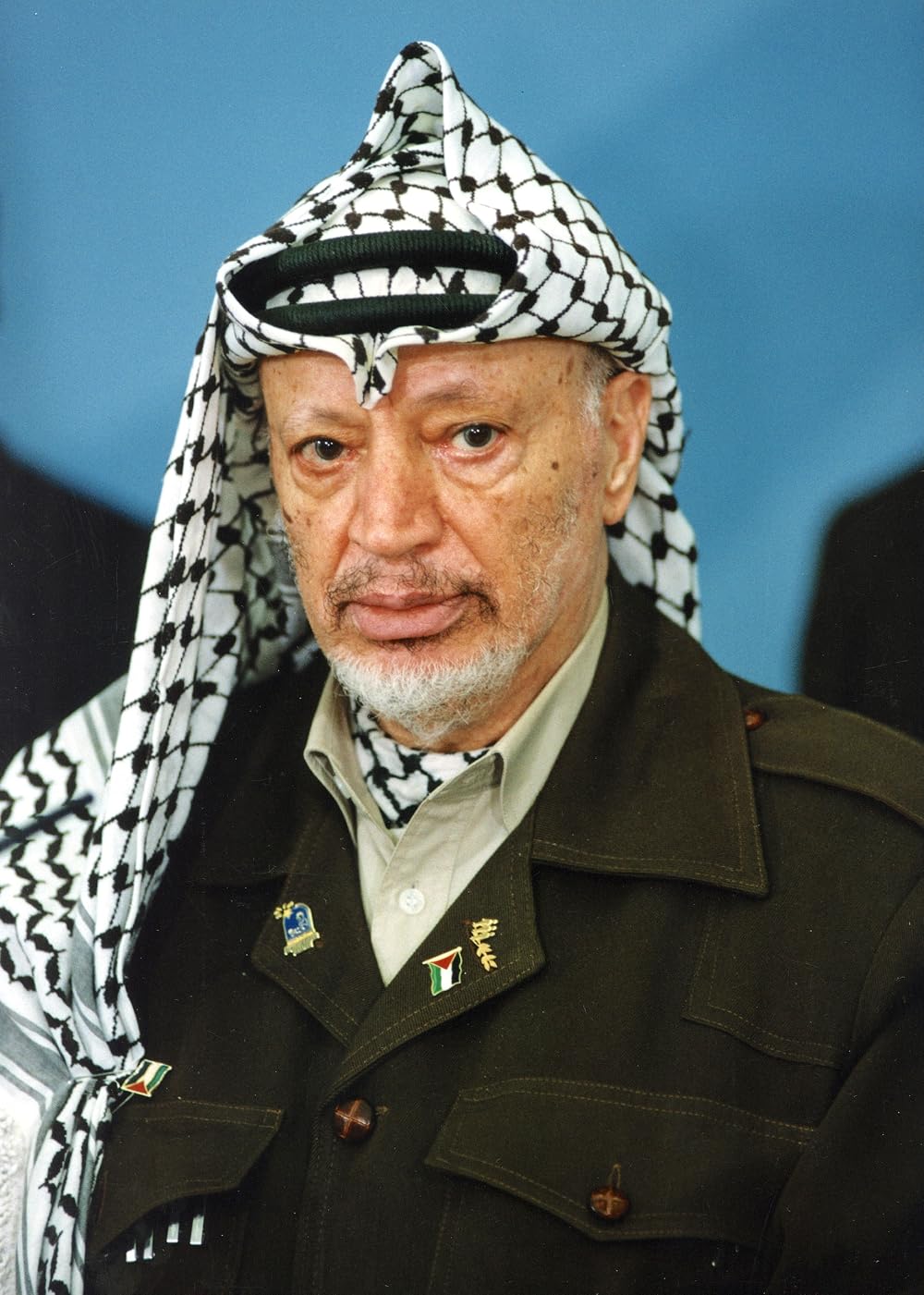
Yasser Arafat (1929 – 2004 CE) chaired the Palestine Liberation Organization from 1969 until his death, led Fatah, the largest of the organisations within it, and served as president of the Palestinian Authority from 1996 to 2004. Encyclopaedia Britannica records these offices and their dates, and identifies him as a central figure in Palestinian political history across five decades.
This article sets out the offices he held, the organisations he founded or led, the agreements he signed, and the dates on which each of these things happened. It does not offer a verdict on him, and it does not adjudicate the conflict in which his career was conducted. That restraint is deliberate and is explained in the Historiographical Note below.
The Question of His Birth
An article about Arafat has to begin with an uncertainty, because the most basic biographical facts about him are not settled.
Britannica dates his birth to August 1929 and then states plainly that both the date and the place are disputed. A birth certificate registered in Cairo gives 24 August 1929. Some sources support his own claim to have been born in Jerusalem on 4 August 1929. Others place his birth in Gaza.
The three possibilities are not interchangeable, and the disagreement is not merely clerical. Jerusalem, Cairo and Gaza carry different meanings for the biography of a Palestinian national leader, and a claim to have been born in Jerusalem is a claim of a particular kind. The article reports the variance as Britannica reports it and does not choose between the three.
Education and Early Career
Britannica records that he graduated from the University of Cairo as a civil engineer. That is a detail worth registering, because it places his formation outside both the religious institutions and the military academies: he was trained as an engineer, and he worked as one.
He served in the Egyptian army during the Suez Crisis of 1956. In the same period he was working as an engineer in Kuwait, and it was there, according to Britannica's summary, that he co-founded the organisation that became the vehicle of his career.
Fatah
Britannica's entry on Fatah dates its foundation to the late 1950s and names its founders as Arafat and Khalil al-Wazir, known as Abu Jihad. Its account of the organisation's initial purpose is direct, and it is given here in the encyclopaedia's own terms rather than paraphrased into something softer: the stated goal was to take Palestine from Israeli control through guerrilla warfare.
Fatah became the largest component of the Palestine Liberation Organization and, per Britannica, its leading military element. The relationship between the two bodies is the structural fact of Arafat's career: he led a movement inside a coalition, and his authority in the coalition rested on the movement.
Chairman of the PLO, 1969
Arafat became chairman of the Palestine Liberation Organization in 1969 and held the position until his death thirty-five years later. Britannica's entry on the organisation describes what it did under his leadership from that year: it launched attacks against Israel from bases in Jordan and later in Lebanon.
The relocation implied in that sentence was not voluntary. Britannica's entry on Black September records violent clashes between Hashemites and Palestinians in September 1970, during which the PLO was driven out of Jordan. The organisation's subsequent bases were in Lebanon, and the sequence — Jordan, then Lebanon — is the geography of the PLO's first two decades under Arafat.
The turn to recognition
Alongside the armed campaign, and in tension with it, ran a diplomatic effort. Britannica records that by 1974 Arafat was seeking international recognition of the PLO as the legitimate representative of the Palestinian people.
That is a significant shift to state precisely, because it is the hinge of the whole career. An organisation founded to pursue its aim through guerrilla warfare was, within fifteen years, pursuing recognition as a representative body in international forums. Both tracks were run by the same man, and the two decades that follow in this account are the working out of the relation between them.
The First Intifada
In December 1987 an uprising began in the territories that changed the political situation Arafat operated in. Britannica describes it in these terms: large-scale riots and demonstrations broke out in the Gaza Strip in early December and continued for more than five years, and the uprising, known as the intifada — Arabic for "shaking off" — inspired a new era of Palestinian mass mobilisation.
The point of noting it in a biography of Arafat is that the intifada arose in the territories while the PLO leadership was outside them. A movement of that scale, generated locally, altered the terms on which the external leadership could claim to speak, and it forms the immediate background to the diplomacy of the early 1990s.
The Jordanian disengagement of 1988
One episode from this period is documented in the approved library rather than in Britannica, and it shows Arafat acting as a counterparty in another state's constitutional decision.
The Royal Aal al-Bayt Institute's White Paper on the Hashemite custodianship of the Jerusalem holy sites records that when King Hussein of Jordan declared Jordan's disengagement from the West Bank in 1988, he specifically excluded East Jerusalem's holy sites and waqf properties from that disengagement, so maintaining the Hashemite custodianship. The White Paper states that the exclusion was coordinated with Arafat as PLO president, and elsewhere that the Jordanian waqf was left in place with his agreement.
The arrangement bears on the status of the Al-Aqsa Mosque and the Dome of the Rock, and the encyclopaedia's articles on those sites treat the custodianship question. What it establishes about Arafat is narrower: in 1988 he was the party with whom such a question had to be settled.
The 1993 Agreement
In September 1993 Israel and the PLO signed the Declaration of Principles on Palestinian Self-Rule, which Britannica identifies as the first agreement between the two sides and the opening document of what became known as the Oslo Accords. The signing took place at the White House, with the Israeli prime minister Yitzhak Rabin and the United States president Bill Clinton present.
Britannica's entry on the Oslo Accords describes what the agreements were for: a peace process addressing the Israeli–Palestinian conflict by way of a two-state solution, which produced limited self-governance for Palestinians in the West Bank and the Gaza Strip.
In September 1995 Rabin, Arafat and Shimon Peres assembled at the White House again to sign the Interim Agreement on the West Bank and Gaza Strip, commonly called Oslo II. Britannica notes that by that date all three had been named winners of the Nobel Prize for Peace.
The Nobel Prize
Britannica records that Arafat's part in the 1993 agreement brought him the Nobel Prize for Peace in 1994, shared with Rabin and Peres.
The prize is a fact about how the agreement was received internationally at the time, and it is stated here as that. The Muslim 500 records the same moment from a different angle, noting within its entry on Mahmoud Abbas that Abbas stood alongside Arafat at the White House in 1993 for the signing — an indication of who else was present and would later matter.
President of the Palestinian Authority
The Palestinian Authority was established in 1994 under the Oslo framework, and Britannica records Arafat as its president from 1996 until his death in 2004. He therefore held the chairmanship of the PLO and the presidency of the Authority simultaneously for the last eight years of his life: the leadership of a national movement and the executive office of an administrative body created by agreement with the state that movement had been founded to confront.
Britannica treats the subsequent period under the heading "from agreement to the second intifada", which indicates the direction of events without this article needing to characterise them. The peace process established in 1993 did not reach the settlement it was designed to produce, and a second uprising followed.
Death and Succession
Arafat died on 11 November 2004 in Paris, on Britannica's dating. He had chaired the PLO for thirty-five years and led the Palestinian Authority for eight.
Britannica's entry on the Palestine Liberation Organization records the succession in a single clause: after Arafat's death in 2004, Mahmoud Abbas took over. Abbas remains the figure through whom the institutions Arafat led have since been represented, and The Muslim 500 notes that he was elected president of the Palestinian Authority in 2005 for a four-year term.
Historiographical Note
This article is deliberately narrower than the literature on its subject, in three respects, and each is worth stating openly.
The sources. The approved source base holds very little on Arafat directly. A search of the project's PDF library found him in three places: twice in the Royal Aal al-Bayt Institute's White Paper, both times concerning the 1988 Jordanian disengagement, and once in The Muslim 500, inside the entry on Mahmoud Abbas. In none of these is he the subject. The biographical spine of this article therefore rests on the Encyclopaedia Britannica, which is within the approved base, and on its entries for the organisations and agreements he was associated with. The owner authorised recourse to a source outside the approved base for this article; in the event the approved base proved sufficient for the account given here, and no outside source was used.
What is not covered. A full biography would address much that is absent here, and the absences are not accidental. The approved sources consulted do not establish his family background, the circumstances of his student years in Cairo, the internal politics of Fatah or of the PLO, the organisation's years in Lebanon in any detail, the Israeli invasion of 1982 and the departure from Beirut, the move to Tunis, the declaration of 1988, the negotiations at Camp David in 2000, the circumstances of his confinement at Ramallah, or the cause of his death — a question on which there has been public dispute. A reader who has met claims on any of these should not read their absence here as denial. It means only that no approved source consulted establishes them, and under the project's source policy an untraceable claim is left out rather than asserted.
Why there is no assessment. The encyclopaedia's standards bar it from serving as a platform for political commentary, and require that contemporary politics be treated only where historically necessary. They also prohibit adding hostile characterisation of any subject, and equally prohibit hero-worship. Arafat's career was conducted inside a conflict that remains unresolved, and the literature on him is, in both directions, largely evaluative. This article accordingly reports what he did, when, and under what title, and reports the stated aims of the organisations he led in the words the source uses. It offers no judgement on him, on his opponents, or on the conflict, and a reader looking for one should look elsewhere. That is a limitation of the article by design rather than an oversight.
The disputed birth. Britannica itself presents the date and place of birth as unresolved, giving three possibilities and the evidence for each. This article reproduces that uncertainty rather than selecting the most convenient version, and the frontmatter records the birthplace as disputed for the same reason.
Conclusion
The documented outline of Arafat's public life is this. Trained as a civil engineer at the University of Cairo, he served in the Egyptian army during the Suez Crisis of 1956 and, while working in Kuwait in the late 1950s, co-founded Fatah with Khalil al-Wazir. He became chairman of the Palestine Liberation Organization in 1969, directed its operations from bases in Jordan until the clashes of September 1970 removed it to Lebanon, and by 1974 was pursuing international recognition of the PLO as the representative of the Palestinian people. He signed the Declaration of Principles with Israel in September 1993, shared the Nobel Prize for Peace in 1994, signed the Interim Agreement in September 1995, and served as president of the Palestinian Authority from 1996. He died in Paris on 11 November 2004 and was succeeded in the leadership by Mahmoud Abbas.
Within that outline sits the tension that ran through the whole career: an organisation founded to pursue its aim by armed means, led by the same man who sought its recognition in international forums and signed agreements in its name. The encyclopaedia records the sequence and leaves the assessment to the reader and to the wider literature. The broader period is treated in the article on modern Islamic history.
References and Further Reading
Primary Islamic Sources
- The Hashemite Custodianship of Jerusalem's Islamic and Christian Holy Sites 1917–2020. White Paper of the Royal Aal al-Bayt Institute for Islamic Thought, 2020. Consulted in the approved library — for the 1988 Jordanian disengagement, the exclusion of the East Jerusalem holy sites and waqf properties from it, and the coordination of that exclusion with Arafat. The institute publishes as the Royal Aal al-Bayt Institute, one of the approved sources for this project.
- Declaration of Principles on Palestinian Self-Rule, September 1993 — the agreement Arafat signed on behalf of the PLO, identified by Britannica as the first between the two parties and the opening document of the Oslo Accords.
- Interim Agreement on the West Bank and Gaza Strip, September 1995 — commonly called Oslo II, signed by Arafat with Rabin and Peres.
Classical Islamic Sources
The subject falls entirely within the twentieth and twenty-first centuries. No classical Islamic sources bear on it, and none are listed here rather than manufacturing entries for the sake of a heading. The project's standards state that where a subject genuinely lacks sources in a category, artificial entries are not to be supplied.
Academic and Scholarly Sources
- Encyclopaedia Britannica, entry on Yasser Arafat. https://www.britannica.com/biography/Yasser-Arafat, with the accompanying summary at https://www.britannica.com/summary/Yasser-Arafat — for the presidency of the Palestinian Authority from 1996 to 2004 and the chairmanship of the PLO from 1969 to 2004; his leadership of Fatah; the disputed date and place of birth, with the Cairo birth certificate of 24 August 1929, his own claim of Jerusalem on 4 August 1929, and the reports of Gaza; the civil engineering degree from the University of Cairo; service in the Egyptian army during the 1956 Suez Crisis; the co-founding of Fatah while working as an engineer in Kuwait; his part in the 1993 agreement; the 1994 Nobel Prize for Peace shared with Yitzhak Rabin and Shimon Peres; and the death on 11 November 2004 in Paris.
- Encyclopaedia Britannica, entry on the Palestine Liberation Organization. https://www.britannica.com/topic/Palestine-Liberation-Organization — for his leadership from 1969, the attacks launched from bases in Jordan and later Lebanon, the pursuit of international recognition by 1974, and the succession of Mahmoud Abbas in 2004.
- Encyclopaedia Britannica, entry on Fatah. https://www.britannica.com/topic/Fatah — for its foundation in the late 1950s by Arafat and Khalil al-Wazir, known as Abu Jihad, and for its stated initial aim.
- Encyclopaedia Britannica, entry on the Oslo Accords. https://www.britannica.com/topic/Oslo-Accords — for the character of the agreements as a peace process directed at a two-state solution, producing limited Palestinian self-governance in the West Bank and Gaza Strip.
- Encyclopaedia Britannica, entries on Israel covering the Oslo Accords and Oslo II. https://www.britannica.com/place/Israel/The-Oslo-Accords and https://www.britannica.com/place/Israel/Oslo-II-and-Rabins-assassination — for the September 1993 signing and for the September 1995 Interim Agreement signed by Rabin, Arafat and Peres as newly named Nobel laureates.
- Encyclopaedia Britannica, entry on Black September. https://www.britannica.com/topic/Black-September-Palestine — for the clashes of September 1970 and the removal of the PLO from Jordan.
- Encyclopaedia Britannica, entry on the first intifada. https://www.britannica.com/place/Palestine/The-first-intifada — for the uprising that began in the Gaza Strip in December 1987, its duration of more than five years, and the meaning of the term.
- The Muslim 500: The World's 500 Most Influential Muslims (2026 edition). Chief editor S. Abdallah Schleifer. Consulted in the approved library — for the reference to Arafat within the entry on Mahmoud Abbas, on the 1993 White House signing and Abbas's later election.
Further Reading
- Rubin, Barry, and Judith Colp Rubin. Yasir Arafat: A Political Biography. Oxford: Oxford University Press, 2003 — a full-length scholarly biography, covering the periods this article leaves out.
- Sayigh, Yezid. Armed Struggle and the Search for State: The Palestinian National Movement, 1949–1993. Oxford: Oxford University Press, 1997 — the standard institutional history of the movement Arafat led, and the fullest treatment of Fatah and the PLO as organisations.
- Khalidi, Rashid. The Iron Cage: The Story of the Palestinian Struggle for Statehood. Boston: Beacon Press, 2006 — on the political context across the century.
- Shlaim, Avi. The Iron Wall: Israel and the Arab World. New York: W. W. Norton, 2000 — on the diplomatic history within which the agreements of 1993 and 1995 were reached.
Mentioned In
1 article references this topic
More from Modern Era
Modern Islamic History (1800-2024)
Islamic history from 1800 to the present: the weakening of the Ottoman and other Muslim empires, the period of European colonial rule, the independence movements that followed, the founding of the modern Muslim states, and the changes since.
Aligarh Muslim University: From the Muhammadan Anglo-Oriental College to a Central University
Aligarh Muslim University grew out of the school founded by Syed Ahmad Khan in 1875, which became the Muhammadan Anglo-Oriental College in 1877 and a university by Act of the Indian legislature in 1920. It was the central institution of the Aligarh Movement.
Growth of Islamic Finance
Banking and financial services conducted according to Islamic law, which forbids interest and requires risk to be shared. From institutional beginnings in the 1960s the sector has grown into a multi-trillion-dollar industry serving Muslim and non-Muslim customers alike.
Hamdard Laboratories (India): From Unani Clinic to National Institution
Hamdard Laboratories (India) is a Unani pharmaceutical company and welfare institution founded in Old Delhi in 1906 by Hakeem Hafiz Abdul Majeed. Converted into a waqf in 1948 under his son Hakeem Abdul Hameed, it produces Rooh Afza and established Jamia Hamdard university in Delhi.