Aligarh Muslim University: From the Muhammadan Anglo-Oriental College to a Central University
Aligarh Muslim University grew out of the school founded by Syed Ahmad Khan in 1875, which became the Muhammadan Anglo-Oriental College in 1877 and a university by Act of the Indian legislature in 1920. It was the central institution of the Aligarh Movement.
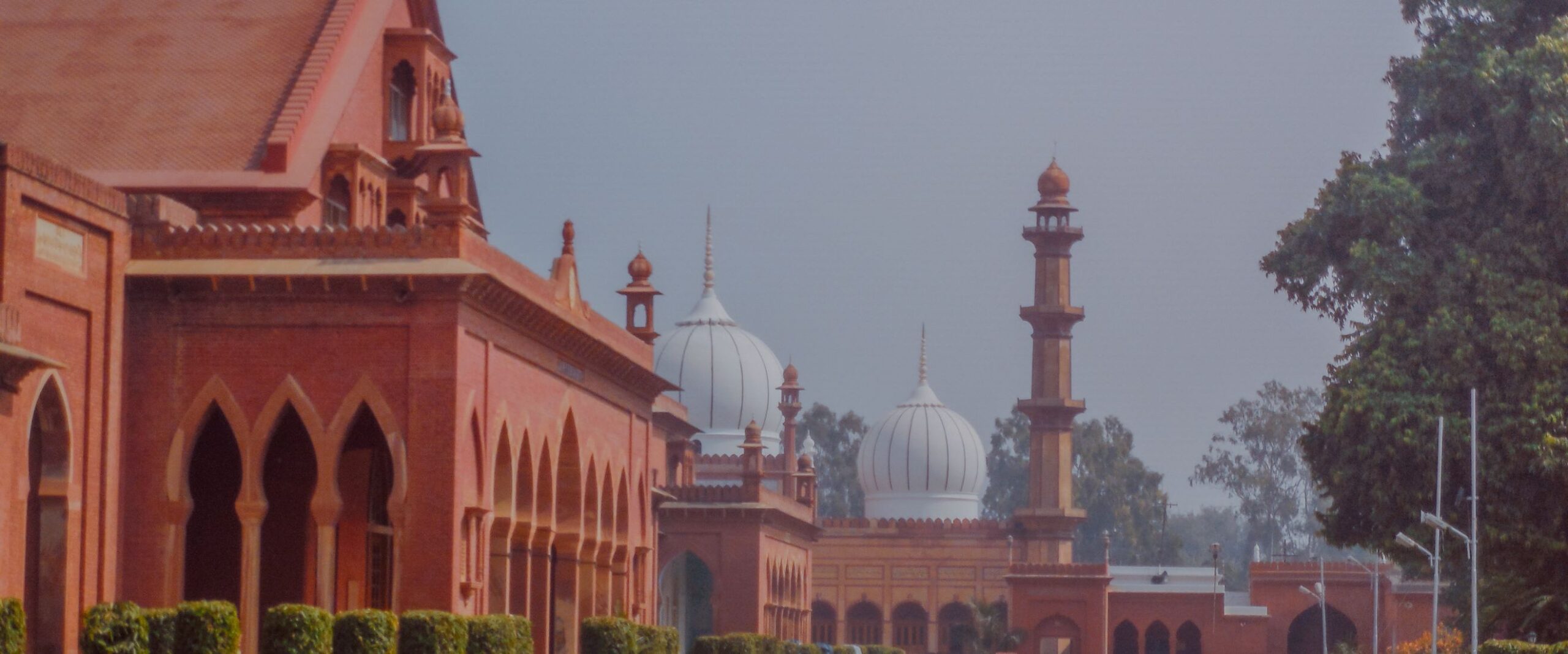
Aligarh Muslim University is a residential university at Aligarh in Uttar Pradesh, India, and one of the country's oldest and largest institutions of higher education. It traces its origin to a school founded by Syed Ahmad Khan in 1875, which grew into the Muhammadan Anglo-Oriental College and was reconstituted as a university by an Act of the Indian legislature in 1920.
Its historical importance rests on more than longevity. The college at Aligarh was the institutional centre of what came to be called the Aligarh Movement — an attempt, made in the decades after the revolt of 1857, to answer a specific and urgent question: whether Indian Muslims could take up English education and the modern sciences without ceasing to be Muslims. Syed Ahmad Khan's answer was that they could and must, and Aligarh was the answer built in brick. Nearly every current of Muslim public life in twentieth-century South Asia passed through it, including currents that came to oppose one another sharply, and one of them walked out of its gates in 1920 to found Jamia Millia Islamia.
Origins
The Setting After 1857
The institution cannot be understood apart from the situation that produced it. The revolt of 1857 ended with the abolition of the Mughal monarchy, the transfer of Indian government from the East India Company to the Crown, and a period of severe reprisal in which the Muslim service and landholding classes of northern India — those closest to the old order — lost position, property and confidence. Delhi in particular was devastated.
Syed Ahmad Khan, then a judicial officer in Company service, was among the Muslim officials who remained loyal during the revolt, and he spent the following decades arguing two propositions at once: to the British, that the revolt had causes in administrative failure rather than in Muslim disloyalty, which he set out in Asbab-e-Baghawat-e-Hind ("The Causes of the Indian Revolt", 1858); and to Muslims, that the recovery of their position depended on education of a kind the traditional curriculum did not supply.
The Scientific Society and the Journals
Before there was a college there was a publishing and translating enterprise. Syed Ahmad founded the Scientific Society in 1864 at Ghazipur, moving it to Aligarh when he was posted there; its purpose was to translate works of Western science and history into Urdu so that they could be read by people with no English. From 1866 it issued the bilingual Aligarh Institute Gazette. In 1870 he began Tahzib al-Akhlaq ("The Refinement of Morals"), a journal of religious and social reform that carried much of his own most controversial writing.
These ventures established the pattern the college would follow: the medium was to be adapted without the substance being surrendered, and the argument was to be conducted in Urdu, before an Indian Muslim readership, rather than in English before officials.
England, 1869–70
Syed Ahmad travelled to England in 1869 and remained until 1870. He visited Cambridge and Oxford and studied their organisation closely, and what impressed him was less the syllabus than the form: the residential college in which teaching, worship, discipline, sport and social life were held together in one community. He returned convinced that a Muslim college in India should be built on that model rather than as a day school attached to a mosque or a government department.
On his return he formed a committee — its full title was the Committee for the Better Diffusion and Advancement of Learning among Muhammadans of India — to raise funds and settle a plan. The fundraising was conducted by public subscription across a wide social range, from princely donations to very small contributions, and it took five years.
The College
Madrasatul Uloom, 1875
The school opened at Aligarh on 24 May 1875 as Madrasatul Uloom Musalmanan-e-Hind. On 7 January 1877 it became the Muhammadan Anglo-Oriental College, the date the university's own official history treats as its foundation; the foundation stone of the college was laid by the Viceroy, Lord Lytton. The two dates are both correct for different things — the school in 1875, the college in 1877 — and accounts that give only one of them are the source of a good deal of confusion about Aligarh's age.
The name states the programme. Muhammadan fixed the community it served; Anglo the English language and the English curriculum; Oriental the Arabic, Persian and Islamic religious instruction that was to continue alongside them. Students were prepared for the examinations of Calcutta and later Allahabad University, since the college was affiliated and could not award its own degrees.
How It Worked
The college was residential from the outset, and the residential system did much of the work Syed Ahmad intended. Students lived in halls, ate in common dining halls, took part in organised sport, and debated in a students' union modelled on English lines. Religious instruction and congregational prayer were part of the institutional routine rather than left to private observance.
The design was deliberate on a point that is easy to miss. Syed Ahmad's problem was not how to deliver a syllabus — the government colleges already did that — but how to produce a particular kind of person, and he had concluded in England that this is done by the company a young man keeps for four years rather than by what he is lectured on. Hence the halls, the common table, the sport, the debating society, the shared discipline, and the deliberate cultivation of an alumni network that persisted after graduation. It is also why the college's critics attacked its social forms as readily as its curriculum.
The teaching staff was mixed, and the principals in the formative decades were English. Theodore Beck, principal from 1883 until his death in 1899, is the figure most associated with the college's early character; he was closely involved in its politics as well as its teaching. The extent of British staff influence on the institution's political direction is a matter on which historians differ, David Lelyveld's study of the college's first generation being the fullest treatment.
What the college produced was a stratum rather than a profession: a generation of Muslim graduates equipped for government service, law, journalism and public life, connected to one another by a shared institutional formation. That network, more than any doctrine, is what the term "Aligarh Movement" describes.
Money
The financing deserves a note of its own, because the college was built without an endowment from any ruler. Syed Ahmad raised the money by subscription across India over a period of years, soliciting from princes, landholders, professionals and people of very modest means, and using methods that ranged from public appeals in the Aligarh Institute Gazette to personal solicitation. The pattern mattered later: the requirement that a substantial endowment be in place before the government would grant university status meant that the campaign of the 1910s had to repeat the exercise on a much larger scale.
The Limits of Affiliation
The college could not award degrees. Its students sat the examinations of Calcutta University and later of Allahabad, and its curriculum was correspondingly constrained by what those universities examined. This is the practical grievance behind the long campaign for university status: an affiliated college teaches to somebody else's syllabus, and the Aligarh leadership wanted the authority to set its own.
The Muhammadan Educational Conference
In 1886 Syed Ahmad founded the Muhammadan Educational Conference, an annual gathering that met in different cities to promote Muslim education across India. It extended Aligarh's influence well beyond its own enrolment and became a significant forum of Muslim public opinion. Its later sessions were also, as it happened, where some of the disagreements about Aligarh's political direction were aired.
Education for Women
Aligarh's provision for women began with a school for girls opened in 1906 by Shaikh Abdullah, a teacher at the college, with the sustained involvement of his wife Wahid Jahan Begum. It faced considerable resistance from conservative opinion, including within the Aligarh circle, and grew slowly; it developed into the Women's College, which remains part of the university. The initiative is worth recording precisely because it was not part of Syed Ahmad's original design — he had been cautious about women's formal schooling — and represents the movement outgrowing its founder.
Syed Ahmad Khan died in 1898 and is buried on the campus, beside the college mosque.
The University
The Act of 1920
The campaign to convert the college into a university with its own degree-granting powers ran for more than a decade and required both a large endowment and legislation. Its leading figures included Aga Khan III, Mohsin-ul-Mulk and Viqar-ul-Mulk. The Aligarh Muslim University Act was passed in 1920, and the college became Aligarh Muslim University, absorbing the MAO College and the Muslim University Association.
Sultan Jahan Begum, the ruler of Bhopal, was a major benefactor of the endowment and became the university's first Chancellor — the first woman to hold such a position at an Indian university.
1920: The Split
The Act arrived in the same year as the Non-Cooperation and Khilafat movements, and the coincidence produced a rupture that is central to the history of Muslim education in India. Because the new university was constituted by government legislation and depended on government funds, it fell within the scope of the non-cooperation programme's call to boycott official institutions.
Gandhi and the Ali brothers — Mohammad Ali Jauhar among them — pressed the case at Aligarh, and a group of teachers and students left. On 29 October 1920 they founded Jamia Millia Islamia in the city, as a national Muslim university funded and governed independently of the colonial state. Among those who left was the young Zakir Husain, later Jamia's Vice-Chancellor and later still President of India — and, between those two appointments, Vice-Chancellor of Aligarh itself from 1948 to 1956, which is a fair indication of how porous the division proved over time.
Between the Wars
The university's growth in the interwar decades was substantial, and the additions indicate the direction it took: professional and scientific faculties alongside the arts and theology. An engineering college was established in 1935. A faculty of medicine followed after independence, and the university also maintains a college of Unani medicine named for Hakim Ajmal Khan — a connection worth noting, since Ajmal Khan was simultaneously the founding Chancellor of the rival institution at Jamia and a figure Aligarh honoured.
The campus was also, through these decades, a place where the political arguments of Indian Muslim life were conducted rather than settled. Both Congress-aligned and Muslim League-aligned currents were active among students and staff, and the university's association with the movement for Pakistan in the 1940s is a matter of record, as is the presence within it of those who opposed that movement. This encyclopaedia notes the range and does not characterise the institution by any one part of it.
After Independence
The university was continued by the Constitution of independent India as an institution of national importance and is funded by the central government. Zakir Husain, who had left Aligarh in the 1920 walkout, returned as its Vice-Chancellor from 1948 to 1956, a period in which the university was reoriented toward the institutions of the new republic.
Its statutory framework was amended in 1951, 1965 and 1981. The 1951 amendment removed the requirement of religious instruction for Muslim students and opened the university's governing Court to non-Muslims. The 1965 amendment reconstituted the Court and reduced its powers, and was strongly contested on the campus. The 1981 amendment sought to restore the university's minority character by statute, and is the provision at the centre of the litigation described below. Each amendment adjusted the balance between the university's internal self-government and external oversight, and each was controversial at the time.
The university now teaches across the faculties of arts, science, social science, law, medicine, engineering, agriculture, commerce, management, theology and Unani medicine, maintains schools attached to the campus, and operates centres outside Aligarh. Its Maulana Azad Library holds one of the more significant collections of Persian, Arabic and Urdu manuscripts in India.
The Question of Minority Status
Aligarh's legal character has been litigated for more than half a century, and because the matter is live and politically contested in India, this article sets out what the courts have decided and does not take a position on what they should decide.
Article 30 of the Indian Constitution gives religious and linguistic minorities the right to establish and administer educational institutions of their choice. Whether Aligarh Muslim University falls within it turns on whether the university was established by the Muslim community or by the state.
In S. Azeez Basha v Union of India (1967) a five-judge bench of the Supreme Court held that it was not a minority institution, on the reasoning that the university — as distinct from the earlier college — was brought into existence by the Act of 1920, an instrument of the legislature. The 1981 amendment to the Act sought to restore minority character by legislation; that amendment was itself struck down by the Allahabad High Court in 2006, and the resulting appeals were eventually referred to a larger bench.
On 8 November 2024 a seven-judge Constitution Bench of the Supreme Court, by a majority of four to three, overruled Azeez Basha. The majority opinion, written by Chief Justice D.Y. Chandrachud, held that an institution does not lose minority character merely because it was incorporated by statute, and that what must be examined is who founded it and for what purpose; the judgment laid down the criteria by which minority character is to be determined and observed that it is not a rigid concept.
One point about that ruling is regularly misreported and should be stated plainly: the Court settled the legal test but did not itself decide Aligarh's status. It referred the application of the test to the university's facts to a smaller bench. Reports announcing that minority status was restored in November 2024 describe a step in the litigation rather than its conclusion.
Assessment
Aligarh's significance is easiest to see by asking what would have been absent without it. The proposition that modern scientific and professional education was compatible with Muslim religious life was, in the 1870s, contested in India and not obviously true to anyone; a functioning residential college that ran on that proposition for decades settled the question in practice rather than in argument. The graduates it produced staffed a great deal of Muslim public life in the subcontinent for three generations.
It is also fair to record that the institution's influence was not uniform in direction. Aligarh produced nationalists and separatists, Congress politicians and Muslim League politicians, secularists and religious scholars; the 1920 walkout that created Jamia was a repudiation of Aligarh's relationship with the colonial state by people Aligarh had itself educated. An institution that shapes a generation does not thereby determine what that generation concludes, and Aligarh is a clear case of the distinction.
Alongside it stands the alternative model that emerged in the same period from a very different premise. Darul Uloom Deoband, founded a decade before the Aligarh school, addressed the same crisis of 1857 by rebuilding the transmission of the traditional religious sciences on a new institutional footing rather than by adopting the colonial curriculum. Taken together, Aligarh and Deoband represent the two principal answers Indian Muslims gave to the same question, and neither can be read properly without the other.
References and Further Reading
Primary Islamic Sources
- Quran, Surah Al-Zumar (39:9) — "Are those who know equal to those who do not know?" — a verse repeatedly invoked in nineteenth-century Indian Muslim arguments for educational reform
- Quran, Surah Al-Alaq (96:1-5) — the first revelation, on reading and the pen, cited across the reform literature of the period in defence of the pursuit of learning
- Quran, Surah Ta-Ha (20:114) — "My Lord, increase me in knowledge"
- Sahih al-Bukhari 71, Kitab al-Ilm — "If God wants to do good to a person, He makes him comprehend the religion" (Mu'awiya), the hadith most often cited in the period's debates over what kind of knowledge religious education should transmit
- Syed Ahmad Khan. Asbab-e-Baghawat-e-Hind (The Causes of the Indian Revolt). 1858. His analysis of the revolt and of the administrative failures he held responsible for it.
- Syed Ahmad Khan. Tahzib al-Akhlaq. From 1870. The journal in which he set out his programme of religious and social reform.
- The Aligarh Institute Gazette. From 1866. The bilingual organ of the Scientific Society and the earliest continuous record of the movement.
Classical Islamic Sources
- Shah Waliullah of Delhi. Hujjat Allah al-Baligha and his other works. [18th century CE]. The intellectual background common to both wings of nineteenth-century Indian Muslim reform; see Shah Waliullah.
- Al-Ghazali, Abu Hamid. Ihya Ulum al-Din, Book 1, Kitab al-Ilm. [c. 1100 CE]. The classical treatment of the classification of the sciences and of the purposes of religious learning, the framework against which the nineteenth-century curriculum debates were conducted.
- Ibn Khaldun. Al-Muqaddimah, sections on the teaching of the sciences. [14th century CE]. Classical discussion of educational method frequently cited in modern Muslim debates on curriculum.
- Al-Zarnuji, Burhan al-Din. Ta'lim al-Muta'allim Tariq al-Ta'allum. [13th century CE]. The manual on the conduct of study that formed part of the traditional South Asian curriculum the Aligarh model was departing from.
Academic and Scholarly Sources
- Lelyveld, David. Aligarh's First Generation: Muslim Solidarity in British India. Princeton: Princeton University Press, 1978. The standard academic study of the college's formative decades and of the social formation of its graduates.
- Minault, Gail. The Khilafat Movement: Religious Symbolism and Political Mobilization in India. New York: Columbia University Press, 1982. On the politics of 1919–24, including the non-cooperation pressure at Aligarh and the founding of Jamia Millia Islamia.
- Minault, Gail. Secluded Scholars: Women's Education and Muslim Social Reform in Colonial India. Delhi: Oxford University Press, 1998. On the girls' school at Aligarh and the wider debate over women's education in the reform movements.
- Hefner, Robert W., and Muhammad Qasim Zaman, eds. Schooling Islam: The Culture and Politics of Modern Muslim Education. Princeton: Princeton University Press, 2007. Comparative treatment of Muslim educational institutions, placing Aligarh alongside Deoband and the reformed madrasa.
- Encyclopaedia Britannica, entry on "Aligarh Muslim University." Concise reference treatment of the institution's foundation and development.
- Aligarh Muslim University, official institutional history and factsheet (amu.ac.in). The university's own account, giving 24 May 1875 for the school and 7 January 1877 for the college.
Further Reading
- Supreme Court Observer, reports and judgment summary on the AMU minority status case (scobserver.in). Accessible account of Azeez Basha, the 1981 amendment, and the seven-judge judgment of 8 November 2024, including the referral of the remaining question to a smaller bench.
- Robinson, Francis. Separatism among Indian Muslims: The Politics of the United Provinces' Muslims, 1860–1923. Cambridge: Cambridge University Press, 1974. On the political trajectory of the Aligarh network in the United Provinces.
- Graham, G.F.I. The Life and Work of Sir Syed Ahmed Khan. Edinburgh, 1885. Contemporary biography by an associate; valuable as a source from within the movement and to be read as such.
- Metcalf, Barbara D. Islamic Revival in British India: Deoband, 1860–1900. Princeton: Princeton University Press, 1982. The counterpart study, essential for understanding the alternative response to the same crisis.
- Begum Hazrat Mahal — the regent of Awadh in the revolt of 1857, a generation before the college was founded
Mentioned In
22 articles reference this topic
and 10 more articles
More from Modern Era
Abadi Bano Begum (Bi Amma): Mother of the Khilafat Movement
Abadi Bano Begum (1852-1924), known affectionately as Bi Amma, was the mother of the Ali Brothers and one of the first Muslim women to enter Indian nationalist politics, mobilizing women for the Khilafat and Non-Cooperation movements while observing purdah.
Ali Musliyar: Religious Leader of the Malabar Rebellion
Ali Musliyar (1861-1922), a scholar trained at Ponnani and Mecca, served as chief musaliar of the Tirurangadi mosque in south Malabar from 1907 and became the central religious authority of the Malabar Rebellion of 1921-22, before his capture and execution.
Aruna Asaf Ali: The Grand Old Lady of the Indian Independence Movement
Aruna Asaf Ali (1909-1996), born Aruna Ganguly, hoisted the Indian flag at Gowalia Tank Maidan on 9 August 1942, marking the start of the Quit India Movement. She spent four years underground, became Delhi's first mayor in 1958, and was awarded the Bharat Ratna posthumously in 1997.
Asaf Ali: Barrister, Freedom Fighter, and India's First Ambassador to America
Asaf Ali (1888-1953) was an Indian barrister and Congress leader who defended Bhagat Singh and the INA officers at the Red Fort trial. He served in the Interim Government of 1946, became independent India's first Ambassador to the United States in 1947, and was Governor of Odisha to 1952.