Abd al-Rahman III: The First Caliph of Cordoba
Abd al-Rahman III (891-961) inherited a collapsing emirate in 912, spent twenty years restoring it by force, and in 929 declared himself caliph. His fifty-year reign made Cordoba the strongest state in western Europe and built the palace-city of Madinat al-Zahra.
Abd al-Rahman III ibn Muhammad, who took the regnal title al-Nasir li-Din Allah — "the Defender of God's Faith" — ruled al-Andalus for just under fifty years, from 912 to 961. He came to power at twenty-one over a state that had shrunk to the districts immediately around its capital, and he left it the strongest and richest polity in western Europe. In January 929 he broke with the practice of his ancestors and proclaimed himself caliph, a claim no Andalusi Umayyad had made in the 173 years since Abd al-Rahman I founded the emirate.
His reign is conventionally treated as the high point of Muslim rule in Iberia, and in material and political terms the description holds. He suppressed the revolts that had almost destroyed the emirate, brought Toledo and the frontier marches back under Córdoban authority, built a navy that contested North Africa with the Fatimids, received embassies from Byzantium and Germany, and constructed the palace-city of Madinat al-Zahra as the seat of a caliphal court. The scientific and literary culture for which tenth-century Córdoba is remembered took shape under his patronage and that of his son.
The reign also had a harder edge and clear limits. The restoration was accomplished by two decades of siege warfare against his own subjects. He suffered a severe defeat at Simancas in 939 from which his personal military reputation never recovered. He executed one of his own sons. And the instrument he relied on most heavily — a professional army of Berber and Slav troops loyal to the ruler alone — became, two generations later, one of the mechanisms by which the caliphate destroyed itself.
Birth, Parentage, and Accession
Abd al-Rahman was born at Córdoba in January 891, by the reckoning most sources follow; some give 889 or 890.
His descent, which he later had reason to advertise, ran back through six generations to the founder of the emirate: he was the son of Muhammad, son of the emir Abdallah, and through Abdallah's line back through al-Hakam I and Hisham I to Abd al-Rahman I himself. The Britannica entry gives the full chain, and it matters because the caliphal claim he made in 929 rested on Umayyad legitimacy and on nothing else.
His immediate family circumstances were violent. His father Muhammad was killed by his own brother al-Mutarrif, and the boy was raised in his grandfather's household. When the emir Abdallah died in October 912 the succession passed over surviving sons to the grandson, and Abd al-Rahman took power at twenty-one.
On his mother's side he was largely of northern Iberian Christian descent. His mother was a concubine of the household, named in the sources as Muzna or Muzayna and understood to have been a Christian captive; and his paternal grandmother was Onneca Fortúnez, a daughter of the king of Pamplona, whose marriage into the Córdoban family made Abd al-Rahman a blood relative of the Navarrese royal house he would later campaign against. This kind of ancestry was entirely normal in the dynasty and carried no legal disadvantage, since status followed the father. It is noted here because it illustrates how thoroughly the ruling family of al-Andalus had merged with the peninsula's population within two centuries of the conquest.
The sources describe him as fair-skinned with reddish or blond hair and blue eyes, and add that he dyed his hair black. The detail is reported rather than documented, and later writers have made more of it than the evidence supports; what can be said is that his appearance was remembered as northern.
The Inheritance of 912
The emirate Abd al-Rahman inherited was close to dissolution, and the scale of the crisis is essential to understanding both his methods and his later claim to the caliphate.
Through the second half of the ninth century, central authority had drained away. The reign of his grandfather Abdallah is remembered as the low point of Umayyad power. Provincial families, both Arab and of convert descent, had made themselves independent lords of their districts; the frontier marches obeyed Córdoba only when it suited them; Toledo, Zaragoza, Badajoz and the Levante were effectively autonomous; and in the mountains of the south a rebel state had been in existence for a generation.
That rebellion, the most serious of them, was led by Umar ibn Hafsun from the stronghold of Bobastro in the hills near Málaga. Ibn Hafsun was a muwallad — a Muslim of indigenous Iberian descent — and his revolt drew on the grievances of converts and of the rural population against an Arab governing élite, which gave it a social base far broader than a warlord's following. At its height it controlled much of the south. Ibn Hafsun's later career included a conversion to Christianity, which the sources record and which cost him Muslim support without ending the revolt.
The nature of the emirate's collapse should be stated precisely, because it shaped everything Abd al-Rahman did. This was not a foreign invasion or a religious schism. It was the failure of a state to collect its taxes, control its governors, and command its own frontier. The remedy was necessarily unglamorous: sieges, one district at a time, for twenty years.
Bobastro and the Muwallad Question
The revolt of Umar ibn Hafsun occupied Córdoba for nearly forty years and was the most serious internal challenge the Andalusi Umayyads ever faced. It deserves fuller treatment than a paragraph, because what it was about determines what Abd al-Rahman III's victory actually settled.
Ibn Hafsun rose in the 880s in the mountains of the Ronda district and established himself at Bobastro, a stronghold on a defensible height whose remains — including a rock-cut church — have been excavated. From there he built something more than a bandit lordship: a territorial power controlling much of the south, collecting revenue, garrisoning fortresses, and at points negotiating with Córdoba as an equal and receiving official recognition of his position.
His social base is the historically interesting question. Ibn Hafsun was a muwallad, a Muslim descended from indigenous Iberian converts, and his following drew heavily on convert and rural populations whose grievances were specific: converts to Islam were in principle the equals of Arab Muslims and in practice were treated as subordinate, excluded from the higher offices and the prestige of Arab descent, while the rural population bore the weight of taxation levied by an urban Arab élite. The revolt therefore combined a fiscal rebellion, an ethnic and social protest, and a regional secession.
Its religious dimension is the most contested element. At some point Ibn Hafsun converted, or reverted, to Christianity. The Arabic sources report this and use it to characterise the whole movement as apostasy, which conveniently discredits the social grievances it expressed. Modern scholarship — Manuel Acién Almansa's study is the standard treatment — has debated whether the conversion indicates that the movement was substantially Christian and Iberian in character from the start, or whether it was a late tactical move by a leader seeking support from the Christian north and from Mozarab communities. What is not in dispute is that it cost him Muslim support and contributed to the movement's decline after his death in 917 or 918.
Bobastro fell in 928, and Abd al-Rahman went there in person. The bodies of Ibn Hafsun and his sons were exhumed and taken to Córdoba for public display — an act whose meaning was precise. It asserted that the rebellion had been apostasy rather than politics, that the caliph-to-be was the defender of Islam against it, and that the settlement was not a reconciliation. The caliphal proclamation followed within months.
What the victory settled and what it did not is worth stating. It ended the possibility of provincial secession for the next eighty years, and it removed the immediate threat to the state. It did not resolve the underlying question of the standing of converts and of non-Arab Muslims in Andalusi society, which continued to generate friction and which resurfaced in the ethnic fracturing of the civil wars after 1009.
The Reconquest of al-Andalus, 912–933
Abd al-Rahman began campaigning within weeks of his accession and did not stop for two decades. The pattern was consistent — a summer campaign, the reduction of fortresses, the acceptance of submission on terms where it was offered, the destruction of strongholds where it was not, and the installation of garrisons and governors answerable to Córdoba.
The south came first. Campaigns from 913 recovered the districts around Seville and along the Guadalquivir, and Seville itself submitted in 913. Ibn Hafsun died in 917 or 918, and his sons could not hold the movement together; Bobastro, the symbol of the whole rebellion, finally fell in 928. Abd al-Rahman visited it in person, and the sources report that the bodies of Ibn Hafsun and his sons were exhumed and displayed at Córdoba — a piece of public theatre of the same kind his ancestor had used, and a reminder that the restoration was not a reconciliation.
The centre and the marches followed. Badajoz was recovered in 929. Toledo, which had resisted Córdoban authority intermittently for a century and a half, was reduced only after a long siege and submitted in 932. Zaragoza and the Upper March were brought back under control in the early 930s, with the frontier families reduced to governors holding office at the caliph's pleasure. By 933 there was no significant independent power left in Muslim Iberia.
The northern frontier is treated separately below, since its logic was quite different: there the object was never annexation.
The Caliphal Proclamation of 929
On 16 January 929 Abd al-Rahman had himself proclaimed caliph, adopting the title amir al-mu'minin — Commander of the Faithful — and the regnal name al-Nasir li-Din Allah. Coins, official documents and the Friday sermon were changed accordingly.
The step reversed the deliberate restraint of every Andalusi ruler since 756. Abd al-Rahman I had made himself independent of Baghdad but had pointedly not claimed to lead the Muslim community; his successors had followed him. Understanding why the claim was made in 929, and not before or after, requires three things to be held together.
The first is the collapse of Abbasid authority. By the 920s the Abbasid caliphate in Baghdad had lost effective control of most of its territory to provincial dynasties and was shortly to fall under the tutelage of soldiers and then of the Buyids. Its claim to universal leadership had become a formality, which made a rival claim far less audacious than it would have been a century earlier.
The second, and the immediate provocation, was the rise of the Fatimids. In 909 the Fatimid dynasty had proclaimed a caliphate in Ifriqiya on the basis of descent from the Prophet through Fatima and Ali, and it advanced an Ismaili Shia claim to be the rightful leadership of all Muslims. Its ambitions ran westward along the North African coast toward the Strait of Gibraltar and the Berber tribes on whom Córdoba depended for soldiers. A ruler who claimed only to be an amir was, in the terms of that contest, a subordinate; a caliph was not. The Fatimid challenge made the Umayyad claim not merely possible but useful.
The third is that Abd al-Rahman had by 929 made it credible. Bobastro had fallen the previous year, the south was pacified, and the state was collecting revenue and fielding armies again. A caliphal proclamation in 912 would have been ridiculous. In 929 it described something real.
Janina Safran's study of Andalusi caliphal legitimacy traces the care with which the claim was constructed and publicised — through titulature, coinage, ceremonial, the language of chancery documents, and the physical setting of the court — and shows that it was a sustained programme rather than a single announcement. Maribel Fierro's biography reads the proclamation as the organising act of the reign, the point at which Abd al-Rahman's restoration of the state was translated into a claim about his place in the Islamic world.
The Construction of a Caliphate
The proclamation of January 929 was not a single announcement but the beginning of a sustained programme, and the machinery deserves description because it is the clearest surviving evidence of how a medieval Islamic state built legitimacy.
The titulature came first. Abd al-Rahman took amir al-mu'minin, Commander of the Faithful, the specific title of the caliphs, and the regnal honorific al-Nasir li-Din Allah, "he who makes victorious the religion of God" — a formulation on the eastern caliphal model asserting that his rule served the faith rather than merely the dynasty. Official correspondence, the Friday sermon throughout his territories, and the formulae used in addressing him were all revised accordingly.
The coinage carried the claim to every market in al-Andalus and beyond. Gold dinars were struck for the first time in Andalusi history — gold coinage being a caliphal prerogative and a statement in itself — alongside silver dirhams bearing the new titles. The mint was brought into the palace complex at Madinat al-Zahra, which located the production of money physically inside the caliphal household.
Ceremonial was elaborated on a scale al-Andalus had not seen. Access to the ruler was regulated through officials and screens; audiences were staged with troops lining long approaches; embassies were received according to a protocol designed to communicate the caliph's remoteness and power. The account left by John of Gorze, the envoy sent by Otto I who spent a long and frustrating period at Córdoba in the mid-950s, describes exactly this: delays, intermediaries, and a carefully managed encounter.
Religious legitimation required care, because the Umayyad claim rested on descent and on the defence of Sunni Islam against the Ismaili Shia claim of the Fatimids rather than on descent from the Prophet's family, which the Fatimids asserted and the Umayyads could not. The response was to emphasise Umayyad legitimacy as heirs of the Damascus caliphate, the caliph's role as defender of orthodoxy, and the patronage of the Maliki scholars who dominated Andalusi religious life. Janina Safran's study traces how this argument was assembled and how much work it took.
Two limits should be recorded. The claim was accepted within al-Andalus and among the Berber clients of the Maghrib and was ignored everywhere else; no eastern Muslim polity recognised the Cordoban caliphate. And it created a permanent problem of consistency, since a caliph is by definition the leader of all Muslims and there were now three claimants — in Baghdad, Ifriqiya and Córdoba — a situation the jurists of each accommodated without ever resolving.
Frontier Warfare and the Christian Kingdoms
The northern frontier occupied Abd al-Rahman for his entire reign and the pattern of that warfare is often misunderstood.
Campaigns of conquest and annexation were never the object. Córdoba's northern strategy was to keep the Christian polities weak, divided and paying, through annual or near-annual summer expeditions that destroyed crops and fortifications, extracted tribute, and supported one Christian ruler against another. The instruments were the marches, the professional army, and a diplomacy that exploited the succession disputes of León, Castile, Navarre and the Catalan counties relentlessly.
Within that framework the reign divides at 939. Before Simancas, Abd al-Rahman commanded in person and had substantial successes: the victory at Valdejunquera in 920 over a combined force of León and Navarre, and the expedition of 924 that reached and sacked Pamplona. After Simancas — where he was heavily defeated by Ramiro II of León, with a further disaster during the retreat at the place the Arabic sources call the ditch, and where his own copy of the Quran and his standard were captured — he never took the field again. The sources record executions of officers held responsible, and the Arabic historical tradition handles the whole episode with visible discomfort.
The interesting point is that Córdoban dominance was re-established without him. Campaigns conducted by his generals through the 940s and 950s, combined with the exploitation of a succession crisis in León, reduced the Christian kingdoms to tribute and clientage by the end of the reign; Christian rulers came to Córdoba to seek support and recognition. The system worked whether or not the caliph was present, which is a measure of how far the state had been institutionalised since 912.
Two structural observations follow. Córdoba could dominate the north but could not absorb it: the terrain of the Cantabrian and Pyrenean zones, the distances, and the absence of any political mechanism for incorporating Christian kingdoms meant that tribute was the practical ceiling. And the arrangement depended on Córdoban strength being overwhelming, so that when the caliphate fractured after 1009 the whole edifice of tribute and clientage inverted within a generation, and the northern kingdoms began the long advance that the article on al-Andalus traces.
North Africa and the Sea
The Fatimid confrontation was fought mainly at sea and in the western Maghrib, and it produced the one genuine expansion of the reign.
Abd al-Rahman built up the Andalusi fleet, with Almería developed as its principal base, and by the 940s Córdoba had the strongest naval force in the western Mediterranean. Ashore, he took Melilla in 927, Ceuta in 931, and later Tangier, establishing a bridgehead on the African coast that secured the strait and the recruitment of Berber troops.
Beyond the coastal enclaves the policy was indirect: subsidies, titles and recognition for Berber leaders in Morocco and the central Maghrib willing to accept Umayyad rather than Fatimid overlordship, and support for the Idrisid dynasty and others against Fatimid pressure. The contest continued for the rest of the century without either side conquering the other outright, and the Fatimids' eventual move eastward to Egypt in 969 owed something to the difficulty of making progress in the west.
Government, Revenue, and the Slave Élite
The administrative state of the caliphate is where Abd al-Rahman's most durable work was done, and it followed directly from the political lessons of the ninth century.
The problem the collapse of 880–912 had exposed was that provincial power in the hands of families with local roots was incompatible with central authority. The remedy was to govern through men who had none. Provincial governors were appointed from Córdoba and rotated before they could establish local followings; the frontier marches were subdivided so that no single command controlled a whole frontier; and the central offices were staffed increasingly by saqaliba — slaves and freedmen of European origin, the word originally meaning Slavs but applied to imported slaves generally — and by clients of the ruling house.
The military rested on the same principle, and its composition is essential to the later history of the caliphate. Berber contingents were recruited from North Africa on contract; saqaliba formed a palace guard and a professional core; and the Arab junds of the old settlement, whose factional quarrels had wrecked the ninth century, were progressively marginalised. The result was an army that was effective, loyal to whoever paid it, and entirely detached from Andalusi society — a solution to one problem that created another, as the assessment below discusses.
Revenue rose steeply with the pacification of the country. The sources give large annual figures for the caliphal treasury with a conventional division into thirds for the army, the reserve and public works. These numbers should not be treated as accounts: medieval fiscal totals of this kind are literary rather than documentary. What can be said from the material evidence — the building programmes, the gold coinage, the size of the standing forces, the scale of diplomatic gift-giving — is that the caliphate commanded resources on a wholly different order from any contemporary state in the Iberian peninsula, and on the available comparisons from any state in western Europe.
The senior offices took shape in this reign in forms that persisted: the hajib or chamberlain as the ruler's chief executive officer, the viziers heading departments, the chief judge of Córdoba, and the sahib al-madina responsible for the capital. It is worth noticing that the office of hajib, created as an instrument of caliphal government, was the one through which al-Mansur ibn Abi Amir later emptied the caliphate of power.
Diplomacy and the Cordoban Court
Once the state had been rebuilt and the caliphal claim made, Córdoba conducted itself as a great power, and diplomacy became a principal instrument of the reign — increasingly so after the defeat at Simancas in 939 closed off the option of personal command in the field.
Service in this administration was open to non-Muslims to a degree worth recording. Hasday ibn Shaprut, a Jewish physician and scholar of Córdoba, served the caliph as a diplomat and translator and handled negotiations with Christian rulers and foreign embassies. His career is one of the concrete instances behind the wider picture discussed in the article on convivencia in al-Andalus — a picture that should be understood as a legal order of protected but subordinate status rather than one of equality, and one that varied greatly with time and place.
Diplomacy became a principal instrument of the reign, particularly after 939. Embassies were exchanged with the Byzantine emperor Constantine VII, and a Byzantine gift of a Greek manuscript of Dioscorides' pharmacological treatise — followed by a monk sent to help render it into Arabic — became one of the foundations of Andalusi medical and botanical scholarship. Otto I of Germany sent an embassy, whose member John of Gorze left an account of a long and difficult residence at Córdoba in the mid-950s that is among the few outside descriptions of the court. Envoys came from Christian Iberian rulers, from southern France, and from North Africa. The reception of embassies was itself a caliphal performance, staged to communicate the scale of Umayyad power.
Religion, Law, and the Non-Muslim Communities
The religious settlement of the caliphate is less dramatic than its wars and it mattered more to the daily life of its subjects.
By Abd al-Rahman's reign the Maliki school of law had become dominant in al-Andalus to an unusual degree, having displaced the Syrian jurisprudence that prevailed in the eighth century. The Maliki jurists of Córdoba formed a coherent, conservative and socially influential body, and the caliph's relationship with them was one of mutual reinforcement: they supplied religious sanction for a dynasty whose claim to the caliphate rested partly on the defence of Sunni orthodoxy, and he supplied appointments, endowments and the prestige of proximity. The chief judge of Córdoba was among the most powerful officials in the state.
That alliance had consequences worth noting. Andalusi Maliki opinion was hostile to speculative theology and suspicious of the rationalist disciplines, which is one reason philosophical work in al-Andalus developed later and more precariously than in the east, and why the celebrated Andalusi philosophers — the tradition running to Ibn Rushd two centuries later — repeatedly encountered official difficulty. The caliphate patronised medicine, astronomy, mathematics and botany generously, and speculative theology very little.
The Ismaili Shia claim of the Fatimids gave this orthodoxy a sharper political edge. Adherence to Fatimid doctrine was treated as subversion rather than as heterodoxy, since the rival caliphate was actively recruiting in the Maghrib among the Berber groups Córdoba depended on, and the sources record proceedings against suspected Fatimid sympathisers.
For the Christian and Jewish populations the framework remained the one established at the conquest: protected status under Islamic law, payment of the poll tax, communal self-government in religious and personal matters, and their own hierarchies dealing with the Muslim administration. Christians retained bishops and churches, and a Christian community with its own liturgy and its increasingly Arabised culture persisted in Córdoba and the other cities throughout the caliphal period.
Two qualifications belong here, because tenth-century Córdoba is often described in terms that flatten it. The arrangement was not equality: it was legally codified subordination, and the mid-ninth century had already produced an episode of confrontation, when a number of Christians in Córdoba sought martyrdom by publicly denouncing Islam and were executed — a movement that indicates real tension beneath the working accommodation. At the same time the accommodation was genuine and productive: non-Muslims served the caliph, as Hasday ibn Shaprut's career shows, Arabic became the common language of educated life across religious lines, and the Jewish community of Córdoba entered a period of scholarly and literary flourishing that lasted into the eleventh century. The article on convivencia in al-Andalus sets out how these two facts are best held together.
Conversion to Islam continued throughout the reign, and by the end of the tenth century Muslims were probably a majority of the population of al-Andalus for the first time — a demographic shift that owed more to the incentives of the tax system and of social advancement than to any policy of compulsion.
Madinat al-Zahra
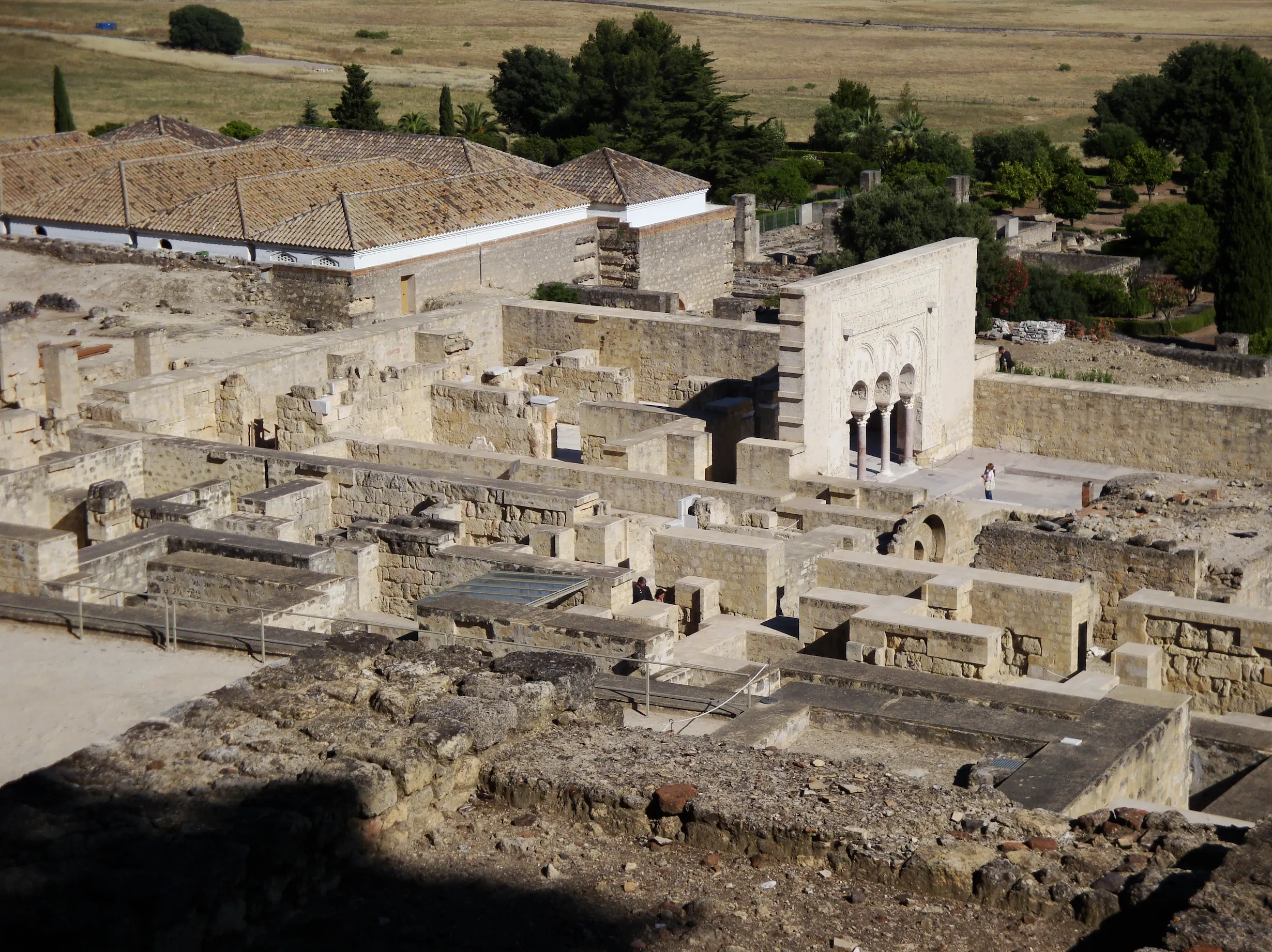
From about 936 Abd al-Rahman began building a new palace-city on the slopes below the Sierra Morena, some five kilometres northwest of Córdoba: Madinat al-Zahra, the seat and the argument of the caliphate.
It was laid out on descending terraces, with the caliph's residence and reception halls above, administration and the mint below, and a congregational mosque, barracks, gardens, and water supply brought by aqueduct. Its reception hall was designed to overwhelm arriving visitors, and the sources describe ceremonial in which an embassy walked a long approach lined with troops before reaching the caliph. Construction continued for decades and the site was still being worked on under his son. The archaeology, the excavation history, and the architectural detail are treated in the article on Madinat al-Zahra.
Two points belong to Abd al-Rahman's reign specifically. The first is that the city was an instrument of the caliphal claim: a purpose-built capital, distinct from the old city, expressed a rupture with the emirate and a rank equivalent to the caliphal capitals of the east. The second is that it was short-lived. Madinat al-Zahra was sacked in the civil wars that began in 1009, less than eighty years after it was founded, and was left a ruin. Its brief existence is a fair emblem of the caliphate itself.
Culture and Learning
The intellectual culture of tenth-century Córdoba, which the article on intellectual life in al-Andalus sets out, developed under Abd al-Rahman and his son al-Hakam II, and the two reigns are difficult to separate. The great library associated with the dynasty was substantially al-Hakam's work, and it is his reign rather than his father's that is remembered for scholarship.
What can be attributed to Abd al-Rahman is the patronage and the conditions: a court that recruited physicians, astronomers, poets and secretaries; the acquisition of Greek and eastern Arabic texts through the diplomatic channels described above; the extension of the Great Mosque of Córdoba, including work on the minaret; and a stable, wealthy state in which such work was possible. The transmission of this learning to the Latin West, discussed in the article on Andalusian influence on Europe, began from the institutions of this period.
Family, Succession, and Death
The dynastic politics of the reign were harsh even by the standards of the family.
In about 949 Abd al-Rahman had his son Abdallah put to death for conspiracy against him. The sources report the charge and the execution; the details of the plot are not securely recoverable. The episode is a reminder that a caliphal court, whatever its ceremonial dignity, remained a place where succession was contested lethally.
He designated his son al-Hakam, who succeeded him in 961 as al-Hakam II and reigned until 976. The succession was orderly, which by Andalusi standards was itself an achievement, and al-Hakam's reign is generally regarded as the cultural high point of the caliphate.
Abd al-Rahman III died at Córdoba on 15 October 961, aged seventy, after a reign of forty-nine years.
A passage widely attributed to him, and much quoted, has the caliph counting the days of genuine happiness in his long life and arriving at fourteen. The story is a late anecdote — it appears in the compilations rather than in the contemporary record — and the number varies in the telling. It is best treated as a moralising tradition about the emptiness of worldly power, of a kind attached to several rulers, rather than as anything the man said.
Historiographical Note
The tenth century is far better documented than the eighth, and for parts of this reign genuinely good material survives, but the limits are still real.
The most valuable source is the fifth volume of Ibn Hayyan's al-Muqtabis, an eleventh-century compilation that preserves substantial passages from the lost contemporary chronicles of the caliphal court, including material by writers with access to official records. It supplies dated campaign narratives, chancery language, and administrative detail of a kind unavailable for earlier reigns. Ibn Idhari and al-Maqqari transmit further material, the latter at a remove of seven centuries. Latin sources from León, Castile and Catalonia give the northern side of the frontier wars, and John of Gorze's account preserves an outsider's view of the court.
Three cautions apply. Court chronicles record what the caliphal chancery wished recorded, and the presentation of the reign as a restoration of legitimate order is the official interpretation rather than a neutral one. Fiscal and troop figures are conventional and should not be used as data. And the treatment of Simancas is visibly awkward in the Arabic tradition, which passes over the defeat quickly, so that its scale has to be reconstructed partly from Latin sources and from the observable fact that the caliph never again took the field.
Where the sources disagree, the disagreement is generally about dates and numbers rather than about the shape of events. His birth year is given variously as 889, 890 or 891. Figures for the size of armies, the revenue, and the population of Córdoba differ widely between authorities and are not treated as established here.
Assessment
Abd al-Rahman III's achievement is the reconstruction of a state that was failing when he inherited it, and the translation of that recovery into a claim of the highest rank in Islamic political life.
The reconstruction is the solid part. In 912 Córdoba controlled little beyond its own hinterland; by 933 there was no independent power left in Muslim Iberia, the frontier marches were governed from the capital, taxes were collected, and the army was paid. This was accomplished without any technological or strategic novelty, by twenty years of methodical siege warfare and negotiated submissions, and it is the least celebrated and most substantial thing he did. The caliphate that his son inherited, and the cultural flowering associated with it, existed because of that unglamorous work.
The caliphal proclamation of 929 was a shrewd reading of a changed world: an Abbasid caliphate reduced to a formality, a Fatimid caliphate advancing a rival universal claim toward his own recruiting grounds, and an Umayyad house with the best genealogical claim available in the west. It gave al-Andalus a standing it had never had and a ceremonial and administrative culture to match, expressed physically at Madinat al-Zahra.
The limits should be stated with equal clarity. Simancas in 939 was a defeat serious enough to end his career as a field commander, and it exposed the ceiling on Córdoban power in the north: the caliphate could raid, extract tribute, and manipulate the Christian kingdoms, but it could not conquer them, and the initiative on that frontier would pass to the north within a century and a half. The African policy secured the strait and the Berber recruiting grounds but never resolved the Fatimid contest. And the restoration was imposed on his own population by force, with the exhumation and display of Ibn Hafsun's remains standing as its emblem.
The most consequential ambiguity in his legacy is the army. His reliance on Berber and saqaliba troops loyal to the ruler personally solved the problem that had destroyed the ninth-century emirate — the political power of Arab settler factions and provincial families — and it gave the caliphate an effective military instrument. But it detached the state's armed force from the country it governed. When al-Mansur ibn Abi Amir expanded that force enormously in the late tenth century and used it to reduce the caliph to a figurehead, and when it fractured along ethnic lines in the civil wars after 1009, the mechanism was the one Abd al-Rahman had strengthened. The caliphate he created lasted just over a century, and Madinat al-Zahra was a ruin within eighty years of its foundation.
That should not be read as a verdict against him. Every solution available in 912 carried a cost, and a ruler who restores a collapsing state cannot be held responsible for how his successors use the instrument. But the caliphate of Córdoba at its height was a more fragile construction than its wealth and ceremonial suggested, and the fragility was built in from the start.
References and Further Reading
Primary Islamic Sources
- Quran, Surah Al-Imran (3:26) — on the giving and taking of sovereignty; a text used in Andalusi chancery rhetoric surrounding the caliphal proclamation
- Quran, Surah al-Nur (24:55) — the promise of succession and authority to the believers, invoked in the titulature and legitimising language of the Cordoban caliphate
- Quran, Surah al-Nisa (4:59) — "Obey God, obey the Messenger, and those in authority among you"; the foundational text for caliphal authority as Andalusi jurists understood it
- Sahih Muslim, Kitab al-Imarah (Book of Leadership), and Sahih al-Bukhari, Kitab al-Ahkam — the prophetic material on legitimate rule, allegiance, and the suppression of rebellion
- The caliphal titulature and coin legends of al-Nasir li-Din Allah, the primary documentary expression of the 929 claim
Classical Islamic Sources
- Ibn Hayyan, Abu Marwan. Al-Muqtabis, vol. V. [11th century] — the essential source, preserving lost contemporary court chronicles of the reign
- Ibn Idhari. Al-Bayan al-Mughrib. [c. 1312]
- Al-Maqqari, Ahmad ibn Muhammad. Nafh al-Tib min Ghusn al-Andalus al-Ratib. Cairo: Dar al-Kutub al-Misriyyah, 1949. [c. 1629]
- Ibn Hazm, Ali. Jamharat Ansab al-Arab. [11th century] — on the genealogy of the Andalusi Umayyads
- Ibn Khaldun, Abd al-Rahman. Kitab al-Ibar, the Andalusi sections. [c. 1377]
- Dhikr Bilad al-Andalus. [Anonymous, later compilation]
Academic and Scholarly Sources
- Fierro, Maribel. Abd al-Rahman III: The First Cordoban Caliph. Oxford: Oneworld, 2005. — the standard modern biography
- Safran, Janina M. The Second Umayyad Caliphate: The Articulation of Caliphal Legitimacy in al-Andalus. Cambridge, MA: Harvard University Press, 2000. — on the construction of the 929 claim
- Kennedy, Hugh. Muslim Spain and Portugal: A Political History of al-Andalus. London: Longman, 1996.
- Wasserstein, David J. The Caliphate in the West: An Islamic Political Institution in the Iberian Peninsula. Oxford: Clarendon Press, 1993.
- Manzano Moreno, Eduardo. Conquistadores, emires y califas: los Omeyas y la formación de al-Andalus. Barcelona: Crítica, 2006.
- Acién Almansa, Manuel. Entre el feudalismo y el Islam: Umar ibn Hafsun en los historiadores, en las fuentes y en la historia. Jaén: Universidad de Jaén, 1994. — on the Bobastro revolt
- Vallejo Triano, Antonio. La ciudad califal de Madinat al-Zahra. Córdoba: Almuzara, 2010.
- Halm, Heinz. The Empire of the Mahdi: The Rise of the Fatimids. Leiden: Brill, 1996. — on the rival caliphate that shaped Cordoban policy
Further Reading
- Catlos, Brian A. Kingdoms of Faith: A New History of Islamic Spain. New York: Basic Books, 2018.
- Menocal, María Rosa. The Ornament of the World. Boston: Little, Brown, 2002.
- Jayyusi, Salma Khadra, ed. The Legacy of Muslim Spain. 2 vols. Leiden: Brill, 1992.
- Dodds, Jerrilynn D., ed. Al-Andalus: The Art of Islamic Spain. New York: Metropolitan Museum of Art, 1992.
- Ashtor, Eliyahu. The Jews of Moslem Spain. Philadelphia: Jewish Publication Society, 1973. — on Hasday ibn Shaprut and the Cordoban Jewish community
Mentioned In
13 articles reference this topic
and 1 more article
More from Al-Andalus
Al-Andalus
Al-Andalus was the Islamic territory in the Iberian Peninsula from 711 to 1492 CE. Over nearly eight centuries it produced major intellectual and architectural achievements, and its mix of Muslim, Christian, and Jewish communities left a lasting mark on European and Islamic civilization.
Convivencia in Al-Andalus: Interfaith Coexistence and Cultural Synthesis
Convivencia, meaning living together, describes relations between the Muslim, Christian and Jewish communities of Al-Andalus between 711 and 1492. Distinct in identity but joined in commerce and learning, they produced a common Andalusi culture.
Córdoba
Córdoba was the capital of Muslim Spain from the eighth century to the eleventh, and for much of that time the largest and most cultivated city of the western Mediterranean. This article follows the city itself: its Roman origins, its rise under the Umayyads, its court and learning, and its fall.
Great Mosque of Córdoba (Mezquita)
The Great Mosque of Córdoba (Mezquita) is one of the most magnificent examples of Islamic architecture. Built over two centuries by Umayyad rulers, it features horseshoe arches and represents the pinnacle of Moorish achievement in Spain.