Al-Zahrawi: The Surgeon of Cordoba
Al-Zahrawi (c. 936-1013), known in Latin Europe as Albucasis, was a physician and surgeon of Umayyad Cordoba. His thirty-volume Kitab al-Tasrif closed with the first illustrated treatise on surgery, which shaped European surgical practice for centuries.
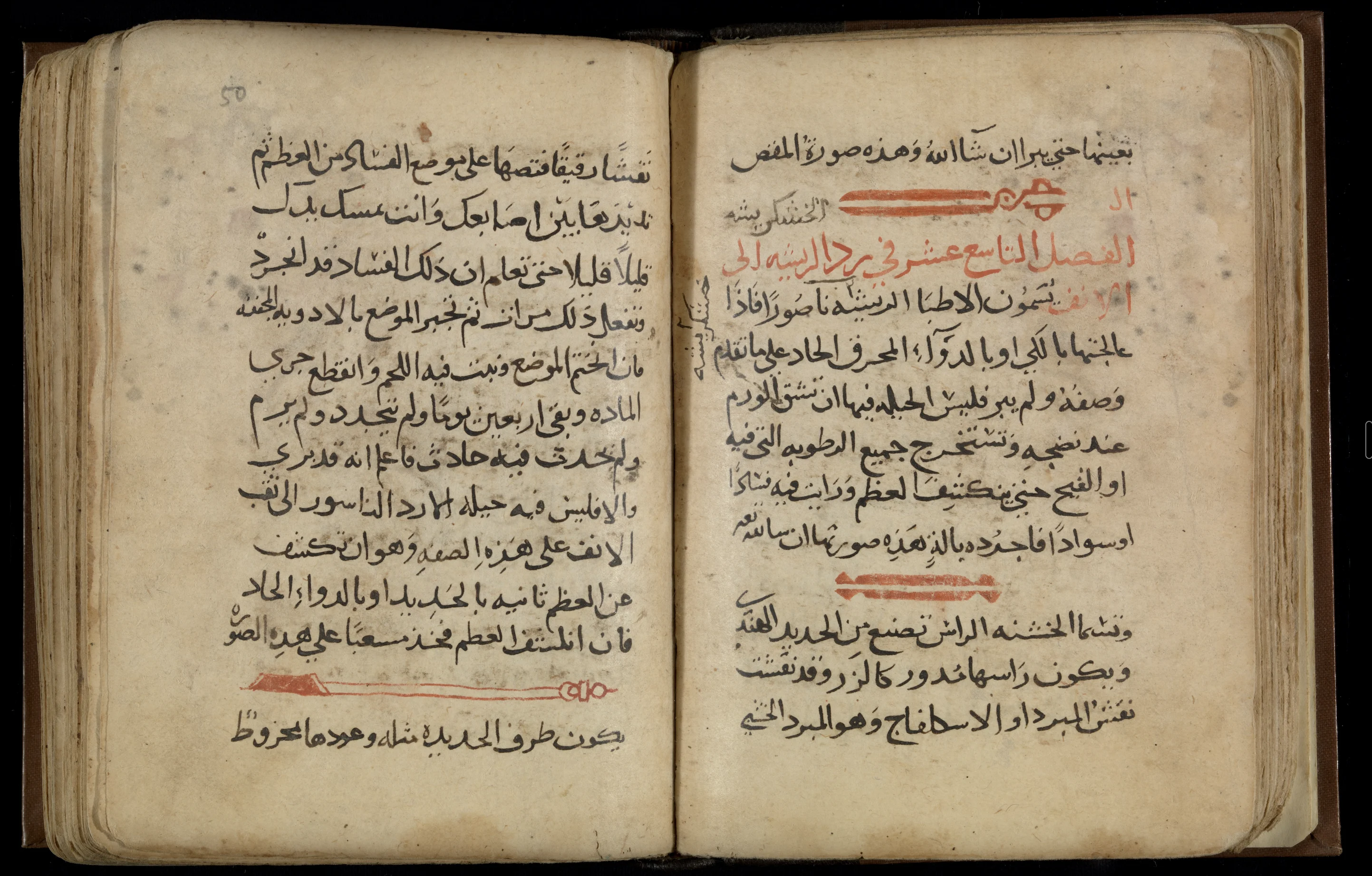
Abu al-Qasim Khalaf ibn al-Abbas al-Zahrawi (c. 936 – c. 1013 CE), known in Latin Europe as Albucasis and also as Abulcasis and Alsaharavius, was a physician, surgeon and pharmacist of Cordoba in the Umayyad caliphate of al-Andalus. Encyclopaedia Britannica describes him as a medieval surgeon of Andalusian Spain whose comprehensive medical text combined Middle Eastern with Greco-Roman classical teaching and shaped European surgical procedure until the Renaissance. That text is Kitab al-Tasrif, a medical encyclopaedia in thirty books whose closing treatise, On Surgery, set out more than two hundred surgical instruments with drawings of each — so far as the surviving record shows, the first illustrated surgical manual in the history of medicine. Translated into Latin in twelfth-century Toledo and printed repeatedly from 1497, it carried his name into European medical teaching for centuries, and The Muslim 500 is one of many modern surveys to describe him simply as the father of surgery.
His career belongs to a particular moment in the history of al-Andalus: the half-century in which Cordoba was the seat of a caliphate rather than a provincial emirate, when its rulers bought books across three continents and drew scholars to the city from Baghdad, Cairo and Constantinople. He was born in the palace-city those rulers built and he died in the years its world came apart. Understanding what he achieved means beginning with the state that paid for it.
Al-Andalus in the Tenth Century
The caliphate at Cordoba
The Umayyad house had governed al-Andalus from Cordoba since the middle of the eighth century, at first with the title of emir. Under Abd al-Rahman III (891–961) it governed as a caliphate. Akbar Shah Najeebabadi's The History of Islam records his accession on 1 Rabi' al-Awwal 300 AH — he succeeded his grandfather Abdullah, whose twenty-five-year reign had been consumed by revolt — and his death in 350 AH, after which his son al-Hakam took the throne at the palace of al-Zahra on 5 Ramadan of that year. The same source describes the reach the court came to have in the interval: when in 336 AH the ruler at Constantinople sent an embassy to Cordoba with gifts, the caliph ordered the whole city decorated to receive it, and the envoys were brought through marble colonnades and mosaic floors to a hall where the caliph sat with his nobles, scholars, poets and commanders drawn up in order. The account preserves a detail that says as much about the court's values as its wealth: two of the men called upon to make the reply speech were overcome and could not deliver it, and when an otherwise unremarkable religious teacher, Mundhir ibn Sa'id, rose and spoke fluently, the caliph appointed him chief justice of the caliphate on the spot.
That was a court in which learning was a route to office. Najeebabadi records that Abd al-Rahman III made a policy of summoning to Cordoba those who excelled in any walk of life, with the result that scholars and men of standing came from Baghdad, Constantinople, Cairo, Damascus, Medina, Yemen, Iran and Khurasan, and that they belonged to different faiths and nationalities. The caliph also spent heavily on the Great Mosque of Cordoba, the building his ancestors had begun, adding a new minaret and enlarging what earlier rulers had raised.
Madinat al-Zahra
The most consequential of his building projects for the present subject was the palace-city of Madinat al-Zahra, laid out a few miles west of Cordoba at the foot of the Sierra Morena. Najeebabadi dates the laying of its foundation to 325 AH and its completion to 350 AH, and describes it as having grown so large in conception that it came to be called a city, Madinat al-Zahra, rather than a palace, Qasr al-Zahra. It was built to be the seat of government and the ceremonial capital of the new caliphate, and for two generations it was exactly that: the place where embassies were received, where the caliphal workshops turned out the carved ivories for which the court became known, and where the administration of al-Andalus was conducted.
It is also, on the best evidence available in the approved sources, the place where al-Zahrawi was born, and the source of the name by which he is known. Al-Zahrawi means "of al-Zahra".
Al-Hakam II and the library
Abd al-Rahman III was succeeded by his son al-Hakam II, who reigned for sixteen years and died of paralysis at Cordoba in Safar 366 AH at the age of sixty-four. Najeebabadi's assessment of him is emphatic on one point: he passed the greater part of his time in academic pursuits, and under him the progress of arts and learning outran everything else the reign achieved.
The mechanism is worth setting out, because it is what made Cordoba a place where a book like Al-Tasrif could be written. Al-Hakam II kept agents permanently at work in Damascus, Baghdad, Constantinople, Cairo, Mecca, Medina, Kufa and Basra, with instructions to buy any good book that came to notice. Authors were induced to send their works to him directly. Copyists were appointed in city after city to reproduce books for the caliph's collection, and because he was on friendly terms with rulers across the known world, his copyists and translators were given facilities to obtain rare books in whatever form they could be had. He also appointed his brother al-Mundhir head of the department of education. What resulted was a library of a scale that later became proverbial; Ibrahim B. Syed's survey of medicine and medical education in Islamic history places the library of Cordoba at 600,000 volumes, a figure it attributes to the historian Haddad and which should be read as the tradition's estimate rather than a count.
Medicine and the hospital
The medical culture into which al-Zahrawi was trained was an institutional one, and its shape had been set further east. Syed's survey describes the hospital of the Islamic world as a development of the first importance: hospitals served all citizens without charge and without regard to colour, religion, sex, age or social status; they were run by government and directed by physicians; they separated male and female patients into different wards staffed by attendants of the same sex; and they allocated distinct wards to fever, wounds, infection, mania, eye conditions, and other categories of illness. Only qualified and licensed physicians were permitted by law to practise. The hospitals were teaching hospitals, with housing for students and resident staff, dispensaries giving out drugs without charge, conference rooms, and libraries kept current. They recorded every patient and the care given, which Syed notes was done for the first time in medical history.
Pharmacy in this system was a separate licensed profession rather than a sideline of medicine. Apothecary shops were inspected by a government officer, the muhtasib, who checked weights, measures and the purity of drugs; pharmacists had to pass examinations to be licensed, were pledged to follow the physician's prescription, and physicians were barred from owning or holding a stake in a pharmacy. The techniques the pharmacists worked by — distillation, crystallisation, sublimation, reduction, calcination — were the same techniques that made the chemical sections of Al-Tasrif possible.
This was the tradition al-Zahrawi inherited. Its Andalusi and eastern branches are treated more fully in the encyclopaedia's articles on Islamic medicine, the development of the Islamic hospital, and the Islamic Golden Age.
The standing of surgery
One feature of the period is essential to understanding why al-Zahrawi wrote as he did. Surgery in the tenth century was not the prestigious branch of medicine; it was the branch physicians of standing tended to avoid. Syed's survey records the institutional position in Latin Europe bluntly enough: the Council of Tours of 1163 ruled that surgery was to be abandoned by the schools of medicine and by all decent physicians. Al-Zahrawi's own view of the state of the craft in his part of the world was scarcely warmer. Syed records that he opened his surgical treatise by explaining that he wrote it because surgery had reached a low condition and was held in low regard by the physicians of his day, and that he ascribed that decline to a specific and remediable cause: ignorance of anatomy and a misunderstanding of how the body worked. In his book on fractures and dislocations he observed that this part of surgery had fallen into contempt.
The whole design of Al-Tasrif — thirty books of general medicine with surgery placed deliberately at the end — is an argument against that state of affairs.
Name, Origins and Early Life
The name and its Latin forms
His full name is given as Abu al-Qasim Khalaf ibn al-Abbas al-Zahrawi al-Ansari. The nisba al-Zahrawi attaches him to Madinat al-Zahra; the nisba al-Ansari, as Syed notes, points to descent from the Ansar, the Medinan tribes of the Prophet's city, and so traces the family's origin back to Medina in the Arabian Peninsula. Such a claim to eastern Arab descent was not unusual in the Andalusi establishment: Najeebabadi records of the family that later produced al-Mansur that its ancestor, a Yemenite soldier, had crossed into Spain in the company of Tariq ibn Ziyad himself.
In Latin he became Albucasis — a contraction of Abu al-Qasim — and appears also as Abulcasis, Bucasis and Alsaharavius. The multiplication of forms is itself evidence of how widely he was read in Europe, since each represents a separate attempt by a different translator or printer to render the Arabic.
Birth at Madinat al-Zahra
The biographical directory in 1001 Inventions gives his birth as 936 at Madinat al-Zahra, near Cordoba, and his death as 1013. Syed places the birth in the same city, which he calls Azahara, and locates it eight kilometres north-west of Cordoba. He is careful about the date in a way that matters: the birth date is not known for certain, and what scholars agree on is that it fell after 936, because 936 is the year the city was founded. A man surnamed "of al-Zahra" cannot have been born there before there was a Zahra to be born in. Britannica gives both dates with the qualification circa, which is the same caution expressed differently.
Nothing in the approved sources records his parentage, his schooling, or a single event of his childhood. The silence is normal for a physician rather than a ruler in this period, and it is left as silence here.
Cordoba
Syed records that he lived most of his life in Cordoba, and that Cordoba is where he studied, taught, and practised medicine and surgery until shortly before his death. Among his contemporaries were the Andalusi chemists Ibn al-Wafid, al-Majriti and Artephius — a detail worth noting because the chemical and pharmaceutical books of Al-Tasrif place him squarely in that company and not only among physicians.
Cordoba in these decades was among the largest cities of the western world and the intellectual centre of the Iberian Peninsula, a subject treated at length in the encyclopaedia's article on the intellectual life of al-Andalus. It is the setting for everything that follows.
Career
Physician to the court
The approved sources place al-Zahrawi at the caliphal court, and they disagree about which ruler he served.
Syed states that in recognition of his skills he was appointed court physician to al-Hakam II — the bibliophile caliph who reigned from 961 to 976 and whose library has already been described. 1001 Inventions states instead that he was recognised in his own day as an eminent surgeon and was court physician to the ruler of al-Andalus, al-Mansur. The reference is to al-Mansur ibn Abi Amir, the chamberlain who governed al-Andalus from 981 until his death in 1002 while the caliph Hisham II remained in ceremonial seclusion, and whom Najeebabadi describes as himself a scholar, fond of learning after the manner of al-Hakam II, and a man who held scholars in esteem.
The two statements are not necessarily incompatible. Al-Zahrawi's working life spanned both regimes: he would have been in his late twenties when al-Hakam II acceded and in his mid-forties when al-Mansur took power, and a physician of standing at Cordoba might well have served both. Neither source, however, cites the evidence for its claim, and the article does not choose between them. The point is taken up again in the Historiographical Note below.
Practitioner and teacher
What both sources agree on is that his reputation rested on practice and teaching as much as on the book. Syed records that Al-Tasrif embodies data accumulated over a career spanning almost fifty years of training, teaching and practice, and that al-Zahrawi wrote of his students affectionately, calling them "my children". Two further principles are recorded of him. He insisted on the importance of a good relationship between physician and patient. And he held that patients were to be treated irrespective of social status — a principle that was, as the account of the hospital system above indicates, the declared norm of the institutions of his world rather than a private eccentricity.
He also urged the close observation of the individual case as the route to accurate diagnosis and the best available treatment. That method is visible throughout the surgical treatise, which repeatedly stops to describe what a particular patient presented with and what was done.
Kitab al-Tasrif
The title
The work's full title is Kitab al-Tasrif li-man 'ajiza 'an al-Ta'lif, usually shortened to Al-Tasrif. The glossary of 1001 Inventions explains tasrif as meaning literally "conducting", or the handling of a certain matter, and renders the whole as The Method of Medicine or The Arrangement of Medicine. Syed renders the full title differently, as An Aid for Those Who Lack the Capacity to Read Big Books — a translation that takes li-man 'ajiza 'an al-Ta'lif as describing the intended reader rather than the author's method. Both readings appear in the literature, and both are given here.
Whichever rendering is preferred, the title announces a book meant to be used. Syed dates its completion to about the year 1000.
Scale and arrangement
Al-Tasrif runs to thirty books, or treatises. 1001 Inventions records its extent as 1,500 pages, and The Muslim 500 describes it in the same terms as a 1,500-page illustrated encyclopaedia of surgery. Syed's account gives the subject range: surgery, general medicine, orthopaedics, ophthalmology, pharmacology, nutrition, dentistry, childbirth and pathology, with further sections on midwifery, therapeutics, dietetics, psychotherapy, weights and measures, and medical chemistry. More than three hundred diseases are described with their treatments.
The arrangement is deliberate. The first book sets out the general principles of medicine; the second treats pathology; much of what follows concerns pharmacology and drugs; and the last and most celebrated treatise is the one on surgery. Syed records al-Zahrawi's own explanation of that ordering, and it is the key to the book: surgery was placed last because it is the highest form of medicine, and no one should attempt it until thoroughly acquainted with every other branch. The book is therefore built as a course, and the surgical treatise is its final examination.
Pharmacy and chemistry
The pharmaceutical books were the part of Al-Tasrif that reached Latin readers first under a title of their own. 1001 Inventions records that the work was translated into Latin as Liber Servitoris, and that in it al-Zahrawi told the reader how to prepare both simple and compound drugs. He described the preparation of medicines by sublimation and distillation, which opened the way to a range of new preparations, and gave methods for producing substances including litharge or lead monoxide, white lead, lead sulphide, burnt copper, cadmium, marcasite iron sulphide, yellow arsenic and lime, along with numerous vitriols and salts.
One item from this material became, in a modest way, universal. Having already adopted catgut for internal stitching, al-Zahrawi used the same substance to make parcels of medicine that could be swallowed whole. 1001 Inventions draws the obvious conclusion: the drug capsule of the modern pharmacy has a forerunner more than a thousand years old.
The Medicines of Beauty
One book of Al-Tasrif was given over entirely to cosmetics, under the title The Medicines of Beauty. 1001 Inventions treats it as the first systematic treatment of the subject as a branch of medicine, and its contents indicate why. Al-Zahrawi described the care and beautification of hair and skin, the whitening of teeth and the strengthening of gums, and did so — the source is explicit on the point — within the boundaries of what Islamic practice permitted. He set out nasal sprays, mouthwashes and hand creams. He described perfumed sticks rolled and pressed in moulds, which 1001 Inventions compares to the modern roll-on. He named medicated cosmetics including depilatory sticks, hair dyes that turned fair hair black, and lotions for straightening curled hair, and he discussed sun lotions and their ingredients.
The religious framing is not incidental to the subject. 1001 Inventions places its chapter on cleanliness, in which this account of al-Zahrawi sits, beneath the report of the Prophet Muhammad (Peace Be Upon Him) that "Allah is Beautiful and He loves beauty" (Sahih Muslim, no. 131), and alongside the Qur'anic instruction to wash the face and the hands to the elbows, to wipe the head and to wash the feet to the ankles before prayer (Qur'an 5:6). Care of the body was therefore an ordinary and unembarrassed subject for a physician of this society to write about, and the chapter matters for more than its curiosity value: it shows a physician treating that care as a proper object of systematic medical writing, and it is a reminder that Al-Tasrif was addressed to practice in a wealthy and urban society rather than to the operating table alone.
On Surgery: the Thirtieth Treatise
The argument from anatomy
The surgical treatise opens with a demand, and the passage Syed quotes is the most direct statement of method that survives from al-Zahrawi's hand:
"Before practicing surgery one should gain knowledge of anatomy and the function of organs so that he will understand their shape, connections and borders. He should become thoroughly familiar with nerves muscles bones arteries and veins. If one does not comprehend the anatomy and physiology one can commit a mistake which will result in the death of the patient. I have seen someone incise into a swelling in the neck thinking it was an abscess, when it was an aneurysm and the patient dying on the spot."
Two things are being done at once here. The first is a clinical instruction. The second is an argument about the status of the craft: if surgery had fallen into disrepute because it was practised without anatomical knowledge, then anatomy was the discipline that could restore it. The nineteenth-century French medical historian L. Leclerc, quoted in 1001 Inventions, identified precisely this as the achievement — that al-Zahrawi "remains a leading scholar who transformed surgery into an independent science based on the knowledge of anatomy", and that his illustration and drawing of the tools is an innovation that keeps his contribution alive through its continuous influence on those who came after him.
The three parts
Syed sets out the treatise's internal division, on the authority of the Muslim Heritage account he cites. It falls into three parts: on cauterisation, in fifty-six sections; on surgery proper, in ninety-seven sections; and on orthopaedics, in thirty-five sections. It was intended, he notes, for medical students seeking to master both procedures and the tools they required.
The illustrated instruments
The feature that made the treatise unlike anything before it was the drawings. 1001 Inventions states the case carefully: apart from some sketches of instruments carved in ancient Egyptian tombs, this may have been the first treatise in the history of medicine to illustrate surgical instruments. There were more than two hundred of them. Al-Zahrawi drew each one by hand and set beside it an account of how and when it was to be used, so that the reader could both recognise the tool and know its indication. Syed describes the result as the first illustrated surgical guide ever written, and notes that the illustrations were the earliest intended for use in teaching and in showing how the instruments were to be made.
The claim about their quality is startling but is stated flatly by 1001 Inventions: the designs were so accurate that they have altered only a little in a thousand years, and it was these illustrations that laid the foundations for surgery in Europe. The same source, setting a modern operating tray beside al-Zahrawi's plates, observes that the instruments of Muslim civilisation bear a close resemblance to those still in use.
The instruments themselves
The categories 1001 Inventions describes give a sense of the range. There were cauterisation tools of various shapes and sizes. There were scalpels, very sharp knives for making incisions of different kinds. There were hooks, with either a sharp or a blunt half-circular end, still used and still named in the same way: blunt hooks were introduced into the veins to clear blood clots, while sharp hooks held and lifted small pieces of tissue so that they could be excised, and retracted the edges of a wound. And there were forceps, two-handled instruments for picking up, pulling and holding tissue — crushing forceps, whose two jaws crushed and removed stones from the urinary bladder, and delivery forceps, with a semicircular end designed to draw the foetus from the mother, an instrument still in use.
Syed's list adds retractors, curettes, pincers and specula, along with instruments designed for al-Zahrawi's favoured techniques of cauterisation and ligature, and hooks with a double tip. Many of these, he records, had not been used by any previous surgeon. Al-Zahrawi also invented forceps for extracting a dead foetus, illustrated in Al-Tasrif itself.
Cauterisation
Cauterisation was the technique with which his name was most closely associated, and to which the first and longest part of the treatise is given. Syed records that he applied it in as many as fifty different operations, using it both to treat growths of the skin and to open abscesses, and that he explained his invention of a cauterising iron which he also used to control bleeding.
The instructions on the instrument itself show how his mind worked. 1001 Inventions quotes him directly: "According to the opinion of the early [physicians] cauterization using gold is better than when using iron. In our opinion the use of iron is quicker and more correct." The received authority is stated, and then set aside on the basis of practice — which is the characteristic move of the whole book.
Procedures and Techniques
Head, neck and throat
Al-Zahrawi described operations on the eye, the ear and the throat, and devised instruments for the internal examination of the ear and for the removal or insertion of objects in the throat. He described the use of a hook to take a polyp from the nose. Syed records that he was the first to illustrate the various cannulae, and the first to treat a wart with an iron tube and a caustic metal used as a boring instrument. He also described exposing and dividing the temporal artery to relieve certain kinds of headache, a procedure Syed notes was recorded some six hundred years before Ambroise Paré reported having tied off his own temporal artery for a headache answering to modern descriptions of migraine.
The account he gives of tonsillectomy is a good example of his attention to what a procedure feels like from the patient's side. 1001 Inventions describes the method: he held the tongue down with a depressor, took hold of the swollen tonsil with a hook, and cut it away with a scissor-like instrument whose transverse blades both severed the gland and held it, so that it could be lifted out of the throat and the patient did not choke on it.
His treatment of an injury to the larynx is preserved in his own words, and it is worth quoting because of what he concluded from it. A slave girl had cut her own throat. Al-Zahrawi sutured the wound and treated her until it healed:
"So, I hurriedly sutured the wound and treated it until healed. No harm was done to the slave-girl except for a hoarseness in the voice, which was not extreme, and after some days she was restored to the best of health. Hence, we may say that laryngotomy is not dangerous."
The reasoning is the interesting part. From a single accidental case he drew a general surgical inference — that an incision in the larynx can heal — and recorded the inference for others to act on.
The urinary stone
Stone in the bladder and the urethra was among the commonest and most painful conditions a surgeon of the period faced, and 1001 Inventions records that al-Zahrawi gave it many pages. He devised an instrument called al-mish'ab, the drill, for crushing urethral stones, and described its use:
"Take a steel rod with a triangular sharp end . . . tie a thread proximal to the stone lest it slips back. Introduce it gently till it reaches the stone, turn it round to perforate it . . . urine comes out immediately, press on the stone from outside and crush it by your finger, it breaks and comes out with urine. If you do not succeed then do cutting."
Geoffrey Lewis and Martin Spink, who translated the surgical treatise into English, are quoted in 1001 Inventions on the originality of the device: "This device of Abulcasis does seem to have been in a manner a true lithotripter . . . many centuries earlier than the modern era and completely lost sight of and not even mentioned by the great middle-era surgeons Franco and Pare nor by Frere Come, doyen of genito-urinary surgery." The observation contains two claims worth separating: that the instrument anticipated the modern stone-crusher, and that the anticipation was subsequently forgotten rather than built upon in Europe.
He also made a knife for cystolithotomy — cutting into the bladder to remove a stone — and Syed describes the technique he taught for it: the surgeon inserts a finger into the rectum, works the stone down to the neck of the bladder, then incises the rectal wall or the perineum and removes it.
Two refinements of this operation are recorded, and both concern the avoidance of harm rather than the removal of the stone. 1001 Inventions notes that both al-Razi and al-Zahrawi insisted that the inner incision be made smaller than the outer one, so as to prevent the leakage of urine afterwards. And al-Zahrawi held that stones were not to be pulled out but extracted with forceps, large ones being broken and delivered piece by piece, with every fragment removed, because a fragment left behind would grow. 1001 Inventions observes that the advice is still given.
One chapter of the treatise is singled out. Chapter 61 is devoted to the removal of bladder stones in women, and 1001 Inventions states that this was the first time in medical writing that the subject had been given a chapter of its own. For the operation in men, the same source records that al-Zahrawi described his own technique in detail, adding several refinements to the method set out in the Sushruta Samhita of Hindu medicine. Syed notes independently that the Sushruta Samhita had been translated into Arabic in the eighth century under the caliph al-Ma'mun; he goes on to suppose that al-Zahrawi therefore knew of it, but that supposition is his own inference and is not repeated as fact here.
Obstetrics and gynaecology
1001 Inventions calls his work in gynaecology pioneering, alongside that of other Muslim surgeons of the period, and identifies three specific contributions. He gave instructions for the training of midwives in how to manage an unusual delivery and how to remove the afterbirth. He designed and introduced the vaginal speculum. And he devised the forceps described above for the removal of a dead foetus, illustrated in the book.
Syed adds that Al-Tasrif described the obstetric posture later known in Europe as the "Walcher position", and that al-Zahrawi was the first to teach the lithotomy position for vaginal operations. He also records al-Zahrawi as the first to describe an abdominal pregnancy — a form of ectopic pregnancy that in his day was invariably fatal — and to describe the retained calcified foetus.
Dentistry
Dentistry occupies a substantial place in Al-Tasrif, and the procedures recorded are recognisably restorative rather than merely extractive. 1001 Inventions records that al-Zahrawi used bone to replace lost teeth, and described how to bind a sound tooth to a loose one with gold or silver wire. Syed adds that he advocated re-implanting a tooth that had been knocked out, and that the dental prostheses he described were carved from cow's bone.
Bones and joints
The third part of the treatise dealt with orthopaedics. 1001 Inventions records that he used plaster casts as a matter of routine and described how to correct a dislocated shoulder. Syed identifies that description with the method later known in European medicine as Kocher's, and records a second anticipation of the same kind: al-Zahrawi described patellectomy — removal of the kneecap — long before it was reintroduced to European surgery in 1937. He also described the stripping of varicose veins in terms Syed says still read like modern surgery.
Ligature, cotton and catgut
Three techniques for the control of bleeding and the closing of wounds are associated with him, and each had a long afterlife.
The first is ligature — tying off a bleeding vessel. Syed records that Al-Tasrif described how to ligate blood vessels roughly six hundred years before Ambroise Paré, the French military surgeon long credited in Europe with the introduction of sutures.
The second is cotton. 1001 Inventions lists among his firsts that he was the first to use cotton to control bleeding. Syed sets out the range of his use of it: in surgical dressings to control haemorrhage, as padding in the splinting of fractures, as vaginal packing, and in dentistry. The English word derives from the Arabic qutn.
The third is catgut, and it is the innovation most often attached to his name. 1001 Inventions records that al-Zahrawi was the first to use catgut in surgery for internal stitching, and that it remains in use today from the simplest operation to the most complex, catgut appearing to be the only natural substance capable of dissolving in the body and being accepted by it. The same source is careful to give the priority correctly: it was al-Razi who first used animal gut — sheep gut — for sutures, and al-Zahrawi who first used catgut in surgery. He also used twisted fibres taken from the strings of musical instruments for surgical purposes. Syed reports an anecdote attaching the discovery to al-Zahrawi's observation of a monkey that ate the strings of his oud; the story is given here as a story told about him, not as an established event.
Neurosurgery and paediatric surgery
Syed's account credits al-Zahrawi with early descriptions of neurological diagnosis and operative treatment: the management of head injuries, skull fractures, spinal injuries and dislocations, hydrocephalus, subdural effusions and headache. He identifies as a first the clinical description of an operation for hydrocephalus, in which al-Zahrawi described the evacuation of superficial intracranial fluid in hydrocephalic children.
In the surgery of children he described harelip, adenoids, ranula, an imperforate urinary meatus, an imperforate anus, gynaecomastia, and supernumerary and webbed fingers.
Hereditary disease and the thyroid
Two descriptions in Al-Tasrif are singled out by Syed as firsts in the medical literature. Al-Zahrawi was the first to identify the hereditary nature of haemophilia, and the first to describe it in detail — a claim Syed makes in both of his accounts. And he distinguished goitre from cancer of the thyroid, a distinction of consequence because it separates a condition that may be left alone from one that may not. Syed also records that al-Zahrawi is credited with performing the first thyroidectomy.
Restraint
The last thing to say about his surgery is the one least likely to appear in a list of firsts. 1001 Inventions records that al-Zahrawi displayed a sensible and humane reluctance to undertake the riskiest and most painful operations, because he was conscious of the discomfort they inflicted, and it calls this a decisive change in the relationship between surgeon and patient. In the same spirit, it records that in order not to frighten patients he devised a concealed knife for opening abscesses, so that the blade was not seen before it was used.
For a surgeon working without reliable anaesthesia, a settled disposition to decline an operation is not timidity but judgement, and the sources treat it as part of his method rather than a qualification of it.
Teaching and the Formation of a Physician
Beyond the technical books, Al-Tasrif contains material on education that Syed describes as substantial: on the education and behaviour of children, on conduct at table, on the school curriculum, and on academic specialisation. The recommendation he singles out concerns the making of a physician. Al-Zahrawi advised that gifted and intelligent students should be encouraged to take up medicine — but only after completing a primary education in language, grammar, mathematics, astronomy and philosophy.
The sequence is consistent with the architecture of Al-Tasrif itself. Just as surgery came last among the thirty books because it presupposed the other twenty-nine, medicine came last in the curriculum because it presupposed the general disciplines that trained a mind to reason. A surgeon, on this account, is the end product of a long education and not the holder of a manual skill.
Transmission to Europe
Toledo and Gerard of Cremona
The route by which Al-Tasrif reached Latin readers ran through Toledo, which in the twelfth century was the principal workshop of translation from Arabic into Latin. 1001 Inventions records that the city was busy with translators — Michael Scot, Daniel of Morley, and above all Gerard of Cremona, who translated al-Zahrawi's thirty-volume medical encyclopaedia along with Ibn al-Haytham's Book of Optics, al-Kindi's treatise on geometrical optics, a work of al-Razi on salts and alums, and the geometry of the Banu Musa brothers.
One detail about Gerard is worth recording, because it bears on how the transmission actually worked. 1001 Inventions notes that he made more than eighty translations yet never had a full grasp of Arabic, and had to work with and rely on local Mozarab collaborators. The Latin Albucasis that Europe read was therefore the product of a collaboration, and its distance from al-Zahrawi's Arabic is part of the history of the text.
The surgical treatise was the part that mattered most to European readers. Syed records that it was translated in the twelfth century, that it found rapid acceptance, and that it became a standard text in the major medical universities, naming Salerno and Montpellier.
The printed editions
Print carried it further. 1001 Inventions dates the first printed Latin edition of Al-Tasrif to Venice in 1497, with further editions at Basel in 1541 and Oxford in 1778 — nearly three centuries of continuous republication. It also reproduces a woodcut of 1532 illustrating cauterisation, from Gerard of Cremona's Latin version. Syed adds a Latin translation of 1531 by Peter Argellata, and notes a title page of 1599 giving the work as Liber theoricae nec non practicae Alsaharavii. His account records that the text was still being reprinted in the 1770s, which the Oxford edition of 1778 confirms.
Reception
The scale of the book's authority in Latin Europe is usually expressed as a span of time. The Muslim 500 states that the illustrated encyclopaedia was used in Europe as a medical reference for five hundred years, and Syed's account gives the same figure, adding that it remained the primary source on surgery there and that its influence extended into the Renaissance. He records a comparison drawn by the historian of medicine Arturo Castiglioni, that al-Zahrawi's treatise held in surgery the same authority as Ibn Sina's Canon held in medicine; and, from the general literature he draws on, that the fourteenth-century French surgeon Guy de Chauliac quoted Al-Tasrif more than two hundred times, that Pietro Argellata described al-Zahrawi as without doubt the chief of all surgeons, and that the French surgeon Jacques Daléchamps was still citing him in the sixteenth century.
These figures come to the account through modern secondary literature rather than from the medieval texts directly, and they are reported here as that literature reports them. What can be said on firmer ground is that the work was translated in the twelfth century, printed in the fifteenth, and reprinted into the eighteenth, and that a book does not go through that sequence unless it is being used.
The wider process of which this is a part — the movement of Arabic learning into Latin Europe through Iberia and Sicily — is treated in the encyclopaedia's article on Islamic influence on Europe through al-Andalus.
Successors
Al-Zahrawi's surgery did not end with him, and the line of physicians who took it up runs in both directions across the Mediterranean.
In al-Andalus itself, Ibn Zuhr, a physician of twelfth-century Seville, improved the urethral drill by fixing a diamond to the end of the steel rod. The medical tradition of al-Andalus that produced both men is discussed in the article on the intellectual life of al-Andalus.
In the eastern Mediterranean, Ibn al-Quff, born in 1233, a Christian surgeon and author, continued al-Zahrawi's project of developing surgery as a science and an independent medical specialty, and wrote Kitab al-Umda fi al-Jirahah, "The Main Pillars of Surgery". 1001 Inventions records his particular observation on bladder stones — that the surgical treatment of large stones was easier than that of small ones, because the large either lodged in the urethra or lay in the cavity of the bladder where they could more readily be felt.
Later still, Serefeddin Sabuncuoglu of Amasya, born in 1385, produced the illustrated Cerrahiyyet'ul Haniyye, showing a range of surgical procedures — evidence that the tradition of the illustrated surgical manual which al-Zahrawi began was still being extended four centuries later in Anatolia.
Death and the End of Umayyad Cordoba
Al-Zahrawi died at about the age of seventy-seven, around 1013, at Cordoba. Syed fixes the date by reference to a catastrophe: it came two years after the sacking of Madinat al-Zahra, the city of his birth.
The sequence of events is set out in Najeebabadi's The History of Islam, and it is worth following, because al-Zahrawi's last years coincided exactly with the destruction of the political order that had made his career possible. Al-Mansur died in 394 AH while returning from a campaign in Castile, and his son Abd al-Malik, given the title al-Muzaffar, succeeded him and held the arrangement together for six years until his death in 399 AH. When the second son, known as Sanchuelo, took the succession and pressed the caliph Hisham II into naming him heir, the Umayyad family and the Quraysh of Cordoba turned against the transfer of the caliphate out of their house. Sanchuelo was killed while campaigning in the north; a great-grandson of Abd al-Rahman III was installed as caliph under the title al-Mahdi; Hisham II was deposed; and Najeebabadi records that the palace-city built by al-Mansur outside Cordoba was razed to the ground in 399 or 400 AH.
What followed he describes as the opening of the doors of anarchy. Berber troops who had been decisive in the change of ruler came to dominate the administration; factions searched for Umayyad princes to front their claims; al-Mahdi was assassinated and Hisham II restored; and the pretender Sulayman al-Musta'in besieged Cordoba with Christian assistance. Hisham II ceded two hundred fortresses and several substantial cities to detach the Christian king from the siege, but the siege continued. In Shawwal of 403 AH — a date that falls in the spring of 1013 — Sulayman al-Musta'in occupied Cordoba. Hisham II was either killed or vanished without trace. The provinces had already broken away: Seville, Badajoz, Valencia, Murcia, Saragossa, Denia. Madinat al-Zahra had been sacked around 1010, and the great library of al-Hakam II was dispersed.
Al-Zahrawi's death therefore falls within months of the fall of the city where he had spent his life, and he did not outlive the caliphate that had employed him. The caliphate of Cordoba was formally abolished in 1031, and al-Andalus broke into the taifa kingdoms.
Legacy
The manuscripts
Al-Tasrif survives in Arabic manuscripts scattered across the libraries of the Islamic world and beyond. 1001 Inventions cites copies in the Süleymaniye Library at Istanbul, in the Bashir Agha collection, and in al-Khizana al-Hasaniyya at Rabat; Syed reproduces two pages from a manuscript held by the Azerbaijan National Academy of Sciences at Baku. A modern critical gathering of the texts and studies was published under the editorship of Fuat Sezgin at Frankfurt in 1996. The dispersal is itself a fact about the work's reach: copies were made and kept from Morocco to the Caucasus.
The title "father of surgery"
The description of al-Zahrawi as the father of surgery is now conventional, and it appears in both the approved treatments used here — The Muslim 500 uses it in passing, and Syed's article carries it in its title. It is a modern formulation rather than a medieval one, and the sources apply it on the strength of three things in particular: the establishment of surgery as a discipline resting on anatomical knowledge, the first illustrated catalogue of instruments, and the transmission of both to Europe in a form that could be taught.
Syed's assessment goes further than the surgical claim, holding that al-Zahrawi was not only one of the greatest surgeons of medieval Islam but a considerable educationist as well, on the strength of the sections of Al-Tasrif dealing with the education of children, conduct, curriculum and specialisation. Britannica's judgement is narrower and is confined to what can be demonstrated: that his medical text shaped European surgical procedure until the Renaissance.
Modern commemoration
1001 Inventions reproduces a Syrian commemorative postage stamp of 1964 bearing an artist's impression of him, and the same volume lists his surgical instruments among the inventions it maps to Cordoba. No portrait or likeness from his own century is known, and the 1964 image is an imagining rather than a record.
His name recurs throughout the encyclopaedia's treatment of the sciences — in Islamic medicine, in Islamic contributions to science and medicine, in the Islamic Golden Age, and among the Muslim scholars who changed the world — because the surgical tradition he founded is one of the few strands of medieval Islamic science whose instruments a modern practitioner would recognise on sight.
Historiographical Note
The evidence base for this article is narrower than the subject deserves, and saying so is more useful than concealing it.
What the approved library contains. A search of the project's PDF library across the transliterations Zahrawi, Zahraawi, Zahrāwī, Albucasis, Abulcasis, Alsaharavius, Azaravius, Zahravi, Tasrif, Taṣrīf, Khalaf ibn al-Abbas and Abu al-Qasim Khalaf returned substantive material in exactly one book: 1001 Inventions: The Enduring Legacy of Muslim Civilization, edited by Salim T. S. al-Hassani and published by the National Geographic Society. The Muslim 500 mentions him in a single sentence within an essay on education. The History of Islam by Akbar Shah Najeebabadi supplies the Cordoban political setting but does not name him. The Rise of Cordoba by Agha Ibrahim Akram, despite its title and its hundreds of references to the city, covers the reigns of Hisham I, al-Hakam I and Abd al-Rahman II and ends roughly a century before al-Zahrawi was born; it contains nothing on him and almost nothing on medicine. The recently added Healing Body and Soul by Amira Ayad, a contemporary guide to wellbeing, contains no reference to him, to Al-Tasrif, to Cordoba or to al-Andalus. These are reported as searches performed and negatives found, not as books passed over.
The gap was filled from the approved external web sources, principally two articles by Ibrahim B. Syed, Clinical Professor and Director of Nuclear Medicine Sciences at the University of Louisville School of Medicine, published on History of Islam, and from the Encyclopaedia Britannica entry. Syed's article on al-Zahrawi carries its own footnotes, and they are of mixed standing: they include a peer-reviewed article in the biomedical literature and the Muslim Heritage project, but also a general encyclopaedia. Where a claim in this article rests only on the weaker end of that apparatus — the figure of five hundred years, Guy de Chauliac's two hundred citations, Argellata's description — it is attributed in the text to the account that reports it rather than asserted, and the reader should treat it as the received view of the modern literature rather than as a datum from a medieval source.
The dates. No source consulted here gives a documented birth date. 1001 Inventions prints 936 in two places; Syed's survey of Islamic medicine prints 930; Britannica gives circa 936 and circa 1013. The one thing that can be reasoned about is the lower bound, and Syed states it: the birth cannot precede the foundation of Madinat al-Zahra, since the name al-Zahrawi derives from that city. Najeebabadi independently dates the laying of the city's foundation to 325 AH, which corresponds to 936–937 CE. A birth "in 936 at Madinat al-Zahra" is therefore at the very edge of possibility, and the more cautious reading — a birth after 936 — is the one adopted here, with the conventional 936 retained in the date range because it is the figure the literature uses. The death is placed at about 1013, on Syed's reckoning of two years after the sack of Madinat al-Zahra, and the year is corroborated in its general placement by the political chronology: Cordoba fell to Sulayman al-Musta'in in Shawwal 403 AH.
Whose physician he was. The two substantive sources disagree, and neither gives its evidence. 1001 Inventions makes him court physician to al-Mansur, the chamberlain who governed from 981 to 1002. Syed makes him court physician to the caliph al-Hakam II, who reigned from 961 to 976. Both are chronologically possible for a man of his lifespan, and both could be true in sequence. The article names the disagreement rather than choosing, and no attempt is made to harmonise it by inference.
Tracheotomy. The sources conflict directly. 1001 Inventions lists the performance of a tracheotomy among his firsts. Syed states that al-Zahrawi never performed the procedure, and offers instead the case of the slave girl's injured larynx as the basis for his conclusion that an incision there could heal; his survey of Islamic medicine says only that al-Zahrawi described tracheotomy. The distinction between describing an operation and performing it is exactly the kind that is lost in summary, and the conflict is reported here rather than resolved.
Claims deliberately omitted. Several statements about al-Zahrawi are widely repeated, including elsewhere on this site, and could not be traced to any source in the approved base. Cataract surgery and the surgical treatment of tumours are attributed to him in the encyclopaedia's older articles on Islamic medicine and Islamic contributions to science and medicine; neither appears in the material used here. The passage in 1001 Inventions on the surgery of "limited cancers" that sits physically beside the al-Zahrawi text belongs, on a careful reading of the page, to Ibn Sina, not to al-Zahrawi, and it is not transferred. The claim that the surgical section was Europe's standard text specifically "from the twelfth to the seventeenth centuries" is likewise not established in these sources, though the translation, printing and reprinting dates given above support a long currency on their own terms. Omitting these is deliberate; where a reader has met them elsewhere, their absence here is the reason.
Ancestry. The nisba al-Ansari is evidence of a claim to Ansari descent, not proof of it. Andalusi genealogies of Arab descent were maintained as marks of standing and are not independently verifiable at this distance. Syed puts the point as a suggestion, and it is repeated here in that form.
Conclusion
Al-Zahrawi's importance rests on a single strategic decision rather than on any one operation. He treated surgery not as a manual craft attached to medicine but as its highest branch, dependent on anatomy, teachable, and therefore capable of being written down. Everything distinctive about Kitab al-Tasrif follows from that: the thirty books arranged so that surgery comes last, the insistence that no one should hold a knife who cannot name what lies beneath it, the two hundred instruments drawn one by one with their indications beside them, and the decision to record failures and refusals as carefully as successes.
The consequences were long. Some were technical, and a few are still in daily use — catgut for internal suture, cotton to control bleeding, the ligature of vessels, the drug capsule, forceps whose form has barely altered. Others were institutional: a book that could be translated, printed and taught carried the discipline into places its author never saw, from Toledo and Salerno to Venice, Basel and Oxford, across a span of six centuries.
He worked in the brief interval when Cordoba was a caliphal capital with a library gathered from three continents and a court that made a place for scholars, and he died in the year that interval closed. That the political structure which supported his work was destroyed within his own lifetime, and the city of his birth reduced to a quarry, makes the survival of the book the more consequential. Al-Andalus did not survive. Al-Tasrif did.
References and Further Reading
Primary Islamic Sources
- Al-Zahrawi, Abu al-Qasim Khalaf ibn al-Abbas. Kitab al-Tasrif li-man 'ajiza 'an al-Ta'lif [c. 1000 CE] — the medical encyclopaedia in thirty books, rendered variously as The Method of Medicine, The Arrangement of Medicine, and An Aid for Those Who Lack the Capacity to Read Big Books. Not consulted directly; all quotation in this article is taken from the passages reproduced in the sources listed below.
- Al-Zahrawi. On Surgery and Instruments — the thirtieth and final treatise of Al-Tasrif, in three parts on cauterisation, surgery and orthopaedics. Manuscript copies cited in the approved library at the Süleymaniye Library, Bashir Agha collection, Istanbul, and at al-Khizana al-Hasaniyya, Rabat; a further copy is held at the Azerbaijan National Academy of Sciences, Baku.
- Al-Zahrawi. The Medicines of Beauty — the book of Al-Tasrif given over to cosmetics, described in the approved library as the first systematic medical treatment of the subject.
- Al-Zahrawi. Liber Servitoris — the Latin title under which the pharmaceutical books of Al-Tasrif circulated in Europe, giving methods for the preparation of simple and compound drugs.
- Sahih Muslim, no. 131 — "Allah is Beautiful and He loves beauty", quoted in the approved library at the head of the chapter on cleanliness in which its account of al-Zahrawi's cosmetics book appears.
- Quran, Surah al-Ma'ida (5:6) — the instruction to wash the face and the hands to the elbows, to wipe the head and to wash the feet to the ankles before prayer, quoted in the same chapter of the approved library.
Classical Islamic Sources
- Ibn al-Quff. Kitab al-Umda fi al-Jirahah (The Main Pillars of Surgery) [13th century] — the work of the Christian surgeon born in 1233 who continued al-Zahrawi's development of surgery as an independent specialty.
- Serefeddin Sabuncuoglu. Cerrahiyyet'ul Haniyye [15th century] — the illustrated surgical treatise produced at Amasya, continuing the tradition of the illustrated manual.
- Sushruta Samhita [ancient Indian medical text] — the treatment of bladder-stone surgery to which al-Zahrawi added refinements, according to the approved library; translated into Arabic in the eighth century under the caliph al-Ma'mun.
- Ibn Sina. Al-Qanun fi al-Tibb (The Canon of Medicine) [c. 1025 CE] — the medical encyclopaedia of the following generation against which Al-Tasrif's authority in surgery was later measured.
- Al-Razi, Abu Bakr Muhammad ibn Zakariya. Al-Hawi (Liber Continens) and Kitab al-Asrar [9th–10th century] — the eastern medical tradition on which al-Zahrawi built, and the source of the prior use of animal gut for sutures.
Academic and Scholarly Sources
- 1001 Inventions: The Enduring Legacy of Muslim Civilization. Chief editor Salim T. S. al-Hassani. Published by the National Geographic Society. Consulted in the approved library — for the biographical entry giving 936 and Madinat al-Zahra; the treatise On Surgery and its more than two hundred illustrated instruments; the quoted passages on cauterisation with gold and iron, the scraper majrad in the treatment of nasal fistula, and the drill al-mish'ab for urethral stones; the assessment of L. Leclerc; the comment of the translators Geoffrey Lewis and Martin Spink on the drill as an early lithotripter; the list of surgical firsts including catgut, cotton, plaster casts and the concealed knife; Chapter 61 on bladder stones in women; the gynaecological instruments and the vaginal speculum; the cosmetics book The Medicines of Beauty; the pharmaceutical preparations and the catgut drug parcel; the Latin printed editions of Venice 1497, Basel 1541 and Oxford 1778; Gerard of Cremona's work at Toledo; and the successors Ibn Zuhr, Ibn al-Quff and Sabuncuoglu.
- Syed, Ibrahim B. "Al-Zahrawi, the father of Surgery." History of Islam, historyofislam.com, 14 January 2022. https://historyofislam.com/2022/01/14/al-zahrawi-the-father-of-surgery/ — for the birth at Madinat al-Zahra after the city's foundation; the nisba al-Ansari; the appointment as court physician to al-Hakam II; the full title and its rendering; the completion of Al-Tasrif about the year 1000 and its arrangement in thirty books with surgery last; the three-part division of the surgical treatise into fifty-six, ninety-seven and thirty-five sections; the quoted passage on anatomy and the aneurysm; the laryngotomy case in the surgeon's own words; the neurosurgical and paediatric material; haemophilia and abdominal pregnancy; the anticipations of Paré, Kocher and the Walcher position; the manuscript at Baku; and the European reception.
- Syed, Ibrahim B. "Medicine and Medical Education in Islamic History." History of Islam, historyofislam.com. https://historyofislam.com/science-and-faith-in-islam-relations-between/medicine-and-medical-education-in-islamic-history/ — for the organisation and staffing of the hospital, the licensing of physicians and pharmacists and the office of the muhtasib, the Council of Tours of 1163, the library of Cordoba, and al-Zahrawi's use of cotton, dental prosthesis from bone, the lithotomy position, patellectomy, varicose-vein stripping and the distinction of goitre from thyroid cancer.
- Najeebabadi, Akbar Shah. The History of Islam, Volume Three. Revised by Safi-ur-Rahman al-Mubarakpuri. Consulted in the approved library — for the court of Abd al-Rahman III and the Byzantine embassy of 336 AH; the summoning of scholars to Cordoba from Baghdad, Constantinople, Cairo, Damascus, Medina, Yemen, Iran and Khurasan; the enlargement of the Great Mosque; the foundation of Madinat al-Zahra in 325 AH and its completion in 350 AH; al-Hakam II's book agents, copyists and library, his death in Safar 366 AH and the accession of Hisham II as a minor; the rise of Muhammad ibn Abi Amir, his campaigns, his patronage of learning and his death in 394 AH; and the collapse that followed, to the occupation of Cordoba by Sulayman al-Musta'in in Shawwal 403 AH.
- The Muslim 500: The World's 500 Most Influential Muslims (2021). Chief editor S. Abdallah Schleifer. Royal Islamic Strategic Studies Centre. Consulted in the approved library — for the description of al-Zahrawi as the father of surgery and of Al-Tasrif as a 1,500-page illustrated encyclopaedia of surgery used as a medical reference in Europe for five hundred years.
- Encyclopaedia Britannica, entry on Abu al-Qasim al-Zahrawi. https://www.britannica.com/biography/Abu-al-Qasim — for the dating of birth and death as approximate, the description of him as a medieval surgeon of Andalusian Spain, and the characterisation of Al-Tasrif as combining Middle Eastern with Greco-Roman classical teaching and shaping European surgical procedure until the Renaissance.
- Sezgin, Fuat, ed. Al-Zahrawi: Texts and Studies I. Institute for the History of Arabic-Islamic Science, Frankfurt, 1996 — cited in the approved library as the modern critical gathering of the texts and the scholarship on them.
Further Reading
- Spink, M. S., and G. L. Lewis, trans. Albucasis on Surgery and Instruments. London: Wellcome Institute of the History of Medicine, 1973 — the English translation of the thirtieth treatise, with the Arabic text and the instrument plates. The translators' assessment of the urethral drill is quoted above from the approved library.
- Hamarneh, Sami K., and Glenn Sonnedecker. A Pharmaceutical View of Abulcasis al-Zahrawi in Moorish Spain. Leiden: E. J. Brill, 1963 — on the pharmaceutical and chemical books of Al-Tasrif, the least studied part of the work.
- Kennedy, Hugh. Muslim Spain and Portugal: A Political History of al-Andalus. London: Longman, 1996 — for the caliphate of Cordoba, the ascendancy of al-Mansur and the fitna that ended both.
- Fierro, Maribel. Abd al-Rahman III: The First Cordoban Caliph. Oxford: Oneworld, 2005 — on the ruler who founded Madinat al-Zahra and the court that drew scholars to it.
- Pormann, Peter E., and Emilie Savage-Smith. Medieval Islamic Medicine. Edinburgh: Edinburgh University Press, 2007 — a scholarly survey placing al-Zahrawi within the wider medical tradition, including the transmission of its texts to Latin Europe.
Mentioned In
9 articles reference this topic
More from Al-Andalus
Al-Andalus
Al-Andalus was the Islamic territory in the Iberian Peninsula from 711 to 1492 CE. Over nearly eight centuries it produced major intellectual and architectural achievements, and its mix of Muslim, Christian, and Jewish communities left a lasting mark on European and Islamic civilization.
Convivencia in Al-Andalus: Interfaith Coexistence and Cultural Synthesis
Convivencia, meaning living together, describes relations between the Muslim, Christian and Jewish communities of Al-Andalus between 711 and 1492. Distinct in identity but joined in commerce and learning, they produced a common Andalusi culture.
Córdoba
Córdoba was the capital of Muslim Spain from the eighth century to the eleventh, and for much of that time the largest and most cultivated city of the western Mediterranean. This article follows the city itself: its Roman origins, its rise under the Umayyads, its court and learning, and its fall.
Great Mosque of Córdoba (Mezquita)
The Great Mosque of Córdoba (Mezquita) is one of the most magnificent examples of Islamic architecture. Built over two centuries by Umayyad rulers, it features horseshoe arches and represents the pinnacle of Moorish achievement in Spain.