Abu Ja'far al-Mansur
Abu Ja'far Abd Allah ibn Muhammad, called al-Mansur, was the second Abbasid caliph (136–158/754–775). He faced the claim of his uncle Abd Allah ibn Ali, the Alid risings of 145/762 and the killing of Abu Muslim, and he founded Baghdad as the Abbasid capital.
Abu Ja'far Abd Allah ibn Muhammad ibn Ali al-Mansur (c. 95–158 AH / c. 714–775 CE) was the second caliph of the Abbasid dynasty and ruled from 136/754 until his death in 158/775.12 He was born at al-Humayma, where the Abbasid family lived, and was a descendant of al-Abbas ibn Abd al-Muttalib through his father Muhammad ibn Ali; the sources differ over the year of his birth.123 He joined his brother Abu al-Abbas al-Saffah, the first Abbasid caliph, at Kufa in the revolution against the Umayyads, was sent against the last Umayyad governor of Iraq at Wasit, and governed al-Jazira and Armenia; when al-Saffah died in Dhu al-Hijja 136/June 754 he was on the pilgrimage in the company of Abu Muslim, the leader of the Abbasid movement in Khurasan, and he returned to take control.124
The first years of the reign brought a series of challenges: the claim of his uncle Abd Allah ibn Ali, who was defeated by the Khurasani army of Abu Muslim; the killing of Abu Muslim at al-Mada'in in 137/755; and disturbances in Iran and the Jazira, among them the revolt of the Rawandiyya.12 He also sought Muhammad and Ibrahim, the sons of Abd Allah ibn al-Hasan; two sources record that he had himself paid homage to Muhammad before the revolution, and a third places him at the meeting at Mecca that chose Muhammad.567 Muhammad's father and others of the family died in his prison.8 In 145/762 Muhammad, called al-Nafs al-Zakiyya, rose at Medina and his brother Ibrahim at Basra, and both were defeated by an army under his nephew Isa ibn Musa.1 In that year he decided to build a new capital at Baghdad, the Round City, and in 147/764 al-Mansur replaced Isa ibn Musa as heir with his son Muhammad al-Mahdi.19
The rest of the reign was spent on government and the frontiers: an army of Khurasanis, governorships given to members of his own family, an administration with a postal and intelligence service, the rising of Ustadhsis in Khurasan, campaigns on the Byzantine frontier, and the establishment in al-Andalus of an independent Umayyad amirate under Abd al-Rahman.12 He died in Dhu al-Hijja 158/October 775 on the pilgrimage to Mecca, and al-Mahdi succeeded him.12 The sources differ over the place of his death and burial, the length of his reign and the date of his accession; those differences are set out where each point is told and gathered in the Historiographical Note at the end of the article.
The sources
The article rests on two modern reference entries, the chronicle of al-Tabari in English translation, later Arabic biographical works and one modern narrative history. H. Kennedy, a modern historian, gives the course of the reign in the Encyclopaedia of Islam, and Nahide Bozkurt gives the whole life in the TDV İslâm Ansiklopedisi, in Turkish.12 The historian al-Tabari (839–923) gives a year-by-year account, read in the State University of New York translation: volume 27 by John Alden Williams, volume 28 by Jane Dammen McAuliffe and volume 29 by Hugh Kennedy.41011 Much of it is given in reports from earlier transmitters, among them the early historian Ali ibn Muhammad al-Mada'ini, whom the translator identifies, and where al-Tabari gives more than one version of an event he sets them side by side; the account below does the same.10
Two later Arabic works give biographical notices: Ibn Kathir (701–774 AH) of Damascus in al-Bidaya wa-l-nihaya, and Jalal al-Din al-Suyuti (died 911 AH) in Tarikh al-khulafa', both read on Shamela.312 The library's History of Islam by Akbar Shah Najeebabadi, a modern narrative history, is used for dates and events where it adds to these, and is cited as that author's account.7
Name, family and birth
Name and family
Ibn Kathir gives his name as Abd Allah ibn Muhammad ibn Ali ibn Abd Allah ibn al-Abbas ibn Abd al-Muttalib ibn Hashim, with the kunya (the "father of" name) Abu Ja'far, under which he is known as al-Mansur, and the TDV adds the nisbas al-Hashimi and al-Abbasi.32 His father was Muhammad ibn Ali al-Abbasi.2 Ibn Kathir records that he was older than his brother al-Saffah.3
Kennedy gives his mother's name as Sallama and describes her as a Berber slave girl; the TDV gives Sellame, a slave woman; Ibn Kathir gives Sallama, an umm walad (a slave woman who has borne her master a child); al-Suyuti gives Salama al-Barbariyya, umm walad; and Najeebabadi gives Salameh, a Berber slave girl.123127
Birth
Kennedy, the TDV and Ibn Kathir place his birth at al-Humayma, which Kennedy locates east of the Jordan.123 The sources differ over the year. Kennedy gives about 90–94/709–13; the TDV gives 7 Dhu al-Hijja 95 (23 August 714) and adds that other reports vary between 90 and 101 (708–719); Ibn Kathir, al-Suyuti and Najeebabadi give 95, Ibn Kathir placing it in Safar and Najeebabadi adding another account of 101.123127 The article's date range follows the year 95.
Upbringing
The TDV records that, following Arab custom, he was sent to the desert to learn good Arabic and grow up healthy, that at the age of seven he went to the kuttab (elementary school) with the other children of the tribe, and that he then studied hadith, jurisprudence, genealogy, eloquence and rhetoric.2
Before the revolution
Kennedy states that in 127–9/744–6 he joined the unsuccessful revolt of the Talibid Abd Allah ibn Mu'awiya against the Umayyads in western Iran.1 The TDV tells the episode in more detail. It records that Abd Allah ibn Mu'awiya, a descendant of Abu Talib, began a revolt in western Iran, that Abu Ja'far joined it and was sent to the city of Izaj to collect taxes, and that when he did not send what he had collected to Abd Allah and fled to Basra he was caught and imprisoned. Some time later he got out of prison and went to his brother Ibrahim, called Imam, at al-Humayma, where he stayed until he became caliph.2
Kennedy adds that after the revolt he returned to al-Humayma and took no part in the early stages of the Abbasid revolution.1
The revolution and the reign of al-Saffah, 132–136/750–754
Kufa
In 132/749–50 members of the Abbasid family travelled from al-Humayma to Kufa, and Abu Ja'far was among them. The TDV records that there he took the oath of allegiance for his brother al-Saffah, the first Abbasid caliph, and concerned himself with all his affairs.2 Kennedy writes that he came to Kufa with his brother as the Abbasid armies were approaching from the east.1
Wasit
Al-Saffah sent him against Yazid ibn Umar ibn Hubayra, the last Umayyad governor of Iraq, who was holding out at Wasit.12 In one account in al-Tabari, the Khurasani commander Ghaylan ibn Abd Allah al-Khuza'i asked al-Saffah to give the army a man of his own house to command, and al-Saffah sent Abu Ja'far, who took up quarters at Wasit with al-Hasan ibn Qahtaba, the commander already besieging the city; Kennedy writes that al-Hasan was to be one of his most loyal supporters.131 Al-Tabari gives the length of the siege as eleven months.14
The sources tell the end of the siege in different ways. The TDV records that Ibn Hubayra accepted Abu Ja'far's offer of peace on certain conditions and surrendered, and that Abu Ja'far had him killed, although he had given him a guarantee of safety, under pressure from the caliph and from Abu Muslim.2 Kennedy writes that Abu Ja'far tried to reach an agreement with Ibn Hubayra but was thwarted by Abu Muslim, who demanded that the Umayyad leader be executed.1 All the accounts agree that Ibn Hubayra surrendered at Wasit and was then killed.
Al-Jazira and Armenia
After Wasit he was appointed governor of al-Jazira and Armenia, which the TDV dates to 133/750–51; al-Tabari names the Jazira, Adharbayjan and Armenia.215 The TDV records that he restored Abbasid authority at Harran against Ishaq ibn Muslim al-Ukayli, and Kennedy writes that in that province he won the loyalty of some of the leading Umayyad generals, Ishaq among them.21
Abu Muslim
Kennedy notes that tension between Abu Muslim and Abu Ja'far had been growing since the death of Ibn Hubayra.1 The TDV records that al-Saffah sent Abu Ja'far to Merv to obtain Abu Muslim's oath, that Abu Muslim paid him little attention there, and that on his return Abu Ja'far advised the caliph to remove him.2 Kennedy places a visit by al-Mansur to Abu Muslim's court at Merv before he became caliph, and writes that it convinced him that Abu Muslim was too powerful to be allowed to survive.1
The pilgrimage of 136/754
In 136 Abu Ja'far led the pilgrimage, and Abu Muslim made the pilgrimage with him; the TDV calls him the leader of the pilgrimage (amir al-hajj) of that year.42 Al-Saffah died while they were away.
Accession, 136/754
The designation
Kennedy writes that al-Saffah designated Abu Ja'far as his heir, to be succeeded in turn by his nephew Isa ibn Musa, the governor of Kufa, and the TDV gives the same order of succession.12 Al-Tabari records that in 136 al-Saffah had the oath taken to his brother as heir, with Isa ibn Musa as his successor, wrote the deed of appointment in a document, sealed it with his own seal and the seals of his family, and entrusted it to Isa ibn Musa; Najeebabadi gives the same arrangement as a testament sealed with the seal of the Prophet's family, which Isa received.47
The death of al-Saffah
Al-Saffah died at al-Anbar in Dhu al-Hijja 136/June 754. Al-Tabari gives Sunday 13 Dhu al-Hijja (10 June 754) and a second report, from Hisham ibn Muhammad, of the twelfth night (9 June); Najeebabadi gives 13 Dhu al-Hijja.47 Kennedy writes that Abu Ja'far, who was on the pilgrimage with Abu Muslim, returned quickly to take control.1
Al-Tabari gives more than one account of how the news reached him and where he received the oath. In the account he gives on the authority of Ali ibn Muhammad, Isa ibn Musa took the oath for Abu Ja'far at al-Anbar on the day al-Saffah died and sent a messenger, who met him at a place on the road called Zakiyya; Abu Ja'far called the people together and they swore to him, Abu Muslim among them. Other sources, al-Tabari adds, say that he received the oath after the pilgrimage at a stage on the Mecca road called Sufayyah.10 The TDV records that Isa ibn Musa sent him a letter and took the oath of the Hashimites at al-Anbar, and that on the road Abu Muslim, the Hashimites and the other commanders swore to him.2
In al-Tabari's account Abu Ja'far told Abu Muslim at their meeting that he feared Abd Allah ibn Ali, and Abu Muslim answered that he would deal with the matter, since the rank and file of Abd Allah's army were Khurasanis who would not disobey him.16
Kufa and al-Anbar
Al-Tabari places Abu Ja'far's arrival in Iraq under the year 137. He came from Mecca, encamped at al-Hira and entered Kufa, where he led the Friday prayer and preached to the people; Abu Muslim came before him at al-Hira, and Abu Ja'far went on to al-Anbar and took up residence there.17 At al-Anbar, in the account from Ali ibn Muhammad, the people swore allegiance to him as caliph and then to Isa ibn Musa as his successor, and Isa turned authority over to him.17
The sources therefore date the accession in more than one way. Kennedy places al-Saffah's death in Dhu al-Hijja 136 and the TDV places it in 136; Ibn Kathir dates the oath to Abu Ja'far in Dhu al-Hijja 136, when he was forty-one; al-Suyuti writes that he took the caliphate at the beginning of 137; and Najeebabadi writes that in Muharram 137 he reached al-Anbar and became caliph.123127 The article gives the death of al-Saffah in 136 and counts the reign from 136/754, as Kennedy and the TDV do.
The first years of the reign, 137–143/754–761
Abd Allah ibn Ali
Abd Allah ibn Ali was an uncle of al-Saffah and al-Mansur and had commanded the Abbasid forces in the battle against the Umayyad caliph Marwan.16 Kennedy relates that when al-Saffah died he was preparing to attack the Byzantine Empire with a large army of Syrians and Khurasanis, and that he decided to use this force to make a bid for the caliphate.1 Al-Tabari records that Abd Allah read his commanders the announcement of the death and called on them to support his own claim, telling them that al-Saffah had said that whoever of his kinsmen went out against Marwan would be his heir and that he alone had done so; the commanders present swore allegiance to him, and he moved on to Harran, where he besieged Muqatil al-Akki, whom Abu Ja'far had left as his deputy in the Jazira, for forty nights.18
Abu Ja'far sent Abu Muslim against him. In al-Tabari's account he told Abu Muslim that either he or Abu Muslim must go and deal with the matter, and Kennedy writes that Abu Muslim was persuaded, against his better judgement, to lead a large Khurasani army against the rebel.181 Kennedy places the defeat of Abd Allah's army, by then made up almost entirely of Syrians, near Nisibin in Jumada II 137/November 754; the TDV dates it to 136/754.12 Abd Allah fled to Basra, where his brother Sulayman ibn Ali was governor and gave him shelter.19
The killing of Abu Muslim
After the victory the handling of the captured camp became a point of friction. Al-Tabari records that Abu Muslim wrote to Abu Ja'far with the news, that Abu Ja'far sent his freedman Abu al-Khasib to take an inventory of what had been taken in Abd Allah's camp, and that this angered Abu Muslim.19 Kennedy writes that the conflict between the two men was not simply about personalities but concerned the direction of the caliphate: Abu Muslim wished eastern Iran to be effectively independent under his rule, and its revenues assigned to his Khurasani supporters, while al-Mansur insisted that the caliph should appoint governors and collect taxes there.1 In a letter that al-Tabari preserves, Abu Muslim wrote that he would obey from a distance, where his safety was bound up with his obedience, and that if the caliph insisted on his own will he would renounce his allegiance.20 Al-Mansur wrote to him to come to him, and left al-Anbar for al-Mada'in.20
Abu Muslim came to al-Mada'in, and Kennedy writes that he was killed there in the caliph's presence in Sha'ban 137/February 755.1 Al-Tabari dates the killing to 24 Sha'ban 137, and the TDV gives the same day and the date 12 February 755; Najeebabadi gives 25 Sha'ban.2127 The TDV records that al-Mansur, disturbed by Abu Muslim's growing standing and power, decided to remove him and arranged the killing.2 Al-Tabari preserves several accounts of the scene, which differ over what Isa ibn Musa did. In one, Abu Muslim went to Isa's lodging, Isa lingered over his ablutions, Abu Muslim went ahead alone and was killed before Isa arrived, and al-Mansur then had the body thrown into the Tigris.22 In another, Isa told him to go ahead because he was under his protection.23
Sunbadh and the risings of Khurasan and the Jazira
Disturbances followed in Iran.1 Al-Tabari records under 137 that Sunbadh rose in Khurasan and took Nishapur, Qumis and al-Rayy; al-Mansur sent Jahwar ibn Marrar al-Ijli against him with 10,000 men, and Jahwar routed Sunbadh's force, killing about 60,000 of his followers, according to al-Tabari, while Sunbadh was killed between Tabaristan and Qumis seventy nights after his revolt began.24 Najeebabadi says that Sunbadh rose after Abu Muslim's killing to demand compensation for it and gives the number of his men killed as about 7,000.7 The TDV calls Sunbadh, whom it names Sunbaz, a Magian, and records that his revolt was suppressed in 137/754–55 and that of Ishaq al-Turki in 139/756–57.2
In the Jazira, al-Tabari records, the Kharijite Mulabbid ibn Harmala al-Shaybani rose in revolt and defeated several forces that al-Mansur sent against him; al-Tabari places his rising in 137 and records that al-Waqidi dated it to 138.25 Kennedy writes that after the rebellion of Abd al-Jabbar al-Azdi in Khurasan in 140/757–8 al-Mansur sent his son Muhammad, later the caliph al-Mahdi, to al-Rayy as viceroy, which gave Khurasan a wide measure of autonomy while keeping overall Abbasid control over it.1
The arrest of Abd Allah ibn Ali
Al-Tabari records that in 139 al-Mansur replaced Sulayman ibn Ali as governor of Basra, that Abd Allah and his companions went into hiding, and that al-Mansur wrote to Sulayman and Isa, the sons of Ali, asking them to send Abd Allah to him under a pledge of safety. They brought him on Thursday 17 Dhu al-Hijja, and he was taken to a place of confinement that al-Mansur had prepared in his palace; other sources, al-Tabari adds, place the imprisonment in 140.26 What became of him afterwards is told below with the succession of 147/764, where al-Tabari places it.
The Rawandiyya
Kennedy records that the Rawandiyya launched a revolt in 141/758–9 that was short-lived but dangerous, and that al-Mansur rejected the demands of groups like them, who sought a more messianic role.1 Al-Tabari places the episode in 141, and notes that some sources place it in 137 or 136.27 In his account, which he gives on the authority of Ali ibn Muhammad, the Rawandiyya were a Khurasani group that followed Abu Muslim. They came to al-Mansur's castle and walked round it, saying, "This is the castle of our Lord," and al-Mansur had 200 of their leaders imprisoned; their companions freed them, and about 600 of them then set off for the caliph, who left the castle on foot. The people of the market fought the group until it was exhausted, and when Khazim ibn Khuzayma asked whether he should kill them, al-Mansur said yes, and all of them were killed.27
The sources describe the group's beliefs differently. The TDV writes that the Rawandiyya regarded the caliph as God and Abu Muslim as a prophet, and that al-Mansur put down the revolt in 141/758 and the whole group was put to the sword.2 Najeebabadi writes that the Rawandiyya held that Adam's soul had entered Uthman ibn Nahik and the angel Gabriel's soul Haytham ibn Mu'awiya, and that they took al-Mansur to be God.7
The sons of Abd Allah ibn al-Hasan, 136–145/754–763
The search
One matter ran through these years alongside the challenges described above. Al-Tabari records, at the opening of his account of the year 144, that al-Mansur was preoccupied with Muhammad and Ibrahim, the sons of Abd Allah ibn al-Hasan ibn al-Hasan ibn Ali ibn Abi Talib, and with their absence from his audience with the rest of the Banu Hashim, who had paid him their allegiance during the lifetime of his brother al-Saffah.6 The translator of al-Tabari's volume describes Abd Allah ibn al-Hasan as the acknowledged elder of the Hasanids, the descendants of al-Hasan ibn Ali, and notes that Ibrahim was Muhammad's full brother.6 Muhammad is the man later known as al-Nafs al-Zakiyya (the Pure Soul).5
Three sources bear on whether Abu Ja'far had himself paid homage to Muhammad ibn Abd Allah in the years before the Abbasids came to power. F. Buhl, a modern contributor to the Encyclopaedia of Islam, writes in his entry on Muhammad that as signs of the Umayyads' collapse appeared Abd Allah's family paid homage to Muhammad by Abd Allah's command, and that it is several times recorded that Abu Ja'far, later the Abbasid caliph, was among those who paid homage to him; Buhl adds that Muhammad nowhere refers to this, even in his polemical letters to Abu Ja'far.5 Al-Tabari records a report that Muhammad used to say that Abu Ja'far was among those who swore to him on the night when the Banu Hashim and others deliberated at Mecca about whom to choose as caliph, at the time when the position of the Marwanids was unstable.6 Najeebabadi places a meeting at Mecca in Dhu al-Hijja 130, attended by Abu Ja'far and by Abbasid and Alid supporters, at which Muhammad ibn Abd Allah was chosen unanimously as the next caliph, and writes that Abu Ja'far did not contradict the choice; elsewhere he calls Muhammad the man "Mansoor took the oath for".7
Najeebabadi writes that al-Saffah had kept the Alids quiet by gifts of money, that al-Mansur did not continue them, and that Abd Allah ibn al-Hasan hid his sons once al-Mansur became caliph.7 Al-Tabari describes the means used to find them. Al-Mansur made Ziyad ibn Ubayd Allah governor of Medina and responsible for the two brothers, summoned the Banu Hashim one by one to ask each privately what Muhammad intended, and sent slaves round Medina to ask for news of Muhammad at the watering places.628
When al-Mansur made the pilgrimage in 140 and the sons did not present themselves, al-Tabari records, he asked their father about them, and Abd Allah said he did not know where they were; al-Mansur had Abd Allah confined, and one report in al-Tabari states that he remained in confinement for three years.2930 In 144 al-Mansur led the pilgrimage and replaced the governor of Medina, Muhammad ibn Khalid ibn Abd Allah al-Qasri, with Riyah ibn Uthman al-Murri, ordering Riyah to make every effort to find Muhammad and Ibrahim; Riyah reached Medina on Friday 23 Ramadan 144.31
The arrests of 144/761–2
Al-Tabari records that al-Mansur ordered Riyah to arrest the Hasanids, and also that he sent Muhammad ibn Imran and Malik ibn Anas to the imprisoned Hasanids to ask them to send Muhammad and Ibrahim to him, and refused to see Abd Allah until the sons were brought.3233 J. Schacht, a modern contributor to the Encyclopaedia of Islam, writes in his entry on Malik ibn Anas that al-Mansur sent the demand through Malik in 144/761 to the Hasanids of Mecca, and that the mission had no success.34 In 144, al-Tabari records, al-Mansur turned back from the pilgrimage without entering Medina, met Riyah at al-Rabadha and ordered him to send the Hasanids to him, together with their maternal half-brother Muhammad ibn Abd Allah ibn Amr ibn Uthman; they were held in Iraq, at al-Hashimiyya according to one report and at Qasr Ibn Hubayra, east of Kufa, according to another.3335 Abd Allah ibn al-Hasan and others of the family died in al-Mansur's prison, and al-Tabari preserves accounts of how they died that differ from one another.836
The rising of Muhammad, 145/762
Kennedy dates the rising, which broke out at Medina under Muhammad ibn Abd Allah, to Rajab 145/September 762, and the TDV gives 1 Rajab 145 (25 September 762).12 Al-Tabari gives the first day of Rajab on the authority of one witness and 27 Jumada II in two other reports.37
Al-Tabari records that al-Mansur took counsel, and that his uncle Abd Allah ibn Ali, who was in his custody, advised him to go to Kufa, surround it with strongpoints and send for Salm ibn Qutayba from al-Rayy and for troops from Syria; al-Mansur did as he advised.38 Kennedy writes that attempts to spread the revolt to Syria and Egypt failed, that Kufa, the traditional centre of Alid support, was closely watched by the caliph and his troops, and that al-Mansur ordered the food supplies from Egypt cut off, so that Muhammad, isolated in Medina, was easily defeated; the TDV says that he blocked supplies from Egypt and Syria.12
Al-Tabari preserves two letters that passed between al-Mansur and Muhammad. In the first, al-Mansur offered Muhammad, his family and his followers immunity for their lives and property if he repented before he was overpowered, 1,000,000 dirhams, a place to settle anywhere in the country, and the release of the members of his family in custody.39 Muhammad replied that the Abbasids had laid claim to the office only through the Alids, that his family descended from the Prophet's foremother Fatimah bint Amr and from the Prophet's daughter Fatimah, and that Ali was the wasi and the imam; he asked "how could you have inherited his wilayah when his own descendants are still alive". The translator explains wilayah as the religio-political authority of the imam.39 Al-Mansur answered that God had not made kinship through women equal to that of uncles and fathers, and that "God gave the uncle status equal to a father".40 The letters thus set descent through Fatimah against descent through the Prophet's uncle.
Al-Mansur sent Isa ibn Musa against Muhammad. When Isa suggested that he consult his uncles, al-Tabari records, al-Mansur answered, "Either you must go, or I must." He gave Isa 4,000 soldiers detached from the army, and sent with him Muhammad, the son of the late caliph al-Saffah.41 Kennedy writes that an Abbasid force led by Isa defeated and killed Muhammad in Ramadan 145/November 762, and the TDV gives Ramadan 145/December 762; al-Tabari gives Monday 14 Ramadan in one report and the middle of Ramadan in another.124243
The measures against Ibrahim at Basra
Kennedy observes that Ibrahim rose at Basra shortly before his brother's death, that his rising attracted widespread support in the city, and that he began to march on Kufa.1 Al-Tabari records that al-Mansur learned of Ibrahim's movements from a letter of al-Fadl ibn Salih ibn Ali, then in authority at Qinnasrin, ordered spies, checkpoints and watch posts, placed an army at al-Ahwaz and wrote to Syria for troops; as the Syrian contingents arrived he ordered the soldiers to leave his camp by night and enter it again in the morning, so that the people of Kufa would take each group for a new army.4445 He summoned Isa and sent him against Ibrahim.46 Kennedy writes that Isa defeated and killed Ibrahim at Bakhamra in Dhu al-Qa'da 145/February 763, and that the Syrian leaders with whom al-Mansur had made contact in al-Saffah's reign were a source of support during the rising.1
After the risings
According to Kennedy, the failure of the revolt left al-Mansur free to consolidate his rule in comparative peace.1 Al-Tabari records several measures that followed. Isa seized the property of the Hasanids when Muhammad was killed, and al-Mansur declared the seizure lawful. Ja'far al-Sadiq asked al-Mansur to return his land grant, the spring of Abu Ziyad; al-Mansur did not return it in his lifetime, and al-Mahdi later gave it back to Ja'far's descendants. Al-Mansur ordered a sea embargo against the people of Medina, which al-Mahdi lifted when he became caliph. In a dispute over Abd Allah's estate he wrote that the sons of Muhammad were to inherit their grandfather, and that he was returning their assets in recognition of their kinship.47
Two of the scholars of the age were drawn in. Schacht writes that when Muhammad took Medina, Malik gave a fatwa (legal opinion) that the homage paid to al-Mansur was not binding because it had been given under compulsion, that many who would otherwise have held back then joined Muhammad, and that Malik himself took no active part; he was afterwards flogged by Ja'far ibn Sulayman, the governor of Medina, and suffered a dislocated shoulder, an event the entry places after the failure of the rebellion, which it dates to 147/763.34 The TDV gives another reason: Malik taught the hadith that a divorce pronounced under compulsion is invalid, which was interpreted as a ruling for al-Mansur's deposition and an encouragement to give allegiance to Muhammad, and for this he was arrested and beaten.2
Schacht writes that the biographical legend about Abu Hanifa has al-Mansur call him to the newly founded capital, want to appoint him qadi (judge) and imprison him because of his steady refusal; Schacht judges it probable instead that Abu Hanifa compromised himself by unguarded remarks at the time of the rising of al-Nafs al-Zakiyya and Ibrahim in 145, and was transported to Baghdad and imprisoned there.48 Al-Tabari tells of Abu Hanifa's part in building the city below.
Baghdad
The choice of the site
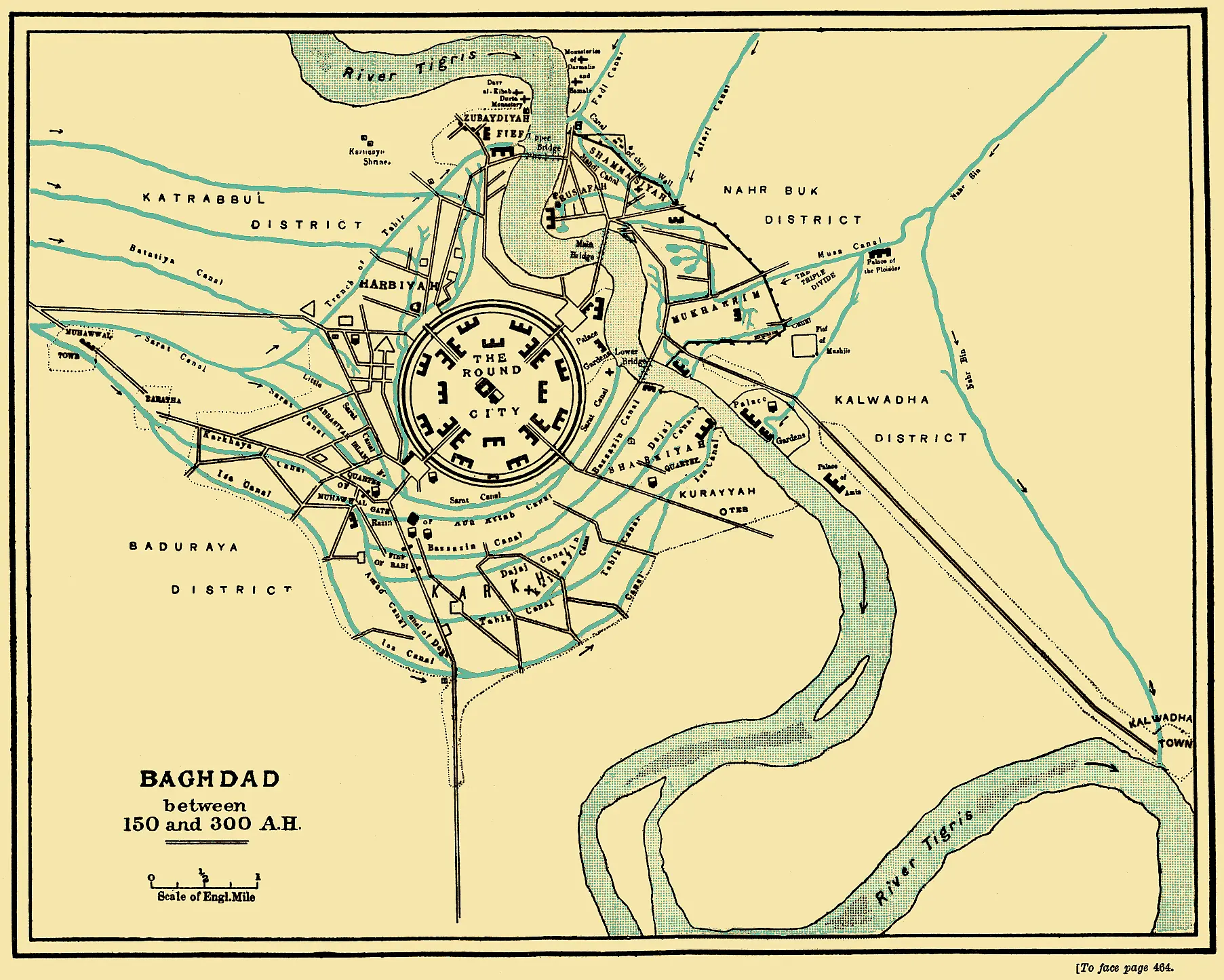
Kennedy writes that al-Saffah and al-Mansur lived at a variety of sites in central Iraq until in 145/762 the caliph decided to build a new capital at Baghdad.1 A. A. Duri, the author of the Encyclopaedia of Islam entry on Baghdad, writes that al-Mansur had moved to al-Hashimiyya near Kufa but soon judged Kufa, where pro-Alid feeling was strong, to be a bad influence on his army and al-Hashimiyya to be vulnerable, as the rising of the Rawandiyya had shown; he adds that the Abbasids "turned to the east and looked for a new capital to symbolise their dawla".49 Al-Tabari gives the same reasons: the disturbance made by the Rawandiyya, the nearness of Kufa, and al-Mansur's lack of confidence in the loyalty of its people.50 Kennedy adds that the city was developed as a centre for the Khurasani soldiers, who could not be settled in existing cities such as Kufa without arousing the hostility of the local population.1
Duri writes that after careful exploration al-Mansur chose the site for military, economic and climatic reasons: a fertile plain with good cultivation on both banks of the river, on the Khurasan road and at a meeting place of caravan routes, with a network of canals that served the fields and could serve as ramparts, and a temperate climate with relative freedom from mosquitoes; none of the older settlements on the west bank, among them the village of Baghdad and Karkh, had political or commercial importance, so that the city may be regarded as a new foundation.49 In al-Tabari, al-Mansur declares of the site: "Goods can come here via the Tigris, the Euphrates, and various canals." He marked the boundaries, set the first brick in place with his own hand, saying the name of God and praising Him, and ended with the words "Build, then, with God's blessing."51
The sources give different dates. Al-Tabari records, on the authority of al-Mansur's retainer Hammad the Turk, that scouts made their search in 144 and chose a village called Baghdad on the Sarat canal, next to the place where al-Khuld was later built; a second report, transmitted by Ibrahim ibn Isa from Hammad the Turk, has al-Mansur send men to search in 145, and Sulayman ibn Mujalid says that the first stage of the work was begun in 145.5253 Duri writes that al-Ya'qubi, in his Kitab al-buldan, dates the drawing of the plan to 141 (758–759) and that work began on 1 Jumada 145/2 August 762, on a report of al-Khwarizmi.49 Al-Suyuti and Najeebabadi date the beginning of the building to 140, Najeebabadi adding that the work continued for nine or ten years, and Duri, al-Suyuti and Najeebabadi all give 149 for the completion of the Round City.5474955
Building the Round City
Duri records that al-Mansur called his city Madinat al-Salam, "city of peace", in reference to paradise, and that this was its official name on documents, coins and weights; four architects worked on the plan, and al-Mansur assembled 100,000 workmen and craftsmen.49 Al-Tabari records that he sent for craftsmen and labourers from Syria, al-Mawsil, al-Jabal, Kufa, Wasit and Basra; among those brought were al-Hajjaj ibn Artah, whom the translator describes as a traditionist and jurist of Kufa, and Abu Hanifa.52
The plan was circular. Al-Tabari, in the volume that covers the later years of the reign, says that the city was built round so that a ruler settled at its centre was no nearer to one part than another, and that al-Mansur built two walls, the inner one higher than the outer.11 Duri describes the defences from the outside inwards: a ditch 40 dhira' wide, a brick quay, a first wall of 18 dhira' (9 m) at the base, an empty space left for defence, and the main wall of sun-baked brick, 34.14 m high and 50.2 m wide at the base, with towers between the gates and a dome over each gate; a simple third wall enclosed the inner space, which held the caliph's palace (Bab al-Dhahab), the great mosque, the diwans, the houses of the caliph's sons and two sakifas (guard-houses) for the chiefs of the guard and of the police.49 A report in al-Tabari given on the authority of "some sources" has him order the wall to be fifty cubits thick at its base and twenty at its top.53
Two roads from four equidistant gates divided the city into four equal quarters: the Khurasan gate (also called Bab al-Dawla) lay to the north-east, the Basra gate to the south-west, the Syria gate to the north-west and the Kufa gate to the south-east.49 At the centre, Duri writes, the Green Dome rose 48.36 m above the palace with a mounted horseman on top, and fell on a stormy night in 329/941; the palace remained the official residence for about half a century. The Jami' al-Mansur was built after the palace and so lies slightly off the direction of prayer.49
Al-Tabari gives Abu Hanifa a part in the work. Sulayman ibn Mujalid relates that al-Mansur wanted him to head the judiciary and that he refused; each swore an oath, and the caliph put him in charge of the construction, making the mud bricks, calculating the quantity and overseeing the workmen, until the wall beside the moat was completed in 149. Al-Haytham ibn Adi relates that he later fell ill and died in Baghdad.53 These accounts differ from the one in the Encyclopaedia of Islam given above.
Al-Tabari records that the work was interrupted in 145: when the wall had risen one fathom, the caliph received word of Muhammad's rising and left for Kufa, and he returned to Baghdad when the war was over.5356
On the cost, Duri gives three reports: 18 million, understood as dinars; a hundred million dirhams; and the official report based on the caliphal archives, which Duri gives as "four million, eight hundred and eighty three dirhams"; al-Tabari's report reads "four million eight hundred and thirty three dirhams", while the translator's note gives Hitti's calculation as 4,883,000 dirhams.4952 The reports on the size of the city also differ; the sources of each figure are given in the Historiographical Note.
Karkh and the markets
Duri writes that markets formed part of the first plan: shops stood in arched rooms along each of the four roads between the great wall and the inner wall, and each of the four districts outside the wall was to have room for a great market.49 Al-Tabari records that a Byzantine patrician who came as ambassador was asked by al-Mansur what he thought of the city, and said: "I saw a beautiful building, but I saw your enemies with you in the city." He meant the market people. When he had left, al-Mansur ordered the markets out of the city, put Ibrahim ibn Hubaysh al-Kufi and his freedman Jawwas ibn al-Musayyab in charge of building booths and houses for every trade at al-Karkh, and moved the market there, imposing rents according to size.57
The sources date the move differently and give different reasons. Duri places it in 157/773, when, he writes, al-Mansur wished to keep the populace away from the city, to keep the gates of the quarters from being left open at night for the markets, and to guard against spies.49 Al-Tabari gives 157 (21 November 773 to 10 November 774) in a report from al-Fadl ibn Sulayman al-Hashimi, who links the move with a commotion in the markets at a time when al-Mansur was pursuing those who had risen with Muhammad and Ibrahim.57 Kennedy dates the building of the commercial district of al-Karkh to the south from 151/768 onwards, and writes that with it and the settlement on the east bank the capital was by the end of the reign already a thriving metropolis.1
Al-Khuld and al-Mahdi's camp
Duri writes that in 157/773 al-Mansur built a palace on the Tigris below the Khurasan gate, with spacious gardens, and called it al-Khuld, a name that recalled paradise.49 Ibn Kathir, in his entries for the year 158, records that the building of al-Mansur's palace called al-Khuld was completed in that year and that al-Mansur lived in it for a few days before he died.58
Duri writes that strategic considerations, al-Mansur's policy of dividing the army and the lack of space led him to build a camp for his heir al-Mahdi on the east bank of the Tigris; its central part, later called Rusafa after a palace built there by Harun al-Rashid, held al-Mahdi's palace and mosque, with a wall and a ditch around the camp, and work began in 151/768 and ended in 157/773.49 Najeebabadi also gives 151 for the order to build Rusafa (which he writes Rosafah), which he places to the north of Baghdad.7
Other foundations and works
The TDV states that, besides Baghdad, al-Mansur had al-Hashimiyya and al-Rafiqa built, and Ibn Kathir writes in his notice of him that he built Madinat al-Salam (Baghdad), al-Rafiqa and the palace of al-Khuld.259 On al-Hashimiyya the sources differ. Al-Tabari's explanation of why al-Mansur built Baghdad begins with his building of al-Hashimiyya opposite Madinat Ibn Hubayra, while Najeebabadi writes that al-Saffah made al-Anbar his capital and had a palace and offices built next to it, in a new colony named Hashmia, where al-Mansur was living when the disturbances in Khurasan began.507 Kennedy writes that garrison cities were established for the Khurasani soldiers in Iraq, at Baghdad and al-Raqqa, and that al-Raqqa was developed from 155/772 as a Khurasani base from which to supervise Syria and the Byzantine frontier.1
Al-Tabari records that al-Mansur ordered the White Palace at Ctesiphon demolished but, when the cost of demolishing it and carrying away the materials was found to exceed the cost of building a new one, ordered that it should not be demolished.11 Duri gives two other reports: that al-Mansur wanted to pull down part of the palace to use its bricks and stopped because the expense was not justified, and that he wished to repair it but did not have the time.49
The succession of 147/764
Isa ibn Musa gives precedence to al-Mahdi
The account of the capital has run past the date of the next event, the change of succession in 147/764. The arrangement of 136/754 had made Isa ibn Musa the next heir after al-Mansur.1 Kennedy writes in the Encyclopaedia of Islam that in 147/764 al-Mansur forced Isa to resign his place as heir apparent and designated his own son Muhammad al-Mahdi, who had the support of most of the Khurasaniyya, the Khurasani soldiers of the revolution; they obliged Isa to content himself with being heir to al-Mahdi.1 Al-Suyuti also dates the removal to 147 and says that Isa was deposed under compulsion (mukrahan), although he had been the commander who fought the brothers Muhammad and Ibrahim for al-Mansur.55 Najeebabadi writes that after the defeat of Muhammad and Ibrahim al-Mansur wished to make his own son his successor, that Isa refused when it was put to him, that al-Mansur then brought Khalid ibn Barmak and other non-Arab chiefs into the consultations and dismissed Isa from the governorship of Kufa in favour of Muhammad ibn Sulayman, that Khalid made it known that Isa had abdicated in his presence, and that al-Mansur gave gifts and rewards to the people and made Isa heir after al-Mahdi.7
Al-Tabari opens his account of the year 147 by saying that opinions differ about what brought al-Mansur to depose Isa, and he gives several versions, each on a different authority. This article gives them in the order in which he tells them.9
The first version begins with the settlement made by al-Saffah, who had designated Abu Ja'far and then Isa ibn Musa. Al-Mansur had confirmed Isa as governor of Kufa and its Sawad, the cultivated land around it. When he asked Isa to give his son precedence, Isa answered that the oaths, agreements and guarantees that bound him and the Muslims in his favour left no way to do it. Al-Mansur then changed the order in which the members of the family were admitted to his audience, so that al-Mahdi entered first and Isa after others, and al-Tabari adds that Isa did not complain of this. Isa's son Musa then went to al-Abbas ibn Muhammad, the caliph's brother, and al-Mansur told Isa that he knew Isa wanted the position for his son. When Isa still did not give way, al-Mansur ordered his freedman al-Rabi' to strangle Musa with his sword belt, and Isa, seeing al-Rabi' begin to tighten it, gave his hand for the oath to al-Mahdi. Al-Mansur then asked that the succession pass to Isa after al-Mahdi, and Isa answered that he could not enter into it after going out from it; the caliph and the members of the family present went on pressing him until he said that the caliph knew best.9
A second version is given by "those who relate this matter from other sources." Al-Mansur wanted the oath for al-Mahdi and spoke to the army, whose men made remarks to Isa that he disliked when they saw him ride. Al-Mansur wrote to Isa, and Isa replied, refusing and citing the pact that gave him the succession; al-Tabari gives both letters.60 Al-Mansur was angry, and the army renewed its pressure: al-Tabari names Asad ibn al-Marzban, Uqba ibn Salm and Nasr ibn Harb with a group, who came to Isa's door and kept visitors from him. Isa complained to al-Mansur, who answered that he feared what they might do to Isa and to himself and that they would refrain if Isa put al-Mahdi between them, and Isa agreed.61 Al-Tabari adds a report from al-Rabi', through Ishaq al-Mawsili, that al-Mansur wrote on Isa's reply that if Isa accepted the loss he might be compensated in this world and be secure from responsibility in the next.61
A third version, which al-Tabari gives on the authority of al-Aswari, who had it from al-Hasan ibn Isa the secretary, has al-Mansur ask Khalid ibn Barmak for a stratagem after Isa refused. Khalid took thirty senior men of the Abbasid party to Isa, who again refused, and Khalid then told them that they would report to the caliph that Isa had agreed and testify against him if he denied it. When Isa came to al-Mansur and denied that he had agreed, the men said that they bore witness that he had agreed. Al-Mansur issued the document for the oath to al-Mahdi.61
A fourth version comes from al-Walid ibn Muhammad al-Anbari. Salm ibn Qutayba told Isa that if he gave al-Mahdi precedence, al-Mahdi would assign the succession to him afterwards; Isa agreed, and the people swore to al-Mahdi and to Isa after him. Al-Mansur preached the sermon announcing al-Mahdi's precedence, Isa preached after him and gave precedence to al-Mahdi, and al-Mansur fulfilled what he had promised.62
A fifth account comes from "some of the companions of Abu Ja'far," in which one of the commanders describes the day on which Isa resigned, in the maqsura (the enclosure reserved for the ruler) of the mosque in the City of Peace. Abu Ubaydallah, al-Mahdi's secretary, asked Isa to say what he had been given for it, and Isa answered that he had sold his precedence to al-Mahdi for ten million dirhams, with three hundred thousand to be divided among his children and seven hundred thousand for one of his wives. The document was written and the witnesses witnessed it, and Isa put his handwriting and seal on it.63 Al-Tabari adds that Isa's governorship of Kufa lasted thirteen years until al-Mansur removed him and appointed Muhammad ibn Sulayman ibn Ali, and the translator of the volume, Hugh Kennedy, notes that al-Tabari elsewhere dates Isa's appointment to 131/750, which would give fifteen years.63
The end of Abd Allah ibn Ali
Al-Tabari tells the end of al-Mansur's uncle Abd Allah ibn Ali under the same year, on the authority of Ali ibn Muhammad al-Nawfali, who had it from his father: al-Mansur handed Abd Allah to Isa ibn Musa secretly at night with orders to behead him, and Isa, on the advice of his secretary Yunus ibn Farwa, hid him instead.64 Al-Tabari gives a second report, on the authority of Ibrahim ibn Isa ibn al-Mansur ibn Burayh, that Abd Allah died in prison in 147 at the age of fifty-two, and the TDV also places his death in the house in which he was imprisoned in 147/764.642
Government
Family and governors
Kennedy writes that al-Mansur's policy was to establish a centralised, largely secular state resting on a reliable, salaried army and an efficient system of collecting revenue, and that he took the Umayyad caliphs Abd al-Malik and Hisham as his models.1 The same entry names the groups on which he relied. The Khurasaniyya, who had formed the army that overthrew the Umayyads, became a privileged military group: governors of Khurasan were always chosen from among them, and garrison cities were established for them in Iraq at Baghdad and al-Raqqa. Members of his own family were given key governorates in Iraq and the western half of the caliphate, and two of them, Sulayman ibn Ali at Basra and Salih ibn Ali in Syria, came near to founding semi-autonomous sub-dynasties. He also recruited leaders of the Yamani faction of the Umayyad state, among them the Muhallabi family, who held governorates in Egypt, Ifriqiya and Adharbayjan as well as in their native Basra. Kennedy concludes that because the caliph was never dependent on any one of these groups he kept considerable political autonomy within the system.1
Administration and finance
Nahide Bozkurt writes in the TDV that al-Mansur followed the policy of the state in person in order to keep control at the centre, instructed tax officials to deal justly, gave particular importance to the barid, the postal and intelligence service, and was never under the influence of his viziers.2 Al-Tabari gives a report in which a narrator says he heard al-Mansur name four men he needed at his door as the pillars of the state: a judge who is not turned aside from what pleases God, a chief of police who defends the weak against the strong, a chief of taxation who does not oppress the peasants, and a head of the post who writes reliable information about the other three.65 On the authority of Ibrahim ibn Musa ibn Isa ibn Musa, al-Tabari records that the postmasters of the outlying districts wrote to al-Mansur every day on the price of wheat, corn and other foods, the qadi's decisions, the governor's acts, the money returned to the treasury and the news, and that when a price had changed he wrote to the governor and the tax collector for the reason until prices returned to normal.66
The sources give different accounts of what the treasury held at his death. The TDV states 600 million dirhams and 4 million dinars.2 Al-Khatib al-Baghdadi, the eleventh-century author of Tarikh Baghdad, records a statement from al-Rabi' that al-Mansur left 100 million dirhams and 60 million dirhams in the treasury, and that al-Mahdi divided and spent it.67 Ibn Kathir and al-Tabari give no balance; what each says of it is told with the testament below.6869
Law, scholars and learning
The Encyclopaedia of Islam entry on the Malikiyya, by N. Cottart, a modern scholar, says that al-Mansur approached Malik ibn Anas with a proposal to establish a judicial system that would unify the methods then in force in the different Islamic countries; it adds that the plan accorded with Abbasid policy and that Malik was chosen because he represented Medina.70 Najeebabadi writes that al-Mansur persuaded Malik to compile the Muwatta' and gives the words he spoke to him, followed by Malik's remark that al-Mansur had not said those things but had taught him how to write.7
Al-Suyuti quotes the fourteenth-century biographer al-Dhahabi for the statement that in 143 the scholars of Islam began to record hadith, jurisprudence and exegesis, among them Ibn Jurayj at Mecca, Malik with the Muwatta' at Medina and Sufyan al-Thawri at Kufa.54 The TDV adds that in al-Mansur's reign works were translated from Sanskrit, Syriac, Coptic and classical Greek, and that Ibn Ishaq wrote his work at al-Mansur's request.2 Najeebabadi writes that translations of Syriac and other non-Arabic books, among them Kalila wa-Dimna, began under al-Mansur.7
The TDV describes al-Mansur himself as a scholar and poet who patronised literary men and scholars and took a close interest in logic, philosophy, arithmetic, geometry, astronomy, medicine and history.2
Campaigns and frontiers
The northern and Byzantine frontiers
Kennedy states that on the Byzantine frontier the reign saw settlement and fortification rather than major campaigns, and that in 147/764 the Khazars came through the Caucasus and took Tiflis for a short time before being driven out.1 Al-Tabari tells the same events under 147 as an attack by Turks in the region of Armenia, under a leader he names Istarkhan al-Khwarazmi, who took many prisoners and entered Tiflis; al-Mansur sent Jibra'il ibn Yahya against them, and in 148/765–6 he sent Humayd ibn Qahtaba, who found that they had gone. The translator's note identifies the invaders as Khazars.7172 The TDV adds that when the Armenian Byzantine commander Kusan plundered Erzurum, al-Mansur sent an army that recovered the city in 139/756, and that he had fortified castles built against the Khazars.2 Al-Tabari records that in 155/771–2 the Byzantine emperor sought peace from al-Mansur on condition of paying the poll tax.73
Khurasan and the coast
The TDV states that in Khurasan the revolt of Ustadhsis, who claimed prophethood, was put down between 145 and 151/762–768; Kennedy gives c. 147/764 to 151/768 and says that it did not seriously threaten Abbasid power.21 Al-Tabari dates the rising to 150/767–8 and adds that Muhammad ibn Umar put the defeat in 151; in his account Khazim ibn Khuzayma besieged Ustadhsis until they accepted the judgement of Abu Awn, who decided that Ustadhsis, his sons and his household be bound in irons and the rest, 30,000 in number, be released.74 Najeebabadi gives the date as 150, says that 70,000 of Ustadhsis' men were killed, and says that he surrendered with the 14,000 who remained.7
Al-Tabari records that in 153/770, returning from the pilgrimage, al-Mansur reached Basra and prepared an army and a naval expedition against the Kurk, who had sacked Jedda.75
Ifriqiya
Kennedy writes that Ifriqiya was threatened by continuous Kharijite risings until Yazid ibn Hatim al-Muhallabi established Abbasid rule there in 155/772, and the TDV gives the same year and name.12
Al-Andalus
Kennedy and the TDV agree that Abd al-Rahman ibn Mu'awiya, of the Umayyad family, established an independent amirate in al-Andalus in 138 AH, which Kennedy gives as 756 and the TDV as 755–6.12 The TDV writes that al-Mansur tried hard to remove him and failed, and that he then turned to agreement and sent envoys to win him over.2 Kennedy writes in his Muslim Spain and Portugal that al-Mansur made one serious attempt to regain control in 763, sending no troops but a standard and a diploma of investiture as amir of al-Andalus to al-Ala ibn al-Mughith al-Yahsubi of Beja, who gathered many supporters; Abd al-Rahman fought him at Carmona and al-Ala was killed, which Kennedy calls the end of direct Abbasid interference in al-Andalus.76 Najeebabadi dates the declaration of independence to 146 and says that al-Mansur wrote to al-Ala ibn Mughith, the commander in Africa, who landed at Beja with the black flag.77 Al-Suyuti writes that al-Andalus alone remained outside al-Mansur's authority in 148, that Abd al-Rahman took the title amir and not amir al-mu'minin, and that his sons did the same.55
The last pilgrimage and death, 158/775
The journey and the testament
The sources count al-Mansur's pilgrimages differently. The TDV gives 140/758, 147/765, 148/766 and 152/769, and then 158/775; Ibn Kathir gives 140, 144, 147, 152 and the year of his death; al-Dhahabi writes in Siyar a'lam al-nubala' that he made the pilgrimage several times, two of them in his caliphate, and that he died on the third.25978 Under 158 al-Tabari records that al-Mansur was thrown from his grey horse at Jarjaraya, while inspecting an estate of Isa ibn Ali, and fractured his skull.79
Al-Tabari says that al-Mansur set out from the City of Peace for Mecca in Shawwal 158 (4 August to 1 September 775), and that he stayed some days at Qasr Abdawayh, where, in the account of al-Haytham ibn Adi, he made a testament for al-Mahdi.68 In that account he gave al-Mahdi a locked container of notebooks holding the knowledge of his forebears and told him to keep the city of Baghdad, in which he had gathered wealth that would meet the army's pay and other expenses for ten years if the kharaj (land tax) were interrupted; he urged him to honour the members of the family, to care for the freedmen, to treat the Khurasanis generously and to complete the eastern city of Baghdad.68 Al-Tabari gives other accounts in which al-Mansur told al-Mahdi of a sealed book with his instructions and asked him to take over a debt of 300,000 dirhams that he did not consider it lawful to pay from the Muslims' treasury; Ibn Kathir gives the debt as 300,000 dinars, and Najeebabadi gives a testament that tells al-Mahdi to keep the box of his diaries, to guard Baghdad and not to move the capital.68697
Illness and death
Al-Tabari records that al-Mansur went by Kufa and the Rusafa of Kufa and began the pilgrimage and the lesser pilgrimage, and that after some stages the illness of which he died appeared.80 He gives two accounts of its nature. In the first, from Ali ibn Muhammad al-Nawfali, who had it from his father, al-Mansur could not digest his food, and a digestive powder prepared by an Indian physician digested it but eroded the lining of his stomach little by little, and he died, in the narrator's words, because of his stomach. In the second, from an unnamed source, it began as a heatstroke from riding in the midday sun, followed by an excess of red bile and dysentery.81 Ibn Kathir gives heat, riding at midday and a violent diarrhoea.82 Najeebabadi says that he entered ihram near Kufa and fell ill after travelling two or three stages.7
The sources differ over where he died. In al-Tabari's first account he stopped at Bi'r Ibn al-Murtafi' and then at Bi'r Maymun, asked whether he had entered the Haram, left what he wished to al-Rabi', and died at dawn or sunrise on 6 Dhu al-Hijja 158 (7 October 775), with only his servants and his freedman al-Rabi' present.81 Al-Rabi', in al-Tabari's second account, says that al-Mansur asked to be hurried to the Haram, that at Bi'r Maymun he told him they had entered it, and that al-Mansur thanked God and died that day.83 In a report in al-Tabari from Muhammad ibn Imran, a freedman of the governor of Mecca, al-Mansur entered Mecca and stayed there only a short time before he died.84 Al-Dhahabi says that he died at Bi'r Maymun before entering Mecca, the TDV gives Bi'r Maymun, Kennedy writes that he died on the road to Mecca, Najeebabadi gives al-Batn (Batan), three miles from Mecca, and al-Suyuti also gives al-Batn.7821755 Ibn Kathir writes that he entered Mecca and died there on the night of Saturday, the sixth of Dhu al-Hijja.8285
The last words are also given in two ways. Ibn Kathir has him ask God to bless his meeting with Him.85 Al-Dhahabi, citing al-Mada'ini, has him say that he had committed grave wrongs in boldness towards God and had obeyed Him in the matter dearest to Him, the testimony that there is no god but God, as a favour from God and not a favour to Him.86
Al-Tabari says that al-Rabi' kept the death hidden and kept the women from weeping, and that the members of the family were admitted in the morning and swore to al-Mahdi and then to Isa ibn Musa, by the hand of al-Mahdi's son Musa. Only Ali ibn Isa ibn Mahan, one of the commanders, held back from swearing to Isa.87 Another account in al-Tabari has al-Rabi' say that he dressed the body, set it upright behind a thin veil and told the people that the caliph was recovering and wished the oath to al-Mahdi renewed.83 A third has Isa ibn Musa refuse a renewed oath on the night of the death until Ali ibn Isa threatened him, and Najeebabadi gives the same incident.887 Al-Abbas ibn Muhammad and Muhammad ibn Sulayman then took the oath of the people at Mecca.87 Al-Tabari gives the dates of the oath to al-Mahdi as 6 Dhu al-Hijja, from Hisham ibn Muhammad and Muhammad ibn Umar, and as Thursday 18 Dhu al-Hijja (19 October), at Baghdad, from al-Waqidi.89 The news reached al-Mahdi at Baghdad on 15 Dhu al-Hijja, according to al-Tabari, Ibn Kathir and Najeebabadi, and the staff and mantle of the Prophet and the seal of the caliphate were sent to him.8883907
Burial
Al-Tabari writes that al-Mansur was washed and shrouded, with his head uncovered because he was in ihram. On who prayed over him, al-Tabari gives al-Waqidi's report that Isa ibn Musa prayed over him at Shi'b al-Khuz, and a report from Ali ibn Muhammad al-Nawfali, who had it from his father, that Ibrahim ibn Yahya ibn Muhammad ibn Ali prayed over him in the tents, because al-Rabi' said that no one who aspired to the caliphate should do it.87 Ibn Kathir names Ibrahim ibn Yahya, who led the pilgrimage that year, and says that another report names Isa ibn Musa but that the first is correct, since Ibrahim was the deputy governor of Mecca and al-Ta'if; Najeebabadi names Isa ibn Musa.917
For the grave, al-Tabari gives Thaniyyat al-Madaniyyin, also called Thaniyyat al-Ma'lat because it lies above Mecca.87 Al-Dhahabi, citing al-Suli, places the burial between al-Hajun and Bi'r Maymun; Ibn Kathir gives Kada' at Thaniyyat al-Mu'alla above Mecca, and elsewhere Bab al-Mu'alla; Najeebabadi gives the Mu'alla cemetery between al-Hajun and the well of Maymun.8682927 Al-Tabari, in al-Rabi's account, says that a hundred graves were dug and filled in so that the position of the tomb would not be known and that he was buried in a different one; Ibn Kathir also says that al-Rabi' dug a hundred graves and that the grave is not known, and the TDV says that a hundred graves were dug and that he was buried near Bi'r Maymun or in the Jannat al-Mu'alla.83922
The age at death is also differently given. Al-Tabari reports that some said sixty-four, some sixty-five and some sixty-three, and that Hisham ibn al-Kalbi said sixty-eight; Ibn Kathir gives sixty-three as the well-known age, with sixty-four, sixty-five and sixty-eight as other reports; Kennedy writes that he was in his mid-sixties.8782851 For the length of the reign al-Tabari gives twenty-two years less twenty-four days (Hisham ibn al-Kalbi), less three days or less seven nights (reports from Abu Ma'shar), less six days (al-Waqidi) and two days short of twenty-two years (Umar ibn Shabba); Ibn Kathir gives twenty-two years less a few days, Najeebabadi twenty-two years less one week, and Kennedy twenty-one years.87371 His son Muhammad al-Mahdi succeeded him.2
Conduct and sayings
Al-Tabari records, on the authority of members of the Banu Hashim, that al-Mansur worked from daybreak on appointments and dismissals, the frontiers, the roads, the taxes and expenditure, and the livelihood of the subjects; that after the afternoon prayer he sat with the members of his household; that after the last evening prayer he read the letters that had come from the frontiers and the districts and consulted his night companions; and that when the second third of the night had passed he rose, made his ablutions and prayed before his mihrab until dawn.93
Al-Tabari gives sayings attributed to him in several places. In a sermon at the City of Peace in 151/769, according to a courtier who heard it, he said that people should not wrong one another and that if he knew where there was "a man more worthy of this authority than I", he would bring him and hand it over to him.94 In a passage on wealth he says that were it not that wealth is "the fortress of authority and the pillar of the Faith and of this world and the glory and ornament of them", he would not keep a dinar or dirham overnight, because of the pleasure he finds in spending it and the reward he knows lies in giving it away.95
Al-Tabari and Ibn Kathir both tell that when a Kharijite who had defeated his armies was brought to him to be killed, he spared him and let him go.9697 Al-Suyuti gives an account of his judge at Basra, Sawwar ibn Abd Allah, who refused to hand over land to a commander against the evidence for a merchant, and says that al-Mansur said that Sawwar had filled it with justice.98
Wives and children
Al-Tabari gives, on the authority of Ali ibn Muhammad, that al-Mansur promised Umm Musa al-Himyariyya that he would marry no one else and take no concubine, that she had the promise written down, confirmed and witnessed, and that he kept to her alone for ten years of his rule. The annotator writes that Umm Musa was Arwa, daughter of Mansur, whom he married before he became caliph, and that the date of her death is not known.99
Al-Tabari and Ibn Kathir list the children in the same way.10090 Al-Mahdi, whose name was Muhammad, and Ja'far the Elder were the sons of Arwa, also called Umm Musa, a sister of Yazid ibn Mansur al-Himyari; Ja'far the Elder died before his father. Sulayman, Isa and Ya'qub were the sons of Fatima, daughter of Muhammad, one of the descendants of Talha ibn Ubayd Allah. Ja'far the Younger was the son of a Kurdish slave woman, and Salih al-Miskin the son of a Greek slave girl called Qali al-Farrasha. Al-Qasim, whose mother was a slave girl, died before his father at the age of ten, according to al-Tabari. Aliyah, whose mother was an Umayyad woman, married Ishaq ibn Sulayman ibn Ali ibn Abd Allah ibn al-Abbas.10090 Najeebabadi gives seven sons and one daughter, naming Muhammad al-Mahdi, Ja'far the Elder, Ja'far the Younger, Sulayman, Isa, Ya'qub and Salim, and the daughter Aliyah as the wife of Ishaq ibn Sulayman ibn Ali.7
How later writers remember him
The TDV calls al-Mansur the man considered the real founder of the Abbasids, and says that he was a scholar and poet of many interests.2 Kennedy writes in the Encyclopaedia of Islam that his most lasting achievement was the foundation of Baghdad, and that his twenty-one years saw the Abbasid caliphate established as a centralised state under the caliph's control. He adds that "without his firm hand, the Muslim world might well have become prematurely fragmented in the mid-2nd/8th century".1
Historiographical Note
The sources disagree on several points, and each version is given, with its source, where the point is told. The birth year, the end of the siege of Wasit, the date of the accession and the date and beliefs of the Rawandiyya are told in full in their own sections and are not repeated here. The points that need explaining are collected below.
Abd Allah ibn Ali and Isa ibn Musa. The sources give different ends for Abd Allah ibn Ali, told under the succession of 147/764. Al-Tabari gives five accounts of how Isa came to give al-Mahdi precedence, which differ in the order of events and in whether he was pressed, had witnesses testify against him, was promised the succession after al-Mahdi, or was paid; Kennedy, in the Encyclopaedia of Islam, and the TDV and al-Suyuti place the change of succession in 147, while Najeebabadi places al-Mahdi's appointment as heir in 144.961626312557
Baghdad: dates, measurements and costs. The dates of the founding and the accounts of the walls are told under the choice of the site and the Round City. Duri adds that the Round City was complete by 149/766.49 On the size, the entry cites a report of 800 dhira' from the Khurasan gate to the Kufa gate and 600 from the Syrian gate to the Basra gate (al-Khatib, Ibn al-Faqih), a report from Waki' of 1,200 dhira' between each pair of gates, and a report from one of the builders of one mile between each pair; a measurement made under al-Mu'tadid gives a diameter of 2,352 metres, and al-Ya'qubi gives 5,000 black dhira' (2,534.5 metres) between the gates outside the ditch. The entry says that the first two reports underestimate the size of the city.49 On the cost, it names the sources of the three reports given under the Round City: al-Khatib, Ibn al-Jawzi and Yaqut for 18 million, understood as dinars, and Abu al-Mahasin for 100 million dirhams; the official report from the caliphal archives it explains by low labour and provision costs and by al-Mansur's strict supervision of his accounts.49
Death, burial and age. The sources differ over where al-Mansur died (Bi'r Maymun, al-Batn or Mecca), where he was buried, who prayed over him, what his last words were, the illness, his age, and the length of the reign; each version is given, with its source, under the last pilgrimage. The same holds for the treasury he left, for which the TDV, al-Khatib al-Baghdadi, Ibn Kathir and al-Tabari give different figures or none.2676968
See also
- The Abbasid Caliphate — the dynasty whose second caliph he was
- Baghdad — the city he founded as the Abbasid capital
- Isa ibn Musa — his nephew, the heir after him until the succession of 147/764
- Muhammad al-Nafs al-Zakiyya — the Hasanid who rose at Medina in 145/762
- Harun al-Rashid — the later caliph who built the palace at al-Rusafa, on the site of al-Mahdi's camp
- Umayyad and Abbasid Caliphates compared — the two dynasties side by side
- Al-Mansur ibn Abi Amir — the chamberlain who ruled al-Andalus, a different man who bore the same epithet
References
Citations
Footnotes
-
H. Kennedy, 'al-Mansur', The Encyclopaedia of Islam, new edition, vol. 6 — the entry on the second Abbasid caliph: his birth and mother, the revolt of Abd Allah ibn Mu'awiya, Wasit, al-Jazira and Armenia, the designation as heir, the accession, Abd Allah ibn Ali, Abu Muslim, the Rawandiyya, Abd al-Jabbar and the viceroyalty of al-Rayy, the risings of 145, Baghdad and the garrison cities, the succession of 147, the army and the governors, Ustadhsis, Ifriqiya and al-Andalus, his death and age, and the assessment of the reign. ↩ ↩2 ↩3 ↩4 ↩5 ↩6 ↩7 ↩8 ↩9 ↩10 ↩11 ↩12 ↩13 ↩14 ↩15 ↩16 ↩17 ↩18 ↩19 ↩20 ↩21 ↩22 ↩23 ↩24 ↩25 ↩26 ↩27 ↩28 ↩29 ↩30 ↩31 ↩32 ↩33 ↩34 ↩35 ↩36 ↩37 ↩38 ↩39 ↩40 ↩41 ↩42 ↩43 ↩44 ↩45 ↩46 ↩47 ↩48 ↩49 ↩50 ↩51 ↩52 ↩53 ↩54 ↩55
-
Nahide Bozkurt, 'Mansûr', TDV İslâm Ansiklopedisi, vol. 28 (Ankara, 2003), pp. 5–6 — https://islamansiklopedisi.org.tr/mansur--halife, register entry 2, islamansiklopedisi.org.tr. ↩ ↩2 ↩3 ↩4 ↩5 ↩6 ↩7 ↩8 ↩9 ↩10 ↩11 ↩12 ↩13 ↩14 ↩15 ↩16 ↩17 ↩18 ↩19 ↩20 ↩21 ↩22 ↩23 ↩24 ↩25 ↩26 ↩27 ↩28 ↩29 ↩30 ↩31 ↩32 ↩33 ↩34 ↩35 ↩36 ↩37 ↩38 ↩39 ↩40 ↩41 ↩42 ↩43 ↩44 ↩45 ↩46 ↩47 ↩48 ↩49 ↩50 ↩51
-
Ibn Kathir, al-Bidaya wa-l-nihaya, ed. Abd Allah ibn Abd al-Muhsin al-Turki (Dar Hajar), xiii, 459 — the notice on Abu Ja'far al-Mansur: his lineage, his mother, his birth and the oath of allegiance in Dhu al-Hijja 136; https://shamela.ws/book/4445/8127, register entry 4, shamela.ws. ↩ ↩2 ↩3 ↩4 ↩5 ↩6 ↩7 ↩8 ↩9
-
Al-Tabari, The History of al-Tabari, vol. 27, pp. 211–212 (Leiden iii 87–88) — the pilgrimage of 136, the designation of Abu Ja'far and Isa ibn Musa, and the death of al-Saffah; https://archive.org/details/tabarivolume27, register entry 12, archive.org. ↩ ↩2 ↩3 ↩4 ↩5
-
F. Buhl, 'Muhammad b. 'Abd Allah b. al-Hasan b. al-Hasan al-Muthanna b. al-Hasan b. 'Ali b. Abi Talib, called al-Nafs al-Zakiyya', The Encyclopaedia of Islam, new edition, vol. 7 — the homage paid to Muhammad, Abu Ja'far among those recorded as paying it, and Muhammad's letters. ↩ ↩2 ↩3
-
Al-Tabari, The History of al-Tabari, vol. 28, 'Abbasid Authority Affirmed: The Early Years of al-Mansur, translated by Jane Dammen McAuliffe (Albany: State University of New York Press, 1995), pp. 85–86 (Leiden iii 143–144) — the year 144: al-Mansur's concern for Muhammad and Ibrahim, the appointment of Ziyad ibn Ubayd Allah, the report that Muhammad used to say Abu Ja'far swore to him at Mecca, and the translator's notes on Abd Allah ibn al-Hasan and Ibrahim; https://archive.org/details/tabarivolume28, register entry 12, archive.org. ↩ ↩2 ↩3 ↩4 ↩5
-
Akbar Shah Najeebabadi, The History of Islam, vol. 2 (Riyadh: Darussalam) — the notice on Abu Ja'far al-Mansur and the accounts of the testament of al-Saffah, the meeting at Mecca of 130, the accession, Abu Muslim, Sunbadh, the Rawandiyya, Abd Allah ibn Ali, the Hasanids, Baghdad, the succession of 147, Ustadhsis, the Muwatta', the testament, the death and burial, and the children. ↩ ↩2 ↩3 ↩4 ↩5 ↩6 ↩7 ↩8 ↩9 ↩10 ↩11 ↩12 ↩13 ↩14 ↩15 ↩16 ↩17 ↩18 ↩19 ↩20 ↩21 ↩22 ↩23 ↩24 ↩25 ↩26 ↩27 ↩28 ↩29
-
Al-Tabari, The History of al-Tabari, vol. 28, p. 134 (Leiden iii 183) — the Hasanids held in prison and the order of their deaths in one report; https://archive.org/details/tabarivolume28, register entry 12, archive.org. ↩ ↩2
-
Al-Tabari, The History of al-Tabari, vol. 29, Al-Mansur and al-Mahdi, translated by Hugh Kennedy (Albany: State University of New York Press, 1990), pp. 18–24 (Leiden iii 332–338) — the removal of Isa ibn Musa from the succession: the first account; https://archive.org/details/tabarivolume29, register entry 12, archive.org. ↩ ↩2 ↩3 ↩4
-
Al-Tabari, The History of al-Tabari, vol. 28, 'Abbasid Authority Affirmed: The Early Years of al-Mansur, translated by Jane Dammen McAuliffe (Albany: State University of New York Press, 1995), pp. 2–3 (Leiden iii 89–90) — the oath of allegiance to Abu Ja'far, at Zakiyya or at Sufayyah, and the translator's notes on al-Mada'ini; https://archive.org/details/tabarivolume28, register entry 12, archive.org. ↩ ↩2 ↩3
-
Al-Tabari, The History of al-Tabari, vol. 29, Al-Mansur and al-Mahdi, translated by Hugh Kennedy (Albany: State University of New York Press, 1990), pp. 5–6 (Leiden iii 321–322) — the White Palace at Ctesiphon, the plan of the Round City (its shape, gates, two walls, palace and mosque), and the volume's title page; https://archive.org/details/tabarivolume29, register entry 12, archive.org. ↩ ↩2 ↩3
-
Al-Suyuti, Tarikh al-khulafa', ed. Hamdi al-Dimirdash (Maktabat Nizar Mustafa al-Baz, 2004), 193 — the notice on al-Mansur: his lineage, mother, birth, teachers and the start of his caliphate in 137; https://shamela.ws/book/30182/213, register entry 4, shamela.ws. ↩ ↩2 ↩3 ↩4
-
Al-Tabari, The History of al-Tabari, vol. 27, The 'Abbasid Revolution, translated by John Alden Williams (Albany: State University of New York Press, 1985), p. 188 (Leiden iii 64–65) — the sending of Abu Ja'far to Wasit; https://archive.org/details/tabarivolume27, register entry 12, archive.org. ↩
-
Al-Tabari, The History of al-Tabari, vol. 27, p. 189 (Leiden iii 65–66) — the length of the siege of Wasit; https://archive.org/details/tabarivolume27, register entry 12, archive.org. ↩
-
Al-Tabari, The History of al-Tabari, vol. 27, pp. 194–195 (Leiden iii 71–72) — the governorship of the Jazira, Adharbayjan and Armenia; https://archive.org/details/tabarivolume27, register entry 12, archive.org. ↩
-
Al-Tabari, The History of al-Tabari, vol. 28, p. 4 (Leiden iii 90) — Abu Ja'far and Abu Muslim on the road, and the translator's note on Abd Allah ibn Ali; https://archive.org/details/tabarivolume28, register entry 12, archive.org. ↩ ↩2
-
Al-Tabari, The History of al-Tabari, vol. 28, pp. 7–8 (Leiden iii 91–92) — Abu Ja'far at al-Hira, Kufa and al-Anbar, and the oath to him and to Isa ibn Musa; https://archive.org/details/tabarivolume28, register entry 12, archive.org. ↩ ↩2
-
Al-Tabari, The History of al-Tabari, vol. 28, pp. 8–12 (Leiden iii 92–95) — the claim of Abd Allah ibn Ali, the siege and death of Muqatil al-Akki, and Abu Ja'far's instruction to Abu Muslim; https://archive.org/details/tabarivolume28, register entry 12, archive.org. ↩ ↩2
-
Al-Tabari, The History of al-Tabari, vol. 28, pp. 17–18 (Leiden iii 98–99) — the inventory of Abd Allah ibn Ali's camp and Abd Allah's flight to Basra; https://archive.org/details/tabarivolume28, register entry 12, archive.org. ↩ ↩2
-
Al-Tabari, The History of al-Tabari, vol. 28, pp. 24–25 (Leiden iii 104) — Abu Muslim's letter and al-Mansur's summons; https://archive.org/details/tabarivolume28, register entry 12, archive.org. ↩ ↩2
-
Al-Tabari, The History of al-Tabari, vol. 28, p. 39 (Leiden iii 115) — the date of Abu Muslim's killing; https://archive.org/details/tabarivolume28, register entry 12, archive.org. ↩
-
Al-Tabari, The History of al-Tabari, vol. 28, pp. 35–36 (Leiden iii 112–113) — the account in which Isa ibn Musa lingered over his ablutions; https://archive.org/details/tabarivolume28, register entry 12, archive.org. ↩
-
Al-Tabari, The History of al-Tabari, vol. 28, pp. 37–38 (Leiden iii 113–114) — the account in which Isa ibn Musa told Abu Muslim he was under his protection; https://archive.org/details/tabarivolume28, register entry 12, archive.org. ↩
-
Al-Tabari, The History of al-Tabari, vol. 28, pp. 44–45 (Leiden iii 119–120) — the revolt and defeat of Sunbadh; https://archive.org/details/tabarivolume28, register entry 12, archive.org. ↩
-
Al-Tabari, The History of al-Tabari, vol. 28, pp. 45–46 (Leiden iii 120–121) — the Kharijite revolt of Mulabbid ibn Harmala and its two dates; https://archive.org/details/tabarivolume28, register entry 12, archive.org. ↩
-
Al-Tabari, The History of al-Tabari, vol. 28, pp. 56–57 (Leiden iii 126–127) — the arrest of Abd Allah ibn Ali in 139, with the date 140 given by other sources; https://archive.org/details/tabarivolume28, register entry 12, archive.org. ↩
-
Al-Tabari, The History of al-Tabari, vol. 28, pp. 62–64 (Leiden iii 129–131) — the revolt of the Rawandiyya and its dating; https://archive.org/details/tabarivolume28, register entry 12, archive.org. ↩ ↩2
-
Al-Tabari, The History of al-Tabari, vol. 28, pp. 87–88 (Leiden iii 145) — al-Mansur's questioning of the Banu Hashim and the slaves sent around Medina; https://archive.org/details/tabarivolume28, register entry 12, archive.org. ↩
-
Al-Tabari, The History of al-Tabari, vol. 28, p. 94 (Leiden iii 150) — the pilgrimage of 140 and the questioning of Abd Allah ibn al-Hasan; https://archive.org/details/tabarivolume28, register entry 12, archive.org. ↩
-
Al-Tabari, The History of al-Tabari, vol. 28, pp. 96–99 (Leiden iii 151–153) — the confinement of Abd Allah ibn al-Hasan and the report of three years; https://archive.org/details/tabarivolume28, register entry 12, archive.org. ↩
-
Al-Tabari, The History of al-Tabari, vol. 28, pp. 107–109 (Leiden iii 160–163) — Muhammad ibn Khalid, the appointment of Riyah ibn Uthman and his arrival at Medina; https://archive.org/details/tabarivolume28, register entry 12, archive.org. ↩
-
Al-Tabari, The History of al-Tabari, vol. 28, p. 117 (Leiden iii 169) — the order to Riyah to arrest the Hasanids; https://archive.org/details/tabarivolume28, register entry 12, archive.org. ↩
-
Al-Tabari, The History of al-Tabari, vol. 28, pp. 122–123 (Leiden iii 173–174) — the mission of Muhammad ibn Imran and Malik ibn Anas, and the meeting of al-Mansur and Riyah at al-Rabadha; https://archive.org/details/tabarivolume28, register entry 12, archive.org. ↩ ↩2
-
J. Schacht, 'Malik b. Anas', The Encyclopaedia of Islam, new edition, vol. 6 — Malik's mission to the Hasanids in 144/761, his fatwa during the rising of Muhammad ibn Abd Allah and his flogging. ↩ ↩2
-
Al-Tabari, The History of al-Tabari, vol. 28, pp. 133–134 (Leiden iii 182–183) — the confinement of the Hasanids at al-Hashimiyya and at Qasr Ibn Hubayra; https://archive.org/details/tabarivolume28, register entry 12, archive.org. ↩
-
Al-Tabari, The History of al-Tabari, vol. 28, p. 137 (Leiden iii 186) — the further reports on the deaths of the prisoners; https://archive.org/details/tabarivolume28, register entry 12, archive.org. ↩
-
Al-Tabari, The History of al-Tabari, vol. 28, p. 150 (Leiden iii 195) — the reports on the date of Muhammad ibn Abd Allah's rising; https://archive.org/details/tabarivolume28, register entry 12, archive.org. ↩
-
Al-Tabari, The History of al-Tabari, vol. 28, p. 164 (Leiden iii 207) — the advice of Abd Allah ibn Ali to al-Mansur; https://archive.org/details/tabarivolume28, register entry 12, archive.org. ↩
-
Al-Tabari, The History of al-Tabari, vol. 28, pp. 166–169 (Leiden iii 209–210) — al-Mansur's first letter to Muhammad ibn Abd Allah and Muhammad's reply, with the translator's notes; https://archive.org/details/tabarivolume28, register entry 12, archive.org. ↩ ↩2
-
Al-Tabari, The History of al-Tabari, vol. 28, pp. 169–171 (Leiden iii 210–212) — al-Mansur's reply to Muhammad's letter; https://archive.org/details/tabarivolume28, register entry 12, archive.org. ↩
-
Al-Tabari, The History of al-Tabari, vol. 28, p. 185 (Leiden iii 223) — Isa ibn Musa put in command against Muhammad; https://archive.org/details/tabarivolume28, register entry 12, archive.org. ↩
-
Al-Tabari, The History of al-Tabari, vol. 28, p. 213 (Leiden iii 249–250) — the report of Monday 14 Ramadan as the day of Muhammad's death; https://archive.org/details/tabarivolume28, register entry 12, archive.org. ↩
-
Al-Tabari, The History of al-Tabari, vol. 28, p. 231 (Leiden iii 265) — the report that Muhammad was killed in the middle of Ramadan 145; https://archive.org/details/tabarivolume28, register entry 12, archive.org. ↩
-
Al-Tabari, The History of al-Tabari, vol. 28, p. 254 (Leiden iii 283–284) — the letter of al-Fadl ibn Salih on Ibrahim and the orders for spies and checkpoints; https://archive.org/details/tabarivolume28, register entry 12, archive.org. ↩
-
Al-Tabari, The History of al-Tabari, vol. 28, pp. 262–263 (Leiden iii 291–293) — the advice given to al-Mansur on Basra, al-Ahwaz and Syrian reinforcements; https://archive.org/details/tabarivolume28, register entry 12, archive.org. ↩
-
Al-Tabari, The History of al-Tabari, vol. 28, pp. 287–288 (Leiden iii 312–313) — Isa ibn Musa summoned and sent against Ibrahim; https://archive.org/details/tabarivolume28, register entry 12, archive.org. ↩
-
Al-Tabari, The History of al-Tabari, vol. 28, pp. 222–223 (Leiden iii 257–258) — the seizure of the Hasanids' property, the land grant of Ja'far al-Sadiq, the embargo on Medina and the ruling on the inheritance of Muhammad's sons; https://archive.org/details/tabarivolume28, register entry 12, archive.org. ↩
-
J. Schacht, 'Abu Hanifa al-Nu'man b. Thabit', The Encyclopaedia of Islam, new edition, vol. 1 — the legend of Abu Hanifa and al-Mansur and the entry's view of the imprisonment. ↩
-
A. A. Duri, 'Baghdad', The Encyclopaedia of Islam, new edition, vol. 1 — the history of the city: the earlier settlements, the reasons for the foundation, the plan, walls, gates, palace and mosque of the Round City, the workers, the dates, the cost and measurements, the markets of al-Karkh, al-Khuld and the camp of al-Mahdi. ↩ ↩2 ↩3 ↩4 ↩5 ↩6 ↩7 ↩8 ↩9 ↩10 ↩11 ↩12 ↩13 ↩14 ↩15 ↩16 ↩17
-
Al-Tabari, The History of al-Tabari, vol. 28, pp. 238–239 (Leiden iii 271–272) — the reason al-Mansur built Baghdad and his building of al-Hashimiyya; https://archive.org/details/tabarivolume28, register entry 12, archive.org. ↩ ↩2
-
Al-Tabari, The History of al-Tabari, vol. 28, p. 241 (Leiden iii 274) — al-Mansur's choice of the site and the laying of the first brick; https://archive.org/details/tabarivolume28, register entry 12, archive.org. ↩
-
Al-Tabari, The History of al-Tabari, vol. 28, pp. 244–245 (Leiden iii 276–277) — the search for a site in 145, the craftsmen and labourers brought to the work, and the translator's notes on al-Rafiqa, al-Hajjaj ibn Artah and the cost; https://archive.org/details/tabarivolume28, register entry 12, archive.org. ↩ ↩2 ↩3
-
Al-Tabari, The History of al-Tabari, vol. 28, pp. 246–248 (Leiden iii 277–279) — the search of 144, Abu Hanifa and the construction, the thickness of the wall and the interruption of 145; https://archive.org/details/tabarivolume28, register entry 12, archive.org. ↩ ↩2 ↩3 ↩4
-
Al-Suyuti, Tarikh al-khulafa', ed. Hamdi al-Dimirdash (Maktabat Nizar Mustafa al-Baz, 2004), 194 — the notice on al-Mansur: the beginning of Baghdad in 140, the Rawandiyya in 141, and the compilation of hadith, jurisprudence and exegesis quoted from al-Dhahabi; https://shamela.ws/book/30182/214, register entry 4, shamela.ws. ↩ ↩2
-
Al-Suyuti, Tarikh al-khulafa', ed. Hamdi al-Dimirdash (Maktabat Nizar Mustafa al-Baz, 2004), 195 — the notice on al-Mansur: the removal of Isa ibn Musa from the succession in 147, the year 149 as the completion of Baghdad, al-Andalus, and his death at al-Batn; https://shamela.ws/book/30182/215, register entry 4, shamela.ws. ↩ ↩2 ↩3 ↩4 ↩5
-
Al-Tabari, The History of al-Tabari, vol. 28, pp. 250–252 (Leiden iii 280–281) — al-Mansur's stay at Kufa until the war with Muhammad and Ibrahim was over; https://archive.org/details/tabarivolume28, register entry 12, archive.org. ↩
-
Al-Tabari, The History of al-Tabari, vol. 29, pp. 7–9 (Leiden iii 323–325) — the markets of the Round City and their removal to al-Karkh, with the report of al-Fadl ibn Sulayman al-Hashimi on the date; https://archive.org/details/tabarivolume29, register entry 12, archive.org. ↩ ↩2
-
Ibn Kathir, al-Bidaya wa-l-nihaya, ed. Abd Allah ibn Abd al-Muhsin al-Turki (Dar Hajar), xiii, 457 — the entry for the year 158: the completion of the palace called al-Khuld; https://shamela.ws/book/4445/8125, register entry 4, shamela.ws. ↩
-
Ibn Kathir, al-Bidaya wa-l-nihaya, ed. Abd Allah ibn Abd al-Muhsin al-Turki (Dar Hajar), xiii, 461 — the notice on Abu Ja'far al-Mansur: the cities and the palace he built, and the pilgrimages; https://shamela.ws/book/4445/8129, register entry 4, shamela.ws. ↩ ↩2
-
Al-Tabari, The History of al-Tabari, vol. 29, Al-Mansur and al-Mahdi, translated by Hugh Kennedy (Albany: State University of New York Press, 1990), pp. 24–31 (Leiden iii 338–345) — the letters of al-Mansur and Isa ibn Musa; https://archive.org/details/tabarivolume29, register entry 12, archive.org. ↩
-
Al-Tabari, The History of al-Tabari, vol. 29, Al-Mansur and al-Mahdi, translated by Hugh Kennedy (Albany: State University of New York Press, 1990), pp. 31–33 (Leiden iii 345–346) — the pressure of the army, al-Rabi''s report, and the account of Khalid ibn Barmak and the thirty men; https://archive.org/details/tabarivolume29, register entry 12, archive.org. ↩ ↩2 ↩3 ↩4
-
Al-Tabari, The History of al-Tabari, vol. 29, Al-Mansur and al-Mahdi, translated by Hugh Kennedy (Albany: State University of New York Press, 1990), pp. 37–38 (Leiden iii 350–351) — the account of Salm ibn Qutayba's promise; https://archive.org/details/tabarivolume29, register entry 12, archive.org. ↩ ↩2
-
Al-Tabari, The History of al-Tabari, vol. 29, Al-Mansur and al-Mahdi, translated by Hugh Kennedy (Albany: State University of New York Press, 1990), pp. 38–39 (Leiden iii 351–352) — the payment to Isa ibn Musa, and the length of his governorship of Kufa; https://archive.org/details/tabarivolume29, register entry 12, archive.org. ↩ ↩2 ↩3
-
Al-Tabari, The History of al-Tabari, vol. 29, Al-Mansur and al-Mahdi, translated by Hugh Kennedy (Albany: State University of New York Press, 1990), pp. 15–17 (Leiden iii 329–331) — the account of Abd Allah ibn Ali and Isa ibn Musa, and the report of his death in prison in 147; https://archive.org/details/tabarivolume29, register entry 12, archive.org. ↩ ↩2
-
Al-Tabari, The History of al-Tabari, vol. 29, Al-Mansur and al-Mahdi, translated by Hugh Kennedy (Albany: State University of New York Press, 1990), pp. 100–101 (Leiden iii 398–399) — the four pillars of the state; https://archive.org/details/tabarivolume29, register entry 12, archive.org. ↩
-
Al-Tabari, The History of al-Tabari, vol. 29, Al-Mansur and al-Mahdi, translated by Hugh Kennedy (Albany: State University of New York Press, 1990), pp. 140–141 (Leiden iii 435–436) — the salaries of secretaries and the daily reports of the postmasters; https://archive.org/details/tabarivolume29, register entry 12, archive.org. ↩
-
Al-Khatib al-Baghdadi, Tarikh Baghdad, ed. Bashshar Awwad Ma'ruf (Beirut: Dar al-Gharb al-Islami, 2002), iii, 385 — the notice on al-Mahdi: the treasury left by al-Mansur, reported from al-Rabi'; https://shamela.ws/book/736/1299, register entry 4, shamela.ws. ↩ ↩2
-
Al-Tabari, The History of al-Tabari, vol. 29, Al-Mansur and al-Mahdi, translated by Hugh Kennedy (Albany: State University of New York Press, 1990), pp. 149–155 (Leiden iii 443–449) — the testament of al-Mansur to al-Mahdi; https://archive.org/details/tabarivolume29, register entry 12, archive.org. ↩ ↩2 ↩3 ↩4 ↩5
-
Ibn Kathir, al-Bidaya wa-l-nihaya, ed. Abd Allah ibn Abd al-Muhsin al-Turki (Dar Hajar), xiii, 470 — the sayings on wealth and the testament to al-Mahdi, with the debt of 300,000 dinars; https://shamela.ws/book/4445/8138, register entry 4, shamela.ws. ↩ ↩2 ↩3
-
N. Cottart, 'Malikiyya', The Encyclopaedia of Islam, new edition, vol. 6 — al-Mansur's proposal to Malik ibn Anas for a unified judicial system. ↩
-
Al-Tabari, The History of al-Tabari, vol. 29, Al-Mansur and al-Mahdi, translated by Hugh Kennedy (Albany: State University of New York Press, 1990), pp. 14–15 (Leiden iii 328–329) — the attack on Armenia and Tiflis in 147; https://archive.org/details/tabarivolume29, register entry 12, archive.org. ↩
-
Al-Tabari, The History of al-Tabari, vol. 29, Al-Mansur and al-Mahdi, translated by Hugh Kennedy (Albany: State University of New York Press, 1990), p. 40 (Leiden iii 353) — the expedition of Humayd ibn Qahtaba to Armenia in 148; https://archive.org/details/tabarivolume29, register entry 12, archive.org. ↩
-
Al-Tabari, The History of al-Tabari, vol. 29, Al-Mansur and al-Mahdi, translated by Hugh Kennedy (Albany: State University of New York Press, 1990), pp. 70–71 (Leiden iii 377–378) — the Byzantine request for peace in 155; https://archive.org/details/tabarivolume29, register entry 12, archive.org. ↩
-
Al-Tabari, The History of al-Tabari, vol. 29, Al-Mansur and al-Mahdi, translated by Hugh Kennedy (Albany: State University of New York Press, 1990), pp. 44–49 (Leiden iii 354–359) — the rising of Ustadhsis; https://archive.org/details/tabarivolume29, register entry 12, archive.org. ↩
-
Al-Tabari, The History of al-Tabari, vol. 29, Al-Mansur and al-Mahdi, translated by Hugh Kennedy (Albany: State University of New York Press, 1990), p. 64 (Leiden iii 371) — the naval expedition against the Kurk in 153; https://archive.org/details/tabarivolume29, register entry 12, archive.org. ↩
-
Hugh Kennedy, Muslim Spain and Portugal: A Political History of al-Andalus (London: Longman, 1996) — the attempt of 763 to regain al-Andalus and the battle of Carmona. ↩
-
Akbar Shah Najeebabadi, The History of Islam, vol. 3 (Riyadh: Darussalam) — the account of the Abbasid action against Abd al-Rahman in al-Andalus in 146. ↩
-
Al-Dhahabi, Siyar a'lam al-nubala', ed. Shu'ayb al-Arna'ut and others (Beirut: Mu'assasat al-Risala, 3rd ed., 1985), vii, 84 — the notice on al-Mansur: his pilgrimages and his death at Bi'r Maymun; https://shamela.ws/book/10906/4748, register entry 4, shamela.ws. ↩ ↩2
-
Al-Tabari, The History of al-Tabari, vol. 29, Al-Mansur and al-Mahdi, translated by Hugh Kennedy (Albany: State University of New York Press, 1990), pp. 85–86 (Leiden iii 385) — the fall from the horse at Jarjaraya in 158; https://archive.org/details/tabarivolume29, register entry 12, archive.org. ↩
-
Al-Tabari, The History of al-Tabari, vol. 29, Al-Mansur and al-Mahdi, translated by Hugh Kennedy (Albany: State University of New York Press, 1990), pp. 88–89 (Leiden iii 387–388) — the departure for the pilgrimage of 158 and the onset of the illness; https://archive.org/details/tabarivolume29, register entry 12, archive.org. ↩
-
Al-Tabari, The History of al-Tabari, vol. 29, Al-Mansur and al-Mahdi, translated by Hugh Kennedy (Albany: State University of New York Press, 1990), pp. 89–90 (Leiden iii 388–389) — the two accounts of the illness, and the death at Bi'r Maymun; https://archive.org/details/tabarivolume29, register entry 12, archive.org. ↩ ↩2
-
Ibn Kathir, al-Bidaya wa-l-nihaya, ed. Abd Allah ibn Abd al-Muhsin al-Turki (Dar Hajar), xiii, 458 — the events of 158: the illness, death at Mecca, burial at Kada', the age at death and the funeral prayer; https://shamela.ws/book/4445/8126, register entry 4, shamela.ws. ↩ ↩2 ↩3 ↩4
-
Al-Tabari, The History of al-Tabari, vol. 29, Al-Mansur and al-Mahdi, translated by Hugh Kennedy (Albany: State University of New York Press, 1990), pp. 166–167 (Leiden iii 456–457) — al-Rabi''s account of the death, the oath and the hundred graves; https://archive.org/details/tabarivolume29, register entry 12, archive.org. ↩ ↩2 ↩3 ↩4
-
Al-Tabari, The History of al-Tabari, vol. 29, Al-Mansur and al-Mahdi, translated by Hugh Kennedy (Albany: State University of New York Press, 1990), pp. 86–88 (Leiden iii 386–387) — the report from Muhammad ibn Imran that al-Mansur entered Mecca and died after a short time; https://archive.org/details/tabarivolume29, register entry 12, archive.org. ↩
-
Ibn Kathir, al-Bidaya wa-l-nihaya, ed. Abd Allah ibn Abd al-Muhsin al-Turki (Dar Hajar), xiii, 472 — the death of al-Mansur and his last words; https://shamela.ws/book/4445/8140, register entry 4, shamela.ws. ↩ ↩2 ↩3
-
Al-Dhahabi, Siyar a'lam al-nubala', vii, 87 — the words at his death reported from al-Mada'ini, and the burial between al-Hajun and Bi'r Maymun reported from al-Suli; https://shamela.ws/book/10906/4751, register entry 4, shamela.ws. ↩ ↩2
-
Al-Tabari, The History of al-Tabari, vol. 29, Al-Mansur and al-Mahdi, translated by Hugh Kennedy (Albany: State University of New York Press, 1990), pp. 90–92 (Leiden iii 389–391) — the oath to al-Mahdi, the funeral prayer, the burial, the age and the length of the reign; https://archive.org/details/tabarivolume29, register entry 12, archive.org. ↩ ↩2 ↩3 ↩4 ↩5 ↩6
-
Al-Tabari, The History of al-Tabari, vol. 29, Al-Mansur and al-Mahdi, translated by Hugh Kennedy (Albany: State University of New York Press, 1990), p. 165 (Leiden iii 455–456) — the oath demanded of Isa ibn Musa and the regalia sent to al-Mahdi; https://archive.org/details/tabarivolume29, register entry 12, archive.org. ↩ ↩2
-
Al-Tabari, The History of al-Tabari, vol. 29, Al-Mansur and al-Mahdi, translated by Hugh Kennedy (Albany: State University of New York Press, 1990), p. 157 (Leiden iii 451) — the dates of the oath to al-Mahdi; https://archive.org/details/tabarivolume29, register entry 12, archive.org. ↩
-
Ibn Kathir, al-Bidaya wa-l-nihaya, ed. Abd Allah ibn Abd al-Muhsin al-Turki (Dar Hajar), xiii, 474 — the children of al-Mansur, and the news sent to al-Mahdi; https://shamela.ws/book/4445/8142, register entry 4, shamela.ws. ↩ ↩2 ↩3
-
Ibn Kathir, al-Bidaya wa-l-nihaya, ed. Abd Allah ibn Abd al-Muhsin al-Turki (Dar Hajar), xiii, 475 — the funeral prayer and the pilgrimage leader of 158; https://shamela.ws/book/4445/8143, register entry 4, shamela.ws. ↩
-
Ibn Kathir, al-Bidaya wa-l-nihaya, ed. Abd Allah ibn Abd al-Muhsin al-Turki (Dar Hajar), xiii, 473 — the burial at Bab al-Mu'alla and the hundred graves; https://shamela.ws/book/4445/8141, register entry 4, shamela.ws. ↩ ↩2
-
Al-Tabari, The History of al-Tabari, vol. 29, Al-Mansur and al-Mahdi, translated by Hugh Kennedy (Albany: State University of New York Press, 1990), pp. 105–106 (Leiden iii 402–403) — the working day of al-Mansur; https://archive.org/details/tabarivolume29, register entry 12, archive.org. ↩
-
Al-Tabari, The History of al-Tabari, vol. 29, Al-Mansur and al-Mahdi, translated by Hugh Kennedy (Albany: State University of New York Press, 1990), p. 130 (Leiden iii 425–426) — the sermon of 151 at the City of Peace; https://archive.org/details/tabarivolume29, register entry 12, archive.org. ↩
-
Al-Tabari, The History of al-Tabari, vol. 29, Al-Mansur and al-Mahdi, translated by Hugh Kennedy (Albany: State University of New York Press, 1990), p. 129 (Leiden iii 425) — the sayings on wealth and secrets; https://archive.org/details/tabarivolume29, register entry 12, archive.org. ↩
-
Al-Tabari, The History of al-Tabari, vol. 29, Al-Mansur and al-Mahdi, translated by Hugh Kennedy (Albany: State University of New York Press, 1990), pp. 102–103 (Leiden iii 399–400) — the Kharijite spared; https://archive.org/details/tabarivolume29, register entry 12, archive.org. ↩
-
Ibn Kathir, al-Bidaya wa-l-nihaya, ed. Abd Allah ibn Abd al-Muhsin al-Turki (Dar Hajar), xiii, 468 — the Kharijite spared by al-Mansur; https://shamela.ws/book/4445/8136, register entry 4, shamela.ws. ↩
-
Al-Suyuti, Tarikh al-khulafa', ed. Hamdi al-Dimirdash (Maktabat Nizar Mustafa al-Baz, 2004), 197 — the notice on al-Mansur: his sayings to al-Mahdi, the judge Sawwar ibn Abd Allah; https://shamela.ws/book/30182/217, register entry 4, shamela.ws. ↩
-
Al-Tabari, The History of al-Tabari, vol. 29, Al-Mansur and al-Mahdi, translated by Hugh Kennedy (Albany: State University of New York Press, 1990), pp. 127–128 (Leiden iii 423–424) — the promise to Umm Musa; https://archive.org/details/tabarivolume29, register entry 12, archive.org. ↩
-
Al-Tabari, The History of al-Tabari, vol. 29, Al-Mansur and al-Mahdi, translated by Hugh Kennedy (Albany: State University of New York Press, 1990), pp. 148–149 (Leiden iii 442–443) — the children and wives of al-Mansur; https://archive.org/details/tabarivolume29, register entry 12, archive.org. ↩ ↩2
Sources
Works in the approved library. Cited by title and author, and by the entry used.
- Bearman, P. J., et al., eds. The Encyclopaedia of Islam, new (second) edition — H. Kennedy, 'al-Mansur' (vol. 6); A. A. Duri, 'Baghdad' (vol. 1); J. Schacht, 'Malik b. Anas' (vol. 6); J. Schacht, 'Abu Hanifa al-Nu'man b. Thabit' (vol. 1); N. Cottart, 'Malikiyya' (vol. 6); F. Buhl, 'Muhammad b. Abd Allah b. al-Hasan al-Muthanna b. al-Hasan b. Ali b. Abi Talib, called al-Nafs al-Zakiyya' (vol. 7).
- Najeebabadi, Akbar Shah. The History of Islam, vols 2 and 3. Riyadh: Darussalam.
- Kennedy, Hugh. Muslim Spain and Portugal: A Political History of al-Andalus. London: Longman, 1996.
Classical works read at Shamela (register entry 4, shamela.ws).
- Ibn Kathir. Al-Bidaya wa-l-nihaya, edited by Abd Allah ibn Abd al-Muhsin al-Turki, vol. 13. Dar Hajar.
- Al-Suyuti. Tarikh al-khulafa', edited by Hamdi al-Dimirdash. Maktabat Nizar Mustafa al-Baz, 2004.
- Al-Dhahabi. Siyar a'lam al-nubala', edited by Shu'ayb al-Arna'ut et al., vol. 7. Beirut: Mu'assasat al-Risala, 3rd ed., 1985.
- Al-Khatib al-Baghdadi. Tarikh Baghdad, edited by Bashshar Awwad Ma'ruf, vol. 3. Beirut: Dar al-Gharb al-Islami, 2002.
Read at archive.org (register entry 12, archive.org).
- Al-Tabari. The History of al-Tabari, vol. 27: The 'Abbasid Revolution, translated and annotated by John Alden Williams. Albany: State University of New York Press, 1985.
- Al-Tabari. The History of al-Tabari, vol. 28: 'Abbasid Authority Affirmed: The Early Years of al-Mansur, translated by Jane Dammen McAuliffe. Albany: State University of New York Press, 1995.
- Al-Tabari. The History of al-Tabari, vol. 29: Al-Mansur and al-Mahdi, translated by Hugh Kennedy. Albany: State University of New York Press, 1990.
Encyclopaedia entry read at the TDV (register entry 2, islamansiklopedisi.org.tr).
- Bozkurt, Nahide. 'Mansûr'. TDV İslâm Ansiklopedisi, vol. 28. Ankara, 2003.
Further reading
Offered to the reader for further study. Nothing in this article rests on the works below beyond what the sources above record of them.
- Al-Ya'qubi. Ta'rikh, vol. 2 — one of the chronicles on which the Encyclopaedia of Islam entry on al-Mansur is based; his Kitab al-buldan is cited in the entry on Baghdad.
- Khalifa ibn Khayyat. Ta'rikh, edited by Umar — cited in the Encyclopaedia of Islam entry on al-Mansur and in the notes to al-Tabari.
- Al-Baladhuri. Ansab al-ashraf, vol. 3, edited by Duri — cited in the Encyclopaedia of Islam entry on al-Mansur and in the notes to al-Tabari, vol. 28.
- Al-Mas'udi. Muruj al-dhahab, vol. 6 — cited in the Encyclopaedia of Islam entry on al-Mansur.
- Al-Jahshiyari. Kitab al-wuzara', edited by al-Sakka' — cited in the Encyclopaedia of Islam entry and in the notes to al-Tabari, vols 28 and 29.
- Abu al-Faraj al-Isfahani. Maqatil al-Talibiyyin, edited by Saqr — cited in the Encyclopaedia of Islam entry on al-Mansur for the Alid risings.
- Al-Tha'alibi. Lata'if al-ma'arif, edited by Abyari and Sayrafi, translated by C. E. Bosworth — cited in the Encyclopaedia of Islam entry on al-Mansur.
- Al-Azdi. Ta'rikh al-Mawsil — cited in the notes to al-Tabari, vols 27 and 28.
- Al-Dinawari. Al-Akhbar al-tiwal — cited in the notes to al-Tabari, vol. 28.
- Ibn al-Athir. Al-Kamil fi al-ta'rikh — cited in the notes to al-Tabari and in the Encyclopaedia of Islam entry on Baghdad.
- Ibn al-Jawzi. Manaqib and al-Muntazam — cited in the Encyclopaedia of Islam entry on Baghdad for the building of the city.
- Yaqut. Mu'jam al-buldan — cited in the Encyclopaedia of Islam entry on Baghdad and in the notes to al-Tabari.
- Nöldeke, T. Orientalische Skizzen, pp. 113–51. Berlin, 1892 — cited in the Encyclopaedia of Islam entry on al-Mansur.
- Moscati, S. 'La rivolta di Abd al-Djabbar contro il califfo al-Mansur'. Riv. Lin., ser. 8, ii (1947); and 'Studi su Abu Muslim', Riv. Lin., ser. 8, iv (1949–50) and v (1950–1) — cited in the Encyclopaedia of Islam entry and in the notes to al-Tabari, vol. 28.
- Dietrich, A. 'Das politische Testament des zweiten Abbasiden Kalifen al-Mansur'. Isl., xxx (1952), 33–65 — cited in the Encyclopaedia of Islam entry.
- Sourdel, D. 'La biographie d'Ibn al-Muqaffa' d'après les sources anciennes'. Arabica, i (1954), 307–23; and Le vizirat abbaside. Damascus, 1959–60.
- Omar, F. The Abbasid Caliphate. Baghdad, 1969; and 'Aspects of Abbasid-Husaynid relations'. Arabica, xxii (1976), 170–9.
- Daniel, E. Khurasan under Abbasid Rule. Minneapolis, 1979.
- Lassner, J. The Shaping of Abbasid Rule. Princeton, 1980.
- Kennedy, H. The Early Abbasid Caliphate. London, 1981.
External links
Approved sources only, each with its number on the Register of Approved External Web Sources.
- Mansûr — the TDV İslâm Ansiklopedisi, register entry 2, islamansiklopedisi.org.tr: the entry on the caliph, in Turkish
- Ibn Kathir, al-Bidaya wa-l-nihaya, the notice on Abu Ja'far al-Mansur — register entry 4, shamela.ws: in Arabic
- Al-Suyuti, Tarikh al-khulafa', the notice on al-Mansur — register entry 4, shamela.ws: in Arabic
- Al-Dhahabi, Siyar a'lam al-nubala', the notice on al-Mansur — register entry 4, shamela.ws: in Arabic
- Al-Tabari, The History of al-Tabari, vol. 27, The 'Abbasid Revolution — register entry 12, archive.org: the scanned translation
- Al-Tabari, The History of al-Tabari, vol. 28, 'Abbasid Authority Affirmed — register entry 12, archive.org: the scanned translation
- Al-Tabari, The History of al-Tabari, vol. 29, Al-Mansur and al-Mahdi — register entry 12, archive.org: the scanned translation
Mentioned In
6 articles reference this topic
More from Abbasid Caliphate
Abbasid Caliphate
The third major Islamic caliphate (750–1258 CE), centered in Baghdad. It presided over the Islamic Golden Age, with landmark advances in science, philosophy, literature, and the arts, forging a cosmopolitan empire that blended Greek, Persian, Indian, and Arab traditions.
Baghdad
Baghdad, founded in 762 CE by Caliph al-Mansur, served as the capital of the Abbasid Caliphate and became the intellectual, cultural, and economic center of the Islamic world during the Islamic Golden Age, reaching a population of over one million before its destruction by the Mongols in 1258 CE.
Islamic Urban Planning and City Development
How cities were laid out in the Islamic world from the eighth century onward, with the congregational mosque and market at the centre, streets graded from public to private, and courtyard houses built for seclusion. Baghdad, Cordoba, Cairo and Istanbul show the pattern at scale.
The Mihna
The Mihna (833–849 CE) was an inquisition begun by Caliph al-Ma'mun to enforce the Mu'tazilite doctrine that the Quran was created. Its failure, symbolized by Ahmad ibn Hanbal's resistance, established the independence of religious scholarship from political authority.