Shaykh Ahmed Deedat: Preacher and Writer on Comparative Religion
Ahmad Husein Deedat (1918-2005) was a South African preacher and writer on comparative religion who founded the Islamic Propagation Centre International at Durban, held public inter-religious debates, and received the King Faisal Prize in Service to Islam in 1986.
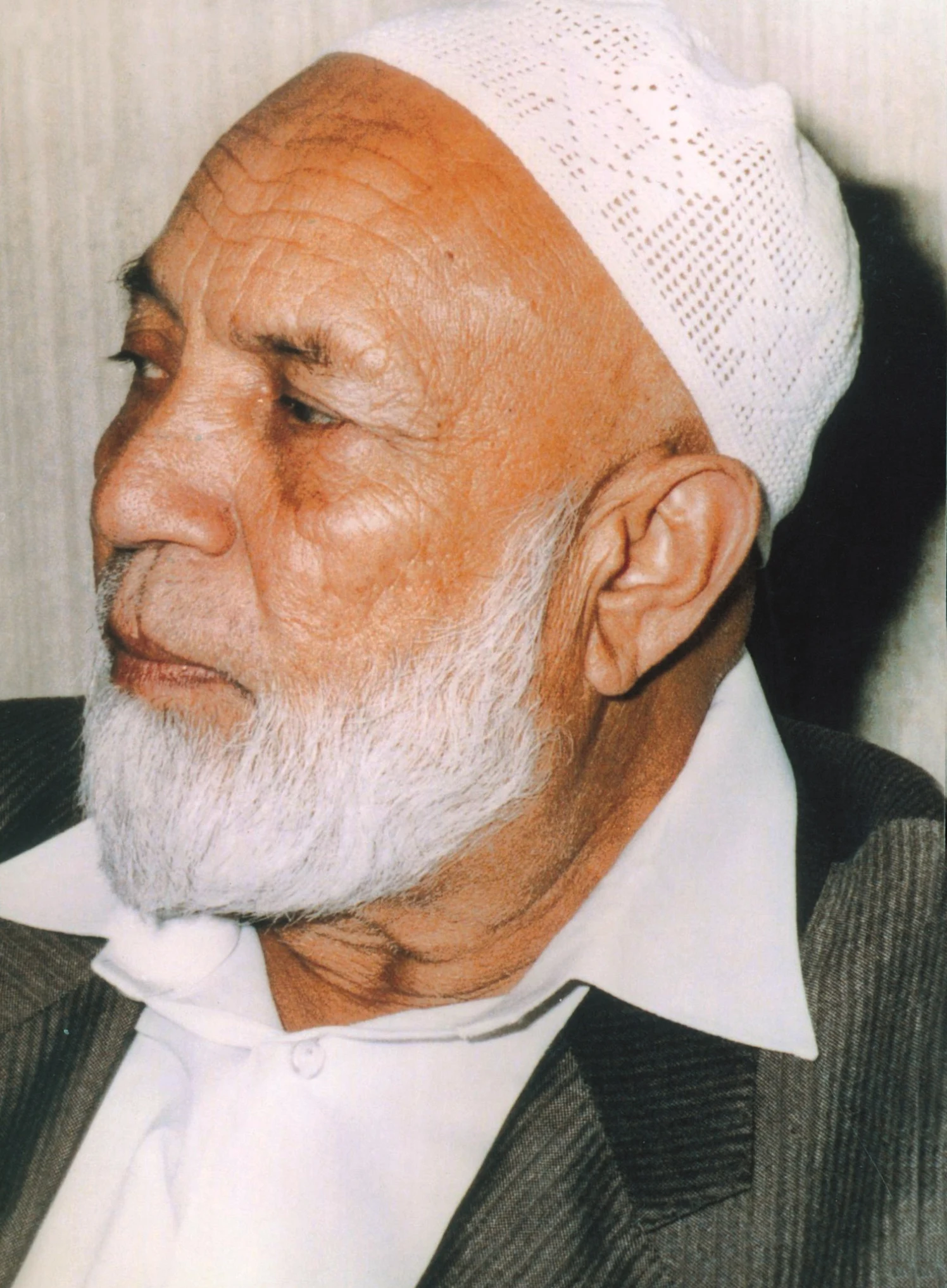
Ahmad Husein Deedat (1 July 1918 – 8 August 2005), generally known as Ahmed Deedat, was a South African preacher and writer on comparative religion. Born at Surat in India and brought to Durban as a boy, he left school at sixteen and educated himself while working in a furniture shop, where encounters with Christian missionaries turned his attention to the comparative study of scripture. From a first lecture in a Durban cinema he built a career of public lectures and inter-religious debates that ran for more than four decades, founded the Islamic Propagation Centre International at Durban, published more than twenty books that were translated into numerous languages, and in 1986 received the King Faisal Prize in Service to Islam. A stroke in 1996 left him paralysed and unable to speak, and he continued to work until his death nine years later.
Surat, Durban and the Years Before Public Work
The King Faisal Prize record gives his birth as 1 July 1918 at Surat, in India. Al Jazeera gives the year as 1918 and the place as Surat without a date. His father was a tailor who emigrated to South Africa soon after the birth, and both sources agree that Deedat joined him at Durban, on the east coast of South Africa, in 1927.
Both accounts of his schooling end the same way. The foundation's record states that he learned English in a short time and was a bright pupil, but had to leave school at the age of sixteen to support his family; Al Jazeera says he excelled at school and that poverty forced him to leave and start work at the same age. Neither names the school.
He went to work in a furniture shop — Al Jazeera describes him as a furniture salesman — and pursued his own education alongside the work, with what the foundation's record calls extensive study of comparative religion. It was in that shop, according to the obituary, that he encountered missionaries sent to convert non-Christians, and there that he began to think about comparative religion.
The foundation's record adds the setting in its own words: that he was profoundly influenced by observing that, besides racial discrimination, the authorities used religious ideology to "numb the masses", and that there was a deep misunderstanding of Islam among non-Muslims. The same record names the thing that gave him a method. He was inspired by the idea of holding inter-religious public debates, which he read about in Kairanvi's book Truth Revealed, the work of a nineteenth-century Indian scholar whose name the foundation spells Kairanvi. That is where the approved sources locate the origin of the form his career took.
The First Lecture and the Durban Study Circle
Al Jazeera dates his first public lecture to 1942, at what was then the Avalon Cinema in Durban, and gives its title as Muhammad: Messenger of Peace. The foundation's record gives the title as Mohammad: Messenger of Islam, places it in a cinema in Durban without naming it or giving a year, and adds the detail the obituary omits: fifteen people attended. The foundation's record then states that within a short time his lectures were drawing thousands of people, and that those audiences crossed the racial barrier — the same record having already noted racial discrimination as a feature of the country in which he was speaking.
He was not working alone. Al Jazeera names Goolam Hoosein Vanker and Taahir Rasool as close friends, describes them as the unsung figures of his career, and records that the three formed a study circle to examine the teachings of the Qur'an. It was from that circle that his institutional work came.
The Islamic Propagation Centre International
Both sources credit him with founding the body his name is attached to, and they describe its founding differently. Al Jazeera states that in 1956 Deedat and Vanker set up the Islamic Propagation Centre International (IPCI) at Durban. The foundation's record states that he founded and chaired the Islamic Propagation Center International in Durban, without a date and without naming a co-founder. The same record, in the prize citation itself, credits him with founding a differently named body — the As-Salaam Centre, established to train preachers of Islam and to give them the theological grounding to argue for it. No source consulted explains how the two institutions were related, and this article does not supply a relationship the evidence does not state.
The centre's premises were on Grey Street in Durban. Al Jazeera records that the building had earlier borne another name, and gives the explanation on the authority of Deedat's son Yusuf: Muhammad bin Laden had contributed the largest single share of the cost of putting the building up, and when it was finished those responsible named it after the family in acknowledgement. Told of this some years later, bin Laden declined the honour, on the ground that the family had not met the whole cost, and the name was accordingly removed. The obituary notes that the former name drew attention to the centre in the Western press, particularly after September 2001, and that journalists came to Deedat's home to ask about the connection.
By the time of his death the centre was being run by others. Al Jazeera names Rafik Hassan as its director, Fuad Hendricks as a former director and personal friend, and Ebrahim Jadwat as its secretary-general.
Method and Subject Matter
The foundation's record attributes his standing to an intensive knowledge of the Bible and the scriptures combined with his command of English, and treats that combination as what set him apart from his contemporaries. Hendricks, quoted in the obituary, says that he became a specialist on the Bible, and that his purpose was the reaffirmation that Jesus should be understood and valued as a prophet of God, as Adam, Moses and Muhammad were.
His lectures and writings addressed the textual history of the Bible, the place of Jesus in Islamic belief, the crucifixion, and the question of whether the earlier scriptures foretell the coming of Muhammad. Al Jazeera summarises his aim, in Hendricks's words, as dispelling "myths and lies about Islam and Christianity", and names Crucifixion or Cruci-Fiction? and What the Bible says about Muhammed as examples.
Over the four decades after 1942, Al Jazeera records, he immersed himself in studying and memorising both the Bible and the Qur'an while lecturing and debating around the world. The foundation's record describes output in three forms besides the printed books: hundreds of audio-taped lectures, televised programmes, and public debates. The recordings circulated independently of the man, and large numbers of them have since been uploaded to archive.org under his name.
Debates
Public debate with Christian clergy was the activity for which he became most widely known, and the prize citation treats it as a distinct part of his service: that he discussed and debated Islam publicly with religious leaders of different religions.
Two occasions are named in the approved sources. Al Jazeera records a debate with Bishop Josh McDowell at Durban in 1981 on the question Was Christ Crucified?, and debates with the American evangelist Jimmy Swaggart. The obituary adds that he spoke with numerous Christian organisations and clergy in America, and that, on the authority of his own website, he invited Pope John Paul II both to debate and to accept Islam. No approved source records a response.
The debates became well enough known in the wider Muslim world to raise a question of law in their own right. The Islamic Awakening, a work of fatwa-style questions and answers in the approved library, asks whether it is permissible to organise debates with followers of other religions, "such as the famous debates that take place between the Da'i Ahmad Didat and Christian priests". The reply is that where there is a need to do so it becomes obligatory for Muslims to debate, and it grounds that on the Qur'an's references to dispute and argument (Quran 42:16; Quran 21:18); the respondent adds that he had watched part of one such debate. The question is framed around Deedat's debates as the recognised example of the practice, and it describes him as a da'i, one who calls others to the faith, rather than as a scholar of the religious sciences.
Writings
Al Jazeera gives the total as more than twenty books, published in numerous languages. The foundation's record lists those it considered most significant, with publishers and dates:
| Title | Publisher | Date |
|---|---|---|
| 50000 Errors In The Bible | — | 1991 |
| Alcohol in Christianity and Islam | Dar Al-Nasr | 1992 |
| Muhammed The Greatest | Peace Vision Publications | 1993 |
| Ikhtifa'a Lafth Al-Jalalah | Bayt Al-Hikmah | 1993 |
| The Choice: Islam and Christianity | Abu Al-Qasim Publications | 1993 |
The wider body of work in circulation is visible in the archive.org holdings, which carry eighty-six texts under his name. The titles that recur there, across many independent uploads, include Is the Bible God's Word, Crucifixion or Cruci-Fiction, Christ in Islam, Muhammad the Greatest, Al-Qur'an: The Miracle of Miracles, The Choice: Islam and Christianity, Combat Kit against Bible Thumpers, What is His Name?, Resurrection or Resuscitation?, The God That Never Was, Muhammad the Natural Successor to Christ, and What the Bible Says About Muhammad. Translations appear there in Arabic, Amharic, Spanish, Italian, Romanian and Chinese. Because those uploads are user-contributed, their publisher and date fields are not relied on here; what they establish is which titles and which languages were in circulation.
His work was reaching other languages well before those dates. The TDV İslâm Ansiklopedisi, in the bibliography to its entry on the Prophet, lists among works on the Prophet's place in the earlier scriptures A. H. Deedat, Eski ve Yeni Ahid'de Hz. Muhammed, in the Turkish translation of Şinasi Siber, published at Ankara in 1960 and again in 1972. A work of his on Muhammad in the Old and New Testaments was therefore circulating in Turkish within two decades of his first lecture, and the encyclopaedia still listed it among the works on that question when its own entry on the Prophet was compiled. It carries no entry on Deedat himself.
The King Faisal Prize, 1986
In 1986 he received the King Faisal Prize in Service to Islam. The citation records the grounds: continuous preaching of Islam over what it describes as nearly thirty-five years, at local, regional and international levels; participation in many Islamic events and lectures in many Muslim countries; public discussion and debate with religious leaders of other religions; the founding of the As-Salaam Centre to train preachers and equip them theologically; and the publication of books and research in service to Islam.
Al Jazeera notes the award as coming from Saudi Arabia for outstanding services to Islam, and records separately that he was commended by Nelson Mandela. The obituary does not date the commendation or give its occasion.
The foundation also preserves a remark of his, which it displays with the laureate record: that the most dangerous enemy of Islam is an ignorant and fanatical Muslim who misrepresents it and conveys a misleading idea of it.
The Stroke of 1996 and the Last Years
In 1996 he suffered a stroke which left him paralysed and without the power of speech. Al Jazeera records that it took away his ability to speak, to swallow and to show expression, and that doctors expected him not to live.
He lived nine more years and went on working. His son Yusuf, quoted in the obituary, says that his mind was unaffected: that he could see and hear, laugh and cry, blink, and reason. Communication ran through a grid of the alphabet arranged in five numbered rows — the first holding A to E, the second F to J, and so on — with Deedat indicating letters by blinking for yes and widening his eyes for no while his son worked through the grid to spell out words. By that means he continued to discuss affairs and to talk with the Christian clergy who visited him, and he dictated tracts and kept up correspondence with people abroad until the end of his life. His wife, Hawa Deedat, cared for him at their home throughout those years.
Al Jazeera records two framed quotations that stood at his bedside. One was the supplication of the prophet Job from Surah al-Anbya: "And [mention] Job, when he called to his Lord, 'Indeed, adversity has touched me, and You are the most merciful of the merciful'" (Quran 21:83). The other read: "There is no end to what a man can achieve if he does not mind who gets the credit." Shortly before his death he told Al Jazeera: "Since my illness I have learnt to laugh and cry easily."
Death
He died on 8 August 2005. Al Jazeera gives the cause as kidney failure and his age as eighty-seven, which agrees with the birth date of 1 July 1918 in the foundation's record. The foundation's record places the death in KwaZulu, South Africa; the obituary describes his last years as spent at his home, and the centre he founded was at Durban, which lies in the province of KwaZulu-Natal. The two are compatible, and no town is asserted here.
Standing and Influence
In the approved sources his standing registers mostly through other people's entries rather than his own. The Muslim 500, the annual survey of influential Muslims held in the approved library, carries no entry on him — he had died before the series began — but in each of eleven consecutive editions from 2016 to 2026 its entry on the Indian preacher Zakir Naik describes Naik in identical words as "a popular preacher and comparative religion specialist in the mould of the legendary Ahmed Deedat". The TDV İslâm Ansiklopedisi likewise has no entry on him while citing his work in its bibliography on the Prophet, and Brill's Encyclopaedia of Islam Three, which does carry a dedicated entry, is noted below.
Al Jazeera opens its obituary with a comparison of its own: that South Africa is known in the Muslim world and much of the globe not only for Nelson Mandela but for Deedat, whom it describes as famous for his inter-religious public debates. The obituary also attributes to Hendricks the observation that his lectures made people question their own beliefs and seek answers, and that they prompted Muslims as well as Christians to re-examine what they held.
Historiographical Note
The two documents this article mainly rests on were written nineteen years apart and for different purposes — one to justify an award, the other to mark a death — and they disagree at several points. The disagreements are recorded here with the variants named, on the owner's decision of 5 October 2026 as to how each should be handled.
The first lecture. Al Jazeera dates it to 1942, names the venue as the Avalon Cinema in Durban, and gives the title as Muhammad: Messenger of Peace. The King Faisal Prize record gives no year, names no venue beyond a cinema in Durban, gives the title as Mohammad: Messenger of Islam, and records an audience of fifteen. The year and venue above are taken from the obituary and the audience figure from the foundation's record; both titles are genuine variants and neither source is preferred.
The institutions. The obituary has the IPCI founded at Durban in 1956 by Deedat and Vanker. The prize citation credits Deedat with founding the As-Salaam Centre to train preachers, and the accompanying biography credits him, separately and without a date, with founding and chairing the Islamic Propagation Center International. The two bodies are named as distinct and no approved source explains how they were related; this article therefore states each as its source states it and asserts no relationship between them. The approved library contributes nothing: a search for "Islamic Propagation Center" returns the International Islamic Propagation Center of Karachi, founded by Mohammad Shaikh and recorded in The Muslim 500 for 2010, which is a different organisation in a different country.
The length of his career. The prize citation gives "nearly 35 years"; the biography on the same page gives "more than 40 years"; the obituary implies four decades from a first lecture in 1942. The King Faisal source is thus inconsistent with itself, and no total is asserted above. The span is instead anchored on the dated events: the first lecture in 1942, the prize in 1986, the stroke in 1996.
The place of death. The foundation's record says KwaZulu; the obituary places his final years at his home, with the centre he founded at Durban. Durban lies within KwaZulu-Natal, so the two are compatible rather than contradictory, and the article gives the date without asserting a town.
His name. The King Faisal Foundation records him as Ahmad Husein Deedat and refers to him as Shaikh Ahmad Deedat; Al Jazeera uses Shaikh Ahmed Deedat; the TDV İslâm Ansiklopedisi cites him as A. H. Deedat, which corroborates the middle initial; The Islamic Awakening renders the surname Didat. These are variants of one name and not a question of identity.
The publication details of his books. The foundation's list gives The Choice: Islam and Christianity to Abu Al-Qasim Publications in 1993 and Muhammed The Greatest to Peace Vision Publications in the same year, while archive.org carries a two-volume edition of the first dated 1994 to Islamic Book Services. These are most likely separate editions of the same works, and no single publisher is asserted. One internal oddity in the foundation's page is worth recording: it states that the biography was written in the year the prize was awarded, 1986, yet the publication list on the same page runs to 1993, so that list was evidently updated later.
The styling of Josh McDowell. Al Jazeera's obituary describes the opponent in the Durban debate of 1981 as "Bishop Josh McDowell". No other approved source names him, so the title is reported as the obituary gives it and is not independently confirmed here.
What the approved base holds but could not be read. Brill's platform carries seven entries that name him, identified by their metadata: the dedicated "Deedat, Ahmed" by Samadia Sadouni in the Encyclopaedia of Islam Three; "South Africa" by A. I. Tayob in the second edition; "Gospel, Muslim conception of" by David Thomas; entries on Iẓhār al-ḥaqq and on the Histoire de la Turquie in Christian-Muslim Relations; an entry on media in the Encyclopedia of Global Pentecostalism; and an introduction in Arabic Literature of Africa Online. All seven are behind a subscription and none was read. Fragments served intermittently by the search interface were tested for reproducibility and could not be re-served, so nothing from them is used here; under the project's source policy a passage that cannot be pointed to cannot carry a claim. Two further sources the owner authorised for this article, an item in the Revue française de science politique on the Cairn platform and a copy of The Choice volume one, both refused access and were not read.
What is therefore not established. No approved source consulted gives the name of his school, the name of the furniture business, the date or occasion of Nelson Mandela's commendation, any response to the invitation sent to Pope John Paul II, the dates of his debates other than the Durban debate of 1981, the number or names of his children beyond his son Yusuf, or the date of his marriage. Those gaps are left as gaps.
References and Further Reading
Primary Islamic Sources
- The Qur'an, Surah al-Anbya 21:83, the supplication of the prophet Job, verified for reference and wording at quran.com. https://quran.com/21/83
- The Qur'an, 42:16 and 21:18, as cited in the reply to the question on inter-religious debate in The Islamic Awakening.
A note on this subsection: the subject is a twentieth-century figure, and the project's standard directs that where a subject does not genuinely have four relevant primary Islamic sources, artificial entries are not to be manufactured to reach the minimum. For the same reason no Classical Islamic Sources subsection appears below: no pre-modern authority bears on this life. The nineteenth-century work that the King Faisal Prize record names as the origin of his method, Kairanvi's Truth Revealed, was not consulted and is listed under Further Reading.
Academic and Scholarly Sources
- King Faisal Prize, laureate record for the 1986 Prize in Service to Islam, "Mr. Ahmad Husein Deedat". The awarding foundation's own record, comprising the citation, a biography stated to have been written in the year of the award, and a list of publications. https://kingfaisalprize.org/mr-ahmad-husein-deedat/
- "The life of Shaikh Ahmed Deedat", Al Jazeera, 20 August 2005. An obituary, used for factual detail and identified as journalism. https://www.aljazeera.com/news/2005/8/20/the-life-of-shaikh-ahmed-deedat
- "MUHAMMED", TDV İslâm Ansiklopedisi, İSAM. Used for the bibliography of works on the Prophet's place in the earlier scriptures, which lists Deedat's work in Turkish translation. https://islamansiklopedisi.org.tr/muhammed
- The Muslim 500, editions 2016 to 2026. Used for the description of Zakir Naik as working in the mould of Deedat, repeated verbatim across eleven editions.
- The Islamic Awakening. Used for the question on the permissibility of organising inter-religious debates, which names his debates as its example.
- Brill reference works. Used only for the existence, titles, authors and host works of the seven entries on the platform that name him; the contents of all seven are behind a subscription and were not read. https://referenceworks.brill.com
- archive.org. Used for the corpus of texts attributed to him and the languages of translation in circulation; the uploads are user-contributed and their publisher and date fields are not relied on. https://archive.org
Further Reading
- Sadouni, Samadia. "Deedat, Ahmed", in Encyclopaedia of Islam Three. The only dedicated scholarly encyclopaedia entry on the subject identified in the approved base. DOI 10.1163/1573-3912_ei3_COM_25964
- Tayob, A. I. "South Africa", in Encyclopaedia of Islam, 2nd edn. For the South African Muslim setting in which his career ran.
- Sadouni, Samadia. La controverse islamo-chrétienne en Afrique du Sud: Ahmed Deedat et les nouvelles formes de débat. A monograph on the subject by the author of the encyclopaedia entry above.
- Larkin, Brian. "Ahmed Deedat and the form of Islamic evangelism", Social Text 26/3 (2008), pp. 101–21.
- Kairanvi, Rahmatullah. Truth Revealed. Named by the King Faisal Prize record as the book in which Deedat encountered the idea of inter-religious public debate.
- Deedat's own writings, among them The Choice: Islam and Christianity, Crucifixion or Cruci-Fiction?, What the Bible Says About Muhammad and Al-Qur'an: The Miracle of Miracles.
None of the items in this Further Reading list was consulted for this article, and nothing in the body rests on any of them.