The Quran (Al-Qur'an)
The Quran is the scripture of Islam, held by Muslims to be the speech of Allah revealed to Prophet Muhammad over some twenty-three years. It comprises 114 surahs and, in the Egyptian standard edition, 6,236 verses.
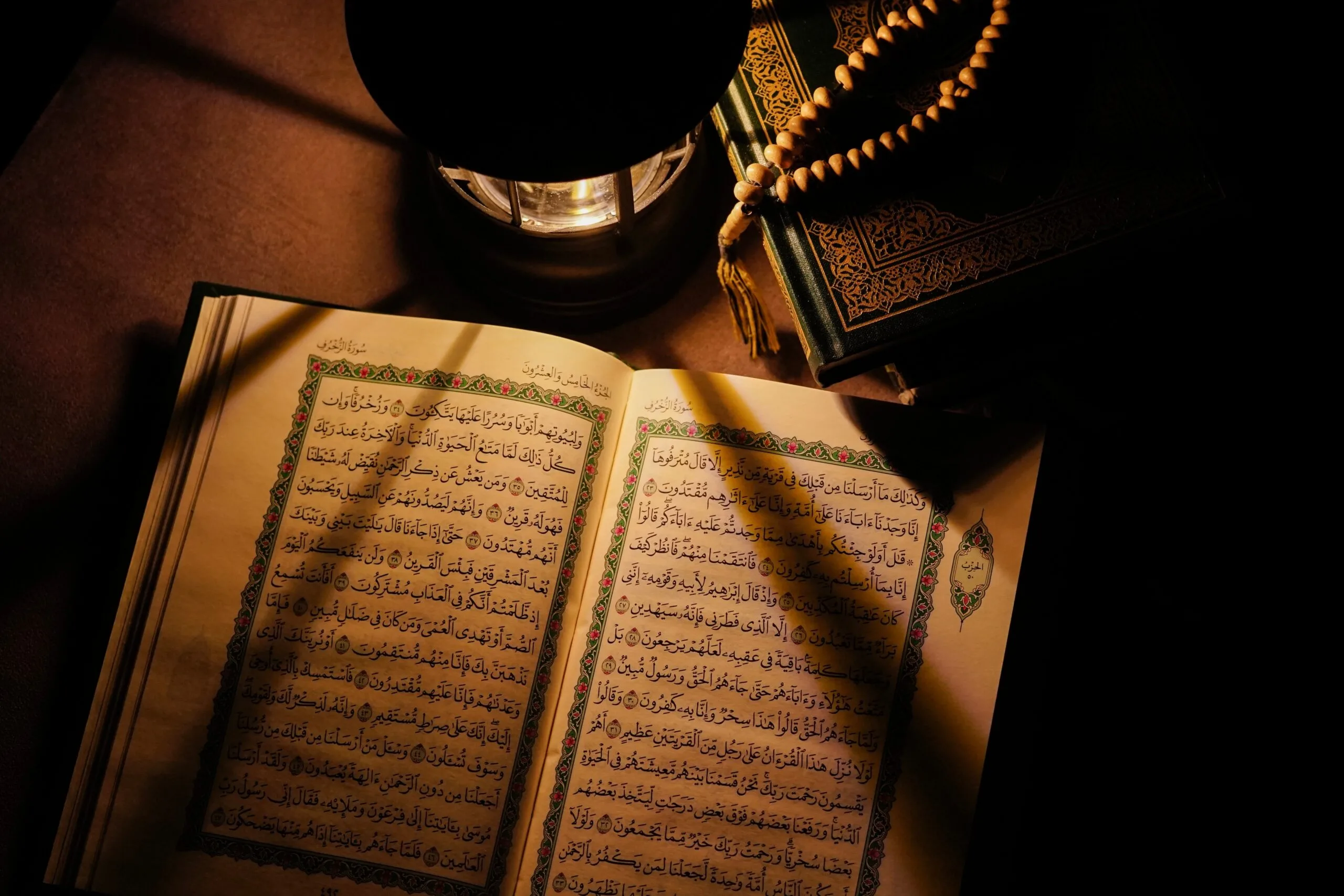
The Quran (Arabic: القرآن, al-Qur'an) is the scripture of Islam, held by Muslims to be the speech of Allah revealed to Prophet Muhammad and preserved since in a fixed written form. It did not arrive as a finished book. The revelation came in portions over some twenty-three years, from about 610 CE until shortly before the Prophet's death in 11 AH, each portion attached to the circumstances that occasioned it; and the text that resulted stands in 114 surahs containing, in the Egyptian standard edition,[a] 6,236 verses.1
The book's name is also its oldest description of itself. Qur'an is most often taken to be the verbal noun of qara'a, to read or to recite, and the Quran is a recited text before it is a read one — recited in the five daily prayers, memorised in whole or in part, and transmitted by voice alongside every written copy made of it.2 That double transmission, in writing and in memory, runs through its history and is built into the scholars' own definition of what the Quran is: a text established by mass transmission, conforming to the Uthmanic orthography,[b] and inimitable in its Arabic.3
The arrangement of the book is its own and is not chronological. After the short opening surah the rest stand roughly in descending order of length, so that the reader meets the long legislative surahs of Medina first and the short Meccan surahs last — very nearly the reverse of the order in which they came.4 Each surah is conventionally labelled Makki or Madani according to whether it was revealed before or after the Hijra, a distinction of date rather than of place, and one the classical authorities transmitted in more than one version.5
The written text reached its present form in stages that the reports in Sahih al-Bukhari set out plainly. In the Prophet's lifetime the Quran was held chiefly in memory and written down piecemeal as it came; after the deaths of many of its memorisers at Yamama[c] it was gathered into a single manuscript under Abu Bakr; and when the armies of the provinces began to differ over recitation it was copied, under Uthman, into an authorised text that was sent out to the major cities and has been the basis of every copy since.6
Around the text there grew up a body of disciplines known collectively as ulum al-Quran,[d] and its scale is worth stating at the outset: al-Zarkashi treated forty-seven of these sciences, al-Bulqini fifty, al-Suyuti eighty, and Ibn Aqilah al-Makki a hundred and fifty-four, with some reckonings running past four hundred.3 They cover the occasions of individual revelations, the variant readings and the chains through which each is transmitted, the rules of pronunciation in recitation, the relation between rulings given at different stages, and above all the long tradition of commentary. The Quran is the first source of Islamic law and the foundation of Islamic theology, and its reach into intellectual history is wider still: the great movements of that history were argued out on Quranic ground by every side, which is why a book that is not a history can hardly be dispensed with by anyone trying to understand one.7
Names and definition
The word qur'an
The earliest attested use of the word qur'an is in the Quran itself, where it occurs about seventy times across a range of senses.2 Its derivation was debated. Some linguists held it to be a proper noun, the book's own name and nothing else; most took it to be the verbal noun of qara'a, "he read" or "he recited" — a reading the text bears out, since that verb appears seventeen times and, wherever it plainly means "recite", what is recited is the Quran.2 A third line of analysis connects it to jama'a, to gather or compile, which would make the name a description of the book's assembly from its chapters and verses; and the various derivations of qara'a themselves carry senses of understanding, reflection, learning, worship and following.3
The word's own usage develops across the revelation. In some of the earliest passages it is the act of reciting: "Ours is it to put it together and [Ours is] its qur'an. When We recite it, follow its qur'an" (Quran 75:17–18). Elsewhere it is an individual passage recited, as when the jinn report having heard "a qur'an, a wonder, which guides to rectitude" (Quran 72:1–2). Then, in the largest group of contexts — mostly late Meccan and very early Medinan — al-qur'an takes the definite article and a fuller meaning: the revelation sent down upon the Prophet, sent down at intervals (Quran 17:106; 25:32), and in some places something in Allah's possession larger than what has so far been sent down, as in "What We send down of al-qur'an is a healing and mercy to the believers" (Quran 17:82).2
The Book's other names
Qur'an is the commonest name but not the only one. The text also calls itself al-Furqan, the Criterion that distinguishes truth from falsehood; al-Dhikr, the Reminder; and al-Kitab, the Book. Alongside these it applies to itself a series of descriptions rather than names — glad tiding (bushra), knowledge (ilm), the trustworthy handhold (al-urwah al-wuthqa), the Truth (haqq), the rope of Allah (habl Allah), and a clear statement for mankind (bayan li-l-nas).3 The opening surah has a whole set of names of its own, discussed below.
Aya, sura and kalima
Three words carry most of the structural weight, and each has a history.
Aya basically means "sign", in the sense of a token of some unseen reality, and it is among the commonest words in the book: it and its plural ayat occur almost four hundred times. Most of those occurrences are not about scripture at all but about natural phenomena — rain, wind, the alternation of night and day — presented as confirmations of Allah's power and bounty and as grounds for gratitude. In other contexts it is the extraordinary event by which a prophet's message is confirmed. Only in late Meccan and Medinan passages does it come to mean a revealed message, and then the basic unit of revelation, which later scholars identified with the verse.8 Ibn Kathir is more exact about that technical sense: an aya is the sign, or the pause, that separates the speech before it from the speech after, so that the verse stands apart from what precedes and follows it; he cites Quran 2:248, "the sign of His kingdom", for the usage, and notes that it was also said to be called aya in the sense of a wonder, because mankind is unable to produce the like of it.9
Kitab, literally "book" or "writing", occurs 255 times in the singular and six in the plural, and only rarely of an everyday piece of writing — Solomon's letter to the queen of Sheba (Quran 27:28–29), a document of manumission (Quran 24:33). Far more often it is a record of deeds, or what has been prescribed, or Allah's knowledge itself.8
Sura is the word for the divisions of the text, and the TDV İslâm Ansiklopedisi's dedicated entry on it traces its senses back to building and to height. The root means to leap or to climb a wall, and the noun carries the ideas of a high and beautiful building, a part or storey of a house, high rank, glory and honour, and a sign or mark. The technical definition is exact: a section formed by the bringing together of Quranic verses, whose boundaries were fixed by the Messenger in accordance with revelation. The entry suggests the divisions are called suras either because they are composed of mutually harmonious parts of high spiritual degree, or because each forms one storey of the building of the Quran. The word itself occurs in eight verses, nine times in the singular and once in the plural.10 Maariful Quran gives the same thing in a sentence: a limited or definite piece, technically a passage of the Quran set apart from other passages by revelation, of which there are 114, some long and others very short.11
Ibn Kathir records that even the derivation was argued over, and his survey of the proposals is a fair sample of how closely this vocabulary was examined. One view holds that sura means elevation and height, and he cites in support a line of the pre-Islamic poet al-Nabigha praising a king: "Do you realize that Allah has given you such a sawra, that every other king remains far below it?" A second takes it to imply that the reader climbs from one stage to the next. A third compares it to the walls that surround a city. A fourth derives it from asar, what remains in a pot, a surah being a portion of the whole. A fifth notes that the Arabs called a perfect camel a sura, the word carrying a sense of completeness. His own view is the third: the word means collecting or surrounding parts — the verses, in this case — as a city wall surrounds the homes and buildings inside it.9
The smallest unit is the kalima, the single word, and its range is wider than the term suggests. A kalima may be two letters long or run past ten, as in three long verbal forms Ibn Kathir cites from Quran 24:55, 11:28 and 15:22; it may constitute an entire verse, as at Quran 89:1, 93:1 and 103:1; and the scholars of Kufa counted each of the detached letter-groups alif lam mim, ta ha, ya sin and ha mim as one. Abu Amr al-Dani remarked that he knew of only a single verse consisting of one word, mudhammatan at Quran 55:64.9
How the scholars define it
Because several disciplines needed to say exactly where the boundaries of the text lay — law, theology, linguistics and Quranic studies alike — a technical definition was worked out, and it turns on three properties rather than on content. A text is the Quran if it is inimitable in its Arabic (i'jaz), if it comes down by mass transmission (tawatur),[e] and if it conforms to the Uthmanic orthography (rasm). The definition most commonly given across those disciplines runs: the speech of Allah revealed upon His Prophet Muhammad, whose recitation is used in acts of worship and whose smallest chapter is miraculous in nature.3
Each of the three criteria does identifiable work. Tawatur excludes a reading transmitted by too few chains to be certain, which is why the scholars of the readings graded their material so carefully. Rasm excludes a reading the Uthmanic consonantal skeleton cannot carry. And inimitability is what the text itself appeals to when it challenges its audience to produce the like of it.
Whether any of it is non-Arabic
The Quran describes itself as Arabic — "an Arabic Qur'an" (Quran 12:2), "in the plain Arabic language" (Quran 26:195) — and the classical commentators took the question of foreign vocabulary seriously enough to settle it in stages. There is a consensus that the Quran contains no non-Arabic expressions, and equally an agreement that it does contain some non-Arabic names, Ibrahim, Nuh and Lut among them. What remained disputed was whether anything in it is exclusively foreign, and al-Baqillani and al-Tabari rejected that notion outright, holding that what the Quran carries of non-Arabic terms is shared between several languages rather than borrowed from one.12
Revelation
The Preserved Tablet and the two descents
Before the revelation reached the Prophet at all, the sources place the Quran somewhere else. It is, in its own words, "the glorious Qur'an in the Preserved Tablet" (Quran 85:21–22) — al-Lawh al-Mahfuz — and from there, on the account Maariful Quran sets out, its descent happened not once but twice. The whole of it came down at one time to al-Bayt al-Izzah, the Exalted House in the lowest heaven; and from there it was given to the Prophet in portions, as occasions arose, over twenty-three years. The report behind this is transmitted from Ibn Abbas by al-Nasa'i, al-Bayhaqi and al-Hakim, and reaches Maariful Quran through al-Suyuti's al-Itqan.13
Ibn Kathir finds the same doctrine inside a variant reading. Commenting on "And (it is) a Qur'an which We have divided" (Quran 17:106), he notes that the word may be read two ways, and that the two readings carry two different meanings. Read faraqnahu, without doubling, it means that Allah made it depart from the Preserved Tablet to the Bayt al-Izzah in the lowest heaven, and that it was then revealed in stages to the Messenger according to events over a period of twenty-three years — the reading Ikrima transmits from Ibn Abbas. Read farraqnahu, with doubling, it means that He revealed it verse by verse and made its meaning clear. Both readings are reported from Ibn Abbas, by way of al-Tabari.14
The Exalted House is not to be confused with al-Bayt al-Ma'mur,[f] which stands in the seventh heaven. Ibn Kathir distinguishes them: every heaven has its own house of worship, which is also the direction of prayer for its residents, and the one in the lowest heaven is Bayt al-Izzah, while al-Bayt al-Ma'mur is the Kaaba of those who dwell in the seventh, visited each day by seventy thousand angels who never return to it again, and the house against which the Prophet saw Ibrahim reclining during the Night Journey.15
Two reasons were offered for a descent in two stages rather than one. Abu Shamah held that the first descent demonstrated the standing of the Quran and announced to the angels that this was the last Book of Allah, ready to be sent down for the guidance of the people of the earth. Al-Zurqani, in Manahil al-Irfan, added that it put the text beyond doubt by preserving it in two further places besides the Prophet's own heart — in the Preserved Tablet and in the Exalted House.13
The night of the first descent
That first descent took place on the Night of Qadr, the night the Quran itself singles out: "the month of Ramadan in which was revealed the Qur'an" (Quran 2:185). Commenting on that verse, Ibn Kathir reports from Imam Ahmad, on the authority of Wathilah ibn al-Asqa', that the Prophet named the nights on which each of the scriptures came down: the Suhuf of Ibrahim on the first night of Ramadan, the Torah on the sixth, the Injil on the thirteenth, and the Quran on the twenty-fourth night of Ramadan.16
The same night was the beginning of the second, gradual descent, which the scholars are almost agreed began when the Prophet was forty; and it is the night on which, some years later, the Battle of Badr fell. Which night of Ramadan it was has been given differently elsewhere, some reports naming the seventeenth, some the nineteenth and some the twenty-seventh, and Maariful Quran concludes that nothing definite can be said about the date on that evidence.13
The beginning at Hira
The revelation to the Prophet himself did not begin with the angel. It began with sleep. Sahih al-Bukhari opens its Book of Revelation with Aishah's account of the commencement, and the sequence she gives runs from true dreams, which came true like bright daylight, to a love of seclusion that was given to him afterwards (Sahih al-Bukhari 3). In that seclusion, in the cave of Hira above Mecca, he would worship for many nights at a time, taking provisions with him and returning to his household for more. Then came the angel, and the first word was Iqra, "Read"; he answered that he was unable to read, and the opening verses of Surah al-Alaq followed (Quran 96:1–5).17
These were the first verses revealed, and after them the revelation stopped. The interval that followed is known as the fatrah,[g] and it ended when the same angel who had visited him in the cave became visible to him between the heaven and the earth.17
The modes of revelation
The Prophet was asked directly how revelation came to him, and his answer names two modes. Al-Harith ibn Hisham put the question, and the harder of the two is described first: "Sometimes it is revealed like the ringing of a bell, this form of revelation is the hardest of all, and then this state passes off after I have grasped what is revealed. Sometimes the angel comes in the form of a man and talks to me and I grasp whatever he says." Aishah, who transmits the report, adds an observation of her own: she once saw him being inspired on a very cold day, and noticed the sweat dropping from his forehead when the revelation was over (Sahih al-Bukhari 2).
Maariful Quran gathers the reports into five modes in all, and the fuller account is worth having, because the two of the hadith are the two the Prophet was asked about rather than the whole of what the sources record.18
The bell-like sound. Ibn al-Arabi explains why the comparison is to a bell and not to a voice: the sound of revelation is continuous, as a bell's is, without breaking off; and when a bell rings continuously the hearer cannot tell which direction it comes from, the Divine Word likewise having no one direction but seeming to come from all of them. This was the hardest mode, and the reports describe its physical effect in some detail. In another narration Aishah relates that his breath would seem to stop, his face would change and turn pale like the branch of a date palm, his front teeth would shiver as though from cold, and he would perspire so heavily that the drops rolled like pearls. The animal he was riding would sometimes sit down under the weight. Once, when his head was resting on Zayd ibn Thabit's lap, the revelation came in that posture and bore down on Zayd's thigh until it seemed it would break. Umar reports that a sound somewhat like the buzzing of bees could be heard near his face when revelation came.18
The angel in human form. Jibril would come as a man and deliver the message, generally in the form of the Companion Dihyah al-Kalbi,[h] though at other times in other forms. This was the easiest of the modes on the Prophet.18
The angel in his own form. Jibril would appear as he is, without taking on human shape. This happened only three times in the Prophet's whole prophethood, and the sources do not treat the three equally: the first two are soundly attested, while the third rests on weak chains and is accordingly doubtful.18
Direct speech without an intermediary. A two-way conversation with Allah, with no angel between. This was granted once, at the Mi'raj, while the Prophet was awake; and once more in a dream.18
Words cast into the heart. Jibril would, without appearing in any form at all, let the words of the message fall into the Prophet's heart. The technical name for this is nafth fi al-raw'.[i]
A second report shows revelation from the outside, and it survives because a Companion was frankly curious. Ya'la ibn Umayya used to say that he wished he could see the Prophet at the moment revelation came. At al-Ji'rana, with the Prophet shaded by a garment hung over him, a man came to ask about a pilgrim who had put on a cloak after perfuming himself. The Prophet waited a while; the revelation came; Umar beckoned Ya'la over, and Ya'la pushed his head under the covering and saw the Prophet's face red and his breathing heavy, until he was relieved of it and gave the answer (Sahih al-Bukhari 4985).
What the Quran was to the Prophet's mission is stated in the same book, in a report from Abu Hurayrah: "There was no Prophet among the Prophets but was given miracles because of which people had security or had belief, but what I have been given is the divine revelation which Allah has revealed to me" (Sahih al-Bukhari 4981). The distinction drawn there is between a miracle witnessed once by those who were present and a revelation that stays, and it is the distinction on which the whole later discipline of i'jaz al-Quran rests.
Over twenty-three years
Because the revelation came in portions attached to circumstances, the circumstances are often recoverable, and one report preserves the process closely enough to be followed step by step. When the verse "Not equal are those believers who sit at home and those who strive hard and fight in the cause of Allah" was revealed, the Prophet said, "Call Zayd for me and let him bring the board, the inkpot and the scapula bone," and dictated it. Amr ibn Umm Maktum, who was blind, was sitting behind him and asked what his own position was. The verse was then revealed again in its present form, with the exception for those who are disabled (Sahih al-Bukhari 4990; Quran 4:95).
Three things in that one report bear on everything that follows. A scribe was called and named. The writing materials were ordinary and to hand — a board, an inkpot, the shoulder blade of an animal. And a verse already given could be completed by a further revelation in answer to a question somebody had actually asked.
The occasions are sometimes recorded in as much detail. Jundub relates that the Prophet fell ill and could not offer the night prayer for a night or two, and that a woman said to him, "O Muhammad! I do not see but that your Satan has left you" — upon which Surah ad-Duha was revealed: "By the forenoon, and by the night when it darkens and stands still: your Lord has neither forsaken you nor hates you" (Sahih al-Bukhari 4983; Quran 93:1–3).
Nor was the flow even across the twenty-three years. Anas ibn Malik reports that revelation came down continuously and abundantly in the period immediately preceding the Prophet's death, and that this was the period of the greatest part of it (Sahih al-Bukhari 4982).
The language of the text
Sahih al-Bukhari gives a chapter of its Book of the Virtues of the Qur'an to the point that the revelation came in the tongue of Quraysh and of the Arabs, and the report the chapter rests on turns out to be one of the most consequential in the history of the written text. Anas ibn Malik relates that Uthman ordered Zayd ibn Thabit, Sa'id ibn al-As, Abdullah ibn al-Zubayr and Abd al-Rahman ibn al-Harith ibn Hisham to write the Quran in the form of a mushaf,[j] and gave them a tie-breaker to use: "In case you disagree with Zayd ibn Thabit regarding any dialectic Arabic utterance of the Qur'an, then write it in the dialect of Quraysh, for the Qur'an was revealed in their dialect." And so they did (Sahih al-Bukhari 4984).
The Meccan and the Medinan periods
The Hijra divides the revelation in two, and the emphasis shifts across the divide. In the Meccan years the weight fell on the correction of belief, the reform of morals, the logical refutation of the idolaters, and the miraculous character of the Quran itself. By the Medinan years an Islamic state had arisen and people were entering Islam in groups; idolatry stood refuted intellectually, and the confrontation moved onto different ground.5
The annual review
One practice bears directly on the integrity of the text, and three separate reports record it. Jibril did not only bring the revelation; he went back over it. Fatimah related that the Prophet told her privately: "Jibril used to recite to me and I to him the whole Qur'an once in a year, but this year he recited the whole Qur'an with me twice. I do not think but that my death is approaching."
Ibn Abbas supplies the setting. The Prophet was the most generous of people and became more so in Ramadan, because Jibril used to meet him every night of that month until it elapsed, and the Prophet used to recite the Quran to him (Sahih al-Bukhari 4997). Abu Hurayrah confirms both the pattern and the exception, and adds a second measure of the same year: Jibril would go over the recitation once a year, but twice in the year the Prophet died; and whereas the Prophet used to keep i'tikaf[k] for ten days each Ramadan, in that last year he kept it for twenty (Sahih al-Bukhari 4998).
Makki and Madani
Every surah is conventionally classified as Makki or Madani, and the classification is among the oldest subjects of Quranic scholarship. Two things have to be said about it before any table of the surahs can be read correctly, because both cut against what the labels look like they mean.
A matter of date, not of place
What makes a passage Madani is that it was revealed after the Hijra, not that it was revealed inside Medina. The example that settles it is Quran 4:58, "Surely, Allah commands you to fulfil trust obligations towards those entitled to them", which is Madani although it was revealed in Mecca; the rule is stated in al-Burhan and Manahil al-Irfan, and Maariful Quran carries it. A passage revealed at Mecca after the migration is therefore Madani notwithstanding where it came, and the label records a date rather than a postal address.5
Some surahs are also mixed, and the classification of certain surahs is disputed in the sources themselves. Surah al-Hajj is the standing example, and it is worth setting out because it shows what a single label has to suppress. Its opening addresses humanity at large — "O mankind!" — and warns of the Day of Judgement in the manner of the Meccan surahs; its later portions legislate in detail for the pilgrimage and the sacrificial animals; and at Quran 22:39 comes the first permission to the Muslims to fight, which could only have been given after the migration. Ibn Kathir confirms the dating directly: commenting elsewhere he notes that a certain Meccan verse preceded "the Ayah of the sword", and identifies that as Quran 22:39–40, "revealed after the Hijrah".19 Maariful Quran accordingly records that commentators differ over the surah, that Ibn Abbas expressed two views on different occasions, and that a majority hold it to combine Makki and Madani verses, with al-Qurtubi preferring that view.5
Because the boundary is a matter of inference for many surahs, the scholars worked out rules of thumb for the doubtful cases — that every surah containing a verse of prostration is Makki according to the Hanafiyya; that every surah except al-Baqarah in which the story of Adam and Iblis appears is Makki; that every surah mentioning or describing the injunctions of jihad is Madani.5
The classifications are transmitted, and they differ
The clearest way to see how far they differ is to set a named early authority beside a modern reference list. Ibn Kathir's introduction preserves the classification of Qatadah, transmitted by Hammam, as a bare list: the surahs revealed at Medina are al-Baqarah, Al Imran, an-Nisa, al-Ma'idah, Bara'ah, ar-Ra'd, an-Nahl, al-Hajj, an-Nur, al-Ahzab, Muhammad, al-Fath, al-Hujurat, ar-Rahman, al-Hadid, al-Mujadila, al-Hashr, al-Mumtahana, as-Saff, al-Jumu'a, al-Munafiqun, at-Taghabun, at-Talaq, at-Tahrim as far as its tenth verse, az-Zalzalah and an-Nasr — "the rest were revealed in Makkah."20
That is twenty-six, against the twenty-eight of the table below, and the two lists diverge in substance and not only in count. Qatadah makes an-Nahl Medinan where the table has it Meccan. The table counts al-Anfal, al-Insan and al-Bayyinah as Medinan, and none of the three appears in his list. And he qualifies at-Tahrim, making it Medinan only as far as its tenth verse — which states the mixed case as a classification instead of leaving it implicit, as a two-value column must.
A single-word label in a table is therefore a summary of a transmitted scholarly judgement. The column below gives the classification used by quran.com, which follows the standard attribution for each surah; where the approved sources disagree, the disagreement is recorded in the historiographical note at the foot of the article rather than hidden inside the table.21
Structure of the text
How the surahs are arranged
After al-Fatihah, the surahs stand roughly in order of descending length. Al-Baqarah comes first of them, running to over seven hundred lines and some sixty pages in a modern printed copy; the book closes with surahs of two or three lines, and the shortest of all is al-Kawthar, the one hundred and eighth, at ten words.4
Length is only the first of the principles at work, and the places where the order departs from it are what reveal the others. Surahs 13, 14 and 15 are much too short for the positions they hold, and 39, 40 and 43 too long. The explanation is that 13, 14 and 15 open with the letters alif lam mim ra and were kept beside the other alif lam ra surahs, 10 to 12, while 40 and 43 open with ha mim and were kept with the other ha mim surahs, a group to which 39 also belongs. Date, subject and opening formula govern as well. Surahs 57 to 66 are a run of Medinan surahs held together in spite of varying lengths; surahs 10 to 15 all carry prophet narratives and all but 13 are named after prophets; and 34 and 35, 65 and 66, 73 and 74, 85 and 86 are paired by the way they open.4
The order is not an editorial decision taken after the fact. It was the arrangement the Prophet instructed, and it is the arrangement applied in the Uthmanic codex — which is precisely why the gap between it and the order of revelation is a feature of the book rather than an accident of its assembly.3
How the surahs are named
The names are not arbitrary, and knowing how they were formed makes the table that follows intelligible rather than merely long. They were not established during the Prophet's lifetime and never came to be regarded as part of the text, with the consequence that most surahs came to be known by more than one name. The Egyptian standard edition has since had a considerable effect in fixing a single name for each, and most alternatives have fallen out of use; one survival is Bani Isra'il for the seventeenth surah, still current in the Indian subcontinent and used in Pickthall's translation.22
The names sort into three kinds.
- Named from the opening. Most surahs take their name from a word at or near the beginning. Thirty are named for the first rhyme-word, which is the last word of the first verse; fourteen for the first word of the surah; four for the detached letters that open them; and eighteen for some other key word in the first or second verse.
- Named for a catchword from within. In about a third of the surahs the name is a term occurring somewhere inside it, and in sixteen of those the name is the only occurrence of that word in the whole Quran — among them the Cow (al-Baqarah 2:67–71), the Table (al-Ma'idah 5:112–114), the Bee (an-Nahl 16:68), the Cave (al-Kahf 18:9 onward), the Poets (ash-Shu'ara 26:224), the Ant (an-Naml 27:18), the Spider (al-Ankabut 29:41) and the Apartments (al-Hujurat 49:4). Only two of the narrative surahs are named for a term designating their single theme: Yusuf and Nuh.
- Named for something not in the surah at all. The names of fourteen surahs do not occur in them, and most occur nowhere in the Quran. Most are formed from verbs that do appear, usually near the opening — the Night Journey, the Prostration, the Disputer, the Woman Tested, the Congregation, the Divorce, the Prohibition, the Veiling, the Splitting, the Rending, the Expanding. Three were chosen instead to indicate the function or the main theme of the surah: al-Fatihah, "The Opening"; al-Anbiya, "The Prophets"; and al-Ikhlas, the surah of the oneness of Allah.22
The 114 surahs
The Arabic names, the transliterations, the place of revelation, the verse counts and the order of revelation below are those given by quran.com.21 The last column repays attention, because it carries a point the rest of the table conceals: the order in which the surahs stand in the book is not the order in which they were revealed. Al-Fatihah stands first and was the fifth revealed; al-Baqarah stands second and was the eighty-seventh; an-Nas stands last and was the twenty-first. The arrangement is its own, and the chronology has to be read off separately. Any column below can be sorted by clicking its heading, which is the quickest way to read the book by length, by chronology or by name instead of by its received order.
There are two columns of meanings, because the English renderings of the surah names differ legitimately between translators and the difference is worth seeing. The first is quran.com's. The second comes from the approved library: from The Meanings of the Noble Qur'an with Explanatory Notes of Mufti Muhammad Taqi Usmani, published by Maktaba Ma'ariful Quran at Karachi — the publishing house of Darul Uloom Karachi, and so the same tradition as Maariful Quran, whose author was his father — supplemented for thirteen surahs by the glosses printed in Maariful Quran itself.23 Neither column is more correct than the other. Where they differ, they usually differ over how much of the Arabic sense to carry across: al-Ma'idah is "The Table Spread" in one and "The Repast" in the other.
Twenty cells in the second column are blank, and the reason is recorded rather than papered over. The library holds these works as scanned volumes, and the headings of those twenty surahs either did not survive the optical character recognition or carry no English gloss at all in the original — which is the case for the surahs named after a person, such as Hud, Luqman and Muhammad, and for those named after a group of letters, such as Ta-Ha, Ya-Sin, Sad and Qaf, where the heading gives the name and nothing more. An em dash means that no rendering could be verified from the library, not that none exists.
| # | Arabic | Name | Meaning (quran.com) | Meaning (Usmani) | Revealed | Verses | Order |
|---|---|---|---|---|---|---|---|
| 1 | الفاتحة | Al-Fatihah | The Opener | The Opening | Mecca | 7 | 5 |
| 2 | البقرة | Al-Baqarah | The Cow | The Cow | Medina | 286 | 87 |
| 3 | آل عمران | Ali 'Imran | Family of Imran | — | Medina | 200 | 89 |
| 4 | النساء | An-Nisa | The Women | The Women | Medina | 176 | 92 |
| 5 | المائدة | Al-Ma'idah | The Table Spread | The Repast | Medina | 120 | 112 |
| 6 | الأنعام | Al-An'am | The Cattle | The Cattle | Mecca | 165 | 55 |
| 7 | الأعراف | Al-A'raf | The Heights | The Heights | Mecca | 206 | 39 |
| 8 | الأنفال | Al-Anfal | The Spoils of War | The Spoils | Medina | 75 | 88 |
| 9 | التوبة | At-Tawbah | The Repentance | Repentance | Medina | 129 | 113 |
| 10 | يونس | Yunus | Jonah | Jonah | Mecca | 109 | 51 |
| 11 | هود | Hud | Hud | — | Mecca | 123 | 52 |
| 12 | يوسف | Yusuf | Joseph | Joseph | Mecca | 111 | 53 |
| 13 | الرعد | Ar-Ra'd | The Thunder | The Thunder | Medina | 43 | 96 |
| 14 | ابراهيم | Ibrahim | Abraham | Abraham | Mecca | 52 | 72 |
| 15 | الحجر | Al-Hijr | The Rocky Tract | — | Mecca | 99 | 54 |
| 16 | النحل | An-Nahl | The Bee | The Honey Bee | Mecca | 128 | 70 |
| 17 | الإسراء | Al-Isra | The Night Journey | Children of Israel | Mecca | 111 | 50 |
| 18 | الكهف | Al-Kahf | The Cave | The Cave | Mecca | 110 | 69 |
| 19 | مريم | Maryam | Mary | Mary | Mecca | 98 | 44 |
| 20 | طه | Taha | Ta-Ha | — | Mecca | 135 | 45 |
| 21 | الأنبياء | Al-Anbya | The Prophets | — | Mecca | 112 | 73 |
| 22 | الحج | Al-Hajj | The Pilgrimage | The Pilgrimage | Medina | 78 | 103 |
| 23 | المؤمنون | Al-Mu'minun | The Believers | The Believers | Mecca | 118 | 74 |
| 24 | النور | An-Nur | The Light | The Light | Medina | 64 | 102 |
| 25 | الفرقان | Al-Furqan | The Criterion | The Criterion | Mecca | 77 | 42 |
| 26 | الشعراء | Ash-Shu'ara | The Poets | The Poets | Mecca | 227 | 47 |
| 27 | النمل | An-Naml | The Ant | The Ant | Mecca | 93 | 48 |
| 28 | القصص | Al-Qasas | The Stories | The Stories | Mecca | 88 | 49 |
| 29 | العنكبوت | Al-'Ankabut | The Spider | The Spider | Mecca | 69 | 85 |
| 30 | الروم | Ar-Rum | The Romans | The Romans | Mecca | 60 | 84 |
| 31 | لقمان | Luqman | Luqman | — | Mecca | 34 | 57 |
| 32 | السجدة | As-Sajdah | The Prostration | The Prostration | Mecca | 30 | 75 |
| 33 | الأحزاب | Al-Ahzab | The Combined Forces | The Coalition Forces | Medina | 73 | 90 |
| 34 | سبإ | Saba | Sheba | Sheba | Mecca | 54 | 58 |
| 35 | فاطر | Fatir | Originator | Originator | Mecca | 45 | 43 |
| 36 | يس | Ya-Sin | Ya Sin | — | Mecca | 83 | 41 |
| 37 | الصافات | As-Saffat | Those who set the Ranks | Those Standing in Rows | Mecca | 182 | 56 |
| 38 | ص | Sad | The Letter "Saad" | — | Mecca | 88 | 38 |
| 39 | الزمر | Az-Zumar | The Troops | The Groups | Mecca | 75 | 59 |
| 40 | غافر | Ghafir | The Forgiver | The Forgiver | Mecca | 85 | 60 |
| 41 | فصلت | Fussilat | Explained in Detail | — | Mecca | 54 | 61 |
| 42 | الشورى | Ash-Shuraa | The Consultation | — | Mecca | 53 | 62 |
| 43 | الزخرف | Az-Zukhruf | The Ornaments of Gold | The Gold | Mecca | 89 | 63 |
| 44 | الدخان | Ad-Dukhan | The Smoke | The Smoke | Mecca | 59 | 64 |
| 45 | الجاثية | Al-Jathiyah | The Crouching | The Kneeling | Mecca | 37 | 65 |
| 46 | الأحقاف | Al-Ahqaf | The Wind-Curved Sandhills | The Sand Dunes | Mecca | 35 | 66 |
| 47 | محمد | Muhammad | Muhammad | — | Medina | 38 | 95 |
| 48 | الفتح | Al-Fath | The Victory | The Victory | Medina | 29 | 111 |
| 49 | الحجرات | Al-Hujurat | The Rooms | The Chambers | Medina | 18 | 106 |
| 50 | ق | Qaf | The Letter "Qaf" | — | Mecca | 45 | 34 |
| 51 | الذاريات | Adh-Dhariyat | The Winnowing Winds | The Winds Scattering Dust | Mecca | 60 | 67 |
| 52 | الطور | At-Tur | The Mount | The Mount of Tur | Mecca | 49 | 76 |
| 53 | النجم | An-Najm | The Star | The Star | Mecca | 62 | 23 |
| 54 | القمر | Al-Qamar | The Moon | The Moon | Mecca | 55 | 37 |
| 55 | الرحمن | Ar-Rahman | The Beneficent | The All-Merciful | Medina | 78 | 97 |
| 56 | الواقعة | Al-Waqi'ah | The Inevitable | The Event | Mecca | 96 | 46 |
| 57 | الحديد | Al-Hadid | The Iron | The Iron | Medina | 29 | 94 |
| 58 | المجادلة | Al-Mujadila | The Pleading Woman | The Debate | Medina | 22 | 105 |
| 59 | الحشر | Al-Hashr | The Exile | The Gathering | Medina | 24 | 101 |
| 60 | الممتحنة | Al-Mumtahanah | She that is to be examined | The Examiner | Medina | 13 | 91 |
| 61 | الصف | As-Saf | The Ranks | The Row | Medina | 14 | 109 |
| 62 | الجمعة | Al-Jumu'ah | The Congregation, Friday | Friday | Medina | 11 | 110 |
| 63 | المنافقون | Al-Munafiqun | The Hypocrites | The Hypocrites | Medina | 11 | 104 |
| 64 | التغابن | At-Taghabun | The Mutual Disillusion | The Loss and Gain | Medina | 18 | 108 |
| 65 | الطلاق | At-Talaq | The Divorce | The Divorce | Medina | 12 | 99 |
| 66 | التحريم | At-Tahrim | The Prohibition | The Prohibiting | Medina | 12 | 107 |
| 67 | الملك | Al-Mulk | The Sovereignty | The Kingdom | Mecca | 30 | 77 |
| 68 | القلم | Al-Qalam | The Pen | The Pen | Mecca | 52 | 2 |
| 69 | الحاقة | Al-Haqqah | The Reality | The Imminent Happening | Mecca | 52 | 78 |
| 70 | المعارج | Al-Ma'arij | The Ascending Stairways | The Stairways | Mecca | 44 | 79 |
| 71 | نوح | Nuh | Noah | Noah | Mecca | 28 | 71 |
| 72 | الجن | Al-Jinn | The Jinn | The Jinns | Mecca | 28 | 40 |
| 73 | المزمل | Al-Muzzammil | The Enshrouded One | The Wrapped Up One | Mecca | 20 | 3 |
| 74 | المدثر | Al-Muddaththir | The Cloaked One | The Enveloped One | Mecca | 56 | 4 |
| 75 | القيامة | Al-Qiyamah | The Resurrection | The Day of Judgement / The Resurrection | Mecca | 40 | 31 |
| 76 | الانسان | Al-Insan | The Man | Man | Medina | 31 | 98 |
| 77 | المرسلات | Al-Mursalat | The Emissaries | Those Sent | Mecca | 50 | 33 |
| 78 | النبإ | An-Naba | The Tidings | The Great Event | Mecca | 40 | 80 |
| 79 | النازعات | An-Nazi'at | Those who drag forth | Those Who Pull Out | Mecca | 46 | 81 |
| 80 | عبس | 'Abasa | He Frowned | — | Mecca | 42 | 24 |
| 81 | التكوير | At-Takwir | The Overthrowing | The Folding | Mecca | 29 | 7 |
| 82 | الإنفطار | Al-Infitar | The Cleaving | The Cleaving | Mecca | 19 | 82 |
| 83 | المطففين | Al-Mutaffifin | The Defrauding | — | Mecca | 36 | 86 |
| 84 | الإنشقاق | Al-Inshiqaq | The Sundering | The Splitting | Mecca | 25 | 83 |
| 85 | البروج | Al-Buruj | The Mansions of the Stars | Stellar Formations | Mecca | 22 | 27 |
| 86 | الطارق | At-Tariq | The Nightcommer | The Night-Comer | Mecca | 17 | 36 |
| 87 | الأعلى | Al-A'la | The Most High | The Most Exalted | Mecca | 19 | 8 |
| 88 | الغاشية | Al-Ghashiyah | The Overwhelming | The Overwhelming Event | Mecca | 26 | 68 |
| 89 | الفجر | Al-Fajr | The Dawn | The Dawn | Mecca | 30 | 10 |
| 90 | البلد | Al-Balad | The City | The City | Mecca | 20 | 35 |
| 91 | الشمس | Ash-Shams | The Sun | The Sun | Mecca | 15 | 26 |
| 92 | الليل | Al-Layl | The Night | — | Mecca | 21 | 9 |
| 93 | الضحى | Ad-Duhaa | The Morning Hours | — | Mecca | 11 | 11 |
| 94 | الشرح | Ash-Sharh | The Relief | — | Mecca | 8 | 12 |
| 95 | التين | At-Tin | The Fig | The Fig | Mecca | 8 | 28 |
| 96 | العلق | Al-'Alaq | The Clot | The Clot | Mecca | 19 | 1 |
| 97 | القدر | Al-Qadr | The Power | The Qadr | Mecca | 5 | 25 |
| 98 | البينة | Al-Bayyinah | The Clear Proof | The Clear Proof | Medina | 8 | 100 |
| 99 | الزلزلة | Az-Zalzalah | The Earthquake | — | Medina | 8 | 93 |
| 100 | العاديات | Al-'Adiyat | The Courser | The Running Horses | Mecca | 11 | 14 |
| 101 | القارعة | Al-Qari'ah | The Calamity | The Striking Event | Mecca | 11 | 30 |
| 102 | التكاثر | At-Takathur | The Rivalry in world increase | Competition in Amassing | Mecca | 8 | 16 |
| 103 | العصر | Al-'Asr | The Declining Day | The Time | Mecca | 3 | 13 |
| 104 | الهمزة | Al-Humazah | The Traducer | The Backbiter | Mecca | 9 | 32 |
| 105 | الفيل | Al-Fil | The Elephant | The Elephant | Mecca | 5 | 19 |
| 106 | قريش | Quraysh | Quraysh | The Quraish | Mecca | 4 | 29 |
| 107 | الماعون | Al-Ma'un | The Small kindnesses | The Small Gifts | Mecca | 7 | 17 |
| 108 | الكوثر | Al-Kawthar | The Abundance | — | Mecca | 3 | 15 |
| 109 | الكافرون | Al-Kafirun | The Disbelievers | The Disbelievers | Mecca | 6 | 18 |
| 110 | النصر | An-Nasr | The Divine Support | The Help | Medina | 3 | 114 |
| 111 | المسد | Al-Masad | The Palm Fiber | — | Mecca | 5 | 6 |
| 112 | الإخلاص | Al-Ikhlas | The Sincerity | The Sincerity | Mecca | 4 | 22 |
| 113 | الفلق | Al-Falaq | The Daybreak | The Break of Dawn | Mecca | 5 | 20 |
| 114 | الناس | An-Nas | Mankind | The Mankind | Mecca | 6 | 21 |
Of the 114, this classification makes 86 Meccan and 28 Medinan, and the verse counts sum to 6,236 — the total of the Egyptian standard edition, and the figure the approved library gives.1
The distribution of length across the two periods is itself informative. The Medinan surahs include most of the longest in the Quran — al-Baqarah at 286 verses, an-Nisa at 176, al-Ma'idah at 120 — and the legislative material concentrated in them accounts for much of that length. The Meccan surahs include almost all of the shortest: of the last thirty-five surahs, all but a handful are Meccan, and several run to five or six verses.
One disagreement in the table should be named here rather than left to the note at the foot. The last two surahs, al-Falaq and an-Nas, are given above as Meccan, which is quran.com's classification and the one the whole column follows. Three of the approved sources place them at Medina instead: Maariful Quran, al-Qurtubi as reported there, and Tafsir Ibn Kathir, whose heading for the pair reads "Which were revealed in Al-Madinah".24 The ground for the Medinan view is the occasion of revelation described below, which belongs to the Medinan years. The two surahs have been among the disputed cases since the earliest period, and the disagreement is a real one in the classical literature rather than an error in any of the sources.
Surahs of particular standing
A table gives every surah the same weight. The tradition does not, and three in particular carry a standing of their own in the canonical reports.
Al-Fatihah, recited in every unit of the ritual prayer, has attracted more names than any other surah, and each name records something about how it was used. In Sahih al-Bukhari the Prophet tells Abu Hurayrah that Umm al-Qur'an, the Mother of the Qur'an, is "the seven repeatedly recited Verses" — al-sab' al-mathani[l] — "and the Grand Qur'an"; the same is recorded through Ahmad and through al-Tabari, with al-Fatihah of the Book added to the list. In another report the Prophet promises a Companion to teach him, before the two of them leave the mosque, "a Surah which is the greatest Surah in the Qur'an", and the surah proves to be this one.25
Ibn Kathir gathers the remaining names with a reason attached to each. It is al-Salah, the prayer, because reciting it is a condition of the prayer's correctness, and he cites the report in which Allah says, "The prayer is divided into two halves between Me and My servants: when the servant says, all praise is due to Allah, the Lord of existence, Allah says, My servant has praised Me." It is al-Shifa, the cure, and al-Ruqyah, the remedy, on the strength of the narration in the Sahih in which a Companion treated a poisoned tribal chief with it and the Prophet asked him afterwards, "How did you know that it is a ruqyah?" For Umm al-Kitab he quotes al-Bukhari's own explanation from the opening of the Book of Tafsir — that the Quran starts with it, and that the prayer is started by reciting it — and adds a second reason given by others, that it contains the meanings of the entire Quran. Ibn Jarir al-Tabari explains the usage from the language itself: the Arabs call any comprehensive thing containing several particulars an umm, so that the membrane around the brain is umm al-ra's and the standard gathering the ranks of an army is an umm, and Mecca is Umm al-Qura, the mother of the settlements, as the greatest of them and their leader.25
Two further details about the surah are unusually firm. Its length is not in dispute at all — seven verses by universal agreement, with twenty-five words and one hundred and thirteen letters. And it was revealed at Mecca, as Ibn Abbas, Qatadah and Abu al-Aliya all stated, the argument being that Quran 15:87, which refers to it as the seven mathani, was itself revealed at Mecca.25 Maariful Quran adds a point about its function rather than its names: placed at the head of the book, it instructs the one beginning to recite or study the Quran to come to it with a mind cleared of his previous opinions, seeking nothing but the truth and the right path.26
Al-Ikhlas, the one hundred and twelfth surah, is four verses on the oneness of Allah, and of it the Prophet said: "By Him in Whose Hand my soul is, this Surah is equal to one-third of the Qur'an." The report is given three times over in the Book of the Virtues of the Qur'an, and in each case the occasion is the same — a Companion who had recited it repeatedly, or recited nothing else in a prayer, whose practice was reported to the Prophet by someone who thought it insufficient (Sahih al-Bukhari 5013–5015).
Al-Baqarah is the longest surah at 286 verses, Medinan, and the source of much of the legislative material. It is also the single exception the classification rules make to the principle that a surah mentioning the story of Adam and Iblis is Meccan.5
The Mu'awwidhatayn, "the two surahs of seeking refuge", are al-Falaq and an-Nas, and they are treated as a pair because they were revealed on one occasion and in one event — which is why Ibn al-Qayyim wrote their commentary as a single piece.27 The occasion is recorded in Sahih al-Bukhari on Aishah's authority. A spell had been worked on the Prophet, so that he would think he had done a thing he had not; he told Aishah that Allah had shown him the cause in a dream, in which two men came to him, one sitting by his head and one by his feet, and asked each other what was wrong with him. The answers name the man and the method: he was bewitched by Labid ibn al-A'sam, of Banu Zurayq, an ally of the Jews; the instrument was a comb and the hair caught in it; and it lay in the dried bark of a male date palm under a rock in the well of Dharwan. The Prophet went to the well and drew it out, saying, "This is the well I was shown in my dream." Aishah asked whether he would not make the matter public, and he answered: "Allah has cured me, and I hate to cause harm to anyone" (Sahih al-Bukhari 5763 and 5765).
The Musnad of Ahmad adds that the illness lasted six months, and a narration attributed to Imam Tha'lab supplies the detail that joins the occasion to the text. Labid had obtained strands of the Prophet's hair and some teeth of his comb, tied eleven knots in a string with a needle driven into each, and buried it in the well. On that occasion the two surahs were revealed — eleven verses between them, five in al-Falaq and six in an-Nas — and the Prophet recited one verse at a time, untying one knot at each, until every knot was loose.27
The two are then distinguished by what each seeks refuge from: al-Falaq directs how to seek Allah's protection against the calamities of this world, and an-Nas against those of the Hereafter. Sahih Muslim records Uqbah ibn Amir reporting the Prophet's words on the night they came: "Do you not see that there have been revealed to me verses tonight the like of which has not been seen before?"27 Their standing in practice is recorded in the same place — taught to Uqbah on a journey and recited in the maghrib prayer, enjoined on lying down and on rising, and recited by the Prophet over himself whenever he was ill, which Aishah did for him when the pain on his deathbed became too great for him to do it himself. The word falaq itself means to split or cleave, and is used here of the breaking of the dawn, as at Quran 6:96.27
The classical counts
The 114 surahs are not in dispute. Almost every other total is, and the classical scholars counted carefully enough to record where they parted company.
On verses, Ibn Kathir reports the count as at least six thousand and then lays out the variants: six thousand exactly; six thousand with two hundred and four added; with fourteen; with two hundred and nineteen; with two hundred and twenty-five or twenty-six; and with two hundred and thirty-six, which he attributes to Abu Amr al-Dani's al-Bayan. That last figure — 6,236 — is the total of the Egyptian standard edition in use today, and it is also the figure reached independently by adding up the verse counts in the table above. The spread is not carelessness. It follows from whether the basmala and the detached letters are counted as verses, and from where certain long verses are taken to divide.28
On words, al-Fadl ibn Shadhan reported from Ata ibn Yasar a count of 77,439.28
On letters the figures diverge more widely. Mujahid's count, transmitted by Abdullah ibn Kathir, was 321,180; Ata ibn Yasar gave 323,015. The largest figure arrives with a story attached. Salam Abu Muhammad al-Hamani reported that al-Hajjaj assembled the reciters, the memorisers and the scribes and asked them how many letters the whole Quran consists of, and they answered 340,740. Al-Hajjaj then asked them where the middle of the Quran falls — and the exercise that followed is recorded below.28
Divisions of the text
Besides the surah and the verse, the text carries divisions introduced for the practical business of reading and reciting it, and Maariful Quran is careful to mark them off from the text itself.
The thirty ajza. The Quran is today divided into thirty ajza (singular juz), or parts,[m] and this division has nothing to do with the meaning of the Quran. It is a reading convenience, and its usual purpose is to let the whole be completed over a month. Alongside it the ruku, or section, is used, and the older groupings of verses in fives and tens, the akhmas and the a'shar, are also recorded. The practice of the Companions and their Successors was to complete the recitation of the entire Quran once every week.29
The Companions divided it differently. A report recorded in the Musnad of Ahmad and in the Sunan of Abu Dawud and Ibn Majah has Aws ibn Hudhayfa ask the Companions, during the Prophet's lifetime, how they used to divide the Quran. Their answer names units of their own: "a third, a fifth, a seventh, a ninth, one-eleventh, one-thirteenth, and the Mufassal until the end." The thirty ajza now in use are therefore later than the practice they serve, and the Mufassal[n] is the one unit in that list still in common use.30
Where the halves and thirds fall. The counting exercise al-Hajjaj set his reciters produced answers specific enough to check. They found the middle of the Quran at the words "and let him be careful" in Surah al-Kahf (Quran 18:19). The first third ends at the hundredth verse of Surah Bara'ah, the second at the hundredth or hundred and first verse of ash-Shu'ara, and the last at the end of the book. The sevenths end, in order, at Quran 4:55, 7:147, 13:35, 22:34, 33:36, 48:6 and the close. Salam ibn Muhammad, who reports it, adds that they learned these facts in four months. Al-Hajjaj is also said to have read a quarter of the Quran each night, the quarters ending at the close of Surah al-An'am, at Quran 18:19, at the close of az-Zumar, and at the end. Abu Amr al-Dani, in al-Bayan, records that there is a difference of opinion over every one of those statements.30
Verse division and numbering. Because the verses end in a rhyme or assonance, they form the most natural divisions of the text — and yet verse divisions are not indicated in the oldest manuscripts and vary somewhat where they are marked, the main reason being that the same rhyming grammatical endings also occur inside many of the longer verses. Several systems of verse division and numbering consequently arose. The Egyptian standard edition counts the basmala as a verse only in al-Fatihah, and treats the detached letters as a separate first verse in some surahs and not in others. Pickthall's English translation follows an Indian text tradition which divides Quran 6:73 and 18:18 into two verses each and combines 36:34 and 35, so that the numbering of those surahs runs one ahead or behind for the remainder; and some texts and translations from the subcontinent count the basmala as the first verse of every surah. A reader comparing two editions should therefore expect the occasional difference of a verse number, and should read it as a difference of enumeration rather than of text.31
The basmala. At the head of every surah except the ninth stands the basmala, bismi Llahi l-rahmani l-rahim. The formula occurs once inside the text of the Quran itself, at Quran 27:30, as the opening of Solomon's letter to the queen of Sheba. Its two attributes occur together four further times, at Quran 1:3, 2:163, 41:2 and 59:22; al-rahman, always with the definite article, occurs fifty-seven times within the text, and al-rahim thirty-three times with the article and frequently without.31
Whether the basmala is itself a verse of each surah is a long-standing question among the schools, and it is the reason the enumerations differ. Both sides of it sit in the approved sources. Ibn Kathir reports that according to the majority of the reciters of Kufa, a group of the Companions, the Tabi'in and a number of later scholars, the bismillah is a separate verse at the beginning of al-Fatihah — while noting that there is no disagreement at all that al-Fatihah contains seven verses, so that the question is which seven rather than how many.25 From the other direction, the Quran scholars of Medina, Basra and Syria did not count it as a verse of al-Fatihah, and al-Fatihah without the basmala is often referred to as al-hamd.31
The detached letters
At the beginning of twenty-nine surahs, immediately after the basmala, stands a letter or a group of letters. They are known in Arabic as the fawatih al-suwar, "the openers of the surahs", the awa'il al-suwar, "the beginnings of the surahs", and the al-huruf al-muqatta'a, "the disconnected letters"; in European writing they are usually called the mysterious letters. They are recited as the names of the letters of the alphabet rather than read as words, and they have occupied Muslim scholars for fourteen centuries.32
Ibn Kathir supplies the arithmetic. Setting repetitions aside, the letters used are fourteen — alif, lam, mim, sad, ra, kaf, ha, ya, ayn, ta, sin, ha, qaf and nun — exactly half of the twenty-eight letters of the Arabic alphabet. He also records where the scholars stood before any explanation is attempted: "There is no doubt that Allah did not reveal these letters for jest and play."33
A range of explanations has been offered. Some read the letters as abbreviations of divine names or of forms of address — alif lam ra for al-rahman, ha mim for al-rahman al-rahim, ya sin for ya sayyid al-mursalin — and al-Suyuti's al-Itqan records a view related from Ibn Abbas by Ikrima and others in which alif lam ra, ha mim and nun together stand for al-rahman.32 Another view, which Ibn Kathir attributes to Ibn Jarir al-Tabari, is that they stand for the alphabet itself, some of its letters being cited rather than all of them, in the way that a man who says his son recites alif, ba, ta, tha means the whole alphabet and stops short of reciting it. Other scholars concluded that they are not abbreviations at all.33
The letters also bear on the arrangement of the book, as the departures from descending length above have already shown: the groups sharing an opening were kept together, which is why three surahs much shorter than their neighbours sit where they do.
Compilation and preservation
The Islamic account of how the written text reached its present form rests on reports in Sahih al-Bukhari, and it falls into three stages, each occasioned by a particular pressure. The undertaking has a warrant the sources quote at its head: "Verily, We have revealed the Qur'an and We will surely protect it" (Quran 15:9).34
In the Prophet's lifetime
The first stage follows from the nature of the revelation itself. Because the Quran came not all at once but in portions as occasions arose, it was not possible from the outset to write and preserve it as a book, and so in the earliest stage the principal means of preservation was memory. When revelation first came the Prophet would repeat the words at once so as to hold them, and he was then directed otherwise through the verses of Surah al-Qiyamah (Quran 75:16–19).35
Writing ran alongside from early on, done by Companions who served as scribes. Zayd ibn Thabit is described in the reports as "one of those who used to write the Divine Revelation", and the account of Quran 4:95 shows him called by name, bringing board, inkpot and scapula bone to take dictation (Sahih al-Bukhari 4990). The two means were never alternatives, and the collection that followed drew on both.36
The collection under Abu Bakr
The second stage was occasioned by deaths. After the battle of Yamama, in which a great number of those who knew the Quran by heart were killed, Umar ibn al-Khattab put it to Abu Bakr that the Quran should be collected, fearing that further casualties among the reciters[o] would mean the loss of part of it. Abu Bakr's first answer was a refusal on principle — "How can I do something which Allah's Messenger has not done?" — and Umar pressed him until, in Abu Bakr's own words as the report gives them, Allah opened his breast to it.
Zayd ibn Thabit was then sent for, and Abu Bakr's commission to him is as much a statement of the qualifications required as of the task: "You are a wise young man and we do not suspect you; and you used to write the Divine Revelation for Allah's Messenger. Therefore, look for the Qur'an and collect it." Zayd's own comment on it is among the most quoted sentences in the literature of the subject: "By Allah, if he had ordered me to shift one of the mountains, it would not have been harder for me than what he had ordered me concerning the collection of the Qur'an." He searched out the material and gathered it "from parchments, scapula, leafstalks of date-palms and from the memories of men", and found the closing verses of Surah at-Tawba with Abu Khuzayma al-Ansari and with no one else (Sahih al-Bukhari 4679 and 4986; Quran 9:128–129). The manuscript so made stayed with Abu Bakr, then with Umar, and then with Umar's daughter Hafsa.6
What that manuscript was for is worth being precise about, because it differed from what Uthman later produced. Abu Bakr's compilation was kept in safekeeping; it was not promulgated as a standard, and Muslims went on reciting as they had been taught and from the personal copies they held.37
The recension under Uthman
The third stage was occasioned by differences in recitation rather than by any loss of text. While the armies of Syria and Iraq were campaigning towards Armenia and Azerbaijan, Hudhayfa ibn al-Yaman came to Uthman alarmed at the divergences he had heard on the march, and put the danger in the plainest terms available to him: "O chief of the believers! Save this nation before they differ about the Book as the Jews and the Christians did before them."
Uthman sent to Hafsa for the manuscript, with the message that copies would be made from it and the original returned to her, and appointed Zayd ibn Thabit, Abdullah ibn al-Zubayr, Sa'id ibn al-As and Abd al-Rahman ibn al-Harith ibn Hisham to copy it (Sahih al-Bukhari 4987). No verse was transcribed on the authority of memory alone: each required written material, memorisation and the direct testimony of those who had recorded it from the Prophet to agree.34
Two things then distinguished this text from Abu Bakr's. Conforming to it was compulsory, and written copies that did not conform were burned or corrected. And al-Baghawi records the editorial principle behind it: in seeking to unify the Muslims upon a single text, Uthman compiled the Quran according to one harf, one of the modes in which the Prophet had taught it to be recited, so as to reduce the differences that had alarmed Hudhayfa.34 The copies produced under that commission are the basis of the text in use ever since, which is why the received text is called the Uthmanic.
How many copies, and where they went
How many authorised copies Uthman had made, and which provinces received them, is a question the sources answer differently, and the range of named authorities runs from four to nine.
Four is the minimum, and Abu Amr al-Dani (d. 444 AH) reports it as the majority view: Uthman made four, keeping one and sending one each to Kufa, Basra and Sham. Seven is given by Abu Hatim al-Sijistani (d. 255 AH), who names Makkah, Sham, Yemen, Bahrain, Basra, Kufa and the one kept at Madinah; Ibn Kathir gives the same count but puts Egypt where al-Sijistani has Bahrain, and Makki ibn Abi Talib also supports seven. Eight is Ibn al-Jazari's own preference, taking al-Sijistani's seven and adding Uthman's personal codex — a distinction al-Ja'bari drew as well, between the codex Uthman kept for himself and the copy made for Madinah. Nine is al-Ya'qubi's (d. 292 AH), who excludes the personal codex but adds al-Jazirah to the list of regions.34
The accounts can be reconciled by supposing that the copies went out in stages rather than all at once. On that reading the first dispatch was indeed four — Madinah, Kufa, Basra and Sham — and those regions came first because they were precisely where Muslims had come into conflict over their differing recitations, which is what Hudhayfa had reported to Uthman; the other provinces acquired their official copies afterwards.34
A later account, which al-Ja'bari cites without a chain of transmission, names a reciter sent with each codex: Zayd ibn Thabit instructed to recite according to the Madinan copy, Abdullah ibn al-Sa'ib sent with the Makkan, Mughirah ibn Abi Shihab with the Syrian, Abu Abd al-Rahman al-Sulami with the Kufan, and Amir ibn Abd Qays with the Basran. The report is not found in the earlier extant sources, and it need not be assumed, since eminent Companions were already teaching the Quran in each of those cities.34
The undotted skeleton
One feature of the Uthmanic copies explains a great deal of what follows, and it was deliberate rather than primitive. The codex was written without the dots that distinguish one consonant from another and without any marking of the vowels, so that its bare consonantal skeleton could carry more than one legitimate recitation at once.34 A text written that way does not choose between the readings its letters permit; it preserves the room for them. This is why the history of the script and the history of the readings are a single subject rather than two.
The marks came later, and the reports differ as to who supplied them. Some name Abu al-Aswad al-Du'ali as the first to place the desinential marks; others credit Hajjaj ibn Yusuf, working through Yahya ibn Ya'mur and Nasr ibn Asim al-Laythi. Weighing the reports together, Maariful Quran concludes that the marks were first devised by Abu al-Aswad al-Du'ali, but not in their present form: a dot above the letter for fathah, a dot below for kasrah, a dot in front for dammah, and two dots for tanwin. Khalil ibn Ahmad afterwards devised the signs for hamzah and tashdid. Later again Hajjaj ibn Yusuf asked Yahya ibn Ya'mur, Nasr ibn Asim al-Laythi and Hasan al-Basri to place the dots and the desinential marks on the text together, and it was on that occasion that the present forms were adopted in place of dots — the reason being a practical one, that the case marks should no longer be confused with the dots belonging to the letters themselves.38
The Companions' own codices
Before the Uthmanic text became the standard, individual Companions held personal copies, and these did not all agree with one another in arrangement or even in contents. The clearest instance is recorded in Ibn Kathir's commentary on the last two surahs: Abdullah ibn Mas'ud did not write al-Falaq and an-Nas into his codex at all. Ubayy ibn Ka'b testified against the omission, reporting from the Prophet that Jibril had brought him both — "Say: I seek refuge with the Lord of al-Falaq" and "Say: I seek refuge with the Lord of mankind" — and concluding, "Therefore, we say what the Prophet said." The report reaches Ibn Kathir through Imam Ahmad, from Zirr ibn Hubaysh.24
A second instance concerns arrangement rather than contents. Ibn Mas'ud spoke of the naza'ir,[p] the surahs the Prophet used to recite in pairs within a single unit of prayer; Alqama reported that they were twenty surahs, running from the beginning of the Mufassal "according to the arrangement done by Ibn Mas'ud" and ending with the surah beginning Ha Mim (Sahih al-Bukhari 4996). Such reports are part of why the Uthmanic undertaking mattered: they show a plurality that was unremarkable while the Prophet was alive to be consulted, and dangerous once he was not.
The Companions who carried it
Sahih al-Bukhari gives a chapter to the qurra among the Companions, and the reports in it name the men on whom the transmission actually rested. Abdullah ibn Amr relates that the Prophet said: "Take the Qur'an from four — Abdullah ibn Mas'ud, Salim, Mu'adh and Ubayy ibn Ka'b" (Sahih al-Bukhari 4999).
Ibn Mas'ud's own statement of what he held is recorded by Shaqiq ibn Salama, and it ends with a qualification: "By Allah, I learnt over seventy surahs direct from the mouth of Allah's Messenger. By Allah, the Companions of the Prophet came to know that I am one of those who know Allah's Book best of all of them — yet I am not the best of them" (Sahih al-Bukhari 5000). A third report shows what that authority meant in practice. At Hims in Syria, Ibn Mas'ud recited Surah Yusuf, and a man told him, "It was not revealed in this way." Ibn Mas'ud answered: "I recited it in this way before Allah's Messenger, and he confirmed my recitation by saying, well done." He then detected wine on the man's breath (Sahih al-Bukhari 5001).
What was revealed early, and in what order
Several reports record which surahs the Companions received first, and they are among the evidence for the chronology set out in the last column of the table above. Ibn Mas'ud said of Surah Bani Isra'il, al-Kahf, Maryam, Taha and al-Anbiya that they "are amongst my first earnings and are my old property", meaning that they were among the earliest revealed (Sahih al-Bukhari 4994). Al-Bara related that he learnt Surah al-A'la before the Prophet came to Medina (Sahih al-Bukhari 4995). Aishah, asked about the order of a surah's verses, said that al-Baqarah and an-Nisa were revealed while she was with him, and then took out the copy of the Quran and dictated the verses of the surah in their proper order (Sahih al-Bukhari 4993).
The readings
The seven ahruf
The science of the readings, ilm al-qira'at, rests on a group of reports about the manner in which the revelation was given, and they are spread across the collections rather than confined to one. In the shortest of them Ibn Abbas relates that Jibril recited the Quran to the Prophet in one way, and that he asked for more until Jibril had recited it in seven different ways (Sahih al-Bukhari 4991; Sahih Muslim 819).
The fullest is Umar ibn al-Khattab's own, and it is valuable because it records a dispute being settled rather than a doctrine being stated. Umar heard Hisham ibn Hakim reciting Surah al-Furqan during the Prophet's lifetime in ways he had not been taught, and was moved to confront him; he waited until the prayer was finished, took hold of him by his cloak, and brought him to the Prophet. The Prophet told Hisham to recite, and said, "This is how it was revealed." He then told Umar to recite, and said of his recitation also, "This is how it was revealed." He added: "Indeed this Qur'an was revealed in seven modes, so recite of it what is easier for you" (Sahih al-Bukhari 4992; Sahih Muslim 818; Sunan al-Tirmidhi 2943, graded sahih).
Two further reports explain the concession rather than merely record it. The first gives its reason. Ubayy ibn Ka'b relates that the Prophet met Jibril and said, "O Jibril! I have been sent to an illiterate nation among whom are the elderly woman, the old man, the boy and the girl, and the man who cannot read a book at all" — and Jibril answered, "O Muhammad! Indeed the Qur'an was revealed in seven modes" (Sunan al-Tirmidhi 2944, graded hasan). The second shows that the seven were not granted at once. Jibril came with one mode, then a second, a third and a fourth, the Prophet each time asking Allah's pardon and forgiveness and saying that his community was not able for it, until on the fourth approach came the answer: "Allah commands you to teach the Qur'an to your Ummah according to seven modes of recitation, and whichever mode of recitation they recite it in, they will be right" (Sahih Muslim 821).
That the reports come through many hands is itself part of their standing. Tirmidhi notes, after Ubayy's version, that the same subject is transmitted from Umar, Hudhayfa ibn al-Yaman, Abu Hurayrah, Umm Ayyub the wife of Abu Ayyub al-Ansari, Samurah, Ibn Abbas, Abu Juhaym ibn al-Harith ibn al-Simmah, Amr ibn al-As and Abu Bakrah.
What the permission covered
The reach of the permission is limited, and the sources are careful about it in two directions.
It does not mean that every word of the Quran may be recited seven ways. The published translation of Sahih al-Bukhari in the approved library attaches a note to the chapter heading making exactly this point: some of its words can be read in seven ways, seven being the maximum number of variations, not a licence applying throughout.39
Nor do the modes differ in what they require. Ibn Shihab, in Sahih Muslim, reports having heard "that these seven modes of recitation are essentially one, and there is no difference between them concerning lawful and unlawful" — which locates the variation in wording and pronunciation rather than in ruling. Tirmidhi's own comment on the question is that the best explanation of the seven ahruf is that they are seven different forms or types of pronunciation. The TDV İslâm Ansiklopedisi treats them under its own headword as the seven modes or dialectal forms bearing on the wording and the recitation of the text.40
How the discipline formed
The practical history begins with Uthman's copies. When he sent them out to the provinces he also sent reciters who could teach them, and each taught in accordance with his own reading, so that the readings spread in the regions where those reciters settled. Scholars then devoted themselves to memorising and transmitting them, and the science of the readings took shape around that work.41
A standard rule was accepted throughout the community for deciding what counts as the Quran, and a reading is accepted only if it satisfies all three of its conditions:
- there is room for it in the script of the Uthmanic copies;
- it conforms to the grammar of Arabic; and
- it is established with sound authority as originating from the Prophet, and is well known among the masters of the readings.
A reading failing any one of the three cannot be considered part of the Quran.41
Collections were then compiled. Abu Ubayd Qasim ibn Sallam, Abu Hatim al-Sijistani, Qadi Isma'il and Abu Ja'far al-Tabari were among the first to write books in the field, covering more than twenty readings. Then Abu Bakr ibn Mujahid (d. 324 AH) produced a book containing the readings of seven reciters only, and it became so popular that those seven grew far more famous than the rest.41
Two misunderstandings followed, and Maariful Quran corrects both. The first is that these are the only soundly transmitted readings, and the answer to it is blunt: Ibn Mujahid gathered those seven in one place "just by chance", and never meant that other readings were wrong or unacceptable. The second is that the "seven huruf" of the hadith means precisely Ibn Mujahid's seven readings. That too is rejected — the seven readings are a part of the sound readings, and every reading satisfying the three conditions is sound and acceptable and falls within the seven huruf in which the Quran was revealed.41
The seven readers
The seven whom Ibn Mujahid's book made famous, with their regions and their principal transmitters, are these.42
| Reader | Died | Reading current in | Principal transmitters |
|---|---|---|---|
| Abdullah ibn Kathir al-Dari | 120 AH | Mecca | al-Bazzi, Qambal |
| Nafi ibn Abd al-Rahman ibn Abi Nu'aym | 169 AH | Medina | Qalun (d. 220 AH), Warsh (d. 197 AH) |
| Abdullah al-Hisbi, known as Ibn Amir | 118 AH | Syria | Hisham, Dhakwan |
| Abu Amr Zabban ibn al-Ala | 154 AH | Basra | Abu Umar al-Dawri (d. 246 AH), Abu Shu'ayb al-Susi (d. 261 AH) |
| Hamzah ibn Habib al-Zayyat | 188 AH | Kufa | Khalaf ibn Hisham, Khallad ibn Khalid (d. 220 AH) |
| Asim ibn Abi al-Najud al-Asadi | 127 AH | Kufa | Shu'bah ibn Ayyash (d. 193 AH), Hafs ibn Sulayman (d. 180 AH) |
| Abu al-Hasan Ali ibn Hamzah al-Kisa'i | 189 AH | Kufa | Abu al-Harith al-Marwazi (d. 240 AH), Abu Umar al-Dawri |
Several of those chains run back to the Companions, and the links are recorded individually. The Meccan reciter — not to be confused with the later exegete of similar name — had himself seen Anas ibn Malik, Abdullah ibn al-Zubayr and Abu Ayyub al-Ansari. Nafi learnt from seventy Successors who were themselves disciples of Ubayy ibn Ka'b, Abdullah ibn Abbas and Abu Hurayrah. Ibn Amir learnt from Mughirah ibn Abi Shihab al-Makhzumi, a disciple of Uthman. Abu Amr reported from Ibn Abbas and Ubayy ibn Ka'b through Mujahid and Sa'id ibn Jubayr. And Asim was a disciple of Abdullah ibn Mas'ud through Zirr ibn Hubaysh, and of Ali through Abu Abd al-Rahman al-Sulami.42
One line from that table governs almost every printed Quran in use today: the recitation generally followed in the present day is the rendition of Hafs ibn Sulayman, the transmitter of Asim of Kufa.42
The ten and the fourteen
Because the belief had taken hold that the sound readings were limited to seven, scholars set about correcting the impression by enlarging the collection. Allamah Shadha'i and Abu Bakr ibn Mihran compiled ten readings in one book instead, and the term al-qira'at al-ashrah, the Ten Readings, came into use. The three added to the seven are Ya'qub ibn Ishaq al-Hadrami (d. 205 AH), current chiefly in Basra; Khalaf ibn Hisham (d. 205 AH), himself a transmitter of Hamzah, current chiefly in Kufa; and Abu Ja'far Yazid ibn al-Qa'qa (d. 130 AH), current chiefly in Medina. A fourteen-reader count adds Abu al-Faraj al-Shanbudhi (d. 388 AH) of Baghdad and others, some scholars counting Sulayman al-A'mash in his place. Of all of these the first ten are the ones credited with uninterrupted transmission on sound authority; the remainder are classed as shadhdh,[q] on the authority of Manahil al-Irfan citing Ibn al-Jazari's Munjid al-Muqri'in.42
The Quranic sciences
The field and its history
Ulum al-Quran is an umbrella term rather than the name of a single discipline: it covers the groups of principles, rules and characteristics that relate to some aspect of the Quran's meaning, its oral and written history, and its rendition. It emerged as a synthesis of disciplines that already existed rather than as an independent subject, which is why its boundaries were never fixed and its contents kept growing.3
No work is known from before the fourth Hijri century that treats these sciences as an independent set in the way that became usual later. The topics were handled instead in the introductions to commentaries, in the legal commentaries (ahkam al-Quran), in the sections on legal proofs in works of legal theory, and in specialised monographs on particular questions — the variant readings, abrogation, semantic synonymity (wujuh and naza'ir), ambiguous words and phrases (mushkil al-Quran), and grammatical analysis (i'rab al-Quran). Some early books did carry the term in their titles — al-Hawi fi Ulum al-Quran of Muhammad ibn Khalaf al-Marzuban (d. 309 AH), and an al-Burhan fi Ulum al-Quran by Ali ibn Ibrahim al-Hufi (d. 430 AH), not to be confused with al-Zarkashi's later work of the same name — but the size of their manuscripts suggests they were commentaries rather than works dedicated to the sciences. The Yaqeen survey takes Fahm al-Quran of al-Muhasibi (d. 243 AH) to be the earliest work on the subject that survives, written before the term itself had settled.3
The scale of the earlier literature can be measured from what a later writer could draw on. Makki ibn Abi Talib (d. 437 AH), in the introduction to his commentary al-Hidayah ila Bulugh al-Nihaya, says he relied on al-Istighna of Abu Bakr al-Udfuwi, which devoted about three hundred sections to these sciences, and that he had drawn in all on more than a thousand works on them besides the commentaries. From the fifth Hijri century the output becomes substantial and most of it is still in print: Shaidhalah's al-Burhan fi Mushkilat al-Quran, Ibn al-Jawzi's Funun al-Afnan, al-Sakhawi's Jamal al-Qurra and Abu Shamah's al-Murshid al-Wajiz.3
How many sciences there are was never agreed, because classifying them was a matter of individual reasoning. Al-Zarkashi, whose al-Burhan fi Ulum al-Quran set the tone for everything after it, acknowledged that they could not be counted at all and confined himself to the major principles of forty-seven. Jalal al-Din al-Bulqini delineated fifty. Al-Suyuti first expanded al-Bulqini's list to one hundred and one in al-Tahbir fi Ulum al-Tafsir — using "exegetical sciences" in the title to make the point that the object of the whole field is to interpret the words of Allah — and then, in al-Itqan fi Ulum al-Quran, the most cited work the field has produced, settled on eighty, each of them in his view worthy of separate treatment and their amalgamation subsuming more than three hundred. Ibn Aqilah al-Makki (d. 1150 AH) took al-Suyuti's list to one hundred and fifty-four and reckoned that the topics might exceed four hundred. Later writers gave up counting and covered the subject thematically.3
A different kind of classification ran alongside, reducing the Quran's own content to a few themes. Al-Zarkashi collected several such schemes: al-Tabari's three — monotheism (tawhid), reports (akhbar) and rituals (diyanat); Ibn al-Arabi's three — tawhid, reminders (tadhkir) and rulings (ahkam); Ali ibn Eisa's thirty, which Shaidhalah thought were all contained in al-Tabari's three anyway; and Abu al-Hakam ibn Barjan's, which covered the whole message under Allah's names and attributes, prophethood with its proofs, and moral responsibility with its tests.3
Al-Bulqini's taxonomy
Al-Bulqini's fifty are the most useful map of the field, because they are grouped rather than listed and the grouping shows what the disciplines are for. His six areas are: the places, occasions and circumstances of revelation (twelve sub-disciplines); textual transmission and its transmitters (six); phonetics and elocution (six); linguistic forms and rhetorical devices (seven); the meanings bearing on rulings, that is the interpretive principles (fourteen); and the meanings bearing on words, that is the rhetorical styles (five).3
The first group is the largest, and the reason is that the Quran is not a treatise. It was revealed over twenty-three years in response to occasions, which makes it a text rooted in its contexts, and a whole family of sub-disciplines grew up to record those contexts — the Meccan revelation and the Medinan, verses revealed during travel, at night, in summer, and those revealed while the Prophet was asleep or in his bed, down to the question of which verses came first.3
Tafsir and the order of recourse
Tafsir, commentary, is the largest of the sciences and generally counted both a part of ulum al-Quran and its goal. Its necessity follows from the Quran's own position as the basic guide for the religious and worldly life of Muslims from the setting of its revelation to the Day of Judgement: a text in that position requires explanation in every generation, not once.43 It draws on all the other disciplines — exegetical principles, lexical and grammatical and rhetorical analysis, Prophetic traditions, the circumstances of revelation, the variant readings and abrogation.3 The approved library holds Tafsir Ibn Kathir, Mufti Muhammad Shafi Usmani's Maariful Quran in eight volumes and al-Sa'di's commentary in ten; the Royal Aal al-Bayt Institute's altafsir corpus holds more than a hundred works of commentary in Arabic together with English translations of al-Jalalayn, the commentary attributed to Ibn Abbas, al-Wahidi's Asbab al-Nuzul, al-Tustari, al-Baydawi and Kashani.
Ibn Kathir opens his own commentary by setting out the method, and the order he gives is the classical answer to the question of how the Quran is to be explained at all.
The best method is to explain the Quran by the Quran, since what is stated in general terms in one place is usually explained in another. Where that yields no answer, recourse is to the Sunnah, whose purpose is to explain the Quran and elaborate its meanings; the warrant is the Quran's own statements that the Book was sent down so that the Prophet might judge between men by it (Quran 4:105), might make clear to them the things in which they differ (Quran 16:64), and might explain clearly to men what is sent down to them (Quran 16:44). Ibn Kathir quotes the Prophet's words, "I was given the Qur'an and its equal with it," as referring to the Sunnah, which he describes as a revelation from Allah just as the Quran is, although it is not recited as the Quran is recited.44
Failing both, recourse is to the statements of the Companions, who were the most knowledgeable in this field "for they witnessed the situations and incidents that we did not witness", and who had the deepest comprehension and the soundest knowledge — the Rightly Guided Caliphs and the scholars among them above all. Two are singled out. Ibn Mas'ud said: "By Him other than Whom there is no God, no verse in the Book of Allah was revealed but I have knowledge about whom and where it was revealed; and if I knew of a man with more knowledge of the Book of Allah than me whom riding beasts could reach, I would travel to him." And Abdullah ibn Abbas, for whom the Prophet prayed, "O Allah, teach him understanding in the religion and interpretation," is called by Ibn Mas'ud himself "the interpreter of the Qur'an" — a report Ibn Kathir notes has an authentic chain. He adds a chronological observation with a point to it: Ibn Mas'ud died in 32 AH and Ibn Abbas lived thirty-six years after him, so the question of how much Ibn Abbas gathered in that interval answers itself.44
Commentary by opinion
Against that order of recourse stands a prohibition, stated flatly: it is forbidden to engage in tafsir by mere opinion. Ibn Kathir supports it with the practice of the authorities rather than with argument, and the examples are all of men declining to answer.
Ibn Abbas, asked what was meant by the day whose measure is fifty thousand years, answered that they are two days Allah has mentioned in His Book and that He has better knowledge of them. Sa'id ibn al-Musayyib used to speak only about what he knew of the Quran. Muhammad ibn Sirin asked Ubayda al-Salmani about a verse and was told: "Those who had knowledge of the circumstances in which the Qur'an was revealed have perished. So fear Allah, and seek the right way." Masruq put it most shortly: "Avoid tafsir, because it is narration related to Allah."44
The balance is as much a part of the rule as the prohibition. Those who speak about what they have linguistic and religious knowledge of commit no sin in doing so, and the scholars named above issued commentary on what they knew while avoiding what they did not. The duty also runs both ways: refraining from what one has no knowledge of is required of everyone, and so is conveying the knowledge one has when asked, on the authority of Quran 3:187 and of the warning that whoever is asked about knowledge he has and conceals it will be bridled with fire on the Day of Resurrection.44
Israelite reports
One class of material needed a rule of its own, because the early commentaries carry a good deal of it. Narration from the Children of Israel is permitted, on the Prophet's own words as recorded by al-Bukhari: "Convey on my behalf, even if it is one verse, and narrate from the Children of Israel, as there is no sin in this; and whoever intentionally lies about me, let him take his assured seat in the Fire." Abdullah ibn Amr, who transmits that report, had two books from the People of the Scripture after the battle of Yarmuk and used to narrate from them on the strength of the permission.45
The limit is then stated precisely. Such accounts are to be used as supporting evidence, not as evidence in themselves, and they fall into three kinds: what we know to be sound, because something in our own religion testifies to its truth; what we know to be false, on the same basis; and what is neither, which is neither affirmed nor denied, and may be narrated.45
Most of it, Ibn Kathir observes, carries no religious benefit at all, and his examples are worth repeating because they show exactly what the restraint is protecting: the names and number of the people of the Cave and the colour of their dog; the kind of tree from which Musa's staff was made; the species of the birds Ibrahim brought back to life; which part of the cow the dead Israelite was struck with; and the kind of tree through which Allah spoke to Musa. These are things the Quran deliberately left unexplained, and knowing them would make no difference to anybody's duty.45
Muhkam and mutashabih
The Quran distinguishes two kinds of verse within itself. Quran 3:7 describes the Book as containing verses that are muhkamat, whose sense is clearly established, and others that are mutashabihat, ambiguous. The Encyclopaedia of Islam's glossary of terms defines the latter as the verses whose picturesque style, if taken literally, would seem to ascribe human attributes or acts to Allah, as distinct from the muhkam verses whose sense is clear.46
What to do with the ambiguous verses — accept them in faith without interpretation, or interpret them by exegesis — became one of the longest-running questions in Islamic theology, and the positions taken on it are properly the subject of the articles on theology and on the Mu'tazilite controversy rather than of this one. For the Quran as a text, the point to register is that the distinction is the Book's own and not something imposed on it, and that the interpretive principles of ulum al-Quran — fourteen of al-Bulqini's fifty sub-disciplines — exist largely to handle it.3
The remaining sciences
Asbab al-nuzul, the occasions of revelation, records the circumstances in which particular passages came down, and its value is visible in the report of Quran 4:95 above: without the occasion, the exception in the verse is simply a clause; with it, the clause is an answer to a blind man's question.
Al-nasikh wa-l-mansukh, the abrogating and the abrogated, treats the relation between rulings given at different stages of a revelation delivered over twenty-three years. It belongs among al-Bulqini's interpretive principles, where the abrogated (mansukh) sits alongside the universal whose application is universal, the universal whose intended meaning is particular, the Sunnah that particularises the Quran, the explicit (mubayyan), the implied (mafhum) and the qualified (muqayyad) — a list that shows abrogation to be one technique among several for establishing what a verse requires, rather than a special case.3
Ilm al-qira'at, the readings, and tajwid, the rules of correct pronunciation and delivery, govern the Quran as a recited text — and the word qur'an itself, as its Quranic usage shows, began in the sense of reciting. Al-Bulqini groups them with phonetics and elocution.3
I'jaz al-Quran, the inimitability of the Quran, is the discipline that grew out of the challenge the text makes to its audience. The TDV entry sets that challenge back in its original setting: the first addressees lived in a Hijaz where tribal solidarity, worldly pleasure and idolatry were the determining forces, and the claim made on them was made in their own language and judged by them in it.47 Commenting on Quran 2:23 and the challenge to produce the like of it, Maariful Quran treats the Quran as the standing miracle of the Prophet's mission, distinguished among the miracles of the prophets by being still available for inspection rather than reported from the past.48 Inimitability is also, as the definition above showed, one of the three properties by which the scholars marked out what the Quran is.3
Content and major themes
The Quran addresses itself to the various attitudes and conduct of the communities who were the Prophet's first audience, to their needs, and to the development of events.49 Which is to say that its content is not laid out as a system but delivered in response to a situation, and that the system has to be gathered from it — which is what the thematic classifications collected by al-Zarkashi were attempts to do. Certain subjects recur throughout.
The oneness of Allah. Tawhid is the Quran's central subject, and the surah named for it, al-Ikhlas, states it in four verses. Allah's attributes recur constantly, including in the formula that heads every surah but one.
Prophethood. The Quran names and narrates earlier prophets at length, and the prophet stories are the largest single category of its narrative material.50 The theme is prominent enough to have shaped the order of the book, as the run of surahs from 10 to 15 shows. That several of these accounts return in more than one version is taken up immediately below, since it is the feature of the book a reader notices earliest.
The signs in creation. The commonest use of the word aya in the Quran, covering a large part of its almost four hundred occurrences, is of natural phenomena that confirm Allah's power and bounty and call for gratitude. These passages form a recognisable type, and the survey of the Quran's literary forms treats them as one.51
The Hereafter. Resurrection, the judgement and the two destinations are a constant subject, and several surahs are named for the event itself — al-Qiyamah, "The Resurrection", and al-Waqi'ah, "The Imminent Event", among them.
Law and society. The legislative material is concentrated in the Medinan surahs, and the consequence for Islamic history can be put in a single sentence: the Quran "became the first 'source' (asl) of Islamic law, the Sharia".51 How that material is actually laid out matters as much as its concentration, and the shape of it is described under Regulations below: there is no code and no list of duties, and each question is taken up separately and usually in more than one place, which is why deriving a ruling became a discipline rather than a matter of looking the answer up.52
Two features of the way these subjects are handled are worth stating on their own, because they shape the experience of reading the book from end to end.
The same material returns in different versions. This is most visible in the punishment-stories, which the Encyclopaedia of Islam's survey finds in sixteen different surahs: the longer accounts of Nuh, Hud, Salih and Lut stand in al-Qamar, ash-Shu'ara, al-A'raf and Hud, while shorter notices and bare references to them are scattered across the rest. The versions differ in length, in which details are given, and in what each is doing where it stands — a story told at length to a hostile audience in Mecca and recalled in a clause in a Medinan surah are not performing the same office. The survey treats the extent of that repetition as the central fact about this body of material.50
The themes are not separable from the forms. The survey's own treatment puts literary form and major theme under a single heading, and the reason is that in this book a theme tends to arrive in a form built for it: the signs in creation come as sign-passages with their closing refrain, objections come as say-passages with an answer directed in reply, the warning comes as a punishment-story or an oath followed by a reckoning, and the law comes as a plural imperative addressed to those who have believed. A reader who has the forms in view has the themes in view as well, which is why the section that follows is better read as a continuation of this one than as a separate subject.53
Literary form
The Encyclopaedia of Islam's survey opens its treatment of the subject by explaining why the obvious method does not work. Sorting the Quran's contents into the standard literary types — myth, legend, saga, short story, parable — founders quickly: a few examples can be found for each, but together they make up a very small proportion of the text, and they have been adapted so thoroughly to the style and the message of the book that they carry little significance as distinct types. The survey notes R. Bell's argument that, because the Quran denies that the Prophet was a poet and describes his function as the conveying of messages, the forms to look for are didactic rather than poetic or artistic ones; and it qualifies that in turn, since only parts of the text are didactic in purpose while others are hortatory, rhetorical or legislative. Its conclusion is that the Quran is best described in terms of its own distinctive types of material, and what it then offers is explicitly not a complete classification but a description of the main forms.53 Those forms are set out below, and they make a useful guide for a reader opening the book for the first time.
Rhyme, assonance and refrain
The feature running through the whole text, and the one the survey ties most closely to its oral character and its use in worship, is that the Quran is rhymed or assonanced prose throughout. It does not attempt the strict rhyme of Arabic poetry. Some short surahs and some segments of long ones do hold a consistent rhyme once the short inflectional vowels at the ends of verses are disregarded: the three verses of al-Kawthar end in -ar, the four of al-Ikhlas in -ad, and the fifty-five verses of al-Qamar in r preceded by a short vowel. More often a surah carries a looser assonance formed out of the ordinary grammatical endings, and the commonest of these by a wide margin is -un and -in, treated as interchangeable, which the plural endings of nouns and verbs supply in abundance. This is what makes the verse the natural unit of the text — and, as the section on enumeration above explained, what makes the verse divisions harder to fix than they look.54
Out of that texture a stronger device emerges, the refrain: an entire verse, or more, repeated verbatim at intervals. The instance sustained furthest is the rhetorical question "Then which of the favors of your Lord would you deny?", which enters at Quran 55:13 and then recurs at Quran 55:16, Quran 55:18 and Quran 55:21 and through almost every other verse to the close of the surah at Quran 55:78. A second is "Woe, that Day, to the deniers", which stands at Quran 77:15 and returns nine times more before that surah ends. The survey observes that in both cases the refrain bears little relation to the sense of the verses it punctuates, so that it is genuinely difficult to say whether the material between the repetitions should be read as leading up to the refrain or down from it.54
Oaths, and the "when" passages
Oaths cluster in the shorter surahs and usually at their openings. The subject has a discipline and a dedicated encyclopaedia entry of its own, aqsam al-Quran, the oaths of the Quran.55 Besides the ordinary oath introduced by wa, the Quran uses a stronger form, la uqsimu bi-, "I swear by", which opens al-Qiyamah at Quran 75:1 and al-Balad at Quran 90:1.56
Alongside the oath proper the survey groups several formulaic openings that carry the same force without the same grammar. Chief among them is the idha or "when" passage, a run of subordinate clauses held open until a single main clause closes it. Al-Infitar is the clear example: "When the sky breaks apart, and when the stars fall, scattering, and when the seas are erupted, and when the graves are opened, a soul will know what it has put forth and kept back" (Quran 82:1–5). The longest of these runs to fourteen verses at the opening of at-Takwir, and closes in the same way, with a soul coming to know what it has done.56
Sign-passages
The sign-passage calls attention to a phenomenon of the created order as a token of Allah's power and bounty, and it is built out of a repeated formula. Ar-Rum carries a developed example: "And of His signs is that He created you from dust... And of His signs is that He created for you from yourselves mates... And of His signs is the creation of the heavens and the earth and the diversity of your languages and your colors" (Quran 30:20–22), where the clauses that follow close on "indeed in that are signs for a people who" — who listen, and who use reason. An-Nahl carries a second, opening from the water sent down from the sky and the crops, olives, palms and vines brought forth by it, and closing on "indeed in that is a sign for a people who reflect" (Quran 16:10–11).57
Those two are unusual in having a set introduction and a closing formula. The survey records that most sign-passages are simply separate sign-verses grouped together in no particular order, and it notes a distinction of number worth having: the singular aya appears where one verse treats a single sign, while the plural ayat, which is much the commoner, usually accompanies two or more signs named in the same verse.57
Say-passages
In a say-passage a question or a statement of the addressees is set out and an answer is then directed to be given, the direction carried by the imperative qul, "say". The plainest form pairs the two: "And they ask you about orphans. Say..." (Quran 2:220). Sometimes a first qul puts the question and a second supplies the answer, as at Quran 6:12.58
The survey sorts the say-statements themselves into kinds. Some are maxims — "To Allah belongs the east and the west" (Quran 2:142), "the guidance of Allah is guidance" (Quran 2:120), "intercession belongs to Allah entirely" (Quran 39:44). Others are statements of belief, as at Quran 2:136, where the direction is to profess faith in what was revealed to Abraham, to Moses and to Jesus alike. Others again are prayers, and the survey notes that these sit a little apart from the rest, since a prayer is not preceded by the setting statement that introduces an answer to an objection; the example it gives is the address to Allah as the owner of sovereignty at Quran 3:26.58
Narratives
The prophet stories make up the largest category of Quranic narrative, and the survey records the formulas by which they are introduced, all of them addressed to the Prophet: "recite to them the account (naba') of", "we recite to you part of the account of", "has there come to you the account of", and "mention in the Book". Far more frequent than any of these are two plain constructions, idh qala, "when he said", used of Moses, of Abraham and of Joseph among others, and wa-laqad arsalna, "and We certainly sent", used of Noah and of Moses.50
The longest single narrative is the account of Joseph, which occupies nearly the whole of its surah's hundred and eleven verses and is the one story the survey is willing to call a short story. The births of John and of Jesus are each given in two places, at Quran 3:33–51 and Quran 19:1–36. Abraham, Moses and Solomon each carry several distinct stories rather than one.50
A particular kind of narrative, which the survey describes as making up a major part of the Meccan revelation, is the punishment-story, and five of these stand out: those of Noah, of Hud and the tribe of 'Ad, of Salih and his people, of Lot, and of Shu'ayb. Their recurrence across surahs is the clearest instance of the repetition described under Content above. Distinct from them are the parables, many of which are little more than extended similes — the fire kindled at night and the downpour at Quran 2:17 and Quran 2:19, the dumb slave at Quran 16:75, the vegetation that withers at Quran 18:45, the lamp in a niche at Quran 24:35. These have no standard form, and the survey notes that they are introduced either by a direction to the Prophet, "and present to them an example", or by the statement that Allah has presented one.50
Regulations
The legislative material has a shape of its own, and the survey's description of it is worth stating precisely, because it bears on how the law was afterwards derived from the book. The Quran gives detailed regulation on some aspects of the conduct of the community and general instruction on others; it presents no complete code of conduct and no list of required duties, and each matter is treated separately and usually in more than one place.52
The form used most often to introduce and press a regulation is the plural imperative — the address "O you who have believed" followed by a command. The washing before prayer is given that way at Quran 5:6, the abandonment of riba at Quran 2:278, the writing down of a debt at Quran 2:282, and the spending in the way of Allah at Quran 2:195. Prohibitions take the same form from the other direction, as in the series of things forbidden at Quran 6:151. Where prayer and zakat are concerned the survey observes a progression in the grammar itself: the two are named together in the accounts of the earlier prophets and commended to the believers as marks of piety, and are then required of them with the plural imperatives aqimu al-salat and atu al-zakat.52
Liturgical forms
The last of the forms is the material shaped for use in worship, and it is identifiable by its opening formulas. Praise of Allah in the third person is the commonest, and the best known instance is the Verse of the Throne at Quran 2:255. Five surahs open with the sabbaha li-llah formula, "whatever is in the heavens and the earth exalts Allah" — al-Hadid, al-Hashr, as-Saf, al-Jumu'ah and at-Taghabun — and three of those continue with "and He is the Exalted in Might, the Wise". Two further formulas recur throughout: the tahmid, al-hamdu li-llah, "praise be to Allah", which opens al-Fatihah, al-An'am, al-Kahf, Saba and Fatir; and the tasbih, subhana llah, "glory be to Allah", which opens al-Isra at Quran 17:1 and recurs in varied forms elsewhere.59
Memorisation
Memorised transmission has run continuously alongside the written transmission from the beginning, and one who has committed the whole of the text to memory is a hafiz.[r] The two accounts given above show the arrangement from both ends. At the start, memory was the principal means of preservation because a revelation arriving in portions could not yet be a book; at the first crisis, the written collection was ordered precisely because the men who held the text in memory were dying, and Zayd then gathered it from their memories as well as from parchment.
What sustained the practice was a settled rhythm rather than an exceptional effort: the Companions and their Successors would complete the recitation of the whole Quran once every week, and the division of printed copies into thirty parts exists to let a reader complete it over a month.29
Recitation and its etiquette
Since the text is meant above all to be recited, a body of practical guidance grew up around the act of reciting it. Etiquettes of Life in Islam collects that guidance with the reports each rule rests on, and the picture it gives is of a discipline concerned less with technique than with disposition.60
The standing of the act. The Prophet is reported as saying that the best form of worship for his followers is the recitation of the Quran, and that the servant comes nearest to Allah by means of it. One report in the Jami' at-Tirmidhi gives the contrast as a simile: the man who has studied the Quran and recites it daily is like a basket full of musk whose fragrance fills the air, and the man who has studied it but does not recite it is like a bottle of musk whose mouth has been stopped.60
Motive. The Quran is to be recited seeking guidance, and not for popularity, nor for a reputation for fine recitation, nor to be thought pious; one who recites with those motives obtains no guidance from it.60
Manner. Be clean, and do not touch the Book without ablution; recite in a clean place, facing the qiblah, with the head bowed. Recite clearly and distinctly, pronouncing the letters correctly and not hurrying — the Prophet is reported in the Sunan Abu Dawud as saying, "Use your voice and style to recite the Qur'an in the best manner," and he used to recite each word distinctly and each verse separately. The voice should be neither loud nor inaudible but between the two, on the authority of Quran 17:110. Recitation in the tahajjud prayer before dawn is singled out.60
Pace. One rule cuts against any temptation to treat completion as the object: the whole Quran is not to be finished in less than three days, on the report that whoever recites the entire text in less than three days has not understood its meanings at all. Ibn Abbas is quoted to the same effect from the other direction — that he considered it far better to recite short surahs such as al-Qari'ah and al-Qadr with understanding and care than to read through al-Baqarah and Al Imran at speed without attending to the meaning. The Prophet himself is reported to have spent a whole night repeating a single verse (Quran 5:118).60 Sahih Muslim gives a chapter to the same principle under the name tartil, the slow and measured pace, coupling it with the rule against rushing and the permission to recite two or more surahs in a single unit of prayer (Sahih Muslim 822).
The state of the reciter. The heart is to be cleared as the body is, a heart occupied with evil thought being unable to appreciate what it is reciting. Ikrima is described as often fainting when he opened the Quran, saying, "These are the words of my Great and Glorious Lord." The reader is to feel the force of what he reads — gladness at the verses of mercy and forgiveness, trembling at the verses of warning — and to read with the intention of bringing his life into conformity with it, the Quran being likened to a mirror that shows every mark on a man's character, which it is then his own business to remove. Quran 38:29 is the warrant for the whole approach: a Book sent down full of blessing, that they may ponder its verses and that men of understanding may take guidance from it. After reciting, a supplication is offered, and one attributed to Umar asks for reflection and understanding of what is recited, for knowledge of its meanings, for attention to its wonders, and for acting upon it.60
Translation
Neither the Quran nor the hadith contains any statement expressly commanding or forbidding the translation of the Quran into other languages, and the question was accordingly taken up in the juristic literature. The position the tradition settled on is that a translation is not the Quran: it is an explanation of the meanings, it cannot be used in the ritual prayer in place of the Arabic, and it carries none of the standing of the text.61 The technical definition set out above explains why: a translation satisfies none of its three conditions.3
The reason is put bluntly in the account at historyofislam.com — the Quran cannot be translated, being self-sustained eloquence — and the same page then defends translation nonetheless, on the practical ground that the Quran cannot be dispensed with by anyone trying to understand Islamic history and that most of the world's Muslims do not read Arabic.7 The Encyclopaedia of Islam devotes the closing part of its survey to the subject, treating first the orthodox doctrine and then the history of translation into particular languages, and records that the eighteenth century brought the first translations made directly from the Arabic into European languages rather than through intermediaries. Translation into the languages of the Muslim world has its own long history, and the survey notes the modern cases where a translation was undertaken as a matter of state policy.62
The Quran in Muslim life
Beyond the prayer and the memorising already described, the Quran stands as the first source of the law, and it is from it that the schools of jurisprudence derive their rulings — by the disciplines of interpretation, abrogation and the rest set out above, since the text itself carries no code and no list of duties.51 52
Its place in the intellectual history of Islam is the point on which the account at historyofislam.com closes. The great intellectual movements were formulated in terms of conformity with the Quran or departure from it; the Mu'tazilite controversy of the eighth and ninth centuries and the reaction that overcame it were both argued on Quranic ground; and Sufis and Salafis, modernists and traditionalists, reformists and conservatives have all looked to the Quran in support of their positions.7
Historiographical Note
Two of the approved sources describe the Exalted House differently. This article follows Tafsir Ibn Kathir, which distinguishes Bayt al-Izzah in the lowest heaven from al-Bayt al-Ma'mur in the seventh, on the principle that each heaven has its own house of worship. Maariful Quran, in the passage on the two descents, treats the two names as belonging to one house. Ibn Kathir's distinction is consistent across his commentary on Quran 17:106 and on Quran 52:4, and it is the reading adopted here.
The classification of al-Falaq and an-Nas is contested, and the weight of the approved sources is not on the side the table takes. The table follows quran.com's Meccan classification, as it does for all 114 rows; Maariful Quran, al-Qurtubi as reported there, and Tafsir Ibn Kathir all place the pair at Medina. The disagreement and the occasion of revelation that grounds the Medinan view are set out beneath the table and under the Mu'awwidhatayn above.
The number of authorised copies Uthman sent out is given as four, seven, eight or nine by different authorities, as set out above. No figure is asserted here; the named positions are reported and the staged-dispatch reconciliation is given as what it is, a proposal that accommodates them rather than a report.
The night of the first descent is dated differently in the sources. This article gives the twenty-fourth night of Ramadan on the report Ibn Kathir carries from Imam Ahmad, through Wathilah ibn al-Asqa'. Other reports place the Night of Qadr on the seventeenth, the nineteenth or the twenty-seventh, and Maariful Quran concludes from them that nothing definite can be said. The two sets of reports are not strictly about the same question — one dates the revelation, the others the Night — but they cannot all be satisfied at once, and the variance is recorded rather than resolved.
The length of the Meccan period is given differently within the canonical material itself. This article follows the consensus of twenty-three years, thirteen at Mecca and ten at Medina. The report of Aishah and Ibn Abbas in Sahih al-Bukhari 4978–4979, however, states that the Prophet remained at Mecca for ten years during which the Quran was revealed to him, and stayed at Medina for ten — a span of twenty. The Medinan decade is not in question; the variance falls on the Meccan period.
The verse total depends on the system of enumeration, and the classical sources say so. The 6,236 verses given throughout are the total of the Egyptian standard edition, reached independently by summing the verse counts in the table; the classical variants, and the reasons the systems diverge, are set out above. The figure is therefore edition-specific rather than disputed, and a reader meeting a different total has met a different enumeration. The Encyclopaedia of Islam records the standard modern study of those systems as A. Spitaler's Die Verszählung des Koran nach islamischer Überlieferung (Munich, 1935).
The English renderings of the surah names vary between the approved sources, and the variation is not error. The table gives two columns for that reason. A third set of renderings exists in the Encyclopaedia of Islam, differing again from both — "Mutual Fraud" for at-Taghabun, "Unity" for al-Ikhlas, "The Table" for al-Ma'idah, "Hobbling" for al-Jathiyah. Where a surah is named for a person or for a group of letters, several of the sources give no English rendering at all, which is why twenty cells of the second column are empty.
The number of surahs was itself the subject of an early minority report. The Encyclopaedia of Islam records that Ubayy ibn Ka'b and some other early authorities are reported to have regarded the one hundred and fifth and one hundred and sixth surahs as a single surah. The received text of 114 surahs is not in question; the report is noted because it is part of the early record. The converse case is recorded above: Ibn Mas'ud's codex omitted the last two surahs, and Ubayy testified against the omission.
Three dates in one of the sources used here do not convert correctly. The Yaqeen Institute survey of ulum al-Quran gives Common Era years beside the Hijri years of al-Muhasibi, Makki ibn Abi Talib and al-Bulqini that do not correspond to them. The Hijri figures are consistent with the sequence the survey narrates, so the slips are in the conversion; dates from that source are accordingly given here in Hijri only.
See also
- Hadith — the second source of Islamic law, and the literature in which the Quran's own history is preserved
- Muhammad al-Bukhari — compiler of the collection on which this article's account of the revelation and the compilation chiefly rests
- Imam Muslim — compiler of the second of the two most authoritative hadith collections
- The Five Pillars of Islam — the acts of worship in which the Quran is recited daily
- The Rashidun Caliphate — the period of the collection under Abu Bakr and the recension under Uthman
- The Islamic Golden Age — the period in which the Quranic sciences took their classical shape
Notes
Explanatory notes
- a. The Egyptian standard edition is the printed edition whose enumeration this article follows throughout. It gives 6,236 verses; it counts the basmala as a verse only in al-Fatihah; it treats the detached letters as a separate first verse in some surahs and not in others; and it has had a considerable effect in fixing a single accepted name for each surah. ↩
- b. The Uthmanic orthography, rasm, is the consonantal spelling of the copies made under Uthman. A reading that the written skeleton of those copies cannot accommodate fails the first of the three conditions for an accepted reading. ↩
- c. Yamama was the battle in which a great number of those who knew the Quran by heart were killed, and the occasion of Umar's proposal to Abu Bakr that the written text be collected. ↩
- d. Ulum al-Quran, the Quranic sciences, is an umbrella term rather than a single discipline, covering the principles and areas of study bearing on the Quran's meaning, its oral and written history, and its rendition. ↩
- e. Tawatur is mass transmission: a text or reading carried by so many independent chains that error or collusion is not credible. A reading transmitted by too few chains fails the test, and this is one of the three criteria by which the scholars marked out what the Quran is. ↩
- f. Al-Bayt al-Ma'mur stands in the seventh heaven and is the Kaaba of those who dwell there, visited each day by seventy thousand angels who never return to it again. It is the house against which the Prophet saw Ibrahim reclining during the Night Journey, and Tafsir Ibn Kathir distinguishes it from Bayt al-Izzah in the lowest heaven. ↩
- g. The fatrah is the interval during which revelation ceased after the first verses came in the cave of Hira, ending when the angel became visible to the Prophet between the heaven and the earth. ↩
- h. Dihyah al-Kalbi was a Companion of the Prophet whose form Jibril generally took when he came in human shape. ↩
- i. Nafth fi al-raw' — "blowing into the heart" — is the technical name for the mode in which Jibril let the words of the message fall into the Prophet's heart without appearing in any form at all. ↩
- j. A mushaf is a written copy of the Quran as a single volume. It is the word used in the report of Uthman's commission, and the copies made under it are what the literature calls the Uthmanic copies, al-masahif. ↩
- k. I'tikaf is the retreat the Prophet kept in Ramadan, for ten days in most years and for twenty in the year of his death (Sahih al-Bukhari 4998). ↩
- l. Al-sab' al-mathani — "the seven repeatedly recited verses", that is al-Fatihah. The phrase is drawn from Quran 15:87. ↩
- m. A juz (plural ajza) is one of the thirty parts, and a ruku one of the sections, into which printed copies are divided for reading. Both are conveniences of recitation and have nothing to do with the meaning of the text; the older groupings in fives and tens are the akhmas and the a'shar. ↩
- n. The Mufassal is the closing run of shorter surahs, and the one unit from the Companions' own divisions of the Quran still in common use. On Ibn Kathir's view, which the published translation of Sahih Muslim records as the correct one, it begins at Surah Qaf and runs to the end of the book. ↩
- o. The qurra are those who knew the Quran by heart. The deaths of a great number of them at Yamama are what prompted the first collection of the written text. ↩
- p. The naza'ir are the surahs the Prophet used to recite in pairs within a single unit of prayer, glossed in the published translation of Sahih al-Bukhari as those treating the same subject or matching in length. ↩
- q. Shadhdh means "rare", and is the classification given to readings falling outside the ten credited with uninterrupted transmission on sound authority. ↩
- r. A hafiz is one who has committed the whole of the Quran to memory. ↩
References
Citations
Footnotes
-
Islamic Studies, Grade 12 — for the count of 114 surahs and 6,236 verses. ↩ ↩2
-
'Al-Kur'an', The Encyclopaedia of Islam, vol. 5 — on the Qur'anic usage of the word qur'an and of the verb qara'a. ↩ ↩2 ↩3 ↩4
-
Sh. Yousef Wahb, 'An Introduction to Ulum al-Qur'an: The Field of Qur'anic Studies', Yaqeen Institute for Islamic Research, register entry 1: yaqeeninstitute.org — the Qur'an's other names, the technical definition and its three criteria, the history of the field and the counts of its sciences, and al-Bulqini's taxonomy. ↩ ↩2 ↩3 ↩4 ↩5 ↩6 ↩7 ↩8 ↩9 ↩10 ↩11 ↩12 ↩13 ↩14 ↩15 ↩16 ↩17 ↩18 ↩19
-
'Al-Kur'an', The Encyclopaedia of Islam, vol. 5 — on the arrangement of the surahs and the factors other than length that govern it. ↩ ↩2 ↩3
-
Mufti Muhammad Shafi Usmani, Maariful Quran, the Introduction to vol. 1 — the Makki and Madani classification, its chronological basis, the mixed and disputed surahs, the rules of thumb, and the difference of emphasis between the two periods. ↩ ↩2 ↩3 ↩4 ↩5 ↩6
-
Sahih al-Bukhari, The Book of the Virtues of the Qur'an — hadith 4679 and 4986 on the collection under Abu Bakr, and 4987 on the recension under Uthman. ↩ ↩2
-
Nazeer Ahmed, 'The Qur'an — Its significance for Islamic History', historyofislam.com, register entry 7: the Qur'an. ↩ ↩2 ↩3
-
'Al-Kur'an', The Encyclopaedia of Islam, vol. 5 — on the Qur'anic usage of aya and kitab. ↩ ↩2
-
Ibn Kathir, Tafsir Ibn Kathir, the Introduction — on the derivation of sura and the meanings of aya and kalima. ↩ ↩2 ↩3
-
Abdulhamit Birışık, 'Sûre', TDV İslâm Ansiklopedisi, register entry 2, islamansiklopedisi.org.tr: islamansiklopedisi.org.tr/sure. ↩
-
Mufti Muhammad Shafi Usmani, Maariful Quran, the Introduction to vol. 1 — the definition of a surah. ↩
-
Ibn Kathir, Tafsir Ibn Kathir, the Introduction — reporting al-Qurtubi on non-Arabic words, with the contrary position of al-Baqillani and al-Tabari. ↩
-
Mufti Muhammad Shafi Usmani, Maariful Quran, the Introduction to vol. 1 — the two descents from the Preserved Tablet, the report from Ibn Abbas through al-Nasa'i, al-Bayhaqi and al-Hakim, the Night of Qadr and the disagreement over its date, and Abu Shamah and al-Zurqani on the wisdom of a descent in two stages. ↩ ↩2 ↩3
-
Ibn Kathir, Tafsir Ibn Kathir, the commentary on Quran 17:106 — the readings faraqnahu and farraqnahu and the descent from the Preserved Tablet to the Bayt al-Izzah, from Ikrima and from Ibn Abbas by way of al-Tabari. ↩
-
Ibn Kathir, Tafsir Ibn Kathir, the commentary on Quran 52:4 — al-Bayt al-Ma'mur in the seventh heaven, the house of worship of each heaven, and Bayt al-Izzah in the lowest. ↩
-
Ibn Kathir, Tafsir Ibn Kathir, the commentary on Quran 2:185 — the nights of Ramadan on which each scripture was revealed, reported from Imam Ahmad on the authority of Wathilah ibn al-Asqa'. ↩
-
Mufti Muhammad Shafi Usmani, Maariful Quran, the Introduction to vol. 1 — the first verses revealed, the seclusion at Hira, the fatrah, and the angel becoming visible between the heaven and the earth. ↩ ↩2
-
Mufti Muhammad Shafi Usmani, Maariful Quran, the Introduction to vol. 1 — the five modes of wahy, with Ibn al-Arabi on the bell, Aishah and Umar on the physical effects, and the reports drawn from Fath al-Bari, al-Itqan, Zad al-Ma'ad and the Musnad of Ahmad. ↩ ↩2 ↩3 ↩4 ↩5
-
Ibn Kathir, Tafsir Ibn Kathir, the commentary on Quran 42:15 — identifying the verse of the sword as Quran 22:39–40 and dating it after the Hijra. ↩
-
Ibn Kathir, Tafsir Ibn Kathir, the Introduction — Qatadah's classification of the Madinan surahs, transmitted by Hammam. ↩
-
Quran.com, the chapter list and the surah pages, register entry 8: quran.com — the source of the Arabic names, the English renderings, the revelation place, the verse counts and the order of revelation for all 114 surahs. ↩ ↩2
-
'Al-Kur'an', The Encyclopaedia of Islam, vol. 5 — on the naming of the surahs and the three kinds of name. ↩ ↩2
-
Mufti Muhammad Taqi Usmani, The Meanings of the Noble Qur'an with Explanatory Notes. Karachi: Maktaba Ma'ariful Quran — the surah headings, used for the second column of English renderings in the table above. ↩
-
Ibn Kathir, Tafsir Ibn Kathir, the commentary on Surahs al-Falaq and an-Nas — their classification as Madani, and Ibn Mas'ud's omission of them from his codex with Ubayy ibn Ka'b's testimony against it, from Imam Ahmad through Zirr ibn Hubaysh. ↩ ↩2
-
Ibn Kathir, Tafsir Ibn Kathir, the commentary on Surah al-Fatihah — the names of the surah with the reason for each, its length in verses, words and letters, its revelation at Mecca, and the status of the basmala within it. ↩ ↩2 ↩3 ↩4
-
Mufti Muhammad Shafi Usmani, Maariful Quran — on the function of al-Fatihah at the head of the book. ↩
-
Ma'arif al-Qur'an on Surah al-Falaq, register entry 8, quran.com: quran.com/al-falaq/1/tafsirs/en-tafsir-maarif-ul-quran — the two surahs revealed on one occasion, Ibn al-Qayyim treating them together, the occasion of revelation with Labid ibn al-A'sam from Sahih al-Bukhari and the Musnad of Ahmad, the eleven knots and eleven verses on the narration attributed to Imam Tha'lab, the distinction between the two surahs, Uqbah ibn Amir in Sahih Muslim, and the sense of falaq. The tafsir notes that its narratives of the occasion are adapted from Ibn Kathir. ↩ ↩2 ↩3 ↩4
-
Ibn Kathir, Tafsir Ibn Kathir, the Introduction — the counts of verses, words and letters, and the variants for each. ↩ ↩2 ↩3
-
Mufti Muhammad Shafi Usmani, Maariful Quran, the Introduction to vol. 1 — the juz and ruku divisions, the akhmas and a'shar, and the weekly completion practised by the Companions and their Successors. ↩ ↩2
-
Ibn Kathir, Tafsir Ibn Kathir, the Introduction — the report of Aws ibn Hudhayfa, and the halves, thirds, quarters and sevenths with al-Dani's note of disagreement. ↩ ↩2
-
'Al-Kur'an', The Encyclopaedia of Islam, vol. 5 — on verse division, the numbering systems and the basmala. ↩ ↩2 ↩3
-
'Al-Kur'an', The Encyclopaedia of Islam, vol. 5 — on the detached letters and the explanations offered for them, including the view related from Ibn Abbas in al-Suyuti's al-Itqan. ↩ ↩2
-
Ibn Kathir, Tafsir Ibn Kathir, the Introduction — the fourteen detached letters and the explanations offered for them. ↩ ↩2
-
Ammar Khatib and Nazir Khan, 'The Uthmanic Codex: Understanding how the Qur'an was Preserved', Yaqeen Institute for Islamic Research, register entry 1: yaqeeninstitute.org — the number and destinations of the regional codices, al-Baghawi on the single harf, the undotted skeleton, the threefold attestation required of each verse, and al-Ja'bari's account of the reciters. ↩ ↩2 ↩3 ↩4 ↩5 ↩6 ↩7
-
Mufti Muhammad Shafi Usmani, Maariful Quran, the Introduction to vol. 1 — the primacy of memory in the earliest preservation. ↩
-
'How the Qur'an was Preserved During the Prophet's Time: Mechanisms of Oral and Written Transmission', Yaqeen Institute for Islamic Research, register entry 1. ↩
-
'The First Codex: Abu Bakr's Compilation of the Qur'an', Yaqeen Institute for Islamic Research, register entry 1 — on the difference in purpose between Abu Bakr's compilation and the Uthmanic codex. ↩
-
Mufti Muhammad Shafi Usmani, Maariful Quran, the Introduction to vol. 1 — the history of the pointing and vowelling of the text. ↩
-
Sahih al-Bukhari, The Book of the Virtues of the Qur'an — the note attached to the chapter heading in the published translation held in the approved library, limiting the scope of the seven ways. ↩
-
'Yedi Harf', TDV İslâm Ansiklopedisi, register entry 2: islamansiklopedisi.org.tr/yedi-harf. ↩
-
Mufti Muhammad Shafi Usmani, Maariful Quran, the Introduction to vol. 1 — the spread of the readings after Uthman, the three conditions for an accepted reading, the first collections, and the two corrections on Ibn Mujahid. ↩ ↩2 ↩3 ↩4
-
Mufti Muhammad Shafi Usmani, Maariful Quran, the Introduction to vol. 1 — the seven readers with their regions, transmitters and chains; the primacy of Hafs ibn Sulayman's rendition today; and the ten and fourteen readings. ↩ ↩2 ↩3 ↩4
-
'Kur'an', TDV İslâm Ansiklopedisi, section VII, Explanation and Interpretation, by Mehmet Paçacı, register entry 2: islamansiklopedisi.org.tr/kuran. ↩
-
Ibn Kathir, Tafsir Ibn Kathir, the Introduction — the order of recourse in tafsir and the prohibition on commentary by mere opinion. ↩ ↩2 ↩3 ↩4
-
Ibn Kathir, Tafsir Ibn Kathir, the Introduction — the rule on narration from the Children of Israel, its three kinds, and the examples carrying no religious benefit. ↩ ↩2 ↩3
-
The Encyclopaedia of Islam, Glossary and Index of Terms, vol. 13 — the entry defining mutashabih against muhkam. ↩
-
'Kur'an', TDV İslâm Ansiklopedisi, section VI, Inimitability and Style, by Mehmet Taha Boyalık, register entry 2: islamansiklopedisi.org.tr/kuran. ↩
-
Mufti Muhammad Shafi Usmani, Maariful Quran, the commentary on Quran 2:23 — the Qur'an as the standing miracle of the Prophet's mission. ↩
-
'Kur'an', TDV İslâm Ansiklopedisi, section V, Content, by Mustafa Çağrıcı, register entry 2: islamansiklopedisi.org.tr/kuran. ↩
-
'Al-Kur'an', The Encyclopaedia of Islam, vol. 5, sections 7.d and 7.e, "Narratives" and the parables — the prophet stories as the largest category and the formulas introducing them, idh qala and wa-laqad arsalna as the commonest; the account of Joseph as the longest single narrative and the one the entry calls a short story; the two accounts each of the births of John and of Jesus; the punishment-story as a major part of the Meccan revelation with five standing out; the punishment-stories found across sixteen surahs with the longer accounts in al-Qamar, ash-Shu'ara, al-A'raf and Hud; and the parables as extended similes with the two formulas that introduce them. ↩ ↩2 ↩3 ↩4 ↩5
-
'Al-Kur'an', The Encyclopaedia of Islam, vol. 5 — on the literary forms of the Qur'an, the recurring prophet narratives, and the Qur'an as the first source of Islamic law. ↩ ↩2 ↩3
-
'Al-Kur'an', The Encyclopaedia of Islam, vol. 5, section 7.e, "Regulations" — detailed regulation on some matters and general instruction on others, no complete code of conduct and no list of required duties, each matter treated separately and usually in several places; the plural imperative as the commonest form of address, with the examples cited; and the progression in the grammar by which prayer and zakat pass from being commended to being required. ↩ ↩2 ↩3 ↩4
-
'Al-Kur'an', The Encyclopaedia of Islam, vol. 5, section 7, "Literary forms and major themes" — the opening statement of method: that sorting the text into the standard literary types founders, that the examples of each make up a very small proportion of it and have been adapted too far to the book's own style to signify as distinct types, R. Bell's argument for didactic rather than poetic forms with the entry's qualification of it, and the entry's own statement that what follows is a description of the main forms rather than a complete classification. The entry treats literary form and major theme under this one heading. ↩ ↩2
-
'Al-Kur'an', The Encyclopaedia of Islam, vol. 5, section 6.c, "Rhymes and refrains" — the whole text as rhymed or assonanced prose and its relation to the oral and liturgical use; the consistent rhymes of al-Kawthar, al-Ikhlas and al-Qamar once the short inflectional vowels are disregarded; -un and -in as the commonest assonance; and the refrains of ar-Rahman and al-Mursalat with the observation that neither bears closely on the sense of the verses between. ↩ ↩2
-
'Aksâmü'l-Kur'ân', TDV İslâm Ansiklopedisi, register entry 2: islamansiklopedisi.org.tr/aksamul-kuran. ↩
-
'Al-Kur'an', The Encyclopaedia of Islam, vol. 5, section 7.a, "Oaths and related forms" — the la uqsimu bi- form at the openings of al-Qiyamah and al-Balad, and the idha or "when" passage, with al-Infitar given as the example and the fourteen-verse run at the opening of at-Takwir named as the longest. ↩ ↩2
-
'Al-Kur'an', The Encyclopaedia of Islam, vol. 5, section 7.b, "Sign-passages" — the developed examples at Quran 30:20–22 and Quran 16:10–11 with their introductory and closing formulas, the observation that most sign-passages are separate sign-verses grouped in no particular order, and the distinction in use between the singular aya and the plural ayat. ↩ ↩2
-
'Al-Kur'an', The Encyclopaedia of Islam, vol. 5, section 7.c, "Say-passages" — the "they ask you… say" form, the paired qul putting a question and answering it, and the sorting of say-statements into maxims, credal statements and prayers, with the note that a prayer is not preceded by a setting statement. ↩ ↩2
-
'Al-Kur'an', The Encyclopaedia of Islam, vol. 5, section 7.f, "Liturgical forms" — praise in the third person with the Verse of the Throne as the best known instance; the sabbaha li-llah formula opening five surahs, three of which continue with the same epithets; and the tahmid and tasbih formulas with the surahs each opens. ↩
-
Etiquettes of Life in Islam, the chapter on the etiquettes of reciting the Qur'an, with the reports from Tirmidhi and Abu Dawud on which its rules rest. ↩ ↩2 ↩3 ↩4 ↩5 ↩6
-
'Kur'an', TDV İslâm Ansiklopedisi, section IX, Translation, by Hidayet Aydar, register entry 2: islamansiklopedisi.org.tr/kuran. ↩
-
'Al-Kur'an', The Encyclopaedia of Islam, vol. 5 — the closing section, on the doctrine and the history of translation. ↩
Sources
Primary Islamic sources.
- The Quran, cited throughout by surah and verse.
- Sahih al-Bukhari, The Book of Revelation, The Book of Commentary, The Book of Medicine and The Book of the Virtues of the Qur'an.
- Sahih Muslim, The Book of the Virtues.
- Jami' at-Tirmidhi, The Chapters on Recitation.
- Ibn Kathir, Tafsir Ibn Kathir, the Introduction and the commentary on Surah al-Fatihah, Quran 2:185, 17:106, 42:15, 52:4, and al-Falaq and an-Nas.
- Mufti Muhammad Shafi Usmani, Maariful Quran, 8 vols.
- Mufti Muhammad Taqi Usmani, The Meanings of the Noble Qur'an with Explanatory Notes. Karachi: Maktaba Ma'ariful Quran.
- Etiquettes of Life in Islam, the chapter on the etiquettes of reciting the Qur'an.
Classical Islamic sources. The works below are cited as they are quoted or referred to in Maariful Quran, in Tafsir Ibn Kathir, in the Encyclopaedia of Islam and in the Yaqeen Institute papers, and were not consulted directly. They are listed so that the chain of attribution can be followed.
- Jalal al-Din al-Suyuti, al-Itqan fi Ulum al-Quran and al-Tahbir fi Ulum al-Tafsir — for the two descents, the surah count, the detached letters, and the enumeration of the sciences.
- Badr al-Din al-Zarkashi, al-Burhan fi Ulum al-Quran — for the rule that a verse revealed after the Hijra is Madani wherever revealed, the thematic classifications, and the forty-seven sciences.
- Jalal al-Din al-Bulqini, Mawaqi al-Ulum fi Mawaqi al-Nujum — the taxonomy of fifty sub-disciplines.
- Ibn Aqilah al-Makki, al-Ziadah wal-Ihsan fi Ulum al-Quran — the extension to one hundred and fifty-four.
- Muhammad Abd al-Azim al-Zarqani, Manahil al-Irfan fi Ulum al-Quran — for the wisdom of the two descents and the classification of readings beyond the ten.
- Al-Qurtubi, al-Jami li-Ahkam al-Quran — for the preferred view on Surah al-Hajj, the classification of the Mu'awwidhatayn, and the question of non-Arabic words.
- Abu Amr al-Dani, al-Bayan — for the count of 6,236 verses, the divisions of the text, and the majority view on four codices.
- Ibn al-Jazari, Munjid al-Muqri'in — for readings beyond the ten, and for his preference for eight codices.
- Abu Bakr ibn Mujahid, Kitab al-Sab'a fi al-Qira'at — the book that fixed the seven readings in common reckoning.
- Al-Raghib al-Isfahani, al-Mufradat fi Gharib al-Quran, and Muhammad Fu'ad Abd al-Baqi, al-Mu'jam al-Mufahras li-Alfaz al-Quran al-Karim — both cited in the TDV entry on the sura.
- Al-Muhasibi, Fahm al-Quran; Shaidhalah, al-Burhan fi Mushkilat al-Quran; Ibn al-Jawzi, Funun al-Afnan; al-Sakhawi, Jamal al-Qurra; Abu Shamah, al-Murshid al-Wajiz; Makki ibn Abi Talib, al-Hidayah ila Bulugh al-Nihaya; Abu Bakr al-Udfuwi, al-Istighna — the early literature of the field.
Academic and scholarly sources.
- 'Al-Kur'an', The Encyclopaedia of Islam, vol. 5 — the survey in nine parts; and the Glossary of terms, vol. 13.
- 'Kur'an', TDV İslâm Ansiklopedisi, the eleven-part entry: I. Definition and Names and VIII. Quranic Sciences by Abdulhamit Birışık, IV. Nature by Tahsin Görgün, V. Content by Mustafa Çağrıcı, VI. Inimitability and Style by Mehmet Taha Boyalık, VII. Explanation and Interpretation by Mehmet Paçacı, IX. Translation by Hidayet Aydar.
- Abdulhamit Birışık, 'Sûre'; and 'Yedi Harf' and 'Aksâmü'l-Kur'ân', TDV İslâm Ansiklopedisi.
- Sh. Yousef Wahb, 'An Introduction to Ulum al-Qur'an: The Field of Qur'anic Studies', Yaqeen Institute for Islamic Research.
- Ammar Khatib and Nazir Khan, 'The Uthmanic Codex: Understanding how the Qur'an was Preserved', Yaqeen Institute for Islamic Research.
- 'The First Codex: Abu Bakr's Compilation of the Qur'an' and 'How the Qur'an was Preserved During the Prophet's Time: Mechanisms of Oral and Written Transmission', Yaqeen Institute for Islamic Research.
- Quran.com — the chapter list and the surah pages.
- Nazeer Ahmed, 'The Qur'an — Its significance for Islamic History', historyofislam.com.
- A. Spitaler, Die Verszählung des Koran nach islamischer Überlieferung. Munich, 1935 — named in the Encyclopaedia of Islam as the standard study of the verse-numbering systems.
- Islamic Studies, Grade 12.
Further reading
Offered to the reader for further study. Nothing in this article rests on the works below.
- Al-Suyuti, al-Itqan fi Ulum al-Quran, and al-Zarkashi, al-Burhan fi Ulum al-Quran — the two classical handbooks of the Quranic sciences, for a reader who wishes to go to the works the commentaries cite.
- Marmaduke Pickthall, The Meaning of the Glorious Koran — the translation whose Indian text tradition accounts for several of the verse-numbering differences described above.
- The translations surveyed in the Encyclopaedia of Islam's section on translation.
External links
Approved sources only, each with its number on the Register of Approved External Web Sources.
- The Quran, surah by surah — quran.com, register entry 8: the Arabic text with English translations and tafsir excerpts
- Ulum al-Qur'an: the field of Qur'anic studies and the Uthmanic codex — the Yaqeen Institute for Islamic Research, register entry 1
- Kur'an and Sûre — the TDV İslâm Ansiklopedisi, register entry 2
- The altafsir commentary corpus — the Royal Aal al-Bayt Institute for Islamic Thought, register entry 16: over a hundred works of tafsir in Arabic, with English translations of al-Jalalayn, the commentary attributed to Ibn Abbas, al-Wahidi's Asbab al-Nuzul, al-Tustari, al-Baydawi and Kashani
- The Qur'an and its significance for Islamic history — Nazeer Ahmed, historyofislam.com, register entry 7
Mentioned In
38 articles reference this topic
and 26 more articles
More from Foundational Beliefs
Angels in Islam
Angels (mala'ikah) are beings created from light who hold a central place in Islamic theology. Belief in them is one of the six articles of faith; the Quran describes them as servants of God who transmit revelation, record deeds, and act in death and the afterlife.
Sharia - Islamic Law and Guidance
Sharia is the comprehensive legal and moral framework of Islam, derived from the Quran and Sunnah. It encompasses ethics, spirituality, and social justice, aiming to promote human welfare and establish a just society based on divine guidance.
Sidrat al-Muntaha: The Lote Tree of the Utmost Boundary
The Lote Tree of the Utmost Boundary, named in the Qur'an and described in the hadith as standing in the highest heaven, at the limit beyond which no created being passes. The Prophet Muhammad reached it during the Night Journey and Ascension.
Al-Lawh al-Mahfuz: The Preserved Tablet in Islamic Theology
The Preserved Tablet, in Islamic theology the divine record in which Allah's knowledge and decrees are inscribed. Named in the Qur'an and elaborated in the hadith literature, it bears on divine omniscience, predestination and the nature of revelation.