Al-Biruni
Abu Rayhan al-Biruni (973–1048 CE) was one of the greatest polymaths of the Islamic Golden Age. His Kitab al-Hind remains the most systematic medieval study of India, while his astronomical, geodetic, and chronological work marked him as a scientist of the first rank.
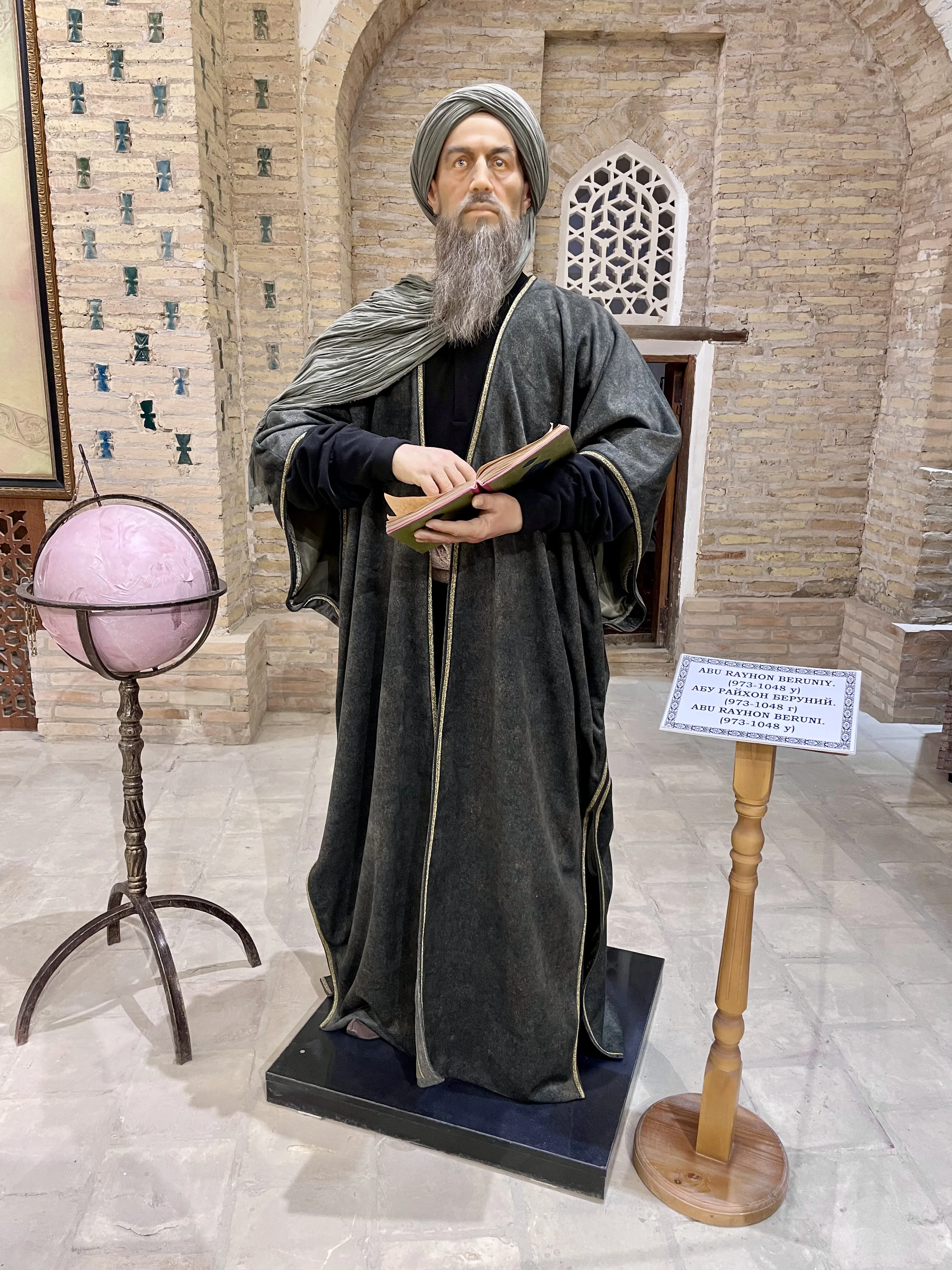
Abu Rayhan Muhammad ibn Ahmad al-Biruni (973–1048 CE / 362–440 AH) was one of the most wide-ranging and original intellects of the Islamic Golden Age — a mathematician, astronomer, geographer, historian, pharmacologist, and comparative scholar whose work spanned disciplines that would not be formally separated for centuries. He calculated the Earth's circumference with remarkable accuracy using a method of his own devising, wrote the most comprehensive medieval study of Indian civilization, compiled an astronomical encyclopedia that synthesized and extended the Greek and Islamic astronomical traditions, and produced a systematic comparison of the calendar systems of a dozen ancient and medieval civilizations. He did all of this while living, for much of his adult life, as a scholar attached to a court he had not chosen and a ruler he did not admire.
Al-Biruni is sometimes described as the founder of anthropology, or of comparative religion, or of geodesy — claims that are all somewhat anachronistic but that point toward something real. He was a thinker who consistently approached unfamiliar civilizations and traditions with the same systematic rigor he brought to astronomical observation: gathering primary sources, learning the relevant languages, suspending judgment, and describing what he found on its own terms before offering his own assessment. This combination of empirical discipline and intellectual openness was unusual in the medieval world, and it produced work that remains remarkable more than a thousand years after it was written.
Historical Context: Khwarezm and the Ghaznavid World
Al-Biruni was born in 973 CE in Kath, the capital of Khwarezm — a prosperous region in Central Asia centered on the lower Oxus River (modern Uzbekistan and Turkmenistan) that had been a center of Persian-Islamic culture for centuries. The cities of Samarkand and Bukhara were nearby, and the intellectual traditions of the region were rich: Khwarezm had produced important scholars in mathematics, astronomy, and medicine, and the young al-Biruni grew up in an environment that valued learning and had access to the accumulated knowledge of Greek, Persian, and Indian science.
His early career was spent in Khwarezm under the patronage of the local Khwarazmshah dynasty, and it was productive. He conducted astronomical observations, wrote his first major work — al-Athar al-Baqiya (The Chronology of Ancient Nations), completed around 1000 CE — and began the correspondence with Ibn Sina that would become one of the most interesting intellectual exchanges of the medieval Islamic world. The two scholars, roughly contemporaries, exchanged a series of questions and answers on Aristotelian natural philosophy — al-Biruni posing sharp challenges to received Aristotelian doctrine, Ibn Sina defending it with characteristic confidence. The exchange reveals al-Biruni's characteristic intellectual independence: he was willing to question even the most authoritative philosophical tradition when his observations suggested it was wrong.
This relatively settled period ended in 1017 CE when the Ghaznavid sultan Mahmud of Ghazni conquered Khwarezm. Mahmud was one of the most powerful rulers of his era — a military commander of genius who had built an empire stretching from Khorasan to the Punjab through a series of devastating campaigns — but he was not, by most accounts, a man of great intellectual sympathy. He valued scholars as ornaments of his court and as useful sources of practical knowledge, but he was not the kind of patron who engaged with ideas. Al-Biruni was taken to Ghazni, the Ghaznavid capital in present-day Afghanistan, as part of the spoils of conquest. He would spend the rest of his life there.
A Captive Scholar at the Ghaznavid Court
Al-Biruni's situation at the Ghaznavid court was comfortable in material terms but constrained in ways that he occasionally made clear in his writings. He had access to excellent libraries, instruments, and the resources needed for his research. He was respected and well-compensated. But he had not chosen to be there, and the court's priorities — military campaigns, political administration, the display of wealth and power — were not his.
What the Ghaznavid court did give him, unexpectedly, was access to India. Mahmud conducted seventeen military campaigns into the Indian subcontinent between 1000 and 1027 CE, and al-Biruni accompanied several of them. These campaigns were destructive — Mahmud's forces sacked temples, carried off enormous wealth, and left a trail of devastation — but they also brought al-Biruni into direct contact with Indian civilization in a way that no previous Islamic scholar had experienced. He learned Sanskrit. He read primary texts. He interviewed Indian scholars and priests. And he began accumulating the material that would eventually become Kitab al-Hind.
He was not uncritical of what he observed. He noted the insularity of Indian intellectual culture, the difficulty of extracting reliable information from scholars who were suspicious of outsiders, and the ways in which Indian science had developed in isolation from the Greek and Islamic traditions he knew. But he was genuinely curious, genuinely respectful, and genuinely committed to understanding Indian civilization on its own terms rather than through the lens of Islamic superiority. This combination of critical engagement and intellectual respect was what made Kitab al-Hind extraordinary.
There is a further detail about his position at court that is not incidental, because it bears on how his scientific work should be read. The office in which he served the Ghaznavids was, at least in part, that of court astrologer — and al-Biruni held astrology in open contempt, ridiculing the pretensions of those who claimed to forecast events from the heavens. He wrote on the subject nonetheless, and at length: Kitab al-Tafhim li-Awa'il Sina'at al-Tanjim ("The Book of Instruction in the Elements of the Art of Astrology"), running to some five hundred and thirty short sections, is an introduction to the whole apparatus of mathematical astronomy and to the astrological art built upon it. The arrangement is telling. The astronomy is presented as knowledge; the astrological superstructure is presented as the thing a practitioner must know about, its claims set out without their being endorsed.
The position this put him in was awkward and he did not conceal it. A scholar dependent on a patron who wanted horoscopes had either to supply them or to lose his place, and al-Biruni supplied them while making his estimate of their value reasonably plain in what he wrote. It is worth registering as a corrective to any picture of the Islamic scientific tradition as either uniformly credulous about astrology or uniformly free of it. The same man could compute a planetary position to the limits of his instruments and regard the prediction drawn from it as worthless.
The Chronology of Ancient Nations
Al-Biruni's first major work, al-Athar al-Baqiya an al-Qurun al-Khaliya (The Chronology of Ancient Nations, or Vestiges of the Past), completed around 1000 CE, was a systematic comparison of the calendar systems used by different civilizations — Greeks, Romans, Persians, Jews, Christians, Arabs, Zoroastrians, Sabians, and others. For each system, al-Biruni explained the underlying astronomical basis, described the months and their names, documented the major festivals and their significance, and showed how the system related to the others.
This was not merely a technical exercise in calendar conversion. Al-Biruni was interested in what calendar systems revealed about the civilizations that used them — how they organized time, what they considered sacred, how they related their own history to the movements of the heavens. He approached each tradition with the same systematic curiosity he would later bring to India, describing Zoroastrian festivals and Jewish holy days and Christian liturgical cycles with equal care and without privileging any of them over the others.
The Chronology also contains some of al-Biruni's most interesting methodological reflections. He was acutely aware of the ways in which historical accounts could be distorted by cultural bias, political interest, and the passage of time, and he developed explicit criteria for evaluating the reliability of sources. His insistence on cross-referencing different traditions against each other — using astronomical data to check historical claims, comparing accounts from different cultures to identify where they agreed and where they diverged — anticipated the source-critical methods that would become standard in European historical scholarship only centuries later.
Measuring the Earth: Geodesy from a Mountain
One of al-Biruni's most celebrated scientific achievements was his calculation of the Earth's circumference, carried out during the Ghaznavid campaigns in India. The method he used was elegant and original, requiring only a single mountain and a few trigonometric calculations.
The standard method for measuring the Earth's circumference, used by the Greek astronomer Eratosthenes and by Islamic astronomers before al-Biruni, required two observers at different latitudes measuring the angle of the sun or a star simultaneously. This was logistically demanding and required coordinated observations across large distances. Al-Biruni devised a method that could be carried out by a single observer.
Standing at the top of a mountain of known height, he measured the angle of dip to the horizon — the angle between the horizontal and the line of sight to the point where the Earth's surface disappeared from view. Using the height of the mountain and this angle, he could calculate the radius of the Earth through straightforward trigonometry. He carried out this measurement at a mountain near the town of Nandana in the Punjab, obtaining a value for the Earth's circumference that was remarkably close to the modern figure. The method was not only accurate but methodologically significant: it demonstrated that a single careful observer with good instruments could obtain reliable geodetic data without the logistical complexity of coordinated multi-site observations.
The Qanun al-Mas'udi: An Astronomical Encyclopedia
Al-Biruni's al-Qanun al-Mas'udi (The Mas'udic Canon), dedicated to Sultan Mas'ud — Mahmud's son and successor — and completed around 1030 CE, was his most comprehensive scientific work. It was an astronomical encyclopedia of the first rank, covering the full range of mathematical astronomy: spherical trigonometry, the theory of the solar, lunar, and planetary motions, the calculation of eclipses, the determination of geographic coordinates, and the construction and use of astronomical instruments.
The Qanun was not merely a compilation of existing knowledge. Al-Biruni engaged critically with his sources — Ptolemy's Almagest, the Indian astronomical tradition (siddhanta), and the work of earlier Islamic astronomers — identifying errors, proposing corrections, and in some cases developing new methods. His treatment of trigonometry was particularly significant: he systematized and extended the trigonometric methods that had been developed by earlier Islamic mathematicians, producing tables and formulas that were more accurate and more comprehensive than anything previously available.
He also addressed, in the Qanun, the question of whether the Earth moves. He noted that the astronomical observations were equally consistent with a stationary Earth and a rotating one, and that the choice between the two models was not a matter that astronomy alone could settle. This was a remarkably sophisticated methodological observation — recognizing that empirical data could be consistent with multiple theoretical frameworks — and it anticipates the kind of argument that Copernicus and Galileo would make five centuries later.
Kitab al-Hind: The Study of Indian Civilization
Al-Biruni's Kitab fi Tahqiq ma lil-Hind (A Book Confirming What Pertains to India), usually known simply as Kitab al-Hind, completed around 1030 CE, is his most celebrated work and one of the most remarkable works of cross-cultural scholarship in the medieval world. It is a systematic account of Indian civilization — its philosophy, religion, mathematics, astronomy, geography, customs, and literature — written for a Muslim audience that knew almost nothing about India and that was likely to approach it with a mixture of curiosity and condescension.
Al-Biruni's approach was methodologically self-conscious in a way that was unusual for his time. He learned Sanskrit — a difficult undertaking for an adult scholar — and read primary texts directly rather than relying on translations or intermediaries. He interviewed Indian scholars and priests, asking them to explain their own traditions in their own terms. And he explicitly set aside his own judgments about the truth or falsity of what he was describing, presenting Hindu philosophy, cosmology, and religious practice as coherent systems that deserved to be understood on their own terms before being evaluated.
The result was a work of extraordinary breadth and depth. Al-Biruni described the major schools of Hindu philosophy — Samkhya, Yoga, Vedanta — with enough accuracy that modern scholars of Indian philosophy have found his accounts useful. He described the Indian astronomical tradition, noting both its similarities to and differences from the Greek and Islamic traditions he knew, and identifying specific mathematical techniques that the Indians had developed independently. He described the caste system, the geography of the subcontinent, the major religious festivals, and the literary traditions of Sanskrit poetry and drama.
He was not uncritical. He noted what he saw as the insularity and arrogance of Indian scholars, their reluctance to share knowledge with outsiders, and the ways in which the caste system restricted the transmission of learning. He compared Indian philosophical positions with Greek and Islamic ones, sometimes finding the Indian positions wanting. But these criticisms were offered within a framework of genuine respect and genuine curiosity, and they were always grounded in specific observations rather than general prejudice.
The Kitab al-Hind had no real precedent in Islamic literature and no real successor for centuries. It was, as the historian Edward Sachau wrote in his nineteenth-century translation, "a unique work in the literature of the world." Its combination of linguistic competence, methodological rigor, and intellectual openness made it a model of cross-cultural scholarship that later anthropologists and historians of religion have recognized as genuinely anticipating their own disciplines.
Reading the Earth: Al-Biruni's Geology
Among the observations al-Biruni made during the Indian campaigns was one that had nothing to do with the culture he had come to study, and it shows the habit of mind that made him unusual.
Travelling across the plains of the Indus valley and northern India, he noticed the character of the ground: rounded stones, the kind worn smooth by moving water, and deep beds of sediment lying where no river now ran deep enough to have laid them. He noticed too that the stones grew smaller and the deposits finer as one moved away from the mountains and towards the sea. From this he drew an inference about the history of the landscape rather than about its present state — that the plains had once been a sea basin, gradually filled by material carried down from the highlands over an extent of time long enough for the process to have completed itself.
The inference is set out in Kitab al-Hind, alongside the philosophy and the astronomy, and it is a piece of geological reasoning in the strict sense: it treats the present configuration of the land as the outcome of processes still observably at work, and it reads the deposits as a record of those processes. This is the principle that European geology would later formalise, and al-Biruni arrived at it in the eleventh century from the evidence in front of him.
Two cautions are in order. He did not develop the observation into a systematic theory of the earth, and it would be an overstatement to describe him as the founder of a discipline he did not found. Nor did he possess any means of estimating the timescales involved beyond the recognition that they must be very long. What the passage demonstrates is not a geological system but a method — the willingness to infer past process from present evidence — which is the same method his historical and chronological work applied to human records.
Mineralogy, Weight, and the Measurement of Substances
Al-Biruni's work on minerals is among his most technically impressive and is almost entirely unknown outside the specialist literature.
Its foundation is a physical problem: how to characterise a substance so that it can be identified with certainty. His answer was density. In a treatise on the ratios between metals and precious stones with respect to volume and weight, written between about 1010 and 1017, he set out measurements of the specific gravity of a long series of metals and gemstones, obtained by weighing samples in air and again in water and comparing the results. The instrument was a conical vessel designed to displace a measurable volume, and the technique required extreme care in the handling of small quantities. The values he obtained are, for a substantial number of the substances, close to the figures accepted today — an accuracy that is difficult to achieve even with modern balances and that stands as one of the most exact sets of physical measurements produced anywhere before the early modern period.
The larger work on the subject is Kitab al-Jamahir fi Ma'rifat al-Jawahir ("The Book of Multitudes, on the Knowledge of Precious Stones"), a treatise on minerals and gems that combines this physical data with descriptions of appearance, hardness, and provenance, with the commercial values attaching to each, and with the accounts given of them in earlier literature. It is simultaneously a work of physics, a mineralogical handbook, and a source for the trade in stones across the medieval Islamic world.
What connects this to the rest of his output is the conviction that a quantity carefully measured settles a question that description alone leaves open. It is the same conviction behind the geodetic measurement at Nandana and behind his insistence in the Chronology on checking historical claims against astronomical data.
Kitab al-Saydana and the Craft of the Pharmacist
Al-Biruni's last work was on drugs. Kitab al-Saydana ("The Book of Pharmacy"), arranged alphabetically and compiled at the very end of his long life, catalogues medicinal substances with their properties, their sources, and — a characteristic touch — their names in the several languages in which he had encountered them, Arabic, Persian, Greek, Syriac, and Sanskrit among them. For the historian of medicine the multilingual nomenclature is much of the value: it allows substances named differently in different traditions to be identified with one another.
His prefatory definition of the pharmacist's craft is worth attending to, because it states a standard rather than describing a trade. The saydalani, on his account, is one who makes a profession of gathering medications in their best forms and of testing the best types experimentally, whether simple or compound, according to the formulas transmitted by the most reputable physicians. Three requirements are packed into that: the material must be sound, the selection must be tested rather than assumed, and the authority relied upon must be the best available. It is the same standard he applied to astronomical data and to historical reports.
The transmission history of the book is itself instructive about how much of the medieval scientific corpus survives by chance. For a long period the work was known to European scholarship only through a Persian translation, the Arabic original being presumed lost; the Arabic text was identified by Zeki Velidi Togan at Bursa in 1926. A full edition and English translation was produced in 1973 by a team at the Hamdard National Foundation in Karachi under Hakim Mohammad Said, with a companion volume of introduction and commentary by Sami Hamarneh of the Smithsonian Institution. That a major work by one of the most celebrated scholars of the Islamic world waited nine centuries for an edition indicates how much of this literature remains unexamined.
The Correspondence with Ibn Sina
The philosophical correspondence between al-Biruni and Ibn Sina, conducted in the early eleventh century, is one of the most interesting intellectual exchanges of the medieval Islamic world. Al-Biruni posed a series of questions about Aristotelian natural philosophy — questions about the nature of heat and cold, the movement of heavy bodies, the existence of a vacuum, and the structure of the heavens — and Ibn Sina responded with detailed answers defending the Aristotelian position.
What makes the exchange remarkable is al-Biruni's willingness to challenge Aristotle directly. He questioned whether Aristotle's account of the elements was consistent with observation, whether the Aristotelian prohibition on a vacuum was empirically justified, and whether the circular motion of the heavens was as self-evident as Aristotle claimed. Ibn Sina's responses were confident and technically accomplished, but al-Biruni was not always persuaded, and he said so.
The exchange reveals the difference between the two scholars' intellectual temperaments. Ibn Sina was a systematic philosopher who worked within the Aristotelian framework and sought to perfect it; al-Biruni was an empiricist who was willing to question any framework when his observations suggested it was inadequate. Both approaches were valuable, and the tension between them — between systematic theory and empirical observation — is one of the productive tensions at the heart of the scientific enterprise.
Legacy
Al-Biruni died in Ghazni around 1048 CE at approximately seventy-five years of age, having spent the last three decades of his life at a court he had not chosen but had used productively. His output was extraordinary: medieval bibliographers attributed more than a hundred and forty works to him, covering astronomy, mathematics, geography, mineralogy, pharmacology, history, and comparative religion. Most of these works have been lost, but what survives is enough to establish him as one of the most original and wide-ranging scholars of the medieval world.
His influence on subsequent Islamic scholarship was significant but uneven. His astronomical work was known and used by later Islamic astronomers. His Kitab al-Hind was read and cited, though its full significance was not always appreciated. His methodological innovations — the systematic use of primary sources, the explicit attention to cultural bias, the willingness to question received authority — did not generate a school of followers in the way that al-Ghazali's synthesis of law and spirituality had done.
His rediscovery in the modern period came largely through European scholarship. Edward Sachau's translation of Kitab al-Hind in 1888 introduced al-Biruni to Western readers and established his reputation as a pioneer of comparative cultural studies. Since then, his standing has grown steadily. He is recognized as a major figure in the history of astronomy, mathematics, and geography, and as a genuine precursor of the anthropological and comparative religious studies that would develop as formal disciplines in the nineteenth and twentieth centuries.
What al-Biruni represents, at his best, is a particular ideal of scholarship: the willingness to go where the evidence leads, to learn what needs to be learned in order to understand what one is studying, and to describe what one finds with honesty and precision even when it challenges one's own assumptions. In the Islamic Golden Age that produced al-Kindi, al-Razi, Ibn Sina, and Ibn al-Haytham, al-Biruni stands as the figure who most fully embodied the ideal of the scholar as a citizen of the world of knowledge — someone for whom no civilization was too foreign to understand and no question too difficult to ask.
References and Further Reading
Primary Islamic Sources
- Al-Biruni, Abu Rayhan. Kitab fi Tahqiq ma lil-Hind (Indica — on Indian religion, philosophy, and science). Translated by Edward Sachau. London: Trübner, 1888. [Original c. 1030 CE]
- Al-Biruni, Abu Rayhan. Al-Athar al-Baqiyah an al-Qurun al-Khaliyah (Chronology of Ancient Nations). Translated by C. Edward Sachau. London: William H. Allen, 1879. [Original c. 1000 CE]
- Al-Biruni, Abu Rayhan. Al-Qanun al-Mas'udi fi al-Hay'a wa al-Nujum (Mas'udi Canon on Astronomy). Hyderabad: Dairat al-Ma'arif al-Uthmaniyyah, 1954. [Original c. 1030 CE]
- Al-Biruni, Abu Rayhan. Kitab al-Saydana fi al-Tibb (Book of Pharmacy). Edited and translated by Hakim Mohammad Said, with a commentary volume by Sami K. Hamarneh. Karachi: Hamdard National Foundation, 1973. [Original c. 1050 CE]. His last work; the Arabic original was identified by Zeki Velidi Togan at Bursa in 1926, having previously been known only through a Persian translation.
- Al-Biruni, Abu Rayhan. Kitab al-Jamahir fi Ma'rifat al-Jawahir (Book of Multitudes, on the Knowledge of Precious Stones). [Original 11th century CE]. Treatise on minerals and gems combining specific-gravity measurements with description, provenance, and commercial value.
- Al-Biruni, Abu Rayhan. Kitab al-Tafhim li-Awa'il Sina'at al-Tanjim (Book of Instruction in the Elements of the Art of Astrology). [Original c. 1029 CE]. Introduction in some 530 sections to mathematical astronomy and to the astrological art built upon it.
Classical Islamic Sources
- Al-Qifti, Ali ibn Yusuf. Tarikh al-Hukama, biography of al-Biruni. [Original c. 1248 CE]
- Ibn Abi Usaybi'a. Uyun al-Anba fi Tabaqat al-Atibba, entry on al-Biruni. [Original c. 1270 CE]
- Yaqut al-Hamawi. Mu'jam al-Udaba (Dictionary of Scholars), entry on al-Biruni. [Original c. 1229 CE]
Academic and Scholarly Sources
- Sachau, C. Edward. Alberuni's India. 2 vols. London: Kegan Paul, 1910.
- Kennedy, E.S. "Al-Biruni." In Dictionary of Scientific Biography, edited by Charles Coulston Gillispie, Vol. 2. New York: Scribner's, 1970.
- Saliba, George. Islamic Science and the Making of the European Renaissance. Cambridge: MIT Press, 2007.
- Starr, S. Frederick. Lost Enlightenment: Central Asia's Golden Age. Princeton: Princeton University Press, 2013.
- Rashed, Roshdi, ed. Encyclopedia of the History of Arabic Science. 3 vols. London: Routledge, 1996.
- Boilot, D.J. "Al-Biruni." In Encyclopaedia of Islam, 2nd ed. Leiden: Brill, 1960.
- "Bīrūnī, Abū Rayḥān: Pharmacology and Mineralogy." Encyclopaedia Iranica. The authoritative reference treatment of Kitab al-Saydana and the mineralogical work, including the manuscript history and the modern editions.
- Anawati, G. C. Studies on the authenticity and manuscript tradition of Kitab al-Saydana (1976). On the textual basis for attributing the work to al-Biruni.
Further Reading
- Al-Khalili, Jim. The House of Wisdom. New York: Penguin Press, 2011.
- Turner, Howard R. Science in Medieval Islam. Austin: University of Texas Press, 1997.
- Hogendijk, Jan P., and Abdelhamid I. Sabra, eds. The Enterprise of Science in Islam. Cambridge: MIT Press, 2003.
- Hill, Donald R. Islamic Science and Engineering. Edinburgh: Edinburgh University Press, 1993.
Mentioned In
17 articles reference this topic
and 5 more articles
More from Islamic Golden Age
Algebra
Algebra takes its name from the Arabic al-jabr, an operation described by al-Khwarizmi in his ninth-century treatise that established the discipline. Building on Babylonian, Greek, and Indian traditions, his framework for solving equations later shaped European science.
House of Wisdom
The House of Wisdom (Bayt al-Hikma) was the premier intellectual institution of the Islamic Golden Age, established in Baghdad under the Abbasid caliphs. For over a century it was the world's leading center for translation, research, and scholarship across the sciences.
Islamic Astronomy and Navigation: Mapping the Heavens and Seas
Islamic astronomers revolutionized celestial study during the Golden Age, building observatories, creating astronomical tables, developing instruments like the astrolabe, and making discoveries that transformed navigation and cosmology.
Islamic Contributions to Science and Medicine: A Comprehensive Guide
Islamic scholars made groundbreaking contributions to science, medicine, mathematics, and astronomy during the 8th-15th centuries, preserving ancient knowledge and advancing human understanding through systematic research and institutional support.