Al-Zamakhshari: The Language of the Qur'an
Al-Zamakhshari (1075-1144) was an Arabic scholar of Khwarazm whose commentary Al-Kashshaf read the Qur'an through its grammar and rhetoric. Completed at Mecca, where he earned the name Jar Allah, it became a standard text of Islamic learning despite his Mu'tazilite theology.
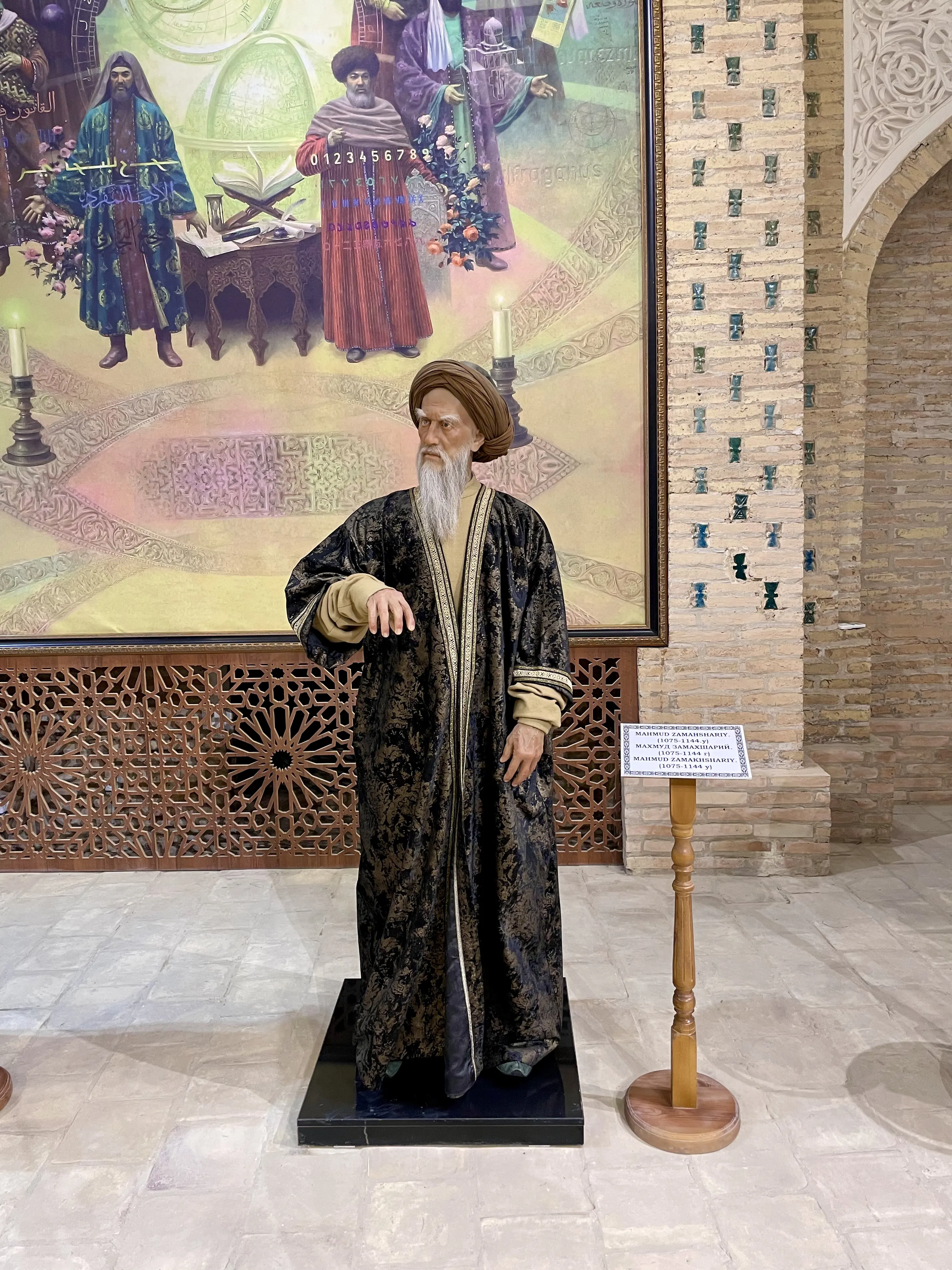
Abu al-Qasim Mahmud ibn Umar al-Zamakhshari (1075 – 1144 CE / 467 – 538 AH), known by the honorific Jar Allah, "the neighbour of God", was a scholar of Arabic language and Qur'anic exegesis from Khwarazm, the region south of the Aral Sea. Encyclopaedia Britannica describes him as a Persian-born Arabic scholar and gives his birth as 18 March 1075 in Khwarazm and his death as 14 June 1144 at al-Jurjaniya in the same region; the approved library independently places his death in 538 AH, which corresponds to the same year.
His reputation rests on a single decision about method. Al-Zamakhshari approached the Qur'an as a work of Arabic before he approached it as anything else, on the conviction — Britannica records it plainly — that Arabic was the paramount language. The commentary that resulted, al-Kashshaf 'an Haqa'iq al-Tanzil, completed in 1134, examines the revelation through its grammar, its word choice and its figures of speech, asking at every turn what a particular construction is doing and why another was not used. It is a book about how the Qur'an says what it says.
That approach carried it a long way. Al-Zamakhshari was affiliated with the Mu'tazilah, a school of theology whose central positions were not those that the Sunni majority settled on, and his commentary carries those leanings. It was read anyway, and it was read for centuries: Britannica notes that despite its theological colouring the work was widely read and is valued for the comprehensiveness with which it treats the text. In India it became one of three standard tafsir texts of the madrasa curriculum for some two hundred years. Ibn Kathir engaged with it verse by verse in the fourteenth century, sometimes to record his agreement. Modern commentaries in the approved library still cite it as a matter of course. Few books in Islamic scholarship have been used so steadily by readers who did not share their author's theology.
Khwarazm in the Eleventh and Twelfth Centuries
The land and its rulers
Khwarazm was the oasis region of the lower Oxus, lying in what is now split between Uzbekistan and Turkmenistan — Britannica, giving al-Zamakhshari's birthplace, notes the modern division. It was neither a periphery nor a backwater. Irrigated agriculture supported dense settlement, and the region sat on the routes running north from Iran and Transoxiana towards the steppe and the Volga.
Its politics in al-Zamakhshari's lifetime were in transition. Britannica records that from the late eleventh century to the early thirteenth Khwarazm was governed by an independent dynasty, the Khwarazm-Shahs, and that thereafter it passed in turn to the Mongols, the Timurids and the Shaybanids until it became the centre of the khanate of Khiva under the Uzbek Ilbar dynasty. Al-Zamakhshari was born, then, at the beginning of the period in which Khwarazm became a power in its own right rather than a province of somebody else's empire. He died in it, at al-Jurjaniya, the seat of that dynasty.
A frontier of learning
The scholarly geography mattered more to his life than the political geography, and it ran along the same roads. To the south-east lay Bukhara and Samarkand, the two great teaching cities of Transoxiana; to the south-west, across Iran, lay Baghdad, still the seat of the caliphate and the largest concentration of scholarship in the Islamic world. Al-Zamakhshari studied in the first two and spent time in the third, and the region that produced him had already produced Ibn Sina at Bukhara and al-Biruni in Khwarazm itself. This was the same eastern Iranian world that had given Arabic letters some of its most exacting grammarians, and the point is worth holding onto: the man who would write the most linguistically demanding commentary on the Qur'an in Arabic was not a native speaker of it.
Name, Birth and Early Years
The name
The nisba al-Zamakhshari attaches him to a place; the name is formed exactly as al-Khwarizmi's attaches him to Khwarazm and al-Bukhari's to Bukhara. His full name as the sources give it is Abu al-Qasim Mahmud ibn Umar al-Zamakhshari. In the library he appears variously as al-Zamakhshari, az-Zamakhsharee and Allamah Zamakhshari, the last a title of learning rather than part of the name.
The second name is the one that carries a story. Jar Allah, the neighbour of God, was earned rather than inherited, and it was earned by residence: Britannica records that he lived at least twice in Mecca, once for an extended period, and that it was there that the epithet attached to him. To be God's neighbour, in this usage, is to live beside the Sacred House. It is the name by which much of the later tradition knows him, and it fixes the geographical fact that matters most about his life — that a scholar of the far north-east of the Islamic world did his most important work in its sacred centre.
Birth
Britannica gives 18 March 1075 for the birth, and the region of Khwarazm for the place. The approved library does not give a birth date at all. It gives the death: The Unchallengeable Miracles of the Qur'an records him as "Al-Zamakhshari (d. 538 A.H.)", and the textbook Islamic Studies Grade 10 independently prints the same year. 538 AH ran from mid-1143 to mid-1144, so the library and Britannica are describing the same event, and the death is the better-attested of the two dates.
What the sources do not record
Nothing in the approved base names his parents, his household, his first teacher, or a single incident of his childhood. There is no account of how he came to study, who paid for it, or why he left Khwarazm. This is ordinary for a scholar rather than a ruler in the twelfth century, and it is left as a blank here rather than filled by inference.
Education and Travels
Britannica summarises his movements in a sentence that repays unpacking: he was apparently well travelled, he studied at Bukhara and Samarkand, and he also spent time at Baghdad.
Bukhara and Samarkand
The two cities of Transoxiana were, by the eleventh century, the established centres of Hanafi legal learning and of the Arabic sciences in the eastern Islamic world. Bukhara had produced Muhammad ibn Isma'il al-Bukhari, whose collection became the most authoritative of the hadith compilations, and Samarkand was its counterpart on the Zarafshan. A student of Arabic grammar and rhetoric had good reason to go to both, and the discipline al-Zamakhshari later brought to the Qur'an — the habit of asking what a particle is doing in a clause — is the discipline those schools taught.
Baghdad
Time at Baghdad put him in the city where the philological tradition of the Arabic grammarians had been assembled and argued over for three centuries, and where the theological schools maintained their libraries and their teachers. His Mu'tazilite affiliation, discussed below, is most naturally accounted for by contact of this kind, though the approved sources do not name the teachers through whom it came and no such claim is made here.
Mecca and the name Jar Allah
The Meccan residences were the decisive ones. Britannica records two, one of them extended, and it is to a stay at Mecca that the completion of al-Kashshaf belongs — the commentary was finished in 1134, in the last decade of his life, after the travelling was largely done. That a book so concerned with the fine grain of Arabic should have been completed in the Hijaz, among native speakers, in sight of the sanctuary the Qur'an itself addresses, is a fact about the book worth registering.
Theological Affiliation
The Mu'tazilah
Britannica, in its account of al-Kashshaf, states that al-Zamakhshari was affiliated with the rationalist Mu'tazilah school of theology. The Mu'tazilite school had taken shape in the second Islamic century and had been the dominant theological current at the Abbasid court for a period in the third; by al-Zamakhshari's day it was a minority position within a Sunni world that had largely settled elsewhere.
Its distinctive commitments, as Britannica sets them out, were three, and they hang together. The Mu'tazilah emphasised the absolute unity of God, and concluded from it that the Qur'an was created rather than eternal. They emphasised the justice of God, and concluded from it that human beings possess free will and are accountable for what they do. And from that accountability they drew the further conclusion that God must reward good and punish evil. Each position begins from an attribute of God and reasons outward.
These are theological conclusions reached by argument, and they were contested by argument. The positions that became the Sunni majority view differ from them on each point. This article states the difference and does not adjudicate it; the doctrinal history belongs to the article on the Mu'tazilite school, and the question of the Qur'an's eternity to the article on the Qur'an.
What the affiliation meant for his work
The practical consequence for a reader of al-Kashshaf is that the commentary's theological passages proceed from premises many of its users did not accept, while its linguistic passages proceed from a discipline they did. That is the structural reason the book had the reception it had. Britannica's formulation is exact: despite its theological leanings the commentary was widely read, and it is celebrated for the comprehensiveness with which it explores the text.
The pattern is visible in how the library's own commentaries use him. When Ibn Kathir cites al-Zamakhshari, it is on the meaning of a particle, the force of a repetition, the sense of a word. When Mufti Muhammad Shafi cites him in Ma'ariful Qur'an, it is on a point of grammar with legal consequences. Nobody in the approved library cites him for a doctrine. They cite him for the language, which is what he was best at, and they take the language and leave the rest.
The Works
Al-Kashshaf
The commentary's full title is given in the bibliography of Atlas of the Qur'an as al-Kashshaf 'an Haqa'iq al-Tanzil wa 'Uyun al-Aqawil fi Wujuh al-Ta'wil, which the volume describes simply as a well-known book of tafsir and cites in the Dar al-Fikr edition published at Beirut. Britannica renders the shorter form of the title as "The Discoverer of Revealed Truths" and dates the completion of the work to 1134. The elements of the longer title describe the method: the uncovering of the realities of the revelation, and the choicest of the sayings on the modes of interpretation. It is a book that gathers the readings and then judges between them.
Its scale and its focus are both recorded. Britannica describes it as an exhaustive linguistic commentary that goes into the Qur'an's linguistic nuance and its grammatical intricacies. Ma'ariful Qur'an refers to it in passing as "the famous Tafsir Kashshaf", which is the way a work is described when its standing needs no argument.
Al-Mufassal fi ilm al-Arabiyah
His second major work is a treatise on the Arabic language itself rather than on the Qur'an. Britannica dates al-Mufassal fi 'ilm al-'Arabiyah to between 1119 and 1121 and describes it as celebrated for a treatment of Arabic linguistics that is concise and comprehensive at once. The dating places it more than a decade before al-Kashshaf, which matters for understanding the sequence of his career: the grammar came first, and the commentary was written by a man who had already set out his account of how the language worked.
Mountains, Places and Waters
A third work belongs to a different discipline altogether. Atlas of the Qur'an, discussing earlier books that described places without illustrating them, names among them Mountains, Places, and Waters by al-Zamakhshari. It is a work of descriptive geography, and its existence corroborates the range that The Unchallengeable Miracles of the Qur'an attributes to him when it records that, although known as a scholar of tafsir, he also had knowledge of geography, linguistics and literature.
The geographical interest is not incidental to the rest. A commentator who wants to know exactly what a word denotes has a reason to want to know exactly what a place is, and The History of Islam shows him being used for precisely that: Akbar Shah Najeebabadi, discussing the pre-Islamic Arabian past, reports that "Allamah Zamakhshari has written that he built the city of Iram in the desert of Aden but it is now traceless", the reference being to Shaddad ibn Ad. Najeebabadi goes on to distinguish the Qur'anic Iram, which he takes to refer to the tribe rather than to a city or a garden — an instance of a later writer citing al-Zamakhshari for a report and then declining to follow him on the interpretation.
Al-Muwafaqah bayna Ahl al-Bayt wa'l-Sahabah
A fourth title surfaces in the apparatus of Ali Muhammad as-Sallabi's biography of Uthman ibn Affan, which cites al-Mukhtasar min Kitab al-Muwafaqah bayna Ahl al-Bayt wa'l-Sahabah — the abridgement of the Book of Concord between the Family of the Prophet and the Companions — as a work of al-Zamakhshari, noting a manuscript held in a university library and a printed edition from Dar al-Hadith. The subject is the relations between the Prophet's household and his Companions, and the title indicates a work arguing for their concord.
Method: Language as the Key to the Qur'an
The character of al-Zamakhshari's exegesis is easier to show than to summarise, and the approved library preserves enough worked examples to show it.
Grammar with consequences: the categories of zakat
The clearest example concerns zakat, and it is set out in Ma'ariful Qur'an. The Qur'anic verse enumerating the categories of people entitled to receive the alms uses two different prepositions across its list: the particle lam for the first categories — for the poor, for the needy — and then the particle fi for the last four, in the freeing of slaves, in the relief of debtors.
Al-Zamakhshari asked why. His answer, as Ma'ariful Qur'an reports it from al-Kashshaf, is that the change is deliberate and signals that the last four categories are the more deserving. His reasoning is that fi denotes attending circumstances or conditions, so that the sense becomes that the alms are to be placed within these people and their situations, and the ground of their greater claim is their greater need — a person owned by another suffers more than a person who is merely poor. When the same particle recurs later in the verse at fi sabil Allah, in the way of God, Ma'ariful Qur'an again reports al-Kashshaf as reading the repetition as marking that category out as more meritorious still, on the reasoning that expenditure there does two things at once, relieving a person in need and assisting a religious cause.
Whatever one makes of the conclusion, the procedure is the whole of al-Zamakhshari's method in miniature. A reader could pass over the shift from lam to fi without noticing it. He notices it, refuses to treat it as stylistic accident, and derives from it a graded order of entitlement with direct consequences for how alms are distributed. Ma'ariful Qur'an also cites al-Kashshaf on the purpose of the verse's enumeration as a whole, taking the list to have been given in order to answer an objection that the Prophet had withheld a share of the alms from those outside the community — the detail being supplied, on that reading, precisely to show that they had no claim to it.
Reading a word in its lexical sense
A second example shows him resisting a technical reading in favour of a plain one. At Qur'an 5:55 the believers are described with a word, ruku', that in Islamic usage names the bowing posture of the ritual prayer. Ma'ariful Qur'an records that the majority of commentators took the word here in its lexical sense instead — to bow, to be modest and humble — and names Abu Hayyan in al-Bahr al-Muhit and al-Zamakhshari in al-Kashshaf as having gone by that meaning, a reading Ma'ariful Qur'an and Tafsir Mazhari both adopt. The resulting sense is that the people described are not proud of their good deeds, their disposition being modesty. Here the grammarian's instinct works against a reading that a pious reader might reach for first.
The disconnected letters
Tafsir Ibn Kathir preserves al-Zamakhshari on one of the oldest puzzles in Qur'anic interpretation: the disconnected letters that open certain suras. On the question of what they are, Ibn Kathir records that al-Zamakhshari agreed in al-Kashshaf with an opinion also held by al-Mubarrid, al-Farra' and Qutrub, and by Ibn Taymiyyah and al-Mizzi after him — the company itself indicating that this was not a fringe position.
On the question of why the letters recur rather than appearing once, Ibn Kathir quotes him at length. Al-Zamakhshari's answer is that they were not all given once at the beginning of the Qur'an but repeated, so that the challenge to the Qur'an's opponents would be the more daring, in the same way that several narratives are repeated and the challenge itself is issued in several places; and he observes the pattern of the repetition, sometimes a single letter as in Sad, Nun and Qaf, sometimes two as in Ha Mim, sometimes three. The reasoning is characteristic. A feature of the text that looks like an oddity is treated as a device, and the device is explained by what it accomplishes.
Ibn Kathir cites him three more times in the same early stretch of the commentary: on the verse challenging the Qur'an's opponents to produce a sura like it, where al-Zamakhshari's reading is grouped with those of Mujahid, Qatada, Ibn Jarir al-Tabari and al-Razi; on the meaning of "or" in the two similitudes given of the hypocrites, where al-Zamakhshari takes it as marking the two comparisons as equivalent, so that either will serve, as one might say sit with al-Hasan or with Ibn Sirin; and on the breaking of the covenant, where Ibn Kathir reports an interpretation, calls it very good, and adds that it is the view al-Zamakhshari held. There is also a point of disagreement recorded without comment: on whether Satan led Adam and Eve astray on his way out of the Garden or from the earth while they remained in it, al-Zamakhshari is named for the second position.
The nineteen keepers
The Unchallengeable Miracles of the Qur'an takes up the question of why the Qur'an specifies nineteen as the number of the keepers of the Fire, and quotes al-Zamakhshari's commentary on it: believers see wisdom in the number and submit to it, holding that all God's acts are good and wise, and so are increased in faith, while those who reject it doubt and are increased in their rejection. Quoting him again on the statement that none knows the hosts of the Lord but He, the volume gives his gloss that it would therefore be no difficulty for God to increase the number, but that there is a wisdom in this particular number which is not known. The volume's own verdict on the passage is that the statements of al-Zamakhshari and al-Ka'bi on the question are acceptable and beautiful.
Weighing the force of a reply
Not all of his attention went to particles. Ma'ariful Qur'an, treating the exchange in which the believers among the people of Thamud answer those who challenged whether their prophet was sent by God, reports what "the famous Tafsir Kashshaf" made of their reply. On al-Zamakhshari's reading the answer is remarkable for what it refuses to argue: the believers treat the question of whether the man is a messenger as settled and not worth debating, and as equally certain that what he brings is a message from God, so that the only question genuinely open is who believes him and who does not — to which their reply is that they believe every word of guidance he has brought. This is rhetorical analysis rather than grammar, and it shows the same instinct at work on a larger unit. A short answer that a reader might pass over as pious formula is examined for its structure, and found to be doing something specific.
Glossing the vocabulary of the Arabs
The smallest example is also the most typical. Gardens of Purification, discussing error and its consequences, reports simply: "Due to this, al-Zamakhshari said: 'Every evil according to the Arabs is a deviation (ghayy), and every good is right guidance.'" The move is to establish what a word meant to the people whose language the Qur'an used, and to let the meaning of the verse follow from that. It is the same move as the argument about lam and fi, conducted on a single word.
Reception
Ibn Kathir
That Ibn Kathir, writing in the fourteenth century in a tradition that did not share al-Zamakhshari's theology, cites al-Kashshaf repeatedly and on occasion endorses its conclusions is the most telling single fact about the commentary's standing. The citations recorded above are neither polemical nor apologetic. Al-Zamakhshari appears in them as one authority among the authorities — named alongside al-Tabari, al-Razi, al-Qurtubi, Mujahid and Qatada — to be followed where he is right and departed from where he is not.
The Indian madrasa curriculum
History of the Dar al-Ulum Deoband records the curricular afterlife in India with unusual precision. Its account of the older Indian syllabus follows the periodisation of Abd al-Hayy Lakhnavi, whose first period begins in the seventh Islamic century — the volume ties the opening to the reign of Sultan Shihab al-Din Ghuri, 597/1191 to 602/1205 — and runs for roughly two hundred years. In that period, the volume states, the disciplines held to constitute a standard education were grammar, syntax, literature, rhetoric, jurisprudence and its principles, logic, scholastic theology, tasawwuf, tafsir and hadith; and in tafsir the texts were three: Madarik, Baydawi and Kashshaf.
The volume also explains, without meaning to, why al-Zamakhshari should have travelled so well in India. The learning that came to the subcontinent came with Muslims arriving from Khurasan and Transoxiana, and it carried their emphases with it. Al-Zamakhshari was a product of exactly that world, and a curriculum weighted towards grammar, rhetoric and literature was one in which a commentary built on grammar and rhetoric would find a natural place. The later history of that curriculum, and of the institution that reformed it, belongs to the article on Darul Uloom Deoband.
Ma'ariful Qur'an and the modern commentaries
The use continues into the twentieth century and into traditions that are explicit about their theological commitments. Ma'ariful Qur'an, the Urdu commentary of Mufti Muhammad Shafi, draws on al-Kashshaf across its volumes, calls it famous, and adopts its readings — the treatment of ruku' at 5:55 is a case where the reading al-Zamakhshari took is the reading Ma'ariful Qur'an prefers. Tafseer as-Sa'di, in the annotation of the last three parts of the Qur'an, cites az-Zamakhshari in its footnotes on six passages, each time in the ordinary company of al-Shawkani, al-Razi, Ibn Ashur and al-Baghawi.
The Muslim 500, setting out the works that made up the traditional course of Islamic learning, lists the standard commentaries as Razi, Zamakhshari and Baydawi, Qurtubi, Jalalayn, Ibn Kathir, Nasafi and al-Wahidi's Asbab al-Nuzul. Nine centuries after it was written, al-Kashshaf is still named in the canon.
Cited outside exegesis
He is also quoted in registers that have nothing to do with grammar. Islamic Studies Grade 10, discussing the scholarly disagreement over how often blessings should be invoked upon the Prophet, introduces "Az-Zamakhsharee (d. 538 AH)" as one of the voices on the question. As-Sallabi's biography of Abu Bakr quotes him on the first caliph: "Abu Bakr's name will be juxtaposed alongside that of the Messenger of Allah until the end of time." Whatever divided him from the Sunni mainstream in theology, sentences of that kind are why he continued to be read inside it.
Death
Al-Zamakhshari died at al-Jurjaniya in Khwarazm — Britannica gives 14 June 1144 — having returned, at the end, to the region whose name he carried. The library's 538 AH agrees. He had outlived the composition of al-Kashshaf by a decade and of al-Mufassal by more than twenty years, and he died in the territory of the Khwarazm-Shahs some seventy-five years before the Mongol armies destroyed it.
Legacy
The clearest measure of al-Zamakhshari's achievement is that his book outlived his school. The Mu'tazilah did not survive as a living theological tradition; al-Kashshaf survived, was copied, was taught, was printed, and is still cited. It did so because of a distinction its readers were able to make and he had made possible: a commentary organised around the question of what the Arabic is doing can be used by anyone who accepts that the Qur'an is in Arabic, whatever they conclude about the created or uncreated status of the text.
That is not a small thing to have built. The two works for which he is remembered, al-Mufassal and al-Kashshaf, form a pair — an account of how the language works, and then an application of that account to the one text where every word was held to be exact. The habit of mind they demanded, of refusing to let any feature of the wording pass as accidental, entered the tafsir tradition and stayed in it. The scholars of the Islamic Golden Age are usually remembered for what they discovered about the world. Al-Zamakhshari is remembered for something narrower and, in its own field, no less durable: for showing how closely a sacred text could be read.
Historiographical Note
The evidence base for this article is thin in a specific way, and the shape of the thinness is worth setting out, because it determines what the article does and does not attempt.
What the approved library holds. A search of the project's PDF library across the transliterations Zamakhshari, Zamakhshary, Zamakshari, Zamakhshar, Kashshaf, Kashaf, Mufassal, Jar Allah, Jarullah, Asas al-Balagha, Rabi al-Abrar and Atwaq al-Dhahab found him cited in some thirty books and given a biography in none. The pattern is consistent: he appears as an authority whose opinion is reported, not as a subject whose life is narrated. That is why the biographical spine of this article — the dates, the places, the education, the Meccan residences, the epithet, the theological affiliation — rests on Encyclopaedia Britannica, while the account of his method and his reception rests on the library, which is rich in exactly that material and empty of the other. Britannica was on the Register of Approved External Web Sources when this article was written; it was removed from the register on 7 October 2026, so those details cannot now be re-verified from the approved base.
Bukhara or Khwarazm. One approved source dissents on the birthplace. Atlas of the Islamic Conquests, listing figures associated with Bukhara, names among those born there "Ibn Sina (980-1037 CE), exegetist Zamakhshari". Britannica gives Khwarazm, and the nisba al-Zamakhshari points the same way, since it is formed from a place name. The likeliest explanation of the discrepancy is visible in Britannica's own account, which records that he studied at Bukhara: a list of a city's notable figures can absorb a man who was educated there. That reconstruction is offered as the more probable reading and not as an established fact, and it is worth noting that the Atlas names general reference works among its sources for the passage. The article follows Khwarazm.
The precise dates. Britannica gives 18 March 1075 and 14 June 1144 without qualification. Day-precise dates for a twelfth-century scholar imply a documentary basis that the approved sources do not display, and they are reported here as that source gives them rather than independently confirmed. The death year is on firmer ground, since 538 AH appears in two library books that do not depend on Britannica.
Works not covered. Several titles regularly attributed to al-Zamakhshari in the wider literature could not be traced anywhere in the approved base and are therefore absent from the account of his writings above. A reader who has met them elsewhere should not read their absence as a judgement that they are not his; it means only that no approved source consulted here names them, and under the project's source policy an untraceable claim is left out rather than asserted. What the approved base does establish is four works, and those four are what the article describes.
The reception debate. The classical discussion of al-Kashshaf — the scholars who wrote glosses on it, those who wrote against its theology, those who produced expurgated recensions — is a substantial literature, and none of it is traceable in the approved base. This article therefore reports the reception it can document, which is the practical kind: who cited the book, on what, and in which curricula it was taught. That is a narrower claim than a full reception history and it is the claim the evidence supports. The absence should not be read as an absence of controversy.
Theology. The Mu'tazilite affiliation is stated on Britannica's authority and the school's positions are given as Britannica summarises them. The approved library, notably, never connects al-Zamakhshari to the Mu'tazilah at all — the term does not occur near his name in any of the thirty books that cite him. The article does not adjudicate the theological questions, and under the project's standards it does not carry the polemical characterisations that this subject attracts in either direction. What can be documented is that his theology differed from the Sunni majority position and that his commentary was used by Sunni scholars anyway, and both halves of that are stated.
Conclusion
Al-Zamakhshari's life, so far as the approved sources record it, is a line drawn from the lower Oxus to Mecca and back. He was born in Khwarazm in 1075, learned his Arabic in the schools of Bukhara and Samarkand and at Baghdad, wrote his grammar in his forties, lived twice beside the Sacred House and took his name from it, finished his commentary there in 1134, and died at al-Jurjaniya in 1144.
What he left was a way of reading. Al-Kashshaf treats the Qur'an as a text whose every construction is chosen, and it holds that the way into its meaning is through the language in which it was given. That conviction produced a commentary whose theology many of its readers rejected and whose philology almost none of them could do without — which is why it was still being taught in Indian madrasas six centuries later, still being quoted by Ibn Kathir, and is still footnoted in commentaries written in the twentieth century.
The approved sources give a thinner life than the subject deserves and a fuller record of his work than of his person. On the evidence available that is the honest proportion, and it is perhaps the proportion he would have recognised. The books were the point.
References and Further Reading
Primary Islamic Sources
- Al-Zamakhshari, Mahmud ibn Umar. Al-Kashshaf 'an Haqa'iq al-Tanzil wa 'Uyun al-Aqawil fi Wujuh al-Ta'wil [completed 1134 CE] — the Qur'anic commentary. Full title and the Dar al-Fikr, Beirut edition as given in the bibliography of Atlas of the Qur'an in the approved library. Not consulted directly; every passage quoted in this article is taken from the works that report it, listed below.
- Al-Zamakhshari. Al-Mufassal fi 'ilm al-'Arabiyah [written 1119–1121 CE] — the treatise on the Arabic language.
- Al-Zamakhshari. Mountains, Places, and Waters — the work of descriptive geography, named in Atlas of the Qur'an.
- Al-Zamakhshari. Kitab al-Muwafaqah bayna Ahl al-Bayt wa'l-Sahabah, in the abridgement al-Mukhtasar min Kitab al-Muwafaqah — cited from a manuscript and a Dar al-Hadith printing in as-Sallabi's biography of Uthman ibn Affan.
- The Qur'an, Surah al-Tawba (9:60) — the enumeration of the categories entitled to receive alms, the verse on which al-Zamakhshari's argument from the particles lam and fi turns.
- The Qur'an, Surah al-Ma'ida (5:55) — the verse in which ruku' is read in its lexical sense of humility rather than as the posture of prayer.
- The Qur'an, Surah al-Muddaththir (74:30-31) — the number of the keepers of the Fire, and the statement that none knows the hosts of the Lord but He.
- The Qur'an, Surah al-Fajr (89:6-8) — the people of Iram, in connection with which The History of Islam cites al-Zamakhshari on Shaddad.
Classical Islamic Sources
- Ibn Kathir, Ismail ibn Umar. Tafsir al-Qur'an al-Azim. Consulted in the approved library — for the citations of al-Kashshaf on the disconnected letters and the reason for their repetition, on the challenge to produce a sura, on the force of "or" in the two similitudes of the hypocrites, on the breaking of the covenant, and on where Satan led Adam astray.
- Al-Baydawi, Abdullah ibn Umar. Anwar al-Tanzil wa Asrar al-Ta'wil [c. 1286 CE] — the commentary taught alongside al-Kashshaf in the Indian madrasa curriculum, and itself indebted to it.
- Al-Nasafi, Abdullah ibn Ahmad. Madarik al-Tanzil wa Haqa'iq al-Ta'wil [c. 1310 CE] — the Madarik named as the third of the three standard tafsir texts of that curriculum.
- Abu Hayyan al-Andalusi. Al-Bahr al-Muhit [c. 1330 CE] — cited in Ma'ariful Qur'an alongside al-Kashshaf for the lexical reading of ruku' at Qur'an 5:55.
- Al-Tabari, Muhammad ibn Jarir. Jami' al-Bayan an Ta'wil Ay al-Qur'an [c. 900 CE] — the earlier commentary with which Ibn Kathir groups al-Zamakhshari's reading of the challenge verse.
Academic and Scholarly Sources
- Encyclopaedia Britannica, entry on Abu al-Qasim Mahmud ibn Umar al-Zamakhshari. https://www.britannica.com/biography/Abu-al-Qasim-Mahmud-ibn-Umar-al-Zamakhshari — for the birth on 18 March 1075 in Khwarazm and the death on 14 June 1144 at al-Jurjaniya; the description of him as a Persian-born Arabic scholar; the rendering of al-Kashshaf as "The Discoverer of Revealed Truths"; his study at Bukhara and Samarkand and his time at Baghdad; and the two residences at Mecca from which he took the name Jar Allah.
- Encyclopaedia Britannica, entry on Al-Kashshaf 'an Haqa'iq at-Tanzil. https://www.britannica.com/topic/Al-Kashshafan-Haqaiq-at-Tanzil — for the completion of the commentary in 1134, its concentration on linguistic nuance and grammatical intricacy, al-Zamakhshari's affiliation with the rationalist Mu'tazilah, his view of Arabic as the paramount language, and the work's wide readership notwithstanding its theological leanings.
- Encyclopaedia Britannica, entry on Al-Mufassal fi 'ilm al-'Arabiyah. https://www.britannica.com/topic/Al-Mufassal-fi-ilm-al-Arabiyah — for its composition between 1119 and 1121 and its character as a concise and comprehensive treatment of Arabic linguistics.
- Encyclopaedia Britannica, entries on the Mu'tazilah (https://www.britannica.com/topic/Mutazilah) and on Khwarezm (https://www.britannica.com/place/Khwarezm) — for the school's positions on divine unity, the created Qur'an, divine justice, free will and accountability; and for the rule of the Khwarazm-Shahs from the late eleventh to the early thirteenth century and the successive Mongol, Timurid and Shaybanid periods.
- Shafi, Mufti Muhammad. Ma'ariful Qur'an, English edition. Consulted in the approved library — for the description of al-Kashshaf as famous; al-Zamakhshari's argument from the shift between the particles lam and fi in the verse on the categories of alms, and from the repetition of fi at fi sabil Allah; his reading of the enumeration as answering an objection; the lexical reading of ruku' at Qur'an 5:55 attributed to him and to Abu Hayyan; and his comment on the reply of the believers among Thamud.
- The Unchallengeable Miracles of the Qur'an. Consulted in the approved library — for his death in 538 AH, for the statement that although known for tafsir he also had knowledge of geography, linguistics and literature, and for his commentary on the wisdom of the number nineteen, which the volume assesses as acceptable.
- Rizvi, Sayyid Mahboob. History of the Dar al-Ulum Deoband, Volume Two. Consulted in the approved library — for Abd al-Hayy Lakhnavi's periodisation of the old Indian curriculum, the opening of its first period in the seventh Islamic century under Shihab al-Din Ghuri, the disciplines it comprised, and the naming of Madarik, Baydawi and Kashshaf as its texts in tafsir.
- Atlas of the Qur'an. Consulted in the approved library — for the full Arabic title of al-Kashshaf and its Dar al-Fikr edition, and for al-Zamakhshari's Mountains, Places, and Waters.
- Najeebabadi, Akbar Shah. The History of Islam, Volume One. Consulted in the approved library — for the report attributed to him concerning Shaddad ibn Ad and the city of Iram, and for the title Allamah under which he is cited there.
- As-Sallabi, Ali Muhammad. Abu Bakr as-Siddeeq and Uthman Ibn Affan. Consulted in the approved library — for his statement on Abu Bakr's name standing beside that of the Messenger of Allah, and for the manuscript and printing of his Kitab al-Muwafaqah bayna Ahl al-Bayt wa'l-Sahabah.
- Tafseer as-Sa'di, Volume Ten. Consulted in the approved library — for the citations of az-Zamakhshari in the annotation of the last three parts of the Qur'an.
- Islamic Studies Grade 10 and Gardens of Purification. Consulted in the approved library — for his death date and his position on invoking blessings upon the Prophet, and for his gloss that among the Arabs every evil is ghayy and every good is right guidance.
Further Reading
- Lane, Andrew J. A Traditional Mu'tazilite Qur'an Commentary: The Kashshaf of Jar Allah al-Zamakhshari. Leiden: Brill, 2006 — the fullest study in English of the commentary, its composition and its later use.
- Saleh, Walid A. The Formation of the Classical Tafsir Tradition. Leiden: Brill, 2004 — on the development of the exegetical genre within which al-Kashshaf sits.
- Versteegh, Kees. The Arabic Linguistic Tradition. London: Routledge, 1997 — on the grammatical scholarship that al-Mufassal summarised and that underlies al-Zamakhshari's method.
- Gilliot, Claude. "Exegesis of the Qur'an: Classical and Medieval," in Encyclopaedia of the Qur'an, ed. Jane Dammen McAuliffe. Leiden: Brill, 2002, vol. 2, pp. 99–124 — a survey placing al-Zamakhshari among the classical commentators.
Mentioned In
1 article references this topic
More from Islamic Golden Age
Algebra
Algebra takes its name from the Arabic al-jabr, an operation described by al-Khwarizmi in his ninth-century treatise that established the discipline. Building on Babylonian, Greek, and Indian traditions, his framework for solving equations later shaped European science.
Bukhara
Bukhara, known across the Islamic world as Bukhara-i-Sharif (Noble Bukhara), was among the most important cities of Islamic civilization. Capital of the Samanid dynasty and a major Silk Road center, it produced scholars such as Imam al-Bukhari and Ibn Sina.
Ferghana Valley: The Pearl of Central Asia
The Ferghana Valley, birthplace of Babur and crossroads of Central Asian civilizations, has served as a crucial center of trade, culture, and Islamic learning for over a millennium.
House of Wisdom
The House of Wisdom (Bayt al-Hikma) was the premier intellectual institution of the Islamic Golden Age, established in Baghdad under the Abbasid caliphs. For over a century it was the world's leading center for translation, research, and scholarship across the sciences.