Hafsa bint Sirin
Hafsa bint Sirin, known as Umm al-Hudhayl, was a woman of Basra of the generation of the Successors and the sister of Muhammad ibn Sirin. The biographical dictionaries record her teachers, her pupils, the reports she transmitted, her recitation of the Quran and her daily worship.
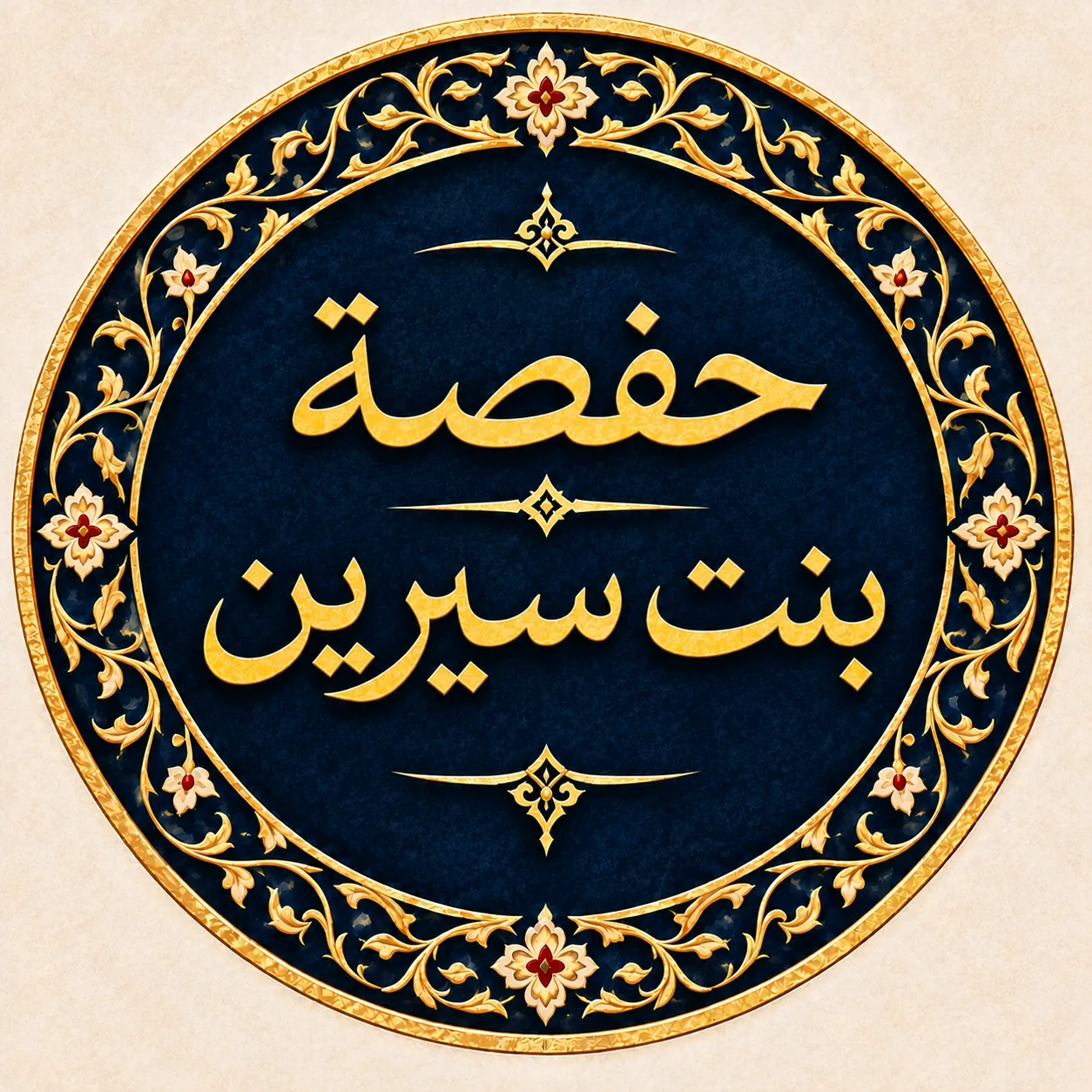
Hafsa bint Sirin (d. after 100 AH / after 718 CE), known by her kunya Umm al-Hudhayl (the mother of al-Hudhayl), was a woman of Basra of the generation of the Successors (tabi'un), the generation after the Companions. She was the sister of Muhammad ibn Sirin, and the biographical dictionaries record that she learned the Quran at the age of twelve, that she received hadith, the reports of the words and actions of the Prophet Muhammad (Peace Be Upon Him), from the Companion Anas ibn Malik and from the Companion Umm Atiyya al-Ansariyya, and that her brother and a number of Basran scholars transmitted from her.123 Al-Ijli, the ninth-century critic of narrators, describes her as a trustworthy Successor of Basra who heard Umm Atiyya, and the TDV İslâm Ansiklopedisi lists her among the siblings of Muhammad ibn Sirin who were reliable transmitters.45 Reports that she transmitted are in the collections of al-Bukhari, Muslim and Abu Dawud, and the sources give accounts of her recitation of the Quran, of her long hours in her place of prayer and of her son al-Hudhayl.67 No source read gives the year or place of her birth or the place of her death. The reports of her age at death differ, and the sources give her death as after 100 AH.82
The sources
The notices on her are short. The earliest of those read here is Ibn Sa'd (d. 230/844–5), whose al-Tabaqat al-kubra has a paragraph on her among his notices of women, with the report of her funeral.1 Al-Ijli (d. 261/874–5) and Ibn Hibban (d. 354/965–6) list her in their books of trustworthy narrators, al-Thiqat.49 Ibn al-Jawzi (d. 597/1200–01) gives her a notice in Sifat al-safwa, a collection of notices on men and women, with the largest number of reports about her worship and her son.6 Al-Mizzi (d. 742/1341–2), in Tahdhib al-kamal, a dictionary of the men and women who appear in the chains of the six canonical hadith collections, gives her teachers, her pupils and the critics' statements on her; Ibn Hajar al-Asqalani (d. 852/1448–9), in Tahdhib al-tahdhib, gives a notice that adds statements of his own; and al-Dhahabi (d. 748/1347–8), in the Siyar a'lam al-nubala', gives a short notice.10112 The modern scholar Mohammad Akram Nadwi, in al-Muhaddithat, his study of women hadith scholars, refers to her.12 The TDV İslâm Ansiklopedisi has no entry of its own on her; its entry on her brother, by the modern scholar Ahmet Yücel (1999), names her among his siblings.5
The sources give no year of birth, and they date nothing in her life except her death.10112 They give her teachers and pupils, a number of her sayings and the reports of her prayer, and they differ over her age at death, as the sections below and the Historiographical Note show.
Name and family
Her name and kunya
The notices call her Hafsa bint Sirin, Umm al-Hudhayl, with the nisba al-Ansariyya and, for the place where she lived, al-Basriyya, the woman of Basra.1011 Abu Dawud, the compiler of the Sunan, says that Umm al-Hudhayl is Hafsa bint Sirin, that her son's name was al-Hudhayl and that her husband's name was Abd al-Rahman; the library's English edition of the Sunan Abi Dawud prints the statement after report 308, which it grades sahih, and al-Mizzi and Ibn Hajar quote it.311 Al-Ijli lists her in the same series of entries as two other women called Hafsa, Hafsa bint Abd al-Rahman, a Medinan Successor, and the Prophet's wife Hafsa bint Umar, and gives each a separate entry.4
Her brothers and sisters
Ibn Sa'd gives Hafsa as the sister of Muhammad ibn Sirin and records the statement of Bakkar ibn Muhammad, a descendant of Muhammad ibn Sirin, that she was the eldest of the children of Sirin, men and women, born to Safiyya; he names those children as Muhammad, Yahya, Hafsa, Karima and Umm Sulaym.1 The TDV İslâm Ansiklopedisi, in its entry on Muhammad ibn Sirin, states that his siblings Yahya, Ma'bad, Anas and Hafsa were also reliable transmitters, and that his mother Safiyya had been a freedwoman of Abu Bakr.5 Al-Mizzi's notice on her describes her as the sister of Muhammad ibn Sirin and of his brothers.10
Al-Mizzi gives her husband's name as Abd al-Rahman, after Abu Dawud, and the sources give no more about him. Her son was al-Hudhayl, from whom she took her kunya.311
The sources describe her relation to Anas ibn Malik in two ways. Al-Dhahabi lists Anas ibn Malik, whom he calls her mawla, among those from whom she transmitted.2 Nadwi writes that she received hadith from "her master Anas ibn Malik" and that she was born a slave; the sources read here do not say whether she was freed, or when.12
The Quran
Several notices give the age at which she learned the Quran. Al-Mizzi and Ibn Hajar, with Ibn Abi Dawud as their authority, say that she read the Quran when she was twelve years old; al-Dhahabi gives the same report; and Ibn al-Jawzi records it with a different age at death.3826 Nadwi, who also gives twelve, writes that she learned the Quran by heart at that age.12
Ibn al-Jawzi preserves reports of her relation to the text. Hisham ibn Hassan, one of those who transmitted from her, said that Muhammad ibn Sirin, when a reading of a verse was unclear to him, told people to go and ask Hafsa how she recited it.7 Asim al-Ahwal, another of her pupils, said that when he and others visited her she had arranged her outer garment over her face, and that when they told her what God said about women past child-bearing, "And women of post-menstrual age who have no desire for marriage - there is no blame upon them for putting aside their outer garments [but] not displaying adornment" (Quran 24:60), she asked what followed it. They answered with the rest of the verse, "But to modestly refrain [from that] is better for them", and she said that this confirmed the keeping of the garment.6 Hafsa's own account, as Ibn al-Jawzi gives it, ties a verse to the death of her son. She said that after al-Hudhayl died God gave her patience, but that a tightness remained in her. One night, reading Surat al-Nahl, she came to "And do not exchange the covenant of Allāh for a small price. Indeed, what is with Allāh is best for you, if only you could know" and "Whatever you have will end, but what Allāh has is lasting. And We will surely give those who were patient their reward according to the best of what they used to do" (Quran 16:95–96); she repeated them, and God removed what she had felt.7
Her teachers and her pupils
Her teachers
The notices name the teachers from whom she transmitted. Ibn Sa'd lists Salman ibn Amir, Umm Atiyya al-Ansariyya and Abu al-Aliya.1 Al-Dhahabi lists Umm Atiyya, Umm al-Ra'ih, Anas ibn Malik and Abu al-Aliya.2 Al-Mizzi names Anas ibn Malik, Abu Dhibyan Khalifa ibn Ka'b, al-Rabi' ibn Ziyad al-Harithi, Abu al-Aliya (Rafi' al-Riyahi), her brother Yahya ibn Sirin, Khayra the mother of al-Hasan al-Basri, al-Rabab Umm al-Ra'ih and Umm Atiyya al-Ansariyya, and Ibn Hajar's list gives the same names.10311 Ibn Hibban says that she transmitted from Umm Atiyya and heard Anas ibn Malik.9
The edition of the Sunan Abi Dawud describes Umm Atiyya as a Companion who had given her oath of allegiance to the Prophet, and Nadwi writes that she migrated to Basra.13 The reports that Hafsa had from her are told below.
Her pupils
Among those who transmitted from her, al-Mizzi, Ibn Hajar and al-Dhahabi name her brother Muhammad ibn Sirin, Qatada, Asim al-Ahwal, Ayyub (al-Sakhtiyani), Khalid al-Hadhdha, Abd Allah ibn Awn and Hisham ibn Hassan.3112 Al-Mizzi adds Iyas ibn Mu'awiya, Abd al-Malik ibn Abi Bashir, Abu Nu'ama al-Adawi and Aisha bint Sa'd al-Basriyya.3 Nadwi writes that Basra became, after Medina, the second centre of hadith learning among women, and names Hafsa bint Sirin among the women of the Successors' generation there, who "diffused much knowledge in Basrah".13
What she transmitted
The reports below are cited by collection and number from the library's English editions of Sahih al-Bukhari, Sahih Muslim and the Sunan Abi Dawud, with the edition's grade where it prints one.
On the washing of the Prophet's daughter. Umm Atiyya was among the women who washed the Prophet's daughter when she died, and Hafsa transmitted her account. In Sahih al-Bukhari 1260 Hafsa reports that Umm Atiyya said that they undid the hair of the Prophet's daughter, washed it and plaited it in three braids; the edition prints no grade. In Sunan Abi Dawud 3143, 3144 and 3145 the same account reaches Abu Dawud through her brother Muhammad ibn Sirin, through Ayyub and through Khalid; the third report adds the Prophet's instruction to them to begin with her right side and the places of ablution, and the edition grades all three sahih. Al-Dhahabi gives the report in his notice of the Prophet's daughter Zaynab, with the chain from Asim al-Ahwal through Hafsa to Umm Atiyya: when Zaynab died, the Prophet told them to wash her an odd number of times, three or five, to put camphor in the last washing and to let him know when they had finished, and afterwards he gave them his waist-wrapper to put next to her body. His editors call the chain sahih and list the report in the collections of al-Bukhari, Muslim, Abu Dawud, al-Tirmidhi, al-Nasa'i and Ibn Majah.14
On women and the festival prayer. Sahih al-Bukhari 980 gives Hafsa's own narration of the matter. She said that on the days of the two festivals they used to forbid their girls to go out for the festival prayer; a woman came and stayed at a palace of the Banu Khalaf, and Hafsa went to her. The woman told of her sister's husband, who had fought in twelve campaigns with the Prophet, with her sister beside him in six, caring for the sick and treating the wounded, and of her sister's question to the Prophet whether a woman with no outer garment was at fault for not going out; he answered that her companion should let her share her veil, and that the women should take part in the good and in the gatherings of the believers. When Umm Atiyya came, Hafsa went to her and asked whether she had heard anything of the matter. Umm Atiyya gave the Prophet's instruction that mature girls, girls who are kept screened, and women who are menstruating should go out, the menstruating keeping away from the place of prayer, and Hafsa asked whether this included those who were menstruating. The edition prints no grade for the report, and the woman who speaks first is not named in it. Sunan Abi Dawud 1138 gives a short version through Asim al-Ahwal, Hafsa and Umm Atiyya, in which the menstruating women stand behind the people and say the takbir with them; the edition grades it sahih.
On discharge after purity. In Sunan Abi Dawud 307 Qatada reports from "Umm Hudhail" that Umm Atiyya, "who was (a Companion) who had given her oath of allegiance to the Prophet", said that they did not count a brownish or yellowish discharge after their purity as anything; report 308 gives another chain, through Muhammad ibn Sirin, and then Abu Dawud's statement identifying Umm al-Hudhayl as Hafsa. The edition grades both sahih.
On the plague. Sahih Muslim 1916 records Hafsa as saying that Anas ibn Malik asked her what Yahya ibn Abi Amra had died of, that she answered "Of the plague", and that Anas then said that the Messenger of Allah said: "The plague is martyrdom for every Muslim." Ibn Hibban gives the same exchange, with Asim al-Ahwal as the transmitter from Hafsa.15 Ibn Sa'd gives the exchange differently: in his version Anas asks her by what she would like to die, she answers that she would like to die of the plague, and he tells her that it is martyrdom for every Muslim; his chain runs through Hafs ibn Ghiyath and Asim al-Ahwal.1 Nadwi gives the same report from Anas through Hafsa and Asim, and refers for it to the chapter of the book of medicine in Sahih al-Bukhari on what is said about the plague.12
How the critics judged her
Yahya ibn Ma'in (d. 233/847–8), whom al-Mizzi and Ibn Hajar quote through Ahmad ibn Abi Maryam, called her trustworthy and, in a literal rendering, "a proof" (thiqa, hujja), and al-Ijli called her a trustworthy Basran Successor.3114 Ibn Hibban lists her in his book of the trustworthy.9 Al-Dhahabi heads his notice with her name and kunya and the word al-faqiha, the jurist.2 A note in the printed edition of Sifat al-safwa classes her as trustworthy and of the third generation of narrators.6
The saying of Iyas ibn Mu'awiya is given by al-Mizzi, Ibn Hajar, al-Dhahabi and Nadwi. In al-Mizzi's and Ibn Hajar's chain it reaches them through Hisham ibn Hassan from Iyas, who is also listed among her pupils; he said that he had not met anyone he preferred to Hafsa, and when al-Hasan and Ibn Sirin were mentioned to him, he said that he preferred no one to her.311 Al-Dhahabi gives the saying as one reported from Iyas, in the same two parts.2 Nadwi gives it in English as: "I did not meet anyone whom I can prefer over Hafsah". He was asked about al-Hasan al-Basri and Muhammad ibn Sirin, and he said: "As for me I do not prefer anyone over her."12
Her worship and her son
Ibn al-Jawzi collects the reports of her daily prayer. Hisham ibn Hassan said that she used to enter her place of prayer for the noon, afternoon, sunset, evening and dawn prayers and remain there until the day was well risen, when she prayed again, came out to do what she needed and to sleep, and returned to the place of prayer when the next prayer was due.7 Mahdi ibn Maymun said that she stayed in her place of prayer for thirty years, leaving it only for the midday rest or for a need; al-Dhahabi gives the same statement.72 Hisham also reported that she told the young men to make use of their youth, because she had seen that action belongs to it.6
The same book has two accounts in her own words about al-Hudhayl. In the first, he gathered wood and cane in the summer and prepared it so that in the winter he could set a brazier of it behind her while she prayed, and its smoke did not trouble her. In the second, he sent her fresh milk in the morning; she told him that she did not drink it because she was fasting, and he answered that the best milk is that which spends the night in the udders of the camels and told her to give it to whom she wished.7 The sources read give no more about him than these reports and, in her own account, his death.
Her death
The sources do not agree on her age at death or on the year. Al-Mizzi and Ibn Hajar report, on the authority of Ibn Abi Dawud, the son of the compiler of the Sunan, that she read the Quran at twelve and died at seventy; al-Dhahabi's notice has the same report.382 Al-Mizzi records that when the figure ninety was put to Ibn Abi Dawud, he answered that this was how it stood in the report.3 Ibn al-Jawzi gives the age at death as ninety.6
For the year, al-Dhahabi says in his own voice that she died after 100 AH, and the printed edition of Ibn al-Jawzi's Sifat al-safwa has a note that says the same.26 Ibn Hajar says in his own voice that she died in 101 AH, and he adds that al-Bukhari names her in his section on those who died between the years 100 and 110.8
Ibn Sa'd records the report of her funeral. Hurayth ibn al-Sa'ib said that they were at the funeral of Hafsa bint Sirin and that al-Hasan asked where their companion, that is Muhammad ibn Sirin, was; they said that he was performing ablution.1 The sources read give no place of death or burial.1
Historiographical Note
The sources agree on who she was: Hafsa bint Sirin, Umm al-Hudhayl, sister of Muhammad ibn Sirin, a trustworthy Successor of Basra.1410 They differ on the points below, and the article gives each version with its source.
Her age at death. Al-Mizzi and Ibn Hajar quote Ibn Abi Dawud for seventy years; al-Dhahabi's notice also gives seventy; Ibn al-Jawzi gives ninety.3826 In al-Mizzi, Ibn Hajar and al-Dhahabi the report of seventy is joined to the report that she read the Quran at twelve, and Ibn al-Jawzi joins the same report of twelve to ninety.3826 The article gives both figures and chooses neither.
The year of her death. Al-Dhahabi and the note in the edition of Sifat al-safwa give "after 100 AH"; Ibn Hajar gives 101 AH.268 The two are consistent with each other, and the Period at the head of this article, "after 100 AH", is the statement all three sources share. No Common Era year is given for her death: the year 100 AH corresponds to 718–719 CE and 101 AH to 719–720 CE, and the sources do not say in which part of those years she died.
Who said that she read the Quran at twelve and died at seventy. Al-Dhahabi writes the report immediately after Iyas ibn Mu'awiya's saying, without naming an authority for it. Al-Mizzi's text, after the words attributed to Iyas, has the figures of twelve and seventy and then a clause saying that Ibn Abi Dawud said so; Ibn Hajar's text gives it as Ibn Abi Dawud's own statement.238 The article gives the figures as Ibn Abi Dawud's statement, as al-Mizzi and Ibn Hajar do.
Salman ibn Amir among her teachers. Ibn Sa'd lists Salman ibn Amir plainly among those from whom she transmitted. Al-Mizzi names him with a qualification that means "if it is preserved", and Ibn Hajar introduces him, with others, with the passive qila, "it was said".1311 The article names him only in Ibn Sa'd's list.
What Anas asked. Sahih Muslim 1916 and Ibn Hibban have Anas ask after Yahya ibn Abi Amra, and Ibn Sa'd has him ask by what she wished to die.151 The article gives each version in the place where the report is told.
Anas ibn Malik as her patron. Al-Dhahabi calls Anas her mawla, and Nadwi calls him her "master" and says that she was born a slave. The other notices read, those of Ibn Sa'd, al-Mizzi, Ibn Hajar and Ibn Hibban, say nothing on whether she was a slave or was freed.212110119
See also
- Muhammad al-Bukhari — the compiler of Sahih al-Bukhari, which carries her reports on women and the festival prayer and on the washing of the Prophet's daughter
- Imam Muslim — the compiler of Sahih Muslim, which carries her report on the plague
- Imam Abu Dawood — the compiler of the Sunan, whose statement identifies Umm al-Hudhayl as Hafsa
- Anas ibn Malik — the Companion from whom she transmitted
- Hadith — the literature in which her reports are collected
References
Citations
Footnotes
-
Ibn Sa'd, al-Tabaqat al-kubra (Beirut: Dar Sadir, 1968), viii, 484 — her being the sister of Muhammad ibn Sirin and Umm al-Hudhayl, her teachers, Bakkar ibn Muhammad's statement and the names of Safiyya's children, her exchange with Anas ibn Malik on the plague, and the report of her funeral; https://shamela.ws/book/9351/3862, register entry 4, shamela.ws. ↩ ↩2 ↩3 ↩4 ↩5 ↩6 ↩7 ↩8 ↩9 ↩10 ↩11
-
Al-Dhahabi, Siyar a'lam al-nubala', ed. Shu'ayb al-Arna'ut et al. (Beirut: Mu'assasat al-Risala), iv, 507, no. 198 — the heading of her notice, her teachers and pupils, Iyas ibn Mu'awiya's saying, the report of twelve and seventy, Mahdi ibn Maymun's statement and al-Dhahabi's own statement that she died after 100; https://shamela.ws/book/10906/3660, register entry 4, shamela.ws. ↩ ↩2 ↩3 ↩4 ↩5 ↩6 ↩7 ↩8 ↩9 ↩10 ↩11 ↩12 ↩13 ↩14 ↩15 ↩16 ↩17 ↩18
-
Al-Mizzi, Tahdhib al-kamal, ed. Bashshar Awwad Ma'ruf (Beirut: Mu'assasat al-Risala), xxxv, 152, no. 7815 — the rest of her teachers, her pupils, the statements of Yahya ibn Ma'in and al-Ijli, Abu Dawud's statement on her kunya, her son and her husband, and the report from Iyas ibn Mu'awiya with the figure of seventy and Ibn Abi Dawud's answer; https://shamela.ws/book/3722/18752, register entry 4, shamela.ws. ↩ ↩2 ↩3 ↩4 ↩5 ↩6 ↩7 ↩8 ↩9 ↩10 ↩11 ↩12 ↩13 ↩14 ↩15
-
Al-Ijli, al-Thiqat, ed. Qal'aji (Dar al-Baz, 1984), 518, no. 2089 — her entry as a Basran, trustworthy Successor who heard Umm Atiyya, beside the entries of Hafsa bint Abd al-Rahman and Hafsa bint Umar; https://shamela.ws/book/9170/519, register entry 4, shamela.ws. ↩ ↩2 ↩3 ↩4 ↩5
-
Ahmet Yücel, 'İBN SÎRÎN', TDV İslâm Ansiklopedisi, vol. 20 (Istanbul, 1999), pp. 358–359 — the statement that Muhammad ibn Sirin's siblings Yahya, Ma'bad, Anas and Hafsa were also reliable transmitters, and that his mother Safiyya had been Abu Bakr's freedwoman; https://islamansiklopedisi.org.tr/ibn-sirin, register entry 2, islamansiklopedisi.org.tr. ↩ ↩2 ↩3
-
Ibn al-Jawzi, Sifat al-safwa (Cairo: Dar al-Hadith, 2000), ii, 241, no. 585 — Asim al-Ahwal's report of the verse on the outer garment, Hisham ibn Hassan's report of her saying to the young men, her reading the Quran at twelve and dying at ninety, her prayer place, and the edition's note classing her as trustworthy and giving her death as after 100; https://shamela.ws/book/12031/1204, register entry 4, shamela.ws. ↩ ↩2 ↩3 ↩4 ↩5 ↩6 ↩7 ↩8 ↩9 ↩10 ↩11
-
Ibn al-Jawzi, Sifat al-safwa, ii, 242 — her prayer place and its hours, Mahdi ibn Maymun's statement, Ibn Sirin's sending people to ask her about a reading, her accounts of al-Hudhayl and of the verses that eased her grief; https://shamela.ws/book/12031/1205, register entry 4, shamela.ws. ↩ ↩2 ↩3 ↩4 ↩5 ↩6
-
Ibn Hajar al-Asqalani, Tahdhib al-tahdhib, xii, 410 — Ibn Abi Dawud's statement of twelve and seventy and the answer on ninety, and Ibn Hajar's own statement that she died in 101 AH and that al-Bukhari names her among those who died between 100 and 110; https://shamela.ws/book/3310/5645, register entry 4, shamela.ws. ↩ ↩2 ↩3 ↩4 ↩5 ↩6 ↩7 ↩8
-
Ibn Hibban, al-Thiqat (Hyderabad: Da'irat al-Ma'arif al-Uthmaniyya, 1973), iv, 194 — her entry as the sister of Muhammad ibn Sirin who transmitted from Umm Atiyya and heard Anas ibn Malik, and from whom Hisham ibn Hassan transmitted; https://shamela.ws/book/5816/1311, register entry 4, shamela.ws. ↩ ↩2 ↩3 ↩4
-
Al-Mizzi, Tahdhib al-kamal, ed. Bashshar Awwad Ma'ruf (Beirut: Mu'assasat al-Risala), xxxv, 151, no. 7815 — the heading of her notice, naming her as the sister of Muhammad ibn Sirin and his brothers, and the first of her teachers; https://shamela.ws/book/3722/18751, register entry 4, shamela.ws. ↩ ↩2 ↩3 ↩4 ↩5 ↩6 ↩7
-
Ibn Hajar al-Asqalani, Tahdhib al-tahdhib (Hyderabad), xii, 409, no. 2762 — her name and nisbas, her teachers and pupils, the statements of Yahya ibn Ma'in, al-Ijli and Abu Dawud, and the report from Iyas ibn Mu'awiya; https://shamela.ws/book/3310/5644, register entry 4, shamela.ws. ↩ ↩2 ↩3 ↩4 ↩5 ↩6 ↩7 ↩8 ↩9 ↩10 ↩11
-
Mohammad Akram Nadwi, al-Muhaddithat: The Women Scholars in Islam (Oxford and London: Interface Publications, 2007), 101–102 — Hafsah bint Sirin as the sister of Muhammad ibn Sirin, her master Anas ibn Malik, the saying of Iyas ibn Mu'awiya, her learning the Quran by heart at twelve, the statement that she was born a slave, and Asim's report from her from Anas on the plague; https://archive.org/details/AlMuhaddithat, register entry 12, archive.org. ↩ ↩2 ↩3 ↩4 ↩5 ↩6
-
Mohammad Akram Nadwi, al-Muhaddithat: The Women Scholars in Islam (Oxford and London: Interface Publications, 2007), 266 — Basra as the second centre of hadith learning among women after Medina, Umm Atiyya's migration there, and Hafsah bint Sirin among the women of the Successors' generation who diffused knowledge in Basra; https://archive.org/details/AlMuhaddithat, register entry 12, archive.org. ↩ ↩2
-
Al-Dhahabi, Siyar a'lam al-nubala', ed. Shu'ayb al-Arna'ut et al. (Beirut: Mu'assasat al-Risala), ii, 250 — Umm Atiyya's report, through Hafsa and Asim al-Ahwal, of the washing of Zaynab, the Prophet's daughter, and the editors' note on its chain and its places in the collections; https://shamela.ws/book/10906/2230, register entry 4, shamela.ws. ↩
-
Ibn Hibban, al-Thiqat, iv, 195 — the report of Anas's question about Yahya ibn Abi Amra and the saying on the plague, through Asim al-Ahwal; https://shamela.ws/book/5816/1312, register entry 4, shamela.ws. ↩ ↩2
Sources
Works in the approved library. Cited by title and author.
- Al-Bukhari. Sahih al-Bukhari, Darussalam English edition.
- Muslim ibn al-Hajjaj. Sahih Muslim, Darussalam English edition.
- Abu Dawud. Sunan Abi Dawud, Darussalam English edition.
Classical works read at Shamela (register entry 4, shamela.ws).
- Ibn Sa'd. Al-Tabaqat al-kubra, vol. 8. Beirut: Dar Sadir, 1968.
- Ibn al-Jawzi. Sifat al-safwa, vol. 2. Cairo: Dar al-Hadith, 2000.
- Al-Dhahabi. Siyar a'lam al-nubala', edited by Shu'ayb al-Arna'ut et al., vols 2 and 4. Beirut: Mu'assasat al-Risala.
- Al-Mizzi. Tahdhib al-kamal fi asma' al-rijal, edited by Bashshar Awwad Ma'ruf, vol. 35. Beirut: Mu'assasat al-Risala.
- Ibn Hajar al-Asqalani. Tahdhib al-tahdhib, vol. 12. Hyderabad.
- Al-Ijli. Al-Thiqat. Dar al-Baz, 1984.
- Ibn Hibban. Al-Thiqat, vol. 4. Hyderabad: Da'irat al-Ma'arif al-Uthmaniyya, 1973.
Read at archive.org (register entry 12, archive.org).
- Nadwi, Mohammad Akram. Al-Muhaddithat: The Women Scholars in Islam. Oxford and London: Interface Publications, 2007.
Encyclopaedia entry read at the TDV (register entry 2, islamansiklopedisi.org.tr).
- Yücel, Ahmet. 'İbn Sîrîn'. TDV İslâm Ansiklopedisi, vol. 20. Istanbul, 1999.
Quranic text read at quran.com (register entry 8, quran.com).
- The Quran, Saheeh International translation, 24:60 and 16:95–96.
Further reading
Offered to the reader for further study. Nothing in this article rests on the works below beyond what the sources above record of them.
- Ibn Abi Hatim. Al-Jarh wa-l-ta'dil — the dictionary of narrators in which, as read here, the entry on al-Rabab Umm al-Ra'ih records Hafsa as a narrator from her.
- Abu Nu'aym. Hilyat al-awliya' — the biographical dictionary of devout men and women in which he names Hafsa in the chains of reports from Anas and other Companions.
External links
Approved sources only, each with its number on the Register of Approved External Web Sources.
- Ibn Sa'd, al-Tabaqat al-kubra, the notice on Hafsa bint Sirin — register entry 4, shamela.ws: in Arabic
- Ibn al-Jawzi, Sifat al-safwa, the notice on Hafsa bint Sirin — register entry 4, shamela.ws: in Arabic
- Al-Dhahabi, Siyar a'lam al-nubala', the notice on Hafsa bint Sirin — register entry 4, shamela.ws: in Arabic
- Al-Mizzi, Tahdhib al-kamal, the notice on Hafsa bint Sirin — register entry 4, shamela.ws: in Arabic
- İbn Sîrîn — the TDV İslâm Ansiklopedisi, register entry 2, islamansiklopedisi.org.tr: the entry on her brother, in Turkish
- Nadwi, Al-Muhaddithat — register entry 12, archive.org
More from Umayyad Caliphate
Al-Aqsa Mosque: The Farthest Sanctuary
Al-Aqsa Mosque in Jerusalem is the third holiest site in Islam, central to the Night Journey (Isra and Miraj) of Prophet Muhammad, and a symbol of Islamic heritage and Palestinian identity for over 1,300 years.
Battle of Karbala
The Battle of Karbala (680 CE) was a confrontation in which Husayn ibn Ali, grandson of Prophet Muhammad, was killed with his companions by Umayyad forces near the Euphrates. It became one of the most consequential events in Islamic history, shaping the development of Shia Islam.
The Battle of Tours - Turning Point in European History
The Battle of Tours (732 CE) between Charles Martel's Frankish forces and the Umayyad army halted Muslim expansion into Western Europe, marking a decisive turning point that shaped the continent's political and religious landscape for centuries.
The Dome of the Rock
Comprehensive history of the Dome of the Rock, one of Islam's most iconic monuments and the oldest surviving Islamic building, built in Jerusalem in 691 CE