Umm Kulthum bint Abi Bakr
Umm Kulthum bint Abi Bakr, the youngest daughter of the first caliph Abu Bakr, was born in Medina after his death in 13 AH. She was raised by her sister Aisha, married Talha ibn Ubayd Allah and then Abd al-Rahman al-Makhzumi, and transmitted hadith as a Successor.
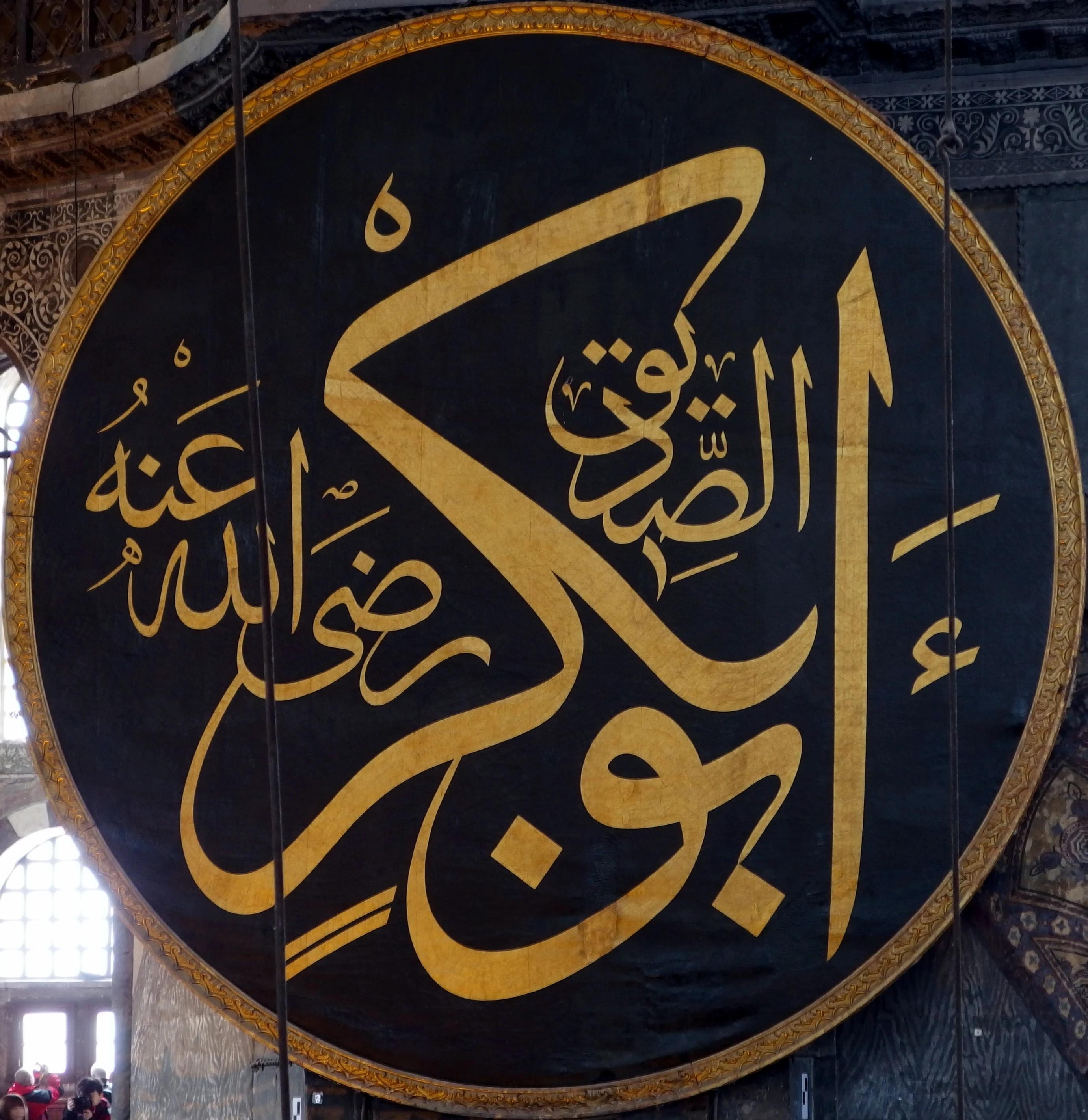
Umm Kulthum bint Abi Bakr (Arabic Umm Kulthum bint Abi Bakr al-Siddiq) was the youngest daughter of Abu Bakr, the first caliph, and of his wife Habiba bint Kharija, of the Khazraj of Medina.12 She was born in Medina several months after her father's death in 13 AH (634 CE), and so after the death of the Prophet Muhammad (Peace Be Upon Him) as well, and the biographers count her among the Successors (tabi'un), the generation after the Companions.134 Aisha, the Prophet's wife and Abu Bakr's daughter by his wife Umm Ruman, named her and had the care of her, and she transmitted hadith from Aisha.15
She was married twice, first to Talha ibn Ubayd Allah, by whom she was the mother of Aisha bint Talha, and after his death at the Battle of the Camel in 36 AH (656 CE) to Abd al-Rahman ibn Abd Allah ibn Abi Rabi'a of the clan of Makhzum.16 Umar ibn al-Khattab had asked for her hand before that, and the sources tell how the proposal ended.17 No source gives a year for her birth, and the TDV encyclopaedia, which says that no information exists on the date or place of her death, gives it as after the death of Aisha in 58 AH (678 CE).1
The sources
The one dedicated modern entry on her is by Gülgün Uyar in the TDV İslâm Ansiklopedisi.1 The earliest notice read here is Ibn Sa'd's, in al-Tabaqat al-kubra, a dictionary of the Companions and the generations after them (Ibn Sa'd died in 230/844–5).89 Later dictionaries repeat and extend it: al-Isti'ab of Ibn Abd al-Barr (d. 463/1070–71), which ascribes the account of her name, birth, marriage and children to the genealogists (ahl al-nasab); Usd al-ghaba of Ibn al-Athir (d. 630/1232–3); the Tarikh al-Islam of al-Dhahabi (d. 748/1347–8); Imta' al-asma' of al-Maqrizi (d. 845/1441–2); and the Isaba and the Tahdhib al-tahdhib of Ibn Hajar al-Asqalani (d. 852/1448–9).1031112413 The twelfth-century historian of Damascus Ibn Asakir (d. 571/1175–6) names her in his notices on Talha and on her daughter, and the historian al-Tabari (d. 310/922–3) names her in his list of Abu Bakr's wives and in his account of the wives of Umar.14657
None of these gives a year for her birth or her death. They agree that she was born after Abu Bakr died and that Talha married her, and they differ on details of her family and of the proposal of Umar, which the article gives where each is told.
Her family and her name
Her name is given in the notices as Umm Kulthum bint Abi Bakr, and the TDV encyclopaedia gives the full form Umm Kulthum bint Abi Bakr al-Siddiq ibn Abi Quhafa al-Qurashiyya al-Taymiyya.1 Ibn Sa'd traces her father's line to Taym, the clan to which Abu Bakr belonged.8 The sources separate her from the other women called Umm Kulthum. Ibn Sa'd's next notice is on Umm Kulthum bint Ali, and al-Dhahabi gives separate notices to Umm Kulthum bint Uqba and to Umm Kulthum bint Ali, so this article concerns neither of them, nor the daughter of the Prophet.1511
Her mother was Habiba bint Kharija, whom Abu Bakr had married under Islam; al-Tabari lists her among his wives, and the Encyclopaedia of Islam, in its entry on Abu Bakr by W. Montgomery Watt, records that the marriage was made late in his life.52 Ibn Sa'd gives Habiba's descent through Kharija ibn Zayd and Abu Zuhayr to the Banu al-Harith ibn al-Khazraj.8 Aisha was the daughter of another of Abu Bakr's wives, Umm Ruman, whom al-Tabari names, and al-Maqrizi, in his notice on Talha, calls Umm Kulthum Aisha's sister through their father.512
Her birth
Abu Bakr died on 22 Jumada II 13 AH, which the Encyclopaedia of Islam converts to 23 August 634, and the TDV encyclopaedia says that she was born in Medina several months after his death.21 Al-Dhahabi, Ibn Hajar, Ibn al-Athir and Ibn Abd al-Barr likewise say that she was born after his death, and al-Tabari says that Habiba's pregnancy had just appeared when he died.11133105 No source gives the month or the year of her birth.
The sources record words of Abu Bakr about the child in his last illness. Al-Suyuti (d. 911/1505–6), in his History of the Khalifahs, gives them from the Muwatta of Malik ibn Anas (d. 179/795–6), an early collection of hadith, in the report of a gift that Abu Bakr had made to Aisha, "twenty camel loads" of the fruit-cuttings of palm trees from al-Ghaba, and adds that Ibn Sa'd narrated it as well. In Abdassamad Clarke's English, Abu Bakr tells Aisha that the gift passes to the heirs, her two brothers and her two sisters; she answers that she has only Asma and asks who the other sister is; and he says, "The child who is in the womb of Kharijah's daughter; I think it is a girl."16 In a second version that al-Suyuti gives, his words are "it occurs to me that it is a girl, so make her your concern."16 Ibn Abd al-Barr says that Abu Bakr spoke in the illness in which he died of its having been cast into his mind that the child was a girl, and that a girl was born after his death and Aisha named her Umm Kulthum.10 The editor of Usd al-ghaba cites the wording of the Muwatta for the saying, in which Abu Bakr says that he sees the child in Kharija's daughter's womb as a girl, and Ibn Hajar says that the account of her birth is sound in the Muwatta and other works.34 The TDV encyclopaedia, which names Ibn Sa'd for the conversation, adds that Abu Bakr entrusted the child to Aisha's care, and that Aisha gave the newborn the name Umm Kulthum.1
In Aisha's care, and the proposal of Umar
The TDV encyclopaedia states that she grew up under Aisha's training, learned from her and transmitted hadith from her.1 Before her marriage to Talha, Umar ibn al-Khattab asked Aisha for her hand. No source dates the proposal. The sources tell its end differently.
The TDV encyclopaedia says that Aisha sent Amr ibn al-As or al-Mughira ibn Shu'ba to Umar with word that she did not think the marriage suitable, and that Umar then withdrew.1 Al-Tabari gives the report of the early historian al-Mada'ini, in which Aisha told Umm Kulthum that the matter was hers to decide and she refused; Aisha sent word to Amr ibn al-As, who spoke to Umar and pointed him instead to Umm Kulthum bint Ali ibn Abi Talib.7 Ibn Abd al-Barr gives a report from Sufyan ibn Uyayna, through Isma'il ibn Abi Khalid, in which Aisha gave Umar hope, Umm Kulthum refused, Amr ibn al-As spoke to Umar, Umar left the matter and Talha married her; Ibn Asakir gives the report with a full chain through Ibn Abi Khalid, and al-Suyuti's Jam' al-jawami', as an extract from Ibn Asakir, names its transmitter Abu Khalid.171819 The modern biographer of Umar, Ali Muhammad as-Sallabi, gives two reports: in the first she refuses, Aisha sends for Amr and Amr points Umar to Umm Kulthum bint Ali, whom Umar then asks of Ali; in the second Amr speaks to Umar, Umar leaves her alone and Talha marries her.20
Marriage to Talha
She married Talha ibn Ubayd Allah, a man of her father's clan of Taym.18 The sources do not date the marriage. The TDV encyclopaedia gives their children as Zakariyya, Yusuf and Aisha, and Ibn Sa'd and al-Maqrizi give the same three, Ibn Sa'd adding that Yusuf died young.1812 A note of the translator in al-Tabari's volume gives them as two sons and a daughter, the daughter being Aisha bint Talha.5 Ibn Abd al-Barr, in the genealogists' account, names only Zakariya and Aisha, as does a report that Ibn Asakir gives in the name of al-Zubayr on the names of Talha's children.106
Two sources tell of her counsel to Talha on a sum of money. The TDV encyclopaedia says that she proposed that he give a sum he held as charity, and that Talha, showing his satisfaction, addressed her as the daughter of a muwaffaq and herself a muwaffaqa, a man and a woman granted success.1 Ibn Asakir gives a longer report, which goes back to Talha through his son Musa. A sum of seven hundred thousand (the page names no coin) reached Talha from Hadramawt, and he lay awake that night; his wife told him to call for bowls and dishes in the morning and divide the money among the households of the Muhajirun and the Ansar according to their rank, and Talha answered, in words that resemble the TDV's, that she was a muwaffaqa, daughter of a muwaffaq. The narrator adds that she was Umm Kulthum bint Abi Bakr, and Talha divided the money the next morning.14
Talha was killed at the Battle of the Camel; the TDV encyclopaedia gives the year as 36 AH (656 CE) and its entry on Talha gives Jumada II 36 (December 656), and Ibn Sa'd says that he was killed on the day of the Camel and left her a widow.1218
Widowhood and her second marriage
Ibn Sa'd gives three reports of what Aisha did with her sister in her waiting period (idda) after Talha's death. In the first, from Ata, Aisha took her out to Mecca; in the second, also from Ata, Aisha made the pilgrimage with her; and in the third, which Ayyub gave beside Jarir ibn Hazim's, Aisha moved her to her country, without Mecca or the pilgrimage being named.89 In his biography of Abu Bakr, al-Sallabi says that she performed the Hajj in Aisha's company during her waiting period.22
She then married Abd al-Rahman ibn Abd Allah ibn Abi Rabi'a of Makhzum; the TDV encyclopaedia and al-Dhahabi say so, and so does Ibn Sa'd, in a report that he gives from Muhammad ibn Umar.1118 No source dates the marriage, and the sources differ on the children. Ibn Sa'd names four: Ibrahim, called al-Ahwal, Musa, Umm Humayd and Umm Uthman.8 The TDV encyclopaedia names three sons, Ibrahim, Uthman and Musa, and so does the report of al-Zubayr that Ibn Asakir gives, as her daughter Aisha's brothers on their mother's side.16 Al-Dhahabi and the translator of al-Tabari's volume say only that she bore him four children.115 Ibn Abi Hatim (d. 327/938–9), in al-Jarh wa-l-ta'dil, lists Ibrahim, her son, as transmitting from Aisha and from his mother, and al-Zuhri and Ibrahim's sons Isma'il and Musa as transmitting from him.23
She also nursed. In the report that Malik gives in the Muwatta, in the transmission of Muhammad ibn al-Hasan al-Shaybani, Salim ibn Abd Allah ibn Umar says that Aisha sent him, while he was nursing, to her sister Umm Kulthum, with the instruction to nurse him ten times so that he might enter Aisha's presence. Umm Kulthum nursed him three times, then fell ill and nursed him only three times more, so that the ten feedings were not completed and he did not enter Aisha's presence.24 Ibn Sa'd's notice gives the first part of the account and ends with her illness.8 The TDV encyclopaedia adds that she was the wet nurse of Abu Salama ibn Abd al-Rahman ibn Awf.1
As a transmitter of hadith
The TDV encyclopaedia counts her among the hadith scholars of the Successors and calls her a reliable narrator (thiqa); it states that her reports are in Sahih al-Bukhari, Sahih Muslim, Jami' al-Tirmidhi, Sunan Ibn Majah and Sunan al-Nasa'i.1 Ibn Hajar gives her teacher as her sister Aisha and adds that she has a report from Aisha in Sahih Muslim.134
The TDV encyclopaedia lists among those who narrated from her her son Ibrahim ibn Abd al-Rahman, Jabir ibn Abd Allah al-Ansari, Talha ibn Yahya ibn Talha, al-Mughira ibn Hakim al-San'ani, Jubayr ibn Habib and Abd Allah ibn Ubayd ibn Umayr.1 Ibn Hajar's Tahdhib al-tahdhib has the same first five and ends with Lut ibn Yahya, and says that Jabir was older than she; his al-Isaba calls Jabir a Companion and names Jabr ibn Habib, Talha ibn Yahya and al-Mughira ibn Hakim and others.134
Two reports with her name in the chain are set out in the sources. In the first, she reports from Aisha that the Prophet told her to hold to the comprehensive supplications. Sunan Ibn Majah (Ibn Majah d. 273/886–7), report 3846, gives the prayer he taught her, which asks God for all good, in this world and the next, seeks refuge from all evil and asks for Paradise and what leads to it, and the Darussalam edition grades it sahih; the Musnad of Ahmad ibn Hanbal (d. 241/855–6) has it as report 25138.2526 The editors of both judge the chain sound. The editors of the Musnad record that the narrator al-Nadr ibn Shumayl, from Shu'ba, gives the woman as Umm Kulthum bint Ali, and the narrator Baqiyya ibn al-Walid, also from Shu'ba, as Fatima bint Abi Bakr; they hold that the correct reading is Umm Kulthum bint Abi Bakr, as Abd al-Samad, Muhammad ibn Ja'far and others narrate it, that her descent from Abu Bakr is stated outright in al-Hakim's version, and that al-Tahawi, whose Sharh ma'ani al-athar they cite, held it correct.26 The editors of Sunan Ibn Majah record that the versions in the books of Ishaq ibn Rahawayh and al-Tahawi, which they cite, give Umm Kulthum bint Ali in her place.25
The second is a report on striking women. She says that men had been forbidden to strike women, that they then complained of them to the Prophet, and that he left the matter between them and the striking; then he said that seventy women had gone round the household of Muhammad that night, every one of them struck. In the version of al-Hakim (d. 405/1014–5), the narrator Yahya adds that he thought al-Qasim said that the men were afterwards told that the best of them would not strike.27 Ibn Hajar and Ibn al-Athir give it through Ibrahim ibn Tahman, Yahya ibn Sa'id and Humayd ibn Nafi', with al-Layth ibn Sa'd narrating it from Yahya in similar words, while al-Thawri narrated it from Humayd ibn Nafi' on the authority of Zaynab bint Abi Salama.43 Al-Hakim, who gives it through al-Layth, introduces it as a corroborating report with a sound chain.27
Successor or Companion
Ibn Hajar says in al-Isaba that she was a Successor, born after the death of her father, and that she transmitted her report in the mursal form; for that reason, he says, Ibn al-Sakan and Ibn Manda (d. 395/1004–5), who compiled lists of the Companions, listed her among them.4 In the Tahdhib al-tahdhib he writes that Ibn Manda, Abu Nu'aym (d. 430/1038–9) and others listed her among the Companions and were mistaken, because she was born after the death of Abu Bakr.13 The TDV encyclopaedia names Ibn Manda and Abu Nu'aym as scholars who presented her as a Companion and holds that, since it is known that she was born after Abu Bakr's death, there is no doubt that she belongs to the Successors.1 Ibn al-Athir says that she was not a Companion, because she was born after the death of the Prophet.3 This article follows these judgements.
Her death
No source read gives the date or place of her death, or her burial. The TDV encyclopaedia states that no information exists on the date or place of her death and gives it as after the death of Aisha in 58 AH (678 CE).1 The Period of this article is open at its end for that reason.
Historiographical Note
The sources agree that she was Abu Bakr's daughter by Habiba bint Kharija, that she was born after his death, that Talha married her and that she married Abd al-Rahman al-Makhzumi after him.1811 They differ on many details of her family, her children and the proposal of Umar, and each is given with its source where it is told. The points below need an explanation as well.
Her dates. The Encyclopaedia of Islam gives the death of Abu Bakr as 22 Jumada II 13 AH (23 August 634 CE) and the TDV encyclopaedia as 13 (634); the TDV encyclopaedia places her birth several months later and al-Sallabi shortly afterwards, and none gives the month.2122 For her death the TDV encyclopaedia gives only after 58 AH (678 CE), the year in which it places Aisha's death, and al-Sallabi gives Aisha's death as 57 AH.122 The Period at the head of the article uses the TDV encyclopaedia's year.
Her mother's lineage. The TDV encyclopaedia writes Habiba bint Kharija ibn Abi Zuhayr. Ibn Sa'd, Ibn Abd al-Barr and the translation of al-Tabari write Kharija ibn Zayd ibn Abi Zuhayr, and the printed text of al-Maqrizi's Imta' al-asma' has Kharija ibn Rahm al-Ansari.1810512 The editor of al-Isti'ab notes that Usd al-ghaba reads bint Zayd ibn Kharija, that al-Isaba has Kharija ibn Zayd or Zayd ibn Kharija, and that Ibn al-Athir calls Ibn Abd al-Barr's form the correct one.10
Abu Bakr's words about the child. The wordings differ: "I think it is a girl" and "it occurs to me that it is a girl, so make her your concern" in al-Suyuti; a thought cast into his mind, in Ibn Abd al-Barr and al-Sallabi; a statement that he sees the child as a girl in the wording Usd al-ghaba gives; and a statement that he sees her as a girl in the Muwatta as the editor of Usd al-ghaba cites it. All of them say that he took the child to be a girl.1610223
The proposal of Umar. The reports differ in their transmitters: al-Mada'ini in al-Tabari, Ibn Uyayna through Isma'il ibn Abi Khalid in Ibn Abd al-Barr, a longer chain through Ibn Abi Khalid in Ibn Asakir, and Abu Khalid in al-Suyuti's Jam' al-jawami', which calls itself an extract from Ibn Asakir.7171819 The sources give no date for any of the versions.
The report on striking women. Al-Thawri's chain reads from Humayd ibn Nafi' through Yahya in Usd al-ghaba as edited, and from Yahya ibn Humayd in al-Isaba; the editor of Usd al-ghaba records that its earlier printing has Yahya ibn Humayd and thinks his own reading correct.34 Ibn al-Athir's version ends with the seventy women, and al-Hakim's continues with the narrator's reckoning.327
See also
- Abu Bakr — her father, the first caliph
- Aisha bint Abu Bakr — her sister, who named her and had the care of her
- Asma bint Abu Bakr — her other sister, named in Abu Bakr's last words to Aisha
- Talha ibn Ubayd Allah — her first husband
- Aisha bint Talha — her daughter by Talha
- Ali ibn Abi Talib — the father of the Umm Kulthum to whom, in two of the reports, Amr ibn al-As directed Umar
- Rashidun Caliphate — the period of her birth
References
Citations
Footnotes
-
Gülgün Uyar, 'ÜMMÜ KÜLSÛM bint EBÛ BEKİR', TDV İslâm Ansiklopedisi, vol. 42 (İstanbul, 2012), pp. 324–325 — the whole entry: her name, birth, mother, Abu Bakr's conversation with Aisha, the proposal of Umar, her marriages and children, the nursing, the statement on her death, Talha's words, her teaching, those who transmitted from her and the Companion question; https://islamansiklopedisi.org.tr/ummu-kulsum-bint-ebu-bekir, register entry 2, islamansiklopedisi.org.tr. ↩ ↩2 ↩3 ↩4 ↩5 ↩6 ↩7 ↩8 ↩9 ↩10 ↩11 ↩12 ↩13 ↩14 ↩15 ↩16 ↩17 ↩18 ↩19 ↩20 ↩21 ↩22 ↩23 ↩24 ↩25 ↩26 ↩27
-
W. Montgomery Watt, 'Abu Bakr', The Encyclopaedia of Islam, new edition, vol. 1 — Habiba bint Kharija and the posthumous birth of Umm Kulthum, the late date of the marriage, and the date of Abu Bakr's death, 22 Jumada II 13 / 23 August 634. ↩ ↩2 ↩3 ↩4
-
Ibn al-Athir, Usd al-ghaba, ed. Muhammad Ibrahim al-Banna et al. (Cairo: Kitab al-Sha'b), vii, 383, no. 7572 — the report on striking women, the statement that she was not a Companion, and, in the editor's footnotes, the wording of the saying in the Muwatta and the variant reading of al-Thawri's chain; https://shamela.ws/book/1564/3455, register entry 4, shamela.ws. ↩ ↩2 ↩3 ↩4 ↩5 ↩6 ↩7 ↩8 ↩9
-
Ibn Hajar al-Asqalani, al-Isaba fi tamyiz al-Sahaba, ed. Adil Ahmad Abd al-Mawjud and Ali Muhammad Mu'awwad (Beirut: Dar al-Kutub al-Ilmiyya, 1415 AH), viii, 466–467 — her notice, her standing as a Successor, the account of her birth, the report on striking women with its chains, her other report in Sahih Muslim and those who transmitted from her; https://shamela.ws/book/9767/4379 and https://shamela.ws/book/9767/4380, register entry 4, shamela.ws. ↩ ↩2 ↩3 ↩4 ↩5 ↩6 ↩7 ↩8
-
Al-Tabari, The History of al-Tabari, vol. 11, The Challenge to the Empires, translated by Khalid Yahya Blankinship (Albany: State University of New York Press, 1993), p. 141 (Leiden i 2135) — the list of Abu Bakr's wives, with Habiba's pregnancy and the birth of Umm Kulthum, and the translator's note 769; https://archive.org/details/tabarivolume11, register entry 12, archive.org. ↩ ↩2 ↩3 ↩4 ↩5 ↩6 ↩7 ↩8
-
Ibn Asakir, Tarikh madinat Dimashq, lxix, 248–249 (the notice on Aisha bint Talha) — al-Zubayr's list of Talha's children by her and of her sons by Abd al-Rahman al-Makhzumi; https://shamela.ws/book/71/31425 and https://shamela.ws/book/71/31426, register entry 4, shamela.ws. ↩ ↩2 ↩3 ↩4
-
Al-Tabari, The History of al-Tabari, vol. 14, The Conquest of Iran, translated by G. Rex Smith (Albany: State University of New York Press, 1994), pp. 101–102 (Leiden i 2734–2735) — al-Mada'ini's account of Umar's proposal; https://archive.org/details/tabarivolume14, register entry 12, archive.org. ↩ ↩2 ↩3 ↩4
-
Ibn Sa'd, al-Tabaqat al-kubra (Beirut: Dar Sadir), viii, 462 — her lineage and her mother's, Talha and the children, the three reports of her waiting period, Abd al-Rahman al-Makhzumi and the children, and the first part of the nursing of Salim; https://shamela.ws/book/9351/3840, register entry 4, shamela.ws. ↩ ↩2 ↩3 ↩4 ↩5 ↩6 ↩7 ↩8 ↩9 ↩10 ↩11 ↩12
-
Ibn Sa'd, al-Tabaqat al-kubra, ed. Ali Muhammad Umar (Cairo: Maktabat al-Khanji, 2001), x, 429, no. 5462 — the same notice, with its three reports of her waiting period; https://shamela.ws/book/146/4849, register entry 4, shamela.ws. ↩ ↩2
-
Ibn Abd al-Barr, al-Isti'ab fi ma'rifat al-ashab, ed. Ali Muhammad al-Bajawi (Cairo: Maktabat Nahdat Misr, 1960), iv, 1807, within no. 3287 — her mother's lineage, Abu Bakr's words in his illness, her naming, her marriage to Talha and the children, the genealogists' account, and the beginning of the report on Umar's proposal, with the editor's note on the forms of her mother's name; https://shamela.ws/book/12288/1794, register entry 4, shamela.ws. ↩ ↩2 ↩3 ↩4 ↩5 ↩6 ↩7
-
Al-Dhahabi, Tarikh al-Islam, ed. Umar Abd al-Salam Tadmuri (Beirut: Dar al-Kitab al-Arabi, 1993), iv, 136 — her identification, her marriage to Talha, her being the mother of Aisha bint Talha, her birth after her father's death, her marriage to the Makhzumi man and its four children, and the entries on Umm Kulthum bint Uqba and Umm Kulthum bint Ali; https://shamela.ws/book/12397/2045, register entry 4, shamela.ws. ↩ ↩2 ↩3 ↩4 ↩5 ↩6
-
Al-Maqrizi, Imta' al-asma', ed. Muhammad Abd al-Hamid al-Namisi (Beirut: Dar al-Kutub al-Ilmiyya, 1999), vi, 142 — Talha's death in Jumada II 36, his wife Umm Kulthum, the three children, and her description as Aisha's sister through their father; https://shamela.ws/book/1524/2179, register entry 4, shamela.ws. ↩ ↩2 ↩3 ↩4
-
Ibn Hajar al-Asqalani, Tahdhib al-tahdhib (Hyderabad), xii, 477, no. 2978 — her notice, her mother, her teacher, those who transmitted from her and the statement on the Companion listing; https://shamela.ws/book/3310/5712, register entry 4, shamela.ws. ↩ ↩2 ↩3 ↩4 ↩5
-
Ibn Asakir, Tarikh madinat Dimashq, xxv, 99 (the notice on Talha ibn Ubayd Allah) — the report on the money from Hadramawt and his wife's counsel; https://shamela.ws/book/71/11216, register entry 4, shamela.ws. ↩ ↩2
-
Ibn Sa'd, al-Tabaqat al-kubra, viii, 463 — the next notice, on Umm Kulthum bint Ali; https://shamela.ws/book/9351/3841, register entry 4, shamela.ws. ↩
-
Jalal al-Din al-Suyuti, The History of the Khalifahs Who Took the Right Way, translated by Abdassamad Clarke (London: Ta-Ha Publishers), the chapter on Abu Bakr — Abu Bakr's gift to Aisha and his words to her in his last illness, in two versions. ↩ ↩2 ↩3
-
Ibn Abd al-Barr, al-Isti'ab, iv, 1808 — the rest of the report on Umar's proposal, ending with Talha's marriage to her; https://shamela.ws/book/12288/1795, register entry 4, shamela.ws. ↩ ↩2
-
Ibn Asakir, Tarikh madinat Dimashq, xxv, 96 (the notice on Talha ibn Ubayd Allah) — the report on Umar's proposal with its chain through al-Humaydi, Sufyan and Ibn Abi Khalid; https://shamela.ws/book/71/11213, register entry 4, shamela.ws. ↩ ↩2
-
Al-Suyuti, Jam' al-jawami' (al-Jami' al-kabir), ed. Mukhtar Ibrahim al-Hayij et al. (Cairo: al-Azhar al-Sharif, 2005), xvi, 358 — the report on Umar's proposal, given as an extract from Ibn Asakir with the transmitter named Abu Khalid; https://shamela.ws/book/127677/12233, register entry 4, shamela.ws. ↩ ↩2
-
Ali Muhammad as-Sallabi, 'Umar ibn al-Khattab: His Life and Times, translated by Nasiruddin al-Khattab, vol. 1 — two reports on Umar's proposal and the outcome each gives. ↩
-
Bünyamin Erul, 'TALHA b. UBEYDULLAH', TDV İslâm Ansiklopedisi, vol. 39 (İstanbul, 2010), pp. 504–505 — Talha's death in the Battle of the Camel in Jumada II 36 (December 656); https://islamansiklopedisi.org.tr/talha-b-ubeydullah, register entry 2, islamansiklopedisi.org.tr. ↩
-
Ali Muhammad as-Sallabi, The Biography of Abu Bakr As-Siddeeq, translated by Faisal Shafeeq (Darussalam) — her birth after her father's death, Abu Bakr's words in his illness, her Hajj with Aisha in her waiting period, and the year of Aisha's death. ↩ ↩2 ↩3 ↩4
-
Ibn Abi Hatim, al-Jarh wa-l-ta'dil (Hyderabad: Matba'at Majlis Da'irat al-Ma'arif al-Uthmaniyya, 1952), ii, 111, no. 330 — her son Ibrahim ibn Abd al-Rahman, his teachers and those who transmitted from him; https://shamela.ws/book/2170/516, register entry 4, shamela.ws. ↩
-
Malik ibn Anas, al-Muwatta, riwaya of Muhammad ibn al-Hasan al-Shaybani (Beirut: al-Maktaba al-Ilmiyya), p. 210, no. 623 — Salim's report of Aisha's sending him to Umm Kulthum to be nursed; https://shamela.ws/book/16050/828, register entry 4, shamela.ws. ↩
-
Ibn Majah, Sunan, ed. Shu'ayb al-Arna'ut et al. (Dar al-Risala al-Alamiyya, 2009), v, 17, no. 3846, with the editors' note on the chain and its variants; https://shamela.ws/book/98138/2651, register entry 4, shamela.ws; and Sunan Ibn Majah, Darussalam English edition, no. 3846, with the edition's grade (sahih). ↩ ↩2
-
Ahmad ibn Hanbal, al-Musnad, ed. Shu'ayb al-Arna'ut et al. (Mu'assasat al-Risala, 2001), xlii, 68, no. 25138 — the report on the comprehensive supplications with her in its chain, and the editors' notes, which continue from the note on report 25137; https://shamela.ws/book/25794/21239, register entry 4, shamela.ws. ↩ ↩2
-
Al-Hakim al-Naysaburi, al-Mustadrak ala al-Sahihayn (Dar al-Minhaj al-Qawim, 2018), iii, 571, no. 2808 — the report on striking women through al-Layth, al-Hakim's statement on it, and the editors' note that she was a Successor born after her father's death; https://shamela.ws/book/1200/1776, register entry 4, shamela.ws. ↩ ↩2 ↩3
Sources
Works in the approved library. Cited by title and author, and by the entry used.
- Bearman, P. J., et al., eds. The Encyclopaedia of Islam, new (second) edition — W. Montgomery Watt, 'Abu Bakr' (vol. 1).
- As-Sallabi, Ali Muhammad. The Biography of Abu Bakr As-Siddeeq. Translated by Faisal Shafeeq. Darussalam.
- As-Sallabi, Ali Muhammad. 'Umar ibn al-Khattab: His Life and Times. 2 vols. Translated by Nasiruddin al-Khattab.
- Al-Suyuti, Jalal al-Din. The History of the Khalifahs Who Took the Right Way. Translated by Abdassamad Clarke. London: Ta-Ha Publishers.
- Ibn Majah, Muhammad ibn Yazid. Sunan Ibn Majah. Riyadh: Darussalam Publishers.
Classical works read at Shamela (register entry 4, shamela.ws).
- Ibn Sa'd. Al-Tabaqat al-kubra. Beirut: Dar Sadir; and the edition of Ali Muhammad Umar, Cairo: Maktabat al-Khanji, 2001.
- Malik ibn Anas. Al-Muwatta, riwaya of Muhammad ibn al-Hasan al-Shaybani. Beirut: al-Maktaba al-Ilmiyya.
- Ahmad ibn Hanbal. Al-Musnad. Edited by Shu'ayb al-Arna'ut et al. Mu'assasat al-Risala, 2001.
- Ibn Majah. Sunan. Edited by Shu'ayb al-Arna'ut et al. Dar al-Risala al-Alamiyya, 2009.
- Al-Hakim al-Naysaburi. Al-Mustadrak ala al-Sahihayn. Dar al-Minhaj al-Qawim, 2018.
- Ibn Abi Hatim. Al-Jarh wa-l-ta'dil. Hyderabad: Matba'at Majlis Da'irat al-Ma'arif al-Uthmaniyya, 1952.
- Ibn Abd al-Barr. Al-Isti'ab fi ma'rifat al-ashab. Edited by Ali Muhammad al-Bajawi. Cairo: Maktabat Nahdat Misr, 1960.
- Ibn al-Athir. Usd al-ghaba. Edited by Muhammad Ibrahim al-Banna et al. Cairo: Kitab al-Sha'b.
- Ibn Asakir. Tarikh madinat Dimashq, vols 25 and 69.
- Al-Suyuti. Jam' al-jawami' (al-Jami' al-kabir). Edited by Mukhtar Ibrahim al-Hayij et al. Cairo: al-Azhar al-Sharif, 2005.
- Al-Dhahabi. Tarikh al-Islam. Edited by Umar Abd al-Salam Tadmuri. Beirut: Dar al-Kitab al-Arabi, 1993.
- Al-Maqrizi. Imta' al-asma'. Edited by Muhammad Abd al-Hamid al-Namisi. Beirut: Dar al-Kutub al-Ilmiyya, 1999.
- Ibn Hajar al-Asqalani. Al-Isaba fi tamyiz al-Sahaba. Edited by Adil Ahmad Abd al-Mawjud and Ali Muhammad Mu'awwad. Beirut: Dar al-Kutub al-Ilmiyya, 1415 AH.
- Ibn Hajar al-Asqalani. Tahdhib al-tahdhib. Hyderabad.
Read at archive.org (register entry 12, archive.org).
- Al-Tabari. The History of al-Tabari, vol. 11: The Challenge to the Empires. Translated by Khalid Yahya Blankinship. Albany: State University of New York Press, 1993.
- Al-Tabari. The History of al-Tabari, vol. 14: The Conquest of Iran. Translated by G. Rex Smith. Albany: State University of New York Press, 1994.
Encyclopaedia entries read at the TDV (register entry 2, islamansiklopedisi.org.tr).
- Uyar, Gülgün. 'Ümmü Külsûm bint Ebû Bekir'. TDV İslâm Ansiklopedisi, vol. 42. 2012.
- Erul, Bünyamin. 'Talha b. Ubeydullah'. TDV İslâm Ansiklopedisi, vol. 39. 2010.
- Eyice, Semavi. 'Ayasofya'. TDV İslâm Ansiklopedisi, vol. 4. 1991 — consulted for the image caption.
Further reading
Offered to the reader for further study. Nothing in this article rests on the works below beyond what the sources above record of them.
- Ahmad Khalil Jum'a. Nisa' min asr al-tabi'in — listed in the bibliography of the TDV entry on her.
- Ibn Qutayba. Al-Ma'arif — listed in the same bibliography, with the pages on her.
- Ibn Hazm. Jamharat ansab al-Arab — listed in the same bibliography, with the pages on her.
- Al-Zubayri. Nasab — cited by that short title in the translator's note in al-Tabari's volume 11 for her marriages and children.
External links
Approved sources only, each with its number on the Register of Approved External Web Sources.
- Ümmü Külsûm bint Ebû Bekir — the TDV İslâm Ansiklopedisi, register entry 2, islamansiklopedisi.org.tr: the entry on her, in Turkish
- Ibn Sa'd, al-Tabaqat al-kubra, the notice on Umm Kulthum bint Abi Bakr — register entry 4, shamela.ws: in Arabic
- Al-Tabari, The History of al-Tabari, vol. 14 — register entry 12, archive.org: the translation of the account of the wives of Umar
Mentioned In
1 article references this topic
More from Rashidun Caliphate
Battle of the Camel: The First Islamic Civil War
The Battle of the Camel (656 CE) was the first major military confrontation between Muslims, fought near Basra between Caliph Ali and forces led by Aisha, Talha, and Zubayr. This battle marked the beginning of the First Fitna.
Battle of Yarmouk: The Decisive Victory that Opened the Levant
The Battle of Yarmouk (636 CE) was the decisive military engagement that secured Muslim conquest of the Levant, where Khalid ibn al-Walid's tactical genius led to a crushing defeat of the Byzantine Empire and opened Syria and Palestine to Islamic rule.
Compilation of the Qur'an under Abu Bakr
After heavy losses among the Qur'an reciters at Yamama, Caliph Abu Bakr ordered Zayd ibn Thabit to gather the Qur'an into a single written record. The resulting suhuf was an archival master held in the caliph's keeping, not a published edition, and it became the basis of Uthman's standardisation.
Conquest of Jerusalem: The Peaceful Liberation of the Holy City
The conquest of Jerusalem in 638 CE by Caliph Umar ibn al-Khattab marked the peaceful Islamic liberation of the holy city, establishing principles of religious tolerance and protection that would characterize Islamic rule in Jerusalem for centuries.