A'isha bint Talha
A'isha bint Talha, a daughter of the Companion Talha ibn Ubayd Allah and a niece of A'isha, the Prophet's wife, narrated hadith from her aunt and married three times, among her husbands Mus'ab ibn al-Zubayr. She lived in the Umayyad period.
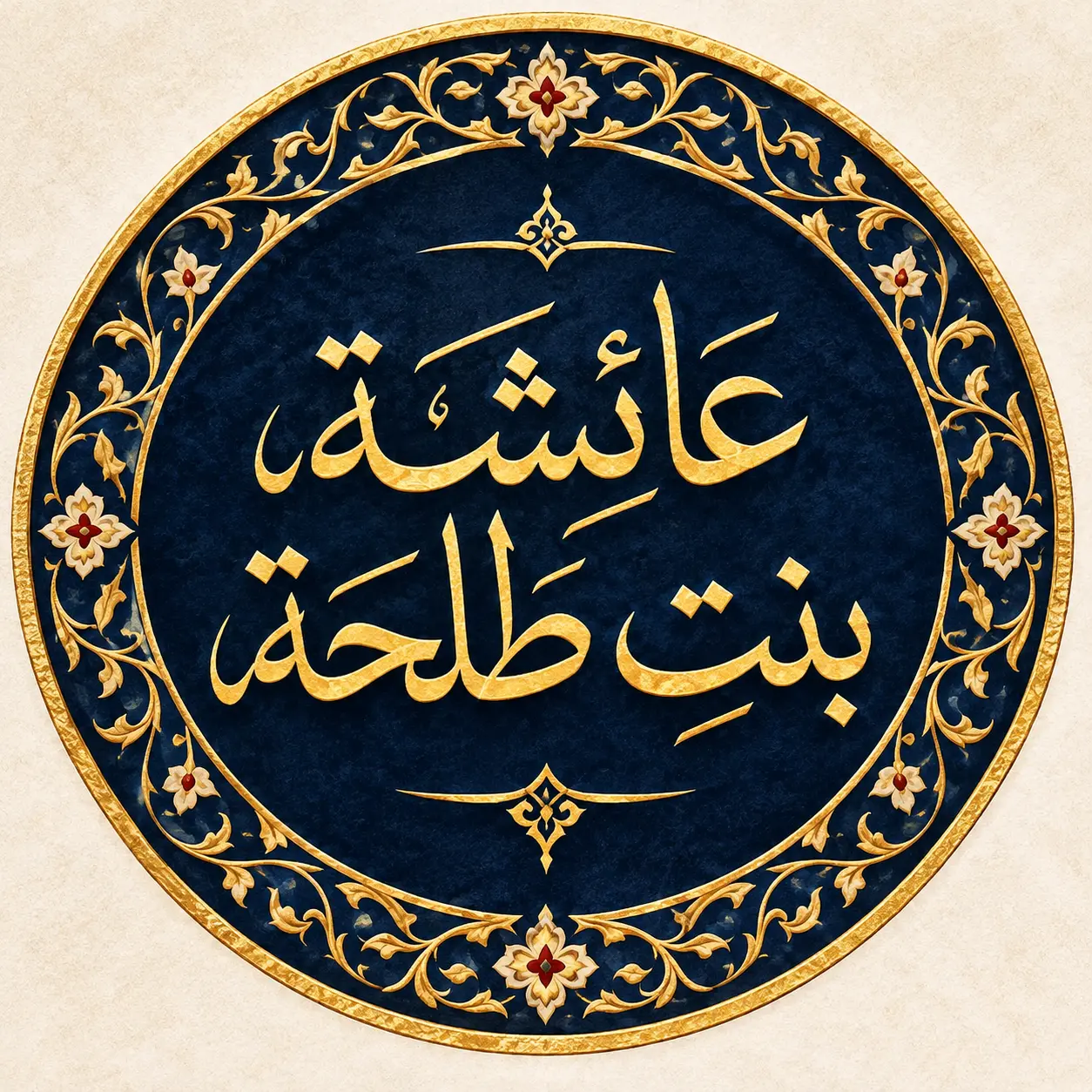
A'isha bint Talha was a woman of the Taym branch of Quraysh, a daughter of the Companion Talha ibn Ubayd Allah and of Umm Kulthum bint Abu Bakr, so that she was a granddaughter of Abu Bakr and a niece of A'isha, the wife of the Prophet Muhammad (Peace Be Upon Him).1 She was married three times: to Abd Allah ibn Abd al-Rahman ibn Abi Bakr, to Mus'ab ibn al-Zubayr, and, after Mus'ab was killed, to Umar ibn Ubayd Allah ibn Ma'mar al-Taymi.23 She narrated hadith from her aunt, and the hadith critics quoted in the biographical dictionaries judged her reliable.451
The sources give different dates for her death, and one of them gives none; the versions are set out in the section on her death.
The sources
The biographical dictionaries and a city history record her. A short entry in al-Tabaqat al-kubra by the biographer Ibn Sa'd (d. 230 AH) gives her parentage, her three husbands in order and the fact that she narrated from A'isha.2 The later dictionaries of al-Mizzi (d. 742 AH), al-Dhahabi (d. 748 AH) and Ibn Hajar al-Asqalani (d. 852 AH) add her pupils and what the hadith critics said of her, and al-Dhahabi alone records her oath and the length of her life.456 The longest notice is in the history of Damascus by Ibn Asakir (d. 571 AH), which also collects anecdotes about her; the genealogy, the visits to the caliphs and the bride-gifts given below come from it.7 Among modern reference works, the entry by Ch. Pellat in the Encyclopaedia of Islam and the entry by Ahmet Lütfi Kazancı in the TDV İslâm Ansiklopedisi (the TDV encyclopaedia below) are devoted to her.31
Family and name
Her full name, as Ibn Sa'd gives it, is A'isha bint Talha ibn Ubayd Allah ibn Uthman ibn Amr ibn Ka'b ibn Sa'd ibn Taym, and al-Mizzi calls her al-Qurashiyya al-Taymiyya, of Quraysh and of Taym.2 Her kunya, the by-name formed with Umm (mother of) and a name, was Umm Imran, and al-Mizzi adds the nisba al-Madaniyya (of Medina).87
Her father, Talha ibn Ubayd Allah, was a Companion of the Prophet, whom the TDV encyclopaedia counts among the ten promised Paradise; its entry on him says that he had fifteen children and names Muhammad, Musa, Imran and A'isha among them.19 Her mother was Umm Kulthum, a daughter of Abu Bakr al-Siddiq.210 Ibn Asakir quotes al-Zubayr ibn Bakkar (d. 256 AH), the author of works of historical reports, who, listing the children of Talha, names Zakariyya ibn Talha and A'isha bint Talha as children of Talha and Umm Kulthum, and gives their brothers on their mother's side as Uthman, Ibrahim and Musa, sons of Abd al-Rahman ibn Abd Allah ibn Abi Rabi'a al-Makhzumi.11
Her aunt on her mother's side was A'isha, the Prophet's wife. Al-Dhahabi, al-Mizzi and Ibn Hajar call A'isha her khala, her mother's sister, and the Encyclopaedia of Islam calls her A'isha's niece.10453
Her marriages
The sources that list her husbands agree on their order. Her first husband was Abd Allah ibn Abd al-Rahman ibn Abi Bakr, a grandson of Abu Bakr, whom al-Mizzi and al-Dhahabi call the son of her maternal uncle and the Encyclopaedia of Islam calls her cousin.8103 The TDV encyclopaedia records four sons of this marriage, Imran, Abd al-Rahman, Abu Bakr and Talha, and a daughter, Nafisa.1 Al-Mizzi records that Abd Allah died, and that Mus'ab ibn al-Zubayr then married her.8
Mus'ab was a son of al-Zubayr ibn al-Awwam and a brother of Abd Allah ibn al-Zubayr, who in 67/686 entrusted him with the province of Iraq; al-Dhahabi, in recording the marriage, gives him the title amir al-Iraq (commander of Iraq).21210
The Encyclopaedia of Islam describes an oath of hers that concerned her husband: in its entry on women it writes that she "even repudiated her husband by using the ancient formula of the zihar", the form in which a man likens his wife to his mother's back, and "would not go back on her oath until she was convinced that it was invalid", while al-Dhahabi gives the oath as a declaration that if she married Mus'ab he would be to her as the back of her mother, and records that after she had married him she asked about it, was ordered to make expiation, and freed a slave of hers.136
Mus'ab was killed in the fighting against the Umayyad caliph Abd al-Malik ibn Marwan about the middle of Jumada I 72 (October 691), and Ibn Sa'd, al-Mizzi and al-Dhahabi record that she then married Umar ibn Ubayd Allah ibn Ma'mar al-Taymi.122810 Ibn Asakir's report from the early biographer of the Prophet Ibn Ishaq (d. 150 or 151 AH) calls Umar a cousin of hers.14
The sources give the bride-gift (mahr) of each of the last two marriages in different sums. For Mus'ab, al-Dhahabi gives 100,000 dinars, and Ibn Asakir gives the same figure in the report he transmits from Ibn Ishaq; al-Mizzi gives 1,000,000 dirhams.10148 For Umar, al-Dhahabi gives 1,000,000 dirhams, and the report from Ibn Ishaq in Ibn Asakir gives 100,000 dinars.1014 The Encyclopaedia of Islam names no sum.3
Learning and the transmission of hadith
A'isha bint Talha narrated from her aunt, and the sources that list her teachers name no other.245 Her own account of her time with her aunt is preserved in the Al-Adab al-Mufrad of the hadith scholar al-Bukhari (d. 256 AH): she says that she spoke to A'isha "when I was in her care", that people came to A'isha from every direction and that young men treated her "as a sister" and sent her presents and letters from their cities, and that A'isha told her to answer them and reward them, offering to give her something if she had nothing to give (Al-Adab al-Mufrad 1118; the edition marks the chain Sound). The report does not date that period. The TDV encyclopaedia states that her close contact with her aunt gave her a sound grounding in hadith, and that she had wide knowledge of Arab history, literature and especially poetry.1
Two of the Sunan carry reports with her in the chain. In Sunan Abi Dawud 4713, which its edition grades Sahih, she narrates from A'isha that an Ansari boy was brought to the Prophet for the funeral prayer and A'isha said that he had done no evil, and the Prophet answered that God had created Paradise and those who belong to it, and the Fire and those who belong to it, while they were still in the loins of their forefathers. In Sunan an-Nasa'i 3066, graded Hasan, she narrates from her maternal aunt A'isha that the Prophet told one of his wives to leave Muzdalifah (Jam') on the night of Jam', to stone Jamrat al-Aqaba and to return to her camp before morning; the report adds that 'Ata' acted on this until he died.
Her pupils, as al-Mizzi and Ibn Hajar list them, include her son Talha ibn Abd Allah ibn Abd al-Rahman, her nephews Talha ibn Yahya ibn Talha and Mu'awiya ibn Ishaq ibn Talha, Habib ibn Abi Amra, Ata ibn Abi Rabah, Fudayl ibn Amr al-Fuqaymi and al-Minhal ibn Amr; the TDV encyclopaedia names her son, three nephews and Ata ibn Abi Rabah among them.41 The hadith critics named in the sources judged her reliable. Yahya ibn Ma'in (d. 233 AH) is quoted as calling her trustworthy and an authority (thiqa, hujja); al-Ijli (d. 261 AH) calls her a trustworthy Medinan tabi'iyya, a woman of the generation after the Companions; Abu Zur'a al-Dimashqi calls her a dignified woman (imra'a jalila) from whom people narrated for her merit and good conduct; and Ibn Hibban (d. 354 AH) lists her in al-Thiqat, his book of reliable transmitters.5 Al-Mizzi adds that the compilers of the six canonical collections transmit from her; al-Dhahabi writes that her hadith is recorded in the Sihah, the sound collections; and the TDV encyclopaedia says that her reports are in the six canonical books (Kutub al-Sitta).4101
Her standing, and her visits to the caliphs
The Encyclopaedia of Islam opens its entry by calling her "one of the most famous of Arab women" and crediting her with "a rare beauty". The same entry records that she occasioned the dismissal of al-Harith ibn Khalid al-Makhzumi, the governor of Mecca, who had agreed to postpone the hour of prayer so that she could complete her circuits of the Kaaba (tawaf); it names no date and no caliph.3
Al-Dhahabi records that she came to the Umayyad caliph Hisham ibn Abd al-Malik, who treated her with respect and gave her a large sum.10 The TDV encyclopaedia says that she went to Hisham to bring the complaints of the people, and that when he asked why she had come she answered that mercy was not raining from the sky and he was not giving them their due.1 Ibn Asakir, in the passage that follows Abu Zur'a's verdict, states that she came to Abd al-Malik ibn Marwan and to Hisham ibn Abd al-Malik, so that one source names a visit to one caliph and another to two.7
Death
The sources give three versions of her death. The Encyclopaedia of Islam states that the date of her death is not known.3 Al-Dhahabi writes that she lived until near the year 110 AH, in Medina.6 The heading of the TDV encyclopaedia's entry gives her death as 101/719.1
Descendants
The Encyclopaedia of Islam records that Muhammad ibn Hafs al-Taymi, Abu Bakr, a genealogist, collector of traditions and wit of Basra, owed his by-name Ibn A'isha to A'isha bint Talha, from whom he was descended.15
Historiographical Note
The sources differ on four points, and the article gives each version beside its source.
The date of her death. The three versions are set out in the section on her death. The period given for her at the head of this article gives both dated versions: the TDV's 101/719 and al-Dhahabi's approximate year, converted to 728 CE. None of the three versions gives a day or a month.
The bride-gifts. The sums are given in two units, dinars and dirhams, and none of the sources explains the difference. The 1,000,000 dirhams that al-Mizzi gives for Mus'ab is the sum al-Dhahabi gives for Umar, and Ibn Asakir's report gives 100,000 dinars for both marriages.10814
Her oath. The Encyclopaedia of Islam places the use of the formula of the zihar within a marriage, calls it a repudiation of her husband, and says she kept to the oath until she was convinced it was invalid; it names neither the husband nor the sequel. Al-Dhahabi places the oath before the marriage to Mus'ab, and records that she afterwards asked, was told to make expiation and freed a slave. He gives it from the Sunan of Sa'id ibn Mansur (d. 227 AH), a collection that his editors describe as a place where reports with an interrupted or mursal chain are found.136
Her visits to the caliphs. Al-Dhahabi and the TDV encyclopaedia name Hisham ibn Abd al-Malik alone, the Encyclopaedia of Islam names no caliph for its own story, and Ibn Asakir names Abd al-Malik ibn Marwan as well. Ibn Asakir's sentence follows Abu Zur'a's verdict without making clear whether it is part of it.1017
See also
- Talha ibn Ubayd Allah — her father
- Abu Bakr — her mother's father
- A'isha bint Abu Bakr — her aunt and her teacher in hadith
- Abd Allah ibn al-Zubayr — the brother of her second husband, who entrusted him with Iraq
- Hisham ibn Abd al-Malik — the caliph she is recorded as visiting
- The Umayyad Caliphate — the caliphate of her later life
- Hadith — the literature in which her reports are preserved
References
Citations
Footnotes
-
Ahmet Lütfi Kazancı, 'Âişe bint Talha b. Ubeydullah', TDV İslâm Ansiklopedisi, vol. 2 (İstanbul, 1989), pp. 206–207 — https://islamansiklopedisi.org.tr/aise-bint-talha-b-ubeydullah, register entry 2, islamansiklopedisi.org.tr. ↩ ↩2 ↩3 ↩4 ↩5 ↩6 ↩7 ↩8 ↩9 ↩10 ↩11
-
Ibn Sa'd, al-Tabaqat al-kubra (Beirut: Dar Sadir), viii, 467 — her parentage, her three husbands in order and her transmission from A'isha; https://shamela.ws/book/9351/3845, register entry 4, shamela.ws; the same notice is in the Khanji edition, x, 433, https://shamela.ws/book/146/4853. ↩ ↩2 ↩3 ↩4 ↩5 ↩6 ↩7
-
Ch. Pellat, 'A'isha bint Talha', The Encyclopaedia of Islam, new edition, vol. 1 — the dedicated entry: her descent, the sentence on her fame and beauty, the governor of Mecca, her three husbands, and the statement that the date of her death is not known. ↩ ↩2 ↩3 ↩4 ↩5 ↩6 ↩7
-
Al-Mizzi, Tahdhib al-kamal, xxxv, 238 — her teacher, her pupils, the verdicts of the critics and the collections that transmit from her; https://shamela.ws/book/3722/18838, register entry 4, shamela.ws. ↩ ↩2 ↩3 ↩4 ↩5 ↩6
-
Ibn Hajar al-Asqalani, Tahdhib al-tahdhib (Hyderabad), xii, 436–437 — her mother, her teacher, her pupils and the verdicts of the critics; https://shamela.ws/book/3310/5672, register entry 4, shamela.ws. ↩ ↩2 ↩3 ↩4 ↩5
-
Al-Dhahabi, Siyar a'lam al-nubala', iv, 370 — the report of her oath, with the editors' note on Sa'id's Sunan, and her life until near 110 in Medina; https://shamela.ws/book/10906/3523, register entry 4, shamela.ws. ↩ ↩2 ↩3 ↩4
-
Ibn Asakir, Tarikh madinat Dimashq, lxix, 248 — her lineage and kunya, her pupils, Abu Zur'a's verdict and her visits to Abd al-Malik and Hisham; https://shamela.ws/book/71/31425, register entry 4, shamela.ws. ↩ ↩2 ↩3 ↩4
-
Al-Mizzi, Tahdhib al-kamal, ed. Bashshar Awwad Ma'ruf (Beirut: Mu'assasat al-Risala), xxxv, 237, no. 7888 — her kunya, her mother, her husbands and Mus'ab's bride-gift; https://shamela.ws/book/3722/18837, register entry 4, shamela.ws. ↩ ↩2 ↩3 ↩4 ↩5 ↩6
-
Bünyamin Erul, 'Talha b. Ubeydullah', TDV İslâm Ansiklopedisi, vol. 39 (İstanbul, 2010), pp. 504–505 — his fifteen children; https://islamansiklopedisi.org.tr/talha-b-ubeydullah, register entry 2, islamansiklopedisi.org.tr. ↩
-
Al-Dhahabi, Siyar a'lam al-nubala' (Beirut: Mu'assasat al-Risala), iv, 369, no. 147 — her lineage, her husbands, the bride-gifts, her teacher and pupils, her visit to Hisham and Ibn Ma'in's verdict; https://shamela.ws/book/10906/3522, register entry 4, shamela.ws. ↩ ↩2 ↩3 ↩4 ↩5 ↩6 ↩7 ↩8 ↩9 ↩10 ↩11
-
Ibn Asakir, Tarikh madinat Dimashq, lxix, 249 — al-Zubayr ibn Bakkar on the children of Talha and Umm Kulthum; https://shamela.ws/book/71/31426, register entry 4, shamela.ws. ↩
-
H. Lammens and Ch. Pellat, 'Mus'ab b. al-Zubayr', The Encyclopaedia of Islam, new edition, vol. 7 — his governorship of Iraq from 67/686 and his death about the middle of Jumada I 72/October 691. ↩ ↩2
-
'Women' (the section on the Hijra period), The Encyclopaedia of Islam, new edition, vol. 6 — the sentence on her use of the zihar and her oath. ↩ ↩2
-
Ibn Asakir, Tarikh madinat Dimashq, lxix, 253 — the report from Ibn Ishaq giving the bride-gifts of Mus'ab and Umar; https://shamela.ws/book/71/31430, register entry 4, shamela.ws. ↩ ↩2 ↩3 ↩4
-
Ch. Pellat, 'Ibn A'isha', The Encyclopaedia of Islam, new edition, vol. 3 — Muhammad ibn Hafs al-Taymi as her descendant. ↩
Sources
Works in the approved library. Cited by title and author, and by the entry used.
- Bearman, P. J., et al., eds. The Encyclopaedia of Islam, new (second) edition — Ch. Pellat, 'A'isha bint Talha' (vol. 1); 'Women' (vol. 6); H. Lammens and Ch. Pellat, 'Mus'ab b. al-Zubayr' (vol. 7); Ch. Pellat, 'Ibn A'isha' (vol. 3).
- Abu Dawud. Sunan Abi Dawud, vol. 5. Riyadh: Darussalam.
- Al-Nasa'i. Sunan an-Nasa'i, vol. 3. Riyadh: Darussalam.
- Al-Bukhari. Al-Adab al-Mufrad. With commentary compiled by Abu Naasir Ibrahim Abdur-Rauf. Petaling Jaya: Dakwah Corner Publications. Classical works read at Shamela (register entry 4, shamela.ws).
- Ibn Sa'd. Al-Tabaqat al-kubra, vol. 8. Beirut: Dar Sadir; and the Khanji edition, vol. 10.
- Al-Dhahabi. Siyar a'lam al-nubala', edited by Shu'ayb al-Arna'ut et al., vol. 4. Beirut: Mu'assasat al-Risala.
- Al-Mizzi. Tahdhib al-kamal fi asma' al-rijal, edited by Bashshar Awwad Ma'ruf, vol. 35. Beirut: Mu'assasat al-Risala.
- Ibn Hajar al-Asqalani. Tahdhib al-tahdhib, vol. 12. Hyderabad.
- Ibn Asakir. Tarikh madinat Dimashq, vol. 69. Encyclopaedia entries read at the TDV (register entry 2, islamansiklopedisi.org.tr).
- Kazancı, Ahmet Lütfi. 'Âişe bint Talha b. Ubeydullah'. TDV İslâm Ansiklopedisi, vol. 2. İstanbul, 1989.
- Erul, Bünyamin. 'Talha b. Ubeydullah'. TDV İslâm Ansiklopedisi, vol. 39. İstanbul, 2010.
Further reading
Offered to the reader for further study. Nothing in this article rests on the works below beyond what the sources above record of them.
- Abu al-Faraj al-Isfahani. Kitab al-Aghani, vol. 11 — cited in the TDV entry and in the Encyclopaedia of Islam among the sources for her life.
- Ibn Abd Rabbih. Al-Iqd al-farid — cited in the TDV entry.
- Ibn Qutayba. Al-Ma'arif — cited in the Encyclopaedia of Islam and in al-Dhahabi's editors' notes.
- Kahhala, Umar Rida. A'lam al-nisa'. Beirut, 1977 — cited in the TDV entry.
External links
Approved sources only, each with its number on the Register of Approved External Web Sources.
- Âişe bint Talha b. Ubeydullah — the TDV İslâm Ansiklopedisi, register entry 2, islamansiklopedisi.org.tr: the dedicated entry, in Turkish
- Ibn Sa'd, al-Tabaqat al-kubra, the notice of A'isha bint Talha — register entry 4, shamela.ws: in Arabic
- Al-Dhahabi, Siyar a'lam al-nubala', the notice of A'isha bint Talha — register entry 4, shamela.ws: in Arabic
- Ibn Asakir, Tarikh madinat Dimashq, the notice of A'isha bint Talha — register entry 4, shamela.ws: in Arabic
Mentioned In
1 article references this topic
More from Umayyad Caliphate
Al-Aqsa Mosque: The Farthest Sanctuary
Al-Aqsa Mosque in Jerusalem is the third holiest site in Islam, central to the Night Journey (Isra and Miraj) of Prophet Muhammad, and a symbol of Islamic heritage and Palestinian identity for over 1,300 years.
Battle of Karbala
The Battle of Karbala (680 CE) was a confrontation in which Husayn ibn Ali, grandson of Prophet Muhammad, was killed with his companions by Umayyad forces near the Euphrates. It became one of the most consequential events in Islamic history, shaping the development of Shia Islam.
The Battle of Tours - Turning Point in European History
The Battle of Tours (732 CE) between Charles Martel's Frankish forces and the Umayyad army halted Muslim expansion into Western Europe, marking a decisive turning point that shaped the continent's political and religious landscape for centuries.
The Dome of the Rock
Comprehensive history of the Dome of the Rock, one of Islam's most iconic monuments and the oldest surviving Islamic building, built in Jerusalem in 691 CE