Ja'far ibn Abi Talib: The Flying Martyr of Mu'tah
Ja'far ibn Abi Talib, Ali's full brother and the Prophet's cousin, led the Muslim emigrants who took refuge in Abyssinia, spoke on their behalf before the Negus, and was killed commanding the army at the Battle of Mu'tah after both his hands were severed holding its banner.
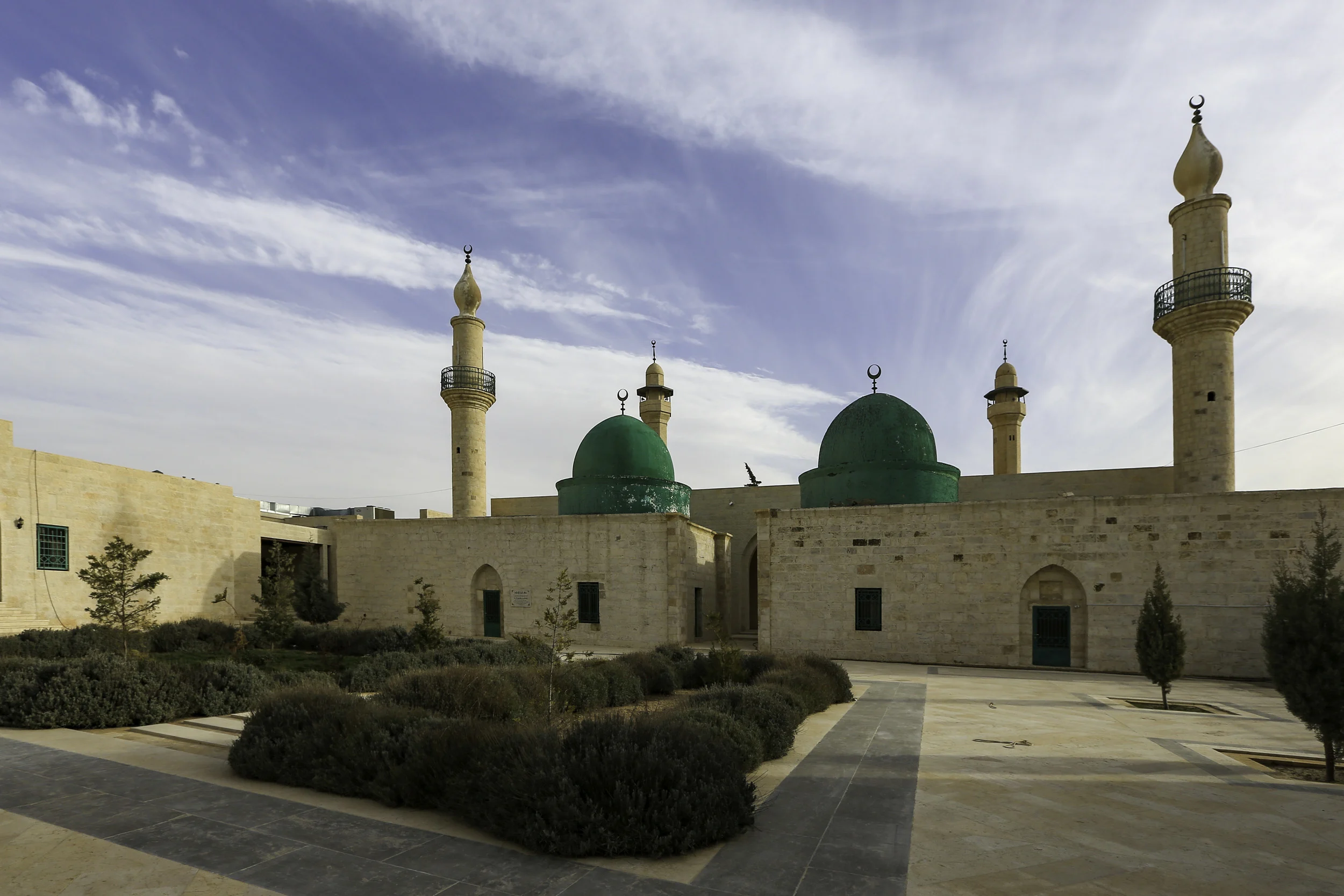
Ja'far ibn Abi Talib (c. 590-629 CE / c. 20 BH-8 AH) was a son of Abu Talib and the full brother of Ali ibn Abi Talib, making him a first cousin of Prophet Muhammad ﷺ. He led the second wave of Muslim emigrants who took refuge in Abyssinia from Meccan persecution, spoke on their behalf before the Negus in an exchange the sira preserves at length, and was killed commanding the Muslim army at the Battle of Mu'tah in 629 CE, after both hands were severed from his body while he held its banner.
Before the Emigration
Ja'far was raised in the household of his father Abu Talib, alongside his brother Ali and, for a period, alongside his cousin Muhammad, whom Abu Talib took in as an orphan. He was among the earlier converts to Islam and, together with his wife, Asma bint Umays of the Banu Khath'am, was among those who suffered the persecution the Quraysh directed at the young Muslim community in Mecca.
Leader of the Emigrants in Abyssinia
When the Prophet permitted a body of Muslims to seek asylum in Abyssinia a second time, after Quraysh hostility to the first group of emigrants had intensified, The Sealed Nectar records the second migration as numbering eighty-three men and eighteen or nineteen women. The Quraysh, unwilling to accept that the refugees had found safety, sent Amr ibn al-As and Abdullah ibn Abi Rabi'a — both before their own conversion to Islam — to the court of the Negus with gifts, demanding that the Muslims be handed over on the ground that they had abandoned the religion of their ancestors.
The Negus summoned the Muslims and asked them to explain their faith. Ja'far ibn Abi Talib stood and answered on their behalf: "O king, we were an ignorant people. We worshipped idols and ate the meat of dead carcasses. We were accustomed to lewd behaviour, to severing the ties of kinship, and the strong among us consumed the property of the weak. This is how we were, until God sent a Messenger to us, whose lineage, truthfulness and trustworthiness we already knew." Ja'far set out what the Prophet had commanded — the worship of God alone, truthful speech, the fulfilment of trusts, kindness to kin and neighbours, the prohibition of bloodshed, of consuming an orphan's wealth, and of slandering chaste women — and explained that when the Quraysh had responded to this message with persecution, the emigrants had chosen the Negus's kingdom over any other, hoping he would not wrong them.
Asked by the Negus whether he had brought anything of what his Prophet said had come from God, Ja'far recited the opening verses of Surah Maryam, concerning the birth of John and Jesus. The Negus and his bishops were moved to tears, and the king told the Quraysh envoys, "I cannot give you back these refugees." When the envoys returned the next day claiming the Muslims blasphemed against Jesus, Ja'far was summoned again and answered that the Muslims held Jesus to be the servant of God, His messenger, His spirit, and His word breathed into the Virgin Mary. The Negus affirmed that this matched his own belief, returned the gifts the Quraysh delegation had brought, and confirmed his protection of the Muslims, who remained in Abyssinia undisturbed for a number of years.
Return and Later Life
Ja'far and the other emigrants in Abyssinia returned to join the Prophet after the conquest of Khaybar in 628 CE, by which point the community he had left in Mecca had become the governing power of Medina.
Abu Musa al-Ash'ari, who reached Abyssinia by a separate route with a small party of his own people, left his own account of joining Ja'far's household there and of their return together. He related that news of the Prophet's emigration to Medina reached his group while they were still in Yemen, and that they set out as emigrants themselves — three men in his own party, of a boat carrying between fifty-two and fifty-three men from his people in total. Their boat took them to the Negus in Abyssinia, where they met Ja'far and stayed with him. When the Prophet later sent for them to return, they came back to find that Khaybar had already been conquered, and the Prophet nonetheless gave them a share of its spoils. Some of those who had reached Medina earlier remarked to "the people of the boat" that they had migrated before them. Asma bint Umays, who had come with the party from Abyssinia, was visiting Hafsa, one of the Prophet's wives, when Umar ibn al-Khattab arrived and asked who she was; on learning she was one of the Abyssinian emigrants, he told her that his own people had a greater claim on the Prophet than hers, having migrated before them. Asma answered him sharply, and reported the exchange directly to the Prophet, who ruled in her favour: those who had gone to Abyssinia, he said, had two migrations to their credit against the one migration of those who had gone only to Medina. Abu Musa recorded that the news of this ruling brought members of the boat's party to Asma afterward, wanting to hear it repeated, since nothing pleased them more than what the Prophet had said of them.
A separate account, transmitted through several chains that al-Bayhaqi records as containing narrators of uncertain reliability, describes Ja'far's own reunion with the Prophet at Khaybar: that the Prophet kissed him between the eyes and embraced him, saying he did not know which made him happier, the conquest of Khaybar or the arrival of Ja'far.
The Battle of Mu'tah
In 629 CE (8 AH) the Prophet sent an army toward the Byzantine frontier in response to the killing of a Muslim envoy, al-Harith ibn Umayr. Before the army departed, the Prophet named its command in advance: Zayd ibn Harithah was to lead; if he fell, Ja'far ibn Abi Talib; and if he too fell, Abdullah ibn Rawaha. This sequence is preserved directly in Sahih al-Bukhari, on the authority of Anas ibn Malik: "The Prophet said, 'Zaid took over the flag and was martyred. Then it was taken by Ja'far, who was martyred as well. Then Abdullah ibn Rawaha took the flag, but he too was martyred' — and at that, the eyes of the Messenger of God were full of tears."
At Mu'tah the roughly three thousand Muslims met a force many times their number. The Sealed Nectar records that Zayd ibn Harithah, given command first, fought until he fell fatally wounded. Ja'far then took the leadership. In the thick of the fighting he dismounted and killed his own horse rather than retreat on it, continuing to fight until his right hand was severed. He then held the army's banner in his left hand until that too was severed, and clasped it between both arms until a Byzantine soldier struck him and cut him in two. Sahih al-Bukhari records that fifty wounds were later found on his body, none of them on his back — evidence, in the tradition's reading, that he had faced the enemy throughout and never turned to flee.
Abdullah ibn Rawaha then took up the banner and fought on until he too was killed, after which the army rallied around Khalid ibn al-Walid, who reorganised the force and conducted an orderly withdrawal to Medina.
Haykal's biography records that the Prophet, before the army's return became public, went himself to Ja'far's house, where his wife Asma bint Umays had baked bread, washed and dressed the children, and was awaiting her husband. The Prophet took the children in his arms and wept; Asma, reading his silence, asked directly whether he had news of Ja'far, and he told her that he did, and that they had fallen that day. He instructed those who gathered at the house to prepare food for Ja'far's family and to look after them.
Dhu al-Janahain — "Possessor of the Two Wings"
Ja'far became known after his death by the epithet Dhu al-Janahain, "possessor of the two wings," on the understanding, recorded in the tradition, that God had given him wings in Paradise to replace the hands he lost defending the Prophet's banner. Sahih al-Bukhari preserves the epithet in continued use within a generation: it records that whenever Abdullah ibn Umar greeted Ja'far's son, Abdullah ibn Ja'far, he would say, "Peace be upon you, O son of the possessor of the two wings."
Family
Ja'far's son, Abdullah ibn Ja'far, is named directly in the hadith literature as the bearer of his father's epithet and appears elsewhere in the canonical collections in the company of Abdullah ibn Abbas and Abdullah ibn al-Zubayr, and in matters concerning his family's inheritance and property.
Legacy
Ja'far ibn Abi Talib is remembered in the Islamic tradition for two distinct services rendered at two of the most dangerous moments the early Muslim community faced: his defence of the faith before a foreign king when the community had nowhere else to turn, and his defence of its army's standard at Mu'tah when its first two commanders had already fallen. The sira and the hadith literature treat both as of a piece — a life given first to speaking for the community and finally to dying for it.
References and Further Reading
Primary Islamic Sources
- Sahih al-Bukhari 1246 — the Prophet naming the command sequence at Mu'tah: Zayd, then Ja'far, then Abdullah ibn Rawaha
- Sahih al-Bukhari 3709 and 4264 — Ibn Umar's greeting to Abdullah ibn Ja'far as "son of the possessor of the two wings"
- Sahih al-Bukhari, Hadith No. 539-4, Vol. 5 (as transmitted in Al-Lu'lu Wal-Marjan, Chapter 41) — Abu Musa al-Ash'ari's account of joining Ja'far's household in Abyssinia, the return at Khaybar, and the Prophet's ruling that the Abyssinian emigrants held two migrations to their credit
- Quran, Surah Maryam (19:1-33) — the verses Ja'far recited before the Negus
Classical Islamic Sources
- Ibn Hisham, recension of Ibn Ishaq's Sirat Rasul Allah — the migration to Abyssinia and the exchange before the Negus
- Ibn Kathir, Ismail ibn Umar. Al-Sira al-Nabawiyya [English translation]. [Compiled c. 1373 CE]
- Al-Tabari, Muhammad ibn Jarir. Tarikh al-Rusul wa al-Muluk. [Completed c. 915 CE]
- Ibn Sa'd, Muhammad. Al-Tabaqat al-Kubra. [Compiled c. 845 CE]
Academic and Scholarly Sources
- Al-Mubarakpuri, Safi-ur-Rahman. The Sealed Nectar (Ar-Raheeq Al-Makhtum). Riyadh: Darussalam, 1996.
- Haykal, Muhammad Husayn. The Life of Muhammad. Translated by Isma'il Razi al-Faruqi. Indianapolis: North American Trust Publications, 1976.
- Watt, W. Montgomery. Muhammad at Medina. Oxford: Oxford University Press, 1956.
- Kaegi, Walter E. Byzantium and the Early Islamic Conquests. Cambridge: Cambridge University Press, 1992.
Further Reading
- Lings, Martin. Muhammad: His Life Based on the Earliest Sources. Cambridge: Islamic Texts Society, 1983.
- Guillaume, Alfred, trans. The Life of Muhammad: A Translation of Ibn Ishaq's Sirat Rasul Allah. Oxford: Oxford University Press, 1955.
Mentioned In
2 articles reference this topic