Al-Masjid al-Nabawi: The Prophet's Mosque
Al-Masjid al-Nabawi (the Prophet's Mosque) in Medina is the second holiest mosque in Islam. Founded by Prophet Muhammad in 622 CE after the Hijra, it served as the center of the early Muslim community and contains the Prophet's tomb beneath the Green Dome.
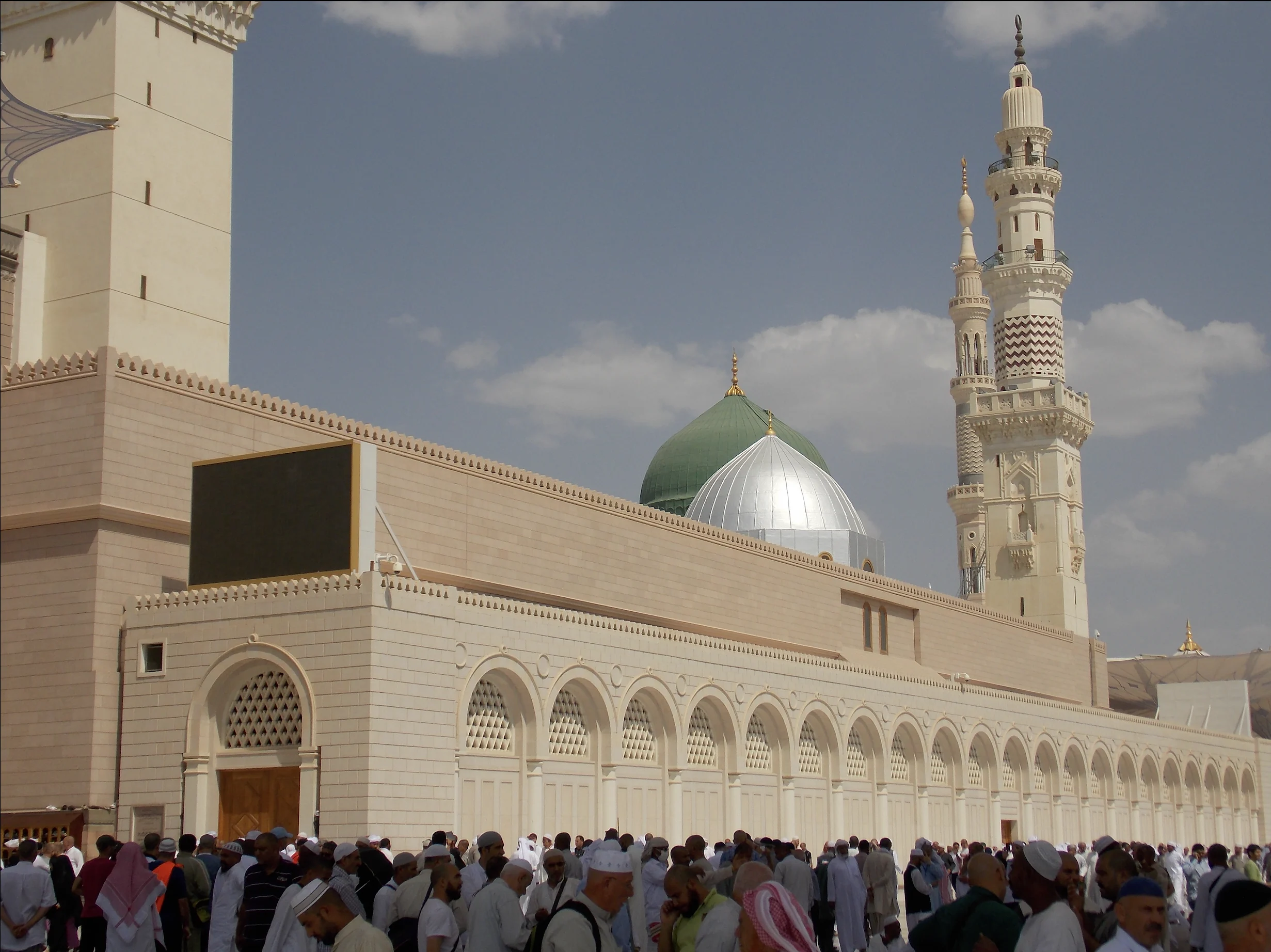
Al-Masjid al-Nabawi (Arabic: المسجد النبوي, the Prophet's Mosque) in Medina is the second holiest mosque in Islam, after Masjid al-Haram in Mecca. Founded by Prophet Muhammad ﷺ in 622 CE immediately after the Hijra (migration from Mecca), it served as the spiritual, political, and social center of the early Muslim community — a place of worship, a court of justice, a center of learning, a gathering place for the community, and the home from which the Prophet governed the first Islamic state.
The mosque holds unique significance in Islam not only for its founding by the Prophet and its role in the community's early history but because it contains the tomb of the Prophet Muhammad — located in what was originally Aisha bint Abu Bakr's chamber, now enclosed within the mosque structure beneath the iconic Green Dome. The tombs of the first two caliphs, Abu Bakr and Umar ibn al-Khattab, are also located beside the Prophet's grave.
The Prophet declared: "A prayer in this mosque of mine is better than a thousand prayers in any other mosque except Masjid al-Haram" (Sahih al-Bukhari 1190; also Sahih Muslim 1394) — establishing a specific spiritual merit for worship in this space that draws millions of visitors annually. The mosque has been expanded repeatedly over fourteen centuries — from the Prophet's simple courtyard of palm trunks and mud walls to the vast modern complex that can accommodate over one million worshippers.
The Founding of the Mosque (622 CE)
The Prophet's Arrival in Medina
When the Prophet arrived in Medina after the Hijra in 622 CE (1 AH), the first major act of community-building he undertook was the construction of a mosque. According to the traditions, the Prophet's camel was allowed to wander freely upon his arrival in the Quba area south of Medina, and it knelt at a spot that belonged to two orphan boys of the Banu Najjar clan. The Prophet purchased the land and personally participated in the construction of what would become his mosque.
Some accounts place the founding at Quba (where the Quba Mosque — described as the first mosque built in Islam — was established during the Prophet's brief stay before entering Medina proper), while the main mosque was built after the Prophet's entry into Medina itself. The site chosen was adjacent to the house of Abu Ayyub al-Ansari, where the Prophet initially stayed before his own quarters were completed.
The Original Structure
The original mosque was remarkably simple — a reflection of the Prophet's insistence on modesty and functionality over grandeur. It measured approximately 30 × 35 meters (100 × 115 feet), roughly the size of a large modern house, with walls of mud brick (labin) rising about seven cubits (approximately 3.5 meters) high on stone foundations. Palm trunks served as columns and palm leaves as roofing over part of the structure, while part of the courtyard was left open, and the floor was packed earth covered with gravel. The qibla initially faced Jerusalem, and it was changed to Mecca approximately sixteen months after the Hijra.
The Prophet participated personally in the construction — carrying bricks, mixing mortar, and laying foundations alongside his companions. This physical labor was itself a statement: the Prophet was not above manual work, and the mosque was the community's collective project rather than a structure imposed from above.
The Function of the Early Mosque
The Prophet's Mosque was not merely a place of prayer — it was the center of all community life. Within its walls or in its courtyard the five daily prayers were established and performed congregationally, and the Prophet delivered his sermons (khutbah) and taught the community. Legal judgments were made there, the mosque functioning as a courthouse, and military planning was conducted as campaigns were organized and debriefings held. Delegations from other tribes were received, the poor — the Ahl al-Suffa, the People of the Bench — lived in a covered area of the mosque supported by community charity, social gatherings made the mosque the community's living room, and prisoners of war were occasionally housed there temporarily.
This multifunctional character — combining worship, governance, education, social welfare, and community life in a single space — established a model for the mosque in Islamic civilization that persisted for centuries. The mosque was not a church (dedicated solely to worship and separate from civic life) but a community center in which the sacred and the practical were integrated.
The Prophet's Chambers
Adjacent to the mosque were the private chambers (hujurat) of the Prophet's wives. Each wife had her own small room opening onto the mosque's courtyard. These chambers were extremely modest — constructed of mud brick with roofs of palm branches, barely large enough for a person to stand and pray within. Aisha's chamber, located on the eastern side of the mosque, would later become the site of the Prophet's burial.
The proximity of the Prophet's private life to the public space of the mosque meant that the community had constant access to their leader. He could be called from his chambers for emergencies, and the community could observe (to the extent the privacy walls allowed) the household's daily life. This accessibility — the absence of palatial distance between ruler and ruled — was itself a feature of the Prophetic governance model.
The Qibla Change
From Jerusalem to Mecca
For approximately sixteen months after the Hijra, the Muslims prayed facing Jerusalem — the qibla inherited from the earlier prophetic traditions. The change of qibla to Mecca came through Quranic revelation (Quran 2:144): "We have certainly seen the turning of your face toward the heaven, and We will surely turn you to a qibla with which you will be pleased. So turn your face toward al-Masjid al-Haram."
This change required a physical reorientation of the mosque. The southern wall (which had been the back) became the qibla wall (the front), and the layout was adjusted accordingly. The change of qibla was one of the defining moments of the Medinan period — establishing Islam's independence from the earlier Jewish and Christian traditions and orienting the community definitively toward the Kaaba in Mecca.
Expansions Through Islamic History
The Prophet's Own Expansion (7 AH / 628 CE)
The first expansion of the mosque occurred during the Prophet's own lifetime, after the conquest of Khaybar in 7 AH (628 CE). The community had grown substantially, and the original structure could no longer accommodate the worshippers. The Prophet expanded the mosque to approximately 50 × 50 meters, roughly doubling its area. Additional columns of palm trunks were added to support the expanded roof.
The Expansion of Umar (17 AH / 638 CE)
Umar ibn al-Khattab, the second caliph, expanded the mosque further to accommodate the growing Medinan population (which had increased significantly with the early conquests). Umar purchased surrounding properties and extended the mosque in all directions except the east (where the Prophet's chambers — now his tomb — prevented expansion). Umar maintained the simplicity of the original materials: mud brick, palm trunks, and packed earth.
The Expansion of Uthman (29-30 AH / 649-650 CE)
Uthman ibn Affan undertook a more substantial renovation, replacing the mud brick and palm trunk construction with carved stone walls, teak wood columns, and a proper roof. This expansion, while larger and more durable than its predecessors, was the first to move away from the extreme simplicity of the Prophet's original structure. Some companions objected to the increased ornamentation, but Uthman argued that the community's growth required a more permanent structure.
The Umayyad Expansion (88-91 AH / 707-710 CE)
The most dramatic transformation came under the Umayyad caliph al-Walid ibn Abd al-Malik, who rebuilt the mosque on a grand scale. This expansion incorporated the Prophet's chambers, and his tomb, within the mosque structure for the first time; introduced elaborate architectural decoration in the form of mosaics, gilded columns, and marble; added the first minarets in the mosque's history; and substantially increased the prayer area.
The incorporation of the Prophet's tomb within the mosque was significant: previously, the tomb had been in Aisha's chamber adjacent to but separate from the mosque. Al-Walid's expansion enclosed it, making it an integral part of the mosque complex. This change was controversial — some scholars argued that the Prophet had warned against making graves into places of worship — but it became the permanent reality.
Subsequent Expansions
The mosque was expanded and renovated repeatedly over the following centuries. The Abbasid caliphs, particularly al-Mahdi in 162 AH / 778 CE, expanded the northern side; the Mamluk sultans of the 13th to 15th centuries added the famous Green Dome over the Prophet's tomb; the Ottoman sultans maintained and beautified the mosque over several centuries; and the Saudi expansions of the 20th and 21st centuries transformed it into one of the largest mosques in the world.
The Modern Mosque
Today, Al-Masjid al-Nabawi covers an area of over 400,000 square meters (nearly 100 acres) and can accommodate over one million worshippers. The modern complex includes multiple prayer halls with climate control, retractable domes that open to the sky in good weather, automated umbrella structures providing shade in the courtyards, the original Green Dome preserved as a historical landmark within the larger structure, and libraries, administrative offices, and service facilities.
Despite its vast modern scale, the mosque retains its original function: it remains a place of daily prayer for the people of Medina and a destination for millions of visitors annually.
The Prophet's Tomb and the Green Dome
The Burial of the Prophet
When the Prophet died on 12 Rabi' al-Awwal 11 AH (8 June 632 CE), the companions debated where to bury him. The biographical sources record that Abu Bakr settled the question by citing a report that a prophet is buried where he dies; that report is transmitted in Sunan Ibn Majah and the Musnad of Ahmad ibn Hanbal, and hadith scholars have graded its chain weak, so it is given here as the reason the sources record rather than as an independently established saying. The burial itself is not in doubt: the Prophet was buried in Aisha's chamber — in the spot where his bed had been, beneath the floor of the small room. Abu Bakr was later buried beside him (d. 634 CE), and Umar was buried beside Abu Bakr (d. 644 CE).
The Green Dome
The dome over the Prophet's tomb — now the iconic Green Dome (al-Qubbah al-Khadra') — was not part of the original structure. Its history traces through several phases: a simple wooden structure was built over the tomb area in the early period, the first proper dome was constructed by the Mamluk sultan Qalawun in 1279 CE, and the dome was painted white, then blue, and finally green during the Ottoman period in 1837 CE. The green color has been maintained since, and the dome has become the visual symbol of the mosque.
The Green Dome is one of the most recognized symbols of Islam worldwide — its image appears on countless books, posters, and decorative items across the Muslim world.
The Rawdah
Between the Prophet's tomb and his original pulpit (minbar) lies an area known as the Rawdah (the Garden) — a space of approximately 22 × 15 meters that the Prophet described with the words: "Between my house and my pulpit is a garden from among the gardens of Paradise" (Sahih al-Bukhari 1196). This area, marked by green carpet (in contrast to the red carpet of the rest of the mosque), is one of the most sought-after prayer spaces in Islam. Pilgrims visiting Medina aspire to pray in the Rawdah, and access is often limited due to overwhelming demand.
The theological significance of the Prophet's statement — that a physical space on earth can be described as "a garden of Paradise" — has generated extensive scholarly commentary. Some interpret it literally (that the space is connected to Paradise in a metaphysical sense); others interpret it as indicating that prayers offered there are particularly likely to be accepted (and that the reward of such prayers is Paradise). In either reading, the Rawdah carries a spiritual significance that makes it among the most sacred indoor spaces in the Islamic world.
The Spiritual Significance of the Mosque
Visitation (Ziyara)
Visiting the Prophet's Mosque is not an obligatory part of the Hajj pilgrimage, but it is strongly recommended (mustahabb) and practiced by the vast majority of pilgrims. The Prophet said: "Do not undertake a journey except to three mosques: Masjid al-Haram, this mosque of mine, and Masjid al-Aqsa" (Sahih al-Bukhari 1189; also Sahih Muslim 1397) — establishing the Prophet's Mosque as one of only three mosques to which special travel for worship is warranted.
Pilgrims who visit the mosque typically pray in the Rawdah when it is accessible, visit the Prophet's tomb and offer greetings (salam), and visit the graves of Abu Bakr and Umar beside the Prophet. They also visit the Baqi cemetery adjacent to the mosque, where many companions and family members are buried, and pray the regular daily prayers in the mosque, each of which earns the reward of 1,000 prayers elsewhere.
The Ahl al-Suffa: The People of the Bench
One of the most distinctive features of the early mosque was the Suffa — a covered area at the back of the mosque where the poorest members of the community lived. The Ahl al-Suffa (People of the Bench) were Muslims — mostly Muhajirun who had no family or property in Medina — who dedicated themselves to worship and learning, surviving on whatever charity the community provided. The Prophet personally ensured their provision, and wealthier companions (particularly Abd al-Rahman ibn Awf) contributed to their support.
The Ahl al-Suffa included some of the most prolific hadith narrators — men like Abu Hurayra, who had the time and proximity to the Prophet to memorize vast numbers of traditions. Their example became a model for later Islamic institutions of learning: the madrasa (school) attached to the mosque, supported by endowment (waqf) and providing both education and accommodation to students of religious knowledge.
The Mosque's Role in Islamic History
Center of Governance
For the entirety of the Prophet's ten years in Medina (622-632 CE), the mosque was the seat of government. It continued as the de facto capital building under Abu Bakr and much of Umar's caliphate. Major decisions — the launch of military campaigns, the appointment of governors, the resolution of disputes, the reception of foreign envoys — all took place in or near the mosque.
The transition of the capital from Medina to Kufa (under Ali), then to Damascus (under the Umayyads), and finally to Baghdad (under the Abbasids) gradually reduced the mosque's political function. But its spiritual function — as the place where the Prophet taught, prayed, and was buried — has never diminished.
The Mosque and Islamic Scholarship
The Prophet's Mosque was the birthplace of Islamic education. The Prophet's teaching sessions — in which he explained the Quran, answered questions, and addressed the community's needs — established the model for Islamic instruction that would later develop into the elaborate halqa (study circle) system of Islamic scholarship. The scholars of Medina, from the generation of the companions through the Successors (Tabi'un) and beyond, taught in the mosque's columns and courtyards, creating the Medinan scholarly tradition that produced Imam Malik and his Muwatta.
The mosque's role as a center of learning persisted across the centuries. Under the Umayyads, Abbasids, and subsequent dynasties, scholars continued to teach in the mosque's spaces — attracted by the spiritual merit of teaching in the Prophet's own mosque and by the concentration of scholarly talent that had accumulated in Medina. Major hadith scholars, Quranic commentators, and legal theorists all spent time teaching in the Prophet's Mosque, creating an unbroken chain of learning from the Prophet's own teaching sessions to the present day.
The Architecture Through the Ages
The Palm-Trunk Mosque (622 CE)
The original Prophet's Mosque was one of the simplest structures ever to serve as a major religious building. Its palm-trunk columns, mud-brick walls, and palm-leaf roof represented the most basic construction possible — a deliberate choice that reflected the Prophet's values of humility and functionality. The mosque was not meant to impress through grandeur but to serve through utility: it provided shade from the sun, shelter from rain, and a defined space for prayer — nothing more.
The famous story of the "weeping trunk" (hannana) comes from this period: when the Prophet had a proper wooden pulpit built (replacing the palm trunk he had leaned against while delivering sermons), the palm trunk was heard to "weep" — producing sounds of grieving at being separated from the Prophet. The Prophet went to it, embraced it, and it was consoled. Whether understood as a literal miracle or as a narrative expressing the community's attachment to the mosque's simple original form, the story captures the emotional bond between the Prophet's community and the humble space in which they worshipped together.
From Simplicity to Grandeur
The transformation of the mosque from the Prophet's simple courtyard to the vast modern complex represents a fourteen-century arc of architectural development that mirrors the trajectory of Islamic civilization itself:
The Rashidun period (632-661 CE): Expansion in size but continuation of simple materials (mud brick, palm trunks). The function remained unchanged: a community mosque serving all the needs of a growing city.
The Umayyad period (661-750 CE): The first introduction of grandeur — al-Walid ibn Abd al-Malik's reconstruction (706-710 CE) replaced mud brick with carved stone, introduced marble columns imported from Egypt, added gold mosaics to the qibla wall, and built the first minarets. This transformation reflected the Umayyad dynasty's broader program of constructing monumental Islamic architecture (they also rebuilt the Masjid al-Haram and built the Dome of the Rock in Jerusalem).
The Abbasid period (750-1258 CE): Further expansions by caliphs al-Mahdi (778 CE) and al-Mu'tadid (893 CE) increased the mosque's area northward. The Abbasid style introduced more elaborate decoration while maintaining the hypostyle hall plan that characterized early Islamic mosque architecture.
The Mamluk period (1250-1517 CE): The Mamluks built the Green Dome (originally wood covered with lead, later painted green) over the Prophet's tomb. They also renovated the mosque after a devastating fire in 1256 CE that destroyed much of the earlier structure. The Mamluk reconstruction established the aesthetic framework that would characterize the mosque for the next several centuries.
The Ottoman period (1517-1924 CE): The Ottoman sultans, as guardians of the holy cities, maintained and beautified the mosque. Sultan Abdulmejid I (1848-1860) undertook the most comprehensive Ottoman renovation, rebuilding the entire mosque with the exception of the Rawdah and the tomb area, and introducing the Ottoman architectural vocabulary (domes, arches, calligraphic decoration) that defined the mosque's appearance until the Saudi expansions.
The Saudi period (1924-present): Two massive expansions transformed the mosque from a historic building of moderate size into one of the largest religious structures in the world. The first Saudi expansion (1951-1955, under King Abdulaziz) added significant new prayer space. The second Saudi expansion (1984-1992, under King Fahd) was far more dramatic — increasing the mosque's area to over 165,000 square meters and its capacity to over 250,000 worshippers. Subsequent expansions under King Abdullah and King Salman have further increased the capacity.
Architectural Features of the Modern Mosque
The modern Al-Masjid al-Nabawi incorporates several distinctive architectural features:
Retractable domes: The mosque's flat roof includes 27 sliding domes that can open to reveal the sky during pleasant weather, providing natural ventilation and light while offering shade and climate control when closed.
Umbrella structures: The expansive outdoor courtyards feature 250 giant mechanized umbrellas that open during the heat of the day to shade worshippers, creating one of the most distinctive visual features of the modern complex.
The Green Dome: Though now surrounded by the vast modern structure, the original Green Dome over the Prophet's tomb remains visible and serves as the mosque's most recognizable visual element — its image reproduced millions of times in Islamic art and decoration worldwide.
Air conditioning: The modern mosque is fully climate-controlled — a necessity given the extreme heat of the Medinan summer, when temperatures regularly exceed 45°C (113°F).
The Prophet's Tomb: Theological and Devotional Dimensions
The Debate Over Visiting Graves
The Prophet's tomb within the mosque has been the subject of theological debate across Islamic history. The Prophet warned against making graves into places of prayer, a warning transmitted in both Sahih al-Bukhari and Sahih Muslim and directed against the practices of earlier communities who had prayed at the graves of their prophets. This hadith has been cited by some scholars (particularly in the Hanbali and later Wahhabi/Salafi traditions) as evidence that the incorporation of the Prophet's tomb within the mosque was problematic — an accidental violation of the Prophet's own warning, resulting from the Umayyad expansion that enclosed Aisha's chamber.
The majority of Islamic scholars, however, distinguish between worshipping at a grave (which is prohibited) and visiting a grave to offer greetings and prayers (which is recommended). The Prophet himself visited graves and encouraged others to do so. Visiting his grave specifically — to offer the greeting of peace (salam) and to pray for his intercession — is considered by the majority of Sunni scholars to be a legitimate and praiseworthy act of devotion, distinct from the prohibited practice of making a grave an object of worship.
The Experience of Visiting the Prophet
For the millions of Muslims who visit the Prophet's tomb annually, the experience carries profound emotional and spiritual significance. The visitor approaches the exterior of the tomb enclosure (the actual tomb is not visible — it is enclosed within multiple walls), faces the tomb, and offers greetings: "Peace be upon you, O Messenger of God. Peace be upon you, O Prophet of God. Peace be upon you, O best of God's creation."
This greeting — offered in the belief that the Prophet is aware of those who visit him and returns their greeting — creates a moment of intimate spiritual connection between the living believer and the deceased Prophet. For many Muslims, it is one of the most emotionally overwhelming moments of their lives: standing in the physical presence of the man they love above all other human beings, addressing him directly, and believing that he hears and responds.
The Gravesite of Abu Bakr and Umar
Beside the Prophet's grave lie the tombs of his two closest companions and immediate successors: Abu Bakr al-Siddiq (d. 634 CE) and Umar ibn al-Khattab (d. 644 CE). Both were buried in what had been Aisha's chamber — Abu Bakr beside the Prophet, and Umar beside Abu Bakr — at their own request and with the family's permission. The juxtaposition of these three graves — the Prophet flanked by his two closest companions — represents, in physical geography, the spiritual hierarchy of the early community: Muhammad the Prophet, Abu Bakr the Truthful, and Umar the Distinguisher.
Visitors to the mosque offer greetings to Abu Bakr and Umar as well as to the Prophet, following the sequence: first the Prophet, then Abu Bakr, then Umar. This practice, established by custom and endorsed by scholars, honors the companions while maintaining the Prophet's priority.
The Baqi Cemetery
The Companions' Resting Place
Adjacent to the Prophet's Mosque lies the cemetery of al-Baqi (Jannat al-Baqi', the Garden of Baqi) — the burial ground of thousands of the Prophet's companions, family members, and the scholars and saints of subsequent generations. Among those buried in al-Baqi are Uthman ibn Affan, the third caliph; Imam Hasan, the Prophet's grandson; and Fatimah bint Muhammad, the Prophet's daughter, according to the most common tradition. Many of the Prophet's wives, the Mothers of the Believers, are buried there as well, along with numerous companions, scholars, and members of the Prophet's family.
The Baqi cemetery is one of the oldest and most historically significant Islamic burial grounds in existence. Pilgrims who visit the Prophet's Mosque typically also visit Baqi to pray for the dead and to pay respects to the companions and family members buried there.
The 1925 Demolition
In 1925, following the Saudi-Wahhabi conquest of the Hejaz, the structures that had been built over the graves in al-Baqi — domes, mausoleums, and decorative enclosures erected by the Ottomans and their predecessors — were demolished. The Saudi authorities, following the Wahhabi interpretation that structures over graves violate Islamic principles, razed all the above-ground constructions to create a flat, open cemetery. This demolition remains one of the most controversial acts in modern Islamic history: Shia Muslims and many Sunnis from other traditions regard it as an act of cultural vandalism and religious extremism, while the Saudi religious establishment maintains that it was a necessary correction of prohibited practices.
The cemetery today is a bare, open space with simple stone markers — a stark contrast to the elaborate tombs that once stood there. Access for prayer and visitation is permitted (for men) during certain hours, and millions of pilgrims visit annually. But the absence of identifying structures means that many visitors cannot locate specific graves — a source of ongoing frustration for those who wish to pay respects to particular individuals.
The Mosque Today: A Living Institution
Daily Life
Despite its vast size and its role as a global pilgrimage destination, Al-Masjid al-Nabawi remains a functioning neighborhood mosque for the residents of Medina. The five daily prayers are performed congregationally; Friday sermons are delivered weekly; Islamic classes are held in the teaching circles; and the Ramadan prayers (tarawih) draw enormous crowds nightly during the fasting month. The mosque serves its local community as well as its global visitors — a dual function it has maintained since the Prophet's time.
Governance and Administration
The mosque is administered by the Saudi government through the Presidency of the Prophet's Mosque Affairs. A large staff of imams, muezzins, cleaners, security personnel, and administrative workers maintains the mosque's operations around the clock. The mosque's imams — who lead the prayers for congregations that can exceed a million — are appointed by royal decree and are among the most listened-to Quran reciters in the world, their voices broadcast via radio, television, and internet to a global audience.
The Medinan Scholarly Tradition
From the Prophet to Imam Malik
The Prophet's Mosque was not merely the birthplace of Islamic education but the incubator of an entire scholarly tradition — the Medinan school — that profoundly shaped Islamic law, hadith, and Quranic interpretation. The chain of scholarship ran from the Prophet himself through his companions (who taught in the mosque after his death), through the Successors (Tabi'un, the next generation), through the Successors of the Successors (Tabi' al-Tabi'in), and ultimately to Imam Malik ibn Anas, who compiled his Muwatta while teaching in the mosque's columns.
Key figures in this chain included the Seven Jurists of Medina (Fuqaha al-Sab'a), seven scholars of the Successor generation — among them Sa'id ibn al-Musayyib, Urwa ibn al-Zubayr, and Qasim ibn Muhammad — who were recognized as the supreme legal authorities of their time, all teaching in or near the Prophet's Mosque. They included Nafi' mawla Ibn Umar, the freed slave of Abdullah ibn Umar who became one of the most prolific hadith transmitters of his generation and taught in the mosque for decades, and Ibn Shihab al-Zuhri (d. 742 CE), the great hadith scholar who synthesized the Medinan transmission into a systematic body of knowledge. The chain culminated in Imam Malik (d. 795 CE), who taught in the Prophet's Mosque for approximately forty years, composing the Muwatta and establishing the Maliki school of jurisprudence.
This scholarly lineage — rooted in the mosque's physical space and drawing spiritual authority from its proximity to the Prophet's tomb — created one of the most authoritative intellectual traditions in Islamic history. Imam Malik's famous concept of amal ahl al-Medina (the practice of the people of Medina as a source of law) was premised on the idea that Medinan practice, transmitted from generation to generation in the Prophet's own city and taught in his own mosque, carried a special authenticity that no other city could claim.
The Mosque as a University
Long before formal institutions of higher learning (madrasas) were established in the Islamic world, the Prophet's Mosque functioned as a de facto university. Its teaching circles (halaqat) — informal but structured gatherings in which a scholar sat against a column while students surrounded him — were the primary mechanism for transmitting Islamic knowledge from the Prophet's era through the first several centuries of Islam.
Each column of the mosque became associated with a particular scholar or a particular subject. Students would know which column hosted which teacher, and they would circulate between different circles to study different disciplines — Quranic recitation at one column, hadith at another, Arabic grammar at a third. This system — free, open to all, and located in a space of supreme spiritual significance — educated generations of scholars who then carried their learning to cities across the Islamic world.
The Prophet's specific statement — "Whoever comes to this mosque of mine, coming only to learn or teach good, is in the status of one who fights in the path of God" (Sunan Ibn Majah 227, graded hasan) — gave religious legitimacy to scholarly activity in the mosque, equating the pursuit of knowledge there with the highest form of Islamic service (jihad). This hadith has been cited across the centuries as the theological foundation for the mosque's educational function.
The Spiritual Geography of the Mosque
The Pillars of the Mosque
Within the modern mosque, certain pillars are marked as historically significant, believed to correspond to locations that held particular importance during the Prophet's time. The Pillar of Aisha (Ustuwana Aisha) is said to be the spot where the Prophet frequently prayed, identified by Aisha as the most meritorious prayer spot after the Rawdah. The Pillar of Repentance (Ustuwana al-Tawba) is where the companion Abu Lubaba tied himself in penance until God accepted his repentance, and the Pillar of the Guard (Ustuwana al-Haras) is where Ali ibn Abi Talib would sit guarding the Prophet. The Pillar of the Delegations (Ustuwana al-Wufud) marks where the Prophet received visiting tribal delegations, and the Pillar of the Bed (Ustuwana al-Sarir) is where the Prophet would sometimes rest.
These pillars — marked by distinctive colors or inscriptions in the modern mosque — create a sacred geography within the larger space, allowing worshippers to pray at locations associated with specific events and blessings from the Prophetic era. For pilgrims familiar with the Prophet's biography, praying at each of these pillars is a way of walking through the sacred history — physically occupying the spaces where the founding events of Islam occurred.
The Mihrab and the Minbar
The mosque's mihrab (prayer niche in the qibla wall) marks the spot where the Prophet led prayers. The current ornate mihrab has been rebuilt many times over the centuries, but its position corresponds to the original location where the Prophet stood to lead the community in worship. For any Muslim praying in the mosque, the knowledge that they are facing in the same direction, from the same spot, as the Prophet did fourteen centuries ago creates a powerful sense of spiritual continuity.
The minbar (pulpit) — from which the Prophet delivered his sermons and from which imams continue to deliver the Friday khutbah — also occupies a position of profound significance. The Prophet's original minbar was a simple three-step structure made of wood. It has been replaced many times, each successive caliphal dynasty providing a more elaborate pulpit. But its position remains the same, and the function it serves — the delivery of the word of God to the assembled community — continues unchanged.
The Pilgrim's Guide: Visiting the Prophet's Mosque
The Experience of Arrival
For the millions of Muslims who visit the Prophet's Mosque annually (most combining their visit with Hajj or Umrah in Mecca), the experience of arriving in Medina and seeing the Green Dome is profoundly emotional. Many pilgrims describe tears upon first seeing the dome — the visible marker of the Prophet's tomb, the physical proof that they have reached the place where he lived, taught, and was buried.
The approach to the mosque, through the streets of modern Medina, builds gradually: the minarets become visible from a distance, the massive complex emerges as one approaches, and finally the Green Dome appears — smaller than one might expect given its iconic status, but instantly recognizable and deeply moving. For many pilgrims, this moment — their first sight of the dome — is one of the most significant emotional experiences of their lives.
The Etiquette of Visitation
Islamic scholars have established detailed etiquette (adab) for visiting the Prophet's Mosque. The visitor enters with the right foot while reciting the du'a for entering a mosque and prays two units of prayer (tahiyyat al-masjid) upon entering, preferably in the Rawdah if it is accessible. They then visit the Prophet's tomb and offer the prescribed greeting (salam), visit the tombs of Abu Bakr and Umar, and pray in the Rawdah, the space "between my house and my pulpit." The visitor also goes to the Baqi cemetery to pray for the dead, seeks to maximize prayers in the mosque during their stay — each prayer counting as 1,000 elsewhere — and maintains reverence, avoiding raising the voice unduly.
This etiquette — detailed in classical fiqh works and in modern pilgrimage guides — reflects the mosque's unique status: it is simultaneously a normal mosque (where all the standard rules of mosque behavior apply) and a sacred site associated with the Prophet (which adds additional layers of respect and protocol).
The Night Prayer (Tahajjud) Experience
One of the most spiritually intense experiences in the Prophet's Mosque is the night prayer (tahajjud) — particularly during Ramadan, when the mosque fills to capacity for the late-night prayers that follow tarawih. The atmosphere of the mosque at 2 or 3 AM — filled with thousands of worshippers reciting, prostrating, and weeping in prayer, with the Green Dome visible above — is described by pilgrims as one of the most powerful spiritual experiences available to a Muslim.
The mosque's acoustics carry the imam's recitation throughout the vast space, and the collective devotion of thousands of people — all praying in the place where the Prophet prayed, all seeking God in the pre-dawn hours as the Prophet did — creates an atmosphere of spiritual intensity that many pilgrims describe as transformative. It is in these night hours, away from the daytime crowds, that many feel closest to the experience of the original community that gathered in this space fourteen centuries ago.
The Mosque's Role in Defining Islamic Architecture
The First Mosque as Architectural Template
The Prophet's Mosque — in its original simple form — established the basic architectural template that would govern mosque design for centuries. The features of the original structure became the canonical elements of mosque architecture worldwide. Chief among them is the qibla wall, a wall oriented toward the direction of prayer that all mosques must have, and the mihrab, or prayer niche: though the Prophet's mosque may not have had a formal niche, the concept of marking the qibla point developed from this setting. The minbar, or pulpit, for the delivery of the Friday sermon originated in the Prophet's three-step platform. The open courtyard (sahn) is the uncovered area that allows light and air while providing overflow prayer space, the covered prayer hall (musalla) is the roofed area that protects worshippers from sun and rain, and the column-and-beam, or hypostyle, structure consists of rows of columns supporting a flat or slightly elevated roof.
These elements — all derived from the Prophet's Mosque in Medina — appear in mosques from Morocco to Indonesia, from the seventh century to the twenty-first. The architectural DNA of the Prophet's simple courtyard has been expressed in thousands of variations across fourteen centuries of Islamic building, but the fundamental components remain recognizable in every mosque: the qibla, the mihrab, the minbar, the courtyard, and the prayer hall.
From Medina to the World
The influence of the Prophet's Mosque on subsequent Islamic architecture cannot be overstated. When the early Muslims built mosques in newly conquered cities — in Kufa, Basra, Fustat (Cairo), Qayrawan, and Damascus — they reproduced the basic plan of the Medinan mosque: a large rectangular enclosure with a qibla wall, columns supporting a roof over the prayer area, and an open courtyard. The Great Mosque of Cordoba, the mosque of Ibn Tulun in Cairo, and countless other masterpieces of Islamic architecture all trace their fundamental layout back to the Prophet's Mosque.
As Islamic architecture developed — incorporating domes from Byzantine tradition, minarets from various sources, elaborate tile-work from Persian tradition, and local building materials and techniques from every region Islam reached — the underlying plan remained rooted in the Medinan model. The Prophet's Mosque is thus not merely a single building but the genetic code of an entire architectural tradition — the original pattern from which all subsequent mosques derive.
Medina and the Mosque: City and Sacred Space
The Mosque as the City's Heart
Throughout Medina's history, the Prophet's Mosque has been the heart of the city — not merely a religious building within an urban landscape but the defining institution around which the city's life revolves. The city's street plan radiates outward from the mosque; its commercial areas cluster near the mosque's gates; its residential neighborhoods are valued by proximity to the mosque; and its civic identity is inseparable from the Prophet's presence within its boundaries.
This relationship between mosque and city has been consistent for fourteen centuries. Despite Medina's growth from a small agricultural settlement to a modern city of over 1.5 million people, the Prophet's Mosque remains the center — the fixed point around which everything else revolves. The modern city's highways, hotels, shopping centers, and residential towers all orient themselves relative to the mosque, which occupies both the geographic and the spiritual center of urban Medina.
The Sanctity of Medina
The Prophet declared Medina a haram (sacred/inviolable territory) — comparable to Mecca's sacred precinct, though with different specific rules. Within the boundaries of the Medinan haram, certain activities are prohibited, such as hunting game and cutting trees, and the city carries a general blessing that the Prophet described in various hadith. He said, "Medina is a sanctuary from that place to that place. Its trees should not be cut and no heresy should be innovated nor any sin committed in it" (Sahih al-Bukhari 1867), and he prayed, "O God, make Medina as beloved to us as Mecca is, or even more so" (Sahih al-Bukhari 1889). He also said, "Whoever is able to die in Medina, let him die there, for I will intercede for those who die there" (Jami’ at-Tirmidhi 3917, graded hasan).
These declarations established Medina — and by extension its central mosque — as a blessed territory where the very act of living, dying, and worshipping carries enhanced spiritual reward. The mosque is the nucleus of this blessed space: the point from which Medina's sanctity radiates outward.
The Rivalry with Damascus and Baghdad
When the caliphal capital moved from Medina — first to Kufa under Ali, then to Damascus under the Umayyads, and finally to Baghdad under the Abbasids — the Prophet's Mosque lost its function as a seat of government but gained in pure spiritual significance. Freed from political duties, the mosque became entirely a place of worship, learning, and pilgrimage — a transformation that some scholars have seen as beneficial to its religious character.
The Umayyads and Abbasids, aware that Medina's mosque carried a spiritual authority that their own capitals could not match, invested heavily in its upkeep and expansion. No caliph could afford to neglect the Prophet's Mosque — to do so would have been seen as disrespect to the Prophet himself and would have undermined the dynasty's religious legitimacy. The mosque thus exercised a kind of moral authority over distant rulers: even the most powerful caliphs deferred to its requirements and competed to be its most generous patron.
The Mosque in Islamic Eschatology
The End Times
Islamic eschatological traditions associate the Prophet's Mosque and Medina with certain events of the end times. A report transmitted in Sahih al-Bukhari and Sahih Muslim describes a time when Medina will be left by its people though it is in its best state, understood by the commentators as referring to a period near the end of the world when the city will be abandoned despite its blessings. Other traditions describe Medina as one of the last places to be affected by the trials (fitan) of the end times, protected by its sanctity until the final cataclysm.
The eschatological traditions also describe the Prophet's intercession (shafa'a) on the Day of Judgment — an intercession that will be exercised from the position he occupies in the next world, which the traditions connect to his earthly burial place. For Muslims who believe that the Prophet is aware of those who visit him and greet him at his tomb, the mosque becomes a point of connection not only to the past (the Prophet's earthly life) but to the future (the Day of Judgment when his intercession will matter most).
The Mosque as an Eternal Institution
Unlike political institutions (which rise and fall), military achievements (which are reversed by subsequent defeats), or commercial enterprises (which are superseded by competitors), the Prophet's Mosque represents an eternal institution — one that has functioned continuously, in the same location, serving the same fundamental purpose, for fourteen centuries without interruption. There has never been a day since 622 CE when prayers were not offered in this space; there has never been a century in which the mosque was not expanded, maintained, and populated by worshippers. This continuity — unbroken despite wars, plagues, political upheavals, and the passage of ages — testifies to the mosque's centrality in Islamic life and to the durability of the community's bond with its Prophet.
The five daily prayers offered in the mosque today connect the present community to the Prophet's own prayer in an unbroken chain of worship stretching back to 622 CE. The khutbah (sermon) delivered from the minbar on Fridays continues a tradition that the Prophet himself established from the same spot. The students who study in the mosque's teaching circles continue a tradition of learning that began when the Prophet sat among his companions and taught them the revelation. In every meaningful sense, the mosque is not merely a memorial to the past but a living continuation of the Prophet's community — a place where the founding impulse of Islam is renewed daily through the acts of worship, learning, and gathering that the Prophet himself initiated.
The Mosque in Islamic Literature and Devotion
Poetry of Longing (Al-Hanin)
The Prophet's Mosque — and Medina generally — has inspired an enormous body of devotional poetry across all Islamic literary traditions. The genre of madih nabawi (prophetic praise poetry) frequently includes verses expressing longing (hanin) for the Prophet's city and his mosque — the desire to be in the place where he lived, to breathe the air he breathed, and to pray in the space where he prayed. This literary tradition spans from the earliest Arabic poets to modern compositions in Urdu, Turkish, Persian, Malay, Swahili, and other languages.
The great Egyptian poet al-Busiri (d. 1296 CE), author of the celebrated Qasidat al-Burda (Poem of the Cloak), devoted sections of his masterpiece to the longing for Medina and the Prophet's presence. His verses — recited in gatherings across the Muslim world to this day — capture the emotional core of the Muslim relationship to the mosque: a place that is simultaneously historical (where the Prophet lived in the seventh century) and present (where his spirit is believed to remain, aware of those who visit and greet him).
In Urdu poetry, the genre of na'at (prophetic praise) includes countless compositions expressing the poet's desire to visit Medina and the Green Dome. Poets from Rumi to Iqbal, from Ahmad Shawqi to Nizar Qabbani, have found in the Prophet's Mosque a subject that combines historical reverence with personal devotion in ways that produce poetry of extraordinary emotional power.
The Mosque in Travel Literature
The Prophet's Mosque has been described by travelers and pilgrims across the centuries — from the earliest Islamic geographical works to modern pilgrimage memoirs. These accounts provide a fascinating record of the mosque's evolution: each traveler describes it as they found it, noting the additions, renovations, and changes that successive generations had made. Collectively, these travel accounts constitute a fourteen-century longitudinal record of a single building — one of the most comprehensively documented architectural histories in existence.
Notable travel accounts include those of Ibn Battuta (who visited multiple times in the 14th century and left detailed descriptions), Ibn Jubayr (who described the mosque during the Crusader period), and the Ottoman traveler Evliya Çelebi. European travelers who visited in disguise — particularly the Swiss Johann Ludwig Burckhardt (1814) and the English Richard Francis Burton (1853) — provided external descriptions that complement the Islamic literary tradition, offering perspectives from outside the community of faith.
The Green Dome in Visual Culture
The Green Dome — the most recognizable visual element of the mosque — has become one of the defining symbols of Islam in global visual culture. Its image appears on decorative items in Muslim homes worldwide, such as paintings, prints, and calligraphy panels; on the covers of Islamic literature, including biographies of the Prophet, hadith collections, and devotional works; and in mosque decoration — murals, tiles, and stained glass — across the Muslim world. It features widely across digital media, from websites and social media to mobile applications, and on commercial products such as perfumes, prayer rugs, and clothing marketed to Muslim consumers.
The dome's distinctive silhouette — round, painted green, topped with a crescent finial, rising above the flat roofline of the surrounding mosque — is instantly recognizable to Muslims and increasingly to non-Muslims as well. It functions as a visual shorthand for "Islam" or "the Prophet" in much the same way that the cross functions for Christianity or the Star of David for Judaism: a single image that encapsulates an entire tradition.
This iconic status is remarkable given that the dome is a relatively late addition to the mosque (built in the 13th century, painted green only in the 19th century). The Prophet himself would not have recognized it — his mosque had no dome. Yet the dome has become so thoroughly identified with the mosque and with his memory that it is virtually impossible to imagine one without the other.
The Mosque and Women
Women's Prayer Space
Throughout its history, the Prophet's Mosque has accommodated women worshippers — though the arrangements have varied significantly across periods and interpretations. In the Prophet's own time, women attended congregational prayers in the mosque (praying in rows behind the men), participated in community gatherings, and were present at the Prophet's teaching sessions. The Prophet explicitly said: "Do not prevent the female servants of God from [attending] the mosques of God" (Sahih Muslim 442; also Sahih al-Bukhari 900).
In the modern mosque, women have designated prayer areas that are separated from the men's sections. The women's areas include access to the Rawdah (on designated times), views of the Green Dome, and all the facilities available to male worshippers. However, the allocation of space and the scheduling of access (particularly to the Rawdah and the tomb area) have been subjects of ongoing discussion — with some advocating for greater access and others supporting the current arrangements as appropriate for maintaining order in an extremely crowded space.
The question of women's access to the mosque — and to sacred spaces generally — intersects with broader discussions about women's participation in Islamic public life. The Prophet's Mosque, as the model for all subsequent mosques, carries particular weight in these discussions: practices established there become precedents for mosques worldwide.
Women Scholars of the Mosque
Throughout Islamic history, women scholars have taught and studied in the Prophet's Mosque — though their presence has varied by period and has been less extensively documented than men's scholarly activities. In the early period, the Mothers of the Believers — particularly Aisha — taught from their chambers adjacent to the mosque, transmitting hadith and legal opinions to students of both genders. Later periods saw women hadith scholars and jurists who held teaching credentials (ijazat) that included transmission chains running through the mosque's scholarly community.
The modern mosque includes women's educational programs and occasional lectures directed specifically at female worshippers — continuing, in modified form, the tradition of women's learning that began when the Prophet's wives taught from their adjacent chambers.
Comparative Sacred Architecture
The Prophet's Mosque Among the World's Sacred Buildings
In the global context of sacred architecture, the Prophet's Mosque occupies a distinctive position. Unlike many of the world's great religious buildings — which are primarily architectural achievements valued for their aesthetic beauty — the Prophet's Mosque derives its significance primarily from association rather than aesthetics. It is sacred not because it is architecturally extraordinary (though its modern form is impressive in scale) but because of who built it, who prayed in it, and who is buried in it.
This distinction separates it from buildings like the Alhambra (valued for artistic perfection), the Hagia Sophia (valued for architectural innovation), or Notre-Dame de Paris (valued for Gothic structural achievement). The Prophet's Mosque is valued for its history and its occupant — for being the place where the Prophet lived and taught and where his body now rests. If the building were entirely demolished and rebuilt in a completely different style (as has happened multiple times throughout history), its sanctity would be entirely unaffected — because the sanctity resides in the site and the association, not in the structure.
This principle — that sacred significance derives from association with sacred persons and events rather than from architectural merit — is characteristic of Islamic sacred geography generally. The Kaaba is a simple cubic structure with no architectural pretension; the Cave of Hira is a natural cavity in a mountainside; and the Rawdah is distinguished from the surrounding floor only by the color of its carpet. In Islam, holiness attaches to places because of what God did there or whom God sent there — not because of what human beings built there. The Prophet's Mosque, in all its modern grandeur, is ultimately sacred for the same reason the original palm-trunk structure was sacred: because Muhammad prayed there.
The Three Sacred Mosques
Islamic tradition designates exactly three mosques as worthy of special travel for worship: Masjid al-Haram in Mecca (the holiest), Al-Masjid al-Nabawi in Medina (the second holiest), and Masjid al-Aqsa in Jerusalem (the third holiest). Together, these three mosques define the sacred geography of Islam — three points that map the spatial dimensions of the faith's history and devotion.
Each carries a specific merit for prayer: at Masjid al-Haram, one prayer equals 100,000 prayers elsewhere; at Masjid al-Nabawi, one prayer equals 1,000 prayers elsewhere; and at Masjid al-Aqsa, one prayer equals 500 prayers elsewhere, or 250 in some narrations.
This hierarchy — established by the Prophet's own hadith — creates a spiritual geography in which physical location affects the value of worship. The Muslim who prays in the Prophet's Mosque earns a thousandfold reward not through any additional effort of their own but through the grace (baraka) that God has placed in the sacred space. This concept — that certain places on earth are charged with divine blessing that amplifies the value of worship performed there — is one of the distinctive features of Islamic sacred geography.
The Mosque in the Modern Era
Expansion
Successive Saudi expansions have made the Prophet's Mosque one of the largest covered structures in the world, and further enlargement has been undertaken to raise its capacity toward approximately 1.6 million worshippers. This work has involved the acquisition and demolition of surrounding properties (hotels, commercial buildings, and residential areas), the construction of new prayer halls, and the addition of infrastructure to support the growing number of visitors.
These expansion plans reflect the ongoing reality that demand for space in the mosque consistently exceeds supply — particularly during Hajj season, the month of Ramadan, and the school holiday periods when families visit. The challenge of accommodating millions of visitors while preserving the mosque's historical character and spiritual atmosphere is one that Saudi planners and architects have grappled with for decades.
Preservation vs. Modernization
The tension between preservation (maintaining historical structures and the atmosphere of antiquity) and modernization (expanding capacity, improving infrastructure, and meeting modern safety and comfort standards) has been a recurring theme in the mosque's history — particularly during the Saudi period. Critics have argued that successive expansions have erased historical fabric, replacing centuries-old architectural elements with modern concrete and marble that lacks the spiritual atmosphere of the older structure. Defenders argue that the expansions are necessary to serve the growing community and that the mosque's sanctity derives from its location and association rather than from any particular set of building materials.
The preservation of the Rawdah area, the Green Dome, and the immediate surroundings of the Prophet's tomb within the modern complex represents a compromise: the historically most significant elements are maintained while the peripheral areas are rebuilt for modern requirements. This approach — preserving the sacred core while expanding the functional periphery — has been the dominant strategy since the first Saudi expansion in the 1950s.
The Mosque in the Digital Age
In the twenty-first century, the Prophet's Mosque has acquired a digital dimension that extends its reach far beyond its physical walls. Live broadcasts of prayers (particularly Ramadan tarawih and the Friday khutbah) are watched by millions worldwide through television, YouTube, and dedicated streaming platforms. The mosque's imams — particularly Shaykh Abdul Rahman al-Sudais and others — have become global religious figures whose voices are recognized by Muslims across continents.
Mobile applications provide virtual tours of the mosque, guide visitors to specific locations within the complex, and offer real-time information about prayer times and crowd conditions. Social media accounts share daily images of the mosque, creating a virtual connection for Muslims who cannot visit in person. And online learning platforms broadcast the teaching circles that continue to function within the mosque's spaces.
This digital extension means that the Prophet's Mosque now serves not only the millions who physically visit it but the hundreds of millions who engage with it remotely — watching its prayers, listening to its recitation, and participating virtually in the spiritual life that has animated this space for fourteen centuries. The mosque that began as a palm-trunk courtyard in a small Arabian oasis has become, through digital technology, a global spiritual institution whose reach encompasses the entire Muslim world.
References and Further Reading
Primary Islamic Sources
- Quran, Surah al-Baqarah (2:144) — the change of qibla to Mecca
- Quran, Surah al-Tawbah (9:108) — "A mosque founded on righteousness from the first day is more worthy for you to stand in"
- Sahih al-Bukhari, Book of the Virtues of Medina — traditions on the Prophet's Mosque and its merits
- Sahih al-Bukhari, Hadith 1190 — "A prayer in this mosque of mine is better than a thousand prayers in any other mosque except Masjid al-Haram"
- Sahih al-Bukhari, Hadith 1195 — "Between my house and my pulpit is a garden from the gardens of Paradise"
- Sahih Muslim, Book of Hajj — traditions on visiting the Prophet's Mosque
Classical Islamic Sources
- Al-Samhudi, Nur al-Din Ali. Wafa' al-Wafa bi-Akhbar Dar al-Mustafa. [c. 1506 CE] — the most comprehensive classical history of Medina and the Prophet's Mosque
- Ibn Hisham. Al-Sirah al-Nabawiyyah. Cairo: 1955. [Based on Ibn Ishaq, 8th century CE]
- Al-Tabari, Muhammad ibn Jarir. Tarikh al-Rusul wa al-Muluk. Leiden: Brill, 1879-1901. [c. 915 CE]
- Ibn Kathir, Ismail. Al-Bidaya wa al-Nihaya. Beirut: 1994. [c. 1373 CE]
- Al-Maqrizi. Imta' al-Asma'. [15th century CE]
Academic and Scholarly Sources
- Creswell, K.A.C. A Short Account of Early Muslim Architecture. Revised by James W. Allan. Aldershot: Scolar Press, 1989.
- Grabar, Oleg. The Formation of Islamic Art. Revised ed. New Haven: Yale University Press, 1987.
- Peters, Francis E. The Hajj: The Muslim Pilgrimage to Mecca and the Holy Places. Princeton: Princeton University Press, 1994.
- Lings, Martin. Muhammad: His Life Based on the Earliest Sources. Cambridge: Islamic Texts Society, 1983.
Further Reading
- Wolfe, Michael. One Thousand Roads to Mecca. New York: Grove Press, 1997.
- al-Mubarakpuri, Safi-ur-Rahman. Ar-Raheeq Al-Makhtum. Riyadh: Darussalam, 1979.
- Hillenbrand, Robert. Islamic Architecture: Form, Function, and Meaning. Edinburgh: Edinburgh University Press, 1994.
Mentioned In
27 articles reference this topic
and 15 more articles
More from Prophetic Era
Abd al-Rahman ibn Awf: The Merchant of Paradise
Abd al-Rahman ibn Awf (c. 580-652 CE) was among the earliest converts to Islam and one of the Ten Promised Paradise. A renowned merchant who built great wealth in Medina and gave lavishly in charity, he served on the council that chose the third caliph, Uthman.
Abdullah ibn Abd al-Muttalib: Father of the Prophet
The father of Prophet Muhammad and the youngest, best-loved son of Abd al-Muttalib. When his father's vow of sacrifice fell on him by lot he was ransomed with a hundred camels, raising the blood-price among the Arabs. He married Amina bint Wahb and died at Medina aged about twenty-five.
Aisha bint Abu Bakr: The Scholar and Mother of the Believers
A wife of the Prophet Muhammad (Peace Be Upon Him), daughter of Abu Bakr al-Siddiq, and the most prolific woman transmitter of hadith in Islam. The Prophet died in her apartment. She taught and issued legal rulings in Medina for more than four decades after him.
Amina bint Wahb: Mother of the Prophet
Amina bint Wahb al-Zuhriyya was the mother of Prophet Muhammad. Married to Abdullah ibn Abd al-Muttalib and widowed almost at once, she bore her son at Mecca, saw him fostered among the Banu Sa'd and returned to her, and died at al-Abwa when he was six, leaving him twice orphaned.