Nasir al-Din al-Tusi
Nasir al-Din al-Tusi (1201-1274) was a mathematician, astronomer, philosopher and theologian who directed the Maragha observatory under the Ilkhanids, made trigonometry a discipline in its own right, and devised the geometrical device known as the Tusi couple.
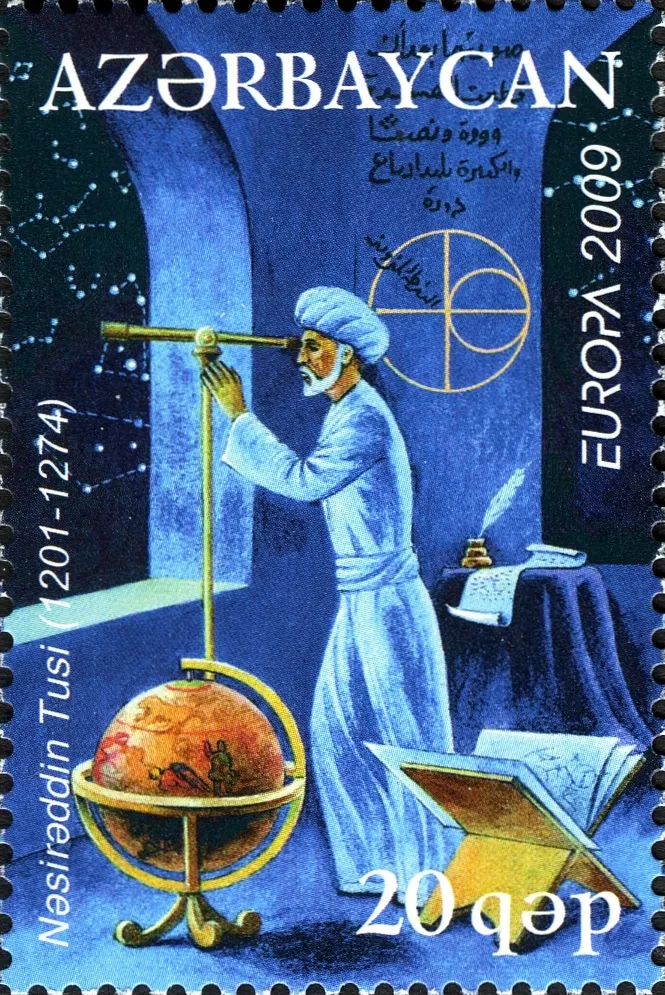
Muhammad ibn Muhammad ibn al-Hasan al-Tusi, known as Nasir al-Din al-Tusi (1201-1274 CE / 597-672 AH), was a mathematician, astronomer, philosopher, logician and theologian, and the founding director of the observatory at Maragha in Azerbaijan. The Encyclopaedia of Islam describes him as the most important and influential Shi'i scholar in mathematics, geometry, astronomy, philosophy and theology, and records that he was styled al-mu'allim al-thalith, "the third teacher", after Aristotle and al-Farabi. In Persian usage he is most often called Khwaja Nasir al-Din, and also Muhaqqiq-i Tusi and Khwaja-i Tusi.
His life spanned the Mongol conquest of the central Islamic lands. He was born in Tus, near Mashhad, in the years before the Mongol armies crossed into Iran; he spent his middle decades in the mountain fortresses of the Nizari Isma'ilis of Kuhistan and Alamut; and he spent his last eighteen years in the service of the Ilkhanid rulers who had destroyed both the Isma'ili state and the Abbasid caliphate. He was present at the fall of Baghdad in 1258. The observatory he then built at Maragha, funded from the religious endowments he was given to administer, gathered scholars from across Asia and produced the astronomical tables known as the Zij-i Ilkhani.
Around a hundred and fifty works are attributed to him, in Arabic and in Persian. In mathematics he produced recensions of the Greek geometrical and astronomical corpus, attempted a proof of Euclid's parallels postulate, and in Shakl al-qatta' treated trigonometry as a subject independent of astronomy. In astronomy he identified what he called the ishkalat, the difficulties in Ptolemy's planetary models, and answered them with the two-sphere device later known as the Tusi couple, which reappears in Sanskrit and Byzantine texts and in the work of Renaissance astronomers including Copernicus. In philosophy his commentary on Ibn Sina's al-Isharat wa'l-tanbihat became the standard defence of Avicennan philosophy against its critics, and his Tajrid al-i'tiqad became the foundational text of philosophical kalam among the Twelver Shi'a.
Much about his life is contested, and the contested parts are the political ones. Whether his years with the Isma'ilis were a conversion or a captivity was disputed in his own century and is disputed still; so is the part he played in the destruction of Baghdad. The sources that report these matters are not of one kind, and they do not agree. This article states what they establish, names them where they diverge, and sets out the principal disagreements in a Historiographical Note.
Iran on the eve of the Mongol invasions
The Iran into which al-Tusi was born was politically fragmented and about to be overrun. The Khwarazmian empire held the eastern Iranian lands; the Abbasid caliphate in Baghdad, under al-Nasir li-Din Allah and then his successors, retained religious prestige and a reduced territorial authority in Iraq; and in the mountains of Daylam, Quhistan and Syria the Nizari Isma'ilis held a network of fortresses that functioned as an independent state, with its own imam, its own libraries and its own patronage of scholars.
The History of Islam by Akbar Shah Najeebabadi gives the succession of Nizari rulers in the generations before al-Tusi: Hasan ibn Muhammad died in 561 AH and was followed by his son Ala al-Din Muhammad; Ala al-Din was followed by Jalal al-Din Hasan, who publicly renounced his predecessors' doctrine and announced his adherence to Sunni Islam, for which the caliph al-Nasir showed him favour; and Jalal al-Din's son, Ala al-Din Muhammad III, was nine years old at his accession, which left the country in disorder. It is to this period, the account notes, that al-Tusi belongs. Ala al-Din Muhammad III died in 653 AH and was succeeded by his son Rukn al-Din Khurshah, the last Nizari ruler of Alamut.
The Mongol campaigns under Chinggis Khan reached Khurasan in the years 1219-1221, during al-Tusi's studies at Nishapur. A generation later Möngke Khan sent his brother Hülegü west with instructions that Najeebabadi records as twofold: to destroy the Isma'ilis and their ruler by taking the fortress of Alamut, and to deal with the caliph of Baghdad peaceably if he sought peace and to fight him to the finish if he did not. Hülegü reached Khurasan and Iran in 651 AH. Both instructions were carried out within five years, and both outcomes shaped the second half of al-Tusi's life.
In the course of the same campaigns Baghdad's libraries and schools were destroyed, among them the institutions that had descended from the House of Wisdom. What al-Tusi built at Maragha afterwards was in part an act of salvage: the observatory's library was assembled, George Lane records in Early Mongol Rule in Thirteenth-Century Iran, from instruments and books the Mongol armies had taken from Baghdad, Khurasan, Syria and other centres of learning, together with works al-Tusi himself had rescued during the sack of Baghdad.
Tus, family and education
Birth, name and family
Al-Tusi was born on 11 Jumada I 597, that is 17 February 1201, at Tus near Mashhad in Khurasan. The TDV İslâm Ansiklopedisi records that his family came from Jahrud Sawa, near Qum or Hamadan, and settled afterwards at Tus; The Encyclopaedia of Islam, citing al-Khwansari's Rawdat al-jannat, gives the same origin at Jahrud Sawa near Qum.
His father was Wajih al-Din Muhammad ibn al-Hasan al-Tusi, a jurist of standing in the town, and al-Tusi received his first education from him: Arabic, the Qur'an, hadith and jurisprudence, in the Imami tradition that followed Alam al-Huda al-Sharif al-Murtada, who died in 436/1044 and who had been an adversary of the Mu'tazili theologian Abd al-Jabbar.
His kunya is a small puzzle that the sources themselves raise. Most of them call him Abu Ja'far, and The Encyclopaedia of Islam heads its entry with that kunya; but TDV observes that no son of his named Ja'far is known, and suggests that the kunya may have arisen either from confusion with Abu Ja'far al-Tusi, the Imami scholar who died in 460/1067, or, as Rahim Sultanov proposed, from his having been likened to that earlier scholar out of respect. Some authors call him Abu Abdullah instead, among them al-Yunini, al-Dhahabi and Ibn Kathir. Lane names three of his sons, none of them a Ja'far: Sadr al-Din Ali, who took over his father's offices after his death; Asil al-Din Hasan, who went with Ghazan Khan to Syria and was given the governorship of Damascus; and Fakhr al-Din Ahmad, who was put to death by Ghazan Khan. The confusion with the earlier Abu Ja'far al-Tusi is easy to make and worth marking here, because the two men share a town, a nisba and nearly a name: the elder was born at Tus in 385/995, died at Najaf, and wrote the Qur'anic commentary al-Tibyan, which is not among the present subject's works.
Nishapur and the line from Ibn Sina
TDV records that al-Tusi left Tus to travel to the learning centres of his day when he was about fifteen. At Nishapur, between 610/1213 and 618/1221, he studied jurisprudence with Mu'in al-Din Salim ibn Badran al-Mazini and philosophy with Farid al-Din Damad, whose proper name TDV gives as Abu Muhammad Hasan ibn Muhammad Farimudi. Both his Nishapur teachers had themselves been pupils of Fakhr al-Din al-Razi, whose criticisms of Ibn Sina al-Tusi would spend much of his later life answering.
TDV identifies Farid al-Din Damad as the decisive influence on his turn to philosophy, and it was with him that al-Tusi read Ibn Sina's works and in particular al-Isharat wa'l-tanbihat. The chain of teachers in the rational sciences that the sources give for him runs from Farid al-Din Damad back through Sadr al-Din Muhammad ibn Harithan al-Sarakhsi, Afdal al-Din Gilani, Fadl ibn Muhammad Lukari and Bahmanyar ibn Marzuban to Ibn Sina himself. The chain in the transmitted sciences runs from his father through Fadlullah ibn Ali al-Hasani al-Rawandi to Abu Ja'far al-Tusi and al-Sharif al-Murtada; TDV notes a break in this second chain, since on the chronology al-Rawandi must have studied with the pupils of those two scholars rather than with the men themselves.
The years at Nishapur also brought mathematics, the natural sciences and medicine. The Encyclopaedia of Islam records that he began the study of philosophy and mathematics at Tus with Kamal al-Din Muhammad al-Hasib before leaving, and that his teacher at Nishapur, Qutb al-Din al-Misri, taught him mathematics, natural science, Ibn Sina's philosophy and medicine. The Brill sourcebook The Heirs of Avicenna, edited by Peter Adamson and Fedor Benevich, notes the same two teachers, Qutb al-Din al-Misri and Kamal al-Din ibn Yunus, and observes that al-Tusi shared them with Athir al-Din al-Abhari.
Iraq and Mosul
From Nishapur he went to Iraq, where he studied jurisprudence with Mu'in al-Din Salim ibn Badran al-Mazini, and then to Mosul, to the mathematician and astronomer Kamal al-Din Yunus, who lived from 551 to 639 AH, that is 1156 to 1242, and who had been a pupil of Baba Afdal. The Encyclopaedia of Islam describes Kamal al-Din Yunus as a renowned Shafi'i legal scholar, and adds the observation that being a Shi'i did not prevent al-Tusi from studying with men of other schools and allegiances. The pattern recurs later: the circle he gathered at Maragha was assembled on competence rather than on confession.
Kuhistan and the Isma'ili years, 630-654 AH
The invitation to Sartakht
By 630/1233 al-Tusi's reputation had reached Nasir al-Din Abd al-Rahim ibn Abi Mansur, called Muhtasham, the Isma'ili governor of Kuhistan, who invited him into his territory. TDV records that al-Tusi accepted because the Mongol invasion had destroyed his peace; The Encyclopaedia of Islam places the patronage at Sartakht in Kuhistan and records that he had been reading the Fusul-i muqaddas of the Nizari imam Hasan ala Dhikrihi al-Salam, who died in 561/1166, and had then turned to the Isma'ili faith.
Lane adds a piece of context that explains why a scholar would go there at all. The Nizaris at this period were in a phase of satr, concealment, during which intellectual activity was encouraged in their strongholds; the patronage they offered drew a number of scholars to their castles. Daftary, whom Lane cites, takes the view that al-Tusi was at one time a genuine convert and was drawn to the Nizari courts for their intellectual reputation, seeing them as a refuge from the disorder of the Persian cities, where feeling against the Shi'a ran high.
Whatever drew him, the Kuhistan years were productive. TDV names three works written there: the Sharh al-Isharat, the Akhlaq-i Nasiri and the Tahrir al-Majisti, his recension of Ptolemy's Almagest. Lane's judgement is that he completed many of his most creative writings during his time with the Isma'ilis, and that the most productive period of his life was the three decades he spent with them.
The Akhlaq-i Nasiri
The work for which he was best known in the Persian-reading world was written for his Isma'ili patron. The Akhlaq-i Nasiri is a treatise on ethics in Persian, named after Nasir al-Din Abd al-Rahim and composed at his request. The Encyclopaedia of Islam places the first version's completion in 633 AH, which corresponds to 1235-36; the printed entry gives the Common Era equivalent as 1245, which does not correspond to that Hijri year, and the Hijri figure is followed here.
Its first part draws on Miskawayh's Tahdhib al-akhlaq. The second and third parts, on the management of the household and the governance of cities, draw on Ibn Sina's Kitab al-Siyasa, the Oikonomikos of Bryson, al-Farabi's al-Siyasa al-madaniyya and Fusul al-madani, and Miskawayh's al-Hikma al-khalida. Lane notes that the book follows the ethical themes of the non-clerical "mirror for princes" literature, and that al-Tusi's works, often written in a non-canonical Persian rather than in Arabic, draw freely on Greek philosophy and pre-Islamic Persian tradition.
Two decades later, after his break with the Isma'ilis, al-Tusi issued the book again with a different opening and different conclusions and without the dedication to Muhtasham Nasir al-Din. In the rewritten preface he explained his changed circumstances briefly before returning to his subject. The Encyclopaedia of Islam records that the book's practical orientation gave it a long influence and that it was repeatedly reworked by later writers: al-Dawwani's Akhlaq-i Jalali, al-Iji, al-Kashifi's Akhlaq-i Muhsini, al-Naraqi's Mi'raj al-sa'ada, and Ubayd al-Zakani in 740/1340-1.
A second ethical work of the same period, the Akhlaq-i Muhtashami, is often listed among his writings, and The Encyclopaedia of Islam treats it as his own composition in forty chapters, written about 630/1233; Lane likewise calls it his, and the earlier of the two. TDV takes a different view, and states on the authority of the book's own introduction that it is not al-Tusi's composition at all, but his completed Persian translation of a work on ethics that Nasir al-Din ibn Muhtasham had himself assembled from Qur'anic verses, hadith, reports concerning the Ahl al-Bayt and the sayings of Isma'ili leaders. TDV's account rests on the text's own statement about itself and is followed here.
Alamut and Maymundiz
About 644/1246 al-Tusi published the Sayr wa suluk, a short spiritual autobiography in which, The Encyclopaedia of Islam records, he describes how he came to turn away from exoteric kalam and to profess Isma'ili esoteric philosophy. Lane summarises its argument: that dissatisfaction with kalam and with hikmat, philosophy, led him to the conviction that an infallible leader was necessary, and so to the Isma'ili doctrine of ta'lim, authoritative instruction. In the same year he is found at Alamut, the principal Nizari fortress.
How he came to be there is one of the disputed points of his life, and the sources divide. The Encyclopaedia of Islam leaves it open: it is unclear, the entry says, whether he travelled there only as the companion of Nasir al-Din Abd al-Rahim, as Badakhchani and Dabashi hold, or whether he had incurred his patron's displeasure and had been banished to Alamut, and it adds the suggestion that in an uncertain political situation, and perhaps out of dissatisfaction with his Isma'ili surroundings, he may have hoped for admission to the court of the last Abbasid caliph, al-Musta'sim bi'llah, who reigned from 640 to 656 AH.
The other two accounts are more definite, and they agree with each other. TDV states that al-Tusi fell out with the Isma'ilis over a letter he had written to al-Musta'sim, that the ruler of Kuhistan imprisoned him for it, and that he was then sent to Alamut. Lane, following the Ilkhanid historian Wassaf, gives the same mechanism with a different document: it was the caliph's possession of a complimentary qasida by al-Tusi that caused him to be brought from Kuhistan to confinement at Alamut, the better for his masters to watch over him. Lane also quotes a chronicle which says that Kiya Muhammad ibn al-Hasan had forcibly detained al-Tusi and compelled him to act as his wazir. The account that the move was punitive, and that it followed from his approach to Baghdad, is what the sources record; The Encyclopaedia of Islam alone declines to decide between it and the alternative.
He remained in the Nizari fortresses of Alamut and Maymundiz until Hülegü's campaign. The Encyclopaedia of Islam notes that during these years he had the use of the rich library there for his scientific work. How long the whole Isma'ili period lasted is given differently by each source: about twenty years in Alamut and Maymundiz in the first part of the Encyclopaedia entry, some twenty-five years in Qa'in, Kuhistan and Alamut in the third, and nearly three decades in Lane. The dates the same sources supply, from the invitation of 630/1233 to the surrender of 654/1256, give a span of some twenty-three years.
Whether his adherence was genuine
The question of whether al-Tusi was an Isma'ili by conviction was contested in his own century and has not been settled. The Encyclopaedia of Islam reports, in the section on his scientific work, that the matter was and continues to be a subject of dispute; in its biographical section the same encyclopaedia states without qualification that he turned to the Isma'ili faith. TDV divides his thought into three phases, of which the second is Isma'ili, beginning with the Muhtasham invitation, and the third begins in 654/1256, when, with the Mongol occupation of Kuhistan, he openly announced that he had abandoned Isma'ilism.
Lane sets out the positions and names them. Twelver Shi'i writers hold that he wrote his apparently Isma'ili works under great duress while a prisoner; contemporary and later Persian officials and historians accepted his own account of coercion; and Isma'ilis, in his time and since, have regarded him as one of their own, the Rawdat al-taslim having been used down to the present as a doctrinal text. Daftary's view, that he was a genuine convert at one period, stands against the first of these.
Al-Tusi's own retrospective statements, which Lane quotes, present the period as one of compulsion and distress. In the revised preface to the Akhlaq-i Nasiri he wrote that it was the hand of destiny that had shackled him to residence in the territory of Kuhistan, and that while there he had been bound by the sense of the verse "humour them while you remain in their house, and placate them while you are in their land"; and he described his release as an egress, granted by the solicitude of the monarch of the age, from a discreditable residence. Of the Sharh al-Isharat he wrote that he had composed most of it in the most difficult circumstances, in a time every portion of which was a container for unbearable sadness, suffering, remorse and sorrow, and that he had prayed to be rescued from the waves of calamities and the surges of hostilities.
Lane observes that it cannot be determined from these passages whether the hardship arose from his treatment by the Isma'ilis or from the general upheaval of a region left in a power vacuum by the collapse of the Khwarazmians and the arrival of the Mongols, and he notes on the other side that the Isma'ilis are unlikely to have kept so prominent a figure, and given him relative freedom of movement and access to their libraries, had he been an unreformed adversary. The evidence does not resolve the question, and this article does not resolve it either.
The works associated with the Isma'ili period are two: the Sayr wa suluk and the Rawdat al-taslim, also called Tasawwurat. TDV records both as attributed to him rather than as certainly his, and describes them as books said to have been written in the Isma'ili fortress in defence of that school, the first telling his own life story and the second setting out the school's positions in philosophical language. Lane treats the Rawdat al-taslim as his, and records that Isma'ili tradition has used it as a standard doctrinal text. The doctrinal content of these works is a matter for the study of Nizari Isma'ili thought rather than for this article.
The Mongol turn, 1256-1258
The surrender of Rukn al-Din Khurshah
In 653/1255 al-Tusi was sent as a negotiator to Hülegü. The Encyclopaedia of Islam records that he persuaded Rukn al-Din Khurshah to submit, and that Alamut fell in 654/1256 regardless. Lane preserves the chronogram al-Tusi composed to mark the submission, which dates it precisely: the year of the Arabs was 654, and on a Sunday morning, 19 November 1256, Khurshah rose from his throne and stood before the throne of Hülegü. Najeebabadi's The History of Islam places the fall of the fortress in Dhu al-Qa'dah 656 AH, which corresponds to 1258; the date given by The Encyclopaedia of Islam and by al-Tusi's own chronogram is followed here.
Lane sets out what the chronicles say about al-Tusi's part in that submission, and the accounts differ in weight. One chronicle he quotes says that al-Tusi, having been forcibly detained and compelled to serve as wazir, counselled Khurshah not to give battle, for which the stars were not propitious, but to surrender Alamut. Rashid al-Din's fuller account places al-Tusi among a group that included the physicians Ra'is al-Dawla and Muwaffaq al-Dawla and their sons, all of whom had been brought into Isma'ili territory against their will, and records that they consulted together in secret on how Hülegü might most easily take the country and pressed Khurshah by encouragement and intimidation to surrender; many exiles and others had attached themselves to them, and all were agreed in the matter. Mustawfi gives the episode comparable space, and Aqsara'i, a financial administrator writing in 1323 for the Mongol governor of Rum, also refers to al-Tusi's role in the fall of Alamut. Against these, Lane notes that Juwayni, who was an eyewitness to the events, makes only one vague reference to any part al-Tusi may have had in influencing Khurshah.
Khurshah was sent to Möngke in Karakorum and was killed on the way; Najeebabadi records that his family and relatives were put to death, and that the Isma'ili treasuries were taken. Al-Tusi, Lane records, lost no time in distancing himself from his former patrons.
Hülegü's court
Al-Tusi was received at once into Hülegü's service. Lane records that the Mongol court recognised and welcomed him, and quotes Rashid al-Din's account of Hülegü acknowledging the probity of al-Tusi and of the physicians who had come over with him, showing them favour and providing post horses so that they could bring out their families and dependants. Al-Tusi himself described his removal from Alamut in a single sentence that Lane quotes: Hülegü brought him forth from that place and ordered him to observe the stars.
The Encyclopaedia of Islam records that under Hülegü and his successor Abaqa al-Tusi held a position of great influence at the Mongol court, and that he founded there a school of Shi'i theology which flourished throughout the Mongol period. Lane describes his functions at court collectively as philosopher, vizier, physician, astronomer and chronographer; TDV notes that some sources state that Hülegü made him vizier. His mastery of both Arabic and Persian was put to use in the correspondence by which the Mongols summoned rulers to submit, and Lane records that after the fall of Baghdad Hülegü commanded him to write a fathnama, a proclamation of victory, to be sent to Syria.
He was also given financial office. Lane records that his mathematical training showed in the order he brought to the classification of Ilkhanid revenue, compiled when he was appointed a financial overseer, and that he was afterwards made inspector of the religious endowments. The Encyclopaedia of Islam records that Hülegü entrusted him with the administration of all religious foundations and of the finances, and in its article on waqf gives the arrangement in detail: he appointed in each locality an official responsible for the administration of endowments, who kept a tenth of the revenue as salary, while the treasury's share of the revenue was to be sent to Maragha for the observatory. Bar Hebraeus, who knew him, described him as a man of vast learning in all branches of philosophy, under whose control were all the religious endowments in all the lands under Mongol rule.
Baghdad
Al-Tusi accompanied the Baghdad campaign and was present when the city fell on 3 Safar 656, that is 10 February 1258, and when the caliph al-Musta'sim was put to death. The Encyclopaedia of Islam records that owing to al-Tusi, and probably also to Ibn al-Alqami, the Mongols largely spared the Shi'i sanctuaries. Lane extends the point: the Shi'i clergy of Baghdad were spared, among them the scholar Ibn Tawus, and the largely Shi'i populations of Hilla and Najaf were ready to receive the Mongol armies.
Two duties of his during the siege are recorded without disagreement. Lane states that in its final stages al-Tusi was entrusted with carrying personal messages to the caliph, and that he was stationed at the Halba Gate to receive and check those who came out to surrender. Whatever else is disputed, he acted as the intermediary between Hülegü and al-Musta'sim.
What is disputed is whether he brought the campaign about and whether the caliph died on his advice, and here the sources diverge sharply. The Encyclopaedia of Islam states that the accounts of his role are not unequivocal, and refers the reader to Hairi. Lane records that his part in the destruction of Baghdad is underlined by both Wassaf and Rashid al-Din, and that Khwandamir states that al-Tusi prevailed on Hülegü to take his army to Baghdad. Rashid al-Din's version has him break a deadlock: Hülegü's military advisers and ministers were urging the campaign while the astrologers appointed by the Great Khan warned of the consequences, and al-Tusi, asked for his judgement, replied that none of those predicted consequences would occur, and, asked what would happen instead, answered that Hülegü would reign in place of the caliph. Wassaf has Hülegü consult him at Hamadan for reassurance from the stars, and records that he gave it. Najeebabadi's The History of Islam states the matter flatly, that al-Tusi persuaded Hülegü to invade Baghdad and that the caliph's minister conspired with Hülegü through him. Against all of these stands the silence of Juwayni, who was present at the Mongol court and who, Lane notes, barely remarks on al-Tusi's existence.
On the narrower and graver charge, that the caliph was killed on al-Tusi's advice, TDV reports that some sources record it, and then rejects it on a specific ground: none of the sources that give extensive information about the occupation of Baghdad and the killing of the caliph contains the report. TDV adds that Ibn Kathir, in al-Bidaya wa'l-nihaya, treats the report with suspicion. The report circulated, the detailed sources do not carry it, and a classical historian who knew it doubted it.
Maragha: the observatory and its circle
The founding
The observatory at Maragha, south of Tabriz in Azerbaijan, was the largest built in the Islamic world up to that time, and al-Tusi was its founding director. He was almost sixty when the work began.
The accounts of how it came about differ in what they emphasise. TDV records that al-Tusi persuaded Hülegü to fund it, and states that its construction was completed in 657, that is 1259. The Encyclopaedia of Islam records simply that in 1259, almost sixty years old, he began the construction of an observatory at Maragha near Tabriz and became its director. Lane gives the fullest account of the decision, and it is the only one that explains why the site was Maragha: the observatory had been ordered by Möngke Khan, who had wanted it built nearer his own court and who, dissatisfied with the work of his own astronomer Jamal al-Din Muhammad Tahir ibn al-Zaydi Bukhari, had instructed Hülegü to find al-Tusi and send him east. Möngke's parting words to his brother, as Lane quotes them, were that when the castles of the heretics had been taken he should send Khwaja Nasir al-Din to him. Hülegü, whose brother was occupied elsewhere, instead directed al-Tusi to build in the local area rather than travel east, and the site chosen was the first Ilkhanid capital, Maragha. The chronicle Lane quotes gives Hülegü's reason: he had become aware of the goodness of al-Tusi's character and the sincerity of his heart, and wished him to be in attendance. 1001 Inventions describes the observatory as founded by Hülegü and completed in 1263, and records that its foundations are still visible.
The instruments and the library
Lane records that the observatory, the Rasadkhana of Maragha, was equipped with the best instruments available, including those the Mongol armies had collected from Baghdad, Khurasan, Syria and other centres of learning. Among them were astrolabes, representations of the constellations, epicycles and models of the spheres, and one instrument of al-Tusi's own invention, which Lane calls the turquet and describes as containing two planes. TDV names the same instrument, the torquetum, as the most important of the several that al-Tusi devised for the observatory, and describes it as a simpler forerunner of the modern theodolite, used for determining azimuth and altitude.
Bar Hebraeus, who was at Maragha himself, left a description that Lane quotes: al-Tusi constructed instruments for the observation of the stars, and great brass spheres more wonderful than those Ptolemy had set up in Alexandria, and observed and defined the courses of the stars; a numerous company of wise men from various countries gathered about him at Maragha; and since the councils of all the mosques and the houses of instruction of Baghdad and of Assyria were under his direction, he used to allot stipends to the teachers and to the pupils who were with him.
TDV records that al-Tusi assembled a great library at the observatory from the works he had himself rescued during the sack of Baghdad together with books brought from across the Islamic world. 1001 Inventions adds measurements of two of the instruments: the radius of the Fakhri sextant was 40.4 metres, and the radius of the meridian arc about 50 metres, a height it compares with that of the dome of Hagia Sophia. It also records quadrants, armillary spheres and astrolabes among the equipment, and notes that a fifteenth-century Persian manuscript depicts the Maragha observatory with its astronomers and an astrolabe hung on the wall.
The scholars
The observatory was not only an astronomical station. TDV describes it as an institution in which scholars of the rational and the transmitted sciences worked alongside the astronomers, and names the specialists by field: Qutb al-Din al-Shirazi and Najm al-Din Ali ibn Umar al-Katibi in philosophy, kalam and logic; Mu'ayyid al-Din al-Urdi al-Dimashqi in geometry and astronomy; Fakhr al-Din al-Maraghi and Ibn Abi al-Shukr al-Qurtubi in mathematics; and Fakhr al-Din al-Akhlati in medicine. The Encyclopaedia of Islam gives a similar list and adds Bar Hebraeus, the Syriac scholar also called Abu al-Faraj Ibn al-Ibri, and the historian Ibn al-Fuwati.
The circle was deliberately international. TDV records that a Chinese astronomer worked at Maragha, and Lane quotes a description of al-Tusi's friends and colleagues as including Chinese, Turkish, Arab and Persian jurists, philosophers, theologians, mystics, mathematicians and astronomers of diverse religious allegiances. 1001 Inventions records that an astronomer named Jamal al-Din, connected with Maragha, visited Beijing in 1267 and was known in China as Cha-ma-lu-ting. Lane notes that Bar Hebraeus found both sanctuary and peace at Maragha, that his Chronicum Ecclesiasticum refers to a new monastery and church there, and that traces of a church can still be seen on the western face of a hill overlooking the city, thirty or forty metres below the observatory.
One notable absence is recorded. The Encyclopaedia of Islam observes that Qutb al-Din al-Shirazi does not appear in its own list of the Maragha scholars, having criticised al-Tusi and, on Wiedemann's account, having denounced him to Hülegü; TDV places him there as a specialist in philosophy, kalam and logic, and elsewhere among his students.
The Zij-i Ilkhani
The observatory's principal product was the set of astronomical tables called al-Zij al-Ilkhani, the Ilkhanid tables, dedicated to Hülegü. TDV calls it al-Tusi's most important work in astronomy and describes its contents: it treats the several calendars in use, and gives the coordinates of a range of stars and of 256 cities.
Whether he lived to finish it is given differently by the sources. TDV states that he began the work with the help of the Maragha scholars but that it was left unfinished because of his death. The Encyclopaedia of Islam states that he finished the tables at the age of about seventy, under Hülegü's successor the Ilkhan Abaqa, who reigned from 663 to 680 AH. Lane agrees that they were finished, and supplies the reason for the haste: the tables were the result of twelve years of work by al-Tusi and the scholars gathered round him, and although he had wanted thirty years, the time needed for the planetary cycles to complete, Hülegü's orders required him to finish in twelve. Two of the three sources have him complete the work, and that is followed here.
What the tables rested on is also disputed. The Encyclopaedia of Islam finds indications that the work was written in haste and says that it seems not to have incorporated the Maragha observations, while acknowledging that it was used extensively for several centuries. Lane states the opposite, that the tables were for the most part based on original observations, though they also drew on the body of existing astronomical knowledge. Both positions are reported here as what their authors hold.
The tables were widely used. TDV describes the work as the most advanced of the catalogues written up to its time and records that it was known throughout Asia and particularly in China; Lane records that it kept its position as the most popular set of tables for at least two hundred years. TDV also records that the Zij set out the errors of Ptolemy's geocentric system and presented the design of an alternative, itself geocentric, which opened the road towards the Copernican system.
Lane draws attention to al-Tusi's own introduction to the tables, which survives in a manuscript thought to have been made three years after his death, in 1277-8, and which shows whom he expected to read them. The Persian is plainer than his usual scholarly register, the lingua franca of the empire rather than the language of the schools. He used Chinese technical vocabulary freely, describing the three cycles of the sexagenary system and naming the ten celestial stems and twelve earthly branches. He converted the date 1203, the year of the Pig, not only into the Muslim calendar but into those of the Zoroastrians, the Eastern Christians and the Chinese. And he thought it necessary to give his readers a brief account of the rise of Islam and to explain that the Prophet Muhammad was a native of Mecca — explanations, as Lane observes, that no reader with any real contact with the Muslim world would have required.
Mathematics
The recensions of the Greek corpus
A substantial part of al-Tusi's mathematical output consists of tahrir, recensions: critical re-editions of the Greek geometrical and astronomical texts as they existed in Arabic translation. He produced recensions of Euclid's Elements and of Ptolemy's Almagest, and of the body of texts known in Arabic as the mutawassitat, the intermediate books, which were studied between the two.
The Encyclopaedia of Islam lists the authors whose works he treated in that collection: Euclid, Theodosius, Hypsicles, Autolycus, Aristarchus, Archimedes, Menelaus, Thabit ibn Qurra and the Banu Musa. TDV's list of the individual recensions, gathered in the Majmu' al-rasa'il, is longer and names the works: Euclid's Data and Optics and Phenomena, Theodosius's Spherics and On Habitations, Autolycus's On the Moving Sphere and On Risings and Settings, Hypsicles On Ascensions, Aristarchus on the sizes of the sun and moon, Archimedes' Lemmas and On the Sphere and Cylinder, Menelaus's Spherics, the Banu Musa brothers on the measurement of figures, and Thabit ibn Qurra's Data.
The Encyclopaedia of Islam assesses this work as having in many ways revitalised the translation movement of third- and ninth-century Baghdad, the enterprise that had made the Greek sciences available in Arabic during the Islamic Golden Age, and notes two things about its design. The recensions were made usable either with a teacher or without one; and that mattered, the entry observes, in the absence of any continuing institutional structure for teaching the ancient sciences. They were teaching texts rather than antiquarian editions.
Euclid's parallels postulate
Al-Tusi was dissatisfied with Euclid's fifth postulate, the parallels postulate, and attempted to prove it. The Encyclopaedia of Islam describes his attempt as one of the more sophisticated approaches to the problem, and records the sequel: in the nineteenth century it came to be recognised that such proofs are impossible and that non-Euclidean geometries can be constructed.
TDV gives the same account with more of the detail. Al-Tusi did not find the fifth postulate satisfactory and restated it in another form, known since as the Tusi postulate; he did not succeed in proving it, but he clarified what the postulate asserts and so led towards the emergence of the non-Euclidean geometries. TDV cites the study of the attempt by Ali A. al-Daffa and John Stroyls in the Journal of Central Asia.
Trigonometry as a discipline of its own
Shakl al-qatta', the book of the transversal figure, changed the standing of trigonometry. The Encyclopaedia of Islam records that it marked a significant step in treating trigonometry as a discipline independent of astronomy, and compares it in that respect with the work of Regiomontanus, who lived from 1436 to 1476 — two centuries later.
TDV puts the claim more strongly, describing Shakl al-qatta' as the first independent work on trigonometry in the Islamic world, through which trigonometry was separated from astronomy and came to be treated as a branch of mathematics; it records that al-Tusi used the six trigonometric functions and worked on the solution of both plane and spherical triangles. Lane records the same, and specifies the six fundamental formulae for the solution of right-angled spherical triangles. 1001 Inventions places the achievement in a line of development, noting that al-Battani had laid the trigonometric foundations and so prepared the way for al-Tusi to collect, organise and elaborate them.
TDV adds two further mathematical results. Al-Tusi's finding on the locus of a point on a circle rolling inside another circle was used three hundred years later by Gerolamo Cardano and by Copernicus; and he made contributions to algebra, for which TDV cites Ali Dönmez. A separate work on arithmetic, Jawami' al-hisab bi'l-takht wa'l-turab, on calculation with the board and dust, is listed among his writings. The algebraic tradition in which he worked descends from al-Khwarizmi and is treated in the article on Islamic mathematics and algebra.
Astronomy and planetary theory
The difficulties in Ptolemy
The Encyclopaedia of Islam identifies planetary theory as al-Tusi's most original achievement, and the problem he addressed was a problem of principle rather than of measurement. Ptolemy's models reproduced the observed motions of the planets, but they did so by means — the equant chief among them — which required a sphere to turn non-uniformly about its own centre. That contradicted the physical premise on which the whole system rested, that the celestial motions are uniform and circular. Al-Tusi objected to this violation of uniform circular motion, and set out the resulting problems under the name ishkalat, the difficulties.
The Tusi couple
His answer was a geometrical device of great economy. The Encyclopaedia of Islam describes it: two spheres, the smaller internally tangent to one of twice its size, the smaller rotating twice as fast and in the opposite direction, so that a point on the smaller sphere oscillates back and forth along a straight line. The construction produces rectilinear motion out of two uniform circular motions. With it the accuracy of the Ptolemaic models could be retained while the premise of uniform circular motion was preserved.
He stated the device first in Persian, in the Hall-i mushkilat-i Mu'iniyya, written for his Isma'ili patrons, and developed it in Arabic in al-Tadhkira fi ilm al-hay'a, the memoir on astronomy, during the Mongol years. TDV lists the latter among his works under the title Tadhkirat al-Nasiriyya fi'l-hay'a.
Transmission
The Encyclopaedia of Islam records that the device, known since as the Tusi couple, found its way into Sanskrit and Byzantine texts and into the works of several Renaissance astronomers, Copernicus among them. 1001 Inventions records that Copernicus's De Revolutionibus of 1543 drew on the work of al-Tusi and of Ibn al-Shatir, and that a lunar crater some thirty miles across is named Nasireddin after him; it also notes that John Wallis included al-Tusi's work in his Opera Mathematica. TDV records that the alternative geocentric system presented in the Zij opened the road to the Copernican system, and credits Qutb al-Din al-Shirazi, al-Tusi's associate at Maragha, with the true explanation of the rainbow; a work of al-Tusi's own on the rainbow, Risala dar Tahqiq-i Qaws va Quzah, and another on the reflection of rays are among those TDV lists, as is a treatise on the false dawn.
What the observatory passed on was institutional as well as geometrical. Maragha was not the first observatory in the Islamic world — 1001 Inventions gives that distinction to the observatory of Malikshah at Isfahan in the late eleventh century — but it was the largest to that date, and the pattern it set was followed at Samarkand under Ulugh Beg in the fifteenth century. The wider tradition is treated in the article on Islamic astronomy and navigation.
Philosophy, logic and theology
The defence of Ibn Sina
Al-Tusi's standing in philosophy rests above all on his commentary on Ibn Sina. Hall mushkilat al-Isharat, also called Sharh al-Isharat, is a commentary on Ibn Sina's al-Isharat wa'l-tanbihat which defends it against the criticisms of Fakhr al-Din al-Razi. TDV records that he completed it in Safar 644, that is June or July 1246, while in the Isma'ili fortress; The Encyclopaedia of Islam dates it to about 644/1246 and records that it was written for Muhtasham Shihab al-Din.
The Heirs of Avicenna describes it as a critical response to al-Razi's earlier commentary on the Isharat, and observes that within philosophy it is al-Tusi's most frequently consulted text, his wider fame resting on his astronomy. The same sourcebook places him among the most famous of the post-Avicennan philosophers, alongside al-Razi and al-Suhrawardi.
TDV makes a point about the commentary's method that bears on how al-Tusi should be read. The Sharh al-Isharat explains Ibn Sina rather than stating a system of al-Tusi's own; he says as much at the outset and keeps to it. His own positions have to be gathered from his independent treatises rather than from the commentary, and they are not always consistent across them.
A second work of defence, Musari' al-Musari', answers al-Shahrastani's Musara'at al-falasifa, which had criticised Ibn Sina on existence, the proof of the Necessary Being, divine unity, emanation, God's knowledge and the proof of prophethood. The Encyclopaedia of Islam places it after 654/1256. The relation of philosophy to theology in this period was not sharply drawn: Lane observes that in the thirteenth-century Islamic world the distinction between philosophy, still at times a suspect field, and kalam was often blurred. Al-Tusi's defence of Ibn Sina stands in the line of controversy that runs from al-Ghazali's critique of the philosophers through Ibn Rushd's reply.
Logic
Al-Tusi was among the leading logicians of his century. TDV names two works in particular: Asas al-iqtibas, written in Persian and later translated into Arabic by Mulla Khusraw, and Tajrid al-mantiq, on which many commentaries were written, chief among them Ibn al-Mutahhar al-Hilli's al-Jawhar al-nadid. A third, Ta'dil al-mi'yar fi naqd-i Tanzil al-afkar, was written on a work of Athir al-Din al-Abhari's. Lane records that five major works of his on logic survive and counts Asas al-iqtibas among the most important of them.
Tajrid al-i'tiqad and philosophical kalam
Tajrid al-i'tiqad, also called Tajrid al-kalam, is the work by which al-Tusi entered the history of Islamic theology. TDV describes it as one of the first examples of philosophical kalam and records that it became authoritative among the Twelver Shi'a and one of the chief sources of the later kalam tradition; The Encyclopaedia of Islam likewise records that it has become authoritative in Twelver Shi'i circles. TDV identifies al-Tusi as the founder of philosophical kalam within the Imami school, and cites Taşköprizade and others for the judgement that he was the first to fuse kalam fully with Peripatetic philosophy.
The volume of commentary on it is the measure of its standing, and the two accounts of that volume differ. TDV records that around two hundred commentaries, glosses and marginal notes were written on it from its own time onwards, and names Ibn al-Mutahhar al-Hilli, Shams al-Din Mahmud Abd al-Rahman al-Isfahani and Ali Qushji among their authors; Lane puts the figure at over four hundred. Either way it is among the most commented-upon works of Islamic theology. TDV records that al-Tusi was cited as an authority by al-Taftazani, al-Sayyid al-Sharif al-Jurjani, Mir Damad, Mulla Sadra and Mulla Fanari, who call him muhaqqiq, the verifier — the title by which he is still known in Persian as Muhaqqiq-i Tusi.
A second theological work, Qawa'id al-aqa'id, treats the general topics of kalam descriptively and concisely. al-Fusul, written in Persian, was translated into Arabic by Rukn al-Din Muhammad ibn Ali al-Jurjani in 728/1328. His last work, which The Encyclopaedia of Islam dates to 669/1271, was Talkhis al-muhassal, a critical commentary on Fakhr al-Din al-Razi's Muhassal.
Positions on existence, the attributes and emanation
TDV sets out al-Tusi's own doctrinal positions, drawn from his independent treatises, and they show a scholar working between two traditions rather than inside one.
On the proof of the Necessary Being he follows the Avicennan school, placing the argument from contingency at the centre, and treats it at length both in independent treatises and in his correspondence with his student Najm al-Din Ali ibn Umar al-Katibi. The Encyclopaedia of Islam records that al-Katibi held a scholarly discussion with him on metaphysical questions, on necessity and existence and on logic.
On the divine attributes he takes the Imami and Mu'tazili line that the attributes are identical with the essence. On the conception of God he departs from the philosophers and adopts the kalam position of a God who acts by choice rather than the philosophers' God who necessitates by His own nature; but, unlike Fakhr al-Din al-Razi, he holds that no claim is to be found in Ibn Sina or the other Peripatetics that God is not powerful, and that the philosophers accept, on their own terms, that God chooses. The real difference between the two camps, on his account, lies in whether the act must follow necessarily when power and will are both present: the philosophers hold that it must, the theologians that it need not.
On the eternity of the world he inclines to the theologians, writing in the Tajrid that there is nothing eternal but God, while attempting a reconciliation with Ibn Sina in the observation that time is not what is at issue in true eternity and origination — Ibn Sina having held the world to be originated in respect of its essence rather than in respect of time. On God's knowledge of particulars he takes a conciliatory path: God's knowledge encompasses everything, and the Peripatetics did not in fact hold otherwise, the apparent disagreement arising from their wish to mark the difference between human and divine knowing.
He rejects Abu Hashim al-Jubba'i's theory of states, holds that necessity and possibility are not positive attributes, and rejects the atom of the theologians, siding on that question with Abu al-Barakat al-Baghdadi. On emanation, TDV records that he is not consistent: hesitant in the Tajrid, openly critical in al-Fusul, and in places defending it. He admitted as much himself. In answer to a question from Shams al-Din Khusrawshahi he acknowledged that he could not solve how multiplicity arises from a single cause, and he makes the same admission in his correspondence with Sadr al-Din al-Qunawi. The theological tradition against which much of this is defined is treated in the article on the Mu'tazilite school.
On prophethood TDV records that he advances no view differing from the general Islamic position; on the imamate he defends the positions of the Twelver Imami school, and wrote a separate Risalat al-Imama in their defence. Among his shorter works are a treatise on the minimum of belief required of every Muslim, and al-Muqni'a fi awwal al-mawjudat, which treats divine unity, divine justice, prophethood, the imamate and the hereafter in brief.
The correspondence with Sadr al-Din al-Qunawi
Al-Tusi exchanged letters with Sadr al-Din al-Qunawi, a figure of the tradition of philosophical Sufism: a Peripatetic philosopher and a mystical metaphysician in direct correspondence. TDV describes its content as al-Qunawi's questions on existence, quiddity and the relation between them, on emanation and on the soul, with al-Tusi's answers given from the standpoint of Peripatetic philosophy. The Heirs of Avicenna describes al-Qunawi as reacting, in the exchange, to the developments in the circles of al-Abhari and al-Tusi.
TDV records that the authenticity of the correspondence has been questioned, by Mikail Bayram among others, but that the sources do not bear the doubt out, and cites Mudarris-i Razavi to that effect. The Heirs of Avicenna treats the exchange as genuine.
Ethics, and the rest of the writings
The Akhlaq-i Nasiri was the most widely read of his works, and its influence ran well beyond the philosophical schools. Lane notes that both of the ethical works bearing Isma'ili dedications remained popular for centuries.
The range of the remaining writings is wide, and the counts of them differ. The Encyclopaedia of Islam speaks of over a hundred and fifty prose works in Arabic and Persian; TDV puts the figure at around a hundred and fifty, citing al-Safadi, al-Zirikli and Demirkol; Lane gives a hundred and fifty treatises and letters as attributed to him, but notes that Brockelmann's bibliography lists fifty-six and Sarton's sixty-four. The difference is between what tradition ascribes to him and what modern bibliography can secure. Lane's breakdown of the attributed works is that about a quarter concern mathematics, a quarter astronomy, a quarter philosophy and religion, and the remainder a variety of other subjects, including his account of the Ilkhanid tax system.
On the languages: Lane records that he wrote mostly in Arabic though his best-known works are in Persian, and that a treatise on geomancy was composed in Arabic, Persian and Turkish, which shows his command of all three.
Beyond the mathematics, astronomy, philosophy and theology, TDV lists works on inheritance law according to the school of the Ahl al-Bayt; a commentary on Surat al-Asr; Awsaf al-ashraf, a short work on the spiritual path which The Encyclopaedia of Islam dates to about 664/1264 and says was written for the vizier Shams al-Din Muhammad Juwayni; answers to medical questions, with three further medical treatises attributed to him; Mi'yar al-ash'ar on prosody, and a second work on rhyme; a Persian translation of Ibn al-Muqaffa's al-Adab al-wajiz; Tansuqnama-i Ilkhani, on gems and minerals; a treatise on music, whose single manuscript is in Paris; Adab al-muta'allimin, on the conduct of students; Adab al-bahth, on the conduct of disputation; a treatise on the qibla of Tabriz; an essay on the forms and customs of kingship; a short piece on the virtues of Ali ibn Abi Talib; invocations on the Twelve Imams; and Dhayl Jihangusha, a supplement on the events at Baghdad to the history of Juwayni. A handbook of astronomy and calendrical reckoning, Mukhtasar fi ilm al-tanjim wa ma'rifat al-taqwim, known as the Risala-i Si Fasl or Thirty Chapters, was translated into Turkish by Ahmed-i Dai.
Lane notes a group of minor works that stand apart from the rest and that he takes to have been undertaken at the request of his Mongol patrons: the Falnama, the Risala-i raml and the Risala-i istikhraj-i khabaya, which deal with divination and the esoteric arts. He also records that al-Tusi wrote verse, mostly in Persian, and chronograms, many of them preserved by al-Jarjarmi in the Munis al-Abrar, including lines on the death of the last Abbasid caliph and on Hülegü, Abaqa and Arghun. A manuscript of the Akhlaq-i Nasiri copied by Ibn Mulla Mandani Muhammad Ja'far Dihdashti, and dated to the period 1775-1799, is held at the Bibliothèque universitaire des langues et civilisations in Paris, from the collection formed by Paul Geuthner and his wife Walburg; it is one of many, and indicates how long the work went on being copied.
Death and burial
In 1274 al-Tusi left the Maragha observatory with a group of his students and travelled to Baghdad; The Encyclopaedia of Islam records that he set out shortly before his death with many of his pupils and followers. While at Baghdad he fell ill, and he died of that illness, from natural causes, during the night of 25-26 June 1274, 18 Dhu al-Hijja 672, at the age of seventy-three.
He was buried in the Al-Kadhimiya Mosque in Baghdad, near the shrine of the seventh Shi'i imam, Musa al-Kazim, the son of Ja'far al-Sadiq. The Encyclopaedia of Islam records that the burial was in accordance with his own testament. TDV adds a detail about the grave, on the authority of al-Safadi and Ibn Usfur al-Bahrani: it had been prepared earlier for the caliph al-Nasir li-Din Allah, who in the event could not be buried in it.
Students, successors and reputation
Students and sons
TDV names his students: Ali ibn Umar al-Katibi, Qutb al-Din al-Shirazi, Ibn Maytham al-Bahrani, Ibn al-Mutahhar al-Hilli, Hasan ibn Sharafshah, Ibn al-Hawwam and the historian Ibn al-Fuwati. Several of them were colleagues at Maragha as well, and two — al-Katibi and al-Hilli — are among the authors of commentaries on his own works.
His sons continued in Ilkhanid service. Lane records that Sadr al-Din Ali took over his father's offices after his death, that Asil al-Din Hasan went with Ghazan Khan to Syria and was given the governorship of Damascus, and that Fakhr al-Din Ahmad was put to death by Ghazan Khan.
What the sources say of him
The judgements of al-Tusi in the sources run in two directions, and both are recorded here.
TDV reports that Sunni and Shi'i sources alike describe him as of good character, humble and respectful, and cites Ibn al-Fuwati, al-Safadi and Ibn Kathir for it. Lane records that some thirty years after his death Rashid al-Din, the Mongol court's chief vizier and official historian, described him as the most perfect and wisest man in the world; that Khwandamir, who elsewhere assigns him the decisive role in the march on Baghdad, nonetheless called him victorious in the nation and in religion and emperor of the realm of learning; and that Bar Hebraeus, who knew him, devoted a warmly favourable passage to him. Lane also notes the character of the man's intellectual temperament as the sources present it: he held fast to the opinions of the early philosophers and argued vigorously in his writings against those who contradicted them.
Against this, his service to the Mongols and his years with the Isma'ilis drew censure. Among the classical critics the two best known are Ibn Taymiyyah, in Minhaj al-sunna, and Ibn Qayyim al-Jawziyya, in Ighathat al-lahfan, who between them brought a series of grave charges against his conduct and his beliefs. TDV reports those criticisms and then rejects them, stating that none of the claims reflects the truth and that al-Tusi's own books show a man who strove not to step outside the Shari'a. Lane records that modern writers have also attacked his reputation. The particulars of the charges are not reproduced here; what is recorded is that they were made, by whom, and that the standard modern reference work on the subject finds them unfounded.
What is agreed on all sides is the intellectual achievement, and on that the sources do not divide. TDV counts him among the scholars who made major contributions to the development of the exact sciences in the Islamic world. The Encyclopaedia of Islam records his influence in another direction as well: a tolerance of the Shi'a followed the capture of Baghdad under his leadership, with consequences favourable to their social position and to their admission into the Ilkhanid administration, and the school of Shi'i theology he founded at the Mongol court flourished throughout the Mongol period. He is treated alongside his predecessors in the article on Muslim scholars who changed the world and in the survey of Islamic contributions to science and medicine.
Historiographical Note
Al-Tusi's scientific work is well documented and little disputed. His political life is documented by sources of unequal standing which disagree with one another, and several questions about it cannot be settled from the evidence. The principal disagreements are set out here.
His years with the Isma'ilis
Three questions arise, and the sources answer them differently.
| Question | The Encyclopaedia of Islam | TDV İslâm Ansiklopedisi | Lane, Early Mongol Rule |
|---|---|---|---|
| Why he went to Alamut | Unclear: either as the governor's companion (Badakhchani, Dabashi) or banished for having lost his favour; possibly hoping for admission to al-Musta'sim's court | He fell out with the Isma'ilis over a letter to al-Musta'sim; the ruler imprisoned him and then sent him to Alamut | Following Wassaf: the caliph's possession of a qasida by al-Tusi caused him to be brought to confinement at Alamut; a chronicle says he was forcibly detained and compelled to serve as wazir |
| How long the Isma'ili period lasted | About twenty years in Alamut and Maymundiz (sections 1-2); some twenty-five years in Qa'in, Kuhistan and Alamut (section 3) | Not given as a total | Nearly three decades |
| Whether his adherence was genuine | A matter of dispute, then and since (section 3); but states in section 1 that he turned to the Isma'ili faith | An Isma'ili phase of his thought, ended by a public abandonment in 654/1256 | Fiercely contested: Twelver writers say duress; Persian chroniclers accepted his claim of coercion; Isma'ilis claim him; Daftary holds he was once a genuine convert |
The two estimates in the first column come from the two authors of the same encyclopaedia entry, H. Daiber for the biographical and theological sections and F. J. Ragep for the section on his scientific work. The dates all three sources supply, from the invitation of 630/1233 to the surrender of 654/1256, give about twenty-three years.
On the third question the evidence includes al-Tusi's own statements, and they point one way without settling the matter. In the Sayr wa suluk he describes his turn to Isma'ili doctrine as a conviction reached through dissatisfaction with kalam and philosophy; in the revised preface to the Akhlaq-i Nasiri and in his remarks on the composition of the Sharh al-Isharat he describes the years themselves as compulsion and distress. The first was written during the period, the second after it. Lane notes that it cannot be determined whether the distress he describes arose from his treatment by the Isma'ilis or from the general condition of the region, and that the freedom of movement and access to libraries he evidently enjoyed is hard to reconcile with his having been held as an enemy.
His part in the fall of Baghdad
Two duties are recorded without disagreement: in the final stages of the siege he carried personal messages to the caliph, and he was stationed at the Halba Gate to receive those who surrendered.
Beyond that the sources diverge, and the divergence correlates with their distance from the events. Juwayni, who was at the Mongol court and wrote the contemporary history of the conquests, barely mentions al-Tusi. The later Ilkhanid and Timurid historians — Wassaf, Rashid al-Din and, later still, Khwandamir — give him a decisive part, Khwandamir stating that he prevailed on Hülegü to march, Rashid al-Din recording that he broke the deadlock between the generals and the astrologers, and Wassaf that Hülegü sought his reading of the stars at Hamadan. The Encyclopaedia of Islam describes the accounts of his role as not unequivocal. Najeebabadi's The History of Islam, a twentieth-century Urdu history, states the role as established fact.
On the separate and graver report that the caliph was put to death on al-Tusi's advice, TDV's finding is specific and is followed here: the report exists and was urged by critics, but none of the sources that treat the occupation of Baghdad and the killing of the caliph in detail contains it, and Ibn Kathir treated it with suspicion.
The observatory and the tables
| Question | What the sources say |
|---|---|
| Who ordered the observatory | Lane: Möngke Khan ordered it, wanted it near his own court, and told Hülegü to send al-Tusi east; Hülegü had him build at Maragha instead. TDV: al-Tusi persuaded Hülegü to fund it. The Encyclopaedia of Islam: he began its construction and became its director. 1001 Inventions: founded by Hülegü |
| When it was finished | TDV: construction completed 657/1259. The Encyclopaedia of Islam: begun 1259. 1001 Inventions: completed 1263 |
| Whether the Zij-i Ilkhani was completed | The Encyclopaedia of Islam: finished at about seventy, under Abaqa. Lane: finished in twelve years, where al-Tusi had wanted thirty. TDV: left unfinished because of his death |
| Whether the Zij used the Maragha observations | The Encyclopaedia of Islam: seems not to have incorporated them, and shows signs of haste. Lane: for the most part based on original observations |
Lane's account of the founding is followed in this article because it is the only one that explains the choice of site; the completion date of 657/1259 rests on TDV and The Encyclopaedia of Islam together; and the tables are treated as finished, on the agreement of The Encyclopaedia of Islam and Lane.
Dates, figures and attributions
- The first version of the Akhlaq-i Nasiri. The Encyclopaedia of Islam prints "633/1245". The two halves do not correspond: 633 AH falls in 1235-36. The Hijri figure is followed here.
- The fall of Alamut. The Encyclopaedia of Islam gives 654/1256, and al-Tusi's own chronogram, quoted by Lane, dates Khurshah's submission to Sunday 19 November 1256. Najeebabadi gives Dhu al-Qa'dah 656 AH, which falls in 1258, after the fall of Baghdad; the earlier date is followed.
- The Akhlaq-i Muhtashami. The Encyclopaedia of Islam and Lane treat it as al-Tusi's own composition. TDV states, on the authority of the book's own introduction, that it is his completed Persian translation of a compilation made by Nasir al-Din ibn Muhtasham. TDV is followed.
- Commentaries on the Tajrid al-i'tiqad. TDV gives around two hundred; Lane gives over four hundred.
- The number of his works. The Encyclopaedia of Islam gives over a hundred and fifty; TDV around a hundred and fifty; Lane a hundred and fifty attributed, against fifty-six in Brockelmann's bibliography and sixty-four in Sarton's.
- His kunya. Most sources give Abu Ja'far, which The Encyclopaedia of Islam uses in its headword. TDV observes that no son of that name is known and suggests either confusion with Abu Ja'far al-Tusi (d. 460/1067) or an honorific likening to him; al-Yunini, al-Dhahabi and Ibn Kathir use Abu Abdullah. Lane names three sons, none of them a Ja'far.
Material not used
A group of claims about al-Tusi circulates in secondary accounts and is not carried in this article, because the sources that establish his life and work do not support it.
- The two-axis gimbal. Attributed to him by one general-history site; TDV and Lane both name the torquetum as the instrument he devised.
- The derivation of the Tusi couple from the Qur'an. The same site states that he took the idea of infinity, and the Tusi couple with it, from a verse it renders "indeed, We have granted you without limit", citing Qur'an 108:1, and describes the couple as "two opposing forces that do not intersect". The verse reads, in the translation given at quran.com/108/1, "Indeed, We have granted you abundant goodness"; the description of the couple is not what the device is; and neither The Encyclopaedia of Islam nor TDV supports the derivation.
- The chronology of his flight to Alamut. The same site has him escape the destruction of Baghdad and take refuge at Alamut, which had fallen two years before the sack of Baghdad.
- The Mughal afterlife of the Akhlaq-i Nasiri. The claim that the book became the basis of Mughal governance under Akbar, Jahangir and Shah Jahan is made without a source, and no other approved source carries it.
Hostile characterisations of al-Tusi's motives appear in several of the sources consulted, classical and modern alike, and are not reproduced here.
References and Further Reading
Primary Islamic Sources
Only the first two items were consulted directly. The works that follow are al-Tusi's own, and they are the primary textual deposit on which everything in this article ultimately rests; none of them was consulted for this article, and what is reported of their contents is taken from the reference entries and the monograph listed under Academic and Scholarly Sources, which describe and quote them. The subsection is thin for a reason that belongs to the subject: al-Tusi is a scientific and philosophical author rather than a religious authority, and the approved base reaches him through modern scholarship on his works rather than through the works themselves.
- The Qur'an, Surat al-Kawthar 108:1, consulted at quran.com/108/1 — consulted to test a derivation claimed for the Tusi couple elsewhere; see the Historiographical Note.
- Akhlaq-i Nasiri, manuscript copy made by Ibn Mulla Mandani Muhammad Ja'far Dihdashti, dated 1775–1799, Bibliothèque universitaire des langues et civilisations, MS.PERS.184 — the catalogue record and provenance consulted at archive.org/details/MS.PERS.184.
- Tajrid al-i'tiqad (Tajrid al-kalam) — his work of philosophical kalam, ed. M. Javad al-Husayni al-Jalali (Qum, 1407/1986). Not consulted.
- Hall mushkilat al-Isharat (Sharh al-Isharat) — the commentary on Ibn Sina's al-Isharat wa'l-tanbihat, ed. Süleyman Dünyâ, 4 vols. (Cairo, 1948–1949). Not consulted.
- Akhlaq-i Nasiri — the Persian work on ethics (Calcutta, 1269/1853; Tehran, 1356 sh.). Not consulted.
- Asas al-iqtibas (Tehran, 1375 sh.) and Tajrid al-mantiq (Beirut, 1408/1988) — the works on logic. Not consulted.
- Zij-i Ilkhani — the Ilkhanid astronomical tables. Not consulted.
- al-Tadhkira fi ilm al-hay'a and Hall-i mushkilat-i Mu'iniyya — the two works in which the Tusi couple is set out. Not consulted.
- Shakl al-qatta' (Kitab fi shakl al-qatta'), ed. Fuat Sezgin (Frankfurt, 1998) — the treatise on the transversal figure. Not consulted.
- Musari' al-Musari', ed. Hasan Mu'izzi (Qum, 1405/1985); Qawa'id al-aqa'id; al-Fusul; Talkhis al-muhassal, ed. Abdullah Nurani (Beirut, 1405/1985); Risalat al-Imama; Awsaf al-ashraf, ed. Sayyid Mahdi Shamsuddin (Tehran, 1377 sh.). Not consulted.
- Sayr wa suluk, ed. S. J. Badakhchani (London, 1998), and Rawda-yi Taslim (Tasawwurat), ed. and trans. Wladimir Ivanov (Leiden, 1950) and S. J. Badakhchani (London, 2005) — the two works associated with his Isma'ili period, which TDV records as attributed to him. Not consulted.
Classical Islamic Sources
These are the pre-modern authorities on which the reference entries and the monograph used here rest, and through which this article reports the thirteenth- and fourteenth-century testimony about al-Tusi. None was consulted directly; they are listed so that the chain behind each disputed claim is visible, since the disagreements set out in the Historiographical Note are disagreements among these works.
- Ata-Malik Juwayni, Tarikh-i Jahangusha — the contemporary history of the Mongol conquests by an eyewitness at Hülegü's court, and the source whose near-silence about al-Tusi bears on the question of his role at Alamut and Baghdad.
- Rashid al-Din Fadlullah al-Hamadani, Jami' al-tawarikh — the Ilkhanid official history, cited for the pressure put on Rukn al-Din Khurshah to surrender, for al-Tusi's reading of the stars before the march on Baghdad, and for the judgement of him as the wisest man of his age.
- Wassaf — cited for Hülegü's consultation of him at Hamadan, and for the account that a qasida of his found in the caliph's possession caused his removal to Alamut.
- Mustawfi, Tarikh-i Guzida, and Khwandamir — the later Persian historians who give him a decisive part in the march on Baghdad.
- Aqsara'i — the financial administrator writing in 1323 for the Mongol governor of Rum, who refers to his role in the fall of Alamut.
- Bar Hebraeus (Ibn al-Ibri), Chronography, Tarikh al-zaman and Chronicum Ecclesiasticum — the Syriac scholar who worked at Maragha and left a first-hand description of the observatory, its instruments and its company.
- Ibn al-Fuwati, al-Hawadith al-jami'a — his student at Maragha, and a biographical witness.
- Al-Safadi, al-Wafi bi'l-wafayat; al-Dhahabi, Tarikh al-Islam; al-Yunini, Dhayl Mir'at al-zaman; Ibn Kathir, al-Bidaya wa'l-nihaya; Badr al-Din al-Ayni, Iqd al-juman; Ibn al-Imad, Shadharat al-dhahab — the Arabic biographical and chronicle notices. Ibn Kathir's is cited here for his doubt of the report that the caliph was killed on al-Tusi's advice.
- Al-Khwansari, Rawdat al-jannat, and Ibn Usfur al-Bahrani, Lu'lu'at al-Bahrayn — the Shi'i biographical compilations, cited for his family's origin and for the grave at Kadhimiya.
- Ibn Taymiyya, Minhaj al-sunna, and Ibn Qayyim al-Jawziyya, Ighathat al-lahfan — the classical critics, whose charges TDV reports and rejects.
- Ibn al-Mutahhar al-Hilli, Kashf al-murad fi sharh Tajrid al-i'tiqad, and al-Jawhar al-nadid — the earliest and most influential commentaries on the Tajrid and on the Tajrid al-mantiq, by his own student.
- Taşköprizade, Miftah al-sa'ada — cited for the judgement that al-Tusi was the first to fuse kalam fully with Peripatetic philosophy.
- Fakhr al-Din al-Razi, Muhassal afkar al-mutaqaddimin wa'l-muta'akhkhirin, and al-Shahrastani, Musara'at al-falasifa — the two works against which al-Tusi's defences of Ibn Sina were written.
Academic and Scholarly Sources
- H. Daiber, "al-Ṭūsī, Naṣīr al-Dīn", sections 1 (Life) and 2 (As theologian and philosopher), in The Encyclopaedia of Islam, new (second) edition, vol. 10, pp. 746–750 — the principal scholarly treatment used for the biography, and the source of the dates, the teachers, the Kuhistan and Alamut years, the open question about the move to Alamut, the court offices under Hülegü, the founding of the observatory, the Maragha circle, and the account of the philosophical and theological works.
- F. J. Ragep, "al-Ṭūsī, Naṣīr al-Dīn", section 3 (As scientist), in The Encyclopaedia of Islam, new (second) edition, vol. 10, pp. 750–752 — the principal source for the mathematics and astronomy: the recensions and their purpose, the attempt on the parallels postulate, Shakl al-qatta' and the independence of trigonometry, the ishkalat, the geometry of the Tusi couple and its transmission to Copernicus, and the assessment of the Zij-i Ilkhani.
- "TÛSÎ, Nasîrüddin", TDV İslâm Ansiklopedisi, vol. 41 (Istanbul, 2012), pp. 437–442, islamansiklopedisi.org.tr/tusi-nasiruddin — the fullest single biography used, and the source for the family origin, the question over the kunya, the chains of teachers and the break in one of them, the imprisonment and transfer to Alamut, the three phases of his thought, the doctrinal positions on existence and the attributes and emanation, the observatory and its company and library, the torquetum, the contents of the Zij, the Tusi postulate, the works list, the students, and the rejection of the charges brought by Ibn Taymiyya and Ibn Qayyim al-Jawziyya. The entry's author byline could not be recovered from the page, so it is cited by headword. Register entry 2, islamansiklopedisi.org.tr.
- George Lane, Early Mongol Rule in Thirteenth-Century Iran: A Persian Renaissance (2003), chapter 7, "Khwaja Nasir al-Din Tusi" — the principal modern monograph used, consulted at archive.org (register entry 12, archive.org). The source for Möngke's order for the observatory and the choice of Maragha, the instruments and the library, Bar Hebraeus's description, the twelve years of the Zij and its Chinese-facing introduction, the chronogram dating Khurshah's surrender, the accounts of the role at Baghdad and the Halba Gate, the quotations of al-Tusi's own retrospective statements, the financial and waqf offices, the three sons, and the positions in the dispute over his Isma'ili adherence.
- "Iran: religions" and "Ilkhans", in The Encyclopaedia of Islam, new (second) edition, vols. 4 and 3 — for his position of influence at the Mongol court, the school of Shi'i theology he founded there, and the improvement in the standing of the Shi'a and their admission to the Ilkhanid administration after the capture of Baghdad.
- "Wakf", in The Encyclopaedia of Islam, new (second) edition, vol. 11 — for the arrangement by which the endowment revenues funded the observatory, citing Hassan Mahmud Abdel-Latif, "Nasir al-Din Tusi (d. 1274) and his Tajrid al-i'tiqad", PhD thesis, University of London, 1977.
- Peter Adamson and Fedor Benevich (eds.), The Heirs of Avicenna: Philosophy in the Islamic East, 12th–13th Centuries — Metaphysics and Theology (Leiden: Brill, 2023), ISBN 9789004503991, open access, consulted at archive.org (register entry 12, archive.org) — for his standing among the post-Avicennan philosophers, the shared teachers with al-Abhari, the character of the Sharh al-Isharat as a response to al-Razi, and the authenticity of the correspondence with al-Qunawi.
- 1001 Inventions: The Enduring Legacy of Muslim Civilization, chief editor Salim T. S. al-Hassani (National Geographic Society) — for the measurements of the Fakhri sextant and the meridian arc, the surviving foundations, the instruments, the astronomer Jamal al-Din's journey to Beijing in 1267, the observatory of Malikshah at Isfahan as the earlier precedent, the reference to al-Tusi in Copernicus's De Revolutionibus, the lunar crater named for him, and al-Battani's preparation of the trigonometric ground.
- "TÛSÎ, Nasîrüddin" and the related headwords AHLÂK-ı NÂSIRÎ, TECRÎDÜ'l-İ'TİKĀD, ZÎC-i İLHÂNÎ, EVSÂFÜ'l-EŞRÂF, el-FUSÛL and HALLÜ MÜŞKİLÂTİ'l-İŞÂRÂT, TDV İslâm Ansiklopedisi — noted for the individual works.
- Akbar Shah Najeebabadi, The History of Islam, vol. 3, revised by Safiur-Rahman al-Mubarakpuri — for Möngke's instructions to Hülegü, the arrival in Khurasan in 651 AH, the Nizari succession before al-Tusi's time, the fate of Rukn al-Din Khurshah and his family, Hülegü's capital at Maragha and his appointment of Shams al-Din Muhammad Juwayni as his minister. Its account of al-Tusi's own role is reported in the Historiographical Note rather than followed.
Further Reading
None of the following was consulted for this article, and nothing above rests on any of it. The first group addresses directly the two questions this article has had to leave open: the nature of his adherence to Isma'ilism, and the extent of his part in the Mongol campaigns.
- S. J. Badakhchani (ed. and trans.), Paradise of Submission: A Medieval Treatise on Ismaili Thought (London, 2005) — the edition and translation of the Rawda-yi Taslim.
- Hamid Dabashi, "The Philosopher/Vizier: Khwaja Nasir al-Din al-Tusi and the Isma'ilis" — cited by The Encyclopaedia of Islam for the view that he went to Alamut as a companion rather than a captive.
- Farhad Daftary, The Isma'ilis: Their History and Doctrines — for the view that he was at one period a genuine convert.
- A. H. Hairi — cited by The Encyclopaedia of Islam on the question of his role in the fall of Baghdad.
- Muhammad Taqi Mudarris-i Razavi, Ahval va Athar-i Khwaja Nasir al-Din Tusi (Tehran, 1370 sh.) — described by TDV as the most comprehensive study of his life and works.
- Muhammad Mudarris Zanjani, Sarguzasht va Aqa'id-i Falsafi-i Khwaja Nasir al-Din Tusi (Tehran, 1379 sh.) — with his works classified by subject.
- Xâce Nasîreddin Tûsî: Biblioqrafya (Baku, 2004) — the bibliography published by the Azerbaijan Academy of Sciences for the eight hundredth anniversary of his birth, listing his works, their holding libraries, and the literature on him in several languages.
- Ali A. al-Daffa and John Stroyls, "Nasir al-Din al-Tusi's Attempt to Prove the Parallel Postulate of Euclid", Journal of Central Asia IV/1 (Islamabad, 1981), pp. 1–41.
- U. Ballay, "The Astronomical Manuscripts of Naṣīr al-Dīn Ṭūsī", Arabica XXXVII/3 (Leiden, 1990), pp. 389–390.
- Hamit Dilgan, Büyük Türk Âlimi Nasîreddîn Tûsî (Istanbul, 1968) — on his place in the exact sciences, and the source TDV cites for the torquetum.
- Murat Demirkol, Nasîruddin Tûsî'nin İbn Sînâcılığı (doctoral thesis, Ankara University, 2007) — on his Avicennism.
- Agil Şirinov, Nasîruddin Tûsî'de Varlık ve Ulûhiyyet (doctoral thesis, Marmara University, 2007) — on existence and divinity in his thought.
- Abd al-Amir al-A'sam, al-Faylasuf Nasir al-Din al-Tusi (Beirut, 1980), and Suhayl al-Husayni, al-Khwaja Nasir al-Din al-Tusi (Beirut, 2005).
- Bakhtyar Husain Siddiqi, "Nasir al-Din Tusi", in A History of Muslim Philosophy, ed. M. M. Sharif (Karachi, 1983), vol. 1.
- H. Memmedbeyli, Muhammed Nasîreddin Tûsî (Baku, 1980).
- Wilferd Madelung, Nasir ad-Din Tusi's Ethics between Philosophy, Shi'ism and Sufism — cited by The Encyclopaedia of Islam for the analysis of the Akhlaq-i Nasiri.
- Dwight M. Donaldson and Majid Fakhry — cited by The Encyclopaedia of Islam for analytical treatments of the same work.
Mentioned In
10 articles reference this topic