Ibn Arabi
Muhyi al-Din Ibn Arabi (1165-1240 CE) was an Andalusian mystic whose writings, above all al-Futuhat al-Makkiyya and Fusus al-Hikam, form the most influential and most disputed body of speculative thought in Islamic mysticism.
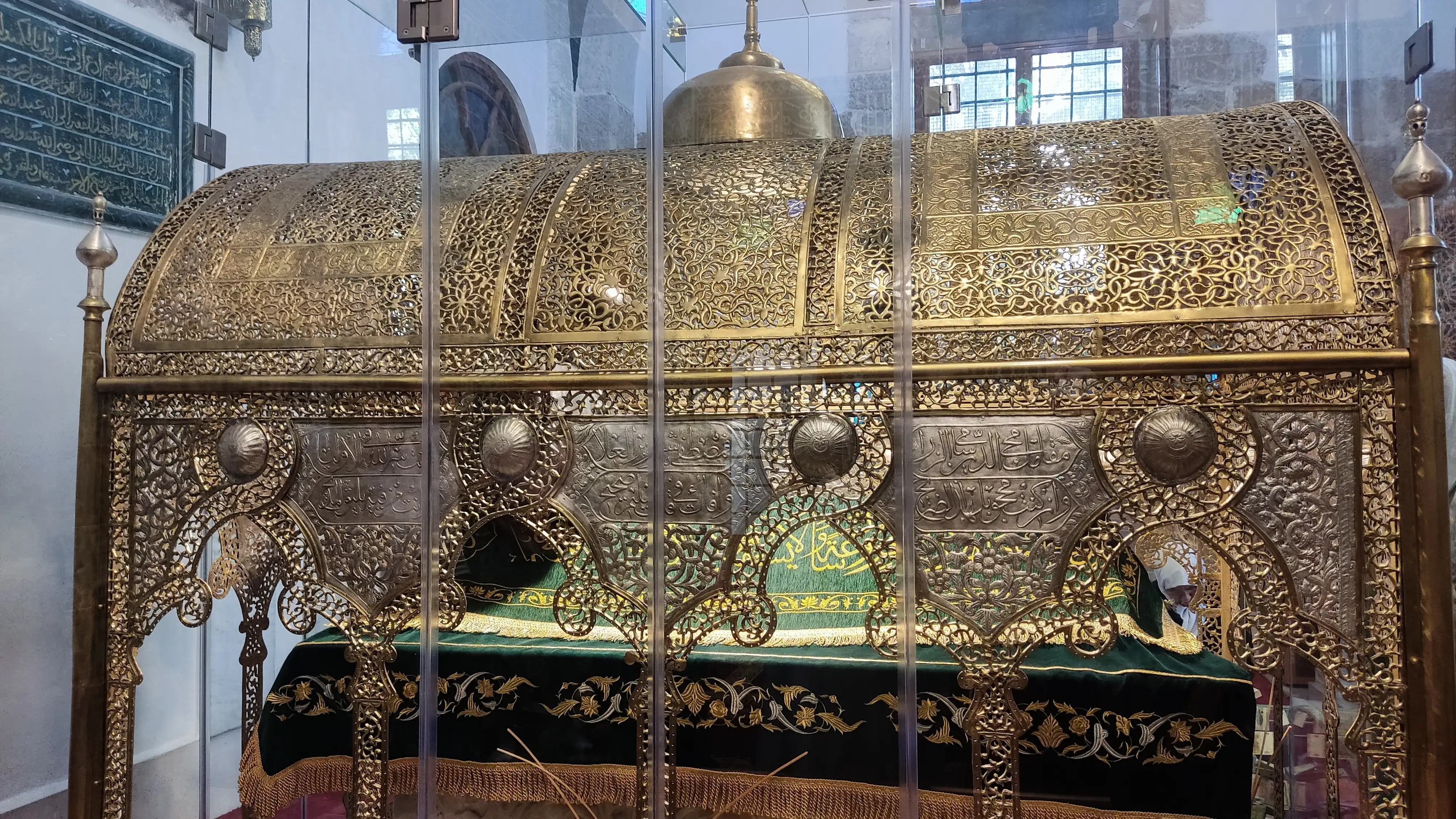
Muhyi al-Din Muhammad ibn Ali ibn Arabi (1165–1240 CE / 560–638 AH) was an Andalusian mystic and metaphysician whose writings constitute the largest and most systematically developed body of speculative thought in the history of Islamic mysticism. Later tradition gave him the title al-Shaykh al-Akbar, the greatest master. His two most consequential works — al-Futuhat al-Makkiyya ("The Meccan Openings") and Fusus al-Hikam ("The Bezels of Wisdom") — shaped the intellectual vocabulary of Sufism from the thirteenth century onwards, and provoked a controversy over his orthodoxy that has never been settled.
He is also the most misrepresented figure in this field, in two specific ways that this article corrects at the outset. The doctrine of wahdat al-wujud, the oneness of being, is universally associated with his name; he did not use the expression. And the figure of "over eight hundred works" that circulates in accounts of his output describes the number of titles that have at some point been attributed to him, not the number he wrote. Both errors are common in popular summaries and both are settled questions among specialists.
Sources for His Life
Ibn Arabi is unusual among medieval figures in that much of what is known about his life comes from his own writings. He refers frequently to his teachers, his travels, his reading and his experiences, and two works — Ruh al-Quds and al-Durrat al-Fakhirah — are specifically devoted to the Sufi masters he encountered in the west of the Islamic world. Claude Addas's biography reconstructs his life largely from these materials.
This has a methodological consequence that should be stated plainly. Much of the biographical record is autobiographical, including the accounts of visions, of instruction received from figures not physically present, and of spiritual openings at particular places and dates. These are reliable evidence of what Ibn Arabi reported and understood about himself. They are not independent corroboration of the events described, and this article presents them as his own testimony rather than as established external fact — a distinction he would have regarded as beside the point, but which the encyclopaedia's standard requires.
Early Life in Al-Andalus
Ibn Arabi was born in Murcia, in the southeast of al-Andalus, in 1165 CE (Ramadan 560 AH). His family belonged to the Arab tribe of Tayy and had standing in the administration; his father held a position in the service of the ruler of Murcia. When Murcia came under Almohad control the family moved to Seville, then the principal city of Islamic Iberia, and it was there that he was educated.
His formation was conventional for a young man of his class: the Qur'an and its recitation, hadith, Arabic grammar and letters, and law. In jurisprudence he was exposed to the Maliki school dominant in the west and to Zahiri method, the strictly literalist approach with which he retained an affinity. He was a serious hadith scholar throughout his life, a fact easily lost behind his metaphysics but visible in the density of prophetic citation in his writing.
By his own account he underwent a decisive spiritual turn in his early teens, which he describes as a visionary conversion at the hands of Jesus — the Jesus of the Qur'an — and which resulted in what he calls an opening (futuh) of the soul toward the divine. The vocabulary matters, because the same word supplies the title of his major work three decades later: what he means by futuhat throughout his writing is this kind of event, not a literary genre.
Shortly afterwards, around 1180, his father took him to meet a friend of his, the philosopher Ibn Rushd — Averroes. Ibn Arabi recounts an elliptical conversation in which he explained to the philosopher the limits of rational perception. The anecdote is his own, and is best read as a statement about the relation of unveiling to demonstration rather than as a documented exchange. Henry Corbin made a great deal of it, treating the meeting as the symbolic parting of Islam and the West, with Latin Averroism carrying Europe toward a purely rationalist path and its attendant conflicts between faith and knowledge. Chittick's response is that this reads too much into a single episode from one side: Muslim intellectuals largely set Ibn Rushd aside, but they went on reading, annotating and improving Ibn Sina and al-Suhrawardi, and many later sought precisely to harmonise reason, mystical intuition and revelation rather than choosing between them.
He studied with a large number of Sufi teachers across al-Andalus and the Maghreb. Two are worth naming because of what they show about the milieu. He was influenced by the teaching of Abu Madyan, the major Maghrebi master of the previous generation, though he did not meet him. And he describes as his teachers several women, among them Fatima bint Ibn al-Muthanna of Cordoba, whom he portrays with particular warmth and reverence — evidence that spiritual authority in this environment was not restricted to men, and among the more valuable social details in his writing.
He also reports instruction from al-Khidr, the figure identified in Islamic tradition with the unnamed servant of God in Surah al-Kahf. Such instruction is understood within Sufi tradition as occurring outside ordinary time and physical presence. It belongs to a different order of claim than study with a living teacher, and the two are distinguished here rather than listed together.
The Journey East
Around 1200 or 1201 CE Ibn Arabi left the Muslim west to perform the pilgrimage, and never returned. He travelled through North Africa to Egypt, then to Mecca, arriving in 1202. The sources place the departure in either year and this article does not resolve the point.
The Meccan period was the pivot of his life. He remained in and around the city for some years, and it was there that he began al-Futuhat al-Makkiyya, whose title refers to the openings or disclosures he received in the precinct of the sanctuary. It was also at Mecca that he met the family of a Persian scholar and encountered Nizam, a young woman whose qualities he describes in his own preface to Tarjuman al-Ashwaq as the occasion of that collection's love poetry.
From Arabia he travelled extensively: to Baghdad, Mosul, Anatolia, Jerusalem and Cairo, teaching and gathering disciples. In Anatolia he formed the most consequential relationship of his later life. He married the widowed mother of Sadr al-Din al-Qunawi (1210–74), who thus became his stepson, and who would do more than any other person to determine how he was read. In 1223 he settled in Damascus, where he spent his final seventeen years writing, teaching, and completing the second recension of the Futuhat. He died there in November 1240 CE (638 AH) and was buried on the slope of Mount Qasiyun; his tomb remains a visited site.
Writings
The Scale of the Corpus
Osman Yahia's critical survey of 1964 remains the basis for all discussion of Ibn Arabi's output. Yahia listed in excess of 850 separate titles that have at some point been associated with his name, assigning each a catalogue number. That figure is the source of the "over eight hundred works" claim, and it is a count of attributions. A considerably smaller number survive in manuscript, and a smaller number again are accepted by specialists as certainly his. The Muhyiddin Ibn Arabi Society maintains working lists distinguishing works of undoubted authenticity from those that are doubtful or spurious.
Even on the conservative count his output was enormous, and no purpose is served by inflating it. The inflation matters because misattributed works have repeatedly been used as evidence of his views, including in the controversy over his orthodoxy.
Al-Futuhat al-Makkiyya
Al-Futuhat al-Makkiyya is his major work and among the largest single books in Arabic. It runs to 560 chapters, begun at Mecca and completed in Damascus, with a second recension finished shortly before his death. Modern printings occupy many volumes; Osman Yahia's critical edition, begun in the 1970s, was never completed.
It resists description as a treatise because it is not one. It moves through the ritual and legal matter of Islam — purification, prayer, fasting, alms, pilgrimage — and treats each as the outward face of a metaphysical reality; it works systematically through the divine names; it maps spiritual stations and states; it develops a cosmology and an account of the human being; and it returns constantly to the interpretation of Qur'anic verses and prophetic reports. Its organisation follows the structure of the religion rather than the sequence of an argument, which is why it can be read as a mystical encyclopaedia and why it has never been read straight through by many.
Fusus al-Hikam
Fusus al-Hikam, composed at Damascus in 1229, is short, dense, and the most influential thing he wrote. Its twenty-seven chapters are each associated with a prophet, from Adam to Muhammad, with each prophet treated as the locus of a particular wisdom or divine disclosure. Ibn Arabi states that the book was given to him by the Prophet Muhammad in a vision — his own claim about its origin, and one that raised the stakes of every subsequent dispute about its contents.
Fusus al-Hikam became the standard vehicle for transmitting his teaching, and over the six centuries following his death it attracted more than a hundred commentaries — beginning with al-Qunawi and running through al-Jandi, al-Qashani, Dawud al-Qaysari and al-Jami. Almost all the controversy about Ibn Arabi concerns this book. Much of what is called "Ibn Arabi's system" is in fact the systematisation of the Fusus carried out by these commentators, a point developed below.
Tarjuman al-Ashwaq and Other Works
Tarjuman al-Ashwaq ("The Interpreter of Desires") is a collection of love poetry whose imagery — the beloved, longing, separation — drew objections that it was merely erotic verse. Ibn Arabi responded by writing his own commentary on it, expounding each image as a reference to divine realities. The episode is revealing about the position of such poetry in the period, and about his willingness to defend himself in writing.
Other significant works include Ruh al-Quds and al-Durrat al-Fakhirah on the masters he encountered in the west; Kitab al-Isra on ascent; Mashahid al-Asrar; and a large number of shorter treatises. His Diwan collects further poetry.
Thought
Method: Realization
Al-Qunawi distinguished his stepfather's position from both philosophy and scholastic theology by a name: mashrab al-tahqiq, the school of realization. The term is the right place to begin, because it identifies what Ibn Arabi thought he was doing.
Tahqiq derives from haqq — true, real, right, worthy, appropriate — and haqiqa, reality or truth. Al-Haqq, the Real, is among the divine names, and in the Qur'an the word stands opposite batil: false, vain, unreal, out of place. To realize is to know and to actualize the haqq of things. Ibn Arabi finds the whole programme in a prophetic saying: everything has a haqq, so give to each that has a haqq its haqq. Every thing in the cosmos, in society and in the soul has a rightness proper to it, and the human task before each is to act rightly toward it.
Set against tahqiq is taqlid, following authority. The distinction maps onto a division the Islamic sciences already recognised, between transmitted knowledge (naqli) — language, scripture, history, law — and intellectual knowledge (aqli), which one comes to know by realizing its truth within oneself. Ibn Arabi holds, with many of the philosophers, that real knowledge cannot come by imitating others. Where he parts from them is in maintaining that full realization is available only by following the prophets.
This is worth registering before anything else about his metaphysics, because it explains a feature of his writing that readers find disorienting. He is not constructing a system to be assented to. He is describing what realization discloses, which is why his books circle rather than argue, and why he holds that a reader who returns to a Qur'anic verse and finds exactly the meaning found last time has not read it properly.
The Three Books
Ibn Arabi's absorption in the Qur'an exceeds that of the theologians and the philosophers alike, and his writing is saturated with its language. Michel Chodkiewicz's study of this dimension of his work is the standard treatment.
The Qur'an is God's speech (kalam), non-manifest and indistinct from the divine Essence, becoming manifest in recitation and writing. But God's speech does not disclose itself in scripture only. The Qur'an calls God's creative act the command "Be!", speaks of creatures as His words (kalimat), and uses one term — aya, sign or verse — for the phenomena of the universe, the inner events of the soul, and its own verses. From this Ibn Arabi draws the scheme that organises much of his thought: God voices three books, each composed of signs. The cosmos, the soul and the scripture are three articulations of one speech. "It is all letters, words, chapters, and verses," he writes of the cosmos, "so it is the Great Qur'an."
The written Qur'an holds a pivotal place because it voices the divine names in human language and so provides the key to deciphering the other two. Interpreting scripture is therefore how one interprets the cosmos and oneself, and it is why he typically opens a discussion with a verse and then draws out meanings bearing on the matter in hand. He insists that readings conform to Arabic as its first recipients spoke it, while producing interpretations that are startling and, on inspection, defensible within the language. That combination — strict fidelity to the transmitted text alongside conclusions no one had drawn from it — is a large part of why the later tradition credited him with exceptional mastery, and a large part of why his critics found him alarming.
The Breath of the All-Merciful and Perpetual Creation
The analogy of speech carries through into cosmology. As human beings form words in the substratum of breath, God articulates the cosmos in the Breath of the All-Merciful (nafas al-rahman), which is the deployment of existence — and existence, on this account, is synonymous with mercy. His most elaborate cosmological scheme maps the levels of that deployment onto the twenty-eight letters of the Arabic alphabet, each a specific modality of articulated existence.
A consequence follows that is among the most distinctive things in his writing. Spoken words dissipate as they are uttered, and so must be renewed continuously; correspondingly, everything other than God is re-created at each instant (tajdid al-khalq fi'l-anat), and all things are in constant change. He states the principle as: there is no repetition in self-disclosure (la takrar fi'l-tajalli). He regards this as a straightforward application of tawhid rather than an innovation — to acknowledge that the Real is one and unique in each of its acts is to accept that each thing, and each moment of each thing, is unique and unrepeatable.
Wujud and the Question of Terminology
Ibn Arabi's central concern is wujud — being, existence, finding. He uses the term for God as the Necessary Being, in whom being is intrinsic, and he applies it also to everything other than God while denying that created things possess it in any independent sense: they borrow being as the earth borrows light from the sun. Creation, on this account, is the perpetual self-disclosure of God through the divine names, and what exists other than God has no reality of its own to set against Him.
The expression wahdat al-wujud, oneness of being, is the standard label for this position. Ibn Arabi did not use it. There is broad agreement among specialists on this point: the phrase does not appear as a doctrinal formula in his writings, and its earliest application to him appears to come from the polemics of Ibn Taymiyya, who used it to characterise — and to condemn — what he took Ibn Arabi's followers to hold. It was subsequently adopted by the tradition itself, and by later critics such as Ahmad Sirhindi, and it is now unavoidable as a term of reference.
This is not pedantry. Naming a position gives it a fixed shape, and the fixed shape that wahdat al-wujud acquired in polemic — a monism in which God and the world are identical, and therefore a pantheism incompatible with Islam — is not straightforwardly what Ibn Arabi wrote. He maintains the absolute distinction between the Necessary and the contingent as firmly as any theologian; his difficulty is that he also denies the contingent any independent being. Whether the resulting position amounts to pantheism has been argued for seven centuries. What can be said without controversy is that the term in which the argument is conducted is not his.
The subsequent history of the phrase is worth setting out, because it shows how a label acquires content. His students used the expression only rarely and without technical weight. The one exception was al-Qunawi's student Sa'id al-Din al-Farghani, who used it for the vision attained at the end of the first of four spiritual journeys — a specific and limited sense that played almost no part in the later disputes. Ibn Taymiyya then made it the name of a heresy. Once in circulation as a term of accusation it accumulated meanings rather than acquiring one: at least seven distinct senses were attributed to it in later literature, usually with no attempt at definition. Abd al-Rahman Jami (d. 1492) was the first of Ibn Arabi's defenders to take the phrase up and own it. European Orientalist scholarship then inherited the term as though it were Ibn Arabi's own and read it, mostly, through Ibn Taymiyya's construction of it.
Nondelimitation
The technical formulation behind the dispute is his account of delimitation. To call the Real one is to speak of the unity of the Essence: existence in itself is nondelimited (mutlaq) — boundless, undefined, indistinguishable — whereas every existent, every found thing (mawjud), is distinct, defined and limited. The Real is transcendent and incomparable, yet discloses itself (tajalli) in all things and is therefore also immanent and similar.
The point he presses further than his predecessors is that nondelimitation cannot itself be a limit. "God possesses Nondelimited Existence, but no delimitation prevents Him from delimitation. On the contrary, He possesses all delimitations, so He is nondelimited delimitation." A God excluded from the delimited would be delimited by that exclusion, which is the argument that makes it hard to convict him of a straightforward pantheism and equally hard to convict him of an unqualified transcendentalism. He also uses the divine name Light for this: God is the light of the heavens and the earth (Quran 24:35), and as al-Qunawi glossed it, true Light brings about perception without itself being perceived, as true Existence brings about manifesting and finding without itself being manifest or found.
The Divine Names and the Two Idioms
The divine names, often called attributes (sifat), are the reference points of Islamic theology, and Ibn Arabi devoted a book-length chapter of the Futuhat to them along with an independent treatise. He notes in passing a point of accuracy about them that is routinely lost: the Qur'an does not mention ninety-nine names but somewhere between seventy and roughly twice that, depending on how one counts. He also distinguishes the names of the names — the names as voiced in human language — from the names as realities in God.
The names matter because the Essence in itself is known only to itself. Everything is a face of God — "wherever you turn, there is God's face" (Quran 2:115) — but to tell the faces apart one must know their names. What the names disclose is that He is merciful, knowing, living; what remains undisclosed is the Essence they name. Of it one can know that it is, not what it is.
From this he derives a two-sided theological idiom which is one of his most useful contributions. Insofar as the names refer to the Essence, their meanings are unknown and they function as markers of incomparability (tanzih). Insofar as they denote added attributes — mercy, knowledge, forgiveness, vengeance — they indicate similarity (tashbih). Neither idiom is dispensable and neither is sufficient. His theology combines the apophatic and the kataphatic instead of choosing, and the requirement to hold both at once is what makes his prose seem to contradict itself when read in short extracts.
Fixed Entities
Everything in the cosmos receives according to its own preparedness (isti'dad) or receptivity, which is why no created thing displays the Real as such. He illustrates it with sunlight: the sun withholds its light from nothing, and the loci receive in the measure of their preparedness.
What sets that measure is a thing's reality or quiddity, determined not by our definitions but by God's knowledge, since God knows things always and forever whether or not they exist in the cosmos. These known realities Ibn Arabi calls entities (a'yan), and most famously fixed entities (a'yan thabita), whose "thingness of fixity" (shay'iyyat al-thubut) never changes. In themselves they do not exist, since nothing truly exists but the Real; they are the possible things, which may or may not enter being when the engendering command — "Be!" — is addressed to them.
A correction is needed here, because the standard English rendering has done real damage. Early translators gave a'yan thabita as immutable or permanent "archetypes" or "essences", which implies two tiers of reality with the fixed entity standing behind the existent one. Chittick's point is that there is no difference of whatness between a fixed entity and an existent entity: they are not archetypes of the existent entities but identical with them. The fixed entity is the thing as nonexistent in itself and known to God; the existent entity is the very same thing, become manifest as delimited existence. His own image is light through coloured glass — the light appears coloured, the glass does not change, and only light becomes manifest.
The device does substantial work for him. It lets him say that the long dispute between theologians and philosophers over whether the world is eternal turns on which aspect of the entities each party attended to. Those who held the world eternal grasped that the Real is never first not seeing the cosmos and then seeing it. Those who held it to have come newly into being considered the cosmos in relation to its own entity, which is nonexistent. On his reading both are seeing something real, and neither is seeing the whole.
Imagination
Among his most consequential contributions is his treatment of imagination (khayal) as a genuine ontological realm rather than a faculty of invention. He rated it very highly among the branches of knowledge: after knowledge of the divine names and of self-disclosure, he says, no pillar of knowledge is more complete. He also criticised the philosophers and theologians repeatedly for failing to recognise it.
His usage is closer to image than to imagination in the modern sense, and covers mirror images, shadows, and everything appearing in dreams and visions. What interests him is that an image joins two things and is both the same as and different from each: a mirror image is both the mirror and the object, or neither. Images, in his formula, are and are not. Reason judges a notion true or false; imagination perceives notions as images and recognises them as simultaneously both, or neither.
He distinguishes three senses. In the widest, imagination designates everything other than God — the cosmos as contingent and evanescent, which he calls Nondelimited Imagination. Every existent is both a face of God, revealing some attributes, and a veil concealing others; his most compressed statement of this is that each thing is huwa la huwa, He/not He. In a narrower sense, imagination denotes the intermediate world (alam al-khayal), which Corbin rendered mundus imaginalis: a real, external realm between the spiritual and the corporeal, in which spirits take bodily form — as Gabriel appeared in human form to Mary — and bodies become subtle, as in the pleasure and pain of the posthumous states. Its actual existence, he holds, is what accounts for visionary experience and bodily resurrection, which earlier philosophers tended to explain away. In the third sense imagination is the human soul itself, the meeting place of spirit and body, which is why human experience is always at once spiritual and bodily, and why the soul can choose to move toward either.
Corbin's work made this dimension widely known in European scholarship, and one caution belongs with it: "creative imagination", the phrase by which it became famous, has no equivalent in Ibn Arabi's vocabulary.
The Barzakh
The term he most often uses in this connection is barzakh — isthmus, barrier, limit. The Qur'an uses it for what stands between the sweet and the salt seas (Quran 25:53; Quran 55:20) and for what prevents the dead from returning (Quran 23:100), and the theologians took it for the state of the soul between death and resurrection. Ibn Arabi generalises it to anything that at once divides and joins two things without itself having two sides — his image is the line separating sunlight from shade.
Used as Supreme Barzakh (al-barzakh al-a'la) it becomes a synonym for Nondelimited Imagination: the cosmos as the realm of the possible, neither necessary nor impossible. "The Real is sheer Light and the impossible is sheer darkness," he writes. "The created realm is the barzakh between Light and darkness. In its essence it is qualified neither by darkness nor by Light" — and he connects this to the verse giving the human being two eyes and guiding him on the two highways (Quran 90:8–10), since a creature standing between the two paths needs one eye for each.
The Heart's Two Eyes
That image of two eyes carries his epistemology. The locus of awareness in Qur'anic language is the heart (qalb), a word whose root carries the sense of fluctuation and turning about (taqallub). The heart, he says, has two eyes — reason and imagination — and the dominance of either distorts perception.
Reason (aql, from a root also giving iqal, a fetter) can only delimit, define and analyse. It perceives difference, and it grasps transcendence quickly. Disciplined imagination perceives God's self-disclosure across all three books, and the symbolic language of scripture, like the never-repeated self-disclosures that are cosmos and soul, cannot be interpreted away by reason's strictures. The heart must therefore become attuned to its own fluctuation, seeing incomparability with one eye at one beat and similarity with the other at the next.
He grounds this in the two names of the scripture. Al-Qur'an means that which brings together; al-Furqan means that which differentiates. The first answers to the unifying oneness of existence, perceived by imagination; the second to the differentiating manyness of knowledge and discernment, perceived by reason. The Real, as he often puts it, is the One/the Many — one in Essence, many in names. This is not a concession to reason after the fact. It is why a reader who takes only his unifying statements has misread him as surely as one who takes only his differentiating ones.
The Perfect Human and the Station of No Station
The doctrine of al-insan al-kamil, the perfect or complete human being, is his account of the human station, and it stands at the centre of his worldview. What distinguishes human beings from other creatures is not speech or rationality but their creation in the form of the all-comprehensive name, Allah, which is the referent of all the other names; everything else was created under the care of some less comprehensive name. Hence the proof text that God taught Adam the names, all of them (Quran 2:31), and hence the human capacity to know all names while remaining unable to know the Essence they name. The goal of a human life is accordingly deiformity — becoming characterised by the divine names (al-takhalluq bi-asma Allah), a project al-Ghazali had discussed before him and which the philosophers called al-ta'alluh.
Ethics on this account is not primarily knowledge of correct behaviour but the mapping of the soul's rootedness in the names and the path of coming to be characterised by them. The model is Muhammad, addressed in the Qur'an with the words "you have a magnificent character" (Quran 68:4) — which Ibn Arabi reads as the full realization of the magnificent Qur'an, citing Aisha's description of the Prophet: his character was the Qur'an.
Each divine name and each prophetic archetype establishes a station (maqam) from which things can be seen in a particular way. This is the organising principle of the Fusus, whose twenty-seven chapters each treat a prophet as a word embodying the wisdom of a specific name, and it is why he will say that a given chapter of the Futuhat belongs to the standpoint of Moses, or Jesus, or Abraham. His purpose in cataloguing standpoints, however, is to point beyond all of them, to what he calls the Station of No Station (maqam la maqam), also the Muhammadan Station: the realization of every station without being defined by any. "The people of perfection have realized all stations and states and passed beyond these to the station above both majesty and beauty, so they have no attribute and no description."
The perfect human is thus the human analogue of nondelimited existence, assuming every delimitation without becoming limited, and functions as God's vicegerent (khalifa), the intermediary between God and creation. "The whole cosmos is the differentiation of Adam," he writes, "and Adam is the All-Comprehensive Book. In relation to the cosmos he is like the spirit in relation to the body."
Two attributions require care in this area, because the tradition's vocabulary is not all his. Al-haqiqa al-Muhammadiyya, the Muhammadan Reality — a synonym for what he calls the Reality of Realities — he used only in passing; the first author to work out its meaning in detail was al-Farghani. The term ta'ayyun, entification, which dominates later discussion of how nondelimited existence becomes determinate, was given currency by al-Qunawi. So was the scheme of the Five Divine Presences, which orders the whole system around the perfect human, and which al-Qunawi appears to have originated. Su'ad al-Hakim's study of his technical terminology lists some forty synonyms for the Reality of Realities. A reader meeting these terms in secondary literature is meeting the school as much as the man.
The Two Commands and the Question of the Law
The most serious charge against Ibn Arabi has always been antinomianism: that one who has passed beyond duality has passed beyond obligation. His own answer lies in a distinction that deserves to be better known than it is, because it addresses the objection from inside his own metaphysics rather than by appeal to his personal observance.
God issues two commands. The engendering command (al-amr al-takwini) is the creative word "Be!", addressed to all existent things without exception, and everything obeys it. From this standpoint nothing in the cosmos is batil: everything manifests the Real and each thing is a specific face of God with its own haqq. The engendering command therefore supplies no way whatever to distinguish better from worse, since all things are exactly what they must be.
But human beings, created in the form of the all-comprehensive name, are always faced with choices, and rational investigation cannot reliably make them: unaided, it cannot get past the evanescent images composing the cosmos to the criteria by which the haqq of things is discerned. This is precisely the function of prophecy. The prescriptive command (al-amr al-taklifi) is God's issuing of commandments and prohibitions through the prophets, setting down what must be followed if the haqq of things is to be found and acted upon.
The consequence is that the law is not a lower stage to be transcended by realization; it is the only available means to it. Becoming rightly characterised by names such as mercy, justice and forgiveness does not happen by the natural course of events, because those attributes require the engagement of a will. In making guidance available the prescriptive command also makes error possible, and so opens the way for possibilities — paradise and hell among them — that would otherwise have no occasion to be actualised. Human freedom is therefore load-bearing in his cosmos rather than illusory, which he states in a characteristic paradox: people are "compelled to be free" (majbur fi ikhtiyarihim). Chodkiewicz's An Ocean Without Shore is the study that traces this out across his writing on scripture and law.
The Return
The third principle of Islamic faith, after divine unity and prophecy, is the Return (ma'ad), and Ibn Arabi treats it in two aspects. Compulsory, the cosmos unfolds by its own laws and human beings go back to God through stages mirroring those of cosmogenesis. Voluntary, free will lets human beings shape the trajectory of their own becoming, so that to a degree they are co-creators of their own souls and of the posthumous states, experienced as the outcome of what their own understanding, character and action set in motion.
The favourite image is drawn from the verse on the Prophet's night journey, "he was two bows' length away, or closer" (Quran 53:9). Since qaws means both bow and the arc of a circle, the two bows were read as two arcs: the descending arc of increasing delimitation leading away from the Origin, and the ascending arc of increasing luminosity on the path of return. In his scheme of twenty-eight letters, twenty-one correspond to stages of descent, reaching bottom at the four elements; the remainder mark the ascent through minerals, plants, animals, angels and jinn to the human being as the twenty-seventh, with the twenty-eighth designating the invisible degrees of perfection reached by souls on the way back.
One passage shows his method at close range. Chapter 167 of the Futuhat, on the alchemy of happiness, sets side by side the ascents of a philosopher and of a follower of a prophet. At each heaven the follower meets what Muhammad met on the night journey and receives what that prophet knows — in the first heaven, Adam, whom God taught all the names. The philosopher, at the same level, finds only the moon. Seekers passing through the ascending realms gain what their own cognitive preparation permits them to gain, which is his account of why two people can traverse the same reality and return with different worlds.
His treatment here marks a genuine turn in Islamic thought, and for a reason that is technical rather than devotional. Because he had established the intermediate world as ontologically real, he could offer rational arguments for bodily resurrection, which Ibn Sina had held to be acceptable on faith but not available to reason. This line was taken up and extended by later thinkers, most exhaustively by Mulla Sadra in the fourth book of al-Asfar al-Arba'a.
Reception and Controversy
Ibn Arabi's posthumous history divides sharply, and the division is one of the major fault lines of later Islamic intellectual life.
His influence was transmitted principally through al-Qunawi, whose systematising commentaries made the Fusus teachable, and from there into Persian, Turkish, Urdu and Malay literatures. The Persian poetic tradition absorbed his vocabulary; the Ottoman scholarly establishment largely accepted him, and Ottoman authorities issued rulings in his favour; the Indian subcontinent produced both committed exponents and severe critics. In Iran his metaphysics entered the philosophical curriculum and shaped the school of Mulla Sadra. By the later medieval period his framework was, as Alexander Knysh's study of his reception documents, close to dominant in the learned expression of Sufism across much of the Muslim world.
The channel of that transmission is worth naming precisely, because it shaped what was transmitted. Al-Qunawi began the work of systematising the teaching and of setting it in conversation with contemporary philosophy, going so far as to open a correspondence with Nasir al-Din al-Tusi, the leading reviver of Ibn Sina in that generation. His own major students carried it further: al-Farghani, Afif al-Din al-Tilimsani, and Mu'ayyid al-Din al-Jandi, who wrote an extensive commentary on the Fusus. Ibn Arabi's later influence was mediated largely through this group rather than directly, which is why so much of the standard vocabulary is theirs.
Against this stood sustained opposition, and it ran along two distinct lines that are often conflated.
The first concerned prophecy and sainthood. Discussion of human deiformity among both philosophers and Sufis led theologians and jurists to charge them with claiming a status above the prophets, and Ibn Arabi became the centre of a long controversy on the relation between prophets and saints — including over the claims he made about his own station in the hierarchy of sainthood. Chodkiewicz's Seal of the Saints is the study of this question. It matters that the dispute was about rank and authority, not only about metaphysics, since that is what made it a matter for jurists.
The second concerned being. Ibn Taymiyya's critique is the most consequential: he regarded the position he labelled wahdat al-wujud as worse than unbelief, holding that it permitted no distinction to be drawn between God and the world, and that it licensed antinomianism — the conclusion that one beyond duality is beyond the law. His arguments were taken up by later critics and remain the substance of objections to Ibn Arabi in reformist and Salafi currents. Others attacked specific passages of the Fusus, particularly its treatment of the punishment of the faithless and its remarks on individual prophets. Fatwas were issued both condemning and defending him; his books were periodically banned and periodically vindicated.
Three points of accuracy are worth recording about this dispute. The first is that much of it proceeded on the basis of texts of uncertain attribution, which is why the authenticity question matters historically rather than merely bibliographically. The second is that Ibn Arabi's own practice was scrupulously observant — a hadith scholar who upheld the law and wrote at length on ritual obligation — so the charge of antinomianism was directed at the implications critics drew from his metaphysics rather than at his conduct. The third is that his metaphysics contains its own answer to that charge, in the distinction between the engendering and prescriptive commands: on his account the law is the sole available means to realization rather than a stage preceding it. Whether the answer succeeds is a further question, but it exists in the texts and the polemical literature on both sides has largely proceeded without it.
The encyclopaedia records the controversy and does not adjudicate it. Whether his metaphysics is compatible with Islamic monotheism is a theological question on which qualified scholars have disagreed in good faith for seven hundred years, and it is not resolvable by historical method.
Assessment
Ibn Arabi's importance is threefold. He produced the most comprehensive attempt in Islamic history to give mystical experience a systematic metaphysical articulation, and he did so in a vocabulary — being and its disclosure, the divine names, the perfect human, the intermediate world of imagination — that subsequent Sufi writing could not avoid, whether it accepted his conclusions or rejected them. He demonstrated that such an undertaking was possible for a scholar who was simultaneously a serious traditionist and a jurist, which is why the charge that mysticism is inherently opposed to the religious sciences has never been sustainable. And he became the permanent occasion of Islam's most searching internal argument about the limits of speculation concerning God.
The scale of his writing and the difficulty of his idiom mean he has been read partially and quoted selectively for most of the eight centuries since his death, frequently through commentators and frequently through works he did not write. Modern critical scholarship — the cataloguing of the corpus, the editing of the texts, the reconstruction of his life from his own testimony — has made it possible for the first time to distinguish what he actually said from what the tradition and its opponents made of him. That distinction is where any serious reading of him now begins.
References and Further Reading
Primary Islamic Sources
- Quran, Surah Al-Hadid (57:3) — "He is the First and the Last, the Outward and the Inward" — the verse most central to Ibn Arabi's treatment of divine self-disclosure
- Quran, Surah Al-Baqarah (2:115) — "wherever you turn, there is the Face of God" — a foundational verse for his account of the presence of the divine in the created order
- Quran, Surah Al-Rahman (55:29) — God's ongoing engagement in creation at every moment, the scriptural basis of his doctrine of perpetual renewal
- Quran, Surah Al-Kahf (18:60-82) — the account of Moses and the unnamed servant of God, identified in Islamic tradition with al-Khidr, from whom Ibn Arabi reports receiving instruction
- Quran, Surah Al-Baqarah (2:31) — "And He taught Adam the names, all of them" — the proof text for the human capacity to know all the divine names, and the basis of his doctrine of the perfect human
- Quran, Surah Al-Baqarah (2:30) — the appointment of a vicegerent (khalifa) on earth, the role he assigns to the perfect human
- Quran, Surah Al-Qalam (68:4) — "you have a magnificent character" — read by Ibn Arabi as the full realization of the magnificent Qur'an, alongside Aisha's report that the Prophet's character was the Qur'an
- Quran, Surah Al-Nur (24:35) — God as the light of the heavens and the earth, the scriptural basis for his identification of Light with nondelimited existence
- Quran, Surah Al-Furqan (25:53) and Surah Al-Rahman (55:20) — the barzakh between the two seas; with Surah Al-Mu'minun (23:100), the Qur'anic uses from which he generalises the term
- Quran, Surah Al-Balad (90:8-10) — the two eyes and the two highways, applied to reason and imagination as the heart's two modes of perception
- Quran, Surah Al-Najm (53:9) — "two bows' length away, or closer" — read as the descending and ascending arcs of the circle of existence
- Ibn Arabi. Al-Futuhat al-Makkiyya. 560 chapters, begun at Mecca and completed in Damascus in a second recension; his major work.
- Ibn Arabi. Fusus al-Hikam. Damascus, 1229. Twenty-seven chapters, each treating a prophet as the locus of a distinct wisdom; the focus of nearly all controversy about him.
- Ibn Arabi. Tarjuman al-Ashwaq, with the author's own commentary, written in response to objections that the poems were merely erotic.
- Ibn Arabi. Ruh al-Quds and Al-Durrat al-Fakhirah. His accounts of the Sufi masters of al-Andalus and the Maghreb, including the women he names as his teachers; the principal source for his early life.
Classical Islamic Sources
- Al-Qunawi, Sadr al-Din. I'jaz al-Bayan and his commentaries. [13th century CE]. Ibn Arabi's foremost disciple and the interpreter through whom his thought was systematised and transmitted.
- Al-Qashani, Abd al-Razzaq. Sharh Fusus al-Hikam. [14th century CE]. Among the most widely used classical commentaries on the Fusus.
- Al-Qaysari, Dawud. Matla Khusus al-Kalim. [14th century CE]. Commentary that carried Ibn Arabi's framework into the Ottoman scholarly curriculum.
- Ibn Taymiyya. Majmu al-Fatawa, relevant sections. [14th century CE]. The most consequential critique, and the origin of the term wahdat al-wujud as applied to Ibn Arabi.
- Al-Sha'rani, Abd al-Wahhab. Al-Yawaqit wa'l-Jawahir. [16th century CE]. A defence of Ibn Arabi's orthodoxy that also raises the question of interpolated passages in his works.
Academic and Scholarly Sources
- Chittick, William C. The Sufi Path of Knowledge: Ibn al-Arabi's Metaphysics of Imagination. Albany: State University of New York Press, 1989. The standard English study, translating extensively from the Futuhat and correcting the popular misattribution of the term wahdat al-wujud.
- Chittick, William C. The Self-Disclosure of God: Principles of Ibn al-Arabi's Cosmology. Albany: State University of New York Press, 1998. Companion volume on his cosmology.
- Addas, Claude. Quest for the Red Sulphur: The Life of Ibn Arabi. Translated by Peter Kingsley. Cambridge: Islamic Texts Society, 1993. The standard biography, reconstructed from his own writings.
- Yahia, Osman. Histoire et classification de l'oeuvre d'Ibn Arabi: étude critique. Damascus: Institut français de Damas, 1964. The foundational bibliographical survey, listing in excess of 850 titles associated with him and establishing the basis for all authenticity judgements.
- Knysh, Alexander. Ibn Arabi in the Later Islamic Tradition: The Making of a Polemical Image in Medieval Islam. Albany: State University of New York Press, 1999. The essential study of his reception, tracing both the veneration and the opposition.
- Chodkiewicz, Michel. An Ocean Without Shore: Ibn Arabi, the Book, and the Law. Albany: State University of New York Press, 1993. On his relation to scripture and to legal obligation, addressing the charge of antinomianism.
- Chodkiewicz, Michel. Seal of the Saints: Prophethood and Sainthood in the Doctrine of Ibn Arabi. Cambridge: Islamic Texts Society, 1993. The study of the controversy over the relation between prophets and saints, and of his claims about his own station.
- Chittick, William C. "Ibn Arabi." Stanford Encyclopedia of Philosophy. Stanford University. Survey of the method of realization, the three books, ontology, the two commands, and the Return, with the corrections on wahdat al-wujud, the fixed entities, and terms owed to al-Qunawi and al-Farghani rather than to Ibn Arabi.
- Chittick, William C. The Sufi Doctrine of Rumi, and his studies of al-Qunawi and al-Farghani. On the systematisation of Ibn Arabi's teaching by the school that formed around his stepson, and the origin there of much of the vocabulary later attributed to him.
- Al-Hakim, Su'ad. Al-Mu'jam al-Sufi. Beirut, 1981. Extensive study of Ibn Arabi's technical terminology, listing some forty synonyms for the Reality of Realities.
- Corbin, Henry. Alone with the Alone: Creative Imagination in the Sufism of Ibn Arabi. Princeton: Princeton University Press, 1969. Influential treatment of the imaginal world; its philosophical framing has itself been debated.
- Muhyiddin Ibn Arabi Society. Published catalogues of the manuscript and printed corpus, distinguishing authentic from doubtful and spurious attributions.
Further Reading
- Morris, James Winston. The Reflective Heart: Discovering Spiritual Intelligence in Ibn Arabi's Meccan Illuminations. Louisville: Fons Vitae, 2005. An accessible route into the Futuhat.
- Hirtenstein, Stephen. The Unlimited Mercifier: The Spiritual Life and Thought of Ibn Arabi. Oxford: Anqa Publishing, 1999. Readable biography and introduction to his thought.
- Nettler, Ronald L. Sufi Metaphysics and Qur'anic Prophets. Cambridge: Islamic Texts Society, 2003. Close study of how the Fusus reads the prophetic narratives of the Qur'an.
Mentioned In
17 articles reference this topic
and 5 more articles
More from Islamic Golden Age
Bukhara
Bukhara, known across the Islamic world as Bukhara-i-Sharif (Noble Bukhara), was among the most important cities of Islamic civilization. Capital of the Samanid dynasty and a major Silk Road center, it produced scholars such as Imam al-Bukhari and Ibn Sina.
Algebra
Algebra takes its name from the Arabic al-jabr, an operation described by al-Khwarizmi in his ninth-century treatise that established the discipline. Building on Babylonian, Greek, and Indian traditions, his framework for solving equations later shaped European science.
Ferghana Valley: The Pearl of Central Asia
The Ferghana Valley, birthplace of Babur and crossroads of Central Asian civilizations, has served as a crucial center of trade, culture, and Islamic learning for over a millennium.
House of Wisdom
The House of Wisdom (Bayt al-Hikma) was the premier intellectual institution of the Islamic Golden Age, established in Baghdad under the Abbasid caliphs. For over a century it was the world's leading center for translation, research, and scholarship across the sciences.