Abd al-Muttalib: Grandfather and Guardian of the Prophet
Abd al-Muttalib ibn Hashim, chief of the Quraysh and custodian of Zamzam, rediscovered the sacred well, led Mecca's embassy to Abraha before the Year of the Elephant, and became the guardian of the infant Prophet Muhammad after his mother's death.
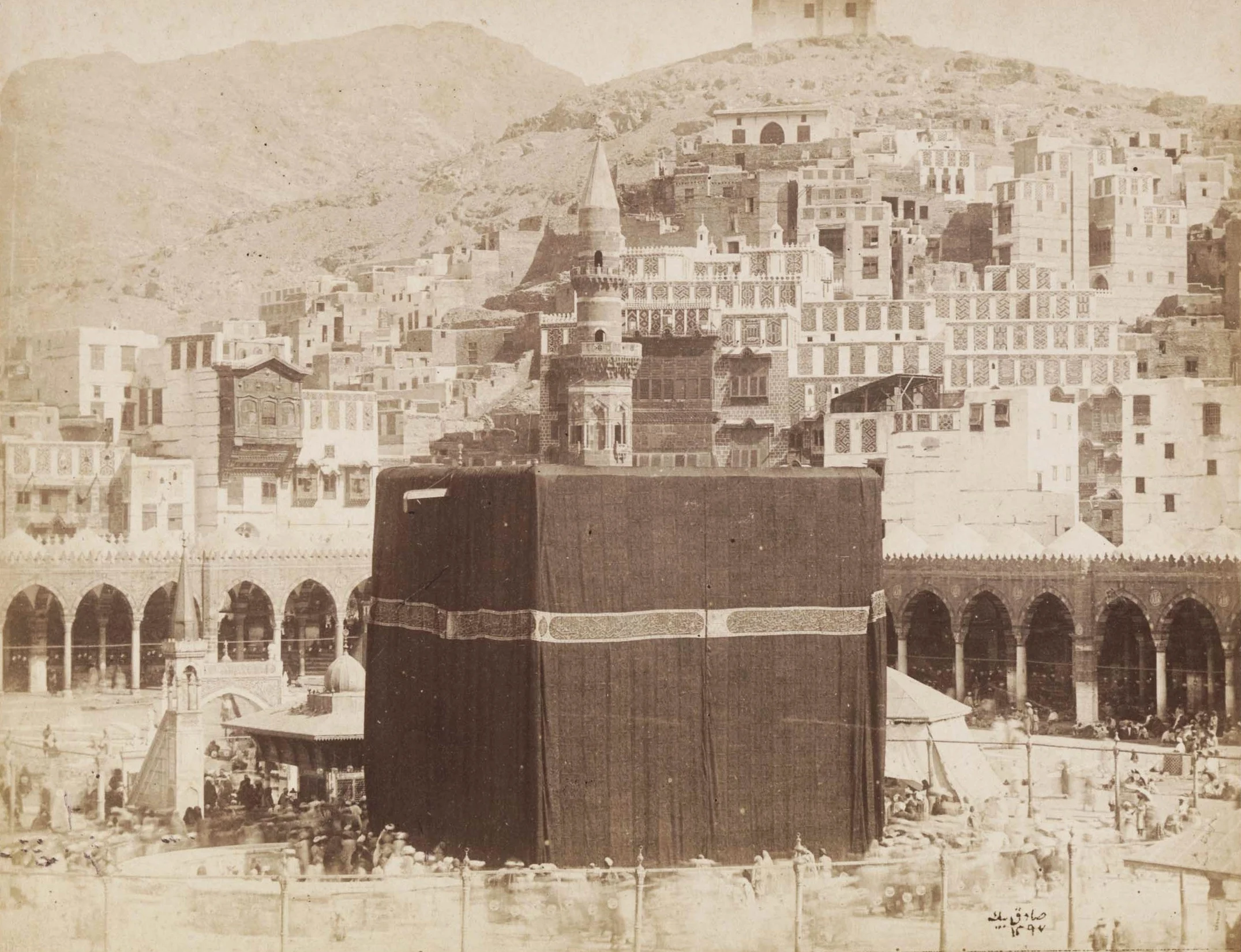
Abd al-Muttalib ibn Hashim (c. 497-578 CE) was the chief of the Quraysh tribe of Mecca, the custodian of the sacred well of Zamzam, and the paternal grandfather of Prophet Muhammad ﷺ. He rediscovered the buried well of Zamzam after receiving what the sira describes as a series of visions directing him to it, led the Meccan delegation that met the Abyssinian commander Abraha before the Year of the Elephant, and — after the early deaths of his son Abdullah and his daughter-in-law Amina — took personal charge of his orphaned grandson until his own death, when the boy was about eight years old.
The account of Abd al-Muttalib's life that follows rests principally on the narration of Ibn Ishaq as preserved by Ibn Kathir, supplemented by The Sealed Nectar. Several of the episodes below — Zamzam, the embassy to Abraha, the vow concerning his son — are transmitted through named chains reaching back to eyewitnesses or their immediate descendants, and this article follows the sira's own attributions rather than smoothing them into an undifferentiated narrative.
Birth and Early Life
Abd al-Muttalib's given name was Shaybah ("the old one" or "grey-haired one"), given to him, according to Ibn Hisham's recension, because of a streak of white hair on his head at birth. His father was Hashim ibn Abd Manaf, the great-grandfather of the Prophet and a leading figure among the Quraysh, who had married Salma bint Amr of the Banu Adi ibn al-Najjar in Medina — then known as Yathrib. Hashim died at Ghazza (Gaza) in Palestine while away on a trading journey, before his son was born; Salma gave birth to Shaybah in her own father's house in Medina, and none of Hashim's family in Mecca knew of the child's birth.
Shaybah grew to boyhood in Medina in his mother's household. Hashim's brother, al-Muttalib ibn Abd Manaf, who had taken charge of the Meccan offices of feeding and watering pilgrims after Hashim's death, eventually heard of his nephew and travelled to Medina to bring him to Mecca. When al-Muttalib saw the boy he wept and embraced him, and took him up on his camel — though Shaybah refused to go until his mother had given her consent, which al-Muttalib obtained only after telling her that the boy's own people in Mecca would treat him better than she alone could. When the pair arrived in Mecca, onlookers took the boy for al-Muttalib's slave and called him Abd al-Muttalib, "the servant of al-Muttalib" — a name that displaced his given name of Shaybah in common use for the rest of his life and afterward.
Chief of the Quraysh
Al-Muttalib died some years later, and the offices he had held — including the siqaya, the provision of water to pilgrims — passed to Abd al-Muttalib, who went on to become the most prominent figure among the Quraysh of his generation. Ibn Ishaq records that a rival branch of the family, the descendants of Abd Shams, contested aspects of his position, and that Abd al-Muttalib secured the support of the Khuza'ah tribe and of the Banu al-Najjar, his mother's people, in an alliance against them — an alliance the sira notes would later bear on events leading to the conquest of Mecca.
The Rediscovery of Zamzam
Ibn Ishaq transmits, on the authority of Ali ibn Abi Talib, Abd al-Muttalib's own account of how he came to dig the well of Zamzam, which had been filled in and lost since the time of the Jurhum tribe's departure from Mecca generations earlier. Abd al-Muttalib related that while sleeping in the sanctuary he was told in a vision to "dig Tiba," and did not understand the word; the vision recurred on successive nights, each time naming something he did not recognise — "Barra," then "al-Madnuna" — until on the fourth night he was told plainly to "dig Zamzam," and was given a description of its location: that it would never fail, that it would water the pilgrims, and that it lay "between the dung and the blood, near the nest of the crow with the white leg and the ants' nest."
Understanding that he had been shown the place, Abd al-Muttalib took his pickaxe and went to it accompanied by his only son at the time, al-Harith, and began to dig. When the ancient covering stone of the well appeared, he cried out in praise of God, and the Quraysh, realising he had succeeded, came to claim a share in the well as the property of their common ancestor Ishmael. Abd al-Muttalib refused, saying he had been singled out for the task, and when the Quraysh pressed their claim he proposed that the matter be put to a diviner of the Banu Sa'd in Syria. On the journey there his party ran out of water in the desert and, by Abd al-Muttalib's own account, was on the point of digging graves for itself in expectation of death from thirst, when he proposed instead that they mount their camels and search further rather than simply await death — and a spring burst from under his own mount's hoof as he did so. Seeing this, the Quraysh travelling with him conceded the dispute over Zamzam without needing to consult the diviner at all, telling him that the God who had given him water in the desert was the same God who had given him Zamzam.
Continuing to dig at Zamzam afterward, Abd al-Muttalib found buried there two gold gazelles and a number of swords and coats of mail, which the Jurhum were said to have hidden before leaving Mecca. The Quraysh again claimed a share, and this time Abd al-Muttalib proposed settling the matter by drawing divinatory arrows before the idol Hubal: two arrows for the Kaaba, two for himself, and two for the Quraysh. The arrows for the Kaaba were drawn for the gazelles, his own arrows were drawn for the swords and armour, and the Quraysh's arrows were not drawn for anything. He had the swords made into a set of doors for the Kaaba, inlaid with the gold gazelles, and from that point held sole charge of providing Zamzam's water to pilgrims.
The Embassy to Abraha
Abd al-Muttalib's second major appearance in the sira is his role in the events preceding the Year of the Elephant, when Abraha, the Abyssinian viceroy of Yemen, marched on Mecca with an army that included a number of elephants, intending to destroy the Kaaba after a church he had built in Sana'a to draw pilgrims away from it was desecrated. When Abraha's forces seized two hundred camels belonging to Abd al-Muttalib, he went to Abraha's camp — as the chief of the Quraysh and the well-known custodian of Mecca — to ask for their return.
Received by Abraha, who is described as treating him with unusual personal respect, Abd al-Muttalib asked only for his camels, not for the safety of the Kaaba. When Abraha expressed surprise that a man who claimed to speak for the Quraysh would raise camels rather than the building he had come to destroy, Abd al-Muttalib replied, "I am the owner of the camels; the building has its own master who will protect it." Abraha returned the camels but not his intention, and Abd al-Muttalib withdrew, told the Quraysh to take shelter in the surrounding hills, and went himself to the door of the Kaaba, where he took hold of its metal ring and prayed aloud for God's protection of His house, reciting verses that Ibn Hisham records as the authentic text of the prayer.
What followed — the lead elephant's refusal to advance toward Mecca, and the destruction of Abraha's army, in the Qur'anic account, by birds casting stones upon it — is treated in the article on the Kaaba and in Surah al-Fil. Abd al-Muttalib's part in the episode, as the sira presents it, is the dignified refusal to bargain over anything but his own property, and the prayer at the Kaaba door that preceded the army's destruction.
The Vow and the Sparing of Abdullah
Abd al-Muttalib had, by his own account transmitted through Ibn Ishaq, made a vow that if he were given ten sons who reached manhood, he would sacrifice one of them at the Kaaba. When the tenth son reached maturity, he disclosed the vow to his sons, who accepted it, and their names were written on divinatory arrows and given to the custodian of Hubal to draw. The arrow drawn was for Abdullah — by the sira's description the son Abd al-Muttalib loved most, and the most chaste of his sons.
Abd al-Muttalib took Abdullah to the Kaaba with a knife to carry out the vow, but the Quraysh, Abdullah's maternal uncles of the Makhzum clan, and his brother Abu Talib intervened and urged Abd al-Muttalib to seek another way. On their advice he consulted a woman diviner, who instructed that the arrows be drawn again between Abdullah and ten camels — and that if the arrow fell on Abdullah again, ten more camels should be added each time, until it fell on the camels instead. The draw was repeated with the number of camels increasing by ten each round until it reached one hundred, at which point the arrow fell on the camels, and one hundred camels were slaughtered in Abdullah's place. Ibn Ishaq's narration adds that this episode is the reason the standard rate of blood-money among the Quraysh was raised from ten camels to one hundred, a rate that Islamic law later confirmed. A saying attributed to the Prophet describes him as "the offspring of the two who were sacrificed" — a reference to his ancestor Ismail, spared at the binding, and to his father Abdullah, spared here.
Choosing a Wife for Abdullah
Abd al-Muttalib chose Amina bint Wahb, of the Banu Zuhrah, as a wife for Abdullah, on the strength of her family's standing among the Quraysh. Their marriage in Mecca produced Muhammad, and Abdullah did not live to see his son grow: he died, according to the sources, either shortly before or a few months after the birth, while away on a journey — an event addressed in the articles on Abdullah ibn Abd al-Muttalib and Amina herself.
Guardian of the Infant Muhammad
After Amina's death, when Muhammad was about six years old, the boy came under Abd al-Muttalib's direct care. Ibn Ishaq's narration, preserved by Ibn Kathir, describes a bed customarily spread for Abd al-Muttalib in the shade of the Kaaba, around which his sons would sit out of respect without any of them sitting on the bed itself — except for the young Muhammad, who would come and sit on it. When his uncles tried to move him away, Abd al-Muttalib would say, "Leave my son alone; he has great things ahead of him," and would seat the boy beside him, stroke his back, and take evident pleasure in watching him.
A separate account of the same period, also transmitted by Ibn Ishaq, states that Abd al-Muttalib treated his grandson with a closeness he had not shown his own sons, allowing the boy to come to him even when he was alone or resting.
One tradition connected to this period is worth noting because Ibn Kathir himself, in commenting on it, rejects it. A report transmitted through al-Suhayli, with a chain Ibn Kathir describes as containing unknown narrators, claims that the Prophet asked God to restore his parents to life so that they might believe in him, and that this was granted. Ibn Kathir calls this "a highly unreliable tradition" and states plainly that what is established in the sahih collections contradicts it. It is recorded here only to note that it is not accepted, not as a fact about Abd al-Muttalib's household or anyone in it.
Death
Abd al-Muttalib died in Mecca when Muhammad was eight years, two months and ten days old, by the reckoning given in The Sealed Nectar. Guardianship of the boy then passed to his uncle Abu Talib, Abdullah's full brother, who raised him thereafter.
Legacy
Abd al-Muttalib's standing in the sira rests on three things the sources return to repeatedly: his recovery of Zamzam, which restored to his family the office of supplying pilgrims with the well's water; his conduct before Abraha, remembered for the plainness of his priorities and his trust that the Kaaba did not depend on him for its protection; and his care of the grandson who would become the Prophet, in whom he is depicted as recognising something exceptional well before anyone else did. His descendants through Abdullah, and separately through his other sons — among them Hamza and al-Abbas, whose line produced the Abbasid Caliphate — carried his name into the first century of Islam and beyond it. His daughter Safiyya and his other daughter Atika are counted among his six daughters, and a grandson through al-Harith, Abu Sufyan ibn al-Harith, is separately covered on this site.
References and Further Reading
Primary Islamic Sources
- Quran, Surah al-Fil (105:1-5) — the destruction of Abraha's army, the episode following directly from Abd al-Muttalib's embassy
- Ibn Ishaq, as transmitted by Ibn Hisham and by Ibn Kathir — the narration of Ali ibn Abi Talib on the digging of Zamzam
- Ibn Ishaq, as transmitted by Ibn Kathir — the embassy to Abraha and the prayer at the Kaaba door
- Ibn Ishaq, as transmitted by Ibn Kathir — the vow concerning Abdullah and its resolution
Classical Islamic Sources
- Ibn Kathir, Ismail ibn Umar. Al-Sira al-Nabawiyya [English translation]. [Compiled c. 1373 CE]
- Ibn Hisham, recension of Ibn Ishaq's Sirat Rasul Allah
- Al-Tabari, Muhammad ibn Jarir. Tarikh al-Rusul wa al-Muluk. [Completed c. 915 CE]
- Ibn Sa'd, Muhammad. Al-Tabaqat al-Kubra. [Compiled c. 845 CE]
Academic and Scholarly Sources
- Al-Mubarakpuri, Safi-ur-Rahman. The Sealed Nectar (Ar-Raheeq Al-Makhtum). Riyadh: Darussalam, 1996.
- Watt, W. Montgomery. Muhammad: Prophet and Statesman. Oxford: Oxford University Press, 1961.
- Guillaume, Alfred, trans. The Life of Muhammad: A Translation of Ibn Ishaq's Sirat Rasul Allah. Oxford: Oxford University Press, 1955.
- Peters, Francis E. Muhammad and the Origins of Islam. Albany: State University of New York Press, 1994.
Further Reading
- Lings, Martin. Muhammad: His Life Based on the Earliest Sources. Cambridge: Islamic Texts Society, 1983.
- Haykal, Muhammad Husayn. The Life of Muhammad. Translated by Isma'il Razi al-Faruqi. Indianapolis: North American Trust Publications, 1976.
- Armstrong, Karen. Muhammad: A Biography of the Prophet. San Francisco: HarperSanFrancisco, 1992.
Mentioned In
9 articles reference this topic