Company Quartermaster Havildar Abdul Hamid: Param Vir Chakra
Company Quartermaster Havildar Abdul Hamid (1933-1965) of 4 Grenadiers destroyed several Pakistani Patton tanks with a jeep-mounted recoilless gun at the Battle of Asal Uttar in 1965. Killed in action, he was posthumously awarded the Param Vir Chakra, India's highest gallantry award.
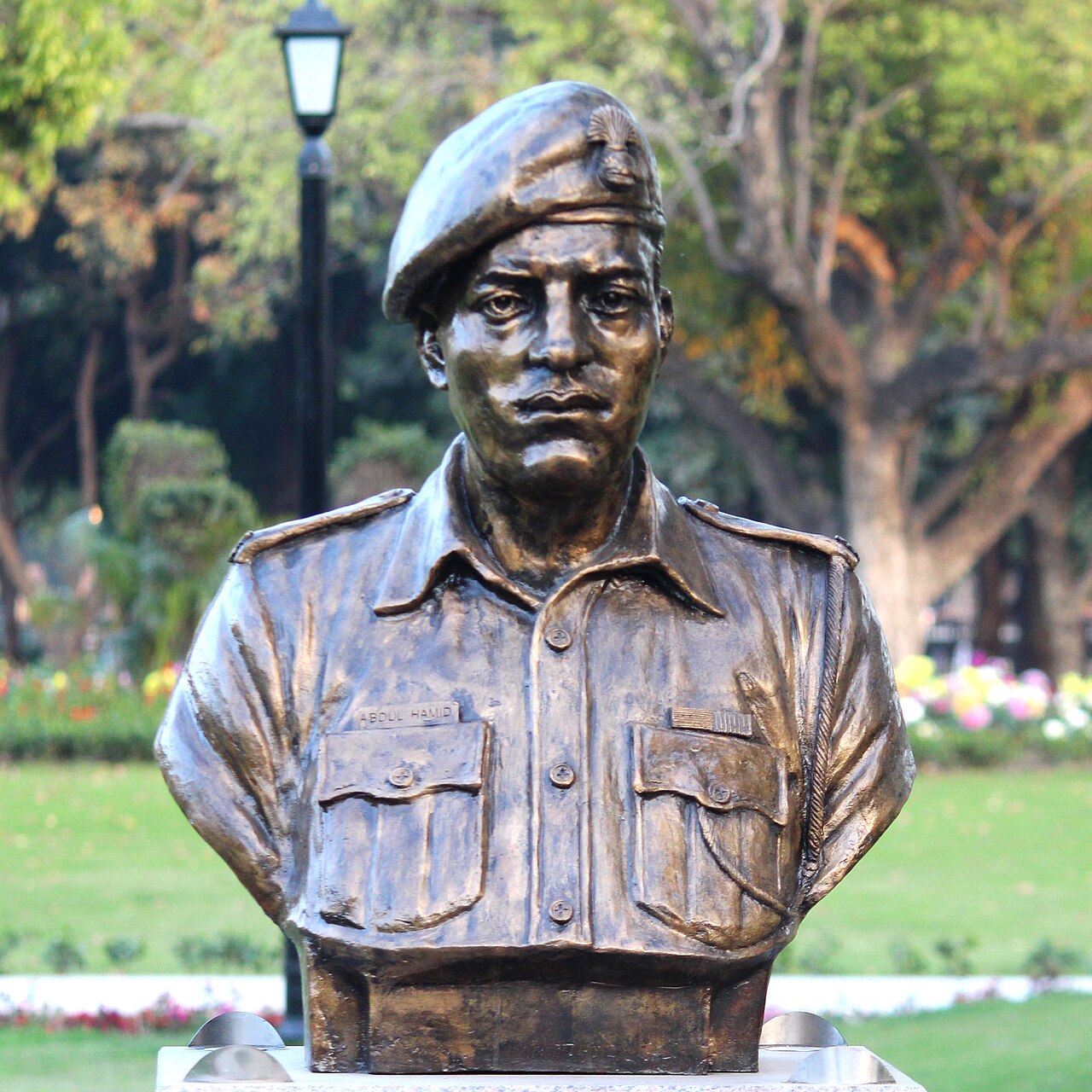
Abdul Hamid is remembered for a single action lasting approximately two days, and for its outcome: the destruction of several Pakistani M48 Patton tanks by a lone infantryman with a jeep-mounted recoilless gun, in the closing phase of the Battle of Asal Uttar during the Indo-Pakistani War of 1965. He was killed in the action and posthumously awarded the Param Vir Chakra, the Republic of India's highest decoration for wartime gallantry. He is the subject of a biographical documentary by the Films Division of India and is commemorated alongside other Muslim soldiers who served in India's wars, including Brigadier Mohammad Usman, who holds a Maha Vir Chakra from the 1948 Kashmir operations.
His story is brief — he was thirty-two years old when he died, and the documented record of his life before the army is thin — but its significance extends beyond the individual feat of arms. The Battle of Asal Uttar was one of the decisive engagements of the 1965 war. Pakistan's 1st Armoured Division, equipped with American-supplied M48 Patton tanks, launched its offensive through the Khem Karan sector with the objective of driving toward Amritsar. The Indian forces, holding positions between Bhikhiwind and Khem Karan, turned the offensive back in three days of fighting. The battle resulted in the loss of ninety-seven Patton tanks for the Pakistani side and the surrender of an entire Pakistani armoured regiment — 4 Cavalry — along with its commanding officer. Hamid's action was one part of that collective achievement.
Early Life
Abdul Hamid was born on 1 July 1933 in Dhamupur, a village in Ghazipur district of what was then the United Provinces of British India (now Uttar Pradesh). His father, Mohammad Usman, was a tailor. The family was of modest means. The Times of India reporting from Dhamupur records that his action in 1965 inspired later generations of the village's youth to seek careers in the armed forces.
Beyond these basics — birth date, village, district, father's name and occupation — the accessible authoritative sources provide little detail about his childhood, schooling, or the circumstances that led him to enlist. This article does not fill that gap with speculation.
Military Service
Enlistment
Hamid was enrolled into the Grenadiers infantry regiment on 27 December 1954 and was posted to the 4th Battalion (4 Grenadiers). He served in the anti-tank section and was noted as an expert shot with the 106mm recoilless rifle — the weapon with which he would later engage Pakistani armour.
By September 1965 he held the rank of Company Quartermaster Havildar (CQMH), a non-commissioned officer's appointment combining administrative responsibility with combat duties. He had recently been promoted to quartermaster stores duties but, on account of his proficiency with the recoilless rifle, was returned to operational command of the battalion's recoilless rifle detachment as the crisis developed.
The Battle of Asal Uttar
Strategic Context
The 1965 Indo-Pakistani War was triggered by Pakistani infiltration into Indian-administered Kashmir (Operation Gibraltar) in August 1965. India responded by opening a front in Punjab on 6 September 1965. Pakistan's counter was Operation Grand Slam in the Chhamb sector, aimed at capturing Akhnoor and severing the Jammu–Srinagar highway, followed by a major armoured thrust in the Khem Karan sector aimed at Amritsar.
The Indian Express and the Indian Defence Review both describe the Pakistani offensive in the Khem Karan sector as led by the 1st Armoured Division, equipped with M48 Patton tanks — at that time considered among the most formidable tanks in Asia. The Pakistani forces initially captured the Indian town of Khem Karan, approximately five kilometres inside the international border.
The Indian Defensive Plan
The Indian 4th Mountain Division and subsequently the 2nd Armoured Brigade held positions between Khem Karan and Bhikhiwind. The Indian Express reports that the Indian Army set a deliberate trap, allowing the Pakistani armour to advance into prepared killing grounds in terrain featuring sugarcane fields and irrigation channels that restricted tank mobility.
The Position of 4 Grenadiers
The 4 Grenadiers battalion was assigned a position before the village of Chima on the Khem Karan–Bhikhiwind road. Firm hold of this area was essential for the Indian defensive plan. The Indian Express reporting from the 60th anniversary in 2025 identifies the battalion as having achieved two notable results in the closing hours of the battle on 10 September 1965: Hamid's Param Vir Chakra action, and the killing of Brigadier Ahsan Rasheed Shami of the Pakistan Army — the highest-ranking enemy officer killed in the 1965 war — by another soldier of the battalion, Naushad Mohammad Khan, using a light machine gun.
Hamid's Action
On 8 and 9 September 1965, Pakistani forces launched a major offensive with a regiment of Patton tanks against the position held by 4 Grenadiers. The artillery barrage was described by reporting as so intense that a shell littered every yard of ground occupied by the Indian battalion.
Hamid, commanding a recoilless gun (RCL) detachment, moved out to a flanking position with his gun mounted on a jeep. Using the cover of tall standing crops, he allowed the enemy tanks to come within effective range of the recoilless rifle before engaging them. He moved repeatedly from one firing position to another under enemy shelling and tank fire, engaging Pakistani armour at close quarters.
The Tank Count: A Note on Sources
The precise number of tanks Hamid destroyed is reported differently by different sources, and intellectual honesty requires stating the variance rather than choosing a figure.
The Drishti IAS account (based on official records, published September 2025) states that on 10 September 1965, Hamid "identified four Pakistani Patton tanks, destroyed three, and damaged one. He was later killed by fire from another tank." The Times of India (Chandigarh, 2017) reports that he "destroyed many Pakistani Patton tanks by his recoilless gun," while a later Times of India report (September 2019) records him destroying "more than half-a-dozen Patton tanks." Aggregated reference sources give a higher figure, claiming he "destroyed eight Pakistani tanks and was killed in action while destroying the ninth tank," a figure that appears widely in popular accounts. The Firstpost account (June 2024), by contrast, gives the figure as four.
The variance likely reflects a difference between the total engagement across 8–10 September (two or three days of fighting) and the action of the final day alone. It may also reflect a difference between the individual citation's claims and the battalion's aggregate achievement at the position Hamid held. This article does not resolve the discrepancy, but notes that the Drishti IAS account, published to mark the 60th anniversary and apparently drawing on official military sources, is the most recent and the most specific.
What is not in dispute across any of the accounts is that Hamid engaged multiple Patton tanks at close range from a jeep-mounted recoilless gun, that he destroyed several, and that he was killed in action by enemy fire directed at his jeep.
Death
Hamid was killed on 10 September 1965 when his jeep was hit by a high-explosive round from an enemy tank. He was thirty-two years old.
The Param Vir Chakra
The Param Vir Chakra, India's highest wartime gallantry decoration, was awarded to Hamid posthumously. The award, established in 1950, recognises "the most conspicuous bravery or some daring or pre-eminent act of valour or self-sacrifice in the presence of the enemy." Hamid is among twenty-one recipients of the decoration as of 2026.
The Indian Express's anniversary reporting confirms that the Indian Army holds an annual ceremony at his grave and war memorial near Chima village on the Khem Karan–Bhikhiwind road in Tarn Taran district, Punjab.
The Battle's Outcome
The Battle of Asal Uttar concluded on 10 September 1965 with the decisive rout of the Pakistani armoured thrust. The Indian Express reports that the Pakistani 4 Cavalry regiment surrendered to Indian troops along with their commanding officer and their Patton tanks. The Drishti IAS account gives the overall Pakistani loss as ninety-seven Patton tanks. The site became known popularly as Patton Nagar (Patton City) or the Patton Graveyard.
The battle's significance in the 1965 war was that it ended the prospect of a Pakistani armoured breakthrough toward Amritsar and thereby settled the military outcome in the Punjab sector. Hamid's individual action was one element of that collective result, recognised by the state at the highest level.
Legacy and Commemoration
A war memorial stands at the site of his death near Chima village, with a captured Pakistani Patton tank displayed as a tribute. His grave lies at the same location.
In his home village of Dhamupur, Ghazipur district, his action has been commemorated locally and is credited by the Times of India with inspiring subsequent generations to seek military careers.
The Government of Jharkhand inaugurated a restored Paramvir Abdul Hamid Memorial site in September 2025, marking the 60th anniversary of his death.
A postal stamp was issued in his honour by India Post. His action is a standard subject in accounts of the 1965 war and in military training materials.
Historiographical Note
The principal challenge in writing an authoritative account of Abdul Hamid is the thin documentary record of his life before the army, combined with the conflicting figures for his action during the battle.
His birth date (1 July 1933), birthplace (Dhamupur, Ghazipur), enlistment date (27 December 1954), regiment (4 Grenadiers), rank (CQMH), and death date (10 September 1965) are confirmed across multiple independent sources including official military commemorations. His father's name (Mohammad Usman) and occupation (tailor) are reported in the Times of India's Dhamupur village coverage.
The tank-count discrepancy is documented above. This article follows the Drishti IAS account (September 2025) as the most recent and specific, while noting the higher figures given elsewhere. A definitive resolution would require access to the official Param Vir Chakra citation text as published in the Gazette of India, which has not been located in the accessible online sources.
The accessible sources for this article are reputable journalism (Indian Express, Times of India), an institutional educational publication (Drishti IAS), and military-affairs reporting (Indian Defence Review). No academic monograph or peer-reviewed article devoted specifically to Abdul Hamid has been identified. The standard published account of the Param Vir Chakra recipients — Ian Cardozo's Param Vir: Our Heroes in Battle — is cited in the references but has not been consulted directly.
References and Further Reading
Primary Islamic Sources
- Quran, Surah An-Nisa (4:75) — "And what is [the matter] with you that you fight not in the cause of Allah and [for] the oppressed among men, women, and children." (The Quranic injunction invoked in the broader tradition of Muslim service in the armed defence of the homeland)
- Quran, Surah Al-Anfal (8:60) — "And prepare against them whatever you are able of power and of steeds of war." (Military preparedness as duty)
- Quran, Surah Al-Baqarah (2:190) — "Fight in the way of Allah those who fight you but do not transgress." (Principles of defensive warfare within which Muslim soldiers have understood their service)
- Quran, Surah As-Saff (61:4) — "Indeed, Allah loves those who fight in His cause in a row as though they are a [single] structure joined firmly." (Unity and discipline in military service)
- Sahih al-Bukhari, Book of Jihad (Kitab al-Jihad wa al-Siyar), Hadith 2785 — "Guarding the frontier for a day in the cause of Allah is better than the world and what is in it." (The classical reference for military frontier service as religious merit)
Classical Islamic Sources
- Al-Sarakhsi, Shams al-Din. Sharh al-Siyar al-Kabir. [Original 11th century CE — the foundational Hanafi text on the law of war; the jurisprudential framework within which Muslim soldiers of the Indian military tradition have understood their obligations]
- Al-Mawardi, Abu al-Hasan. Al-Ahkam al-Sultaniyyah. [Original 11th century CE — on the governance and military obligations of those in authority]
- Ibn Qudamah, Muwaffaq al-Din. Al-Mughni, Kitab al-Jihad. [Original 12th century CE — Hanbali jurisprudence on the ethics of combat, the obligations of a soldier, and the conditions under which fighting is an obligation]
- Shah Waliullah Dehlawi. Hujjat Allah al-Balighah. [Original 18th century CE — Indian Islamic reform tradition; the intellectual heritage shared by the Muslim communities of eastern Uttar Pradesh from which Hamid came]
Academic and Scholarly Sources
- Cardozo, Major General Ian. Param Vir: Our Heroes in Battle. New Delhi: Lotus Collection, Roli Books, 2003. [The standard published account of Param Vir Chakra recipients; Abdul Hamid's citation and action are treated in detail]
- Praval, K.C. India's Paratroopers: A History of the Indian Airborne Forces. New Delhi: Thomson Press, 1975. [Contextual source on the Indian Army's order of battle in 1965]
- Singh, Lt Gen Harbaksh. In the Line of Duty: A Soldier Remembers. New Delhi: Lancer Publishers, 2000. [Memoirs of the Western Army Commander during the 1965 war; provides the operational context of the Khem Karan sector]
- Chakravorty, B.C. History of the Indo-Pak War, 1965. New Delhi: History Division, Ministry of Defence, Government of India, 1992. [The official history of the war published by the Ministry of Defence]
- Shaukat, Riza. The Pakistan Army: War of 1965. Islamabad: Army Education Press. [Pakistani official account providing the opposing perspective on the Battle of Asal Uttar]
Further Reading
- Indian Express. "A momentous day in the Battle of Asal Uttar: Param Vir Chakra won, Pak brigadier killed in action." 10 September 2025. [60th anniversary reporting, confirming Hamid's battalion, the date, and the parallel action by Naushad Mohammad Khan]
- Indian Express. "Explained: The 1965 Battle of Asal Uttar and the role of Abdul Hamid." 10 September 2021. [Detailed explanation of the battle's geography, the Indian Army's defensive plan, and Hamid's grave and memorial location]
- Times of India. "Dhamupur village remembers its war hero." September 2011. [Village-level reporting on Hamid's family background and local commemoration]
- Drishti IAS. "60th Martyrdom Day of Paramvir Abdul Hamid." September 2025. [Gives the most specific publicly accessible account of tanks engaged on 10 September: four identified, three destroyed, one damaged]
Mentioned In
1 article references this topic