Jamia Millia Islamia: The National Muslim University
Jamia Millia Islamia was founded at Aligarh on 29 October 1920 by nationalist Muslim leaders and students who left the Muhammadan Anglo-Oriental College during the Non-Cooperation movement. It moved to Delhi in 1925, to Okhla in 1935, and became a central university by Act of Parliament in 1988.
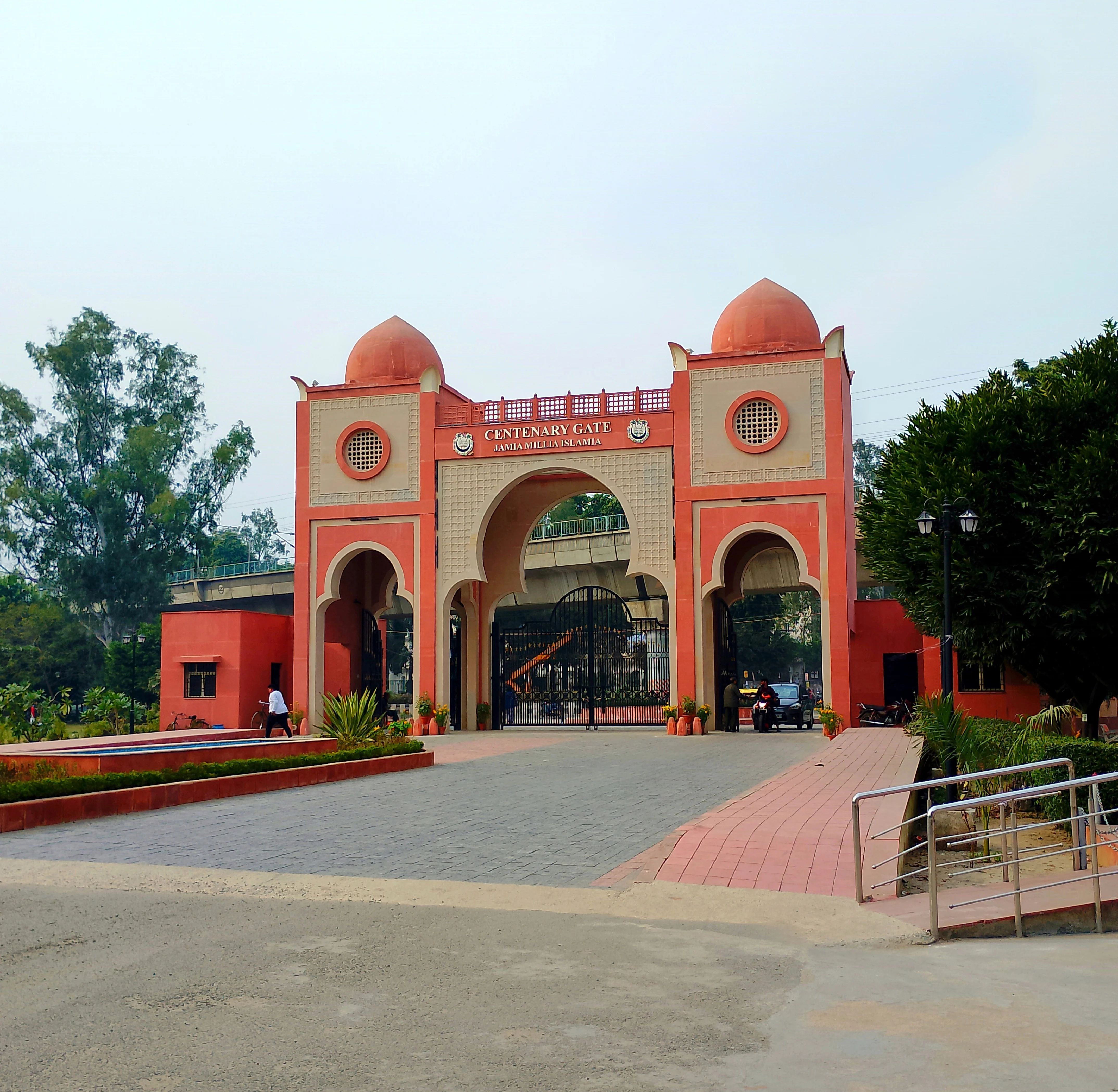
Jamia Millia Islamia — the name means "National Islamic University" — is a central university at Okhla in southern Delhi. It was founded at Aligarh on 29 October 1920, moved to Delhi in 1925 and to its present campus in 1935, and was made a central university by an Act of Parliament in 1988.
It began as a secession. In 1920 the Non-Cooperation and Khilafat movements called for the boycott of institutions dependent on the colonial government, and the Muhammadan Anglo-Oriental College at Aligarh — then in the act of becoming Aligarh Muslim University under a government statute and with government funds — fell squarely within that call. A group of teachers and students walked out and founded a university of their own, to be financed and governed by Indians without official support. That origin is the key to the institution: Jamia was not established to provide an alternative curriculum, but to provide the same kind of modern education under Indian control, and the question it was built to answer was one of political independence rather than of pedagogy.
Foundation
The Setting: 1919–20
The years immediately after the First World War produced an unusual convergence in Indian politics. The Khilafat movement, which mobilised Indian Muslim opinion over the fate of the Ottoman caliphate after the Ottoman defeat, joined with Gandhi's Non-Cooperation movement in a broad campaign of withdrawal from colonial institutions — courts, legislatures, titles, and schools and colleges receiving government aid.
The educational clause of that programme created a practical difficulty that has no obvious answer: if students were to leave government-aided colleges, something had to receive them. Several "national" institutions were founded across India for this purpose in 1920 and 1921. Jamia Millia Islamia was one, and it is the one that survived and grew.
The Walkout at Aligarh
Aligarh was the natural point of collision. It was the premier institution of modern Muslim education in India, it was in the middle of its conversion into a university by Act of the legislature, and its funding and governance were bound up with the colonial administration. Gandhi and the Ali brothers pressed the case for withdrawal on the campus. The trustees declined to sever the connection with the government, and a body of teachers and students left.
The foundation stone was laid at Aligarh on 29 October 1920 by Maulana Mahmud Hasan, known as Shaykh al-Hind — a choice that carried a great deal of meaning. Mahmud Hasan (born 1851 at Bareilly) was a product of a different educational tradition altogether: he had been the first student of Darul Uloom Deoband, and by 1920 he was its most senior figure, recently returned from internment in Malta for his role in the anti-colonial activity known as the Silk Letter conspiracy. That the founding stone of a modern Muslim university, established in the shadow of Aligarh, was laid by Deoband's first student is the clearest single indication of what 1920 did to the older divisions in Indian Muslim life. Mahmud Hasan died a month later, in November 1920.
The Founders
The institution was carried in its first years by a group whose members were, for the most part, not professional educators.
Hakim Ajmal Khan, the Delhi physician of Unani medicine and a president of the Indian National Congress, became the first Chancellor — Amir-e-Jamia — and held the position until his death in 1927. His standing in Delhi, across communities and with both the Congress and the Khilafat leadership, gave the new institution a credibility it could not otherwise have had.
Mohammad Ali Jauhar, journalist and Khilafat leader, was its first Vice-Chancellor — Shaykh al-Jamia. Mukhtar Ahmed Ansari, physician and Congress president, succeeded Ajmal Khan as Chancellor in 1928 and served until his death in 1936. Abdul Majeed Khwaja, a Cambridge-trained lawyer from Aligarh, was among the principal organisers and later led the institution himself.
Gandhi's involvement was direct and practical. He was closely associated with the institution's early fundraising, and Jamia's own account of its origins treats his support as constitutive rather than incidental — a point that matters for understanding what kind of Muslim institution it set out to be.
Delhi and the Crisis of 1925
Jamia's early years at Aligarh were financially precarious, and the collapse of the Non-Cooperation movement after 1922 removed much of the political energy that had brought it into being. In 1925 the institution moved to Delhi, initially to Karol Bagh.
The move coincided with the crisis that determined whether Jamia would survive at all. Funds had run out and the enterprise was close to closure. What rescued it was the arrival, in 1926, of three young men who had met as students in Germany five years earlier and who chose to give their careers to an institution that could not pay them properly.
Zakir Husain had left Aligarh in the 1920 walkout, gone to Berlin, and taken a doctorate in economics. Abid Husain had studied philosophy. Mohammad Mujeeb had read history at Oxford and then trained in printing in Germany. All three returned in 1926 and took up positions at Jamia — Zakir Husain as Vice-Chancellor, Abid Husain as professor of philosophy and psychology, Mujeeb as professor of history — on salaries reported at around eighty rupees a month, a fraction of what men with their qualifications could command. They undertook to serve for a fixed term of years on those terms. Zakir Husain remained Vice-Chancellor for twenty-two years, from 1926 to 1948. Mujeeb stayed on for decades and later became Vice-Chancellor himself; his The Indian Muslims (1967) is among the significant works of Indian historical scholarship written from within the institution.
A fourth figure belongs in this account. Gerda Philipsborn, a German Jewish woman who had met the three in Berlin in 1921, left Germany in 1932 and came to Jamia, where she worked for the rest of her life and was known as Aapa Jaan — elder sister. She is the subject of a biography by the historian Margrit Pernau. That a German Jewish woman fleeing Europe in the 1930s should have spent her remaining years building a Muslim national university in Delhi is an unusual fact, and it says something accurate about the kind of institution Jamia was in that decade.
This episode is central to Jamia's institutional self-understanding, and it is also the reason the institution has a continuous history at all. What the founders of 1920 had created, the teachers who arrived in 1926 kept alive.
Okhla, 1935
In 1935 Jamia moved from Karol Bagh to Okhla, on the southern edge of Delhi, where land had been acquired and where the campus has remained. The surrounding settlement that grew up around it became known as Jamia Nagar.
The institution that developed at Okhla was distinctive in ways worth naming, because they do not follow automatically from its political origin.
It placed unusual emphasis on school education and teacher training rather than concentrating on degrees. Where Aligarh's design was a residential college producing graduates for the professions, Jamia built schools, trained teachers, and worked on the problem of elementary and adult education — which reflects both its Gandhian associations and the practical fact that it had no endowment with which to build faculties.
It taught in Urdu, and treated the language as part of its purpose rather than as a concession.
It published. The Maktaba Jamia, its publishing house, produced textbooks, children's literature and general works in Urdu, and the printing skills Mujeeb had acquired in Germany were applied directly to it. For an institution of Jamia's means, a press was both an income and an instrument.
And it developed vocational and craft-based schooling of a kind that connected closely with Gandhi's ideas on education through productive work. Zakir Husain chaired the committee that produced the 1937 scheme of basic education for the Congress — the Wardha scheme — and the relationship between that scheme and Jamia's own classroom practice was not accidental. This is the clearest instance of the institution exporting a method rather than importing one.
Partition and After
Partition in 1947 was an acute crisis for an institution of this character. Jamia had been built on the proposition that Muslims belonged in a composite Indian nation, its leadership had been Congress-aligned for a quarter of a century, and the division of the subcontinent along religious lines was a repudiation of that position. Delhi saw severe violence, and the Okhla campus and the settlement around it received refugees.
Jamia stayed, and its subsequent trajectory ran through the institutions of the Indian republic. Zakir Husain became Governor of Bihar, then Vice-President, and in 1967 President of India — the first Muslim to hold the office. Jamia was recognised as a deemed university by the University Grants Commission in 1962, and on 26 December 1988 it was made a central university by the Jamia Millia Islamia Act.
It now teaches across faculties including humanities and languages, social sciences, natural sciences, engineering and technology, law, education, architecture, dentistry, fine arts, and Islamic studies, and it retains the schools that were part of its design from the beginning. Its Mass Communication Research Centre, founded in the 1980s, became one of the better-known institutions of its kind in India.
The Two Universities
Jamia and Aligarh are habitually contrasted, and the contrast is real but narrower than it is usually made to sound.
They did not differ over whether Muslims should receive modern education; both were founded on the proposition that they should, and Jamia's curriculum was not markedly more traditional than Aligarh's. They differed over the relationship such an institution should have with the colonial state. Aligarh's founders had judged that Muslim recovery required cooperation with British power and the education of a class able to work within it. Jamia's founders judged, two generations later and in a changed political climate, that dependence on that power was itself the obstacle.
Nor did the division hold. The clearest evidence is Zakir Husain's own career: he left Aligarh in 1920 to help build Jamia, led Jamia for over twenty years — and then served as Vice-Chancellor of Aligarh Muslim University from 1948 to 1956, before the presidency. Institutions founded in opposition to one another had, within a generation, a shared personnel and a shared place in the educational system of independent India.
Assessment
Jamia's historical interest lies in what it demonstrates rather than in its size. A university founded by a boycott, on no endowment, by physicians and journalists rather than educationists, which nearly closed within five years and was saved by teachers agreeing to work for subsistence, is not an obvious candidate for survival — and it survived to become a central university of the Indian republic.
It also occupies a particular position among modern Muslim educational institutions. Deoband answered the crisis of colonial rule by rebuilding the transmission of the religious sciences; Aligarh answered it by adopting the colonial curriculum under official patronage; Jamia adopted the curriculum and rejected the patronage. Of the three responses, Jamia's was the one most closely tied to a specific political moment, which is why it came nearest to disappearing when that moment passed, and why the decision of 1925 rather than the foundation of 1920 is the event on which its continued existence turned.
References and Further Reading
Primary Islamic Sources
- Quran, Surah Al-Zumar (39:9) — "Are those who know equal to those who do not know?" — among the verses most frequently invoked in the Indian Muslim educational movements of the period
- Quran, Surah Al-Alaq (96:1-5) — the first revelation, on reading and the pen
- Quran, Surah Ta-Ha (20:114) — "My Lord, increase me in knowledge"
- Quran, Surah Al-Ma'idah (5:2) — cooperation in righteousness and piety, cited in the period's arguments for Hindu-Muslim common action
- Sahih al-Bukhari 71, Kitab al-Ilm — "If God wants to do good to a person, He makes him comprehend the religion" (Mu'awiya)
- Jamia Millia Islamia, founding documents and the profiles of its founders published by the university (jmi.ac.in), including its account of Maulana Mahmud Hasan laying the foundation stone at Aligarh on 29 October 1920.
Classical Islamic Sources
- Shah Waliullah of Delhi. Hujjat Allah al-Baligha. [18th century CE]. The common intellectual inheritance of the Indian Muslim reform movements from which both Deoband and, at a further remove, the Jamia circle drew; see Shah Waliullah.
- Al-Ghazali, Abu Hamid. Ihya Ulum al-Din, Kitab al-Ilm. [c. 1100 CE]. The classical framework for the classification of the sciences and the purposes of learning.
- Ibn Khaldun. Al-Muqaddimah, sections on instruction and the sciences. [14th century CE].
- Al-Zarnuji, Burhan al-Din. Ta'lim al-Muta'allim Tariq al-Ta'allum. [13th century CE]. The traditional South Asian manual on the conduct of study.
Academic and Scholarly Sources
- Minault, Gail. The Khilafat Movement: Religious Symbolism and Political Mobilization in India. New York: Columbia University Press, 1982. The standard study of the politics of 1919–24, including the educational boycott and the founding of Jamia.
- Hasan, Mushirul, and Rakhshanda Jalil. Partners in Freedom: Jamia Millia Islamia. Delhi: Niyogi Books, 2006. Institutional history covering the foundation, the 1925 crisis, the Okhla period and after.
- Hasan, Mushirul. A Nationalist Conscience: M.A. Ansari, the Congress and the Raj. Delhi: Manohar, 1987. On Mukhtar Ahmed Ansari and the Congress-aligned Muslim leadership that sustained Jamia.
- Hefner, Robert W., and Muhammad Qasim Zaman, eds. Schooling Islam: The Culture and Politics of Modern Muslim Education. Princeton: Princeton University Press, 2007. Places Jamia within the comparative field of modern Muslim educational institutions.
- Metcalf, Barbara D. Islamic Revival in British India: Deoband, 1860–1900. Princeton: Princeton University Press, 1982. Necessary background on Deoband and on Mahmud Hasan, whose role in 1920 links the two institutions.
- Jamia Millia Islamia, official institutional history (jmi.ac.in), and the Jamia Millia Islamia Act, 1988.
Further Reading
- Lelyveld, David. Aligarh's First Generation: Muslim Solidarity in British India. Princeton: Princeton University Press, 1978. On the institution Jamia's founders left, and on the network they were leaving.
- Robinson, Francis. Separatism among Indian Muslims: The Politics of the United Provinces' Muslims, 1860–1923. Cambridge: Cambridge University Press, 1974. Political context for the split of 1920.
- Zaman, Muhammad Qasim. The Ulama in Contemporary Islam: Custodians of Change. Princeton: Princeton University Press, 2002. On the religious scholars whose most senior figure laid Jamia's foundation stone, and on their subsequent relation to modern Muslim institutions.
- Maulana Abul Kalam Azad — a founder of the institution and independent India's first education minister
- Syed Mahmud — a founder of the university and later a minister in independent India
Mentioned In
12 articles reference this topic
More from Modern Era
Abadi Bano Begum (Bi Amma): Mother of the Khilafat Movement
Abadi Bano Begum (1852-1924), known affectionately as Bi Amma, was the mother of the Ali Brothers and one of the first Muslim women to enter Indian nationalist politics, mobilizing women for the Khilafat and Non-Cooperation movements while observing purdah.
Ali Musliyar: Religious Leader of the Malabar Rebellion
Ali Musliyar (1861-1922), a scholar trained at Ponnani and Mecca, served as chief musaliar of the Tirurangadi mosque in south Malabar from 1907 and became the central religious authority of the Malabar Rebellion of 1921-22, before his capture and execution.
Aruna Asaf Ali: The Grand Old Lady of the Indian Independence Movement
Aruna Asaf Ali (1909-1996), born Aruna Ganguly, hoisted the Indian flag at Gowalia Tank Maidan on 9 August 1942, marking the start of the Quit India Movement. She spent four years underground, became Delhi's first mayor in 1958, and was awarded the Bharat Ratna posthumously in 1997.
Asaf Ali: Barrister, Freedom Fighter, and India's First Ambassador to America
Asaf Ali (1888-1953) was an Indian barrister and Congress leader who defended Bhagat Singh and the INA officers at the Red Fort trial. He served in the Interim Government of 1946, became independent India's first Ambassador to the United States in 1947, and was Governor of Odisha to 1952.