Mukhtar Ahmed Ansari: Physician, Nationalist, and Builder of Institutions
Mukhtar Ahmed Ansari (1880-1936) was an Indian physician and nationalist who presided over both the All India Muslim League and the Indian National Congress. Trained in Edinburgh and London, he led the Indian Medical Mission to Turkey in 1912 and was Chancellor of Jamia Millia Islamia.
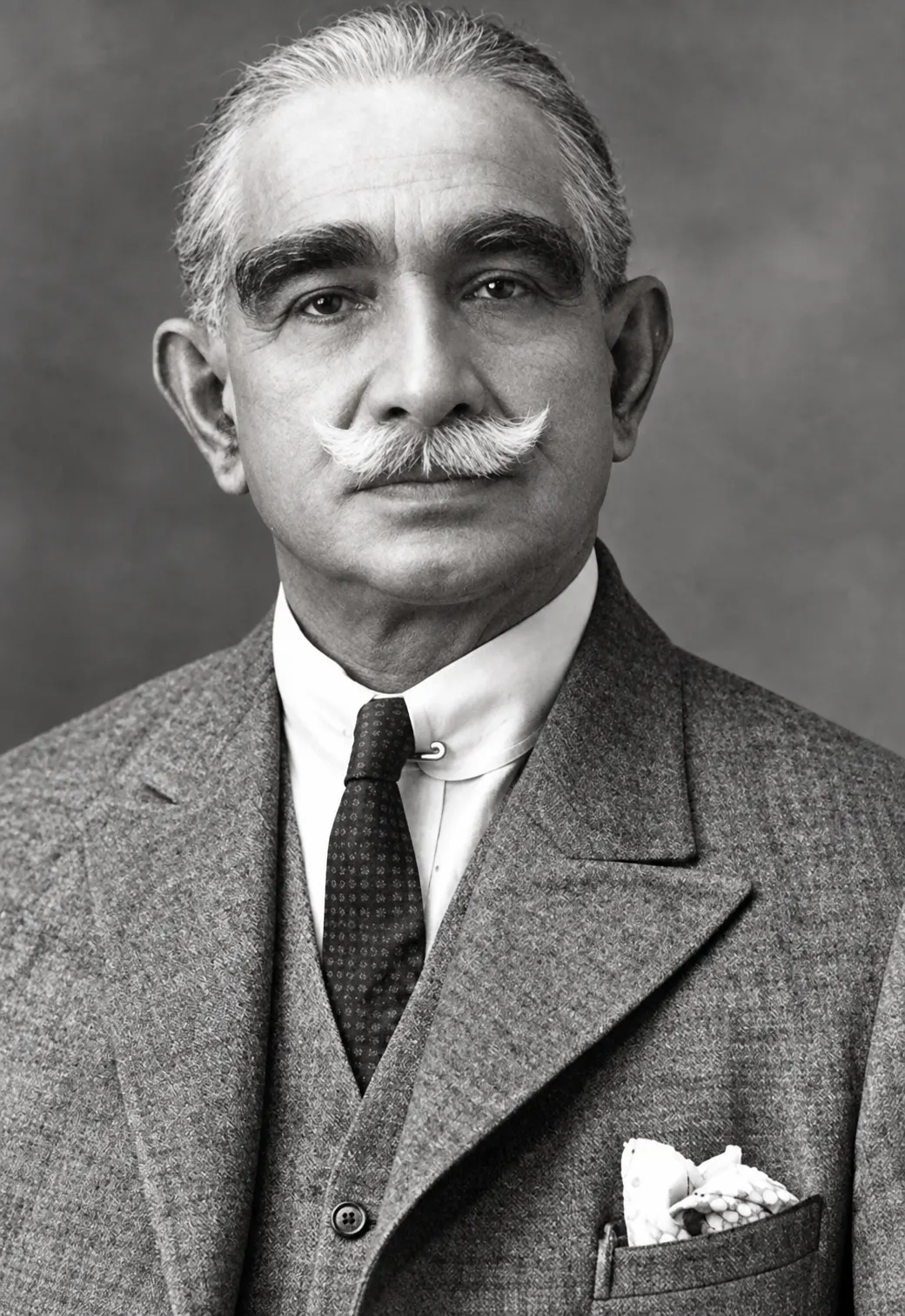
Mukhtar Ahmed Ansari belongs to a small group of figures in the Indian independence movement who held the presidency of both the Muslim League and the Indian National Congress — a combination that was possible during a period when the two organisations shared political goals and impossible after they diverged. His career spanned the years when that convergence existed and when it broke apart, and his efforts were directed throughout at maintaining it.
He was, by training and profession, a surgeon of exceptional distinction — the first Indian to hold the post of Registrar at London's Lock Hospital, a man honoured with a ward in his name at Charing Cross Hospital — who gave up a comfortable career in England to return to India and enter politics. His first public act was to lead a medical mission to the Ottoman Empire during the Balkan Wars of 1912–13, an enterprise that was simultaneously humanitarian and political: it treated wounded soldiers and it put Indian Muslim solidarity with the Ottoman state on an international stage. From there he moved into the leadership of both organisations, presided over the Muslim League in 1918 and 1920, and over the Congress at its Madras session in 1927. He was a founder of Jamia Millia Islamia and served as its Chancellor from 1928 until his death.
Gandhi stayed at his house — Darus-salam, the Abode of Peace — whenever he visited Delhi. He was a member of the Congress Working Committee throughout his active political life, serving as its General Secretary in 1920, 1922, 1926, 1929, 1931 and 1932. He died suddenly on the night of 10 May 1936, returning from Mussoorie by train. He was fifty-five years old.
What makes Ansari historically significant is not the offices alone but what they represent: a political career built on the premise that Indian Muslims and Hindus constituted a single political community, and that their interests were best pursued jointly. This was not a novel position — it was the basis of the Lucknow Pact that he helped to negotiate — but it required constant defence as the League and the Congress diverged, and Ansari spent his energy on that defence. His death in 1936, four years before the Lahore Resolution, spared him the final fracture, but the institutions he built — Jamia Millia Islamia above all — survived it and continue to serve the premise he worked from.
Family Background and Early Life
The Ansari Family of Ghazipur
The Ansari family's connection to India, according to its own genealogical tradition as recorded in the Indian National Congress's institutional account, dates to the reign of Sultan Muhammad Bin Tughlaq (r. 1325–1351). The family is said to have come to India in that period, initially serving in the royal army and holding positions at court. They settled at Yusufpur in what is now Ghazipur district, Uttar Pradesh, and held governmental positions over several generations.
By the time Mukhtar Ahmed Ansari was born on 25 December 1880, the prosperity of the family was in decline — a trajectory common to Muslim service families of the region in the nineteenth century. The INC account states this directly without elaborating on the causes.
Schooling and the Move to Hyderabad
Ansari graduated from Victoria High School, Ghazipur, in 1896. He then moved to Hyderabad, where two of his brothers were employed in the service of the Nizam, and pursued his university education there. The Nizam's state was the wealthiest princely territory in India and a significant patron of Muslim learning and professional advancement; the scholarship Ansari subsequently received for his medical studies in England was a Nizam State Scholarship. These details come from both the INC's account and from Britannica, and together they establish that Ansari's access to advanced education depended on Hyderabad patronage.
Medical Education in Britain
Madras Medical College
Ansari studied medicine at Madras Medical College before receiving the Nizam State Scholarship that took him to England. Britannica and the INC account agree on this sequence, though neither specifies how long the Madras portion lasted or what qualification it conferred.
London and Edinburgh: A Distinguished Record
In England Ansari achieved a record of distinction that the sources uniformly emphasise. The peer-reviewed biographical article in Vesalius (indexed in PubMed, PMID 38832559) and the INC's institutional page both record that he qualified for the MD and MS degrees in 1905, topping the list of successful candidates. By virtue of that performance he was appointed Registrar at London's Lock Hospital — the first Indian to hold the position. He subsequently served as House Surgeon at Charing Cross Hospital, which acknowledged his contribution by opening a ward in his name: the Ansari Ward.
The Vesalius article, which constitutes an academic biographical note in a peer-reviewed journal of medical history, describes him as a "doctor and remarkable political figure" whose distinguished medical career in Britain preceded his return to India and his entry into politics.
These achievements matter for understanding his later career, because they establish that Ansari's decision to enter Indian politics was a decision to leave something substantial behind. The INC account puts it in these terms: "In spite of his ample opportunities to continue in a comfortable life abroad, Dr Mukhtar Ahmad Ansari returned home in 1910."
Return to India
He returned to India in 1910, and after a short stay at Hyderabad and his home town Yusufpur, established his medical practice in Delhi. Britannica confirms the date and the Delhi practice.
During his years in London Ansari had met and formed relationships with Indian nationalists who visited the city. The INC account names Motilal Nehru, Hakim Ajmal Khan, and the young Jawaharlal among those he came to know there. These connections drew him into politics on his return.
The Medical Mission to Turkey, 1912–1913
Context: The Balkan Wars and Indian Muslim Sentiment
The Balkan Wars of 1912–13 placed the Ottoman Empire under severe military pressure from a coalition of Balkan states. The Ottoman state was widely regarded by Indian Muslims as a protector of Islamic interests and, by many, as the seat of the caliphate. The wars produced a wave of popular sympathy across Muslim India, expressed in relief funds, public meetings, and the dispatch of medical teams.
Organisation and Departure
Ansari organised and led the most prominent of these teams: the Indian Medical Mission to Turkey. The mission was constituted under the banner of the Indian Red Crescent Society, and according to The Hindu's report on a subsequent commemorative event, arrived in Istanbul on 9 January 1913 and was received by the Ottoman Red Crescent.
Oxford University Press published the definitive scholarly account of the mission in 2014: Burak Akçapar, People's Mission to the Ottoman Empire: M.A. Ansari and the Indian Medical Mission, 1912–13. Akçapar — a Turkish diplomat, scholar, and at the time the ambassador of Turkey to India — reconstructed the mission's narrative from Ansari's own letters to Indian Muslims during 1912–13. Oxford's description of the book notes that it provides "the first full narrative history of the Medical Mission, detailing its simultaneously humanitarian and political purposes and activities in Turkey."
The dual character of the enterprise is central to its significance. It provided medical and surgical aid to the fighting Turkish army, and it simultaneously placed Indian Muslim solidarity with the Ottoman state before an international audience. The INC account summarises: "Although the mission was organised by Muslim leaders, it paved the way for Indian national leaders to put India on the world map by advocating and fostering international understanding."
Connection to M. Hamid Ansari
Akçapar's book carries a foreword by M. Hamid Ansari, who served as Vice President of the Republic of India (2007–2017). In the acknowledgements Akçapar thanks Hamid Ansari, "whose proud uncle led the Indian Mission to Turkey and whose own father was a member of the Mission." This confirms the family connection and the fact that the mission included more than one member of the Ansari household.
Political Career
The Lucknow Pact of 1916
This was a period when the Congress and the Muslim League shared political goals. Ansari played a role in the Lucknow Pact of 1916, in which the two organisations agreed on the principle of proportional representation for religious minorities in the provincial legislatures. The INC account states that he "played an important role" in the Pact. Britannica's separate entry on the Lucknow Pact identifies the League as led at that session by Muhammad Ali Jinnah and the Congress by Bal Gangadhar Tilak.
The Pact matters in the story of Ansari's life because it was the institutional expression of the premise on which his entire career rested: that the two communities could negotiate their interests within a shared political framework.
President of the Muslim League: 1918 and 1920
Ansari presided over the annual session of the All India Muslim League held at Delhi in 1918. His presidential address was proscribed by the British government — the INC account records this explicitly — "because of his bold and fearless stand supporting the cause of the Khilafat and his demand for complete freedom."
In 1920 he again presided over the Muslim League at its Nagpur session. That year's Nagpur also hosted the Indian National Congress (under Vijayaraghavachariar of Madras) and the All-India Khilafat Committee (under Maulana Abul Kalam Azad). A joint session of all three organisations was held. The convergence of all three bodies in a single city with a shared agenda represents the high-water mark of the Congress-Khilafat-League alignment that Ansari had worked to build.
The Congress Working Committee
Throughout his political life Ansari was a member of the Congress Working Committee, the party's executive. He served as General Secretary in 1920, 1922, 1926, 1929, 1931 and 1932 — six years across thirteen — and as Congress president at the Madras session of 1927. Both Britannica and the INC's own record confirm the Madras presidency.
The Madras Presidential Address, 1927
A portion of Ansari's presidential address at the 1927 session is preserved in the INC's institutional record: "India has been turned into a vast internment camp and a number of Indians abroad have been successfully locked out. Respectable citizens have been prevented from leaving India even for purposes of health, business or travel."
The tone is notable for its directness and its focus on the restriction of movement — a theme with personal resonance for a man whose professional formation had been in London and whose first major public act had taken him to Istanbul.
The No-Changers
On the question of whether the Congress should enter the British-established legislative councils and oppose the government from within, Ansari remained with Gandhi in the camp of the "no-changers", who opposed entry. The INC account notes, however, that his personal relationships with the "pro-changers" — prominently Pandit Motilal Nehru and Vithalbhai Patel — remained unaffected.
This placed him in the faction of principled non-cooperation rather than tactical engagement with colonial institutions — a position consistent with his renunciation of British practice (a surgeon who could have remained at Charing Cross chose instead to return to India) and with his support for Jamia Millia Islamia as a nationalist alternative to government-aided education.
Darus-salam
Ansari's residence in Delhi, known as Darus-salam (the Abode of Peace), functioned in practice as a Congress house. Gandhi stayed there on visits to Delhi. The INC account describes it as a home that was "for all practical purposes like Congress House" and adds that Ansari had access to the inner circles of the British bureaucracy, which allowed him to learn of governmental decisions in advance and alert nationalist leaders during the non-cooperation period.
The combination — a Muslim physician with social access to the colonial establishment, who used that access to serve the Congress rather than himself — made Ansari an unusual and valuable figure in the movement's Delhi operations.
Jamia Millia Islamia
Foundation
Jamia Millia Islamia was founded on 29 October 1920 as a nationalist educational institution, explicitly rejecting British colonial education. Its foundation committee included Mahmud Hasan Deobandi (who laid the foundation stone), Mohammad Ali Jauhar, Hakim Ajmal Khan, Ansari himself, Abdul Majid Khwaja, Zakir Husain, Gandhi, and Azad. Multiple institutional sources — JMI's own history pages and its official publications — confirm Ansari among the founders.
Britannica describes him as "a member of the Foundation Committee" and notes that "the institution's formation, in which Ansari was heavily involved, was based on nationalist rejection of British colonial rule."
Chancellorship, 1928–1936
After the death of the first Chancellor, Hakim Ajmal Khan, Ansari was elected to succeed him. He held the office from 1928 until his own death in 1936. JMI's institutional pages and Britannica both confirm the 1928 starting date and his death as its end.
The importance of the chancellorship in his life is that Jamia Millia Islamia was the institutional expression of what Ansari stood for politically. It was a Muslim institution — Islamic in name, founded by Muslim leaders, serving a Muslim constituency — that was simultaneously nationalist, allied with Gandhi and the Congress, and educationally progressive. Its survival through the decades after his death, and its eventual recognition as a central university of the Indian republic, is the most concrete part of his legacy.
Hindu-Muslim Unity: The Premise and Its Limits
The Premise
Ansari's career is intelligible only as an expression of a single conviction: that Indian Muslims and Hindus constituted a single political community and that their advancement required joint action. This was the premise of the Lucknow Pact, of the Congress-League-Khilafat convergence at Nagpur, and of his willingness to serve simultaneously in both organisations.
He was not alone in this conviction. It was shared by Azad, by the Ali brothers during the Khilafat years, by Hakim Ajmal Khan, and later by Husain Ahmad Madani. But Ansari's particular position was that of a physician and a practical politician rather than a theologian or a literary figure, and his argument for unity was made through institutional work — Jamia, the Working Committee, the medical mission — rather than through published theory.
Mrs Ansari and Social Work
The INC account notes that Mrs Ansari, described as "a devout and orthodox Muslim", took a keen interest in the uplift of women in Delhi, inspired by the political and social work of her husband. The detail is worth recording because it indicates that the household's engagement with public life extended beyond Ansari himself, and because it connects to the wider pattern of women's participation in the nationalist movement documented in this encyclopaedia's articles on Bi Amman and others.
The Limits
Ansari died in 1936. The political fracture he spent his career trying to prevent arrived four years later with the Lahore Resolution of 1940, and was completed eleven years later with Partition. He did not live to see either, and it is not possible to say with confidence how he would have responded. What can be said is that the institutions he built — Jamia above all — survived the fracture and continued to function on the premise he had set: a Muslim institution within a united, secular India.
Death and Burial
On the night of 10 May 1936, Ansari died in a railway compartment while returning from Mussoorie, where he had paid a professional medical visit to the Nawab of Rampur. The INC account states: "Dr Ansari's heart beat for the last time in the railway compartment. The news reached Delhi before the train brought his body back." He was buried at Jamia Millia Islamia, the institution he had helped to found and had led for the last eight years of his life.
He was fifty-five years old. His death preceded by four years the Muslim League's formal demand for Pakistan. Whether his continued presence would have altered the trajectory of communal politics in the late 1930s and 1940s is a counterfactual question that no evidence can answer.
Legacy and Assessment
Institutional
Jamia Millia Islamia is the most tangible element of Ansari's legacy. It was granted central university status in 1988 and remains one of India's prominent institutions. The Ansari family maintained a connection to national life: M. Hamid Ansari, identified by Akçapar as a descendant whose father participated in the 1912 medical mission, served as Vice President of India from 2007 to 2017.
In the Independence Movement
Ansari occupied a particular niche: a Muslim leader whose political position was identical to that of the Congress mainstream, and whose standing in both organisations made him a natural intermediary. This role depends on both organisations regarding the intermediary as one of their own, and it ceased to be possible once the League and the Congress defined themselves against each other. Ansari's career therefore belongs to the period when such a position was tenable, and his death coincided roughly with its end.
In Medical History
The Vesalius article, published in a peer-reviewed journal of medical history, treats Ansari as a figure of interest to the history of medicine as well as to political history. The Lock Hospital registrarship and the Charing Cross ward are cited as evidence of exceptional surgical achievement by an Indian in Edwardian Britain.
Commemorative
The best-known public honour Ansari receives is through Jamia's campus and the naming of Ansari Nagar, the residential area surrounding the All India Institute of Medical Sciences in New Delhi.
Historiographical Note
The principal accessible sources for this article are the Indian National Congress's own institutional page on its past presidents, Encyclopaedia Britannica's entry, JMI's institutional pages, a peer-reviewed article in Vesalius, and the scholarship surrounding the 1912–13 medical mission (Akçapar's OUP monograph, reviewed but not read directly; details of the mission drawn from The Hindu's and the Daily Sabah's reporting on the book's release).
There is no full-length scholarly biography of Ansari in English comparable to Metcalf's work on Madani. The INC's institutional page, while detailed and broadly reliable, is a party document and presents its subject favourably. Britannica is brief. The Vesalius article is academic but short. The OUP monograph covers the medical mission only.
The consequence is that certain aspects of his life — particularly the middle period of the 1920s and 1930s, between the Khilafat alignment and his death — are less well documented in the accessible sources than the early career and the Turkey mission. This article reflects that limitation rather than filling it with conjecture. Where a section is brief, it is because the available authoritative material is brief.
The death date of 10 May 1936 and the circumstances (a railway compartment returning from Mussoorie) are confirmed by both the INC's account and by Britannica.
References and Further Reading
Primary Islamic Sources
- Quran, Surah Al-Hujurat (49:13) — "O mankind, indeed We have created you from male and female and made you peoples and tribes that you may know one another." (The verse most frequently invoked in the Indian nationalist Muslim tradition's theological case for composite nationality, within which Ansari worked)
- Quran, Surah Al-Ma'idah (5:2) — "And cooperate in righteousness and piety, but do not cooperate in sin and aggression." (The scriptural basis for Muslim participation in joint national endeavour with people of other faiths)
- Quran, Surah Al-Mumtahanah (60:8) — "Allah does not forbid you from those who do not fight you because of religion and do not expel you from your homes — from being righteous toward them and acting justly toward them." (Quranic ground for equitable relations with non-Muslim countrymen)
- Quran, Surah Al-Baqarah (2:195) — "And spend in the way of Allah and do not throw yourselves into destruction." (Cited in discussions of the obligation to serve the community's welfare, relevant to Ansari's understanding of medical service as religious duty)
Classical Islamic Sources
- Shah Waliullah Dehlawi. Hujjat Allah al-Balighah. [Original 18th century CE — the foundational text of the Indian Islamic reform tradition; the intellectual environment within which Ansari's generation of Muslim nationalists was formed]
- Jamal al-Din al-Afghani and Muhammad Abduh. Al-Urwa al-Wuthqa. Paris, 1884. [Pan-Islamic journal whose call for Muslim self-strengthening against European imperialism framed the politics of Ansari's generation]
- Muhammad Abduh. Risalat al-Tawhid. Cairo, 1897. [Rational theology of the modernist school that influenced Indian Muslim reformers of Ansari's period]
- Sir Sayyid Ahmad Khan. Writings on Muslim education and engagement with modern learning. [The intellectual precedent for nationalist Muslim educational institution-building, of which Jamia Millia Islamia was the Congress-aligned expression]
Academic and Scholarly Sources
- Akçapar, Burak. People's Mission to the Ottoman Empire: M.A. Ansari and the Indian Medical Mission, 1912–13. New Delhi: Oxford University Press, 2014. [The definitive scholarly account of the medical mission, based on Ansari's own letters; foreword by M. Hamid Ansari]
- Minault, Gail. The Khilafat Movement: Religious Symbolism and Political Mobilization in India. New York: Columbia University Press, 1982. [Standard account of the movement in which Ansari's political career took shape]
- Hasan, Mushirul. Nationalism and Communal Politics in India, 1885–1930. New Delhi: Manohar, 1979. [On the political context of Hindu-Muslim co-operation and its limits]
- Hardy, Peter. The Muslims of British India. Cambridge: Cambridge University Press, 1972. [General history providing the political context]
- Jalal, Ayesha. The Sole Spokesman: Jinnah, the Muslim League and the Demand for Pakistan. Cambridge: Cambridge University Press, 1985. [On the League's trajectory after Ansari's death]
- Vesalius (peer-reviewed journal of medical history). "Mukhtar Ahmad Ansari: Doctor, Indian Nationalist and Humanitarian." PubMed PMID 38832559. [Academic biographical article treating Ansari's medical career and its relationship to his politics]
Further Reading
- Indian National Congress. "M.A. Ansari." Past Party Presidents. Institutional page at inc.in. [The most detailed publicly accessible biographical narrative, from which much of the political career chronology is drawn]
- Encyclopaedia Britannica. "Mukhtar Ahmad Ansari." [Concise authoritative entry confirming dates, offices, and the Jamia connection]
- Jamia Millia Islamia. Institutional history pages at jmi.ac.in. [Confirms Ansari's Foundation Committee membership and his chancellorship 1928–1936]
- The Hindu. "Ansari re-lives his great granduncle's visit to Turkey." 2011. [Reporting on the commemorative visit by Vice President M. Hamid Ansari; confirms the medical mission's arrival in Istanbul on 9 January 1913]
- Surayya Tyabji — who contributed to the design of the Indian national flag
- Abdul Hamid — the Param Vir Chakra recipient of the 1965 war
Mentioned In
6 articles reference this topic