Ali Khamenei
An Iranian Shia cleric who was the second Supreme Leader of Iran, holding the office from 1989 until his death in 2026. He had earlier served as Tehran's Friday prayer leader and as the third president of Iran from 1981 to 1989.
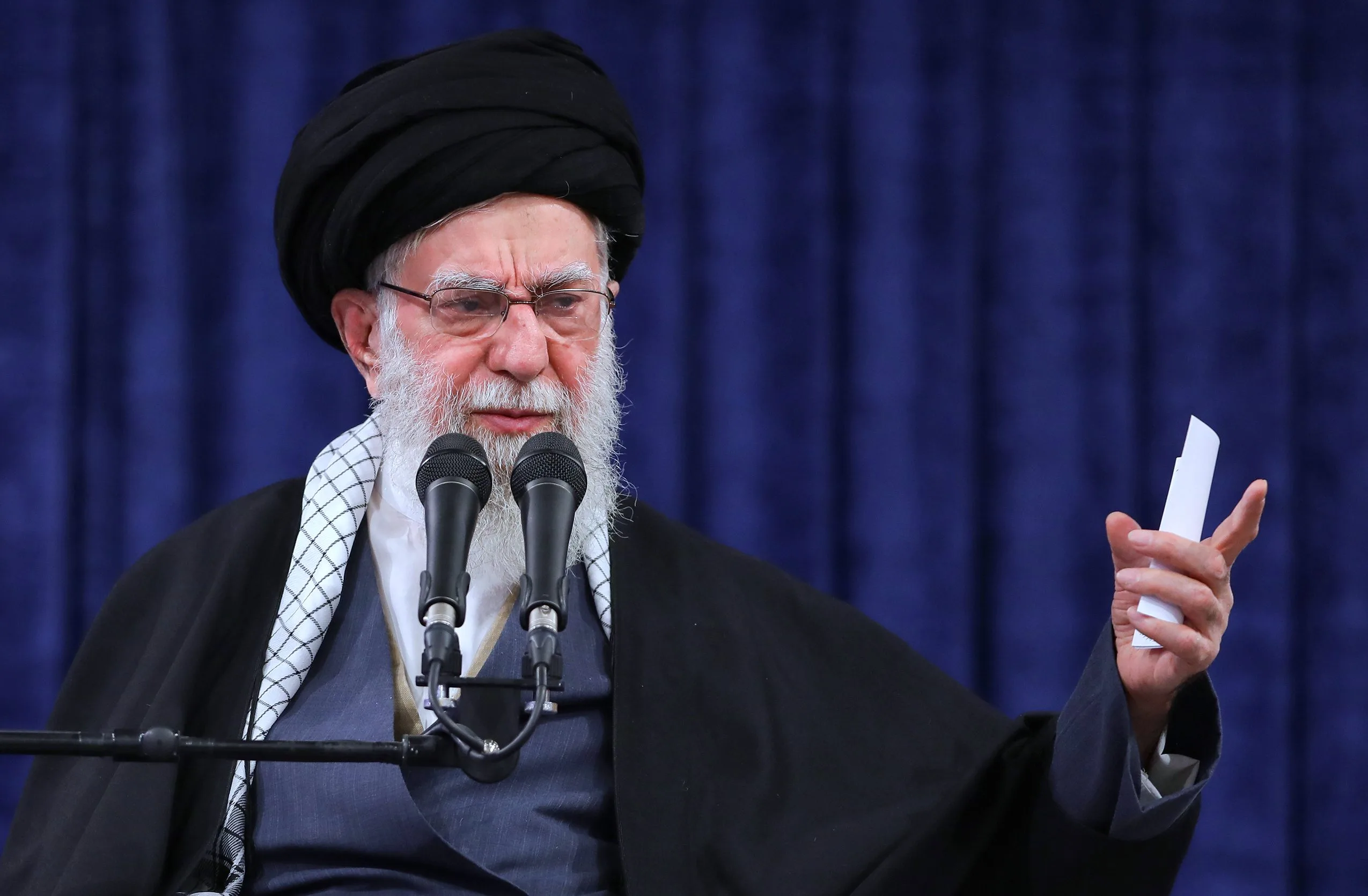
Ali Hosseini Khamenei (1939 – 28 February 2026) was an Iranian Shia cleric who held the office of Supreme Leader of the Islamic Republic of Iran from 1989 until his death, the second person to occupy the position after Ruhollah Khomeini. He had earlier served as Tehran's Friday prayer leader from 1980, as a member of the Islamic Consultative Assembly, and as the third president of Iran from 1981 to 1989. His tenure as Supreme Leader lasted some thirty-six years, and at the time of his death he was the longest-serving head of state in West Asia.
His career is bound up with a question of religious authority peculiar to the Shia tradition, and one that the encyclopaedia's readers may find the most illuminating way into his life. The office he inherited had been created around the doctrine that the most learned jurist of the age should govern the Islamic state. Khamenei was not, when he was chosen, a jurist of that rank, and the constitution had to be amended before he could hold the post. How that came about, and what it meant for the office afterwards, is the substance of what follows.
Birth and Family
Khamenei was born in 1939 at Mashhad, in north-eastern Iran. The city is among the principal centres of Shia devotion, built around the shrine of Ali al-Rida, the eighth of the Twelve Imams, and it drew pilgrims and students in large numbers.
His father, Sayyid Javad Khamenei, was a religious scholar of modest means; his mother was Khadijeh Mirdamadi. The title sayyid borne by the family indicates descent from the Prophet Muhammad (Peace Be Upon Him), a lineage that carries considerable standing in Shia society without implying wealth. Several of his brothers also entered religious scholarship.
He married Mansoureh Khojasteh Bagherzadeh in 1964. They had six children, among them Mostafa, Mojtaba and Masoud.
Religious Education
Khamenei began his studies in the seminaries, or hawza, of Mashhad, working through the traditional curriculum in Arabic grammar, logic and the religious sciences. He continued at Najaf in Iraq, then the pre-eminent centre of Shia learning, before settling at Qom in 1958.
Qom was in these years becoming the principal seminary city of Iran. Khamenei studied there under Husayn Burujardi, who until his death in 1961 was the most widely followed Shia authority of his generation, and he attended the classes of Ruhollah Khomeini, whose teaching combined jurisprudence with an argument about the social and political duties of religious scholars. His own scholarly interests lay in usul al-fiqh, the theory of legal reasoning, and in tafsir, Qur'anic exegesis.
In law he followed the Ja'fari school of the Twelver Shia, and in the theory of jurisprudence the Usuli position, which holds that the trained jurist may reason from the sources to derive rulings rather than relying on transmitted reports alone. This matters for what came later: the Usuli framework is what makes a graded hierarchy of juristic authority possible, and therefore what makes the rank of a scholar a question of consequence.
Under the Pahlavi Government
From the 1960s Khamenei was associated with clerical opposition to the government of Mohammad Reza Pahlavi. He was arrested six times and was subsequently exiled within Iran for three years.
The pattern was not unusual among the seminary-trained men of his generation who followed Khomeini. What distinguished them from the more numerous scholars who kept clear of politics was the conviction that religious learning carried a public obligation, and it was this group that supplied the clerical leadership of the Islamic Republic after 1979.
The Revolution and the Early Republic
After the revolution of 1979 Khamenei held a rapid succession of offices in the new state. In January 1980 Khomeini appointed him Friday prayer leader of Tehran, succeeding Hussein-Ali Montazeri in that pulpit; he retained the appointment for the rest of his life. He was elected to the Islamic Consultative Assembly for Tehran in May 1980, and he was associated with the Islamic Revolutionary Guard Corps from its early years. He belonged to the Islamic Republican Party until it was wound up in 1987.
In the period following the revolution he was the target of an attempted assassination that left his right arm paralysed.
The Presidency, 1981 to 1989
Khamenei became president of Iran in October 1981, following the death in office of Mohammad-Ali Rajai, and served two terms until August 1989. Under the constitution as it then stood, executive administration rested largely with the prime minister — Mir-Hossein Mousavi throughout Khamenei's presidency — while the president was head of state with narrower powers, and final authority lay with the Supreme Leader.
His presidency coincided almost exactly with the Iran–Iraq War, which ran from 1980 to 1988 and dominated the state's resources and attention for its whole duration. In February 1988 he became the first chairman of the Expediency Discernment Council, a body established to resolve deadlock between the legislature and the Guardian Council. He also sat in the Assembly of Experts, the clerical body charged with choosing the Supreme Leader, from 1983.
One episode from the end of this period is worth setting out, because it bears directly on the office Khamenei would shortly inherit and because it is documented in the scholarly literature rather than in political comment. In 1988, amid a dispute over the separation of powers within the state, Khomeini addressed a public letter to Khamenei as president. Muhammad Qasim Zaman's study of the modern ulama describes its substance: Khomeini held that Khamenei had taken "too restricted a view of the power of the government in relation to Islamic law", and set out the far broader position that the authority of an Islamic government is not bounded by the limits of the existing law, since the government exercises the deputyship of the Prophet and of the hidden imam and is therefore the body that defines the shari'a rather than merely applying it.
The exchange is instructive in two ways. It records a genuine difference of view between the founder of the Islamic Republic and its future leader, with Khamenei on the narrower side of the argument. And it marks the point at which the authority attaching to the office reached its widest formulation, a year before Khamenei came to occupy it.
The Doctrine of the Jurist's Authority
To understand the succession of 1989 the office itself has to be understood, and here the approved scholarly literature is precise.
The Islamic Republic was built on the doctrine of wilayat al-faqih, the authority of the pre-eminent jurist. Zaman traces its development to lectures Khomeini delivered at Najaf around 1970, nearly a decade before his return from exile. Shia scholars had generally held that the jurists were deputies of the hidden imam in matters of faith and practice but not in politics, which remained the imam's own preserve. Khomeini reinterpreted that boundary. Building on the institution of the marja al-taqlid — which had emerged in the nineteenth century and denoted the recognition of one or more top-ranking jurists as the focus of emulation for Shia Muslims — he argued that whoever occupied that position ought also to exercise the hidden imam's political authority, and so to establish and guide the Islamic state. The reasoning was that if an Islamic state is one governed according to the shari'a, then the person most learned in the shari'a is the person who should govern it.
Zaman is careful to record that this was not a settled consensus. The doctrine, he writes, "has continued to be opposed by many leading Shi'i scholars in and outside of Iran, during Khumayni's lifetime and after his death." What secured its place was not general agreement among jurists but Khomeini's own standing after the revolution.
The consequence for the succession was direct. If the office belonged by its own logic to the most learned jurist of the age, then the qualifications of any candidate were a matter of substance and not of form.
Succession to the Leadership, 1989
Khomeini died on 3 June 1989, and the Assembly of Experts met to choose his successor. Khamenei was elected on 4 June.
He was at that time a cleric of middle rank who did not hold the standing of a marja, which the constitution then required of the office-holder. The record of the deliberations is notable: Khamenei himself raised reservations about his religious qualifications and his suitability for the position. The constitution was thereafter amended to remove the requirement, and the Assembly reconfirmed him. The same round of constitutional revision abolished the office of prime minister and enlarged the powers of the presidency.
His religious title was subsequently raised, and he was generally addressed as ayatollah and later as grand ayatollah. Britannica notes a point of proportion that readers may find useful here: the honorific ayatollah was at the same period held by more than a hundred other Shia clerics, so the title marks institutional rank rather than a unique standing.
The Office of Supreme Leader
Khamenei held the office from June 1989 until February 2026. Seven presidents served during his tenure: Akbar Hashemi Rafsanjani, Mohammad Khatami, Mahmoud Ahmadinejad, Hassan Rouhani, Ebrahim Raisi, Mohammad Mokhber in an acting capacity, and Masoud Pezeshkian.
The Muslim 500, which recorded him in its top fifty in every edition from 2009 to 2026, describes his school of thought as traditional Twelver Shia and the source of his influence as political and administrative — a formulation that distinguishes his authority from the scholarly authority of the maraji, and reflects the settlement reached in 1989.
Among his acts as a jurist, the best known is a ruling that the production, stockpiling and use of nuclear weapons are forbidden in Islamic law. It is recorded as such in both the approved reference literature and the wider accounts of his tenure, and it is cited as the position of the office rather than a personal opinion.
Death
Khamenei was killed on 28 February 2026 at Tehran, in an airstrike on the compound housing the Office of the Supreme Leader, during the conflict between Iran and the United States and Israel known as the 2026 Iran war. He was eighty-six. Members of his family were killed with him. Iranian state broadcasting confirmed his death the following morning, and the government confirmed it on 1 March.
He was buried at the shrine of Imam Reza in Mashhad, the city of his birth and the shrine beside which he had grown up.
The Assembly of Experts met in the first week of March 2026 and named his son Mojtaba Khamenei as the third Supreme Leader of the Islamic Republic.
Historiographical Note
His date of birth. The approved and authorised sources do not agree. Britannica and the biographical record give 19 April 1939. The Muslim 500, across its editions, gives 16 July 1939. The year is not in dispute; the day and month are. This article therefore gives the year alone in its opening sentence and records both variants here rather than choosing between two sources of comparable standing.
The length of his tenure. His period in office ran from 4 June 1989 to 28 February 2026, which is thirty-six years and rather less than nine months. Sources describing it as a thirty-seven-year tenure are rounding upward. The figure of thirty-six years is used here.
The scope of this article. Khamenei held political office for forty-five years, and a very large body of writing exists on his government, on Iran's foreign relations and nuclear file, on contested elections, and on episodes of domestic unrest. Almost all of that literature is evaluative, and much of it is written from a declared political position on one side or another. Under the standards governing this encyclopaedia — which prohibit political advocacy and commentary, and prohibit hostile characterisation of any subject from any source — that material is not summarised here. What this article sets out is his life, his training, the offices he held with their dates, the juristic doctrine on which the office rested, and the circumstances of his death. Readers seeking an assessment of his rule should consult the specialist literature listed below, where they will find the range of views set out at length. The omission is deliberate and is recorded here so that it is not mistaken for an oversight.
References and Further Reading
Primary Islamic Sources
- The Qur'an — the text at the centre of the tafsir studies that were among his scholarly interests
- The Ja'fari school of law of the Twelver Shia, within which he was trained and issued rulings
- The doctrine of the marja al-taqlid, the recognition of a pre-eminent jurist as the focus of emulation, which the office he held presupposed
- Khomeini's Najaf lectures on wilayat al-faqih, delivered about 1970, the founding statement of the doctrine underlying the Islamic Republic
Classical Islamic Sources
- The Usuli tradition in Shia jurisprudence, which holds that the trained jurist may derive rulings by reasoning from the sources
- The classical Shia literature on the authority of the jurists during the absence of the hidden imam, the question Khomeini's doctrine reopened
- The science of usul al-fiqh, the theory of legal reasoning, one of his two principal fields of study
- The shrine tradition of Mashhad, centred on Ali al-Rida, the eighth Imam, in whose precinct he was born and later buried
Academic and Scholarly Sources
- The Ulama in Contemporary Islam: Custodians of Change by Muhammad Qasim Zaman — for the development of wilayat al-faqih, the institution of the marja al-taqlid, the scholarly opposition the doctrine met, and Khomeini's public letter of 1988 addressed to Khamenei as president
- The Muslim 500: The World's Most Influential Muslims, editions 2009 to 2026, Royal Islamic Strategic Studies Centre — for his offices, school of thought, and the structured biographical record maintained annually across seventeen editions
- Encyclopaedia Britannica, "Ali Khamenei", https://www.britannica.com/biography/Ali-Khamenei — an approved source, consulted for his dates, the sequence of his offices, and the standing of the honorific ayatollah
- Wikipedia, "Ali Khamenei", https://en.wikipedia.org/wiki/Ali_Khamenei — consulted with the owner's authorisation for the dates of the offices he held, his family and teachers, and the circumstances of his death
Further Reading
- Said Amir Arjomand, After Khomeini: Iran Under His Successors (Oxford University Press) — a scholarly study of the period of his leadership
- Wilfried Buchta, Who Rules Iran? The Structure of Power in the Islamic Republic — on the institutions of the state and the relations between them
- Ervand Abrahamian, A History of Modern Iran (Cambridge University Press) — for the wider national history
- Abul A'la Maududi — the Pakistani thinker whose conception of the Islamic state Zaman sets beside Khomeini's
- Iran and Persia — the wider history of the country he governed
Mentioned In
1 article references this topic
More from Modern Era
Aligarh Muslim University: From the Muhammadan Anglo-Oriental College to a Central University
Aligarh Muslim University grew out of the school founded by Syed Ahmad Khan in 1875, which became the Muhammadan Anglo-Oriental College in 1877 and a university by Act of the Indian legislature in 1920. It was the central institution of the Aligarh Movement.
Growth of Islamic Finance
Banking and financial services conducted according to Islamic law, which forbids interest and requires risk to be shared. From institutional beginnings in the 1960s the sector has grown into a multi-trillion-dollar industry serving Muslim and non-Muslim customers alike.
Hamdard Laboratories (India): From Unani Clinic to National Institution
Hamdard Laboratories (India) is a Unani pharmaceutical company and welfare institution founded in Old Delhi in 1906 by Hakeem Hafiz Abdul Majeed. Converted into a waqf in 1948 under his son Hakeem Abdul Hameed, it produces Rooh Afza and established Jamia Hamdard university in Delhi.
Islam in North America - Historical and Contemporary Overview
Islam has been present in North America for more than four centuries, beginning with enslaved West African Muslims. Some 3.45 million Muslims now live in the United States and 1.05 million in Canada, in communities formed by conversion and by immigration.