Baha' al-Din Naqshband: The Master of Silent Remembrance
Baha al-Din Naqshband of Bukhara (1318-1389 CE) gave his name to the Naqshbandi order, one of the most widespread in Islam. His insistence on silent remembrance and his rejection of music, retreat and distinctive dress set the order apart from every other Sufi path of his age.
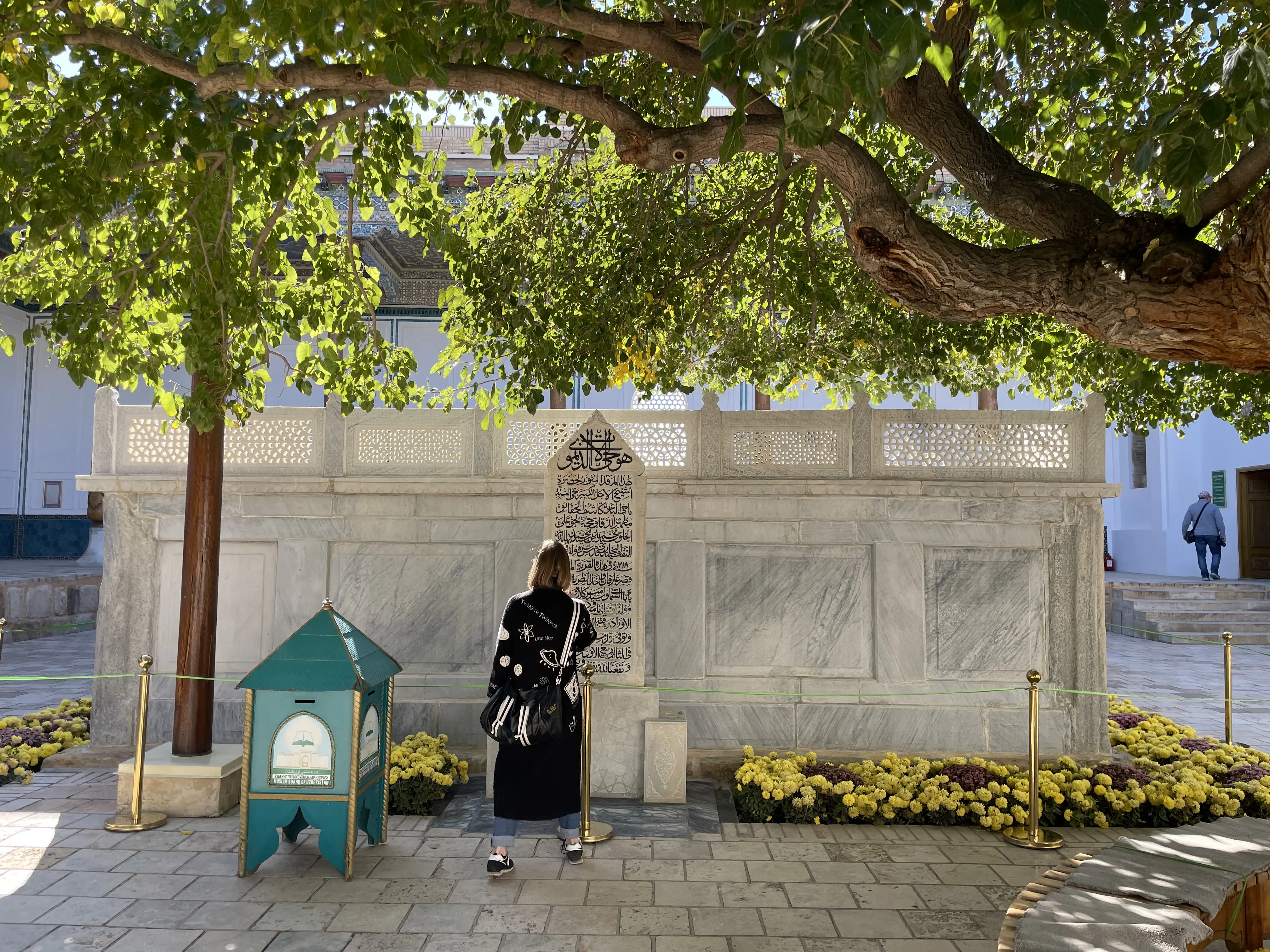
Khwaja Muhammad ibn Muhammad Bukhari, known as Baha' al-Din Naqshband (718–791 AH / 1318–1389 CE), was the Sufi master of Bukhara whose name was given to the Naqshbandiyya, one of the most vigorous and widely diffused of all Sufi orders. Within the order, and especially in Turkey, he is called Shah-i Naqshband. He became in effect the patron saint of his city, and Bukhara's long standing as a centre of learning and sanctity for the whole of Muslim Inner Asia owed a great deal to his presence there.
What distinguishes him from other founders of orders is the character of what he founded. He insisted on silent remembrance of God to the exclusion of the vocal kind, and he rejected almost everything else that Sufism of his period took for granted — music, the forty-day retreat, distinctive dress, residence in a hospice, the claiming of miracles, even the idea that belonging to a chain of transmission is meritorious in itself. The order that carries his name has been, for six centuries, the most law-centred and the least demonstrative of the great Sufi paths, and that character is traceable to him personally.
Bukhara and the Line of the Khwajagan
The order Baha' al-Din gave his name to did not begin with him, and its earlier history explains why his own position in it needs arguing for rather than assuming.
The line ran back through Bukhara and Khorasan to Khwaja Yusuf Hamadani, and from Hamadani to Baha' al-Din it was known not as the Naqshbandiyya but as the tariq-i khwajagan, the path of the masters, after the title khwaja borne by Hamadani and his successors. Hamid Algar, writing on Baha' al-Din in the Encyclopaedia Iranica, notes how durable that older name was: more than a century after Baha' al-Din's death, Abd al-Rahman Jami still called his own treatise on the principles of the path Sar-rishta-i Tariq-i Khwajagan.
In one sense the path's origins lie with Khwaja Abd al-Khaliq Ghujdawani, who died in 617 AH / 1220 CE and who formulated its main principles in eight terse Persian phrases known as the kalimat-i qudsiyya, the sacred words. He is often called the sar-halqa, the chief of the line of masters. Ghujdawani will return in this article in an unexpected capacity.
Birth and Adoption
Baha' al-Din was born in Muharram 718 AH / March 1318 CE in the hamlet of Qasr-i Hinduvan, one farsakh — some four miles — from Bukhara. The village would in time be renamed for him.
Three days after his birth he was adopted as spiritual progeny by Baba Muhammad Sammasi, a master to whom his paternal grandfather owed allegiance. Sammasi did not undertake the training himself: he assigned the child's future formation to Amir Kulal, his most prominent disciple. The arrangement is characteristic of how spiritual descent worked in this milieu — an infant could be claimed for a line before he could speak, on the strength of his grandfather's attachment to a shaikh.
Algar records a genealogical claim and the reason for setting it aside. Accounts attributing to Baha' al-Din descent from the Prophet through Imam Ja'far al-Sadiq are to be treated with reserve: the earliest sources make no mention of such ancestry, though they do indicate that Amir Kulal, his principal teacher, was a Husayni sayyid. Algar's suggestion is that the confusion is mechanical — Baha' al-Din's initiatic silsila does include Ja'far al-Sadiq, and it may simply have been mistaken for his genealogy. The distinction between a chain of spiritual transmission and a line of physical descent is one the tradition itself sometimes lost, and it is worth keeping.
The Years of Training
With Sammasi and Amir Kulal
The chronology of these years cannot be established, and Algar explains why in terms that apply to almost everything written about Baha' al-Din: the principal sources on his life are simple assemblages of anecdotes, unconnected by any narrative thread. There is no sequence to recover because the sources were never composed as sequence.
What they do preserve are episodes. Baha' al-Din may not have seen Sammasi again after his adoption until it was time for him to marry, when his grandfather sent him to the shaikh for the choice of bride to be ratified. From Amir Kulal, Jami's Nafahat al-Uns records that he received three things: the link of companionship, nisbat-i suhbat; instruction in the customs of the path, ta'lim-i adab-i tariqat; and the inculcation of dhikr, talqin-i dhikr. The list is precise and worth noting, because suhbat — simple company with the master — is the first item, and in the Naqshbandi tradition it would remain the principal instrument of training.
He spent many years with Amir Kulal. The Manaqib-i Amir Kulal records that he was frequently upbraided for complacency about his still imperfect state, and assigned menial work by way of correction — fetching the water for his master's ablutions among it. The Naqshbandi literature does not present its founder as a prodigy.
The vision at the graves
The turn in his formation came during his association with Amir Kulal, and it came in a vision rather than at a living master's hands.
Wandering among the graves of Bukhara, Baha' al-Din saw his predecessors in the silsila, from the recently deceased Sammasi back to Abd al-Khaliq Ghujdawani. Algar describes what followed as amounting to a second initiation, received from the spiritual being — ruhaniyyat — of Ghujdawani, who had been dead for around a century. This earned Baha' al-Din the additional epithet Uwaysi, after the remote but powerful link between the Prophet and his Yemeni contemporary Uways al-Qarani, who is held to have been attached to him without ever having met him.
The content of the instruction is as significant as its manner. Ghujdawani told him with great emphasis that he should adhere narrowly to the shari'a, avoiding rukhsat — dispensation, the taking of the easier permitted option — in favour of 'azimat, rigorous obedience. This is the axis on which the whole Naqshbandi tradition would turn: not a mysticism set alongside the law, but a mysticism that took the harder reading of the law as its discipline.
The break over silent dhikr
The chief practical consequence was immediate and divisive. Baha' al-Din began restricting himself to silent dhikr — dhikr-i khafi or khufya — and withdrew from Amir Kulal's circle whenever the dervishes began the vocal kind, dhikr-i jali or jahri.
This caused resentment among his fellow disciples, which is not surprising: a junior who leaves the room when the others begin the central exercise of the house is making a judgement about them. Baha' al-Din continued to treat Amir Kulal himself with the utmost reverence, and the master's favour towards him increased rather than cooled. At the building of a mosque in Amir Kulal's native village of Sukhari, Safi's Rashahat 'Ayn al-Hayat records that the master rebuked his disciples for their hostility to Baha' al-Din and praised him as one whom God Himself had favoured above the rest.
The episode matters because it is the moment at which the order's identity was fixed. Silent dhikr had been practised only sporadically by earlier links in the chain; Algar's judgement is that it was Baha' al-Din's insistence on it that was crucial for the identity of the line descended from him, and for the unique permanence of his imprint upon it.
The Yasawi masters and the years with Khalil Ata
His subsequent attachments took him outside the line of Sammasi and Amir Kulal. He kept company with Mawlana Arif Dikgarani, another of Amir Kulal's disciples, in whose company he sought out other practitioners of silent dhikr. He then spent time with two Turkish masters, both of the Yasawi order — which shared with his own line a spiritual descent from Yusuf Hamadani. The first association, with Qutham Shaikh, was brief; the second, with Khalil Ata, lasted as much as twelve years.
Those twelve years contain the single most surprising notice in the record, and it is reported here as Algar reports it. Khalil Ata appears to be identical with a certain Qazan Khan, who ruled the Chaghatay Khanate from 735 to 748 AH / 1335 to 1347 CE — that is, a reigning sovereign of Transoxiana. According to the Manaqib-i Amir Kulal, Baha' al-Din acted as executioner for this ruler until he was overthrown in a military rebellion.
The interpretation of this is contested and Algar declines the obvious one. Zeki Velidi Togan proposed seeing in the association an early instance of the Naqshbandi disposition to influence rulers in the direction of implementing the shari'a — a disposition the order certainly displayed later. Algar's response is that nothing in the available evidence permits that conclusion, and that the period with Qazan looks rather like a hiatus in Baha' al-Din's spiritual career than a stage within it. The article follows Algar. What the episode does establish is that the record of this life, thin as it is, has not been tidied: the tradition transmitted a report of its founder holding an office that no hagiography would have invented for him.
Master at Qasr-i Arifan
With his long and varied apprenticeship complete, Baha' al-Din returned to his birthplace and began training disciples of his own there.
The most striking fact about the remaining decades is how little he moved. Algar records that he left the region of Bukhara only three times. Two of the journeys were to perform the hajj; on the second he stayed three days at Herat to visit Shaikh Zayn al-Din Abu Bakr Tayyabadi, who died in 791 AH / 1389 CE, the same year as Baha' al-Din himself. The third journey was again to Herat, at the invitation of its ruler Mu'izz al-Din Husayn, to whom he explained the principles of his path — behaving, in Jami's account, with exemplary ascetic detachment.
He died on 3 Rabi' I 791 AH / 2 March 1389 CE, at Qasr-i Hinduvan. The village was renamed Qasr-i Arifan, the castle of the knowers of God, out of deference to him; at a later date that cannot be fixed it took its present name, Bavaddin, which is Baha' al-Din in the colloquial pronunciation of the Bukharans. A vast complex of buildings grew up around his tomb as the order expanded and his posthumous reputation grew with it.
The Shape of His Path
Baha' al-Din's teaching is best described by what it excluded, because the exclusions were deliberate, systematic, and unusual.
Silent remembrance, and what it displaced
His exclusive observance of silent dhikr carried with it a repudiation of two of the standard instruments of Sufi practice. Jami's Nafahat records that he rejected both sama — the listening to music and sung poetry — and khalwa, the retreat, as means of spiritual progress.
The first of these is the sharpest possible contrast with the order that was becoming dominant in the Indian subcontinent in the same century. For the Chishtis under Nizamuddin Auliya, sama was the characteristic practice, defended before the sultan's assembled jurists and regulated in detail; for Baha' al-Din it was not a means of progress at all. The contrast survived into modern times: Barbara Metcalf's study of the Deoband movement, written from the approved source library used by this encyclopaedia, treats the opposition of vocal and silent remembrance as one of the practical marks distinguishing the two orders in nineteenth-century India, and Rizvi's history of the Dar al-Ulum, describing the same landscape from inside the tradition, records the Chishtiyya and the Naqshbandiyya as the two most current orders there and draws precisely this contrast between their manner.
The rejection of the appurtenances
The list of things Baha' al-Din set aside goes considerably further, and Algar assembles it. He denied that adherence to a silsila is in itself meritorious — a remarkable position for a man who became the eponym of one. He deprecated karamat, the charismatic feats by which saints were commonly recognised. He refused any distinctive form of dress for himself or his followers. And he disliked the practice of residing in a khanaqah, the endowed hospice that was the ordinary institutional home of a Sufi group.
Taken together this amounts to a rejection of most of the customary apparatus of the Sufism of his day. Algar's reading is that the pattern is highly reminiscent of the Malamati movement of fourth-century-AH Nishapur, whose adherents deliberately avoided the outward marks of piety. Khwaja Muhammad Parsa, Baha' al-Din's own leading disciple, made the connection explicitly, writing that whatever holds true of the Malamatis holds true of the khwajagan also. Baha' al-Din is therefore best understood as an heir not only of the masters named in his chain but, more diffusely, of that older impulse to strip away everything by which spiritual attainment could be displayed.
The name
The sobriquet Naqshband is not explained by the order's earliest texts, and neither is how he came to bear it. The interpretation that later became quasi-unanimous — recorded, for example, in Abd al-Majid Khani's al-Hadaiq al-Wardiyya — takes it from naqsh, an imprint or engraving: the imprint of the divine name Allah fixed in the heart by constant silent invocation. The reading fits his practice exactly, which is a reason for finding it attractive and also a reason for suspecting that it was arrived at from the practice rather than from any memory of how the name was given.
In Bukhara itself he had another title. Jami records that he was often called Khwaja Bala-Gardan, the averter of disaster, with reference to protective powers conferred on him by Baba Muhammad Sammasi — the master who had adopted him three days after his birth.
Writings and Sayings
Almost nothing survives from his own hand. A number of poems and treatises have been attributed to him, and Algar's judgement is that they are almost certainly not his. The one possible exception is the litany that bears his name, the Awrad-i Baha'iyya, which may indeed be his composition — though there is no reference to it in the early Naqshbandi texts, and its recitation has never been a pillar of regular Naqshbandi practice.
His verbal legacy is therefore a legacy of reported sayings. These are preserved anecdotally in the hagiographies — Safi's Rashahat 'Ayn al-Hayat, Jami's Nafahat al-Uns, and Salah al-Din Bukhari's Anis al-Talibin — and more fully and systematically, with commentary and elucidation, by Khwaja Muhammad Parsa in the Risala-i Qudsiyya. That last work is the nearest thing the order has to a doctrinal statement from its founder, and it comes to us through a disciple's arrangement and explanation rather than in the master's own words.
Succession and the Order's Rise
The succession did not follow the expected course, and the sources disagree about it.
Muhammad Parsa, who died in 822 AH / 1420 CE, was a leading scholar of Bukhara and one of Baha' al-Din's principal successors; it appears that he was designated the main khalifa during one of the pilgrimages to Mecca, and Safi's Rashahat records accounts in which Baha' al-Din confirmed the nomination on his deathbed. In the event it was Khwaja Ala al-Din Attar Bukhari — already favoured by his master through marriage to his daughter — who emerged as the principal successor.
More consequential than either, for the survival of the line, was a third khalifa: Mawlana Ya'qub Charkhi, who died in 851 AH / 1448 CE. It was Charkhi who initiated Khwaja Ubaydallah Ahrar, and under Ahrar the Naqshbandiyya became supreme among the Sufi orders of Central Asia and began the expansion that carried it across the Muslim world.
Algar raises a question that the order's own literature tends to leave alone: why Baha' al-Din, rather than a figure before or after him, should be regarded as the central link in the chain. Ghujdawani formulated the principles; Ahrar built the institution; the name khwajagan outlasted Baha' al-Din by more than a century. Two answers emerge from the evidence. The first is the Uwaysi initiation: Baha' al-Din's vision at the graves places him in direct receipt of authority from Ghujdawani, which confirms his pre-eminence in the very terms the tradition uses. The second is the practice: silent dhikr, taken up exclusively by him and only sporadically by his predecessors, became the identifying mark of everything downstream of him.
The later "renewers" of the order were understood in these terms too. Shaikh Ahmad Sirhindi, who died in 1034 AH / 1624 CE, and Mawlana Khalid Baghdadi, who died in 1242 AH / 1827 CE, were each seen as originating a branch of the Naqshbandiyya — the Mujaddidi and the Khalidi — rather than as founding a new and autonomous order. Metcalf's study records the Mujaddidi branch in exactly those terms, as the Naqshbandi line taking its initiation from Sirhindi, who was called the renewer of the second millennium.
Reach
The order's early social character was narrower than its later spread suggests. Baha' al-Din's companions were overwhelmingly Tajik-speaking town dwellers, and the masters of the Yasawi order were known by contrast as the Turkish shaikhs, mashayikh-i Turk. On this basis the original Naqshbandiyya has sometimes been described as specifically Iranian, or Khorasanian, in orientation.
Algar qualifies the description in both directions. There was a Yasawi, and therefore Turkish, contribution to Baha' al-Din's own formation — the twelve years with Khalil Ata belong to it. And within three generations of his death the order began spreading among the Turkish peoples of Central Asia, which demonstrated an appeal not confined to the milieu in which it arose. From Central Asia it reached the Ottoman lands, the Caucasus, China, and the Indian subcontinent, where it became one of the four orders that shaped Muslim religious life.
Its Indian history belongs to other articles, but its character there followed from its founder. It arrived with an emphasis on the shari'a and on silent remembrance; it produced, in Sirhindi, the critic whose objections to the doctrine of the unity of being defined a whole branch; and it supplied, through the family of Shah Waliullah, much of the intellectual descent claimed by the reformist movements of the nineteenth century, including Deoband. The Naqshbandi combination of law and path, rather than law against path, is the direct inheritance of Ghujdawani's instruction to Baha' al-Din at the graves of Bukhara: 'azimat, not rukhsat.
Historiographical Note
The sources for Baha' al-Din's life are of one kind, and the kind has a specific weakness.
They are hagiographies, and Algar's characterisation of them is the essential point for a reader: they are simple assemblages of anecdotes unconnected by narrative thread. The principal ones are Jami's Nafahat al-Uns, completed in 1476, some eighty-seven years after Baha' al-Din's death; Fakhr al-Din Ali Safi's Rashahat 'Ayn al-Hayat; Salah al-Din Bukhari's Anis al-Talibin; and the Manaqib-i Amir Kulal, which survives in manuscript. Muhammad Parsa's Risala-i Qudsiyya is different in kind, being an ordered presentation of the master's sayings with commentary, but it too comes from a disciple rather than from Baha' al-Din.
The consequence is that his life has episodes but no chronology. It is not possible to say in what order he was with Sammasi, with Amir Kulal, with Arif Dikgarani, with Qutham Shaikh and with Khalil Ata, or for how long, beyond the figures the anecdotes happen to supply. The article above accordingly presents the associations thematically where the sequence is unavailable, and says where that is the case.
Three specific matters are handled as contested rather than settled. The claimed descent from the Prophet through Ja'far al-Sadiq is set aside, on the ground that the earliest sources do not carry it and that the silsila which does include Ja'far al-Sadiq offers an obvious source of confusion. The succession is reported as disputed between Muhammad Parsa, named in some accounts and possibly confirmed on the deathbed, and Ala al-Din Attar, who in the event succeeded. And the identification of Khalil Ata with Qazan Khan, together with the report that Baha' al-Din served him as executioner, is given with Algar's caution that the evidence does not support reading it as an early exercise of Naqshbandi influence over rulers.
One hypothesis in the modern literature is rejected outright rather than reported as an option. The suggestion that the origins of the Naqshbandiyya owe something to Mahayana Buddhist influence — advanced in Aziz Ahmad's intellectual history of Islam in India — must, Algar states, be discounted for lack of evidence. It is mentioned here only because a reader may meet it elsewhere.
On sourcing: the project's approved library carries the Naqshbandi order but not its founder. A search of the extracted texts returned Metcalf's glossary definition — that the Naqshbandi path is that of those initiated into the chain of succession of Baha' al-Din Naqshband, who died in 1389, with the Mujaddidi branch taking its initiation from Sirhindi — together with Metcalf's treatment of the vocal-and-silent contrast and of Naqshbandi reformism, and Rizvi's account of the order's standing in India from within the tradition. That is a death date and a definition, and no more. The approved website historyofislam.com treats the Chishtiyya at length but not the Naqshbandi founding. The whole biographical and doctrinal account above therefore rests on Hamid Algar's article on Baha' al-Din Naqshband in the Encyclopaedia Iranica, a peer-reviewed scholarly reference work with full citation of the primary hagiographies, consulted as an external source under the owner's standing instruction that external material may be used where the approved base is insufficient, and recorded here so that the reliance remains auditable and can be re-checked.
Conclusion
Baha' al-Din Naqshband spent almost the whole of a long life within a few miles of Bukhara, left no writings that can be securely attributed to him, refused a distinctive dress, disliked living in a hospice, denied that belonging to a chain of masters was itself worth anything, and discouraged the miracles by which holiness was ordinarily recognised. He nevertheless gave his name to one of the two or three most widespread Sufi orders in the history of Islam.
The explanation lies in the one thing he did insist on. Silent remembrance was not merely a preference about how to pray; it entailed a whole disposition — towards the strict rather than the permitted reading of the law, towards company with a master rather than spectacle, towards the ordinary rather than the marked life. That disposition made the Naqshbandiyya unusually portable, because it needed neither buildings nor music nor costume, and unusually acceptable to scholars, because it made the shari'a its discipline rather than its boundary. Six centuries later the order was still recognisable by exactly the features he chose, and still being distinguished from the Chishtis of India by exactly the practice he adopted as a junior disciple when he walked out of Amir Kulal's circle.
References and Further Reading
Primary Islamic Sources
- Qur'an 10:62 — the phrase awliya Allah, the friends of God, the scriptural root of the Sufi vocabulary of sainthood used throughout this tradition.
- Khwaja Muhammad Parsa. Risala-i Qudsiyya — the ordered presentation of Baha' al-Din's sayings with commentary and elucidation, compiled by his leading disciple; the nearest thing to a doctrinal statement from the founder.
- Awrad-i Baha'iyya — the litany bearing his name, and the one composition that may genuinely be his, though it is unmentioned in the early Naqshbandi texts.
- Ghujdawani, Khwaja Abd al-Khaliq. Kalimat-i Qudsiyya — the eight Persian phrases in which the principles of the path of the khwajagan were formulated, a century before Baha' al-Din.
- Suhrawardi, Abu Hafs Umar. Awarif al-Ma'arif — the standard Sufi manual of the period, against whose assumptions about sama and retreat Baha' al-Din's positions are best measured.
Classical Islamic Sources
- Jami, Abd al-Rahman. Nafahat al-Uns, completed 881 AH / 1476 CE — the principal hagiographical source, and the authority for the epithet Khwaja Bala-Gardan, for the three things received from Amir Kulal, for the journeys to Herat, and for the rejection of sama and khalwa.
- Safi, Fakhr al-Din Ali. Rashahat 'Ayn al-Hayat — the source for Amir Kulal's sayyid descent, for the break over silent dhikr and the rebuke at Sukhari, and for the deathbed confirmation of Muhammad Parsa.
- Bukhari, Salah al-Din. Anis al-Talibin — a further early collection of Baha' al-Din's sayings.
- Manaqib-i Amir Kulal — the hagiography of his principal teacher, surviving in manuscript; the source for the menial tasks assigned to him and for the report of his service to Khalil Ata.
- Jami, Abd al-Rahman. Sar-rishta-i Tariq-i Khwajagan — the treatise on the path's principles that still used the older name of the line a century after Baha' al-Din's death.
Academic and Scholarly Sources
- Algar, Hamid. "Bahāʾ-al-Dīn Naqšband." Encyclopaedia Iranica. [external source, used under the owner's standing instruction that external sources may be consulted where the approved base is insufficient; recorded per §4A.6] — the source for the whole biographical and doctrinal account above, including the birth date and place, the adoption by Sammasi, the Uwaysi initiation from Ghujdawani, the break over silent dhikr, the identification of Khalil Ata with Qazan Khan and the caution against over-reading it, the three journeys, the death date, the disputed succession, the Malamati parallel, and the rejection of the Buddhist-influence hypothesis.
- Metcalf, Barbara Daly. Islamic Revival in British India: Deoband, 1860–1900. [approved PDF library:
sources/study/] — for the definition of the Naqshbandi path by reference to Baha' al-Din's chain of succession and his death date, for the Mujaddidi branch and Sirhindi, and for the contrast of vocal and silent remembrance in nineteenth-century India. - Rizvi, Sayyid Mahboob. History of the Dar al-Ulum Deoband, Volume 1. [approved PDF library:
sources/study/] — for the standing of the Naqshbandiyya beside the Chishtiyya in India, and the contrast in their manner, described from inside the tradition. - Ahmed, Nazeer. "The Sufis of India and Pakistan." historyofislam.com. https://historyofislam.com/contents/the-post-mongol-period/the-sufis-of-india-and-pakistan/ [approved external web source, §4A.1a] — consulted for the Sufi orders of the subcontinent; it does not treat the Naqshbandi founding, and nothing in this article rests on it.
Further Reading
- Algar, Hamid. Studies on the Naqshbandi order and its expansion — the standard modern treatment.
- Paul, Jürgen. Work on the early Naqshbandiyya and the khwajagan of Central Asia.
- Friedmann, Yohanan. Shaikh Ahmad Sirhindi. Montreal, 1971 — for the Mujaddidi branch and the critique of the unity of being.
- Trimingham, J. Spencer. The Sufi Orders in Islam — for the orders' comparative history.
- The Sufi Orders in South Asian Islam — the Naqshbandiyya as an institution in eighteenth- and nineteenth-century India, including Sirhindi and the family of Shah Waliullah.
- Nizamuddin Auliya — the Chishti master whose practice of sama stands at the opposite pole from Baha' al-Din's silent remembrance.
- Mu'in al-Din Chishti — the founder of the order with which the Naqshbandiyya was most often paired, and contrasted, in India.
Mentioned In
2 articles reference this topic
More from Medieval Islamic World
Ghaznavid Empire - The Turkish-Persian Synthesis
The Ghaznavid Empire (977-1186 CE) was a powerful Turkish-Persian dynasty ruling Afghanistan, Iran, Pakistan, and parts of India. Founded by Sebük-Tegin and reaching its zenith under Mahmud of Ghazni, it became renowned for military prowess, cultural patronage, and spreading Islam to India.
Islam in Southeast Asia
Islam reached Southeast Asia through Indian Ocean trade from the thirteenth century, spreading via Muslim merchants, Sufi teachers, and converting rulers. Today the region holds the world's largest Muslim population, with Indonesia home to more Muslims than any Arab country.
Samanid Dynasty - The Persian Renaissance in Central Asia
The Samanid Dynasty (819-999 CE) ruled a vast empire in Central Asia and Khorasan, presiding over a remarkable cultural renaissance. This Persian dynasty preserved Persian language and culture, patronized scholars and poets, and established foundations for the Islamic Golden Age.
Ayyubid Dynasty - Saladin's Legacy and the Unification of the Muslim East
The Ayyubid Dynasty (1171-1260 CE) was founded by Saladin and ruled Egypt, Syria, and Yemen. The Ayyubids recaptured Jerusalem from the Crusaders, promoted Sunni Islam, and created a sophisticated state combining military power with cultural patronage.