Koprulu Mehmed Pasha: The Grand Vizier Who Restored Ottoman Authority
Koprulu Mehmed Pasha (c. 1575-1661) became Ottoman grand vizier in 1656 on the condition of unrestricted authority. He broke the factions of the capital by mass execution, cleared the Venetian blockade of the Dardanelles, and founded a family that supplied five grand viziers.
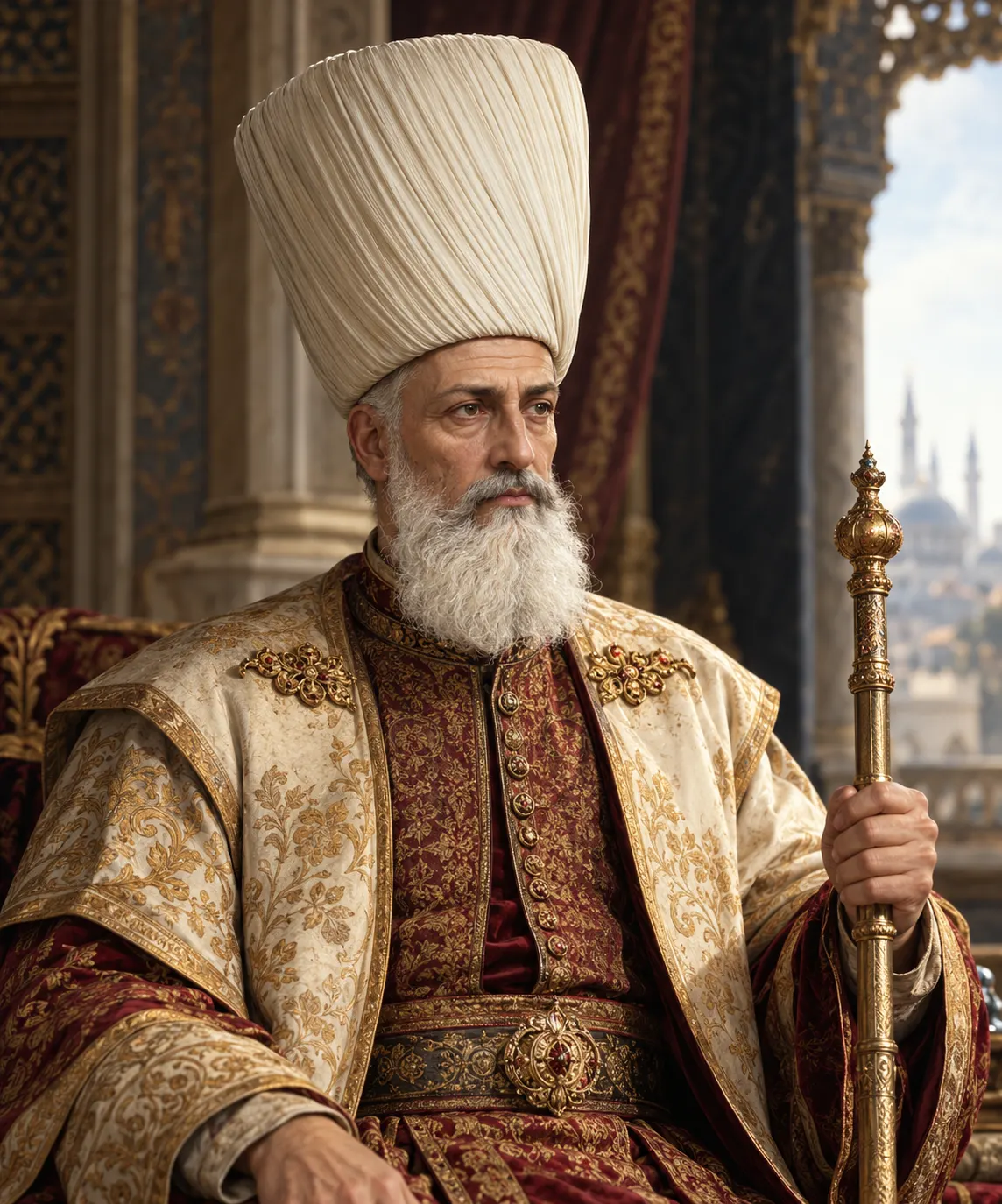
Köprülü Mehmed Pasha was grand vizier of the Ottoman Empire from September 1656 until his death in October 1661. He took office at about eighty years of age, at the lowest point of the empire's seventeenth-century fortunes, and in five years he restored the central government's authority over the army and the capital, broke the Venetian blockade that was threatening Istanbul's food supply, and re-established Ottoman control in Transylvania.
He did it by killing a great many people. The executions of his vizierate were on a scale that Ottoman writers, accustomed to the routine use of capital punishment, recorded with a mixture of approval and horror, and they remain the defining feature of his reputation. He also founded a political dynasty: his son Köprülü Fazıl Ahmed Pasha succeeded him and served fifteen years, and the family supplied five grand viziers and numerous other officeholders over roughly half a century. The period from 1656 is conventionally called the Köprülü era, and it is the last sustained recovery of Ottoman power before the long retreat.
The reign in which he served, that of Mehmed IV, illustrates the arrangement that made him possible: an Ottoman sultan who delegated executive government almost completely, and a grand vizier who was given, in exchange, an authority no Ottoman minister had previously held.
Origins and the Long Climb
Mehmed was born at Roshnik, a village near Berat in what is now Albania, around 1575; some accounts place his birth later, and the date is not securely established.
He was of Albanian Christian family and entered Ottoman service through the devşirme, the levy by which boys were recruited from Christian subject populations, converted to Islam, and trained for military or administrative careers. The system, described in the article on the Ottoman Empire, was the principal channel by which the empire recruited its governing élite, and it is worth noting what it meant in practice: the man who restored the authority of the Ottoman state was a Balkan villager's son with no family connections in Turkish society, whose entire position derived from the household of the sultan.
His early career in the imperial household was undistinguished and long. The accounts place him in service in the palace kitchens and then in the cavalry establishment, and he spent decades in middle-ranking positions. His advancement came through the patronage of Kemankeş Kara Mustafa Pasha, the grand vizier of the late 1630s and early 1640s, and it followed the usual Ottoman pattern in which a rising minister brought forward his own clients.
The provincial appointments that followed gave him the administrative and military experience that mattered later: governor-general of Trebizond in 1644, of Eğri in 1647, of Karaman in 1648, and of Anatolia in 1650. He also settled at the Anatolian town of Köprü, married into a local family there, and took from it the name by which his descendants were known.
His patron's fall — Kemankeş Kara Mustafa Pasha was executed in 1644 — cost him position, and his career thereafter was interrupted by dismissals and periods of exile, which was normal in a system where an official's fortunes tracked those of his protector. By the mid-1650s he was an experienced provincial governor in his late seventies with a reputation for competence and severity, and no obvious prospect of higher office.
The Devshirme and the Making of an Ottoman Official
Köprülü Mehmed Pasha's route to power was the standard one for the Ottoman governing class, and it is worth describing because it explains both his capacities and his complete dependence on the dynasty.
The devşirme was a periodic levy of boys from the Christian rural populations of the Balkans and Anatolia. Those taken were converted to Islam, separated from their families, and trained: the majority for military service in the Janissary corps, a selected minority for the palace schools, where they received an education in Ottoman Turkish, Arabic and Persian, in religious and legal knowledge, in horsemanship and arms, and in the elaborate etiquette of the imperial household. Graduates entered palace service and progressed through household offices toward provincial governorships and, at the summit, the vizierate.
Three features of the system bear on his career.
It produced administrators of high competence, formed by long apprenticeship in the machinery of the state, and the Ottoman Empire's governing class in the fifteenth to seventeenth centuries was probably the most professionally trained in Europe. It also produced men with no families, no lands, no tribal connections and no standing independent of the sultan — the same principle that had governed Andalusi and Mamluk recruitment, and for the same reason. And because promotion depended on patronage, careers rose and fell with patrons: Köprülü Mehmed's advancement came through Kemankeş Kara Mustafa Pasha, and his patron's execution in 1644 cost him position and brought a period of dismissals and exile.
By the standards of that system his rise was slow and unremarkable. He spent decades in middle-ranking household and cavalry positions before the provincial governorships of the 1640s gave him command experience — Trebizond in 1644, Eğri in 1647, Karaman in 1648, Anatolia in 1650. He was, by the mid-1650s, an experienced but not eminent provincial governor in his late seventies with a reputation for hardness.
Two observations follow. The obscurity of the career explains why the appointment of 1656 could be made on the terms it was: he had no faction of his own to alarm the palace, and no obvious prospect of anything better, which made him willing to demand everything and to accept the risk. And a man who had watched the Ottoman state deteriorate for fifty years from inside its administration had an unusually concrete understanding of what was wrong with it.
The Crisis of 1656
The situation that brought him to power was desperate, and the details matter because they define what he was appointed to fix.
Mehmed IV had come to the throne in 1648 aged six, after his father Ibrahim was deposed and killed. Government was exercised by the women of the imperial household — first his grandmother Kösem Sultan, then, after her killing in 1651, his mother Turhan Sultan — in combination with grand viziers who rarely lasted a year. Leslie Peirce's study of the imperial household examines how this authority worked and why it was more fragile than it appeared.
The empire's problems in 1656 were simultaneous. The war with Venice over Crete, begun in 1645, had stalled; the Venetian fleet controlled much of the Aegean and had defeated the Ottoman navy at the Dardanelles, blockading the straits. That blockade was not a distant naval matter: Istanbul depended on seaborne grain, and interrupting it threatened the capital with shortage. The treasury was empty and the coinage debased, so the troops were paid late and in bad money. And the soldiers of the capital had become the effective government, deposing officials at will.
In March 1656 they rose, presented a list of court officials whose lives they demanded, and had them executed; the bodies were displayed hanging from a plane tree in the square by the Sultanahmet mosque. The episode, known in Ottoman historiography as the Incident of the Plane Tree, established that neither the sultan nor the imperial household could protect its own servants.
In September 1656 Turhan Sultan appointed Köprülü Mehmed Pasha grand vizier. The sources report consistently that he accepted on conditions: that he should have unrestricted authority over appointments, dismissals and policy, and that the palace would not interfere or countermand him. Whether the terms were as formal as the accounts suggest is uncertain, but the substance was honoured, and it is the most important fact about the vizierate. For the first time an Ottoman grand vizier held the sultan's executive power without the sultan's household competing for it.
Government by Execution
What followed was a systematic destruction of every organised interest capable of resisting the central government.
The instrument was capital punishment applied on a scale without Ottoman precedent. The leaders and organisers of the Janissary and cavalry factions were identified and killed; officers, officials, tax farmers and provincial figures associated with them followed; and the purge extended into the fleet command, the religious hierarchy and the provincial administration. Ottoman sources give figures in the thousands. The numbers cannot be verified and were probably inflated in the telling, but the character of the policy is not in doubt: opposition was met with death, consistently, over five years, and it stopped.
Two specific cases indicate the reach. A rebellion by the governor Abaza Hasan Pasha, which drew together provincial forces resentful of the new regime, was suppressed in 1658–59 and its leaders killed. And in 1657 the Greek Orthodox Patriarch of Constantinople, Parthenius III, was executed on a charge of treasonable correspondence with foreign powers. The Ottoman state's normal practice was to work through the established hierarchies of its non-Muslim communities, and the killing of a patriarch was an exceptional act that the sources present as a response to a security matter.
Alongside the terror ran fiscal repair, and the two were connected. The payroll of the paid corps was purged of men who did not serve, which cut expenditure. Revenue collection was tightened and defaulting officials punished. The property of the executed was confiscated to the treasury, which was both a fiscal measure and an incentive. The coinage was stabilised. Within a few years the state was solvent enough to pay and supply an army and a fleet, which was the precondition of everything else.
It should be said plainly that this was a policy of terror carried out against the empire's own soldiers, officials and subjects, and that the Ottoman historians who approved of its results did not pretend otherwise. The defence offered at the time and since is that the alternative was the continuing disintegration of the state, and that no lesser measure had worked in thirty years.
The Fiscal and Military Repair
The terror is what the sources dwell on; the reconstruction of the state's finances and forces is what made the recovery last, and it deserves separate treatment.
The fiscal crisis of the 1650s had a specific mechanism. The paid corps of the capital had grown far beyond what the treasury could support, partly through genuine military need and partly because places on the payroll had become a form of property, held by men who did not serve and traded or inherited. Revenue had not kept pace: land assignments that had once supported provincial cavalry had been diverted into tax farms and private hands, and collection was leaking at every stage. The government met the shortfall by debasing the silver coinage, which raised prices, cut the real value of the troops' pay, and produced the mutinies that extorted further payments — the sequence behind the mutiny of 1656 and the hanging of officials from the plane tree.
Köprülü Mehmed attacked all three points at once, and the executions were part of the method rather than a separate policy.
The payroll registers were audited and purged of men who did not serve, which cut expenditure sharply and was bitterly resented — one of the grievances behind the Anatolian revolt. Revenue collection was tightened, with officials held personally responsible for shortfalls and punished for embezzlement; tax farms were reviewed and reassigned. The property of the executed was confiscated to the treasury, which was simultaneously a fiscal measure, a deterrent and an incentive for the government to keep finding offenders. And the coinage was stabilised, which was possible only once expenditure and revenue had been brought closer together.
The military reconstruction followed from the fiscal one. A solvent treasury could pay and provision a fleet and an army, which is why the naval recovery of 1657 was possible after a decade of failure. The fleet was rebuilt and its command purged; the Janissary and cavalry corps were disciplined and their officers replaced; and the campaign machinery — the accumulation of supplies along a march route, the repair of roads and bridges, the assembly of siege trains — was made to function again.
None of this addressed the underlying structural problems. The provincial cavalry system continued to decay, the paid corps remained politicised and hereditary in practice, and the revenue base was not reformed but merely collected more ruthlessly. What Köprülü Mehmed achieved was to force the existing system to work by removing the people who were obstructing it, which produced a genuine and rapid recovery and left the same weaknesses in place for the next crisis. Rifaat Abou-El-Haj's analysis of Ottoman state formation reads the whole Köprülü period in these terms: an administrative élite consolidating its control over the machinery of government, rather than a reform of the machinery itself.
The Anatolian Revolt
The most serious challenge to the new regime came not from the capital but from the provinces, and its suppression shows both the reach and the character of Köprülü Mehmed's government.
The purges in Istanbul had a predictable effect on provincial officeholders: men who had built careers under the old factional arrangements, and who held governorships with troops attached, understood that their turn was coming. In 1658 a coalition formed around Abaza Hasan Pasha, governor of Aleppo, drawing together provincial governors, unemployed cavalry, and irregular troops whose pay had been cut in the payroll purges. Their stated grievance was the grand vizier himself rather than the sultan, and they demanded his dismissal.
This was a formidable combination. Provincial revolts of this kind had troubled the empire since the beginning of the century, and this one commanded substantial forces in Anatolia and the Syrian provinces — the regions from which the imperial army drew much of its manpower. For a period in 1658 and 1659 the rebels held large parts of Anatolia and the central government's authority there lapsed.
The revolt was ended in 1659 by a combination of military pressure and treachery, the accounts describing the killing of Abaza Hasan Pasha and his principal associates by a governor who had appeared to join them. Reprisals followed on a wide scale.
Two observations follow. The first is that Köprülü Mehmed's methods generated the opposition they were designed to prevent: terror in the capital produced a provincial coalition of men with nothing to lose, and the state had to fight a war in Anatolia as a direct consequence. The second is that he won it, and that the victory completed the work of 1656 — after 1659 there was no organised centre of resistance to the central government anywhere in the empire, which is why his son's fifteen years were as untroubled at home as they were.
Recovering the Sea and the Frontier
With the government's authority re-established, the vizierate turned to the military situation.
The naval problem was the most urgent. In 1657 Ottoman forces recovered the islands of Tenedos and Lemnos, which commanded the entrance to the Dardanelles, and broke the Venetian blockade. The capital's supply was secured and the Aegean reopened to Ottoman shipping. The Cretan war itself continued — Candia held out for another twelve years and was taken by his son — but the immediate threat to Istanbul was ended.
In the north, Ottoman authority over Transylvania had been challenged by its prince, George II Rákóczi, who had intervened in Poland without Ottoman permission. Köprülü Mehmed Pasha campaigned against him from 1658, deposed him, installed compliant successors, and in 1660 took the fortress of Oradea, converting part of the principality into directly administered Ottoman territory. The settlement re-established the empire's position on the Hungarian frontier and set up the confrontation with the Habsburgs that his son would fight.
He died in office at Edirne on 31 October 1661, aged about eighty-five. He had, according to the sources, recommended his son as his successor, and Mehmed IV appointed Fazıl Ahmed Pasha, then twenty-six.
The Köprülü System
The most durable thing Köprülü Mehmed Pasha created was not a policy but a form of government, and it deserves to be identified as such.
Before 1656, the Ottoman grand vizierate was an office held at the pleasure of a court in which the sultan's household, the palace establishment, the military corps and rival vizieral factions all competed. Tenures were short, and a minister's energy went into surviving intrigue. The consequence was that the empire had been unable to sustain a coherent policy for decades.
The arrangement Köprülü Mehmed obtained inverted this. The sultan retained sovereignty, legitimacy and ceremonial primacy; the grand vizier exercised executive power, controlled appointments, and was left in place. Because appointments were his, he could staff the administration with his own household and clients, which produced continuity beyond his own tenure — the mechanism by which the family kept the office. Rifaat Abou-El-Haj's work on the formation of the Ottoman state treats this as a decisive step in the emergence of a governing bureaucratic élite distinct from the ruling dynasty, and thus as a stage in the empire's development as a state rather than a symptom of the sultanate's decay.
The Köprülü household went on to supply grand viziers across half a century: Fazıl Ahmed Pasha, then Fazıl Mustafa Pasha, Amcazade Hüseyin Pasha and Numan Pasha, along with numerous provincial governors and officials. The family also became notable patrons of scholarship, and the library founded in Istanbul that bears its name preserves a significant manuscript collection.
Historiographical Note
The evidence for this vizierate is reasonably good and strongly shaped by hindsight.
The principal Ottoman narrative is the history of Naima, written in the early eighteenth century under Köprülü patronage — Naima was employed by Amcazade Hüseyin Pasha, a member of the family. That relationship matters: the canonical account of the Köprülü restoration was produced by a client of the Köprülüs, at a time when the family's record was a political asset, and it presents the executions as the necessary surgery of a physician saving a patient. Evliya Çelebi provides contemporary observation of uneven reliability. European diplomatic reporting from Istanbul, particularly Venetian, is extensive and hostile.
Two cautions follow. The figures for executions come from sources with an interest either in emphasising the scale of the crisis that justified them or in condemning Ottoman government, and none is verifiable. And the framing of the period as a "restoration" is itself a Köprülü-era interpretation, which twentieth-century historiography absorbed into the wider narrative of Ottoman decline and revival. Recent scholarship has been more interested in the institutional shift than in the moral drama, and reads the vizierate as the consolidation of bureaucratic power rather than the rescue of a dynasty.
His birth year is uncertain, given variously in the range from the mid-1570s to the early 1580s, which leaves his age at appointment anywhere between the mid-seventies and the mid-eighties.
Assessment
Köprülü Mehmed Pasha achieved in five years what the Ottoman state had failed to achieve in thirty, and the means he used were indefensible by any standard other than the one his defenders invoke.
The achievement is not seriously disputed. In 1656 the empire's capital was at the mercy of its own troops, its fleet had lost control of the straits, its treasury was empty and its currency debased, its provinces were in revolt, and its government could not protect its own officials. By 1661 the factions were broken, the Dardanelles cleared, the treasury solvent, the coinage stable, the provincial revolts suppressed, and Transylvania back under Ottoman control. His son inherited a functioning state and used it to take Crete and Podolia and to hold the Habsburgs. The recovery was real, it was fast, and it began with him.
The means were mass execution over a sustained period, directed against the empire's own soldiers, officials and subjects, and including the killing of a Christian patriarch. The utilitarian defence — that the state was disintegrating, that milder measures had been tried and failed, and that the alternative was worse — is the argument the Ottoman sources make and it is not frivolous; the 1622 regicide and the 1656 plane tree episode show what the unchecked factions produced. But the argument has the familiar weakness that it is unfalsifiable and that it licenses whatever the ruler judges necessary. A government that maintains itself by killing its own personnel also destroys the flow of honest information that any administration needs, and it cannot pass on its authority except to someone equally willing to kill.
That last point is where the assessment turns, and it is what distinguishes him from Murad IV, who had used similar methods a generation earlier to similar immediate effect and whose order evaporated within a decade of his death. Köprülü Mehmed's did not, because he built something transferable: a redefinition of the grand vizierate as an office holding real executive power, staffed by a household that outlasted him. The empire's recovery continued for twenty years after his death, which is the strongest evidence that his work was institutional and not merely personal.
The limits are worth recording. He left the Cretan war unfinished and the Habsburg question open. He did nothing to address the underlying fiscal and military problems — the decayed provincial cavalry, the bloated and politicised paid corps, the inadequate revenue base — beyond enforcing discipline on them, so the structural weaknesses that produced the crisis of the 1650s were suppressed rather than solved. And the system he created concentrated the state's effectiveness in the person of whoever held the vizierate, which worked while the Köprülüs held it and failed catastrophically in 1683 when Kara Mustafa Pasha used the same unchecked authority to march on Vienna.
References and Further Reading
Primary Islamic Sources
- Quran, Surah al-Nisa (4:58–59) — on rendering trusts, judging with justice, and obedience to those in authority; the framework of Ottoman juristic argument about delegated executive power
- Quran, Surah al-Maidah (5:8) — on standing firmly for justice without regard to persons, the standard invoked against and on behalf of severe governors
- Quran, Surah al-Anfal (8:46) — on obedience and the avoidance of internal division, cited in the literature on the military mutinies of the period
- Quran, Surah al-Baqarah (2:251) — on the removal of corruption from the earth, a text used in the Ottoman justification of exemplary punishment
- Sahih al-Bukhari, Kitab al-Ahkam, and Sahih Muslim, Kitab al-Imarah — the prophetic material on the delegation of authority, the accountability of officials, and the treatment of protected communities
- The fetva literature of the Ottoman chief jurists on the punishment of rebellion, the legal basis relied upon for the executions
Classical Islamic Sources
- Naima, Mustafa. Tarih-i Naima. [early 18th century] — the canonical account, written under Köprülü family patronage
- Evliya Çelebi. Seyahatname. [17th century] — contemporary observation of the capital and the provinces
- Katip Çelebi. Fezleke. [17th century] — for the crisis years preceding the vizierate
- Silahdar Fındıklılı Mehmed Ağa. Silahdar Tarihi. [early 18th century] — on the later Köprülü period
- Rasid, Mehmed. Tarih-i Rasid. [18th century]
- Defterdar Sarı Mehmed Pasha. Zübde-i Vekayiat. [early 18th century]
Academic and Scholarly Sources
- Abou-El-Haj, Rifaat Ali. Formation of the Modern State: The Ottoman Empire, Sixteenth to Eighteenth Centuries. Albany: State University of New York Press, 1991. — the key study of the bureaucratic transformation the Köprülüs represent
- Peirce, Leslie P. The Imperial Harem: Women and Sovereignty in the Ottoman Empire. New York: Oxford University Press, 1993. — on Turhan Sultan and the politics of the appointment
- Finkel, Caroline. Osman's Dream: The Story of the Ottoman Empire, 1300–1923. London: John Murray, 2005.
- Shaw, Stanford J. History of the Ottoman Empire and Modern Turkey, vol. I. Cambridge: Cambridge University Press, 1976.
- Setton, Kenneth M. Venice, Austria, and the Turks in the Seventeenth Century. Philadelphia: American Philosophical Society, 1991. — on the Cretan war and the Dardanelles blockade
- Tezcan, Baki. The Second Ottoman Empire: Political and Social Transformation in the Early Modern World. Cambridge: Cambridge University Press, 2010.
- Ágoston, Gábor. The Last Muslim Conquest: The Ottoman Empire and Its Wars in Europe. Princeton: Princeton University Press, 2021.
- Murphey, Rhoads. Ottoman Warfare, 1500–1700. London: UCL Press, 1999.
Further Reading
- Baer, Marc David. Honored by the Glory of Islam: Conversion and Conquest in Ottoman Europe. New York: Oxford University Press, 2008.
- Faroqhi, Suraiya. The Ottoman Empire and the World Around It. London: I.B. Tauris, 2004.
- Wheatcroft, Andrew. The Enemy at the Gate: Habsburgs, Ottomans and the Battle for Europe. London: Bodley Head, 2008.
- Kunt, Metin. The Sultan's Servants: The Transformation of Ottoman Provincial Government, 1550–1650. New York: Columbia University Press, 1983.
Mentioned In
3 articles reference this topic
More from Ottoman Empire
Conquest of Constantinople - The Fall of Byzantium
The historic conquest of Constantinople by Ottoman Sultan Mehmed II on May 29, 1453 CE, ending the Byzantine Empire and establishing Ottoman dominance in southeastern Europe. This pivotal victory transformed the Ottomans into a major European power.
Ottoman Empire (1299-1922 CE)
The Ottoman Empire ruled for over 600 years, spanning three continents at its height. Founded by Osman I in 1299 CE, it became one of history's most powerful empires, serving as the seat of the Islamic Caliphate from 1517 until 1922.
Battle of Nicopolis (1396 CE)
The Battle of Nicopolis, fought on 25 September 1396, was a decisive Ottoman victory over a combined Western European crusading army under Sigismund of Hungary. The last major crusade of the medieval period, its failure cemented Ottoman dominance over the Balkans.
Blue Mosque: The Sultan Ahmed Mosque of Istanbul
The Blue Mosque (Sultan Ahmed Mosque) in Istanbul, built between 1609-1616 CE, is one of the most magnificent examples of Ottoman architecture and a masterpiece of Islamic architectural achievement.