Koprulu Fazil Ahmed Pasha: The Scholar Vizier
Koprulu Fazil Ahmed Pasha (1635-1676) served fifteen years as Ottoman grand vizier, the longest tenure of the era. Trained as a scholar, he took Candia in 1669 after a 24-year war, won Podolia from Poland, and secured favourable terms from the Habsburgs after losing a battle.
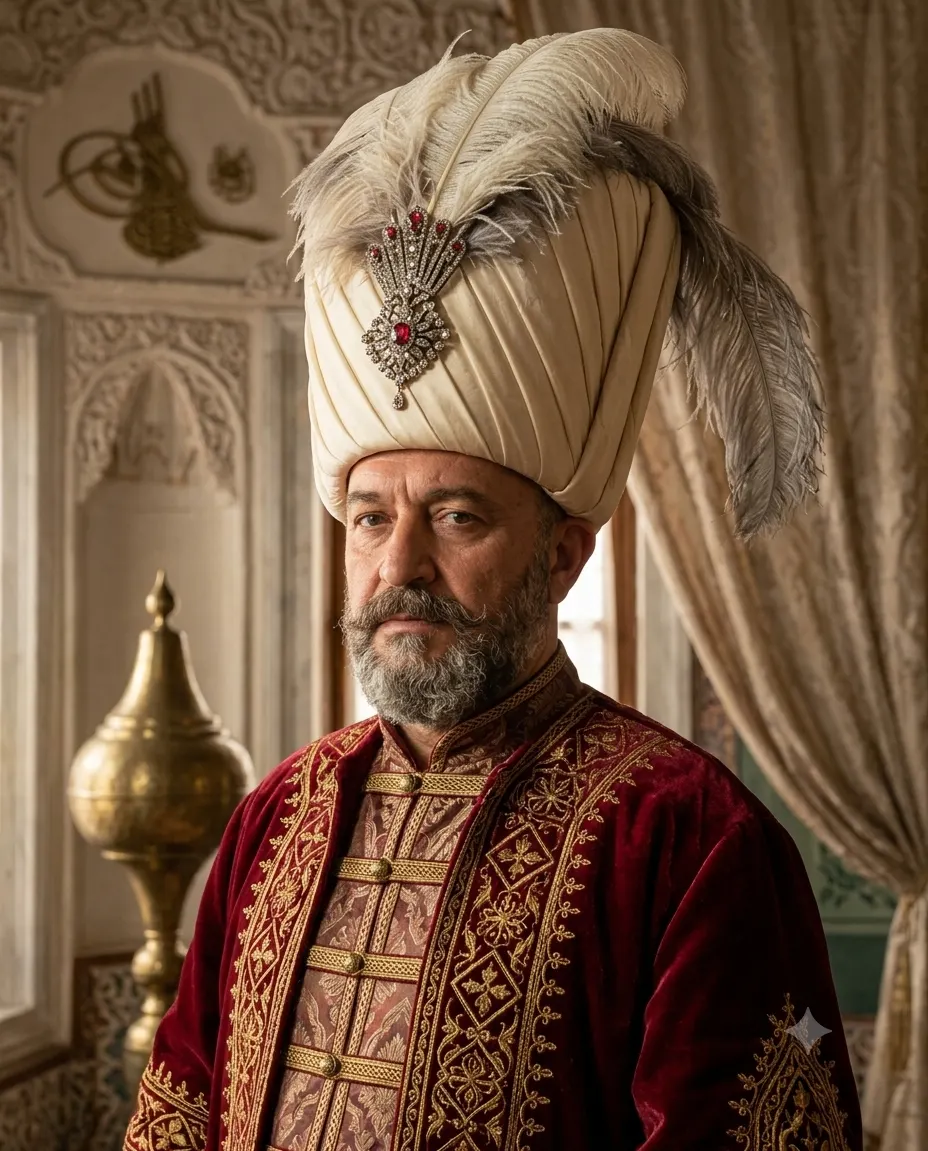
Köprülü Fazıl Ahmed Pasha was grand vizier of the Ottoman Empire from October 1661 until his death in November 1676 — fifteen years, the longest and most successful tenure of the Köprülü era and one of the longest in Ottoman history. He succeeded his father, Köprülü Mehmed Pasha, at the age of twenty-six, and under him the empire reached the greatest territorial extent it ever attained in Europe.
He is distinguished among Ottoman grand viziers by his education. He was trained as a religious scholar and had entered the learned profession as a teacher before transferring to the administrative career, and the epithet by which he is known — Fazıl, the learned — reflects a reputation for scholarship that was unusual in a career soldier-administrator. He was a serious book collector, and the family library he helped build in Istanbul remains a significant manuscript collection.
His record is a study in the difference between battles and wars. He lost his largest field engagement, at Saint Gotthard in 1664, and then negotiated a peace that left the Ottomans holding their gains. He inherited a siege that had already lasted twenty-two years and finished it. He fought a war with Poland that produced a treaty the Polish parliament refused to ratify, fought it again, and kept most of what he had taken. He died in office at forty-one, and his successor lost more in a single campaign than Fazıl Ahmed had won in fifteen years.
Education and Early Career
Fazıl Ahmed was born in 1635 at Vezirköprü in northern Anatolia, the town from which the family took its name. His father was then a provincial official of middling rank; the family's rise to the grand vizierate lay two decades ahead.
His education followed the path of the religious and legal establishment rather than the palace or the army. He studied in the madrasa system, and he was appointed as a teacher — a müderris — which placed him on the career ladder of the ulama, leading toward judgeships and potentially the highest religious offices. This was an unusual formation for a future grand vizier. Ottoman chief ministers were normally products of the palace household or of provincial military administration, and the learned career was a separate hierarchy with its own culture and its own route to influence.
When his father became grand vizier in 1656 the son's prospects changed, and he transferred to the administrative service. He held provincial governorships, including Erzurum and Damascus, and served in the campaigns of his father's vizierate, acquiring in a few years the practical experience his education had not supplied.
Köprülü Mehmed Pasha died at Edirne on 31 October 1661. The sources report that he recommended his son as successor, and Sultan Mehmed IV appointed him. The elevation of a twenty-six-year-old to the highest office in the empire, immediately on his father's death, was a striking demonstration of how far the Köprülü household had come to control the machinery of appointment — the arrangement discussed in the article on his father.
The Habsburg War and the Treaty of Vasvár
The first major undertaking of the vizierate was a war with the Habsburg Empire, arising from the Transylvanian settlement his father had imposed.
Fazıl Ahmed took the army into Hungary in 1663 and captured Nové Zámky — Uyvar in Ottoman usage — a fortress of first importance in the defensive system of Habsburg Hungary. Its fall alarmed the Habsburgs sufficiently to produce reinforcements from the German states and from France, and in 1664 an allied army under Raimondo Montecuccoli met the Ottoman force at Saint Gotthard on the Raab river on 1 August and defeated it.
What happened next is the most instructive episode of his career. Rather than continuing a war he had just lost a battle in, Fazıl Ahmed negotiated, and the Treaty of Vasvár concluded later that month gave the Ottomans terms that bore no relation to the outcome at Saint Gotthard. The Ottomans retained Uyvar and the other conquests of 1663, Transylvania remained an Ottoman vassal principality, and the Habsburgs agreed to a payment. The peace held for nearly twenty years.
The explanation is that both sides wanted the war over for reasons outside Hungary — the Habsburgs faced French pressure in the west, and the Ottomans wanted their army for Crete — and that Fazıl Ahmed read the diplomatic situation more accurately than the military one. It is a reminder that Ottoman policy in this period was conducted by men capable of calculating European alignments, and that the empire's diplomatic performance is often better than its battlefield record.
The Cretan War
The war with Venice over Crete had begun in 1645. The Ottomans had overrun the island quickly and then failed for two decades to take its principal fortress, Candia — modern Heraklion — because Venetian seapower kept it supplied. It was the longest siege of the era and had already consumed the reputations of several Ottoman commanders.
Fazıl Ahmed took personal command of the operation, and the siege that ended it is treated in the following section.
The Siege of Candia
The reduction of Candia was the longest siege of the age and the defining operation of Fazıl Ahmed's career, and its scale deserves setting out.
The war for Crete had begun in 1645. Ottoman forces overran the island within a few seasons and then failed for two decades to take its capital on the north coast, because Venetian seapower kept the fortress supplied while the Ottoman besiegers sat in front of works that were continuously improved. Candia's defences were among the most advanced in Europe: a bastioned circuit designed to resist gunpowder artillery, with outworks, ditches and interior lines, and a garrison receiving reinforcements, engineers and money from across Catholic Europe, including a French expeditionary contingent and volunteers who came for the prestige of the defence.
Fazıl Ahmed took the operation over personally, arriving in 1666 and directing the final phase from 1667. The methods were those of seventeenth-century siegecraft carried out at extreme length: approach trenches driven forward under fire, mines and countermines beneath the bastions, batteries brought up to breach the walls, and repeated assaults on the breaches. The defenders answered with sorties, countermines and rebuilt defences. The sources on both sides describe casualties in the tens of thousands over the whole siege, and the figures are unreliable in every account.
Candia surrendered in September 1669 on terms: the garrison and much of the population were allowed to withdraw, and Venice retained a few fortified islets offshore while ceding the island.
Three points make the episode significant beyond its own drama. It demonstrated the Ottoman capacity for sustained logistical effort at distance — maintaining an army and a siege train on an island for years, across a sea contested by an enemy navy — which is the aspect of Ottoman military power that Rhoads Murphey's work identifies as the empire's real strength in this period. It was accomplished by a grand vizier in personal command, absent from the capital for three years, which was possible only because the Köprülü arrangement had removed the danger of being undermined at court in his absence. And its cost was out of all proportion to the object: twenty-four years of war and enormous casualties for an island, at a time when the empire's strategic position in Hungary and on the Danube was the question that would decide its future.
Ottoman Crete was then organised as a province, and the island's subsequent history — including substantial conversion to Islam among the rural population over the following century — belongs to the settlement made after 1669. Molly Greene's study of the eastern Mediterranean examines that society.
Poland, Podolia, and Ukraine
The final war of the vizierate was fought in the northern borderlands, over the contested territory of Ukraine and the Polish–Lithuanian frontier.
The region was unstable by nature: Poland–Lithuania, the rising power of Russia, the Crimean Khanate as an Ottoman vassal, and the Cossack hosts all had claims and shifting allegiances, and Ottoman intervention followed an appeal from a Cossack leader seeking protection. Fazıl Ahmed campaigned in 1672, taking Kamieniec — the great fortress of Podolia, long considered impregnable — and imposing the Treaty of Buczacz, by which Poland ceded Podolia and agreed to tribute.
The Polish parliament refused to ratify the treaty, and the war resumed. Jan Sobieski, then commanding the Polish army, won a substantial victory at Khotyn in 1673, and the fighting continued inconclusively until the Treaty of Żurawno in 1676 left the Ottomans holding most of Podolia while releasing Poland from the tribute. The territorial result was the furthest northward extension of Ottoman rule in Europe.
Sobieski became king of Poland in 1674, and seven years later he commanded the relief army that broke the Ottoman siege of Vienna.
Ottoman Diplomacy and the European System
Fazıl Ahmed's record makes most sense when read as diplomacy supported by war rather than the reverse, and the European context is worth setting out because it explains his successes.
Seventeenth-century Europe was not united against the Ottomans, and Ottoman policy exploited the divisions systematically. France, under Louis XIV, was the Habsburgs' principal enemy and maintained a working relationship with Istanbul that went back to the sixteenth century; French pressure on the Rhine was one reason the Habsburgs accepted the terms at Vasvár in 1664, and Ottoman negotiators understood this. Venice was a commercial power that wanted trade with the Levant more than it wanted Crete, which is why the Cretan war ended in a negotiated surrender rather than a fight to destruction and why Venetian merchants returned promptly afterwards. Poland–Lithuania was a large state with a weak central government and an elective monarchy whose parliament could repudiate its own treaties — as it did at Buczacz — which made it both difficult to defeat decisively and difficult to bind. And Russia was an emerging power whose interests in Ukraine collided with Ottoman and Polish claims alike.
Ottoman practice in this environment had two features worth noting. The empire did not conduct permanent resident diplomacy of the European kind, receiving foreign ambassadors at Istanbul while sending only temporary missions abroad; information about European politics came through those resident embassies, through tributary states, and through merchants and converts. And Ottoman treaties were framed as grants from the sultan rather than as agreements between equals, a formality that European negotiators found irritating and generally accepted when the terms suited them.
Within these constraints Fazıl Ahmed did well. He kept the Habsburgs and Venetians from combining, ended the Venetian war before the Polish one began, and avoided the situation that destroyed his successor — a coalition of Christian powers acting together. The Holy League that formed after 1683 was precisely what Ottoman diplomacy had spent a century preventing, and its formation, rather than any sudden military decline, is the best explanation for the losses that followed.
Government and Patronage
The domestic record of the vizierate is less dramatic than his father's and in some ways more constructive.
He continued the fiscal discipline and administrative control his father had imposed, and he maintained the practice of staffing the administration from the Köprülü household, which gave Ottoman government an unusual continuity of personnel. Cadastral and revenue survey work was undertaken. What he did not continue was the terror: the executions that defined 1656–61 were not repeated on that scale, and the sources describe a manner of government that was firm rather than murderous. This was possible because his father had already destroyed the factions; Fazıl Ahmed inherited an obedient state and did not have to make one.
His patronage of learning was substantial and is the aspect of his career least connected to war. He collected manuscripts seriously, and the Köprülü Library in Istanbul — established by the family and endowed with the collections of Fazıl Ahmed and his relatives — preserves an important body of Islamic manuscripts and is among the oldest surviving private foundation libraries in Turkey. He supported scholars, and the period of his vizierate coincides with significant Ottoman scholarly and literary activity, including the later work of Evliya Çelebi.
He also lived through, and was implicated in, the religious politics of the reign. The puritan reforming current associated with the Kadızadeli preachers had influence at court through the sultan's preacher Vani Mehmed Efendi, who was connected to Fazıl Ahmed's circle, and the period saw pressure against certain Sufi practices and an emphasis on conversion. This is examined in the article on Mehmed IV.
He died on 3 November 1676 near Çorlu in Thrace, aged forty-one, in office.
The Grand Vizierate as an Institution
Fazıl Ahmed's fifteen years are the clearest illustration of what the Köprülü settlement had done to the Ottoman constitution, and the change was more durable than any of his conquests.
The office of grand vizier was old, and its powers had always been formally extensive: the holder was the sultan's deputy, carried the imperial seal, presided over the imperial council, and directed the administration. What had limited it in practice was insecurity. A grand vizier's tenure depended on the sultan's favour, which was mediated by the palace household, the harem, the Janissary officers and rival viziers, and the result through the late sixteenth and early seventeenth centuries was a rapid turnover in which ministers spent their energy on survival. Between 1622 and 1656 the office changed hands many times, several holders being executed.
What Köprülü Mehmed Pasha obtained in 1656 — unrestricted authority over appointments and policy, with an undertaking that the palace would not interfere — converted the office into something closer to a permanent executive. Fazıl Ahmed inherited that position and held it for fifteen years, and the consequences were substantial.
Security of tenure made long-range policy possible. A minister who expects to be dismissed within the year cannot commit to a three-year siege or a multi-season campaign; one who expects to remain can. Control of appointments allowed the vizierate to staff the administration and the provinces with its own household and clients, which produced continuity of personnel and policy beyond any single tenure — the mechanism by which the Köprülü family supplied five grand viziers across half a century. And the concentration of executive power in one office made the Ottoman state, for a period, unusually decisive by the standards of contemporary European monarchies, where authority was more dispersed.
The corresponding weakness was the absence of any check. The arrangement worked while the holder was capable and failed catastrophically when he was not, because there was no institutional mechanism to restrain a grand vizier with the sultan's full authority. Kara Mustafa Pasha was able to commit the empire's field army and its European position to the siege of Vienna in 1683 on his own judgement, and the disaster that followed cost Hungary. The concentration of power that made Fazıl Ahmed effective made his successor's error unsurvivable.
The longer significance is the one Rifaat Abou-El-Haj's work on Ottoman state formation emphasises. The transfer of executive authority from the person of the sultan to an officeholding élite was not a symptom of decay but a stage in the empire's development into a bureaucratic state — the form in which it survived, and continued to function, into the nineteenth century. The Köprülü vizierates are where that transfer becomes visible.
The Succession and What Followed
Fazıl Ahmed was succeeded as grand vizier by Kara Mustafa Pasha, who had been raised in the Köprülü household and was connected to the family by marriage — a member of the same political establishment rather than a rival to it.
Kara Mustafa continued the northern war and then, in 1683, took the Ottoman army to Vienna and lost it. The siege failed on 12 September 1683 against a relief army commanded by Jan Sobieski; Kara Mustafa was executed that December; and the defeat produced the Holy League and a sixteen-year war that cost the empire Hungary and Transylvania at the Treaty of Karlowitz in 1699.
It should be stated plainly, because the two men are often run together, that Fazıl Ahmed had been dead for seven years when the Vienna campaign was launched and had no part in it. The Ottoman position that Kara Mustafa gambled away — Uyvar and the Hungarian gains, Transylvania as a vassal, Crete, Podolia, a solvent treasury and a disciplined army — was the one Fazıl Ahmed and his father had built. The later Köprülü grand viziers, notably his brother Fazıl Mustafa Pasha and his nephew Amcazade Hüseyin Pasha, spent their tenures managing the consequences, and it was Amcazade Hüseyin who negotiated the settlement at Karlowitz.
Historiographical Note
The sources for this vizierate are comparatively rich and the principal Ottoman one is compromised in a specific way.
Naima's history, the canonical Ottoman narrative of the Köprülü era, was written in the early eighteenth century by a man employed by Amcazade Hüseyin Pasha — Fazıl Ahmed's nephew. The family's record was, at the time of writing, a live political asset, and the account of the Köprülü vizierates is correspondingly favourable. The Silahdar Tarihi of Fındıklılı Mehmed Ağa covers the later period from a participant's perspective. Evliya Çelebi's travel narrative is contemporary and extensive.
European material is abundant and provides the necessary corrective: Venetian reporting on the Cretan war, Habsburg and imperial accounts of the 1663–64 campaign and Saint Gotthard, and Polish sources on the Podolian war. These are hostile but well informed, and on the military narrative they are often more precise than the Ottoman accounts.
Two interpretative points. The reign has been read through the "decline and revival" framework, in which the Köprülüs briefly arrest an inevitable decay; more recent work, including Abou-El-Haj's study of Ottoman state formation and Gábor Ágoston's reassessment of the empire's European wars, treats the period as evidence of considerable and sustained Ottoman military and administrative capacity, and argues that the empire's later reverses owed more to the emergence of a durable coalition against it than to internal decay. And the contrast between Fazıl Ahmed and Kara Mustafa is drawn very sharply in the Ottoman tradition for the obvious reason that the tradition was shaped by Köprülü clients.
Details that remain imprecise include the casualty figures for the siege of Candia, which are large and unreliable in all accounts, and the exact terms and interpretation of the Buczacz and Żurawno treaties, which differ between Ottoman and Polish versions.
Assessment
Fazıl Ahmed Pasha was the most successful Ottoman minister of the seventeenth century, and the qualities that made him so were unglamorous.
He was a competent rather than a brilliant commander. He lost the one large field battle of his career and won his campaigns by siegecraft, logistics and persistence — the capture of Uyvar, the three-year reduction of Candia, the taking of Kamieniec. In an age when fortresses rather than field armies decided territorial outcomes, this was the relevant skill, and he possessed it in unusual measure. Rhoads Murphey's work on Ottoman warfare makes the point that the empire's strength in this period lay in its capacity to organise supply and siege operations at long range, and Fazıl Ahmed's record is the best illustration of it.
He was a better diplomat than soldier. Vasvár is the clearest case: a peace concluded weeks after a defeat that conceded nothing of substance, because he understood that his opponents needed the war ended more than he did. Żurawno was a similar reading of a stalemate. This is the aspect of his career that most complicates the conventional picture of a seventeenth-century Ottoman state losing its grip; a declining power does not normally negotiate like that.
He was also the beneficiary of work he did not do. The obedient army, the solvent treasury, the disciplined administration and the compliant capital that made his fifteen years possible were produced by his father's five years of mass execution. Fazıl Ahmed governed a state that had already been terrorised into order, and the moderation of his own administration is partly a measure of how thoroughly the earlier violence had succeeded. It is fair to credit him with not continuing it, and unfair to praise his mildness without noting what it rested on.
Two limits should be recorded. His conquests were expensive out of proportion to their value: Crete cost twenty-four years of war and enormous casualties for an island, and Podolia was a salient held against a hostile Poland that never accepted the loss. And the Köprülü system's central weakness — that it concentrated the empire's whole executive capacity in one office, unchecked — was as true under him as under his successor. His fifteen years show what that arrangement could achieve with a capable man in the post; 1683 showed what it cost when the man was not. That Kara Mustafa was able to stake the empire's European position on a single siege without effective restraint from the sultan or anyone else was a feature of the constitution the Köprülüs had created, and Fazıl Ahmed's success is what made the risk seem affordable.
References and Further Reading
Primary Islamic Sources
- Quran, Surah al-Nisa (4:58–59) — on rendering trusts, judging justly, and obedience to those in authority; the framework of Ottoman argument about delegated executive power
- Quran, Surah al-Anfal (8:61) — on accepting peace when the adversary inclines to it, the scriptural basis of the juristic case for treaties such as Vasvár and Żurawno
- Quran, Surah al-Nahl (16:91) — on fulfilling covenants once made, cited in Ottoman diplomatic correspondence over the unratified Treaty of Buczacz
- Quran, Surah al-Alaq (96:1–5) and Surah al-Zumar (39:9) — on knowledge and learning, the texts underlying the Ottoman scholarly ideal that shaped his education and library patronage
- Sahih al-Bukhari, Kitab al-Jihad wa al-Siyar, and Sahih Muslim, Kitab al-Imarah — the prophetic material on truces, the conduct of sieges, and the treatment of surrendered garrisons
Classical Islamic Sources
- Naima, Mustafa. Tarih-i Naima. [early 18th century] — the canonical account, written under Köprülü family patronage
- Silahdar Fındıklılı Mehmed Ağa. Silahdar Tarihi. [early 18th century]
- Evliya Çelebi. Seyahatname. [17th century] — contemporary, with material on the Cretan and Hungarian campaigns
- Rasid, Mehmed. Tarih-i Rasid. [18th century]
- Defterdar Sarı Mehmed Pasha. Zübde-i Vekayiat. [early 18th century] — on the wars following his death
- The manuscript collections of the Köprülü Library, Istanbul — the surviving evidence of his scholarly patronage
Academic and Scholarly Sources
- Abou-El-Haj, Rifaat Ali. Formation of the Modern State: The Ottoman Empire, Sixteenth to Eighteenth Centuries. Albany: State University of New York Press, 1991.
- Ágoston, Gábor. The Last Muslim Conquest: The Ottoman Empire and Its Wars in Europe. Princeton: Princeton University Press, 2021. — the leading reassessment of Ottoman military capacity in this period
- Setton, Kenneth M. Venice, Austria, and the Turks in the Seventeenth Century. Philadelphia: American Philosophical Society, 1991. — on the Cretan war and the Habsburg campaigns
- Finkel, Caroline. Osman's Dream: The Story of the Ottoman Empire, 1300–1923. London: John Murray, 2005.
- Murphey, Rhoads. Ottoman Warfare, 1500–1700. London: UCL Press, 1999. — on siegecraft and logistics
- Shaw, Stanford J. History of the Ottoman Empire and Modern Turkey, vol. I. Cambridge: Cambridge University Press, 1976.
- Baer, Marc David. Honored by the Glory of Islam: Conversion and Conquest in Ottoman Europe. New York: Oxford University Press, 2008.
- Zilfi, Madeline C. The Politics of Piety: The Ottoman Ulema in the Postclassical Age. Minneapolis: Bibliotheca Islamica, 1988.
Further Reading
- Stoye, John. The Siege of Vienna. Edinburgh: Birlinn, 2000. — on what followed under his successor
- Wheatcroft, Andrew. The Enemy at the Gate: Habsburgs, Ottomans and the Battle for Europe. London: Bodley Head, 2008.
- Faroqhi, Suraiya. The Ottoman Empire and the World Around It. London: I.B. Tauris, 2004.
- Greene, Molly. A Shared World: Christians and Muslims in the Early Modern Mediterranean. Princeton: Princeton University Press, 2000. — on Ottoman Crete after 1669
- Kołodziejczyk, Dariusz. Ottoman-Polish Diplomatic Relations. Leiden: Brill, 2000.
Mentioned In
2 articles reference this topic
More from Ottoman Empire
Battle of Nicopolis (1396 CE)
The Battle of Nicopolis, fought on 25 September 1396, was a decisive Ottoman victory over a combined Western European crusading army under Sigismund of Hungary. The last major crusade of the medieval period, its failure cemented Ottoman dominance over the Balkans.
Blue Mosque: The Sultan Ahmed Mosque of Istanbul
The Blue Mosque (Sultan Ahmed Mosque) in Istanbul, built between 1609-1616 CE, is one of the most magnificent examples of Ottoman architecture and a masterpiece of Islamic architectural achievement.
Bosnia and Herzegovina: Islamic Heritage in the Balkans
The westernmost region of sustained Muslim presence in Europe. Ottoman rule from 1463 until the Austro-Hungarian occupation of 1878 produced a distinctive Bosniak Muslim culture that joined Ottoman traditions to indigenous Balkan ones.
Conquest of Constantinople - The Fall of Byzantium
The historic conquest of Constantinople by Ottoman Sultan Mehmed II on May 29, 1453 CE, ending the Byzantine Empire and establishing Ottoman dominance in southeastern Europe. This pivotal victory transformed the Ottomans into a major European power.