Mehmed IV: The Hunter and the Koprulu Recovery
Mehmed IV (1642-1693) reigned thirty-nine years from the age of six. His reign spanned the near-collapse of the 1650s, the Kopruluu recovery, the capture of Candia, the failure before Vienna in 1683, and the losses that led to his deposition in 1687.
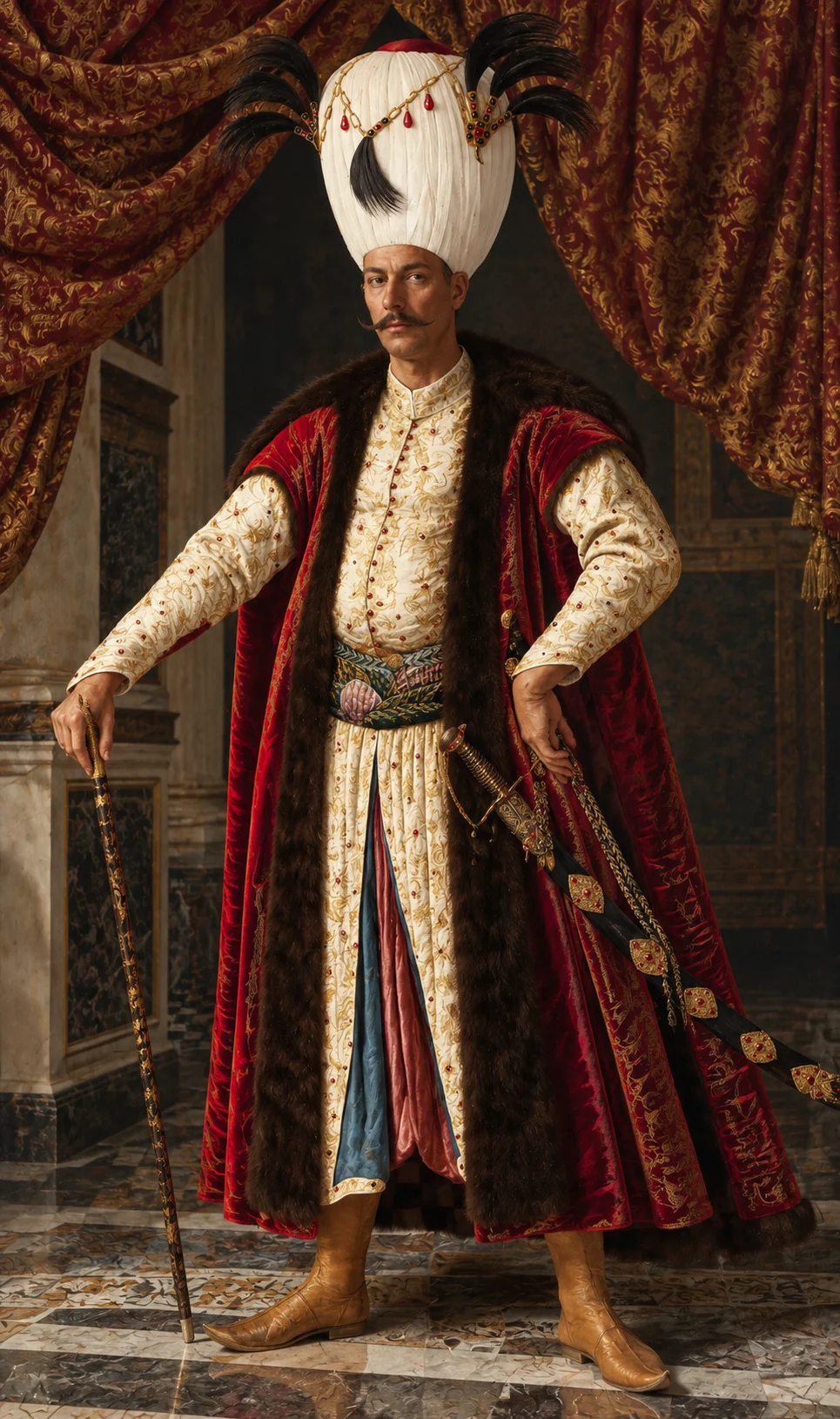
Mehmed IV ruled the Ottoman Empire from 1648 to 1687, one of the longest reigns in the dynasty's history and one of the least personally governed. He came to the throne at the age of six, when his father Ibrahim was deposed and killed, and he was removed at forty-five after the military catastrophes that followed the failure before Vienna. Between those two depositions the Ottoman state passed through its deepest seventeenth-century crisis, recovered dramatically under the grand viziers of the Köprülü family, reached the furthest extent of its European territory, and then began the retreat that would continue for two centuries.
His epithet in Ottoman usage is Avcı, the Hunter, and it is descriptive rather than decorative. Mehmed spent a very large part of his adult life hunting, much of it based at Edirne rather than Istanbul, and he delegated the government of the empire to his grand viziers to a degree unusual even by the standards of a period in which sultans had largely ceased to rule directly. The consequence is that the history of his reign is substantially the history of other men: Köprülü Mehmed Pasha, his son Köprülü Fazıl Ahmed Pasha, and finally Kara Mustafa Pasha, whose decision to march on Vienna in 1683 destroyed the position the other two had built.
Accession in a Collapsing State
Mehmed was born in Istanbul on 2 January 1642, the son of Sultan Ibrahim and of a concubine of Ukrainian or Russian origin who is known to history as Turhan Hatice Sultan.
His father's reign was a disaster by any measure — fiscally ruinous, erratic in its treatment of officials, and increasingly unacceptable to the military and religious establishment. In August 1648 Ibrahim was deposed and shortly afterwards executed, and the six-year-old Mehmed was enthroned.
The condition of the empire at that moment was as bad as at any time since 1402. A war with Venice over Crete had begun in 1645 and was going badly; the Venetian fleet was operating in the Aegean and would at points blockade the Dardanelles, threatening the capital's grain supply. The currency had been debased and state finances were in disorder. Provincial administration was breaking down in Anatolia. And the government of the capital was effectively hostage to the Janissaries and the palace cavalry, who deposed and installed officials at will.
To this was added a struggle within the dynasty itself. Authority over the child sultan was contested between his grandmother Kösem Sultan, who had dominated Ottoman politics through three reigns, and his mother Turhan Sultan. The article on Ottoman court politics in this period is complex and Leslie Peirce's study of the imperial household examines how such power was exercised by women whose formal position was domestic. The contest was settled in September 1651 when Kösem was killed, and Turhan Sultan became the effective regent.
The nadir came in 1656. Facing a naval defeat at the Dardanelles and a fiscal crisis in which the troops were paid in debased coin, the soldiers of the capital rose, demanded the surrender of a list of court officials, and had them executed; their bodies were hung from a plane tree in the square outside the Sultanahmet mosque. The episode is known in Ottoman historiography as the Incident of the Plane Tree, and it demonstrated that the government had no independent authority whatever.
The Household, the Valide Sultan, and the Politics of the Palace
Mehmed IV's first eight years were governed by women of the imperial household, and the arrangement was not an aberration but the working constitution of the Ottoman state for much of the seventeenth century.
The institution behind it was the position of valide sultan, the mother of the reigning sultan. Ottoman dynastic practice had abandoned the marriage of sultans to foreign princesses and produced heirs by concubines of the imperial household; when one of those sons came to the throne, his mother acquired a position of formal precedence, an independent income from assigned revenues, a large staff, and — crucially — legitimate access to the sultan. Leslie Peirce's study of the imperial household established that this was a recognised office with defined resources rather than informal influence, and that its political weight increased precisely as sultans ceased to rule personally.
Kösem Sultan is the outstanding case in Ottoman history. Mother of Murad IV and of Ibrahim, and grandmother of Mehmed IV, she exercised authority across three reigns, managing the regency during her sons' minorities, participating in the deposition of Ibrahim in 1648, and continuing as the dominant figure at court after her grandson's accession. Against her stood Turhan Sultan, Mehmed's own mother, whose claim rested on the standing of the reigning sultan's mother and who had the more legitimate title to the regency by Ottoman convention.
The contest between them was settled by force in September 1651, when Kösem was killed in the palace. It is a brutal episode and a revealing one: it shows that the household was a genuine centre of political power, with factions, armed support among the palace establishment, and stakes worth killing for.
Turhan Sultan's period as regent produced the single most consequential decision of the reign. In September 1656, with the capital in the hands of mutinous soldiers and the Venetian fleet in the straits, she appointed Köprülü Mehmed Pasha as grand vizier on terms giving him unrestricted authority and an undertaking that the palace would not interfere. That decision — made by the sultan's mother on behalf of a fourteen-year-old sovereign — began the Köprülü recovery. She also completed the mosque complex at Eminönü in Istanbul that had been left unfinished for decades, and her building and charitable patronage were substantial.
The wider point is that the sultan's personal disengagement did not leave a vacuum. Authority was exercised by the household, then delegated to the vizierate, and the empire was governed throughout. Recent scholarship treats this as an institutional adaptation — a monarchy learning to function without a warrior-sultan at its head — rather than as the decay the older literature described.
The Köprülü Recovery
In September 1656 Turhan Sultan appointed Köprülü Mehmed Pasha as grand vizier, on the condition — reported consistently in the sources — that he be given unrestricted authority over appointments and policy without interference from the palace.
The consequences were immediate and drastic, and they are treated in the articles on the two Köprülü viziers. In outline: Köprülü Mehmed Pasha (1656–1661) suppressed the factions in the capital by mass execution, broke the Venetian blockade and recovered the islands commanding the Dardanelles, put down revolts in Anatolia and imposed Ottoman authority in Transylvania. His son Köprülü Fazıl Ahmed Pasha (1661–1676) fought the Habsburgs to a favourable settlement in 1664, and in September 1669 finally took Candia — modern Heraklion — ending a siege that had lasted more than two decades and completing the conquest of Crete. He then took Podolia and the fortress of Kamieniec from Poland–Lithuania in 1672 and fought a further war over Ukraine.
By the mid-1670s the Ottoman Empire held more European territory than at any previous point. The recovery was genuine, it was rapid, and it was achieved by delegating the sultan's authority almost entirely to a single family of administrators.
Mehmed's own part in this requires a careful statement. He did not direct these campaigns and he was not, on the evidence, a strategist. What he did was appoint the Köprülüs and — crucially — leave them alone. In an Ottoman court where grand viziers were routinely destroyed by palace intrigue after a season or two, sustaining Köprülü Mehmed Pasha for five years and Fazıl Ahmed Pasha for fifteen was itself a political act, and the stability of tenure was the precondition of everything the two men accomplished. A sultan who consistently declines to undermine a capable minister is doing something, even if it is not government.
He also accompanied the army on campaign at times, notably to Poland in the 1670s, and Ottoman court writing presented him as a warrior sultan and a champion of Islam. Marc Baer's study of the reign examines this self-presentation, including the sultan's association with the puritan preaching current of the day and his patronage of conversions, and argues that the religious image was more deliberately cultivated than the "idle hunter" caricature allows.
Crete, and the Wars in the North
Two long wars defined the reign's military history before 1683, and both illustrate the character of Ottoman warfare in the period.
The Cretan war had begun in 1645, three years before Mehmed's accession, and it lasted until 1669 — one of the longest sieges in European history. The Ottomans overran most of the island quickly and then spent more than two decades unable to take its principal fortress, Candia, on the north coast. The reason was seapower. Venice could not hold Crete but could contest the sea around it, reinforcing and supplying the fortress while intercepting Ottoman convoys, and in the 1640s and 1650s the Venetian fleet operated in the Aegean with enough success to blockade the Dardanelles itself. A blockade of the straits threatened Istanbul's grain supply directly, which is why the naval crisis of the mid-1650s translated so quickly into political crisis in the capital.
Breaking that blockade was Köprülü Mehmed Pasha's first strategic achievement, with the recovery of Tenedos and Lemnos in 1657 restoring Ottoman control of the approaches. Candia itself fell only in September 1669, after Köprülü Fazıl Ahmed Pasha took personal command of the siege for its final phase. The conquest completed Ottoman control of the eastern Mediterranean's largest island and removed Venice's principal base there, at a cost in men, money and time out of all proportion to the object.
The northern wars concerned Ukraine and the Polish–Lithuanian borderlands, a zone contested between Poland, the emerging power of Russia, the Crimean Khanate as an Ottoman vassal, and the Cossack hosts whose shifting allegiances made the region permanently unstable. Fazıl Ahmed Pasha campaigned there from 1672, taking Podolia and the great fortress of Kamieniec and imposing the Treaty of Buczacz; the war continued intermittently, and under Kara Mustafa Pasha it extended into direct conflict with Russia over the Dnieper lands. These campaigns brought the Ottoman Empire to its greatest northern extent and also drew it, for the first time, into sustained hostilities with a Russian state that would become its most dangerous adversary.
Edirne, the Hunt, and the Practice of Kingship
Because Mehmed's epithet has done so much to shape his reputation, the practice behind it is worth examining on its own terms.
Ottoman sultans had always hunted, and the royal hunt was never simply recreation. It was a form of military exercise for the household troops, a means of provisioning the court, an occasion for the display of magnificence before subjects and foreign envoys, and — in a polity where the sultan's physical presence was the state's most potent symbol — a way of being seen. Mehmed pursued it on an exceptional scale, with very large retinues, for long periods, over wide territories.
Bound up with it was his preference for Edirne. He resided there for much of his reign in preference to Istanbul, and the choice had several plausible advantages. Edirne was closer to the European frontier where the empire's wars were fought, which shortened communications with armies in Hungary and the Balkans. It offered the hunting grounds of Thrace. And it removed the sultan from the capital where his father had been deposed and killed, where his grandmother had been murdered, and where the soldiers had hanged court officials from a plane tree during his childhood — a consideration that a modern reader should probably weigh more heavily than the Ottoman sources do.
Contemporary criticism focused on the costs. Moving a court of that size imposed real burdens of provisioning and transport on the districts it passed through, and Ottoman writers commented on the expense and on the sultan's absence from the seat of government.
Marc Baer's study of the reign argues that the court cultivated an image of the sultan as an active Islamic sovereign — a hunter and warrior, a patron of conversion, a defender of the faith — and that this self-presentation was deliberate and reasonably successful in its own terms. On that reading the hunt was part of a coherent conception of kingship rather than an alternative to it: a sultan who no longer commanded armies in the field could still be visibly mobile, martial and present in his provinces.
Two qualifications keep the picture honest. The evidence for Mehmed's own political thinking is thin, and the argument from the court's self-presentation tells us what the court wished to project rather than what the sultan understood himself to be doing. And whatever the hunt meant symbolically, the executive government of the empire for thirty-nine years was conducted by grand viziers, and the record of the reign tracks their competence rather than his.
The Wider Reign
Two other developments of the reign deserve notice.
The first is religious. The period saw the influence of the Kadızadeli movement, a puritan reforming current that pressed for the suppression of practices it regarded as innovations, including elements of Sufi devotion, and for stricter public morality. Mehmed's preacher Vani Mehmed Efendi was associated with this tendency and had access to the sultan. The reign accordingly saw campaigns against certain Sufi practices and an emphasis on conversion, which Baer's work examines in detail.
The second is the episode of Sabbatai Zevi, a Jewish teacher from İzmir who in 1665–66 was proclaimed by a substantial following across the Jewish communities of the Ottoman Empire and Europe as the messiah. The movement's scale alarmed both Jewish communal authorities and the Ottoman state. Sabbatai was arrested, brought before the Ottoman authorities in 1666, and converted to Islam, which broke the movement's public claim while leaving a residue of followers. The episode is one of the most striking religious events in Ottoman social history and it belongs to this reign.
Vienna and the Collapse
Köprülü Fazıl Ahmed Pasha died in 1676 and was succeeded as grand vizier by his brother-in-law Kara Mustafa Pasha, who held office until 1683.
Kara Mustafa fought a war with Russia over Ukraine and then, in 1683, took the Ottoman army to Vienna. The decision was his; Mehmed accompanied the army as far as Belgrade and remained there. The siege began in July, was pressed for two months, and was broken on 12 September 1683 by a relief army in which the decisive force was commanded by John III Sobieski, king of Poland. The Ottoman army was routed and lost its siege train and much of its baggage. John Stoye's account remains the standard narrative in English.
Kara Mustafa was executed in December 1683 on the sultan's order. It did not repair the situation. The defeat produced what the Ottomans had always been able to prevent: a durable coalition. The Holy League, joining the Habsburgs, Poland, Venice and later Russia under papal auspices, opened a war that ran until 1699. Its early course was disastrous for the Ottomans. Hungary was lost progressively, Buda falling in 1686; Venice attacked in the Morea; and in August 1687 the Ottoman field army was defeated near Mohács.
The army held the sultan responsible. In November 1687 the troops mutinied and Mehmed IV was deposed in favour of his brother Süleyman II. He was confined at Edirne and died there on 6 January 1693. The war continued without him and was concluded by the Treaty of Karlowitz in 1699, which transferred Hungary and Transylvania to the Habsburgs — the first major territorial cession in Ottoman history and the beginning of the long contraction described in the article on the fall of the Ottoman Empire.
Historiographical Note
Mehmed IV's reign is well documented and heavily interpreted, and the interpretations have moved a long way in recent decades.
The main Ottoman narratives are Naima's history, which covers the earlier part of the reign and became canonical, and the Silahdar Tarihi of Fındıklılı Mehmed Ağa, a participant-observer for the later years including Vienna. Evliya Çelebi's travel narrative is extensive for this period. European sources are abundant: Habsburg, Venetian, Polish and papal material on the wars, and resident ambassadors' reporting from Istanbul.
The interpretative history matters here more than usual. For most of the twentieth century the reign was read through the framework of Ottoman decline, in which an indolent sultan hunted while his empire was saved by two capable ministers and then ruined by a third. The Köprülü recovery was treated as an interruption in a downward trajectory, and the sultan himself as a nullity with a nickname.
That reading has been substantially revised. Marc Baer's work argues that Mehmed and his court cultivated an active image of Islamic sovereignty, that the sultan was more engaged in religious and symbolic politics than the caricature allows, and that the reign should be understood on its own terms rather than as a stage in a decline. Leslie Peirce's work on the imperial household reframes the regency politics of the 1640s and 1650s as a functioning system rather than a breakdown. Broader reassessments of the seventeenth century treat the period as one of institutional transformation, in which the delegation of the sultan's executive power to grand viziers was a durable adaptation rather than a symptom of decay.
Both the older and the newer readings have to account for the same facts: the empire was close to collapse in 1656, at its greatest European extent in 1676, and losing Hungary by 1687. Specific cautions: the sultan's personal role in appointments and in the decision to besiege Vienna is not documented in detail and is disputed; the "idle hunter" characterisation derives partly from Ottoman writers hostile to him after his deposition; and estimates of the costs of the hunting establishment are impressionistic.
Assessment
Mehmed IV presents the difficulty of assessing a ruler whose most consequential decisions were about whom to let govern.
The negative case is easy to state and largely accurate on its own terms. He did not rule. He spent decades hunting, resided away from his capital, and left policy to his grand viziers; the empire's fortunes accordingly tracked the competence of whoever held that office, rising under two Köprülüs and collapsing under Kara Mustafa. He presided over the loss of Hungary and the first great territorial cession in Ottoman history, and he was deposed by his own army for it. Nothing in the record suggests strategic judgement or administrative interest.
The case in mitigation is more substantial than it first appears. The single most valuable thing an Ottoman sultan of this period could do for his state was to appoint a capable grand vizier and protect him from the court. The normal Ottoman pattern was the opposite: grand viziers were undermined by palace factions and executed after short tenures, which made sustained policy impossible. Mehmed's reign produced two of the longest and most effective vizierates in Ottoman history, and the recovery from the catastrophe of 1656 to the high-water mark of 1676 happened because the sultan did not interfere. That is a low form of statecraft and it is not nothing.
The decisive failure was 1683, and the responsibility is genuinely divided. The decision to march on Vienna rather than consolidate was Kara Mustafa's, and Mehmed's part in authorising it is not clearly documented. But a sultan who has delegated policy for thirty-five years cannot disclaim the consequences of a delegation that goes wrong, and the appointment of Kara Mustafa was his. The catastrophe was not merely a lost siege: it created the coalition that Ottoman diplomacy had always managed to prevent, and the resulting war cost the empire Hungary permanently.
The wider point about the reign is structural rather than personal, and it is why the older "decline" reading is unsatisfying. The Ottoman state of the seventeenth century had already shifted from personal sultanic rule toward government by a bureaucratic and military élite, with the sultan as a source of legitimacy rather than of policy. Mehmed IV's thirty-nine years demonstrate both what that arrangement could achieve when the executive was competent and how exposed it was when he was not. The empire that emerged from his reign was territorially smaller and institutionally more recognisably a state run by its officials — the form in which it would survive, and continue to lose ground, for the next two centuries.
References and Further Reading
Primary Islamic Sources
- Quran, Surah Al-Imran (3:26) — on the granting and withdrawal of sovereignty, invoked in Ottoman accounts of accession and deposition
- Quran, Surah al-Nisa (4:58–59) — on rendering trusts, judging justly, and obedience to those in authority; the framework of Ottoman juristic opinion on the deposition of sultans
- Quran, Surah al-Anfal (8:46) — on obedience and the avoidance of internal division, cited in the literature on the military revolts of the period
- Quran, Surah al-Baqarah (2:256) — "There shall be no compulsion in religion"; a text central to the Ottoman legal treatment of conversion, at issue in this reign
- Sahih al-Bukhari, Kitab al-Ahkam, and Sahih Muslim, Kitab al-Imarah — the prophetic material on the responsibilities of rulers, delegation of authority, and the limits of obedience
- The fetva literature of the Ottoman chief jurists sanctioning the depositions of 1648 and 1687, the primary evidence for the legal mechanism of removing a sultan
Classical Islamic Sources
- Naima, Mustafa. Tarih-i Naima. [early 18th century] — the canonical Ottoman narrative for the earlier reign
- Silahdar Fındıklılı Mehmed Ağa. Silahdar Tarihi. [early 18th century] — a participant's account of the later reign, including the Vienna campaign
- Evliya Çelebi. Seyahatname. [17th century]
- Katip Çelebi. Fezleke. [17th century] — for the crisis years before 1657
- Rasid, Mehmed. Tarih-i Rasid. [18th century]
- Defterdar Sarı Mehmed Pasha. Zübde-i Vekayiat. [early 18th century] — on the wars of the Holy League
Academic and Scholarly Sources
- Baer, Marc David. Honored by the Glory of Islam: Conversion and Conquest in Ottoman Europe. New York: Oxford University Press, 2008. — the principal modern reassessment of the reign
- Peirce, Leslie P. The Imperial Harem: Women and Sovereignty in the Ottoman Empire. New York: Oxford University Press, 1993. — on Kösem and Turhan and the politics of the regency
- Finkel, Caroline. Osman's Dream: The Story of the Ottoman Empire, 1300–1923. London: John Murray, 2005.
- Stoye, John. The Siege of Vienna. Edinburgh: Birlinn, 2000. — the standard English narrative of 1683
- Ágoston, Gábor. The Last Muslim Conquest: The Ottoman Empire and Its Wars in Europe. Princeton: Princeton University Press, 2021.
- Abou-El-Haj, Rifaat Ali. Formation of the Modern State: The Ottoman Empire, Sixteenth to Eighteenth Centuries. Albany: State University of New York Press, 1991. — on the shift to government by the officeholding élite
- Zilfi, Madeline C. The Politics of Piety: The Ottoman Ulema in the Postclassical Age. Minneapolis: Bibliotheca Islamica, 1988. — on the Kadızadeli movement
- Scholem, Gershom. Sabbatai Sevi: The Mystical Messiah. Princeton: Princeton University Press, 1973. — the standard study of the 1666 episode
Further Reading
- Shaw, Stanford J. History of the Ottoman Empire and Modern Turkey, vol. I. Cambridge: Cambridge University Press, 1976.
- Murphey, Rhoads. Ottoman Warfare, 1500–1700. London: UCL Press, 1999.
- Faroqhi, Suraiya. The Ottoman Empire and the World Around It. London: I.B. Tauris, 2004.
- Wheatcroft, Andrew. The Enemy at the Gate: Habsburgs, Ottomans and the Battle for Europe. London: Bodley Head, 2008.
- Setton, Kenneth M. Venice, Austria, and the Turks in the Seventeenth Century. Philadelphia: American Philosophical Society, 1991.
Mentioned In
5 articles reference this topic
More from Ottoman Empire
Battle of Nicopolis (1396 CE)
The Battle of Nicopolis, fought on 25 September 1396, was a decisive Ottoman victory over a combined Western European crusading army under Sigismund of Hungary. The last major crusade of the medieval period, its failure cemented Ottoman dominance over the Balkans.
Blue Mosque: The Sultan Ahmed Mosque of Istanbul
The Blue Mosque (Sultan Ahmed Mosque) in Istanbul, built between 1609-1616 CE, is one of the most magnificent examples of Ottoman architecture and a masterpiece of Islamic architectural achievement.
Bosnia and Herzegovina: Islamic Heritage in the Balkans
The westernmost region of sustained Muslim presence in Europe. Ottoman rule from 1463 until the Austro-Hungarian occupation of 1878 produced a distinctive Bosniak Muslim culture that joined Ottoman traditions to indigenous Balkan ones.
Conquest of Constantinople - The Fall of Byzantium
The historic conquest of Constantinople by Ottoman Sultan Mehmed II on May 29, 1453 CE, ending the Byzantine Empire and establishing Ottoman dominance in southeastern Europe. This pivotal victory transformed the Ottomans into a major European power.