Mehmed VI Vahideddin: The Last Ottoman Sultan
Mehmed VI Vahideddin (1861-1926) was the thirty-sixth and last Ottoman sultan, reigning from 1918 to 1922. He governed under Allied occupation, his government signed the Treaty of Sevres, and he left Istanbul on a British warship after the sultanate was abolished.
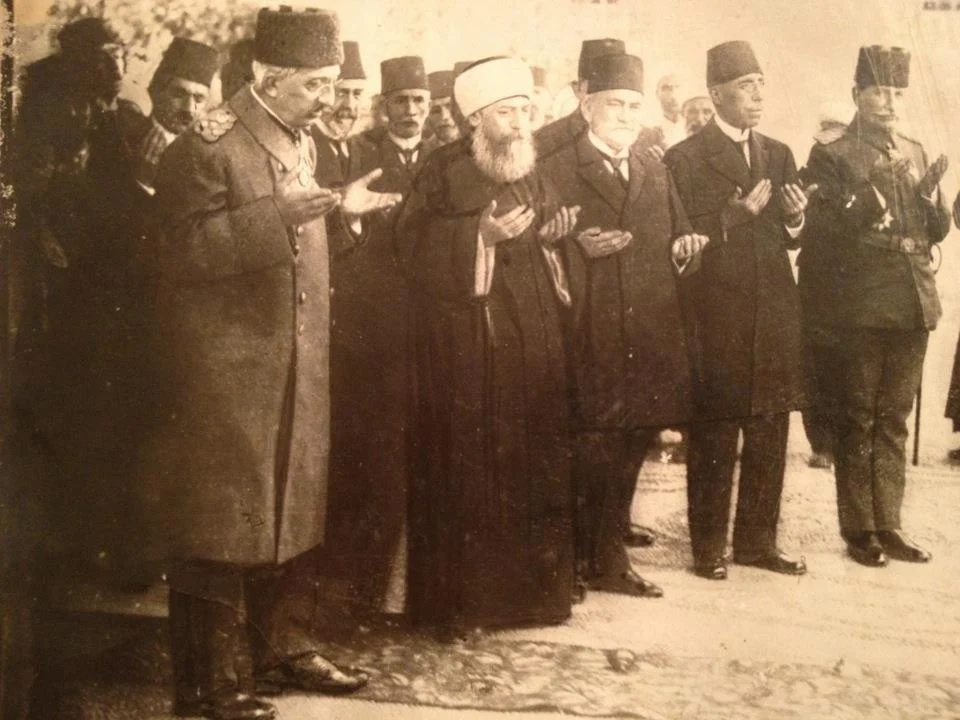
Mehmed VI Vahideddin was the thirty-sixth and last sovereign of the Ottoman Empire, reigning from July 1918 until the sultanate was abolished on 1 November 1922. He came to the throne four months before the empire's defeat in the First World War, governed a capital under Allied occupation, saw his government sign a treaty that partitioned his territory, was displaced by a national movement based in Anatolia, and left Istanbul aboard a British battleship. He died in exile in Italy in 1926.
His reign is the last chapter of a state that had existed for six centuries, and it is a chapter in which the sultan had almost no room to act and used what he had badly. The judgement of Turkish national historiography has been severe: he is remembered there as the sovereign who collaborated with the occupying powers, condemned the leaders of the resistance to death, and put the survival of his dynasty above the independence of the country. The case in his defence is that he commanded nothing — no army, no revenue, no capital he controlled — and that the alternatives available to him in 1919 were narrower than they look in retrospect.
One point of identification should be settled at the outset, because it is a frequent source of confusion. Mehmed VI was the last sultan, and he was not the last caliph. When the Grand National Assembly abolished the sultanate in November 1922, it separated the two offices and elected his cousin Abdülmecid II as caliph; that office was abolished in March 1924. Abdülmecid II is a distinct person from Abdülmecid I, the Tanzimat sultan of 1839–61, who was Mehmed VI's father.
A Late Son of Abdülmecid I
Vahideddin was born in Istanbul on 14 January 1861. His father, Abdülmecid I, died on 25 June of that year, so he was five months old at his accession as an infant prince of a dynasty he would outlive.
He was thus the youngest of the four sons of Abdülmecid I who became sultan — after Murad V, Abdülhamid II and Mehmed V — and the whole of the empire's last half-century was governed by his father's children. Orphaned early, he was raised in the palace establishment and, like his brother Mehmed V, spent the long decades of Abdülhamid II's reign in the seclusion imposed on potential heirs. The sources describe him as reserved, religiously observant, interested in music and calligraphy, and without political or military experience of consequence.
He became heir presumptive in 1916, on the death of an elder brother, and succeeded Mehmed V on 4 July 1918. He was fifty-seven.
Defeat and Occupation
The war was already lost. Bulgaria's collapse in September 1918 severed the Ottoman connection with Germany; the Syrian front had broken; and Ottoman forces in Mesopotamia and Palestine were in retreat.
The Armistice of Mudros was signed on 30 October 1918. Its terms provided for the demobilisation of the Ottoman army, Allied control of the straits and of the railways and telegraphs, and — in a provision that mattered enormously — the right of the Allies to occupy any point whose security they judged threatened. Allied warships anchored off Istanbul in November 1918. The Union and Progress leadership fled abroad. Formal Allied occupation of the capital was extended in stages and completed in March 1920.
What followed for the Ottoman government was a position with no precedent. Mehmed VI held a capital garrisoned by British, French and Italian troops, with his communications, finances and press under Allied supervision, and an army he was treaty-bound to disband. He dissolved parliament in December 1918 and governed through appointed ministries, principally under his brother-in-law Damat Ferid Pasha.
The strategy he adopted was accommodation. His government cooperated with the occupying authorities, prosecuted members of the wartime government — the courts-martial of 1919–20 concerning the Armenian deportations were held under his administration — and sought to persuade the Allies that a compliant Ottoman monarchy was worth preserving. The reasoning was that resistance was impossible and that the dynasty and the capital might be salvaged by demonstrating good conduct at the peace conference.
It was a serious misreading of the Allies' intentions and of his own country. The powers had already agreed on partition in principle during the war, and Greek and Italian claims on Anatolia were pressed regardless of Ottoman cooperation. The Greek landing at Smyrna in May 1919, authorised by the Allies, destroyed whatever credibility the policy of accommodation retained.
The Occupied Capital
The condition of Istanbul between 1918 and 1923 is the physical setting of Mehmed VI's whole reign, and it explains a good deal about the choices he made.
An Allied fleet anchored off the city in November 1918, and Allied control was extended in stages until formal occupation was declared in March 1920. British, French and Italian forces held sectors of the city; Allied officers supervised the police, the ports, the railways, the telegraph and the customs; the press was censored by the occupying authorities; and Ottoman ministers conducted business under the observation of high commissioners whose approval was required for anything of consequence.
The city's population was transformed by the war's aftermath. Muslim refugees from the lost Balkan and Caucasian territories, Armenian survivors returning from deportation, Greek and Armenian communities emboldened by the presence of Allied fleets, and — from 1920 — tens of thousands of Russians fleeing the Bolshevik victory all arrived in a capital whose food supply and housing were already inadequate. Nur Bilge Criss's study of the occupation describes a city of acute shortages, inflation, epidemic disease, and daily friction between occupying troops and inhabitants.
Politically the occupation had a specific effect that mattered more than any of this: it split the Ottoman political nation in two. The government at Istanbul could not act without Allied acquiescence, which meant that any policy it adopted was suspect to those who wanted resistance. The nationalists in Anatolia, by contrast, were unsupervised, and could claim to speak for a nation whose sovereign was a prisoner in his own palace. The longer the occupation lasted, the stronger that claim became.
The Allied decision of March 1920 to occupy the city fully, dissolve the elected chamber and arrest and deport its deputies — many of them to Malta — completed the transfer of legitimacy. It demonstrated that constitutional politics under occupation was impossible, and the Grand National Assembly opened at Ankara six weeks later.
Mustafa Kemal and the National Movement
The most consequential act of the reign was an appointment.
In the spring of 1919 the government sent Mustafa Kemal Pasha, a general with a distinguished war record including the defence of Gallipoli, to Anatolia as inspector, with a brief that included overseeing the demobilisation required by the armistice and restoring order in the eastern provinces. He landed at Samsun on 19 May 1919 and used the authority and the freedom of movement the commission gave him to do the opposite: to organise resistance.
Whether the sultan and his ministers intended anything of the kind has been debated, and some later apologetic writing has claimed that Mehmed VI deliberately sent Kemal to lead a resistance he could not openly support. The evidence does not sustain this, and the government's subsequent conduct contradicts it: Kemal was ordered back, refused, was dismissed, and was eventually condemned to death in absentia by an Istanbul court-martial. Andrew Mango's biography treats the appointment as a serious misjudgement by a government that wanted an orderly demobilisation and chose the wrong man to conduct it.
The national movement developed rapidly. Congresses at Erzurum and Sivas in 1919 formulated a programme for the territorial integrity of the Turkish-populated lands; elections held under Ottoman law in late 1919 returned a nationalist majority to a parliament in Istanbul, which adopted that programme; and the Allies responded in March 1920 by occupying the capital fully and arresting deputies. Mehmed VI dissolved parliament again in April.
The nationalists thereupon constituted their own legislature. The Grand National Assembly opened at Ankara on 23 April 1920, claiming to exercise sovereignty on behalf of the nation. From that point there were two Turkish governments: the sultan's in occupied Istanbul, and the Assembly's in Ankara, which had the army.
The Treaty of Sèvres
The peace treaty was signed by representatives of Mehmed VI's government at Sèvres on 10 August 1920, and its terms explain everything that followed.
It provided for an independent Armenia in the east; autonomy and a probable eventual separation for the Kurdish areas; Greek administration of Smyrna and its hinterland with a plebiscite to follow; Greek annexation of eastern Thrace to the approaches of Istanbul; Italian and French zones of influence in Anatolia; international control of the straits; the retention of the capitulations granting foreigners legal and fiscal privileges; Allied supervision of Ottoman finances; and a drastically limited army. The Arab provinces were detached and placed under British and French mandates, an arrangement described in the article on the fall of the Ottoman Empire.
What remained to the sultan was a portion of central and northern Anatolia and the city of Istanbul, both under foreign supervision.
Sèvres was never ratified and never came into effect. The Ankara Assembly rejected it outright and declared its signatories traitors, and the treaty's terms became the most effective recruiting argument the national movement possessed. In signing it, Mehmed VI's government destroyed the last of its standing among the population it claimed to govern.
The Turkish War of Independence then decided the matter militarily. Nationalist forces defeated the Armenian republic in the east, reached agreement with the French in Cilicia and with the new Soviet government in the Caucasus, and defeated the Greek army in Anatolia in a campaign concluded in September 1922 with the Greek retreat from Smyrna. The Armistice of Mudanya followed in October. The Allies, unwilling to fight a new war, agreed to renegotiate, and invited both Istanbul and Ankara to a conference at Lausanne — an invitation Ankara refused to share.
Two Governments and a War
From April 1920 there were two Turkish governments, and the contest between them is the substance of the reign's final phase.
At Istanbul, Mehmed VI governed through appointed ministries with Allied acquiescence, dissolved the elected chamber, negotiated and signed the Treaty of Sèvres, and in May 1920 had a court-martial condemn Mustafa Kemal and other nationalist leaders to death in absentia. The government also issued religious opinions against the nationalists, using the sultan-caliph's religious authority to characterise the resistance as rebellion — an intervention that Ankara answered with religious opinions of its own from sympathetic scholars.
At Ankara, the Grand National Assembly claimed to exercise sovereignty on behalf of the nation, took over the administration of the territory its forces controlled, raised taxes and troops, and conducted its own foreign policy — concluding agreements with the new Soviet government, which supplied arms and money, and with France over Cilicia and Italy over the southwest.
The military outcome decided everything. Nationalist forces defeated the Armenian republic in the east in late 1920, halted the Greek advance into Anatolia at the Sakarya river in the late summer of 1921, and in August and September 1922 broke the Greek army in a general offensive that ended with the Greek withdrawal from Smyrna. The Armistice of Mudanya followed in October 1922, and the Allies — unwilling to fight a new war over terms that had never been ratified — agreed to reopen negotiations.
The invitation to the conference at Lausanne was the final blow to the Istanbul government. Ankara refused to share the representation of Turkey with the sultan's ministers, and the Allies conceded the point. A government whose only remaining function was to negotiate a peace treaty had been excluded from negotiating it.
The Assembly resolved on 1 November 1922 that the sultanate had ended. Mehmed VI left the city on 17 November aboard a British warship. The Treaty of Lausanne was signed in July 1923, recognising the borders and full sovereignty of the new state; the Republic was proclaimed in October 1923; and the caliphate held by his cousin was abolished in March 1924, with the Ottoman dynasty expelled from Turkey.
Abolition and Exile
On 1 November 1922 the Grand National Assembly resolved that the sultanate had ended, and it separated the caliphate from it. The Ottoman monarchy, founded around 1300, ceased to exist by a vote in a provincial assembly.
Mehmed VI's position in occupied Istanbul was now untenable, and he judged himself in personal danger. On 17 November 1922 he left the city aboard the British battleship Malaya, having asked the British commander for passage. He went first to Malta, then to the Hejaz at the invitation of the Sharif's family, and finally to Italy.
Two days after his departure the Assembly elected his cousin Abdülmecid II as caliph, an office stripped of political authority. That too was abolished on 3 March 1924, when the Assembly ended the caliphate and expelled the members of the Ottoman dynasty from Turkey. The Treaty of Lausanne of July 1923 had by then replaced Sèvres, recognising the borders and full sovereignty of the state that became the Turkish Republic, proclaimed in October 1923.
Mehmed VI lived his last years in reduced circumstances at San Remo on the Italian coast and died there on 16 May 1926, aged sixty-five. He was buried in Damascus, at the mosque of Sultan Selim, having been refused burial in Turkey.
The Caliphate Question
The abolition of the sultanate in 1922 and of the caliphate in 1924 raised a question that reached far beyond Turkey, and Mehmed VI's deposition is the point at which it became urgent.
For most of Ottoman history the caliphal title had been a secondary attribute of the sultanate, and the two were held by the same man without much need to distinguish them. Abdülhamid II had changed this by making the caliphate an active instrument of policy, cultivating the loyalty of Muslims under British, French, Russian and Dutch rule. His success meant that by 1918 large Muslim populations outside the empire regarded the Ottoman caliph as a figure of genuine religious and political significance.
The consequence appeared immediately after the war. In India, the prospect that the caliphate would be destroyed and the holy cities placed under non-Muslim control produced the Khilafat agitation, one of the largest mass political movements in Indian history, led by figures including Mohammad Ali Jauhar and Abul Kalam Azad, and allied for a period with Gandhi's non-cooperation campaign. Its participants were defending, among other things, the office Mehmed VI held.
The Grand National Assembly's decision in November 1922 to abolish the sultanate while retaining the caliphate was an attempt to manage this. By electing Abdülmecid II as caliph without political authority, Ankara removed the dynasty from power while retaining the religious office that gave it standing in the wider Muslim world — a distinction with no real precedent in Sunni practice, where the caliphate had always been understood to carry temporal authority. The arrangement lasted sixteen months. Its abolition in March 1924 removed the institution altogether.
The reaction was substantial and inconclusive. Congresses met in Cairo and Mecca in 1926 to consider whether and how the caliphate might be reconstituted; the Sharif of Mecca and later the king of Egypt were among those whose claims were canvassed; and no candidate commanded general acceptance. The reformist Muslim thinkers of the period divided sharply, some treating the office as an essential institution of Islamic political life and others — including Rashid Rida in his study of the question, and more radically the Egyptian jurist Ali Abd al-Raziq — arguing that the historical caliphate was a political arrangement rather than a religious necessity.
The office was never restored. Mehmed VI is therefore the last man to have held the sultanate and the caliphate together, in the form in which Ottoman sovereigns had held them since Selim I's conquest of the Mamluk lands four centuries earlier.
Historiographical Note
Mehmed VI is among the most polemically treated figures in modern Turkish history, and the reader should be aware that most writing about him is advocacy.
The dominant Turkish republican account, established in the decades after 1923, presents him as a collaborator: a sultan who cooperated with the occupation, signed Sèvres, condemned Mustafa Kemal to death, and fled on an enemy warship. The facts underlying each of these charges are accurate.
A revisionist literature, largely from Turkish conservative and monarchist writers from the later twentieth century onward, argues that he was a patriot in an impossible position, that he covertly favoured the resistance, and in its strongest form that he deliberately sent Mustafa Kemal to Anatolia to organise it. The last claim is not supported by the documentary record and is contradicted by the government's own subsequent orders and court-martial proceedings; it should be treated as apologetic rather than historical.
The sources themselves are extensive but partisan. Ottoman government records for 1918–22 survive, as do Allied occupation archives and British diplomatic reporting, which is particularly full on his departure. The memoirs of participants on both sides were written after the outcome was known and shaped accordingly. There is no substantial neutral contemporary account of his own reasoning.
Two matters remain genuinely uncertain: what he privately intended by Kemal's appointment, and how far he believed the policy of accommodation could succeed. Standard modern treatments — Zürcher's history of modern Turkey, Hanioğlu's study of the late empire, Mango's biography of Atatürk — treat him as a limited man in an unsurvivable position who chose dynastic preservation and lost.
Assessment
Mehmed VI inherited a defeated empire and lost it, and the fair assessment has to weigh how little he had against how poorly he used it.
The constraints were extreme and should be stated first. He acceded four months before capitulation, to a state whose army was to be dismantled by treaty, whose capital was occupied by three foreign powers, whose finances and press were under Allied supervision, and whose wartime government had fled. The Allies had agreed on partition before he came to the throne. No policy available to him could have preserved the empire's territory, and it is not obvious that any could have preserved the dynasty.
Within those constraints, three decisions were his and all three were wrong.
The policy of accommodation rested on a misjudgement of the Allies, who had no intention of rewarding compliance and who authorised the Greek landing at Smyrna while his government was cooperating with them. It also cost him his domestic legitimacy at the moment when legitimacy was the only asset the sultanate still had. Signing Sèvres was the culmination: a treaty that dismembered the country, ratified by the sultan's representatives and rejected by the nation's assembly, transferred the claim to represent Turkey from Istanbul to Ankara more effectively than any nationalist argument could have.
Condemning Mustafa Kemal and the resistance leadership to death placed the dynasty formally on the side of the occupying powers against an armed national movement that was winning. Whatever the legal position, the political meaning was unmistakable, and it made the abolition of the sultanate in 1922 a natural conclusion rather than a radical act.
And leaving on a British warship in November 1922 gave the republican account its defining image. It was arguably a reasonable estimate of his personal safety; it was also the final confirmation of everything his opponents had said about him.
Against this, one thing should be recorded in his favour: his government held the courts-martial of 1919–20 into the wartime deportation and massacre of the Armenians, which produced convictions, including death sentences, against officials of the Union and Progress regime. The proceedings were compromised by their timing under occupation and by the flight of the principal defendants, and their motives were mixed. They remain the only serious attempt by an Ottoman or Turkish government to hold the perpetrators judicially accountable.
The larger point is that the office had been hollowed out long before he held it. Abdülhamid II was the last sultan who governed; Mehmed V reigned while a party dictatorship took the empire into a war that destroyed it; Mehmed VI inherited the consequences with no instrument except the prestige of the throne, and he spent that on a bargain with the occupying powers that they never intended to honour. Six centuries of Ottoman rule ended not with a battle but with a vote in Ankara and a passage to Malta, and the man who was sultan when it happened had, by then, nothing left to lose but the title.
References and Further Reading
Primary Islamic Sources
- Quran, Surah Al-Imran (3:26) — on the granting and withdrawal of sovereignty, the verse most often cited in Muslim reflection on the end of the Ottoman caliphate
- Quran, Surah al-Nisa (4:59) — on obedience to those in authority, the text at issue when two rival Turkish governments each claimed legitimate authority
- Quran, Surah al-Anfal (8:46) — on obedience and the avoidance of internal division
- Quran, Surah Al-Imran (3:103) — on holding fast together and not becoming divided, invoked across the Muslim world during the campaign to preserve the caliphate
- Quran, Surah al-Maidah (5:8) — on standing firmly for justice, the standard applied in the 1919–20 courts-martial
- Sahih al-Bukhari, Kitab al-Ahkam, and Sahih Muslim, Kitab al-Imarah — the prophetic material on allegiance, the caliphate, and the obligations of a ruler who cannot protect his people
Classical Islamic Sources
- The Armistice of Mudros, 30 October 1918 — the instrument of Ottoman capitulation
- The Treaty of Sèvres, 10 August 1920 — signed by his government and never ratified
- The resolution of the Grand National Assembly abolishing the sultanate, 1 November 1922, and the law abolishing the caliphate, 3 March 1924
- The Ottoman courts-martial records of 1919–20 concerning the wartime deportations
- Ali Fuad Türkgeldi. Görüp Isittiklerim. [20th century] — the memoirs of the palace chief secretary, the closest surviving account from within his court
- Damat Ferid Pasha, government papers, and the records of the Sublime Porte for 1918–22
- Rida, Rashid. Al-Khilafa aw al-Imama al-Uzma. [1922–23] — a leading contemporary Muslim reformist treatment of the caliphate question as the office collapsed
Academic and Scholarly Sources
- Zürcher, Erik J. Turkey: A Modern History. London: I.B. Tauris, 2004. — the standard account of the transition from empire to republic
- Hanioğlu, M. Şükrü. A Brief History of the Late Ottoman Empire. Princeton: Princeton University Press, 2008.
- Mango, Andrew. Atatürk. London: John Murray, 1999. — on the Anatolian appointment and the national movement
- Shaw, Stanford J. and Shaw, Ezel Kural. History of the Ottoman Empire and Modern Turkey, vol. II. Cambridge: Cambridge University Press, 1977.
- Sonyel, Salahi R. Turkish Diplomacy 1918–1923. London: Sage, 1975.
- Criss, Nur Bilge. Istanbul under Allied Occupation, 1918–1923. Leiden: Brill, 1999. — the standard study of the occupied capital
- Ardıç, Nurullah. Islam and the Politics of Secularism: The Caliphate and Middle Eastern Modernization in the Early 20th Century. London: Routledge, 2012.
- Kedourie, Elie. The Chatham House Version and Other Middle-Eastern Studies. London: Weidenfeld and Nicolson, 1970. — on the politics of the caliphate's abolition
Further Reading
- Fromkin, David. A Peace to End All Peace: The Fall of the Ottoman Empire and the Creation of the Modern Middle East. New York: Holt, 1989.
- Rogan, Eugene. The Fall of the Ottomans: The Great War in the Middle East. London: Allen Lane, 2015.
- McMeekin, Sean. The Ottoman Endgame: War, Revolution and the Making of the Modern Middle East, 1908–1923. London: Allen Lane, 2015.
- Findley, Carter V. Turkey, Islam, Nationalism, and Modernity: A History, 1789–2007. New Haven: Yale University Press, 2010.
- Macmillan, Margaret. Peacemakers: The Paris Conference of 1919 and Its Attempt to End War. London: John Murray, 2001.
More from Ottoman Empire
Battle of Nicopolis (1396 CE)
The Battle of Nicopolis, fought on 25 September 1396, was a decisive Ottoman victory over a combined Western European crusading army under Sigismund of Hungary. The last major crusade of the medieval period, its failure cemented Ottoman dominance over the Balkans.
Blue Mosque: The Sultan Ahmed Mosque of Istanbul
The Blue Mosque (Sultan Ahmed Mosque) in Istanbul, built between 1609-1616 CE, is one of the most magnificent examples of Ottoman architecture and a masterpiece of Islamic architectural achievement.
Bosnia and Herzegovina: Islamic Heritage in the Balkans
The westernmost region of sustained Muslim presence in Europe. Ottoman rule from 1463 until the Austro-Hungarian occupation of 1878 produced a distinctive Bosniak Muslim culture that joined Ottoman traditions to indigenous Balkan ones.
Conquest of Constantinople - The Fall of Byzantium
The historic conquest of Constantinople by Ottoman Sultan Mehmed II on May 29, 1453 CE, ending the Byzantine Empire and establishing Ottoman dominance in southeastern Europe. This pivotal victory transformed the Ottomans into a major European power.