Abdülmecid II: The Last Caliph
Abdulmecid II (1868-1944) was elected the last Ottoman caliph in November 1922 after the Grand National Assembly abolished the sultanate, and held the office until it too was abolished in March 1924. A painter by inclination, he lived out the last twenty years of his life in exile in Nice and Paris.
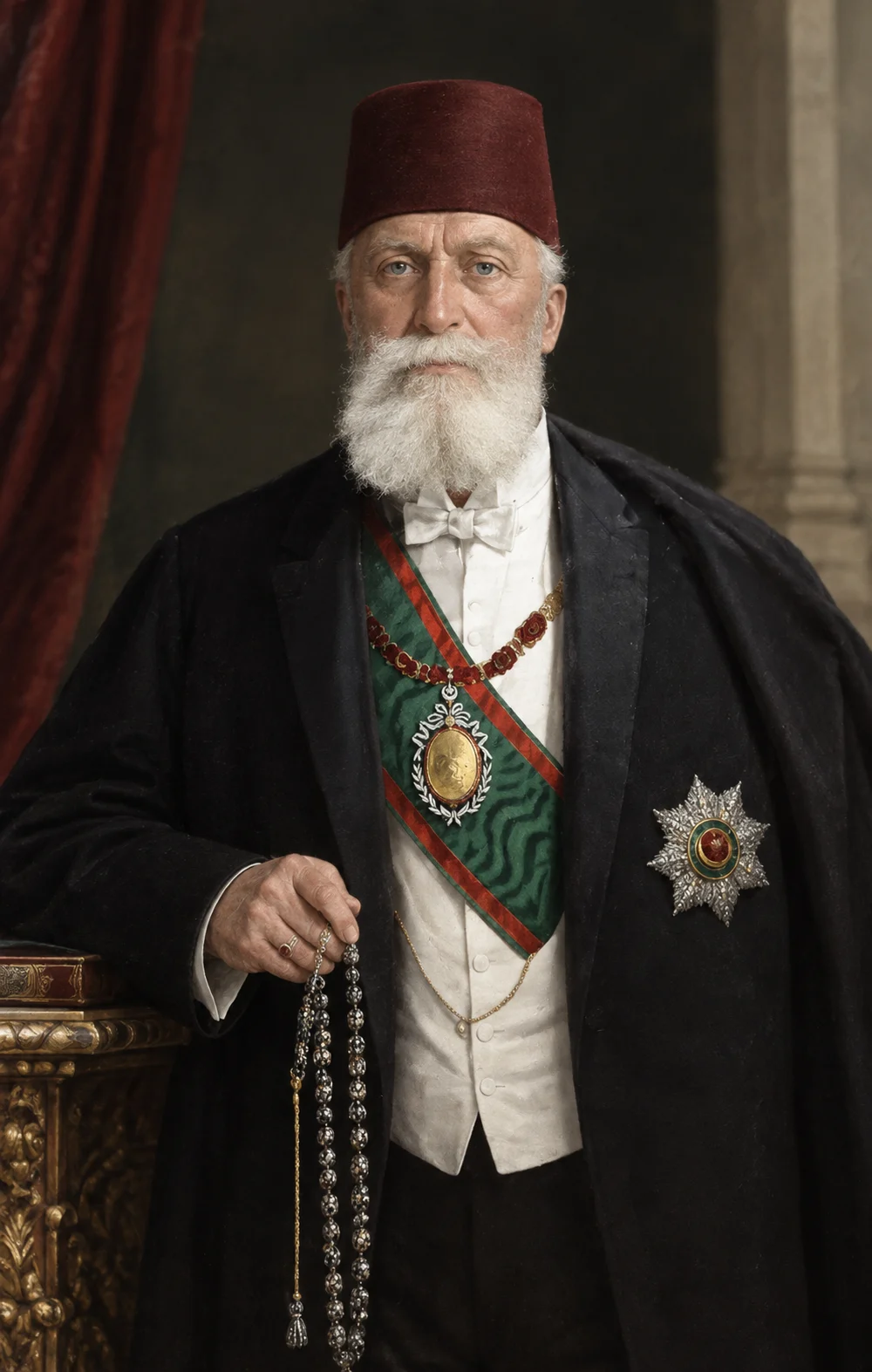
Abdülmecid II was the last person to hold the Ottoman caliphate, elected to the office by the Grand National Assembly of Turkey on 19 November 1922 and deposed by the same body on 3 March 1924. He is a distinct figure from his father Abdülmecid I, the Tanzimat-era sultan who reigned from 1839 to 1861, and from his cousin Mehmed VI, the last Ottoman sultan, whose abdication and departure from Istanbul in November 1922 created the vacancy he was elected to fill. Abdülmecid II never held the sultanate. For sixteen months he held a caliphate that the Assembly had deliberately separated from political power, and when even that office was abolished he spent the remaining twenty years of his life in exile in Switzerland, Nice, and finally Paris, pursuing the painting that had occupied him since childhood.
Early Life
Abdülmecid was born in Istanbul on 29 May 1868, the son of Sultan Abdülaziz and Hayranıdil Kadın. His father was deposed and died in 1876, when Abdülmecid was eight, and from that point until the restoration of constitutional government in 1908 he lived the secluded existence customary for Ottoman princes not in the direct line of succession — a confinement within the palace grounds intended to remove any prince as a focus of conspiracy. During these years he learned foreign languages and took up painting, a pursuit that remained central to his life. He became heir presumptive only on 4 July 1918, when his cousin's brother Mehmed VI Vahideddin came to the throne, and the sultanate he was heir to lasted a further four years before it was abolished.
At the end of the First World War, with Istanbul under Allied occupation, Abdülmecid was openly critical of some of Sultan Vahideddin's conduct and spoke in favour of the Kuvâ-yi Milliye, the national resistance forces gathering in Anatolia under Mustafa Kemal Pasha. At one point he considered travelling to Ankara himself, but the British authorities in occupied Istanbul, unwilling to see a member of the dynasty placed at the head of the national movement, kept him under surveillance and prevented it.
Election as Caliph
The dispute over whether the government to be invited to the postwar peace conference should be Istanbul's or Ankara's culminated in the Grand National Assembly's law of 1 November 1922, which separated the sultanate from the caliphate and abolished the former. The same law provided that the caliphate belonged to the Ottoman dynasty and that the Assembly would elect to it whichever member of the family was most fitted by learning and character, but it did not immediately name a caliph, and it was not disclosed that Vahideddin himself had been excluded from the office he had held as sultan. Vahideddin appeared at Friday prayers on 3 November still styling himself both sultan and caliph, and it was only after the Assembly resolved on 16 November to charge him with treason that he left Istanbul by British warship the following night. With the office now vacant in the Assembly's eyes, it elected Abdülmecid caliph on 19 November 1922, granting him the title khalifat al-Muslimin rather than the fuller style amir al-mu'minin traditionally carried by the caliphs.
The oath of allegiance was performed on 24 November 1922 in the Chamber of the Holy Mantle at Topkapı Palace, in the presence of a delegation from the Ankara government that included Refet Pasha and Hoca Mufid Efendi. For the first time the prayer accompanying the ceremony was recited in Turkish rather than Arabic, and the sermon delivered afterward at the Fatih mosque, also in Turkish, took as its text a hadith on the "greater jihad" against ignorance. Abdülmecid issued a proclamation to the Muslim world thanking the Assembly for his election.
The nature of a caliphate without a sultanate immediately became a live controversy, since the two offices had been held together by every Ottoman ruler since Selim I's conquest of the Mamluk lands, and Sunni practice had no real precedent for separating them. Refet Pasha, the Ankara government's representative in Istanbul, reported to Ankara that Abdülmecid wished to use the title "caliph of the Muslims and servant of the two holy sanctuaries," to appear at the Friday ceremonial procession, to wear a turban in the style of Sultan Mehmed the Conqueror, and to issue his proclamation to the Islamic world also in Arabic — requests that implied continuity with the sultanate's ceremonial forms. Mustafa Kemal Pasha responded that Abdülmecid might wear a frock coat rather than Mehmed the Conqueror's turban, signalling that the new arrangement was to look nothing like the old one. A further dispute arose over Abdülmecid's use of the style "caliph of the Messenger of God" in place of "caliph of the Muslims," and over his signing himself "Abdülmecid bin Abdülaziz Khan" in a manner recalling dynastic sovereignty; both were read in Ankara as an attempt to keep the idea of the sultanate alive under cover of the caliphate.
International reaction from Muslims outside Turkey was immediate and favourable to the new caliph. The Khilafat Conference held in India from 21 to 27 December 1922 recognised and endorsed Abdülmecid's caliphate. On 3 January 1923 Indian Muslim leaders conferred on Mustafa Kemal Pasha the title munji-i hilafet, "saviour of the caliphate," in gratitude for the office's preservation.
The Question of a Caliphate Without a Sultanate
The period between Abdülmecid's election and the declaration of the Turkish Republic in October 1923 was marked by continuing argument over what the caliph's position actually was. Advocates of the old order argued in pamphlets and in the press that a caliph necessarily held some form of governing authority and that the Assembly's arrangement was internally contradictory; the government's supporters replied that the caliphate could be an office of religious leadership only, separable from any state function. The Assembly moved to close the debate by law: on 15 April 1923 it passed Law No. 334, "On the Prohibition of Propaganda in Favour of the Sultanate," making the argument itself an offence.
The proclamation of the Republic on 29 October 1923 reopened the question, since rumours immediately circulated that the caliph intended to resign, rumours Abdülmecid personally denied. The matter came to a head in early December 1923, when a letter reached the Turkish government, published in the press on 5 December over the signatures of the Aga Khan and Amir Ali on behalf of the Islamic Society of Great Britain, urging that the caliphate be preserved and its dignity restored. The Assembly treated the letter as foreign interference in a domestic institution. On the night of 8-9 December 1923 it met in secret session and resolved to send a tribunal of the Independence Courts to Istanbul, a step that suppressed the pro-caliphate opposition within the Assembly itself. When budget debates in February 1924 turned to a formal motion, put forward by the deputy for Urfa, Şeyh Saffet Efendi, and fifty-three others, to abolish the caliphate and remove the dynasty from Turkey, objections that such a step "would grieve the Islamic world, that only the British would welcome it, and that the caliphate was a necessary institution for Turkey" were overruled. The Assembly passed Law No. 431 on 3 March 1924, abolishing the caliphate and providing for the expulsion of the Ottoman dynasty from Turkish territory.
Exile
On the night the law passed, Abdülmecid was taken by car to Çatalca and put on a train, accompanied by his son Ömer Faruk, his daughter Dürrüşehvar, the children's tutor Salih Keramet Nigar, two consorts, his private secretary Hüseyin Nakip, and his physician Selahaddin Bey. At the train the provincial governor handed him an envelope containing £2,000 and Swiss exit-only visas; a telegram was sent ahead reserving rooms at the Grand Hotel des Alpes in Territet, on Lake Geneva.
European journalists sought interviews with the deposed caliph at the hotel, and the European press reported him as devoted to his nation, resigned and dignified, and making no public criticism of those who had exiled him. Messages of regret at the caliphate's abolition reached him from various Muslim countries, seeking further information about events in Turkey. On 11 March 1924, in response to these messages, Abdülmecid issued a public statement through the news agencies declaring the Assembly's decision improper and irregular, announcing to Muslim communities everywhere that he considered it void, and calling for a religious council to be convened toward reviving the institution, for which he asked Muslims' support. Some four or five days later, an official from the Swiss foreign ministry's Near East department visited him to report that the statement had not been well received by the Turkish government and to ask that Switzerland not permit further activity of this kind. Abdülmecid's household expenses at the hotel exceeded £100 a week, and to relieve them he sent Salih Keramet Nigar to Paris to approach the ambassadors of Muslim states for support; failing there, Nigar travelled on to London, where the intercession of Amir Ali secured a monthly allowance of £300 from the Nizam of Hyderabad.
Abdülmecid moved to France in October 1924, settling first at Nice, where he devoted himself to religious observance, painting, and music, having found less interest from the wider Islamic world than he had anticipated. The Nizam of Hyderabad's approach to the family continued on a second footing: his elder son Azam Jah sought the hand of Abdülmecid's daughter Dürrüşehvar, and his younger son Muazzam Jah that of Niloufer, granddaughter of Şehzade Salahaddin Efendi. Both princesses married into the Hyderabad court in a simple ceremony, considerably easing Abdülmecid's financial position.
He settled in Paris in his later years and died there on 23 August 1944, while the city was under bombardment during the Second World War. His deputy, Salih Keramet Nigar, then in Istanbul, petitioned repeatedly for his remains to be returned to Turkey; the Turkish government refused every application, and his daughter Dürrüşehvar travelled to Turkey and secured a personal undertaking from President İsmet İnönü that the body could be brought home, but the undertaking was not honoured. Abdülmecid's remains rested at the Paris Mosque for ten years before being taken to Medina, where he was buried in the Jannat al-Baqi cemetery on 30 March 1954.
Painting
Abdülmecid painted throughout his life against the prevailing landscape tradition of Ottoman court painters of his generation, favouring the human figure instead. Works such as Beethoven at the Palace, Goethe in the Harem, Lady of the Palace, and a portrait of the scholar and museum director Halil Edhem, together with a self-portrait, are cited as examples of this figure-centred approach, in which he sought to bring together elements of Eastern and Western pictorial traditions in multi-figure compositions. His paintings were first exhibited publicly at a private gallery in Istanbul in 1986, more than four decades after his death.
Historiographical Note
This article is drawn entirely from the Diyanet/TDV İslâm Ansiklopedisi's entry on Abdülmecid II, which is itself based on Turkish parliamentary and government records — the secret session minutes of the Grand National Assembly, the correspondence of Refet Pasha as Ankara's representative in Istanbul, and the later memoir of Salih Keramet Nigar. None of these underlying records has been independently consulted for this article; the sequence of events set out above is reported as the Diyanet entry presents it. Interpretation of Abdülmecid's own intentions — whether his requests over titles and ceremonial in late 1922 reflected a wish to preserve the substance of the sultanate under the caliphate's name, or simply an unfamiliarity with the constitutional novelty he had been placed in — is likewise reported here as the entry frames it, without this article resolving the question independently. The wider debate over whether a caliphate could legitimately exist without political sovereignty was taken up at length by contemporary Muslim scholars after the office's abolition, most notably by Rashid Rida and by the Egyptian jurist Ali Abd al-Raziq, whose arguments belong to the history of the caliphate as an institution rather than to Abdülmecid's own biography and are not treated further here.
References and Further Reading
Primary Islamic Sources
- Law No. 431, Grand National Assembly of Turkey, 1 November 1922 — separating the caliphate from the sultanate and abolishing the latter, as discussed in the Diyanet/TDV İslâm Ansiklopedisi entry cited below; not independently consulted for this article.
- Law No. 431, Grand National Assembly of Turkey, 3 March 1924 — abolishing the caliphate and expelling the Ottoman dynasty from Turkey, as discussed in the same entry; not independently consulted for this article.
- Law No. 334, "On the Prohibition of Propaganda in Favour of the Sultanate," Grand National Assembly of Turkey, 15 April 1923 — as discussed in the same entry; not independently consulted for this article.
Classical Islamic Sources
- Keramet, Salih Nigar. Halife II. Abdülmecid [Caliph Abdulmecid II]. Istanbul, 1964. — memoir by Abdülmecid's private secretary and deputy in exile, as discussed and quoted in the Diyanet entry; not independently consulted for this article.
Academic and Scholarly Sources
- Konukçu, Enver (Müellif). "ABDÜLMECİD EFENDİ." TDV İslâm Ansiklopedisi. Istanbul: Türkiye Diyanet Vakfı İslâm Araştırmaları Merkezi, 1988, vol. 1. [approved external source: islamansiklopedisi.org.tr] — the principal source for this article.
Further Reading
- Zürcher, Erik J. Turkey: A Modern History. London: I.B. Tauris, 2004. — for the reader's further research into the wider Republican context; not consulted for this article.
- Minault, Gail. The Khilafat Movement: Religious Symbolism and Political Mobilization in India. New York: Columbia University Press, 1982. — for the reader's further research into the Indian reaction described above; not consulted for this article.
Mentioned In
2 articles reference this topic