Abdulhamid II: The Last Sultan to Rule
Abdulhamid II (1842-1918) ruled the Ottoman Empire from 1876 to 1909, the last sultan to exercise real power. He promulgated the empire's first constitution, suspended parliament within two years, governed personally for three decades, and was deposed after the Young Turk Revolution.
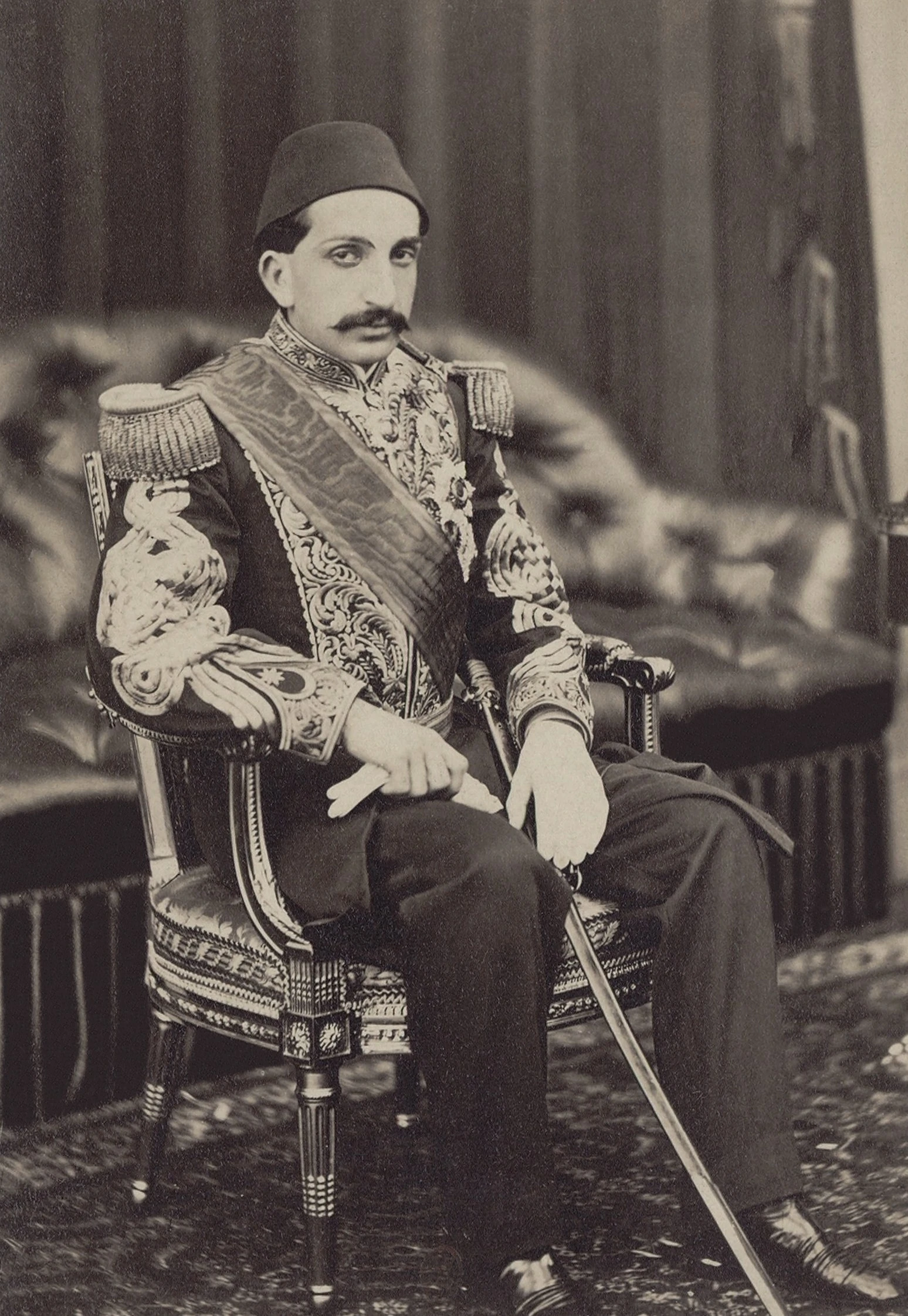
Abdülhamid II was the thirty-fourth ruler of the Ottoman Empire, reigning from August 1876 to April 1909, and the last Ottoman sovereign to exercise genuine executive power. The two sultans who followed him reigned as constitutional figureheads while others governed; he governed himself, from the Yıldız Palace, for thirty years.
His reign contains a contradiction that has defined every assessment of it. In December 1876, four months after his accession, he promulgated the first written constitution in Ottoman history and convened the first Ottoman parliament. In February 1878 he prorogued that parliament and did not recall it for thirty years, ruling instead through a personal administration supported by an extensive network of informers and a censored press. In the same three decades he built more railways, schools, telegraph lines and modern institutions than any predecessor, and he cultivated his position as caliph into a claim on the loyalty of Muslims far beyond his own frontiers.
He also presided over the largest territorial losses in Ottoman history outside wartime collapse, and over the massacres of Armenians in the 1890s. He was deposed by a constitutional movement led by officers his own schools had trained, and he died in 1918, in the year the empire he had held together was defeated and dismembered.
Accession in the Crisis of 1876
Abdülhamid was born in Istanbul on 21 September 1842, a son of Abdülmecid I, the sultan of the Tanzimat reforms. His mother died when he was young, and he was raised in the palace in circumstances the sources describe as isolated; he was not expected to reign.
The year 1876 was the most turbulent in Ottoman politics since the 1820s, and Abdülhamid's accession was its third change of sultan.
The empire had defaulted on its foreign debt in 1875, the culmination of the borrowing that had begun in his father's reign. The Balkans were in revolt: an uprising in Bosnia and Herzegovina from 1875, and an insurrection in Bulgaria in April 1876 whose suppression — carried out substantially by irregulars, with large-scale killing of civilians — became a major political issue in Britain and destroyed Ottoman standing in European opinion. Serbia and Montenegro then declared war.
In this situation a group of reforming ministers and officers, of whom Midhat Pasha was the leading civilian figure, deposed Sultan Abdülaziz in May 1876; he died days later, officially by suicide, in circumstances that were disputed at the time and remain so. His successor, Abdülhamid's elder brother Murad V, proved mentally incapable of governing and was deposed after ninety-three days. Abdülhamid was installed on 31 August 1876, having — according to the accounts — given the reformers to understand that he would grant a constitution.
The Constitution and Its Suspension
He kept the undertaking. The Kanun-ı Esasi, drafted by a commission under Midhat Pasha's influence, was promulgated on 23 December 1876. It provided for a bicameral parliament with an elected chamber, guaranteed personal liberties and equality before the law, and established ministerial government — while reserving very substantial powers to the sultan, including the appointment of ministers, the dissolution of the chamber, and a power of exile.
The timing was diplomatic as well as domestic: an international conference on the Balkan crisis was convening at Istanbul, and a constitution demonstrated that the empire could reform itself without external supervision. The conference failed regardless.
The first Ottoman parliament met in March 1877. It sat, in two sessions, for about a year.
What ended it was the war. Russia declared war in April 1877, and the Russo-Turkish War of 1877–78 was a catastrophe. Despite a prolonged and militarily creditable defence at Plevna, Ottoman forces were broken on both the Balkan and Caucasian fronts; Kars fell, Russian armies crossed the Balkan range, Edirne was taken, and by January 1878 they were at the approaches to Istanbul. The Treaty of San Stefano in March 1878 imposed terms so severe that the other powers intervened, and the settlement was revised at the Congress of Berlin in July 1878.
The losses at Berlin were the heaviest of any Ottoman peace to that date. Romania, Serbia and Montenegro became fully independent; Bulgaria became an autonomous principality with an autonomous province to its south; Bosnia and Herzegovina passed under Austro-Hungarian administration; Russia took Kars, Ardahan and Batum; and Britain took the administration of Cyprus as the price of its diplomatic support. Further losses followed shortly: Thessaly to Greece in 1881, Tunisia to France in 1881, and Egypt to British occupation in 1882.
Abdülhamid prorogued parliament in February 1878, in the last weeks of the war, and did not summon it again. The constitution was not formally abolished — it continued to be printed in the state almanac — but it ceased to operate. Midhat Pasha was removed, exiled, and later died in confinement in Arabia.
Thirty Years of Personal Rule
From 1878 Abdülhamid governed personally, and the character of that government is the central question about him.
He ruled from the Yıldız Palace, which he made into a working centre of administration rather than a ceremonial residence, and he concentrated decisions in his own hands to an extent no Ottoman sultan had attempted since the sixteenth century. Ministers were dependent on him and rotated frequently. The reformed bureaucracy that the Tanzimat had built continued to function, but it reported upward to a palace secretariat.
Two instruments of control defined the regime's reputation. The first was surveillance: an extensive apparatus of informers whose reports flowed into the palace, directed at the officer corps, the bureaucracy, the schools and the exiled opposition. The second was censorship of the press and of publishing, which was thorough and sometimes absurd in its detail, and which drove Ottoman political writing abroad — to Paris, Geneva, London and Cairo, where the opposition movements that eventually overthrew him took shape.
Alongside this, and not in contradiction to it, went a programme of state development that was among the most substantial in Ottoman history. Selim Deringil's study of the reign examines how these two aspects worked together: the modern state apparatus and the ideological legitimation of an autocracy were parts of a single project.
The record includes a very large expansion of education — professional schools for administration, law, medicine, engineering, veterinary science and finance, a great increase in secondary and primary provision, and the reorganisation of the imperial university at Istanbul in 1900. It includes the extension of the railway network, with the Anatolian lines, the concession for the Baghdad Railway, and above all the Hejaz Railway toward Medina, built between 1900 and 1908 and financed substantially by subscription from Muslims across the world. It includes the telegraph network, which reached across Anatolia and the Arab provinces and was the technical foundation of centralised control. And it includes census work, a reorganised judiciary, municipal administration, and the extension of Ottoman administrative presence into provinces that had previously been governed at arm's length.
The Yildiz Regime
The mechanics of Abdülhamid's personal rule are worth describing, both because they defined the experience of politics for a generation and because their failure in 1908 was so complete.
The seat of government was moved in practice from the ministries at the Sublime Porte to the Yıldız Palace on the hills above the Bosphorus. Yıldız was not a ceremonial residence but a working administrative complex, and the palace secretariat became the real centre of decision. Ministers held office at the sultan's pleasure, were rotated frequently, and dealt with him through his secretaries; the grand vizierate, which the Köprülüs had made into an executive office and the Tanzimat statesmen had used to run the empire, was reduced to a channel.
Two instruments sustained this.
The first was information. A large volume of reports flowed into the palace from paid and unpaid informers, directed at the officer corps, the bureaucracy, the schools, the religious establishment and the exile communities. The system's reputation for omnipresence was itself part of its effect, and the sources describing it — many written after 1908 by men with reason to dramatise — should be read with that in mind; the reports certainly existed in quantity, and the belief that anyone might be reporting did the rest.
The second was censorship. The press was licensed, pre-censored and frequently suppressed; publishing was controlled; and the range of prohibited subjects extended to anything touching on constitutions, revolutions, regicide or the deposition of monarchs, with the result that Ottoman newspapers of the period are notably empty of politics. Opponents were exiled to distant provincial posts or driven abroad.
The limits of the system are what make it interesting. Censorship at home pushed Ottoman political writing to Paris, Geneva, London and Cairo, where it circulated freely and returned through the post and through travellers; suppressing the discussion domestically simply relocated it beyond reach. Surveillance of the officer corps failed to detect, or failed to act against, the conspiracies that formed in the Third Army at Salonica. And the schools that were meant to produce loyal officials produced instead the constitutionalists of 1908, because a technical education in a state visibly losing territory to European powers led its recipients toward exactly the conclusions the censorship existed to suppress.
M. Şükrü Hanioğlu's study of Young Turk organisation traces how the opposition was built under these conditions, and the picture that emerges is of a surveillance state effective at silencing public discussion and ineffective at preventing organised conspiracy — a combination that guaranteed the change, when it came, would come from the army.
Railways, Schools, and the Hamidian State
The paradox of the reign is that the most autocratic Ottoman government of the modern period was also the most productive builder of modern state institutions, and the record deserves to be set out rather than gestured at.
Railways. The Ottoman network roughly tripled in length during the reign. The Anatolian Railway, built with German capital, reached Ankara in 1892 and Konya in 1896, and the concession for a line onward to Baghdad was granted at the turn of the century. Lines were extended in the Balkans, in western Anatolia and in Syria. The most striking project was the Hejaz Railway, built between 1900 and 1908 from Damascus to Medina — some 1,300 kilometres across desert — financed substantially by subscriptions from Muslims across the world and constructed largely by Ottoman engineers and soldiers. It shortened the pilgrimage to Medina from weeks to days and gave Istanbul military reach into Arabia, and it is the clearest single instance of the reign's pan-Islamic policy expressed in infrastructure.
Telegraph. The network was extended until it reached almost every provincial and district centre in the empire. Its purpose was administrative and political in equal measure: it allowed Istanbul to govern in something approaching real time, and it allowed the palace to monitor its own officials. It also, as 1908 demonstrated, allowed conspirators to coordinate.
Schools. The expansion of education was the reign's most consequential domestic achievement. Professional and higher schools were founded or reorganised for civil administration, law, medicine, engineering, commerce, fine arts and veterinary science; secondary and preparatory schools multiplied across the provinces; teacher-training institutions were established; and the imperial university at Istanbul was reorganised on a permanent footing in 1900. Benjamin Fortna's study of late Ottoman education examines both the scale of this and its intended purpose, which was to produce loyal, technically competent, religiously observant subjects — a state-directed alternative to the foreign and missionary schools that were educating a growing part of the empire's Christian population.
Administration and finance. The first modern Ottoman census was conducted between 1881 and 1893. Provincial administration, municipal government, land registration and the courts were all further developed on Tanzimat foundations. Fiscally, the reign began in default: the empire had suspended payments in 1875, and in 1881 an international Public Debt Administration was established, taking control of specified Ottoman revenues on behalf of foreign creditors. This was a grave loss of sovereignty and it did stabilise state finances, and Abdülhamid's government worked within it for thirty years.
The unifying thread is that these were instruments of central control as much as of development. Railways moved troops as well as pilgrims; the telegraph carried surveillance reports as well as administrative orders; the schools were designed to produce officials attached to the sultan-caliph. Selim Deringil's study of Hamidian legitimation argues that the modern apparatus and the ideological project were a single programme, and that reading them as contradictory misunderstands the reign.
The Caliphate and Pan-Islamism
Abdülhamid's most distinctive political innovation was his use of the caliphal title, and it responded to a real problem.
The Tanzimat had attempted to build a common Ottoman citizenship uniting subjects of all religions. By 1878 that project had visibly failed: the Christian populations of the Balkans had largely been lost to independent or autonomous states, and the empire's remaining population was, for the first time in centuries, overwhelmingly Muslim. Millions of Muslim refugees from the Caucasus and the Balkans had been resettled in Anatolia and Syria. In these circumstances an Islamic basis of legitimacy was both available and useful, in a way it had not been while the empire was trying to hold Bulgaria and Bosnia.
He therefore emphasised his position as caliph — the leader of the Sunni Muslim community — with a deliberateness his predecessors had not shown. Internally this meant religious patronage, the building of mosques and schools, the cultivation of the ulama and of Sufi orders, and the presentation of the sultan as the protector of Islam. Externally it meant cultivating Muslim populations under European rule: in British India, Russian Central Asia, the Dutch East Indies and French North Africa. Kemal Karpat's work examines how this transformed the caliphate from a largely dormant title into an active political instrument.
The Hejaz Railway was the emblem of the policy, serving the pilgrimage to Medina and Mecca and thereby the Hajj, while also giving Istanbul military reach into Arabia. Its funding by donations from Muslims across Asia and Africa demonstrated the appeal the policy had.
The results were real but limited. Abdülhamid acquired genuine prestige in the Muslim world outside his frontiers, and the attachment of Indian Muslims to the Ottoman caliphate — later expressed in the Khilafat agitation after the First World War, in which figures such as Mohammad Ali Jauhar and Abul Kalam Azad were prominent — owed much to this period. But pan-Islamic sentiment did not translate into force that could defend the empire, and the European powers, while irritated, were not deterred. Meanwhile the reformist Islamic thinkers of the period, including Jamal al-Din al-Afghani and Muhammad Abduh, had their own conceptions of Muslim revival that did not amount to endorsement of Hamidian autocracy; al-Afghani spent his last years in Istanbul under the sultan's supervision.
The Armenian Massacres
The most serious charge against the reign concerns the killings of Armenians in the mid-1890s, and it must be stated directly.
The background lay in the Treaty of Berlin, which had included provisions concerning reforms in the Armenian-populated eastern provinces, and in the emergence in the 1880s and 1890s of Armenian political organisations, some of them revolutionary, seeking autonomy or independence. The Ottoman government regarded these as a secessionist threat of the kind that had already cost it the Balkans, and it treated the wider Armenian population accordingly.
Between roughly 1894 and 1896 large-scale killings took place: in the Sasun district in 1894, in Istanbul in 1895 and 1896, and across the eastern provinces in 1895–96, carried out by regular troops, by irregular Kurdish cavalry formations the state had organised, and by local mobs. The number of deaths is not precisely established; scholarly estimates commonly range from tens of thousands to figures approaching or exceeding two hundred thousand, and the disparity reflects the absence of reliable records. Large numbers were also displaced or forcibly converted, and property destruction was extensive.
The extent of Abdülhamid's personal direction is debated among historians. The killings were not spontaneous, the state's forces were substantially involved, and the regime was highly centralised, which makes it difficult to detach the sultan from responsibility; some historians argue for direct central authorisation, others for a policy of encouragement and permission executed locally. What is not in dispute is that the killings occurred on a very large scale, that state forces participated, and that no serious accountability followed. It is from these events that the epithet applied to him in the European press of the period derives.
Neither the Ottoman government's characterisation of the events as the suppression of rebellion, nor the later Turkish official reticence about them, is an adequate account. Nor is it accurate to present the 1890s killings as identical to the genocide of 1915, which was carried out under a different government, on a different scale, and with a different organisation; the article on Mehmed V addresses that later event, and the article on the fall of the Ottoman Empire sets both in context.
The Young Turk Revolution and Deposition
Opposition to the regime grew from precisely the constituency the regime had created.
The graduates of the military and professional schools — young officers and officials with modern technical education, reading the political literature of Europe, and posted to provinces where they saw the empire losing ground — formed the Young Turk movement, organised in exile and, more dangerously, in clandestine cells within the army. The Committee of Union and Progress, based in the Third Army at Salonica, became its effective centre. Their programme was the restoration of the 1876 constitution.
In July 1908 units in Macedonia mutinied and demanded the constitution, and the movement spread through the army faster than the government could respond. Abdülhamid conceded: the constitution was restored, and elections were held for a new parliament.
In April 1909 a counter-revolutionary rising in Istanbul, driven by soldiers and religious conservatives, briefly overturned the constitutional government. Whether Abdülhamid instigated it has never been established, and historians differ. The Committee of Union and Progress responded by marching an army from Salonica on the capital, suppressing the rising, and deposing him on 27 April 1909.
He was exiled to Salonica and, when that city was lost in the Balkan Wars, brought back to Istanbul and confined at the Beylerbeyi Palace. He died there on 10 February 1918.
His brother Mehmed V succeeded him — as a constitutional figurehead, with the Committee of Union and Progress governing.
Historiographical Note
No Ottoman ruler's reputation is more sharply contested, and readers should know the shape of the disagreement.
Three traditions compete. The first is the contemporary European liberal one, which produced the image of a paranoid despot presiding over massacre and stagnation — a view shaped by the Bulgarian and Armenian killings and by the campaign against him in the British press. The second is Turkish republican historiography, which treated him as a reactionary obstacle whose overthrow prepared the way for the Young Turks and then for the Republic. The third, prominent in Turkish conservative and Islamist writing from the later twentieth century, presents him as a pious and far-sighted statesman who defended the empire against European predation and Zionist designs, and whose deposition opened the way to catastrophe.
None of the three is adequate, and each rests on selecting part of the record. Modern scholarly work has moved toward treating the reign as a case of authoritarian modernisation: Deringil's study of Hamidian legitimation, Hanioğlu's work on the Young Turks and the late empire, and Karpat's on the politicisation of Islam all examine how the expansion of state capacity, the ideological use of Islam, and the machinery of surveillance formed one coherent project rather than a contradiction.
Specific cautions. The claim that he personally ordered the Armenian massacres is argued by serious historians and contested by others; the evidence does not permit certainty, and this article records the dispute rather than resolving it. Death tolls for the 1890s killings vary by an order of magnitude. His role in the 1909 counter-revolution is unproven. The extent of the informer network is described in the sources in terms that may be exaggerated, since the regime benefited from the belief that it was omnipresent. And the reported exchange in which he refused Theodor Herzl's proposals for Jewish settlement in Palestine is documented in Herzl's own diaries and in Ottoman records, but has accumulated a great deal of later embellishment in polemical literature on all sides.
Assessment
Abdülhamid II held the Ottoman Empire together for thirty-three years under conditions that had destroyed the position of every government before him, and he did it by methods that produced the movement that removed him.
The case for the reign is stronger than its European reputation allows. He inherited a bankrupt state that had just lost a war it could not afford, with its Balkan provinces in revolt and the powers negotiating over its territory. He stabilised the finances, though at the cost of accepting foreign control of the debt. He built the physical and educational infrastructure of a modern state — railways, telegraph, schools, professional training, courts, municipal administration — on a scale that no earlier sultan approached, and much of what the Turkish Republic later built on dates from his reign. He extended Ottoman administrative control into Arab and Anatolian provinces that had previously been governed loosely. And he avoided major war for thirty years after 1878, in a period when war was what the empire could least afford, managing the powers by diplomacy, delay and the cultivation of German support.
The case against is equally substantial. He suspended a constitution he had granted and governed for three decades without representative institutions, sustaining his position through surveillance and censorship. The territorial losses of 1878 and the years that followed were the heaviest of any Ottoman peacetime period. And the Armenian massacres of the 1890s occurred under a highly centralised regime whose forces carried them out, which places responsibility with the government whatever the evidentiary position on his personal orders. That is not a matter that his infrastructural record offsets.
There is also a structural irony that is the most instructive thing about the reign. Abdülhamid's schools produced the officers and officials who overthrew him; his telegraph network let the conspirators of 1908 coordinate; his censorship drove the opposition into exile where it organised freely; and his emphasis on Islamic legitimacy could not compete, among the men he had educated, with the constitutional and national ideas they read. An autocracy that modernises its state creates the class that will demand a share of it. He seems to have understood the danger — the surveillance was directed at exactly these people — and the surveillance did not work.
The last judgement is about what followed. Those who defend him observe, correctly, that the empire survived his thirty-three years and was destroyed within thirteen of his deposition: the Balkan Wars stripped its European provinces, the First World War brought its defeat and partition, and the sultanate itself was abolished in 1922. Those who criticise him observe, also correctly, that the disaster of 1914–18 followed from the Young Turk government's decision to enter the war, and that Abdülhamid's own achievement was to postpone a crisis he did not resolve. Both are true. He was the last Ottoman sultan who governed, and the empire's remaining history was written by others.
References and Further Reading
Primary Islamic Sources
- Quran, Surah al-Nisa (4:58–59) — on rendering trusts, judging justly, and obedience to those in authority; the framework of Ottoman argument about the sultan-caliph's authority
- Quran, Surah Al-Imran (3:103) — on holding fast together and not becoming divided, a text central to the pan-Islamic rhetoric of the reign
- Quran, Surah al-Hujurat (49:10) — on the believers as a single brotherhood, the scriptural basis most frequently invoked for the caliphal appeal to Muslims beyond the empire
- Quran, Surah al-Shura (42:38) — on consultation, the verse cited by the constitutionalist opposition against personal rule
- Quran, Surah al-Hajj (22:27–28) — on the summons to pilgrimage, invoked in the campaign to fund the Hejaz Railway
- Sahih al-Bukhari, Kitab al-Ahkam, and Sahih Muslim, Kitab al-Imarah — the prophetic material on the caliphate, allegiance, consultation, and the accountability of rulers
Classical Islamic Sources
- Kanun-ı Esasi (Ottoman Basic Law), 23 December 1876 — the first Ottoman constitution, the central document of the reign
- The Treaty of San Stefano (March 1878) and the Treaty of Berlin (13 July 1878) — the instruments of the territorial settlement
- Ahmed Cevdet Pasha. Tezakir and Tarih-i Cevdet. [19th century]
- Said Pasha. Said Pasa'nin Hatiratı (Memoirs). [early 20th century] — the recollections of one of his grand viziers
- Tahsin Pasha. Yıldız Hatıraları. [20th century] — the memoirs of his palace secretary
- Al-Afghani, Jamal al-Din, and Abduh, Muhammad. Al-Urwa al-Wuthqa. [1884] — the reformist Islamic journal that framed a rival vision of Muslim revival
Academic and Scholarly Sources
- Deringil, Selim. The Well-Protected Domains: Ideology and the Legitimation of Power in the Ottoman Empire, 1876–1909. London: I.B. Tauris, 1998. — the standard study of Hamidian legitimation
- Hanioğlu, M. Şükrü. A Brief History of the Late Ottoman Empire. Princeton: Princeton University Press, 2008.
- Hanioğlu, M. Şükrü. Preparation for a Revolution: The Young Turks, 1902–1908. New York: Oxford University Press, 2001.
- Karpat, Kemal H. The Politicization of Islam: Reconstructing Identity, State, Faith, and Community in the Late Ottoman State. New York: Oxford University Press, 2001.
- Zürcher, Erik J. Turkey: A Modern History. London: I.B. Tauris, 2004.
- Shaw, Stanford J. and Shaw, Ezel Kural. History of the Ottoman Empire and Modern Turkey, vol. II. Cambridge: Cambridge University Press, 1977.
- Fortna, Benjamin C. Imperial Classroom: Islam, the State, and Education in the Late Ottoman Empire. Oxford: Oxford University Press, 2002. — on the school system and its consequences
- Suny, Ronald Grigor. "They Can Live in the Desert but Nowhere Else": A History of the Armenian Genocide. Princeton: Princeton University Press, 2015. — for the 1890s massacres and their relation to later events
Further Reading
- Quataert, Donald. The Ottoman Empire, 1700–1922. Cambridge: Cambridge University Press, 2005.
- Anderson, M. S. The Eastern Question, 1774–1923. London: Macmillan, 1966.
- Ochsenwald, William. The Hijaz Railroad. Charlottesville: University Press of Virginia, 1980.
- Findley, Carter V. Turkey, Islam, Nationalism, and Modernity: A History, 1789–2007. New Haven: Yale University Press, 2010.
- Georgeon, François. Abdulhamid II: le sultan calife. Paris: Fayard, 2003. — the fullest modern biography.
Mentioned In
5 articles reference this topic
More from Ottoman Empire
Battle of Nicopolis (1396 CE)
The Battle of Nicopolis, fought on 25 September 1396, was a decisive Ottoman victory over a combined Western European crusading army under Sigismund of Hungary. The last major crusade of the medieval period, its failure cemented Ottoman dominance over the Balkans.
Blue Mosque: The Sultan Ahmed Mosque of Istanbul
The Blue Mosque (Sultan Ahmed Mosque) in Istanbul, built between 1609-1616 CE, is one of the most magnificent examples of Ottoman architecture and a masterpiece of Islamic architectural achievement.
Bosnia and Herzegovina: Islamic Heritage in the Balkans
The westernmost region of sustained Muslim presence in Europe. Ottoman rule from 1463 until the Austro-Hungarian occupation of 1878 produced a distinctive Bosniak Muslim culture that joined Ottoman traditions to indigenous Balkan ones.
Conquest of Constantinople - The Fall of Byzantium
The historic conquest of Constantinople by Ottoman Sultan Mehmed II on May 29, 1453 CE, ending the Byzantine Empire and establishing Ottoman dominance in southeastern Europe. This pivotal victory transformed the Ottomans into a major European power.