Mehmed V Resad: The Constitutional Sultan
Mehmed V (1844-1918) reigned as Ottoman sultan from 1909 to 1918 as a constitutional figurehead while the Committee of Union and Progress governed. His reign saw the loss of Libya and the Balkan provinces, entry into the First World War, and the Armenian genocide.
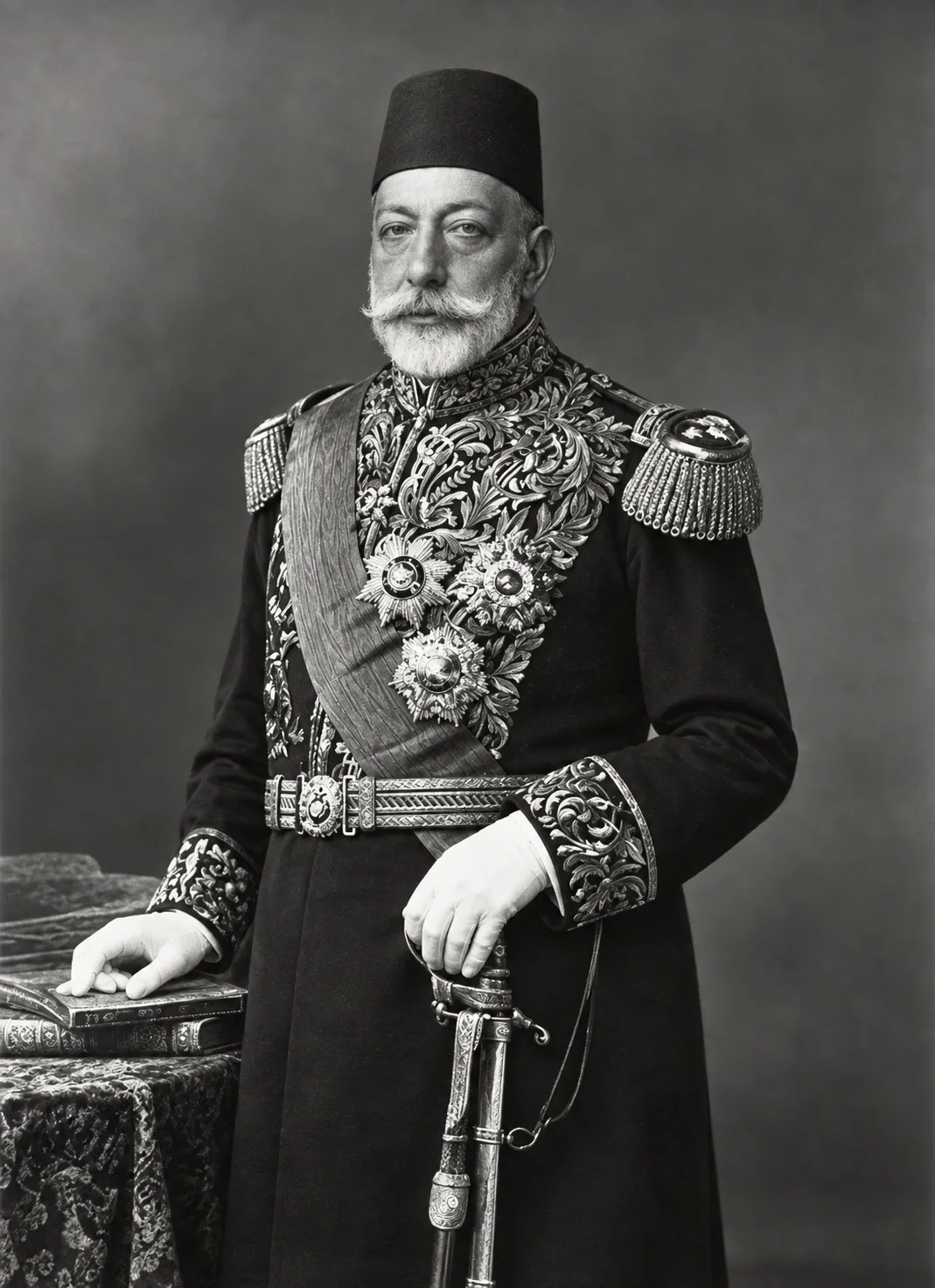
Mehmed V Reşad was the thirty-fifth ruler of the Ottoman Empire, reigning from April 1909 until his death in July 1918. He succeeded his brother Abdülhamid II, who had been deposed by the constitutional movement, and he reigned on terms his brother would not have recognised: as a constitutional monarch who swore to uphold the restored constitution, opened parliament, and left government to his ministers.
In practice the ministers were the Committee of Union and Progress, the organisation that had made the revolution of 1908, and from 1913 the empire was directed by a small group within it — principally Enver Pasha, Talat Pasha and Cemal Pasha. Mehmed V's function was to legitimise their decisions. He did not choose them, and there is little evidence that he could have refused them.
The nine years of his reign were the most destructive in Ottoman history. The empire lost Libya and the Dodecanese to Italy in 1912, and almost all of its remaining European territory in the Balkan Wars of 1912–13. In late 1914 it entered the First World War on the side of Germany and Austria-Hungary, a decision taken by a handful of men, and Mehmed V — as caliph — issued the proclamation of holy war intended to raise the Muslim subjects of the Allied empires. During the war the Armenian population of Anatolia was destroyed in the deportations and massacres of 1915–16, carried out under the authority of the Union and Progress government. He died in July 1918, four months before the armistice that ended the empire's participation in the war and began its dismemberment.
A Prince in Seclusion
Mehmed Reşad was born in Istanbul on 2 November 1844, a son of Abdülmecid I. Three of his brothers reigned before or after him — Murad V, Abdülhamid II, and Mehmed VI — so that the last four decades of the Ottoman dynasty were governed entirely by his father's sons.
He spent the greater part of his adult life in enforced obscurity. Under Abdülhamid II, the heir presumptive was a potential focus for opposition, and Mehmed Reşad lived for some three decades under close supervision, with limited contact with public affairs and no administrative or military experience. He was reportedly a man of scholarly and literary interests, with an attachment to Sufi devotion and to classical Ottoman poetry, and he had no political following of his own.
When the Committee of Union and Progress deposed Abdülhamid II in April 1909, after the suppression of a counter-revolutionary rising in Istanbul, this was the man they placed on the throne. He was sixty-four, inexperienced, and entirely dependent on those who had elevated him — which was the point. The constitutional amendments enacted in 1909 further reduced the sultan's powers, transferring the substance of executive authority to ministers responsible to parliament.
Constitutional Monarch in Name
The constitutional order Mehmed V presided over did not develop into stable parliamentary government, and understanding why is necessary to understand his reign.
The Committee of Union and Progress had come to power as a constitutional movement, but it was also a clandestine organisation with a base in the army, and it was unwilling to lose control of a state it believed to be facing dissolution. Between 1909 and 1913 Ottoman politics ran through a rapid series of governments, contested elections — the 1912 election was so heavily managed that it is remembered as the "election of clubs" — and army intervention on both sides.
The crisis came in January 1913. Following the disasters of the First Balkan War, a Union and Progress group led by Enver seized the government by force in the Raid on the Sublime Porte, killing the war minister. From that point the empire was governed by a Union and Progress dictatorship, with Enver as war minister, Talat as interior minister and later grand vizier, and Cemal in command in Syria. Parliament continued to meet; it did not control the government.
Mehmed V's role in all this was formal. He gave assent, received ministers, opened parliament, and performed the ceremonial and religious functions of the sultanate and caliphate. The sources give no indication that he attempted to direct policy, and the constitutional structure after 1909 left him few means to do so.
Territorial Collapse: Libya and the Balkans
The losses of 1911 to 1913 removed most of what the empire still held outside Anatolia and the Arab lands.
Italy attacked in September 1911, seeking Ottoman Libya. The Ottoman garrison was small, distant and difficult to reinforce, and the Italians also occupied the Dodecanese islands in the Aegean. The Treaty of Lausanne of 1912 ended the war with the loss of Tripolitania and Cyrenaica; Italy retained the Dodecanese as well.
The Balkan Wars followed immediately and were far worse. In October 1912 Bulgaria, Serbia, Greece and Montenegro — having composed their own differences for the purpose — attacked simultaneously. The Ottoman army, in the middle of reorganisation and still committed in Libya, was defeated on every front within weeks. Salonica, the empire's second city and the birthplace of the Young Turk movement, surrendered in November. Ottoman forces fell back on lines close to Istanbul. Edirne, the old European capital, fell in March 1913.
The Treaty of London in May 1913 recorded the loss of nearly all Ottoman territory in Europe. When the victors then fought each other over the spoils in the Second Balkan War later that year, Ottoman forces recovered Edirne and eastern Thrace, confirmed by the Treaty of Constantinople — the reign's only territorial gain.
The consequences went far beyond the map, and the human dimension of the collapse — the killing and expulsion of Muslim civilians and the flight of hundreds of thousands of refugees into Anatolia and Thrace — is treated in the following section, because it shaped the empire's conduct for the rest of its existence.
The Balkan Catastrophe and the Refugees
The loss of Ottoman Europe in 1912–13 was not only a territorial defeat, and its human dimension shaped everything the empire did afterwards.
The territorial outcome is quickly stated. Within a few months the empire lost almost all of its remaining European possessions: Macedonia, Albania, Epirus, most of Thrace, and the Aegean islands. Salonica — the empire's second city, a major port, and the birthplace both of the Young Turk movement and of Mustafa Kemal — surrendered in November 1912. Four centuries of Ottoman rule in southeastern Europe ended in a single campaigning season.
The human dimension was worse. The advancing armies and irregular forces, on all sides, conducted large-scale violence against civilian populations of the wrong religion, and the Muslim populations of the lost provinces were killed, driven out, or fled in very large numbers. Hundreds of thousands of Muslim refugees — the muhacir — arrived in Thrace and Anatolia destitute, and the Ottoman state, already fiscally exhausted, had to feed and resettle them. Estimates of the deaths and of the numbers displaced vary widely and are contested; the scholarship on Muslim losses in the Balkans, of which Justin McCarthy's work is the best known and among the more debated, gives figures that other historians consider high, and no precise accounting is possible.
The political consequences were direct and are essential to understanding 1915.
The Union and Progress leadership concluded from the Balkan Wars that the empire faced not gradual decline but extinction, and that its Christian populations were the instrument by which European powers dismembered it. The sequence they had just watched — a Christian minority with an external patron, foreign pressure for reforms on its behalf, autonomy, and then secession with the patron's army — had cost them Greece, Serbia, Bulgaria, Romania and now Macedonia. When the Armenian question in eastern Anatolia presented what they took to be the same pattern, with Russia as the patron, they responded accordingly. Erik Zürcher's history is explicit that the radicalisation of Ottoman policy toward the Armenian population cannot be understood apart from the Balkan experience, and that the refugees who had just been driven out of the Balkans were among those resettled in Anatolia and, in places, among the perpetrators of what followed.
This is an explanation and not a justification, and the distinction matters. The Balkan Wars supply the political psychology of the Union and Progress regime; they do not make the destruction of a civilian population a defensive measure.
The First World War
The Ottoman decision to enter the war was taken by a small number of men and is among the most consequential decisions in the empire's history.
A secret alliance with Germany was concluded in August 1914. Two German warships took refuge in Ottoman waters, were nominally transferred to the Ottoman navy, and in October, under Ottoman colours and German command, bombarded Russian Black Sea ports. War with the Entente followed in November. Mustafa Aksakal's study of the Ottoman road to war argues that the decision was not German manipulation of a passive empire but an Ottoman calculation — that neutrality offered no protection to a state everyone expected to partition, and that a German alliance offered the only prospect of recovering lost territory and escaping foreign financial and legal controls. It was a gamble taken by men who believed the alternative was slow dissolution.
Mehmed V's part was the proclamation of jihad in November 1914. As caliph he called on Muslims to support the Ottoman cause, and the proclamation was aimed squarely at the Muslim subjects of Britain, France and Russia — in India, Egypt, North Africa and Central Asia. This was the pan-Islamic policy his brother had cultivated, put to its intended use. It had little practical effect: Muslim troops in the Allied armies did not defect in significant numbers, and the Sharif of Mecca revolted against the Ottomans in 1916 with British support. The most durable consequence was felt after the empire's defeat, in the attachment of Indian Muslims to the caliphate that produced the Khilafat agitation, in which figures such as Mohammad Ali Jauhar and Abul Kalam Azad were leading voices.
The military record was mixed and ultimately hopeless. The Ottoman army mounted a successful defence of the Dardanelles against the Allied landings at Gallipoli in 1915–16, one of the significant defensive achievements of the war, and captured a British force at Kut in Mesopotamia in 1916. Against these stand the destruction of an Ottoman army in the Caucasus in the winter of 1914–15 at Sarıkamış, the loss of Baghdad in 1917 and of Jerusalem in the same year, the Arab Revolt from 1916, and the collapse of the Syrian front in 1918. The home front deteriorated severely, with requisitioning, conscription, transport breakdown and famine conditions in parts of Anatolia and Syria.
Gallipoli and the Ottoman War
The Ottoman military effort in the First World War was more substantial than the empire's ultimate defeat suggests, and its outline belongs in any account of the reign.
The war began badly in the east. Enver Pasha's winter offensive into the Caucasus in December 1914 was mounted in mountain terrain against a prepared Russian defence with inadequate supply and clothing, and it ended at Sarıkamış with the destruction of an Ottoman army, the greater part of the losses caused by cold and disease rather than fighting.
The Dardanelles was the counterpoint. An Allied attempt to force the straits by naval power alone failed in March 1915 against mines and shore batteries. The landings that followed in April 1915, at Cape Helles and on the Aegean coast of the Gallipoli peninsula, were contained; a further landing in August failed to break the deadlock; and the Allies evacuated between December 1915 and January 1916. The campaign cost each side something on the order of a quarter of a million casualties. It was the Ottoman army's most significant defensive achievement, it kept Istanbul and the straits closed to the Allies — with grave consequences for Russia, which could not be supplied through the Black Sea — and it made the reputation of Mustafa Kemal, then a divisional commander, whose later career is discussed in the article on Mehmed VI.
Mesopotamia produced the war's other Ottoman success. A British advance up the Tigris was halted and driven back, and the besieged force under General Townshend surrendered at Kut al-Amara in April 1916 — one of the more complete British capitulations of the war.
Against these stand the losses. Baghdad fell in March 1917 and Jerusalem in December of the same year. The Arab Revolt from June 1916 opened a front in the Hejaz and denied the Ottomans the religious argument they had counted on. The Syrian front collapsed in the autumn of 1918, and Damascus fell in October.
The home front deteriorated severely throughout. Conscription stripped the countryside of labour; requisitioning took animals, carts and grain; the transport system, never adequate, broke down; and famine conditions developed in parts of Anatolia and, most severely, in Mount Lebanon and Syria, where blockade, requisitioning and a locust infestation combined to kill civilians in very large numbers. Edward Erickson's study of the Ottoman army examines the military effort, and Eugene Rogan's account of the war in the Middle East sets the fronts and the home front together.
The empire fielded armies on four or five fronts simultaneously for four years with a pre-war population of some twenty million and a broken treasury, which is a considerable military achievement and was not a survivable one.
The Arab Provinces
The war also ended four centuries of Ottoman rule over the Arab lands, and the process deserves separate treatment because its consequences outlasted the empire.
The Arab provinces — Syria, Palestine, Lebanon, Mesopotamia and the Hejaz — had been Ottoman since the conquests of Selim I in 1516–17, and the empire's claim on them rested substantially on the sultan's position as caliph and protector of the holy cities. Ottoman rule there had been loose for much of its history and was tightened considerably during the Hamidian period, with railways, telegraphs and a larger administrative presence.
The Union and Progress government's policies strained this relationship. Its emphasis on centralisation and on Turkish as the language of administration and education antagonised Arab notables and the small but growing Arab nationalist and decentralist movements, and Cemal Pasha's administration in Syria during the war combined military requisitioning with the public execution of Arab nationalist figures in 1915 and 1916 — measures that turned a political grievance into a personal one for the notable families of Damascus and Beirut.
The Arab Revolt began in June 1916, led by Sharif Husayn of Mecca, the Ottoman-appointed guardian of the holy cities, in an arrangement with Britain that promised support for Arab independence in terms that were deliberately imprecise and that conflicted with commitments Britain was making simultaneously to France and, in the Balfour Declaration of 1917, regarding a Jewish national home in Palestine. Ottoman forces held Medina until after the armistice, but the revolt cut the Hejaz Railway, tied down troops, and — most damagingly — destroyed the caliphal argument. The sultan-caliph had proclaimed holy war; the guardian of Mecca and Medina had taken up arms against him.
Syria and Palestine were lost in 1917–18, and Mesopotamia progressively from 1915. The wartime Anglo-French understanding known as the Sykes-Picot Agreement, and the mandate arrangements that followed the war, divided these provinces between Britain and France and drew the boundaries from which the modern states of the region emerged — a process traced in the article on the fall of the Ottoman Empire. The famine that afflicted Mount Lebanon and parts of Syria during the war, caused by blockade, requisitioning, locust infestation and transport collapse, killed civilians in very large numbers and remains a defining memory of the period in those countries.
The Armenian Genocide
The deportation and destruction of the Ottoman Armenian population took place during Mehmed V's reign, and it requires a direct and accurate statement.
From the spring of 1915, following the Ottoman defeat in the Caucasus and the Allied landings at Gallipoli, the Union and Progress government ordered the deportation of the Armenian population of Anatolia to the Syrian desert. Armenian community leaders and intellectuals in Istanbul were arrested in April 1915; men of military age were separated and killed in large numbers; and the remainder — women, children and the elderly — were driven on marches during which they were subjected to massacre, starvation, exposure and abduction. Deaths are generally estimated at between roughly 800,000 and 1.5 million. Assyrian and Greek Orthodox populations were also subjected to deportation and mass killing during the same period.
The scholarly consensus is that these events constitute genocide, and they are recognised as such by many states and by the principal professional bodies of historians of the field; the standard account in English is Ronald Grigor Suny's study. The Republic of Turkey officially disputes that characterisation, acknowledging large-scale Armenian deaths but attributing them to wartime conditions, disease, famine and inter-communal violence rather than to a state policy of extermination. The dispute is recorded here because it exists; it is not a balance between two equally supported historical positions, and the weight of scholarship is on one side.
Responsibility rests with the Union and Progress leadership — Talat Pasha as interior minister above all, together with Enver Pasha and the party's regional apparatus. Mehmed V was a figurehead who neither designed nor directed the policy, and no evidence indicates that he initiated it. Nor is there evidence that he took any effective step to prevent it. The distinction between a sovereign without power and a sovereign who exercised it matters for assessing the man; it does not diminish what was done in his name and under his seal.
Death
Mehmed V died in Istanbul on 3 July 1918, aged seventy-three, after a reign of nine years. He did not live to see the armistice of Mudros in October, the Allied occupation of his capital, or the partition of the empire.
He was succeeded by his brother Mehmed VI, the last Ottoman sultan.
Historiographical Note
Mehmed V is a minor figure in a major period, and the historiography reflects that: he appears in the literature chiefly as a constitutional formality, and there is no substantial modern biography of him in English.
The sources for the reign are abundant but are about other people. Ottoman parliamentary records, the Union and Progress party's own documentation, the memoirs of the leading figures — many written in exile after 1918 and self-serving accordingly — German, British and Russian diplomatic and military archives, and the extensive documentation of the Armenian deportations, including Ottoman court-martial proceedings held in 1919–20, missionary and consular reports, and survivor testimony.
Two interpretative points. First, the older view that the Ottoman Empire was dragged into the war by German manipulation has been substantially revised by work such as Aksakal's, which establishes Ottoman agency in the decision. Second, the question of continuity between the massacres of the 1890s under Abdülhamid II and the genocide of 1915 under the Union and Progress government is actively debated: the perpetrating regimes were different in ideology and organisation, and the 1915 events were of a different order in scale and intent, while the earlier violence, the loss of the Balkans, and the refugee experience form part of the background that made the later policy possible.
Cautions on figures: casualty and death-toll estimates for the Balkan Wars, the Armenian genocide, and the wartime famines are all contested and imprecise. The extent of Mehmed V's own knowledge of the deportations is not established by the available evidence.
Assessment
Mehmed V presided over the destruction of the Ottoman Empire and did not cause it, and the difficulty in assessing him is that so little of what happened in his reign was his doing.
He was placed on the throne at sixty-four precisely because he had no power base, no experience and no faction, after three decades in which his brother had kept him in seclusion. The 1909 constitutional amendments removed most of what remained of the sultan's executive authority. From 1913 the empire was run by a party dictatorship that had seized the government by killing a minister. In these circumstances the sultan's capacity to alter the course of events was very small, and the record contains no evidence that he tried.
Two things can fairly be credited to him. He accepted the constitutional order and did not attempt to subvert it, which — after his brother's thirty years of personal rule and given that a counter-revolution had been mounted in Abdülhamid's name only weeks before his accession — was not a trivial choice. And he performed the legitimising and religious functions of the sultanate and caliphate competently at a time when the dynasty had little else to offer, which held together the loyalty of Muslim populations both inside the empire and beyond it.
Two things weigh against him, and the second heavily. The proclamation of holy war in 1914 attached the religious authority of the caliphate to a decision to enter a European war on the side of Germany, taken by three men, that destroyed the empire. And the Armenian genocide was carried out during his reign, under his government, with his seal on its instruments. He did not order it and could probably not have prevented it; he also did not resist it, and no serious account suggests he attempted to. A sovereign whose only remaining asset was moral authority declined to spend it on the largest crime committed in his name.
The deeper judgement is about the office rather than the man. By 1909 the Ottoman sultanate had been reduced to a source of legitimacy for other people's decisions, and Mehmed V's reign demonstrated how little that was worth when the decisions were catastrophic. His brother had been the last sultan to rule; he was the first to reign in the modern constitutional sense, and the experiment lasted nine years before the state it presided over ceased to exist. The process is traced in the article on the fall of the Ottoman Empire, and its final stage belonged to his brother and successor.
References and Further Reading
Primary Islamic Sources
- Quran, Surah al-Shura (42:38) — on consultation, the verse invoked by Ottoman constitutionalists in support of parliamentary government
- Quran, Surah al-Nisa (4:59) — on obedience to God, the Messenger and those in authority; the text at issue in the constitutional redefinition of the sultan's role
- Quran, Surah Al-Imran (3:103) — on holding fast together and not becoming divided, central to the caliphal appeal of 1914
- Quran, Surah al-Baqarah (2:190) — on fighting those who fight you and not transgressing limits; the verse whose limits were most plainly violated by the deportations of 1915
- Quran, Surah al-Maidah (5:32) — on the gravity of taking a single life, the text most directly relevant to the events of 1915 and cited by Ottoman Muslims who sheltered Armenians
- Sahih al-Bukhari, Kitab al-Jihad wa al-Siyar, and Sahih Muslim, Kitab al-Jihad — the prophetic material on the declaration of war, the prohibition of killing non-combatants, and the protection of non-Muslim subjects
Classical Islamic Sources
- Kanun-ı Esasi (Ottoman Basic Law), as restored in 1908 and amended in 1909 — the constitutional basis of his reign
- The caliphal proclamation of November 1914 and the accompanying fetva — the primary documents of the Ottoman declaration of holy war
- The Treaty of London (1913) and the Treaty of Bucharest (1913) — the instruments recording the Balkan losses
- The Ottoman court-martial records of 1919–20 concerning the wartime deportations — the empire's own judicial proceedings on the events of 1915
- Talat Pasha. Hatıralar (Memoirs). [posthumous] — the recollections of the minister principally responsible for the deportations
- Cemal Pasha. Hatıralar. [1922]; Enver Pasha, papers and correspondence — the accounts of the triumvirate that governed
Academic and Scholarly Sources
- Aksakal, Mustafa. The Ottoman Road to War in 1914. Cambridge: Cambridge University Press, 2008. — the standard study of the decision for war
- Zürcher, Erik J. Turkey: A Modern History. London: I.B. Tauris, 2004.
- Hanioğlu, M. Şükrü. A Brief History of the Late Ottoman Empire. Princeton: Princeton University Press, 2008.
- Suny, Ronald Grigor. "They Can Live in the Desert but Nowhere Else": A History of the Armenian Genocide. Princeton: Princeton University Press, 2015.
- Kévorkian, Raymond. The Armenian Genocide: A Complete History. London: I.B. Tauris, 2011.
- Shaw, Stanford J. and Shaw, Ezel Kural. History of the Ottoman Empire and Modern Turkey, vol. II. Cambridge: Cambridge University Press, 1977.
- Hall, Richard C. The Balkan Wars, 1912–1913. London: Routledge, 2000.
- Erickson, Edward J. Ordered to Die: A History of the Ottoman Army in the First World War. Westport: Greenwood, 2001.
Further Reading
- Fromkin, David. A Peace to End All Peace: The Fall of the Ottoman Empire and the Creation of the Modern Middle East. New York: Holt, 1989.
- Rogan, Eugene. The Fall of the Ottomans: The Great War in the Middle East. London: Allen Lane, 2015.
- McMeekin, Sean. The Ottoman Endgame: War, Revolution and the Making of the Modern Middle East, 1908–1923. London: Allen Lane, 2015.
- Quataert, Donald. The Ottoman Empire, 1700–1922. Cambridge: Cambridge University Press, 2005.
- Findley, Carter V. Turkey, Islam, Nationalism, and Modernity: A History, 1789–2007. New Haven: Yale University Press, 2010.
Mentioned In
3 articles reference this topic
More from Ottoman Empire
Battle of Nicopolis (1396 CE)
The Battle of Nicopolis, fought on 25 September 1396, was a decisive Ottoman victory over a combined Western European crusading army under Sigismund of Hungary. The last major crusade of the medieval period, its failure cemented Ottoman dominance over the Balkans.
Blue Mosque: The Sultan Ahmed Mosque of Istanbul
The Blue Mosque (Sultan Ahmed Mosque) in Istanbul, built between 1609-1616 CE, is one of the most magnificent examples of Ottoman architecture and a masterpiece of Islamic architectural achievement.
Bosnia and Herzegovina: Islamic Heritage in the Balkans
The westernmost region of sustained Muslim presence in Europe. Ottoman rule from 1463 until the Austro-Hungarian occupation of 1878 produced a distinctive Bosniak Muslim culture that joined Ottoman traditions to indigenous Balkan ones.
Conquest of Constantinople - The Fall of Byzantium
The historic conquest of Constantinople by Ottoman Sultan Mehmed II on May 29, 1453 CE, ending the Byzantine Empire and establishing Ottoman dominance in southeastern Europe. This pivotal victory transformed the Ottomans into a major European power.