Abdulmecid I: The Sultan of the Tanzimat
Abdulmecid I (1823-1861) became Ottoman sultan at sixteen and presided over the Tanzimat, the empire's most sweeping programme of legal and administrative reform. He issued the Edict of Gulhane in 1839, survived the Crimean War, and fathered four future sultans.
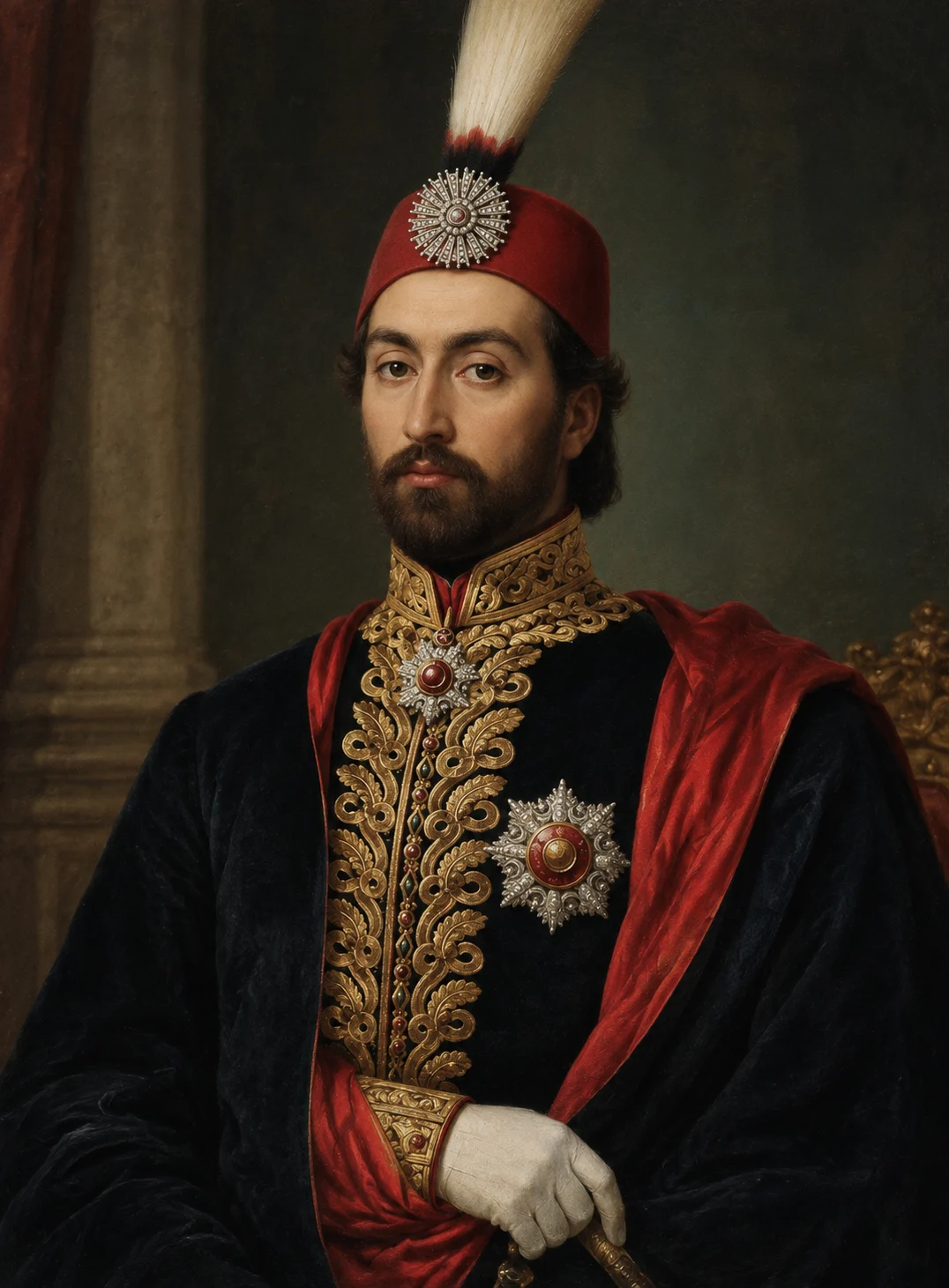
Abdülmecid I was the thirty-first ruler of the Ottoman Empire, reigning from July 1839 until his death in June 1861. He came to the throne at sixteen, in the middle of a military emergency that threatened the empire's existence, and his twenty-two-year reign gave its name to the Tanzimat — the reordering — the most far-reaching programme of legal, administrative and educational reform the Ottoman state ever attempted.
Within four months of his accession his government issued the Edict of Gülhane, which promised every Ottoman subject security of life, honour and property regardless of religion, and undertook to replace tax farming with regular assessment and arbitrary punishment with law. Seventeen years later, a second edict went further, declaring the civil equality of Muslim and non-Muslim subjects and abolishing the poll tax that had defined the legal position of Christians and Jews since the earliest Islamic states. Between and around these documents came new legal codes, secular courts, a reorganised bureaucracy, a modern education system, telegraph and postal services, a state bank, and a new palace on the Bosphorus.
He also presided over the Crimean War, which admitted the Ottoman Empire formally into the European state system while making it dependent on European support; over the beginning of the foreign borrowing that would bankrupt the empire within fifteen years of his death; and over the first serious stirrings of the national movements that eventually dismembered it. And he fathered four sons who all became sultan: Murad V, Abdülhamid II, Mehmed V, and Mehmed VI, the last Ottoman sovereign.
Accession in an Emergency
Abdülmecid was born in Istanbul on 25 April 1823, the son of Sultan Mahmud II. His father's reign had been a sustained attempt to rebuild Ottoman central authority — the destruction of the Janissary corps in 1826, the creation of a new army on European lines, the reduction of provincial notables, and the beginnings of bureaucratic reform — pursued against continuous crisis, including Greek independence and the loss of Algiers to France.
Mahmud II died on 1 July 1839. The situation his son inherited was acute.
Muhammad Ali Pasha, the Ottoman governor of Egypt, had built an autonomous state with its own army and fleet and was in open revolt. On 24 June 1839, a week before Mahmud's death, Egyptian forces had destroyed the main Ottoman army at Nezib in northern Syria. Shortly afterwards the Ottoman fleet's commander took the navy over to Muhammad Ali. Within weeks of the accession of a sixteen-year-old sultan, the empire had no field army, no fleet, and an enemy in Syria with a clear road to Anatolia.
What saved it was European intervention, and the terms of that rescue defined the reign. Britain, Russia, Austria and Prussia acted to prevent the collapse of the Ottoman state — chiefly because none would accept the consequences of its partition or of a French-aligned Egypt controlling the Levant — and by the Convention of London of 1840 and the settlement of 1841 Muhammad Ali was forced out of Syria and confined to Egypt, which he was granted as a hereditary governorship under nominal Ottoman sovereignty.
The empire survived by being useful to the balance of power rather than by its own strength. Every Ottoman government for the next eighty years had to work within that fact, and it is the essential context for the reforms.
The Edict of Gülhane
On 3 November 1839 an imperial edict was read out at the Gülhane park beside the Topkapı Palace. It was prepared by Mustafa Reşid Pasha, the foreign minister and the leading figure of the reforming bureaucracy, and it is conventionally taken as the beginning of the Tanzimat.
Its provisions were general rather than detailed, and its significance lay in what a sultan was prepared to declare. It promised security of life, honour and property to all subjects; the replacement of tax farming — the system by which the right to collect taxes was auctioned, with predictable results — by regular assessment according to means; regular and fair conscription in place of arbitrary levies; public trial and the prohibition of execution without judgment; and, critically, that these guarantees applied to Muslims and non-Muslims alike.
Two things should be said about it. The first is that the document was, in part, addressed abroad. The empire had just been rescued by the European powers and needed to demonstrate that it was a reforming state worth preserving; the timing, fifteen months after Nezib, was not accidental, and Mustafa Reşid Pasha had served as ambassador in London and Paris. The second is that it was nonetheless a genuine change in the theory of Ottoman government. A sultan whose authority was in principle unlimited had publicly bound himself to rule through law, and the guarantee of equal protection irrespective of religion cut across the legal order that had structured Ottoman society for centuries — in which non-Muslims held a protected but subordinate status with distinct obligations. Whether the Ottoman state could deliver on it was another question, but the standard had been set and subjects and foreign powers alike would invoke it.
The Reforms in Substance
The reign's reforming work was carried out by a group of senior bureaucrats — Mustafa Reşid Pasha and, after him, Âli Pasha and Fuad Pasha — and it was extensive. Carter Findley's study of Ottoman bureaucratic reform traces how a professional civil service emerged in this period as the real engine of the Ottoman state.
In law, a new penal code was issued in 1840 and revised substantially in 1858, together with a commercial code and a land code, the last of which attempted to regularise the tangled Ottoman regime of land tenure. New secular courts, the nizamiye system, were established alongside the religious courts, with jurisdiction over commercial and criminal matters and mixed panels in cases involving foreigners and non-Muslims. This dual structure — religious law retaining family and personal status, state law taking over commerce, crime and administration — became the characteristic shape of legal modernisation across the Muslim world.
In administration, provincial government was reorganised with appointed governors and consultative councils, taxation was brought under central assessment, and the bureaucracy was expanded and professionalised with formal training and career structures.
In education, the state began building a system it had never possessed: secondary schools, professional schools for administration, medicine, law and engineering, and a translation and examination apparatus to staff them. The consequence, unintended and considerable, was the creation within a generation of an educated official class that read European languages and political literature and that would in time demand a constitution.
In infrastructure and finance, the reign introduced a modern postal service, brought the telegraph to the empire in the 1850s, began railway construction, established the Ottoman Bank, issued paper currency, and conducted census work. The Dolmabahçe Palace, completed in 1856, replaced Topkapı as the sultan's residence — a European-styled palace on the water, and an expensive statement about the direction of the state.
The Legal Revolution
The most far-reaching work of the Tanzimat was legal, and it deserves separate treatment because its effects outlasted the empire and are still visible in the law of a dozen successor states.
The Ottoman legal order before 1839 rested on two elements. Islamic law, as elaborated by the Hanafi jurists, governed personal status, family, inheritance, contract and much else, and was administered by judges drawn from the religious hierarchy. Alongside it stood the kanun, the sultan's own legislation on matters the religious law left open — taxation, land tenure, provincial administration, and certain criminal penalties — valid on the theory that it did not contradict the religious law.
What the Tanzimat added was a third element: codified statute law on European models, administered by new courts.
The sequence was rapid. A penal code was issued in 1840 and revised in 1851, and in 1858 replaced by a code drawn closely on the French penal code. A commercial code, likewise following French models, was promulgated in 1850, and a maritime commercial code followed. Most consequentially, a land code was issued in 1858, systematising the categories of Ottoman land tenure — state land held with hereditary usufruct, freehold, endowment land, communal pasture, waste — and providing for registration of title.
The land code's significance is easy to underestimate and hard to overstate. It attempted to convert a tangled inheritance of customary and fiscal arrangements into a registrable system of individual rights, and in doing so it reshaped rural property across the empire, in practice often to the advantage of those with the literacy and connections to register land they had previously merely used. It remained the foundation of land law in Ottoman successor territories long after 1918.
To administer this, a parallel court system was created: the nizamiye courts, with jurisdiction over commercial and criminal matters and, increasingly, general civil disputes, staffed by judges trained in the new law rather than in the religious sciences. Mixed tribunals were established for cases involving foreigners and non-Muslims, partly to address the extraterritorial privileges — the capitulations — under which foreign subjects escaped Ottoman jurisdiction altogether. A Council of Judicial Ordinances functioned as the empire's highest deliberative body on legislation and appeals.
The structure that resulted was dual, and it became the characteristic form of legal modernisation across the Muslim world: religious law retaining family and personal status, state law taking over commerce, crime, property and administration, each with its own courts and its own professional class. The codification of Islamic civil law itself — the great compilation of Hanafi rules undertaken in the late 1860s and 1870s under Ahmed Cevdet Pasha's direction — was a direct continuation of this project, and it was itself an innovation: a codified statement of religious law in articles, on the model of a European civil code.
One further measure of the reign belongs here. In 1844 the Ottoman government gave an undertaking that the death penalty would not be applied for apostasy from Islam — a commitment obtained under British diplomatic pressure and one of the sharpest instances of European leverage over Ottoman legal practice. It illustrates both the reality of that leverage and the difficulty the reforms created: a state simultaneously claiming Islamic legitimacy and altering, at foreign insistence, a rule its own jurists regarded as settled.
Education, Communication, and a New Élite
The reforms required people to run them, and the machinery built to produce those people had consequences the reformers did not intend.
The Ottoman state before the Tanzimat had no system of secular education. Instruction was provided by the religious colleges and by the primary schools attached to mosques, and the state's own personnel were trained by apprenticeship within its offices. Building a bureaucracy that could draft codes, run courts, keep modern accounts and conduct diplomacy meant building schools.
Secondary schools were established and multiplied from the 1840s. Professional schools were founded or expanded for civil administration, medicine, law, engineering and military science. A ministry of education was created in 1857 to superintend the whole. And the Translation Bureau, an office originally set up to handle diplomatic correspondence, became the single most important training ground of the era: Mustafa Reşid Pasha, Âli Pasha and Fuad Pasha all passed through it, and it gave a generation of officials competence in French and direct access to European political and legal literature.
Communications developed alongside. A modern postal service was organised from 1840; the telegraph reached the empire during the Crimean War and expanded rapidly afterwards, giving Istanbul something closer to real-time contact with its provinces for the first time; steam navigation on the Danube, the Black Sea and the Aegean linked the empire's ports; and the first railway concessions were granted in the 1850s. A press emerged: an official gazette had existed since the 1830s, a semi-official newspaper followed in 1840, and by 1860 the first privately owned Turkish-language newspaper had appeared.
The unintended consequence was political. Within a generation the empire had produced a body of officials and writers who read European languages, followed European constitutional debates, and possessed the institutional means — the press, the schools, the bureaucracy — to circulate their conclusions. They took the Tanzimat's premises seriously and asked why, if the state was to be governed by law and its subjects were equal before it, the ruler should be absolute. The Young Ottoman movement of the 1860s and 1870s emerged from exactly this milieu, and its programme led to the constitution of 1876 promulgated in the first months of Abdülhamid II's reign. Şerif Mardin's study of Young Ottoman thought traces the intellectual line directly back to the schools and offices of Abdülmecid's reign.
The pattern is a familiar one and worth naming: a state that modernises its administration to strengthen itself creates the educated class that will demand a share in governing it. Abdülhamid II's response, three decades later, was to expand the schools further while suppressing the politics they produced, which worked for thirty years and then did not.
The Crimean War and the Edict of 1856
The Crimean War arose from Russian claims to a protectorate over the Orthodox Christian subjects of the sultan, and behind that from the long-running question of what would happen to Ottoman territory if the empire failed.
War with Russia began in 1853, and an early Russian naval attack destroyed an Ottoman squadron at Sinop. Britain and France entered in 1854 on the Ottoman side, and the war was fought principally in the Crimea, ending with the fall of Sevastopol and the Treaty of Paris in 1856.
The treaty's terms mattered more to the Ottoman position than the fighting. The empire was admitted to the Concert of Europe and its independence and territorial integrity were formally guaranteed by the powers; the Black Sea was neutralised and Russian naval forces there limited. For the first time the Ottoman state was a recognised member of the European system rather than an object of its calculations.
The price was paid in two currencies. The first was reform on demand: the Imperial Reform Edict of February 1856, issued immediately before the peace conference under clear Anglo-French pressure, went considerably beyond Gülhane. It declared the equality of all subjects before the law without distinction of religion, opened public office and military service to non-Muslims, abolished the poll tax levied on non-Muslims — replaced by a payment in lieu of military service — and provided for the reorganisation of the non-Muslim communities' own institutions. Roderic Davison's study of Ottoman reform in this period examines both the edict's content and the difficulty of implementing it.
The second currency was money. The Ottoman government took its first foreign loan in 1854 to finance the war and continued borrowing afterwards, on terms that reflected its weakness. This was the beginning of a debt that reached unsustainable levels within twenty years: the empire defaulted in 1875, and in 1881 an international Public Debt Administration was established to collect Ottoman revenues on behalf of foreign creditors. The financial dependence that followed from Abdülmecid's reign constrained every subsequent Ottoman government.
Reform and Its Resistance
The reforms met opposition, and the shape of it is important for understanding what followed.
Among Muslims, the declaration of legal equality was received in many quarters as a reversal of the proper order of things and as a concession extracted by Christian powers. The abolition of the poll tax removed a marker of Muslim precedence; the appointment of non-Muslims to office and their admission to the courts and the army were resented; and the whole programme was widely understood as European interference. Among non-Muslims, the reforms produced a different disappointment: the guarantees were unevenly implemented, and rising expectations combined with continuing local discrimination fed the national movements rather than reconciling their adherents to Ottoman rule.
The reign saw serious communal violence, most notably in Mount Lebanon and Damascus in 1860, where conflict between Druze and Maronite communities and attacks on Christians in Damascus led to French intervention and to a special administrative regime for Lebanon. Autonomy movements advanced in Serbia, Montenegro and the Danubian principalities.
The underlying dilemma has been much discussed and was not soluble on the terms available. Ottomanism — the attempt to create a common citizenship binding subjects of all religions to the state — required dismantling the religious hierarchy that had legitimised the empire in Muslim eyes, without being able to offer non-Muslims enough, quickly enough, to outbid nationalism.
Death and Succession
Abdülmecid died of tuberculosis on 25 June 1861, aged thirty-eight, and was succeeded by his brother Abdülaziz.
His personal reputation is mixed in the sources. He is generally described as mild, well disposed toward the reformers, and personally committed to the programme his ministers ran; he is also criticised for extravagance, the Dolmabahçe Palace being the standing example, at a time when the state was borrowing abroad.
The dynastic consequence of his reign was unusual. Four of his sons became sultan in succession after their uncle Abdülaziz was deposed in 1876: Murad V, who reigned for ninety-three days; Abdülhamid II, who ruled for thirty-three years; Mehmed V, who reigned through the Balkan Wars and the First World War; and Mehmed VI, the last sultan, who was born five months before his father's death. The whole of the empire's final half-century was governed by Abdülmecid's children.
Historiographical Note
The Tanzimat is one of the best-documented periods of Ottoman history and one of the most contested in its interpretation.
The documentary base is strong: the edicts themselves, the legal codes, the archives of the reformed ministries, the reports of the provincial councils, and the extensive diplomatic correspondence of the European embassies. Ahmed Cevdet Pasha, a jurist and historian who was himself part of the reforming establishment, provides an insider's Ottoman narrative.
The interpretative disagreement concerns what the reforms were for. One reading, common in older Western scholarship, treats the Tanzimat as Westernisation — a modernising élite pulling a reluctant traditional society toward European norms under European tutelage. A second, associated with Turkish republican historiography, treats it as a stage in the emergence of the modern Turkish state, with the sultans as secondary figures. A third, developed in more recent work including Findley's and Davison's, emphasises the autonomy and agency of the Ottoman bureaucracy, arguing that the reforms served the state's own interest in centralising authority and extracting revenue, and that European pressure supplied occasions rather than motives. A fourth line of criticism holds that the reforms, whatever their intent, weakened the empire by dissolving the traditional legitimations of Ottoman rule without producing an effective substitute.
Specific cautions: the extent to which the edicts were implemented varied enormously by province and is difficult to assess; the sultan's personal role as against his ministers' is hard to determine from the sources and is probably smaller than dynastic accounts suggest; and figures for Ottoman debt, revenue and population in this period are approximate.
Assessment
Abdülmecid I's reign began the transformation of the Ottoman Empire from a dynastic Islamic state into something attempting to be a modern territorial one, and the attempt was serious, partly successful, and ultimately insufficient.
The achievements are substantial and often understated. Between 1839 and 1861 the Ottoman state acquired legal codes, secular courts, a professional bureaucracy with formal training, a modern education system, a functioning postal and telegraph network, a state bank, and provincial administration on a rational plan. Much of the apparatus of the later Ottoman Empire and of the Turkish Republic dates from this period. The declaration that all subjects were entitled to equal protection of life, honour and property was, in its context, a considerable step, and it was made by a sultan whose absolute authority it limited.
The reign also secured the empire's survival at two moments when it was genuinely in question — 1839–41 and 1853–56 — and obtained in 1856 a formal guarantee of its integrity by the European powers. That is not a small thing for a state that had lost its army and navy in the first year of the reign.
The failures are equally clear and mostly structural. The reforms did not produce Ottoman citizenship: Muslims experienced them as a demotion imposed by foreigners, non-Muslims as promises unevenly kept, and both reactions strengthened the centrifugal forces the reforms were meant to contain. The empire's survival was purchased by dependence — on European diplomatic support, which came with demands, and on European capital, which came with interest. The borrowing begun in 1854 led directly to the default of 1875 and the loss of fiscal sovereignty in 1881. And the educated official class the reforms created went on to demand constitutional government, which the empire got briefly in 1876 and then lost for thirty years.
Abdülmecid's own contribution is hard to separate from his ministers', and honesty requires saying so. Mustafa Reşid Pasha, Âli Pasha and Fuad Pasha designed and drove the Tanzimat; the sultan's function was to authorise it, protect its authors, and lend it the legitimacy that only a sultan possessed. That is a real function — his successor Abdülhamid II demonstrated what happened when a sultan withdrew it — but it is not the same as governing.
The fairest summary is that he presided over the most constructive period in the Ottoman Empire's last century, that the reforms addressed real weaknesses with real intelligence, and that they could not solve the problem they faced: a multi-religious dynastic empire in an age of nationalism, dependent on the goodwill of powers that expected to inherit its territory. The article on the fall of the Ottoman Empire traces how that problem resolved itself over the following sixty years, under the rule of his four sons.
References and Further Reading
Primary Islamic Sources
- Quran, Surah al-Nisa (4:58) — on rendering trusts and judging between people with justice, the verse invoked in the preamble tradition of Ottoman reform edicts
- Quran, Surah al-Maidah (5:8) — on standing firmly for justice without partiality, cited in the Tanzimat's own justificatory language
- Quran, Surah al-Nahl (16:90) — on the command to justice and good conduct, a standard text of Ottoman legal-administrative rhetoric
- Quran, Surah al-Tawbah (9:29) — on the poll tax on protected communities, the provision whose abolition in 1856 marked the most significant legal change of the reign
- Quran, Surah al-Baqarah (2:256) — "There shall be no compulsion in religion", among the texts cited in Ottoman defences of the equality provisions
- Sahih al-Bukhari, Kitab al-Ahkam, and Sahih Muslim, Kitab al-Imarah — the prophetic material on just rule, the protection of non-Muslim subjects, and the accountability of officials
Classical Islamic Sources
- Hatt-ı Şerif of Gülhane (Edict of Gülhane), 3 November 1839 — the founding document of the Tanzimat
- Islahat Fermanı (Imperial Reform Edict), 18 February 1856
- Ahmed Cevdet Pasha. Tarih-i Cevdet. [19th century] — the history by a jurist central to the reform establishment
- Ahmed Cevdet Pasha et al. Mecelle (Mecelle-i Ahkam-ı Adliyye). [1869–76] — the codification of Islamic civil law that grew out of the Tanzimat legal project
- Ahmed Lutfi Efendi. Tarih-i Lutfi. [19th century] — the official Ottoman chronicle of the reign
- The Ottoman Penal Code of 1858 and the Land Code of 1858 — the principal legislative monuments of the reign
Academic and Scholarly Sources
- Davison, Roderic H. Reform in the Ottoman Empire, 1856–1876. Princeton: Princeton University Press, 1963. — the standard study of the later Tanzimat
- Findley, Carter V. Bureaucratic Reform in the Ottoman Empire: The Sublime Porte, 1789–1922. Princeton: Princeton University Press, 1980.
- Zürcher, Erik J. Turkey: A Modern History. London: I.B. Tauris, 2004.
- Shaw, Stanford J. and Shaw, Ezel Kural. History of the Ottoman Empire and Modern Turkey, vol. II. Cambridge: Cambridge University Press, 1977.
- İnalcık, Halil and Quataert, Donald, eds. An Economic and Social History of the Ottoman Empire. Cambridge: Cambridge University Press, 1994. — on the fiscal and debt history
- Hanioğlu, M. Şükrü. A Brief History of the Late Ottoman Empire. Princeton: Princeton University Press, 2008.
- Deringil, Selim. The Well-Protected Domains: Ideology and the Legitimation of Power in the Ottoman Empire, 1876–1909. London: I.B. Tauris, 1998. — on the legitimation problem the reforms created
- Anderson, M. S. The Eastern Question, 1774–1923. London: Macmillan, 1966. — on the diplomatic framework
Further Reading
- Quataert, Donald. The Ottoman Empire, 1700–1922. Cambridge: Cambridge University Press, 2005.
- Figes, Orlando. Crimea: The Last Crusade. London: Allen Lane, 2010.
- Makdisi, Ussama. The Culture of Sectarianism: Community, History, and Violence in Nineteenth-Century Ottoman Lebanon. Berkeley: University of California Press, 2000.
- Mardin, Şerif. The Genesis of Young Ottoman Thought. Princeton: Princeton University Press, 1962.
- Necipoğlu, Gülru et al., eds. Studies on nineteenth-century Ottoman architecture, for the Dolmabahçe Palace and its context.
Mentioned In
5 articles reference this topic
More from Ottoman Empire
Ottoman Empire (1299-1922 CE)
The Ottoman Empire ruled for over 600 years, spanning three continents at its height. Founded by Osman I in 1299 CE, it became one of history's most powerful empires, serving as the seat of the Islamic Caliphate from 1517 until 1922.
Battle of Nicopolis (1396 CE)
The Battle of Nicopolis, fought on 25 September 1396, was a decisive Ottoman victory over a combined Western European crusading army under Sigismund of Hungary. The last major crusade of the medieval period, its failure cemented Ottoman dominance over the Balkans.
Blue Mosque: The Sultan Ahmed Mosque of Istanbul
The Blue Mosque (Sultan Ahmed Mosque) in Istanbul, built between 1609-1616 CE, is one of the most magnificent examples of Ottoman architecture and a masterpiece of Islamic architectural achievement.
Bosnia and Herzegovina: Islamic Heritage in the Balkans
The westernmost region of sustained Muslim presence in Europe. Ottoman rule from 1463 until the Austro-Hungarian occupation of 1878 produced a distinctive Bosniak Muslim culture that joined Ottoman traditions to indigenous Balkan ones.