Roshanara Begum
Roshanara Begum (1617–1671 CE) was a daughter of the Mughal emperor Shah Jahan and a sister of Aurangzeb. The sources record her support for Aurangzeb in the war of succession, her rewards under his rule, her garden and her tomb at Delhi.
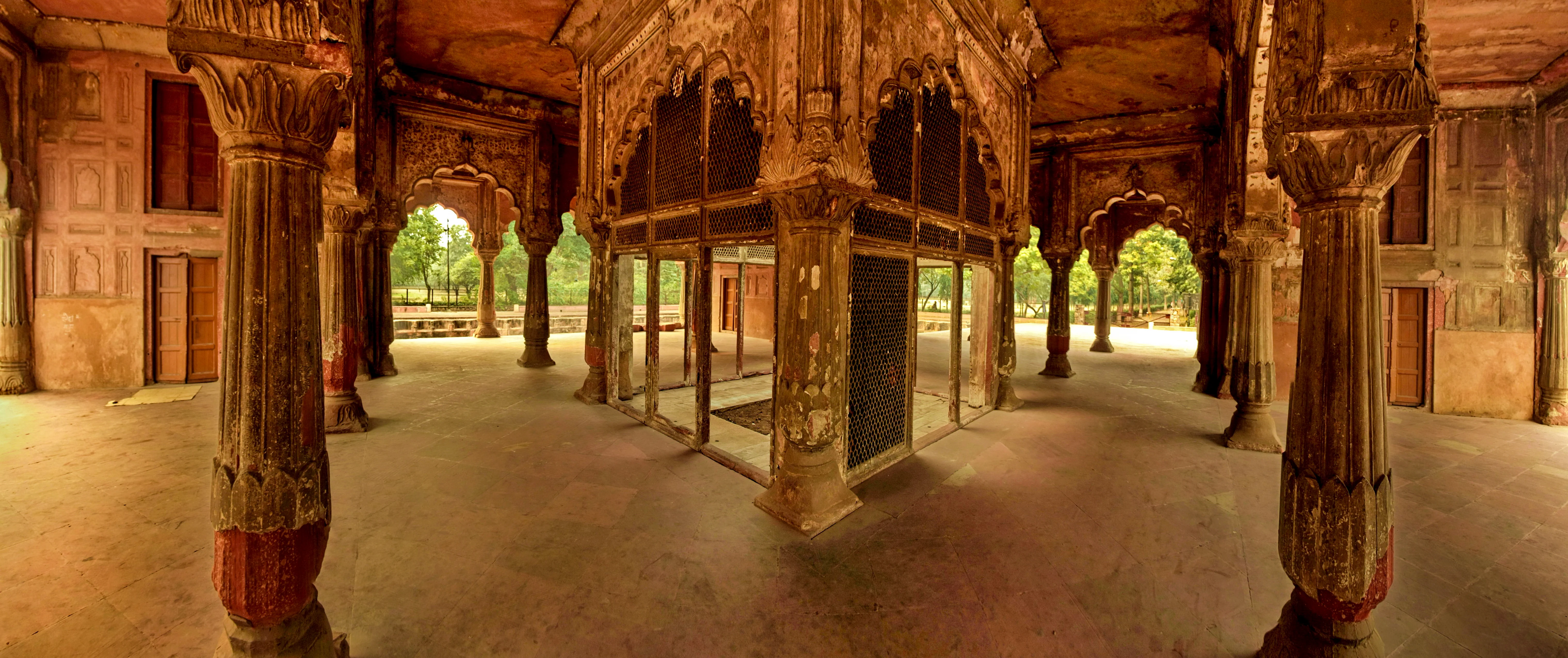
Roshanara Begum (1026–1082 AH / 1617–1671 CE) was a daughter of the Mughal emperor Shah Jahan and a sister of the emperor Aurangzeb. Her name is also written Roshan Ara and Raushanara.1234 The historian B. P. Saksena gives her birth at Burhanpur on 24 August 1617.1 She is recorded as a supporter of Aurangzeb in the war of succession, and as having received five lakhs of rupees when he took the throne; the historian Rekha Misra adds that he conferred on her in 1669 the title Shah Begam.532 The historian Jadunath Sarkar gives her death as 11 September 1671, and the Encyclopaedia of Islam as 1082 AH (1671 CE); she was entombed at Delhi.34 The sources for her life are scattered passages in histories of the Mughal Empire and of its women. None is a biography of her, and the article is correspondingly short.
The sources
No work in the approved base is devoted to Roshanara Begum. A search of the Encyclopaedia of Islam found no entry under her name, and the only place where it names her is a sentence on her tomb in its article on the Mughals, in the section on architecture by Ebba M. Koch.4 Her life is therefore told from three histories read at archive.org and from William Dalrymple's history in the approved PDF library. Banarsi Prasad Saksena, who taught history at Allahabad University and whose History of Shahjahan of Dihli was approved as a University of London doctoral thesis in 1931, covers the reign of her father and records her birth.6 Rekha Misra, of the Department of History at the University of Allahabad, wrote Women in Mughal India (1526–1748 A.D.) from a thesis approved by her university in 1965, and names Roshanara in its chapters on the women of the royal family.7 Jadunath Sarkar, whose History of Aurangzib first appeared in 1912, tells the war of succession and the early years of Aurangzeb's reign; the passages used here come from the second edition of the first two volumes (1925) and the third edition of the third (1928).8 William Dalrymple's The Last Mughal (2006), a history of the fall of the Mughal dynasty at Delhi in 1857, quotes the French traveller François Bernier on a procession of hers.9
Birth and family
Saksena lists the seven surviving children of Prince Khurram, the future Shah Jahan, by his second wife: Jahan Ara Begum, born at Ajmer on 23 March 1614; Dara Shikoh, 1615; Shah Shuja, 1616; Roshan Ara Begum, born at Burhanpur on 24 August 1617; Aurangzeb, 1618; Murad Bakhsh, 1624; and Gauhar Ara Begum, 1631.1 Saksena gives no Hijri date for her birth. Misra calls her Shah Jahan's second daughter.2 Sarkar writes of her as the younger sister of Jahanara Begum, and Misra records that the two sisters were not on very friendly terms.32 Saksena names her once more, in his account of the gifts that Shah Jahan made on his accession. The emperor gave 800,000 rupees to his wife, whom the preceding lines name as the Empress Mumtaz Mahall, of which 450,000 were reserved for Dara, Shuja and Aurangzeb, and the balance was to be distributed among Murad, Lutfullah, Roshanara and Surayya Begum.10
The war of succession
Misra and Sarkar both record that Roshanara took Aurangzeb's side in the war of succession. Misra writes that Roshanara was in touch with affairs in the seraglio, the women's quarters of the palace, and sent her brother regular reports of what happened there, and that when he took up arms to take the throne of Delhi she placed at his disposal all the gold and silver she had.2 Sarkar's second volume says that she watched over Aurangzeb's interests in the harem of Shah Jahan, in opposition to her elder sister Jahanara, the partisan of Dara Shikoh.5 His third volume adds that she acted from within the harem at Agra against Aurangzeb's rivals.3
Under Aurangzeb
Sarkar and Misra record rewards to Roshanara and date them differently. At the enthronement of Aurangzeb, as Sarkar's second volume tells it, the emperor held a court in the harem, where the princesses, the wives of nobles and other women offered their congratulations and scattered gold, silver and jewels; Roshanara received five lakhs of rupees in cash and kind, and his four daughters received smaller sums.5 Sarkar's third volume dates the "grand coronation" to June 1659 and says that she was presented with five lakhs of rupees at it, a larger sum than his gift to any of his daughters.3 Misra gives another account. She writes that Aurangzeb had promised her the title of Shah Begam, that he conferred it on her in 1669, and that he added a cash reward of five lakhs of rupees.2 Each version is given as its author gives it, and the Historiographical Note returns to the point. Sarkar adds that she continued to enjoy her brother's favour and to exercise control over his children and wives until her elder sister returned to the court on their father's death. After that, he writes, nothing more is heard of her.3
A procession described by Bernier
Misra and Dalrymple both quote the French traveller and writer François Bernier on a procession of hers. Dalrymple says that it took her on a summer outing to Kashmir, and quotes Bernier: "You can conceive of nothing more imposing or grand".9 Misra gives Bernier's description in more detail. Roshanara rode a Pegu elephant "blazing with gold and azure", followed by five or six other elephants carrying the ladies of her household; round her elephant went "a troop of female servants", and behind them came eunuchs on horses and footmen with large canes, who went a long way ahead of the princess to clear the road. Behind her retinue came a principal lady of the court, then a second, a third and so on, until "fifteen or sixteen females of quality" had passed.11
Death, burial and garden
Sarkar writes that she died on 11 September 1671, at the age of fifty-six.3 The Encyclopaedia of Islam gives the date as 1082 AH (1671 CE).4 After her death, Sarkar writes, the official history records that Aurangzeb gave away large sums in charity for the benefit of her soul.12 The Encyclopaedia of Islam records that she was entombed at Delhi in a flat-roofed pavilion of the type it calls hasht bihisht, built in the idiom of the later Mughal period, with verandahs carrying baluster columns and cusped arches.4 Misra records that she built a garden near the city of Delhi which is known after her name.13
Historiographical Note
The sources agree on the main facts of her life and differ on a few details. Each is given where it is told; some need a word more. The date of her death. Sarkar gives 11 September 1671 and her age as fifty-six. The text of the archive.org copy of his third volume prints the day unclearly; the page image reads "11th September, 1671". The Encyclopaedia of Islam gives only the year, 1082 AH (1671 CE). Counted from Saksena's date of birth, 24 August 1617, the interval to 11 September 1671 is fifty-four years, whereas Sarkar gives fifty-six.341 The title and the five lakhs. Misra places the title of Shah Begam and a reward of five lakhs of rupees in 1669. Sarkar's third volume places a gift of five lakhs of rupees at the coronation of June 1659, and his second volume gives the same sum at Aurangzeb's enthronement without a year on the page read. The pages read do not say whether these passages describe one reward or two. Misra's note for her sentence cites the Alamgir Nama, p. 368, and Tavernier; Sarkar's note to her name cites "A. N. 368" with the words "rewarded by Aurangzib".235
See also
- Jahanara Begum — her elder sister, who supported Dara Shikoh in the war of succession
- Aurangzeb — her brother, whom she supported
- Shah Jahan — her father
References
Citations
Footnotes
-
Banarsi Prasad Saksena, History of Shahjahan of Dihli (Allahabad: The Indian Press, Ltd.), p. 15 — the children of Prince Khurram by his second wife and Roshan Ara Begum's birth at Burhanpur on 24 August 1617; https://archive.org/details/in.ernet.dli.2015.281500, register entry 12, archive.org. ↩ ↩2 ↩3 ↩4
-
Rekha Misra, Women in Mughal India (1526–1748 A.D.) (Delhi: Munshiram Manoharlal), p. 47 — her place among the daughters, her relations with Jahanara, her support for Aurangzeb, and the title of Shah Begam and the reward of 1669; https://archive.org/details/emvi_women-in-mughal-india-1526-1748-ad-by-rekha-misra-history-delhi-1967-munshi, register entry 12, archive.org. ↩ ↩2 ↩3 ↩4 ↩5 ↩6 ↩7
-
Jadunath Sarkar, History of Aurangzib, vol. III (Calcutta: M. C. Sarkar & Sons, 1928), p. 59 — her position in the war of succession and at the coronation of June 1659, her place at court until Jahanara's return, and her death on 11 September 1671 at fifty-six; the day was read on the page image, https://archive.org/download/in.ernet.dli.2015.15072/page/n70.jpg, and the text at https://archive.org/details/aurangzeb-3-jadunath-sarkar, register entry 12, archive.org. ↩ ↩2 ↩3 ↩4 ↩5 ↩6 ↩7 ↩8 ↩9 ↩10
-
Ebba M. Koch, 'Mughals', section 7 'Architecture', The Encyclopaedia of Islam, new edition, vol. 7 — the sentence naming Aurangzeb's sister Roshanara, her death in 1082/1671 and the description of her tomb at Delhi. ↩ ↩2 ↩3 ↩4 ↩5 ↩6
-
Jadunath Sarkar, History of Aurangzib, vol. II (Calcutta: Orient Longman, 1925), p. 385 — the court held in the harem at the enthronement and the five lakhs given to her; https://archive.org/details/aurangzeb-1-2-jadunath-sarkar, register entry 12, archive.org. ↩ ↩2 ↩3 ↩4
-
Banarsi Prasad Saksena, History of Shahjahan of Dihli (Allahabad: The Indian Press, Ltd.), title page — the author's post and the approval of the thesis in 1931; https://archive.org/details/in.ernet.dli.2015.281500, register entry 12, archive.org. ↩
-
Rekha Misra, Women in Mughal India (1526–1748 A.D.) (Delhi: Munshiram Manoharlal), title page and preface — the author's post, the thesis of 1965 and the preface of October 1967; https://archive.org/details/emvi_women-in-mughal-india-1526-1748-ad-by-rekha-misra-history-delhi-1967-munshi, register entry 12, archive.org. ↩
-
Jadunath Sarkar, History of Aurangzib, Mainly Based on Persian Sources, vols. I and II (second edition, Calcutta: Orient Longman, 1925), title page, and vol. III (third edition, Calcutta: M. C. Sarkar & Sons, 1928), title page — the editions and the date of the first edition; https://archive.org/details/aurangzeb-1-2-jadunath-sarkar and https://archive.org/details/aurangzeb-3-jadunath-sarkar, register entry 12, archive.org. ↩
-
William Dalrymple, The Last Mughal: The Fall of a Dynasty, Delhi, 1857 (London: Bloomsbury, 2006) — the passage that quotes François Bernier's memoirs on the procession that took Raushanara Begum on a summer outing to Kashmir. ↩ ↩2
-
Banarsi Prasad Saksena, History of Shahjahan of Dihli (Allahabad: The Indian Press, Ltd.), p. 64 — the division of the 800,000 rupees among the princes and princesses; https://archive.org/details/in.ernet.dli.2015.281500, register entry 12, archive.org. ↩
-
Rekha Misra, Women in Mughal India (1526–1748 A.D.) (Delhi: Munshiram Manoharlal), p. 107 — Bernier's description of her procession; https://archive.org/details/emvi_women-in-mughal-india-1526-1748-ad-by-rekha-misra-history-delhi-1967-munshi, register entry 12, archive.org. ↩
-
Jadunath Sarkar, History of Aurangzib, vol. III (Calcutta: M. C. Sarkar & Sons, 1928), p. 60 — the official history's record of Aurangzeb's gifts in charity for her soul, cited by Sarkar as "M.A., 110"; https://archive.org/details/aurangzeb-3-jadunath-sarkar, register entry 12, archive.org. ↩
-
Rekha Misra, Women in Mughal India (1526–1748 A.D.) (Delhi: Munshiram Manoharlal), p. 113 — her garden near Delhi; https://archive.org/details/emvi_women-in-mughal-india-1526-1748-ad-by-rekha-misra-history-delhi-1967-munshi, register entry 12, archive.org. ↩

Sources
Works in the approved library. Cited by title and author, and by the entry used.
- Bearman, P. J., et al., eds. The Encyclopaedia of Islam, new (second) edition — Ebba M. Koch, 'Mughals', section 7, 'Architecture' (vol. 7).
- Dalrymple, William. The Last Mughal: The Fall of a Dynasty, Delhi, 1857. London: Bloomsbury, 2006. Read at archive.org (register entry 12, archive.org).
- Saksena, Banarsi Prasad. History of Shahjahan of Dihli. Allahabad: The Indian Press, Ltd.
- Misra, Rekha. Women in Mughal India (1526–1748 A.D.). Delhi: Munshiram Manoharlal.
- Sarkar, Jadunath. History of Aurangzib, Mainly Based on Persian Sources, vols. I and II. 2nd ed. Calcutta: Orient Longman, 1925.
- Sarkar, Jadunath. History of Aurangzib, Mainly Based on Persian Sources, vol. III, Northern India, 1658–1681. 3rd ed. Calcutta: M. C. Sarkar & Sons, 1928.
Further reading
Offered to the reader for further study. Nothing in this article rests on the works below beyond what the sources above record of them.
- François Bernier's account of his travels in India — quoted by Misra and Dalrymple for the procession described above.
- Manucci's Storia — cited by Sarkar in his footnotes to the passages on Roshanara.
- The Alamgir Nama — cited by Misra for the title and reward of 1669.
External links
Approved sources only, each with its number on the Register of Approved External Web Sources.
- History of Shahjahan of Dihli — Saksena, register entry 12, archive.org
- Women in Mughal India (1526–1748 A.D.) — Misra, register entry 12, archive.org
- History of Aurangzib, vols. I and II — Sarkar, register entry 12, archive.org
- History of Aurangzib, vol. III — Sarkar, register entry 12, archive.org
Mentioned In
2 articles reference this topic
More from Mughal Empire
Taj Mahal - Monument to Eternal Love
The Taj Mahal (1632-1653 CE) is an ivory-white marble mausoleum built by Mughal Emperor Shah Jahan in memory of his wife Mumtaz Mahal. Located in Agra, India, this masterpiece blends Persian, Islamic, and Indian architectural traditions, representing the pinnacle of Mughal achievement.
The Mughal Empire: Three Centuries of Islamic Rule in the Indian Subcontinent
The Mughal Empire (1526-1857) ruled most of the Indian subcontinent for three centuries, from Babur's victory at Panipat to the deposition of Bahadur Shah Zafar. At its height it was among the wealthiest and most populous states in the world.
Akbar Shah II: A Mughal Emperor Without an Empire
Akbar Shah II (r. 1806-1837) was the penultimate Mughal emperor, holding a Delhi court that kept its ceremonial and literary life while the East India Company reduced its standing and revenue. He tried for thirty years to make Mirza Jahangir his heir instead of the future Bahadur Shah Zafar.
Aurangzeb Alamgir: The Last Great Mughal Emperor
Aurangzeb Alamgir (1618-1707 CE) was the sixth Mughal emperor, ruling nearly fifty years over the empire at its greatest extent. He commissioned the Fatawa-i Alamgiri, annexed Bijapur and Golconda, and spent his last decades campaigning in the Deccan.